
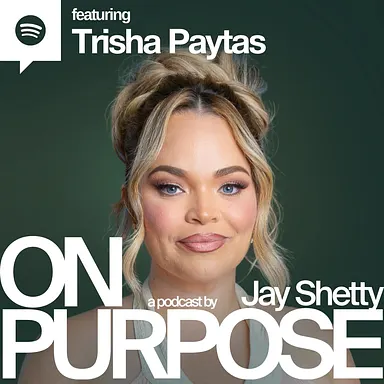
In this episode of On Purpose, Jay Shetty talks with Trisha Paytas about her memoir Crying on the Kitchen Floor and the experiences that shaped her life. She describes a blurry childhood, a longing for her father's approval, and early attention-seeking that led to sexualized online content, lies told for fame, and years of sex work.
She reflects on the Frenemies podcast, the backlash that followed, a 2019 borderline personality diagnosis, and a psychotic episode that led her to meditation. Trisha also discusses her marriage to Moses, motherhood, and how she now defines success and happiness.
Listeners hear her account of her mistakes and recovery, presented from her own perspective.
In this episode Jay Shetty, Trisha Paytas
This episode's transcript on Trisha Paytas's memoir interview was made with the technology behind HappyScribe's notes for Google Meet calls.
Ads in this audio differ from the text. Tap the sentence you're hearing to follow along.
Synced: the text now follows the audio.
This episode is sponsored by BetterHelp, an online psychological counseling service. Looking back, it's easy to feel guilty and regretful, especially over smaller stuff—like accidentally forgetting to reply to a message, or buying a book or game you've had your eye on even though you promised yourself you'd save instead. But should you really let it weigh on you as much as you are? You can analyze those emotions and their impact with BetterHelp's psychological counseling. They match you up with a qualified, experienced German counselor based on your needs and preferences.
Take a closer look at your own expectations and recurring thoughts. BetterHelp makes it easy to find the support that fits your needs. 90% of German members continue working with their counselor after their first session as of May 2026. Our listeners receive 10% off their first month at betterhelp.com/jaystop3. That's betterhelp.com/jaystop3.
Willkommen zu einem Moment nur für dich und zu allem, was du liebst, bei Douglas. Finde einen Duft, der dich nicht mehr loslässt. Pflege, die aus Alltag ein Ritual macht. Farben, mit denen du dich neu entdeckst. Alles für dich am Singles' Day, jetzt 20% auf viele Artikel. Douglas, welcome to beautiful.
Wenn eine Frau sich online so präsentiert, muss sie sich über Dickpics in DMs nicht beschweren. Die soll sich freuen, dass Männer sie überhaupt—
Nach nur 17 Minuten erscheint jungen Männern der erste frauenfeindliche Content auf Social Media. Das ist ungefähr so lange, wie du gerade diesen Podcast hörst. Lasst uns digitale Gewalt gegen Frauen bekämpfen. Wenn du einen frauenfeindlichen Post siehst, kritisier ihn. Melde ihn. Wenn du persönlich betroffen bist, vertrau dich jemandem an und hol dir Unterstützung. Sei mit uns gemeinsam gegen Hass im Netz. Telekom.
Hey, it's Jay. I don't know what your day's been like, but I was just thinking about you for a minute. And I hope you're being a little patient with yourself, because you deserve it. And yeah, I'll talk to you soon.
Hey everyone, welcome back to On Purpose. Today's guest is one of the most recognizable personalities on the internet. For nearly 20 years, Trisha Paytas has built an audience of more than 20 million across platforms by sharing nearly every chapter of her life online. Now, in her new memoir, "Crying on the Kitchen Floor," she's telling the story behind the viral moments, the controversies, and the person she was trying to find underneath it all. Trisha Paytas, welcome to On Purpose.
Oh my gosh, thank you. I'm so nervous. I kept saying this before. I'm so nervous.
Tell me why.
I mean, you're just like the Barbara Walters of this generation. Like, it just feels very much like what's going to happen. I've seen all your interviews. I think people don't know off camera. Like, you're very bubbly and cheerful and just a happy guy. But online, you're so serious. I'm like, I'm ready to cry. I'm ready to barrel. And then I'm like, oh my god, what's happening? Are we excited? Are we happy? Or are we like crying? I don't know.
All of it. All of it's good. All of it's good. I find it so interesting how, for those of us who live online—and that's why I love doing the podcast—is because when you meet someone before we start filming, you get a sense of who someone actually is in real life. And you realize, wow, the version we see of anyone online is 1% of who they are. And that's why I'm so glad you wrote this memoir, because I feel like you've documented everything online, and yet it feels like there was so much going on behind the scenes. I wanted to start by asking you: you literally start the book by writing, "Warning: Lies Ahead," and you talk about yourself being an unreliable narrator.
I wanted to ask you, in and amongst all the controversies, the conspiracies, the conversation, the discussion, which part of Trisha are you sharing now? Who are you today?
I'm trying to be as real as possible. Because yeah, starting the book, I was like, gosh, I feel like I was misremembering things. I was told certain things about who I was, and I didn't know. I struggled with my identity and stuff. So even now, in this moment, sitting with you, I was like, I really want to be as real and honest as possible. Because obviously, I know this gets a lot of reach. I know a lot of people are watching. And it's just like... So even with the book too, it's really like, okay, this is your one shot to be super honest. And people can tell. They're so good nowadays at reading through the bullshit.
You know what I mean? They know if you're being real or not. So I pride myself in being authentic. But when you struggle with identity, you're like, who am I? You know what I mean? So I just want to be as authentic to who I am now. And it's... I think I'm there. I think I'm getting there.
Yeah. Who is the real Trisha Paytas?
I mean, I really found myself when I became a mom. I found more of who I was, oddly. A lot of people lose themselves in motherhood. And I think I found more of who I was and what my values were. And I really do value peace in life and simplicity, as opposed to... I think I valued for so long materialistic things and drama. And I don't know, I think I was chasing a lot of things that I just felt empty for a long time. But then when I became a mom, I really just found that I'm kind of just like a... I use the word "normal" and people hate it. My husband hates when I say "normal." Or I use "boring" a lot too.
It's like... because I just love to be at home and at peace. And that's what I care about. And then this makes it easy. Everyone has to work. So I feel like I have a pretty easy job compared to a lot of people. So this is being able to provide. But if I could just be at home all the time, I would, with my kids.
You're talking about being a mom almost making you feel more connected to yourself. I want to go back to when you were a child. I was thinking about what's a childhood memory that you have that you feel defines who you are today.
Oof. I feel like... I think, again, going back to the "Lies Ahead," I think my childhood is the blurriest part. I feel like I blocked out my childhood. It almost seems like I didn't have a childhood. So it's hard to pinpoint anything in my childhood that made me who I am today, other than a childhood divorce and stuff. But that's kind of everybody's story nowadays.
What were you like growing up? Do you remember?
Kind of no. I kind of was just there. I don't feel like I was super bullied. I don't feel like I was super popular. I just sat home and watched a lot of movies. My parents worked a lot. Divorced, they worked a lot. My mom was a single mom, worked a lot of jobs. So I just sat home and watched a lot of movies and television and was trying to emulate movies and television, I think. I don't know. I don't think I knew who I was. I think...
What were the movies and television you were trying to emulate?
I'm glad. I talk about it a little bit in the book, but I looked up to "Taxi Driver," or Quentin Tarantino, "Reservoir Dogs." And it's like, I watch pulp fiction at 6. So I was like, that's what I need to be. And it's like, these were kind of the wrong movies to be watching. But that's what I idolized. I loved Jodie Foster in "Taxi Driver" because she was 13 and she was just living on her own. And she had this hot older guy taking care of her. That's what I got from it when I was 10, right? So I'm watching that movie and I was like, oh, that's what I want to be. Or "Kate Fear," and I was Juliette Lewis and her acting teacher just being so hot.
And she was just like, I don't know. That's what I got as a child, which I don't know what that said about me as a child or what it said about these movies, but that's what I wanted in life, is to be those damsels in distress with the worst men, I guess.
Do you think it was you projecting your experience at the time onto the characters, or it was those characters imprinting themselves onto you?
That's a good question. I think I watched them from such an early age. So I just was always like, oh, I need to find an older man in my life. So teachers around me or something. So I don't know what attracted what. But yeah, I kind of just like, oh, in movies, they were always saved by an older guy. So I was just like, that's kind of what I gravitated to. And my dad wasn't around. So I was just like, yeah, just trying to find anybody. And I suppose that's what, as a child, I identify most with, is wanting to be with a guy that's going to save me.
Yeah. You've talked about this idea in the book of wanting your father's love, wanting his approval, not experiencing it. Can you put into words what that was? What was it that you were looking for that you didn't receive, that you're then obviously seeking in these different experiences, watching these shows and movies?
Yeah. I feel, again, it's probably like a tale so many girls and guys too deal with when they don't have their father around. It's just like not having male guidance or just someone in your life. I don't know. You don't know what you're missing, right? And so I would watch these movies and I'm like, oh, I'm missing... The reason I'm not loved or cared for is because I don't have my father, which we saw him in the summers and stuff like that. But yeah, I was surprised how heavy I focused on my dad, because we have such a good relationship now. But it was horrible, obviously, growing up and as a teenager. So I think I was just seeking love, attention, hence why I got on the internet.
It's just I wanted attention.
Instagram teen accounts come with automatic protections that limit who can contact teens, the content they can see, and the time they spend on the app. Learn more about teen accounts and Instagram's ongoing work to protect teens online at instagram.com/teenaccounts. Even though you say that it's something we all experience, which people do in different ways, I still think it's interesting to see what people end up doing to get it. And so for some people, it's early dating, relationships.
For some people, it's, like you said, going online, pursuing certain career paths. It's fascinating where it goes for you. What was the earliest thing you remember at that time doing for attention? What was the first thing you remember doing?
I think just probably just being outrageous, just being... I thought I would watch Howard Stern, right? So Howard Stern was on at midnight on the E! Channel. And so I thought, oh, if you want to get that attention or validation, you have to be overly sexual. And so I really overly sexualized myself from an early age without knowing it. Obviously now, through writing the book and also just through therapy, because I never really talk about childhood, I was like, I realized I thought it was just me wanting attention, which it was. But it was kind of like, where did I learn these behaviors? And it actually makes me so sad.
It's why when I found out I was having a daughter, I was so upset. It wasn't because I wanted a boy. It was just because I didn't want a girl in this world. Because I just remember, I don't know, getting so much blame for how I presented myself as really young, like at 6, 7. I remember being really flirty with just men and learning it from movies. I didn't know any other way but that. So I remember wearing really... I would go with the shirt to school and then I would take the shirt off and I'd have a sports bra.
And just wanting that attention, again, from 7, 8, really young. And it worked. I mean, boys in my grade would be like, oh, she has no bra. And look at her. And then also teachers giving me attention and being like, oh, stand up to the class. Show your water braw today. So I think, as a child, I liked it. You know what I mean? So I always felt some sort of guilt for everything that happened in childhood and after. I was like, well, I wanted this and I did this. So why am I complaining? Or I can't complain.
Yeah. It's so fascinating, isn't it? And I'm so interested to hear as we talk today about what you've learned through therapy, but it's so natural as a kid to want validation, to want attention, to seek importance, significance. And significance is such a human need too. We all want to feel like we matter. And it's almost interesting because our early years help us figure out why we matter, but we don't always pick the right things to matter for. And it seems like you went in a direction because of the media you were consuming.
And knowing that you were so nervous about having a daughter, because were you worried that she'd have to be exposed to the same things?
Same things. And you still hear about it. I mean, today we were just having a discussion about it. It's just like, girls will never win, right, when it comes against men in this world. It's always like, well, what did the girl do? And we're getting in a different place now. But no matter what, even me to this day, it's like, well, what did you do back then? Or that's why you're like that. So I was just worried about it because I just think we're making a little bit of progress, but not enough. And it's just really difficult to be a woman and have anyone actually listen to you and hear you.
And yeah, I mean, I'm hoping with the way she's brought up, it's going to be different for her. But I don't know. It's a scary world as a woman.
What do you think's changed about being a woman for you back then and now your daughter? And what stayed the same?
I mean, I think just her home life, obviously. My home life, my parents just worked hard. I wouldn't say they were bad parents. They were just always working. So they were just never around. So my main focus with both my daughters and obviously my son too is just to be around. You always see those memes and stuff that are like, your kids won't care how hard you work at the end of life. They'll know the memories or that you were there for them. So I think my big goal is just to be there. I think, like you were saying, people want attention and validation when maybe they don't get it at home. So I try to give them that as much as possible so they're not seeking it.
Because people do. I did really awful things for attention because I didn't think I had any other value. And I think it's because I didn't hear it from anyone else. No one told me I was smart or talented. So I think my whole life, even to this day, I'm like, I didn't really have a talent. You know what I mean? I'm kind of just... I had to do what I had to do just to make money and stuff like that. But I wish someone would have given me guidance. Like, oh, you can do this and you can do this. My daughter, I really try to put her in everything. She's only 4. But I try to put her in everything and tell her she can do anything.
And I think that's where I didn't have that.
What do you wish someone said to you?
I would have loved to have been just one compliment. Like, you can do that. Everything I ever wanted or asked for, everyone's just like, that's such a silly dream. That's so silly. Again, even from... I go back to teachers because that's kind of all the adult guidance I had. So we'd have guidance counselors or career counselors. And you'd be like, I want to do this. And yeah, maybe early on, saying you want to be an actress at 7 years old, of course they might be like, that's not realistic. But to me, I just heard no. So then I was like, I wasn't great at math. I wasn't great at science. So a lot of my teachers would just be like, well, what are you going to be in life?
And I remember early on being told, you'll just be a stripper. So what did I become, a stripper? And it's like, I think kids take to heart what you say. I was like, well, if that's all I'm going to be. And they said it jokingly or teasingly.
Who said that to you?
Oh my God. There would be boys in school that would be like... We had one strip club and I was like 12 or something like that. And they were like, you should just go work there or something like that. And then I had a teacher. I had a math teacher. This was my seventh grade year. Same thing. He's like, well, you'll be on a pole soon or something like that.
Your math teacher?
Mm-hmm. Yeah. And I get so nervous talking about my schooling because the educators. Because I understand not everyone's like that, but I have such trauma from school. And it happened with multiple. So when people hear that, they're like, how does that happen multiple times? And it's like, I don't know. I don't know. I don't know. Maybe it was because I was wanting to be around them and hanging out with them after school and stuff like that. But yeah, it happened quite frequently. Strippers were a big thing, I guess, in the '90s because everyone told me I was going to be a stripper. So I was like, all right, that's what it's going to be. And it was.
So you didn't enjoy going to school after that period that you were getting attention at 6 or 7.
Yeah.
But after that, it started to feel a bit more negative and...
Yeah, maybe indifferent. Maybe it was like, again, I liked the attention. I think that's what was kind of bad about it, is like, I don't know. At the time, I felt like, oh, wow, I'm something special because they're talking about my body or they're talking about this. So I felt, even though I guess people were laughing at me or whatever, they said it, I don't know. I took it as a compliment. I took it like how Howard Stern would talk to girls on the sibian. I was like, oh, I'm special. So I think I kind of took that and ran with it for pretty much the past 20 years.
Yeah. Wow. I mean, what did little Trisha want to be before those kind of thoughts were put on her?
I don't know. I think wanting to be an actress or those kind of things, I think just came from wanting attention. I just saw people. I don't know. I don't think I had any ambitions. I was never guided in the right path. I never wanted to be a teacher or anything. I don't know. I didn't have options. My mom was a career bartender and she worked really hard. She drove a bus in the morning and then she's been a bartender for the past 30 years. And I saw that. And then my dad, who I didn't see a lot, he was struggling trying to do his own business. So I didn't really have direction of where to go.
And I was a really bad bartender. So shout out to all the bartenders. It's really hard. It's really not easy.
It's a hard job. It's a hard job.
Yeah. So it wears on you too. I was able to retire my mom about 10 years ago, but her hip was bad at 60. And she was just working at the LAX for the past 10 years before. And it's like, yeah, it's really physically demanding and dealing with people. And I was also not good at mixing drinks. I was a horrible brew stuff. I was bad. I was bad at jobs. So maybe that's why I became a stripper, right? So shout out to everyone who can hold a job because I could not.
I'm always fascinated about asking people this. What did you think attention would do for you? What were you hoping? Because you said you didn't want to be rich. It wasn't like you were trying to make money, but it was about attention and validation. What were you hoping it would fill? Or what were you hoping it would solve?
I think just to be loved. I think my entire life I was looking for someone to love me. So I just thought, people love famous people. People love people that are... So I think I was just looking literally for love, which is something I never had in my life. True, unconditional love. I never felt that. Or maybe my parents couldn't show it. So I think that's what it was. I just wanted someone to love me. I think through everything, you're like, how do people love people in movies? It's like, oh, they're popular.
They're well liked. So I think I was just trying to do that.
Yeah. So when I hear you say that, I'm like, I just want to give you a big hug.
Aw. Thank you.
I'm like, yeah, I just feel like I hear that little Trisha, the small person inside all of us. And when you say that, I'm like, God, I can relate to that.
Really? That's what I was asking you before, yeah. I was like, did you have any turmoil? Because I feel like your life is just so peaceful and perfect.
No, I grew up in a really intense home.
And you never talk about that. You didn't do them.
I've spoken about it over time. But I have talked about it because I always like to explain to people, I didn't grow up in a perfect environment. I actually grew up in the opposite. So I got notes on what not to be like growing up. And that's what I did. I just took notes on what not to be like.
How quick could you change it? Were you like, 18, I'm going to be a different person? Or did you have to go through some shit as an adult?
I think I had to go through... I think I realized in my early... I was mediating my parents' marriage when I was like 10 years old. I asked my parents to get divorced when I was 12. I was trying to help them through it.
Oh, so you've always been like a guru.
Yeah, God, I don't know. But I've always been... I feel like the reason I do what I do today is because it's all I've ever known.
Wow. So it was like in you.
Yeah, it was in me and it was also something I had to do. And so I'm grateful for it because I feel like it set me up for a better life because I had to learn these things early on. But I realized that, yeah, and I made bad decisions in my teens because of it as well. When you don't have any guidance, you do all sorts of things. But one thing I've always said is that I feel my mother's love was quite protecting. And that's why I really value this idea of unconditional love. I always felt like my mama had my back. She'd be there if I needed her. She'd catch me if I fall.
And that is just... I feel like that's undeniably the most powerful love in the world. And so what you're doing for your daughter, that feeling that you have, I think does become this protective shield as kids get older.
That's good to hear. Because I'm like, if there's one thing I can do is at least make her feel loved, no matter what. So that's good. And you turned out great. So obviously, mother's love can do a lot.
Well, I think there's a balance. I think there's a balance between mother's love and mother spoiling their sons. And that's a whole nother thing that we could talk about.
Which one were you?
No, mother's love. My mom was like, I had chores. I had responsibilities. I started working when I was 14. She had like... I had things that I had to do.
Not a creepy boy mom. She's okay with your wife and stuff. She's not like...
Exactly. Exactly. Exactly.
I know. I can't be like that either.
But what I find fascinating about you, Trisha, is that... So like you said, many people can relate to what you just said, but the extreme nature you took things to is what makes you so fascinating. Because we all want attention. We all want validation. We all want to feel loved. But a lot of us don't have the courage to say, I'm going to pretend I have a pink addiction and transform my whole space to be pink. Or pretend I have a tanning addiction and to get onto it. That's an extreme form of like, I'm willing to do the work.
Right.
Right? I'm willing to invent things and do things and whatever else it may be in order to get that. Talk to me about how you even understood that that was a way of getting attention and that you would discover all these ways of getting onto TV shows. Walk me through the mindset and the mental process you went through to do that.
Well, I think it's a little mental illness as well. I think that's the difference between some people. Some people are mentally stable. I think I had... I think I had mental illness from early on and I never got help or sought treatment for it. So I think wanting attention is one thing. I think I had a mental illness even back then. And then I think the lying of it all, all that. Lying about addiction. I think you... You just used a good word. Was it like I invented or I don't know. You said something not lying, which I thought was great. But I lied. I was lying about everything to everyone.
If I was acting, I was like, I was in Titanic. I was one of the extras in the pool drowning. You know what I mean? The pool, the ocean. I guess the ocean. And I would just say, oh, there was the movie 300 and I said I was like one of the Spartan warriors. And so I would just lie because I think that also was just in my DNA. I think I was just a pathological liar for most of my life. I thought I was so far gone from having anything of a normal life, like a relationship, a job, anything like that. So I was like, who cares if I lie? You know what I mean? Who cares? I didn't see any harm in it at the time.
And it was relatively harmless. Yeah, I got on my first TV show because I lied. I wrote in as my brother and I was like, yeah, my sister is crazy. And then they called us. So it's either lying or being super creative, I feel. I don't know. Maybe I was just super smart back then, but I just really needed fame. I really needed it.
Did people believe you all the time, especially with the Titanic and the 300 Sparta? Or did people just kind of like...
I don't know. That's a good question. No one questioned it. But yeah, once the internet started becoming a thing thing, I had to stop lying quickly because obviously you could just do a little search to see if I was in Titanic or something like that. So I did have to catch myself in lies. But maybe... That's a good question. If people believe me... I mean, I lied all the time when I was on planes as a kid. When I was like 13, I'd say I was married with three children and I was just lying to people next to me for no reason. So I don't know if they believed me.
Where did that come from?
I guess just the need to feel more interesting than I was at the time. Because I was... You know what? There was a movie... And this is... I hate movies like this now, just for the record. Any movie that shows an older man with a young girl, I freaking hate them. Why? Because it literally made me think it was normal. So there was a movie called Great Walls of Fire and it was about Jerry Lee Lewis. And Dennis Quaid was in the movie and one of the writers. And I think from that age, I was just like... I remember being like, oh, I'm married. And I would say my husband's a musician. I just stole the plotline of Great Walls of Fire to people on the internet just to feel interesting and just to feel... I don't know.
The person next to me would be not anybody. I just felt the need to make myself seem interesting and desirable, I guess, to anybody that would listen.
Why are we still putting out these plotlines to women at a time when we know that the world is caught up and realized how wrong this is? We're calling it out when it's happening. We need to have higher standards and not romanticize and not glorify these types of things and make it look okay and cool and normalize it.
Yeah. Because little girls will think that... There was one with Jenna Ortega too where she was a college student and there was a professor. And then just like... Because the little girls, young girls, of course you can look at Taxi Driver and be like, oh, you took a romance out of that. And you could be like, no, it was all about he was the bad guy and this one. But to a little girl, you just see two men fighting for her and trying to save her. So it's like, oh, that's perfect. I would love two men, even as fucked up as they are. So yeah, I don't love it. I guess it's the same argument as violence in films does it encourage violence in real life. I don't know, maybe. But I feel like specifically this toxic romance of an older man and a young girl, it's really weird.
And I just think it's a little... Even in my book, I try not to go into detail about any romance with teachers when I was a child because I know someone could read it and be like, ooh, I know as a kid I would have read it and thought it was romantic or desirable. It's like, oh, they picked you. So I was trying not to go too much into detail for fear of that.
That's so interesting that you were that mindful about that.
Because I still to this day, I can't watch stuff because I know how my mind worked back then. And still, I used to think it was romantic or sexy and all that stuff like that. It's very disturbing.
Did teachers ever overstep?
Yeah, all the time. I had five different instances. So that's why I moved around to schools a lot. So I think a lot of times people are like, that seems crazy five times, but five different times. And yeah, I mean, it definitely was sexual. And I just didn't think anything of it because I was like, I loved the attention. I loved it at the time, which is like later on finding out, I'm like, oh, maybe that's kind of set my mind weird. And I don't know. My whole... Even with sex, I think it stemmed from early on being that young. I just later on I'm like thinking I'm asexual because I was like, oh, I never really liked sex.
I liked what sex could do, give you attention, give you a leg up, give you fake love. It just felt like I liked what it did, but I always hated how I felt sort of thing.
When you look back on those moments now, which obviously you seem to remember those five instances, what do you feel now when you look back at them?
I just feel... I'm shameful. I think I feel really shameful because I... Again, the internet loves to dig up stuff. Even in my early 20s, I would do sexy dances to like... There's a song called Don't Stand Too Close to Me. It's like by... And I would do sexy striptease to it online. And they're like, okay, so you were... And in there, I wrote a whole thing about every teacher that I had romantic feelings towards. And they're like, okay, so you were fine with this as a 20-year-old. So why are you trying to shame them now? Where I feel like my feelings changed a lot, even though back then I was...
I romanticized it for a long time. But now it's just more shame and I just hate it. But it's like one of those things where it's like, but at the time I didn't. But at the time I was a child, so I don't know.
I mean, obviously, you know, obviously they were taking advantage of you because there's... And it's hard when you logically understand that, but then your experience of it is shame, even though you weren't old enough to know what was right and wrong and where it would go. And is that something you've been working on in therapy as well and looking at that shame and guilt that you're feeling there?
I think more than ever lately because I've never talked about it ever. And even in the book, I really glaze over it. I didn't want to mention it. I remember working on the book and I worked with a really great collaborator on this book. And so I remember telling stories, right? And he's like, I feel like something... Like you're glazing over something that happened. And I would just say, okay, but we can't write about this. I can tell you what happened and stuff. I don't ever want to write about this. I don't want to talk about it. So it wasn't until truly last year that I was able to talk about it in therapy. Because you feel shame, you feel guilt. You don't want someone to get in trouble for something that you were okay with at the time.
There's so many feelings. And then what are you doing now to change what happened? You know what I mean? And it's a whole thing that I wasn't really ready to talk about with anyone. But lately in therapy, I have. And it's made me feel better in just who I am now and not trying to feel shame or guilt for what I did in my past. Specifically as a child, stuff that I did as an adult, obviously the sex work and stuff, that's a whole other thing. But truly as a child, I'm trying to work past that first. And then the sex work I did later on in life, that's a whole other drama that I literally wake up in night sweats sometimes about OnlyFans and stuff like that.
That's something I just can't shake. It's really hard.
I really hope you do get a moment to give your child self grace for people taking advantage of you and the inappropriate behaviors, completely inappropriate behaviors of teachers and people who are older than you that should be protecting you. I don't think there's any excuse for that regardless of how you felt about it or being open to it. And you don't deserve to feel any shame or guilt for that.
Thank you. I appreciate that. I think because of what people seen online and the fact that I have lied so much, it's so hard for me to talk about it because it's like I don't... With anything I say, it's always going to be the wrong messenger talking about it because I've done so much bad stuff online. I've presented myself in such a poor way. So I think I'm sometimes not the voice for this, but I hope that other people who've gone through experiences like this can talk about it and then I can support their voices. Because yeah, I think some people obviously don't want to hear from me. And I understand why obviously the stuff I've done online and stuff like that. But I'm hoping somebody, if they're a fan of mine or know who I am, they'll read it and they'll understand what's okay and what's not.
You know what I mean? Or even my own kids. It's like just so they know. And I'm a big advocate of older men with younger women. I'm a big advocate of it not being okay, especially before, like even 18, when you're with an 18-year-old with a 40-year-old. I'm the first person to be like, there's so much. There's the power, the manipulation, there's the power dynamic. There's so much in it. And I just think it's disgusting. And that's my one platform that I can like... The hill I'll die on online is like, I don't think anybody in their 40s should be with someone obviously under 18.
It's legal, but also even 18, 19, 20. I think that should be illegal. I should be like 21 or something. Because they're still a child. Just because you go from 17 to 18, you're still... You're not fully developed. Your brain is not fully developed.
Yeah. I think what's interesting, at least from my perspective, reading your book, observing your story, learning about it in that way is noticing how the choices people make in adulthood are coded through what they heard as a child. And so I feel like we can always feel... And it's hard. It is hard as we go on to make choices in our adult life and whatever else it may be. But you can always map it back to child experiences and childhood experiences. And so it's almost like if we can all be compassionate towards each other's child selves, we can start to understand why people make...
And when we understand, it doesn't mean that we overlook or we forgive or move on. But it's good to get that context, I think. Because otherwise, you just think, oh, this is the way someone is. I mean, you mentioned it here and I wanted to talk to you about it. People told you you should be a stripper, sex work. I mean, it was something... Talk to me about that decision point of you've heard this, but what makes it a reality and what puts you in such a position to make that decision for you?
Yeah. Well, LA doesn't help. I feel like if you've had any sort of struggle with who you are, LA is not a great place. Well, at least back then. Maybe it's different now. I don't know. But yeah, I came to LA. So I think that's when I knew that it could become a reality. I mean, as soon as I came to LA, I had people be like, really nice guys too. I talk about platonic relationships I had in the book. My neighbor, Superman, my friend Brian, who was... We were platonic. And they all kind of steered me in that direction. They're all like, why don't you go be a stripper? And I think that was, again, just the way I presented myself maybe.
And so to me, I was like, oh, okay. Again, movies. I live my life by movies. I love striptease. So like Demi Moore, getting Burt Reynolds. And I love Burt Reynolds. And I was like, that's how I'm going to meet my guy. I always want to meet someone rich and famous. That was like my end goal. And so I thought, well, that makes sense to become a stripper. And then obviously finding out the reality of stripping isn't like making a ton of money just dancing. It's escorting. It's prostitution on the street. It's like all these other things. So I found out real fast I wasn't like so glamorous. Especially for someone like me. I'm not your quintessential stripper even back then. I had these uneven boobs and all stuff like that.
So it was a little more difficult than most for me on stripping. I just followed what everyone told me, including strippers. Girls would be like, just go on the street and this is what you do for $50. And yeah, I mean, I just kind of went by what people told me out here.
How long did you do it for?
Stripping was four years, four to five years. And then, yeah, and then I did. I started out when OnlyFans came back again. I started a few years.
Now when you look back at that, what emotions and feelings do you have toward it now?
A lot of disgust. If there's like one thing I could tell everybody is like, I don't want to sound judgy, but it's more towards myself. It's more towards young me. I'm like disgusted. I was just talking about this the other day. People were talking about body counts and how it doesn't matter, right? And so people say, I've been with four people. I've been with a hundred people. And someone who I trust, who was like a really good friend of mine and a girlfriend of mine, and she's like, what's yours? I'm like, I mean, thousands. And she was just like, she was like shocked. And then I was too. And then you really think about it. You're like, that's really gross. That's really disgusting. And I think it's disgusting in the sense that I wasn't...
I don't know how to say this. I wasn't in control. I thought I was in control of my body. I was like, oh, yeah, I'm like lending out my body to people for money and stuff like that. But it wasn't. I really just had such low value in myself that I was taking any dollar amount to touch my body. And I think later on in life, I became a little more spiritual and how important my body is and just knowing it and stuff like that. So I think back then, I just really abused my body by letting so many people touch it and be all the stuff like that that I really felt like... This sounds crazy, but it almost felt like getting this negative energy into me, like almost like demonic energy.
And it's like, I think that's why I noticed a shift in myself and who I was. I used to be like so happy, like go lucky. And then the more I was doing that kind of work, the more negative I became. So I don't know. That's only kind of parallel I could drive to it, but I hated it. I think it's so disgusting. And I don't want to judge other people because you have to do what you have to do. I did it out of desperation. I did it out of money. But I think I would more say it to people. I just want people to hear if they're thinking about doing that, how much PTSD I have it for. I'm like so disgusted with myself that I really can't sleep at night.
And there's all about forgiving yourself and all that stuff like that. But especially lately, it's been really a little haunting and it's been a little bit hard to cleanse.
Why has it been haunting lately? What's brought it up in that way?
I think this book, I think it was great to write it. I think having to be so honest in it. And if I wanted to make an impact, I really wanted to be honest, but it was just stuff that I never talked about or thought about until I looked back at old photos. And I think in the past year, I have struggled with it a lot. And I'm happy to put it out because I think then it's not all in vain, right? You think, what was the point of all that? Why did I have to go through all that? And I'm like, well, maybe. And I think everyone could write a memoir. I truly do. I think when I meet people on the street, they're like, I want to write a memoir.
And I'm like, you should, because I think everyone's life story could help somebody. You know what I mean? So it's like if I help one person make the decision not to do what I did back then and that there's other ways, then it's worth it.
Yeah. Is that why you don't want your husband to read the book?
Yeah. Well, even he was like, should I read this? And I was like, and even coming here today because I'm in such a good place. And he's like the least judgmental... Clearly he's with me. He's the least judgmental person. And when I met him, I was doing OnlyFans. I was on drugs. I was hearing voices and demons. So he's the least judgmental person. I still don't want him to look at me in a different light because I think people will, right? You read this book and unless you're a completely non-judgmental person, which is very rare to find, there's always going to be judgment.
Obviously, I would judge myself. If I read this book with somebody, I'd be like, girl, you're nasty. You know what I mean? And it's like a common thing. I would like to give myself more grace. I would like to be myself, but I would definitely be like, yeah, I don't know, just a lot of judgment.
For yourself?
Yeah. Yeah. I would just be like, I get it. I get it. I think that's what the thing is. It's like I'm hyper self-aware of how people see me and no one will be meaner or more judgy of me than myself. So I understand it. I get it. I talk about relationships in the book and I understand why someone's ex-wife wouldn't like me. I understand that now, but at the time, I just remember being like, wow, these people are so judgmental and all stuff like that. But poor decisions. People are going to judge you for your decisions.
What was something you put in the book before the online world that you're like, that's what I judge myself for the most?
I mean, again, just the promiscuousness of my, is that a word, of my early years. I think just I was trying to get pregnant by every single, like any person who could do it. If you were a guy with semen, I was like trying to get pregnant by you. And it wasn't even like a money scam. It wasn't like that. It really was because I wanted to feel like love. So I thought, well, you have a baby and the baby will love you. And that's all I'll need. I didn't care about the person. I would never even tell them. So I think that kind of stuff is like really shameful to me. I'm like, that's crazy.
But it's how I thought. And it's how I thought for a very long time was just I need to get pregnant and I need someone to love me. And I think probably that amongst other things.
Yeah. I mean, you started taking pills early in your career to numb yourself, to not feel anything. What were you trying to avoid? What feeling were you trying to avoid at that time?
I think loneliness. I think loneliness is like a killer for sure. I think, God, some people are really good at being alone. I was not. And I was just really lonely. I felt alone in this world. And when you feel alone in the world, you just want it to all end. So to not do that is I just wanted to numb it. I was like, if I feel numb, then you're still like living the life experience without having to feel the feelings. And I was given pills early on and I didn't even know what they were. I couldn't tell you.
I could guess maybe now, but I remember getting pills from like 18 and stuff because I didn't even know where you would get prescription pills. I didn't know where you got that stuff, but I just knew the feeling it gave me, which was the feeling of nothing. And that was kind of wonderful. It was like how I got through life and I could still have a life experience. And it was great.
You know, when you're talking about these past selves now, do they feel like different lifetimes? Do they feel very different to who you feel embodied to be today? Because when I'm hearing you, that's what it sounds like.
Yeah. It's like a different... It really is a different person. It's so hard to explain. Until you've gone through like a life-changing moment, I don't know how to describe it. I had to go through like a psychosis and like this like spiritual awakening. And I'm not like religious or anything like that, but it was almost this like out-of-body thing that I had to go through to, I don't know, start recognizing who I am. It's still really hard. I still am very much like, who am I? Do I like pink or is it a persona? It's very much like that kind of stuff. And it's kind of like not knowing is okay. I know, again, I know the things I like.
I know I like being a mom. I know I like nurturing and like, I don't know, like helping them in life. I know I like that. I know I like just playing with them, being at peace with them. I like that stuff. So to me, what is life all about? And I really think it is just being with the people you love, which is what I was searching for my whole life. So once I found love for me, it was romantic love and my kids' love. It's not for everybody for sure. That's not everyone's end goal, but it was definitely mine. And I felt like complete then.
At this point, when we're talking about taking pills early on, sex work, could you tell this is something I'm doing for validation, but this is who I am? Or did you get lost in both the roles?
I got lost. I think it was, I really thought that's just who I was. I'm like, I'm just this person. I thought I loved sex. I was like, any boyfriend, I'd be like, I love sex. I love this. I love stuff. So I was really that person. But yeah, looking back, it's, again, I look at it at her, at me, just me specifically, no one else, but like I look at her with so much like disgust and judgment and like that kind of stuff. And unfortunately, it was me and it was my body. So I'm still like, I still have a little bit of that PTSD in me of like this energy that I like couldn't fully shake.
You were saying that there were lots of things you did online that you judge yourself for. And also you were saying that because of what you've done online, people may not also be as compassionate or non-judgmental with you. What were those things that you did that you remember that you're like, I wish I didn't do that or I shouldn't have said that or I wish we didn't go into that? And where was that all coming from? Was it all still just for attention?
For sure. It was definitely attention. To me, when I talk about that, I kind of talk about like my trolling videos. People call it rage bait now. I mean, people just do everything, right? But I trolled back then because it was easier than sex work. So to me, I was like, well, I'm not getting like my teeth punched in or something by posting a video online if I'm just trolling people. And so, you know, stuff that I don't, you know, I regret a lot of things of how I put stuff out there. I mean, there's just a whole list. I don't even know. I have to go specifically through.
Tell me the ones that stand out to you.
You know, I regret the way I talked about my gender identity crisis. I had a video that I got really, we were talking about cancellations earlier that I got like pretty cancelled for. But I couldn't understand why at the time I was so combative with it. It was called I'm Transgender, was my video. And that one even wasn't a rage bait. There is some where I'm like, oh, I was trying to like rage bait. That one I truly was kind of struggling. I was on medications at the time, but I was struggling with my identity. And I think that one rubbed people the wrong way. And then I did one about, I saw kind of a podcast like this about someone interviewing someone with dissociative identity disorder.
And I was like, oh, I think that's what I have. And so basically, I wasn't self-diagnosing myself, but I went online to make a video. I'm like, maybe this is what I had because I couldn't afford therapy at the time. So I talked about it. And then that particular host and that guest, they thought I was like being offensive. So they did a whole video like calling me trash, like putting me into like the trash folder on their computer. And then that kind of triggered me to troll back. So then I was like, well, I'm going to, you know, so then I, so just stuff like that. Like I was so combative where I could have just like let things go. Like I think being misunderstood, obviously early on, my first trolling video was about how I love Mitt Romney.
And I like didn't know anything about him, but it pissed people off and it made me a lot of money, like $8,000. And I was like, well, shit, this is a lot easier than going on Santa Monica Boulevard and hopping into 40 people's cars for this. So just stuff like that. I think just stuff that I don't believe in and just, I don't know, it was good for the money. But again, I mean, money is, in my experience, has been kind of always my downfall if I did things strictly for money.
When you talk about those things, I feel like, did you, it's almost like you're like, I've got to be this person in order to get attention, in order, of course, to make money. What would it feel like at the end of that cycle? Because at the start of that cycle, you're saying, okay, I'm going to be this person. Even if I get hated or liked, gets attention, which gets money, I get fans, whatever. What did it feel like the end of that loop?
It was a vicious cycle. It's just like, well, you know, I'm also a spender. So it's like, you know, you do all this, you get a bad reputation, but you get the money. So you're like, all right, but then the money would be gone. So you're like, how do I keep stepping it up? How do I keep pissing people off? How do I keep doing this? And then ultimately, by pissing people off for the things that I didn't stand by, people didn't believe the things I did stand by. So my transgender video, I really thought, you know, now they call it non-binary, but I really was like, wow, I don't like being a woman. And so maybe, so I was like talking through it. So I stood by it, but because I did, I'm a chicken nugget and I see vampires and all these other things, people are like, oh, she's just trolling us again.
So it's really the boy who cried wolf with me. And I, again, that's why I'm very okay with not being the voice to stand up for people because it's like, who the hell wants to listen to the boy who cried wolf? You know what I mean? So yeah, just another like life lesson to not be the liar. I hate when I see people rage baiting or, you know, doing stuff for attention because I'm like, it lives with you forever. Like I can't wait to one day like the internet be like scrubbed. Like, you know, I hope my kids don't have to see a lot of this stuff, but it's kind of forever right now. Like the internet like does not forget.
Have you ever thought about taking all of your videos down?
I mean, I deleted like 3,000 of them. I think I, but it's up there. You know, like even writing, like we were talking about like the book, it was like, it was very easy for me to just go and find reuploads. I'm like, what did I, what was I thinking back then? Or what was I doing? Because they're all out there. It's out there forever. And it's, that sucks.
It's so interesting, right? Because I'm sure when you see people trolling or rage baiting to get attention, you can see it because you did that. And at the same time, if someone would have told you to stop doing that, I imagine you wouldn't have.
No. Yeah. I mean, you don't listen and you just think, you know, the money's worth it or this. And maybe some people maybe don't care. I care very deeply. Yeah. When you try to like make a change in your life, sometimes you just, you can only grow so much, but some people won't allow you to based on the past. I maybe had to, I think that's fair. I think it's okay for people to not allow you to grow. You know, if you really hurt people, you hurt people and you can't take back things you said. So I, you know, I take full ownership if I hurt anybody intentionally or unintentionally.
Yeah. You spoke about the transgender video. There was also the video that you did on like, do dogs even have brains? And that one attracted a lot of hate. It's fascinating because there's attention and then you're getting equal amounts of hate.
Yeah.
But you keep doing it.
All attention was good attention. Oh my God. Like if I, even if I was getting hate.
Because isn't it, wasn't it hurtful? Or because it was a persona, it didn't.
Yeah. I think because it was a persona. I do talk about it once again. Back to a movie. What about Bob? He talks about if he's faking a heart attack, he's not having a heart attack. And so that's how I thought. I'm like, well, if I'm faking this, the people don't hate me. They hate this persona of me. You know what I mean? So I thought in a way I was a genius. I thought I was very talented. I was like, wow, I am an actress. I am this. You know, I talk about Andy Kaufman and my earliest trolling were Andy Kaufman bits. So I was very misogynistic in my early videos. I'd be like, you know, the woman's place is in the kitchen, chopping carrots, doing dishes. And it was like word for word, Andy Kaufman on like David Letterman in like 1981 or something.
But people were so pissed, right? Because they didn't know and it was so long ago and it was so like niche. So people were just like pissed at me. And I was like, oh, well, they're not pissed at me. They're pissed at Andy Kaufman doing this. So that's kind of how I rationalized it. It didn't really feel like hate towards me.
What are the dangers of inventing a persona that is different from who you are and getting attention for it? What are the dangers of that?
So many. I mean, one, you get lost in it. I really leaned into it. I just started leaning into it. I was like, this is just who I am. I'm the internet mess. I'm the internet angry person. And I just really leaned into it. And then maybe worse than that, the dangers of just other people in life, they don't want to, I'm surprised I'm even here. I think my reputation now, I mean, it's a little different. I'm a little older and stuff like that, but my reputation's bad. It's been bad online. People didn't want to collaborate with me. People, and so I think that's even more is like if you're putting out a persona that's not you, people are going to judge you based on what you put out.
So people didn't want to work with me, collab with me. I mean, in real life too, didn't want to date me, couldn't date me, couldn't be friends with me. It's very difficult. When I make like mom friends today, I'm very much like low key. And then they find stuff on the internet and I'll be like, you know, and they're not, they're nice, but like, oh, I didn't realize you were famous. And you're just like, oh, like that's not really like me. And so it's really, it's really hard. Even now, what I put out online, it's, you know, I have a podcast that we like do gossip about like internet celebrities and stuff like that, but it's still not fully me because it's not like I'm in day-to-day life talking about, you know, Mikayla or something, you know what I mean?
But that's my persona and it's harmless now. It's pretty fun and whatever, but I don't want people to see that and be like, oh, who's this 38-year-old like gossiping about like internet celebrities? You know, it's just kind of like a job.
What do you do in real life now?
In real life? I mean, I'm really just with my husband and kids. So we're very, we're very bubble at the time because there's, my daughter just turned four, my oldest. So we're kind of bubble. So we're really, you know, we're very Miss Rachel. We're very like Cocomelon, like that kind of stuff right now. We're, it's all about the kids. Like everything we do is for them at home. What me and my husband talk about, I mean, we get pretty deep. My husband's very philosophical. He has a lot of life philosophies and I really like it. When we first started dating in COVID, it was like one week into COVID and I, he just, I just asked him a million questions about the Old Testament.
I was like, why would God do that? Like, why do we speak different languages? He's like, well, the Tower of Babel and this, and I'm like, and it's so fascinating to me. So he's like an endless, he's very knowledgeable on all things, all philosophies, all of it. Yeah. He's very, very, so we do talk about that because I still struggle. I still have mental health problems and stuff. And I do traditional therapy, but I do love his, he does, he does not, but he does a very, I don't know how to describe him. He has very interesting philosophies.
Do you find it easy to switch on and off from the persona now and then going back into mom life?
Yeah.
How do you do that now without feeling like you're taking energy from one to the other?
Because I keep everything lighthearted. I feel like, you know, online, it's very, I have a co-host which helps. So he kind of brings me, he'll tell me topics that I've like never heard of and I just give my like off-the-cuff like opinions on it. It makes no difference to me. When we stop recording, I'm just like, I don't really think about this person anymore. And it's, I do come at it as a very nice perspective. I try not to be mean to anyone anymore either because I don't consider myself a mean person. I used to be. I don't consider myself a mean person anymore. So to me, it's just like fun. It's like three hours of just, I'm having a talk. It's like this, right? It's like, you get to talk for a few hours and then it's like, doesn't affect my real life.
Then you go back to real life and it's so different. And I also know more who I am, which is, again, I like being with family. I like being in our little like peace bubble. All the other stuff is kind of just, just fun, just noise, just whatever. Even like this, it's like, it's my socializing. So it's kind of like, oh, this is kind of fun. Because, you know, obviously I consume media. I like watch TV and podcasts and stuff like that. So it's kind of fun. I will say I love social media for that. I love the connection because I don't socialize in real life. So I feel like I know you. We were talking about like even seven years ago when our paths crossed and I remember thinking like, you know, you were relatively like new to this space and seeing you now.
And I'm like, oh my God, like that's what's so cool about the internet is like, I don't know, just kind of, it's kind of like celebrities, but it's also kind of like your friends. So it's like very parasocial. Like I feel like I somewhat know you. And I was like, we talked about you being a monk and I was like, wait, I wanted to be a monk. And so you have this sort of cool connection with the internet, you know? And so, I guess at home we do talk about that too. Me and my husband like to watch like podcasts and stuff.
Yeah. You gave me my award at the streamies. That's seven years ago.
It's crazy you remember.
Yeah, of course I remember.
Yeah. And I was really blacked out. I remember being really, I don't know, I was drunk or something like that. I was really, that was a dark time in my life, but I don't know why we were presenting it to you. Like you're like this like guru. I was like.
It was for like health and wellness. It was amazing.
Was it?
It was for health and wellness. It was like health and wellness creates a award at the streamies.
Maybe they were trying to be ironic or something.
Maybe, maybe.
That's crazy. Especially back then.
I was like, maybe they're making fun of me. I don't know. Like I'll take it.
They're probably making fun of me. Or maybe us together. Like why the hell are we on stage together? Did you think that at the time? Were you like, what the hell?
No, I know.
Be honest.
No, no, no. I've generally like, you know what the truth is? Like whether it was because I was exposed to so much growing up or whether it's because I read a lot of autobiographies and memoirs growing up, I just, and then add my monk training to it. I feel like we were so trained in being quite non-judgmental that I kind of, I'm not saying that I don't have discernment or discrimination or, you know, the ability to know right from wrong or whatever's good or bad. It's, and it's not that I'm not a judgmental person, of course, I'm a human, but I think there's a sense of, I'm like, this is what something is.
Like this is what it is. I accept what is because that's what's going on. I can't change what is. So why would I waste my time trying to, you know, have a viewpoint on it because I'm not in charge of what's going on.
But even for a split second, you're like, what the hell?
No, I just, I was like, I didn't know I was going to win either. You don't know you're going to win those awards.
Oh, really?
Yeah. You don't know you're going to win. No, no, you don't know if you're going to win those awards. Yeah. You have no idea.
You were just there.
I was just, I'm there as a nominee, right? So like you guys introduce the nominees and then they play the tape and then the nominees play. So I don't know I'm going to win. So I don't have any sense of it. I feel like those moments also go so fast.
Yeah. I never won an award.
Have you not? No.
What the hell would I win for?
No, really? No, I don't believe that.
I've never been nominee. What the hell would I win for? Being a mess, being a train wreck. That's what I would win for.
You know, just like you always make a bit, like you always feel like I always walk off stage going, oh, I should have done this and I should have done that. You know?
Oh, interesting.
Yeah. There's always that feeling of like I didn't get it right. But like today when I'm with you and even when you walked in, like you are so pleasant, you are so nice. And I'm like, how did this human choose to be mean to get attention? Like you don't come across mean at all.
Thank you.
Like in any way, like even just like your spirit and what dark place would you have had to be in, in order to make someone else feel bad in order to get attention?
But that's right. I think that's another like little bit of wisdom I can have, especially when I talk about like hot topics or drama on the internet. It's like, I know when people are being mean to people, it really is like I was the most miserable. I was jealous of anyone in a relationship and people's achievements. So if I was like coming at you and I was so angry, it's that old, you know, like, you know, oh, they're jealous of you. They're this, it's whatever, but it's, there is like, there is something to it. It's only people who are like unhappy in their own lives, like get so angry. It's fine to have discourse, of course, and like share your opinion and try to help people in this world and stuff like that. But it's the way I was acting and like attacking people for no reason, like fellow creators too.
It was just a place of jealousy from me anyways. I was just so angry that people were getting opportunities and being taken seriously. And you know, you remember how long have you been on YouTube? You said 10 years or longer?
10 years.
10 years. So do you remember the YouTube red shows?
Oh yeah, of course. Yeah, yeah.
Everybody was getting a show.
Yeah, yeah, yeah.
And like Escape the Night and Joey Christopher was like a friend of mine, but I would be, I was like seething with jealousy because I was like, but I've been doing this longer and I'm funnier. So Grace Helbig would get her own show on E! and I was like, but I'm funny. And so I was just so, and so what did I do? I did hate videos on all those people because I was like, they're not funny. They're not this. And it was truly just because I was like so angry. I wasn't being seen. And that's where it came down to. But yeah, I'm not a mean person. I was just a very hurt person. Even back then when I was being mean, it just came from like just being angry and just being hurt. You know what I mean? I wasn't trying to like be mean, although I was.
Have you ever reached out to people and apologized?
Yeah. I think I've apologized. I think I've apologized to everybody, even people who don't deserve like a full apology. I feel like I do because no matter what, right? It's like I always had like a little bit of it. Sometimes I feel like I was pretty wrong 50-50, but I've apologized to everybody I've had beef with, except for a couple of people, but other than that, I've apologized, but I think I've apologized to those people too. I think I've apologized to everybody. I'm a very apologetic person because I was messy for sure.
So you actually reached out to people and said, hey, I made this video about you and I wish I didn't say this.
Yeah.
Wow.
Like now I'm trying to think.
I'm not asking if you did it to everyone. I'm just saying in general, like.
I think I have. I think I sent messages to everyone, but never the same. I've never gotten an apology from anybody ever. Never. Anybody. And I feel like some were pretty 50-50. So I was like, damn. But you have to apologize, not expecting an apology back, which is fine. Maybe I have a little bit, sometimes a little bit. Apologies go a long way. Sometimes I think, damn, if that person were to be like, I'm sorry, I'd be like, damn, that feels so good, but never.
Yeah, I think apologies do go a long way.
They do. Whether they're heartfelt or not, I was like, I had one person that I had beef with and he apologized to like everybody in the video except for me. I was like, what the hell? Like, I feel like you were pretty nasty, but whatever. You got to let it go or write a book about it.
You're crying on the kitchen floor videos, which obviously the memoirs, you know, named after as well. Like you mentioned the idea of the boy who cried wolf. What were the times when you were really crying out for help that weren't rage bait or trolling and that got caught in the crossfire of this is just the boy who cried wolf?
I think all the kitchen floor videos. I mean, any video that starts with me on my floor, I think those were all cries for help. I talk about not identifying who I am, like my race and all the stuff like that. Like I think those were all, I just, I wanted attention. I mean, I also just wanted help. I think there were so many where I was spiraling and I just wanted people to care about me. And they did. They did. They called, you know, you can do a 5150. You can do a mental health check on somebody and they'll come to your house. And I got called a lot. A lot of people did wellness checks on me.
That was the time when I was like admitted to like, you know, the mental hospital and stuff like that. People would come knock on my door and be like, are you okay? And to me, I really appreciated that, weirdly enough. Like they didn't always take me to a mental hospital, but they would come and be like, are you okay? And then I'd be like, yeah, yeah, I'm fine. Everything's great. I just post videos online, whatever. But I appreciated that someone out there cared enough to call. So I also appreciate that they came to the house. Like if there was police officers that come to the house, like I would beg for them to like stay with me for like an hour. Sometimes they would. Sometimes like, do you want us to call you like an ambulance and I'm like, no, because I don't want to pay it or whatever. But sometimes they'd stay with you.
I don't know if they're supposed to do that, but they were nice and nothing weird. They would just sit there. They're like, are you going to be okay? And I was like, no. And then like, well, you have to call an ambulance. I'm like, well, I'm not going to be okay that way. But yeah, the one time I did say I was going to hurt myself, they do take you to a mental hospital.
How long were you there for?
That was just a 72-hour hold because I was, that was like alcohol and pill induced, that one. And I was there for 72 hours, but I never wanted to go back because it wasn't for me. I don't know. Those, I really feel like they could also use some work. Those, I think it's great that they like take you to a place. I think they just need to be able to like provide help because they really don't. They kind of just hold you there for 72 hours. See if the crazy wears off.
Yeah. Yeah. There's a lot of, there's a lot of work that could be done in the mental health space for sure.
I would love to do that. Maybe if I like win the lottery, I would like do facilities that actually like help, you know what I mean? Very Dr. Drew, although I don't know if he helps people anymore. I don't know. He used to. He was out of show.
Yeah.
I don't know. You know anything about him?
No, no, I don't.
What? Oh, I feel like Dr. Drew.
No, I don't.
Wow.
Yeah, no, no, no.
Probably for the better. I don't know. He kind of went right wing on us.
Oh, okay.
Just fine. No judgment.
Okay.
Maybe a little. I don't know.
You're doing it again.
Yeah. See, I can still be judgy. That's why I wouldn't be a good monk. Because I was like, oh, you told me monks couldn't get married or like any of that stuff. And I was just like, well, damn. What else? Oh, you said they couldn't spend money or have money?
You don't have money. Yeah. You don't have money. You don't make money. You don't have a job because whatever you have is either provided for by donations from the community or what you're given. You don't get to choose what you eat. You don't get to choose what you wear. You don't get to choose anything. The point is to have no choice. The point is to go along with what you're given.
They could fix that a little bit too, I think. Because I would love to be a monk, but damn, I want to choose my own clothes in the morning.
No, you can't do that.
Wait, why? What does it go against?
Because, well, because it's simplicity. It's you're vowing to be simple and vowing to be away from having to think about things that are not connected to your inner self. So you get more and more focused on the outward.
Honestly, you're convincing me to be a monk again. That kind of sounds nice.
I mean, yeah.
You left.
Yeah, exactly. Exactly. It's hard. It's hard. It's really, really hard.
Shout out to the monks too.
Very challenging.
Yeah, the bartenders, the monks.
Shout out to the monks. That is the funniest.
I feel like they must be doing good. They're channeling something in this world. You know, they're giving peace for the people who can't feel peace. They're like just sitting there, you know, all day, just being at peace, which is kind of beautiful. I love it. Can women be monks?
Yes. Yes. That's right. Yeah. That right. Yeah. Payma Chodron is a famous Buddhist female monk. She's incredible. Her books are incredible.
Really?
She's written on heartbreak and suffering and yeah, she's unbelievable.
Wait, what's her name?
Payma Chodron, P-E-M-A. And then Chodron is her last name, C-H-O-D-R-O-N.
But she wrote books. I thought like monks can't like make money. Does she donate that to the monastery?
I assume so. I don't know her personally, but I assume so. Yeah.
Oh, yeah. I love that. I want to be that kind of monk that also writes books. That's kind of funny. You could learn a lot from monks. Oh, okay.
You are an extremist. I wouldn't put it past you. I'm going to meet you in two years and you have shaved your hair and like you'll be wearing robes.
You can't have hair either?
You can't have hair, yeah.
You wear bobs?
Yeah, yeah.
Oh, damn.
Yeah. Even Payma's bald too.
Oh, okay.
Yeah, yeah.
Well, no lice.
Yeah, there you go.
That's crazy. There's a monastery up where I live, St. Francis of Assisi. Have you been up there?
Okay. No, I've not been there.
They.
I've been to St. Francis's, it's a place in Italy. It's spectacular.
Oh, maybe it's based on that.
Yeah.
I don't know.
I assume so.
I guess there's more than one St. Francis in the world.
No, I'm sure it's the same one.
Oh, St. Francis of Assisi.
Yeah, yeah, yeah.
Okay.
Yeah, yeah, yeah.
There's different ones.
Yeah. No, I'm sure it's the same one.
Oh.
Yeah, yeah.
Wow, we have so many connections. I love it. So much in common.
You are cracking. This is why you're good at what you do.
Oh gosh. I got nervous. I just get nervous because it's just like, damn. It's like, I feel like it's like the Jay Shetty podcast. I'm like, let me just tell you all my trauma, but then I'm also like, well, you're not, you're not a doctor. Why am I trauma dumping on you? You're probably like, gosh, like this is a lot for this podcast.
No, not at all. No. I mean, yeah, I feel like everyone needs a space to be able to tell this part of their life online. And so here we are.
You have a great podcast for that, especially because I noticed like when I see the females that come on here, like a Khloé Kardashian or obviously like Hae-Inn Pannitra, it's like you are such a good listener. I feel like because men are so awful, our standards are so low. So we're like.
So I'm not that good. I'm just better than the average.
Yeah. You listen. Which is half the battle right there. I feel like men, if you just listen more, I mean, my husband's the best listener. He can like listen to me talk for like hours. I think that's what you're really good at. I think you're just like good at like letting people talk, and especially the women, and like that's all we want. Do you have men on here? You have men on here.
Yeah, of course we do.
Okay. I've only seen the women. So I was like, God, they really love you. And I think it's, now I know why, because in person, I'm like, wow, you can really just talk to you and you listen, which is wonderful. But I know it's your job. But I'm still happy to be here.
This episode is brought to you by Peloton. Somewhere in a run, things get fun. You stop counting. You stop trying. You're just present, weightless, wide open, more alive than you've been all day. That's the run doing what it does. Clearing the noise, loosening the grip the day had on you, reminding you what your body's capable of when you finally let it go there. And now that feeling fits wherever you need it to. The new Peloton Tread Flex is designed to fit your life, movable and foldable, so you can run, walk, or hike when you need to, and roll it away when you don't.
And with expert instructors and classes for every level, Peloton gives you the right guidance for wherever you are, whether you're just starting out, training for a marathon, or looking to build strength and push your pace. Let yourself run. Explore the new Peloton Tread Flex at 1peloton.com. Oh my gosh. Talking about men, I wanted to talk about a period of your life. In 2017, you were also dating a popular social media personality as well. And you're exposed to this life of being public together.
Everything's content. Now when you look back on such a public relationship that's almost overexposed, what do you look back on and wish you could have done differently or approached differently now that you have the insight that you do?
I learned so much from that. I mean, I think that's a tough one. Because I thought that I felt in my heart that was a real relationship. Looking back, you're like, oh, maybe that was just for content. It's really, it's a fine line. I don't know. Obviously, like me and my husband are online together, but I'm really particular about what we post and all the stuff like that. Because it's just like opening people up to your relationship. It was awful for us. I mean, it really, that one fucked with me the most because I was like, does this person even like me? And so it was like this whole thing of, and like looking back now, you're like, oh no, he didn't like you. But at the time, I don't know, you just feel like so in love because you're like together all the time.
But it dictated our relationship, which made me believe it's not a real relationship, right? If somebody said something about me and Moses now, they'd be like, Moses hates Trisha. I wouldn't care because I know that's not true. But back then, when they're like, oh, he hates her, it kind of dictated our relationship. And as soon as people didn't like me, then he didn't like me. I mean, I really was kicked out of the group the minute, you know, the audience turned on me, you know? So obviously not real love, and which is, I guess, fine. But I think with relationships, better to keep them off, keep them offline. Are you blogging with your wife?
We are. We are on social media. But I think it's also like we like making fun content together. And we've talked about our relationship on long-form podcasts and mainly about challenges and difficulties and things that we're working on. And yeah, we go back and forth on it. Like we go back and forth on whether we feel good about it, don't feel good about it, do we feel overexposed? And I feel like it's a moving scale. And it's not something that you have a rule around and you stick to it for the rest of your life. It's something that you're always reflecting on and evaluating.
Because it's your job too. But I guess, how long have you guys been together?
13 years.
Oh, okay. Then you're pretty solid. It's not like she just, she like came around when you were like famous and you're like, oh.
No, no, no. We've been together since I had no job.
Oh, so that's real. You don't have to, I think then you don't have to question.
Oh, yeah, yeah. I don't have to question the relationship. It's more we think about how much, as our lives grow, do we want to keep private for ourselves? And do we care anymore? And you know, what parts do we feel comfortable? And you know, I think, and what does trigger us and what doesn't? You know, I think that changes as well as life goes on. So regardless of how good you feel about your own relationship with each other, I think there's so many other things that come from it as well.
I'm an oversharer. It's better to keep it private, but I'd be sharing everything. And you know, you just have to make husband's just okay with it. But it's hard. I love to share. I love to share my life. I don't know. But I think in general, it's better to keep it private. You know what I mean? It's just hard.
Did you feel that that was a moment after the relationship broke down and the relationship was falling apart? Certain things you weren't happy with what was happening, but there was a bit of, again, the boy who cried wolf. Like you felt people didn't really fully hear your side of the story.
A thousand percent. I think with anything, I'm going to just put that relationship as part of beefs because that kind of feels like what it was. It doesn't even feel like a relationship. I feel like people, because I was so like disliked, I think people love to see like a downfall. So yeah, I think people just didn't care. I think they just love to be like, fuck this bitch. You know what I mean? But I will say the only little validation I get is like when things go south four or five years later, people are like, Trisha had said that a few years ago. I feel like I'm always pretty spot on with my intuition. Again, it's just like wrong messenger. It's like, we don't want to hear from you, but which is like fine if I can be support when shit goes down.
And not just one situation, lots of my beefs. You know what I mean? And it's like, damn, Trisha kind of called that out. And it's like, I feel a little bit of that. I don't feel as crazy anyway. Sometimes I felt like in the time, people are like, this crazy bitch and stuff like that. But at least there was, people can see a little bit of where I was coming from, the hurt and all that stuff like that. It wasn't just completely out of nowhere being a crazy bitch to people. And I think that's what people perceive me as, is sometimes being like, oh, this came out of nowhere. Trisha just like lost it on us for no reason. And then people can kind of, it's a great thing about the internet too. You can kind of see a track of people can kind of go back and watch. Shout out to the Gen Z for really, really understanding where I was coming from.
Maybe I was like a little, the millennials. Are you a millennial?
I'm a millennial, yeah.
Okay. So millennials don't really get me sometimes. Not to be the creepy old guy that's like, oh, people my age don't get me. But the Gen Z are really more woke in tune with mental health and what's right and what's wrong. They have a better moral compass.
Yeah. I feel very connected to my Gen Z audience too.
Right? That's true. I guess we kind of came up now with Gen Z because they get it. Well, they love, you know, mental health. I think millennials, we were told by our boomer parents, like mental health isn't real. And so I think they're all for people being real and wanting to change and all that stuff.
When I was reading your book and preparing for the interview and thinking about this, I was like, there's a gap. You want attention. You do things to get attention, to get money. Then you realize that life's real as you get older. And then you're doing things to get attention, but then you're also having real challenges. And then now people can't tell the difference. You can't tell the difference. And when this relationship ends, you end up in what you describe as one of the darkest days of your life. Talk to me about that day and talk to me about the awakening or realization that you come through because of that experience.
That was tough. I mean, there was a couple rock bottoms for me. That one was really tough. I think because I lost like everything. Like again, all I wanted was like love. And I thought I found someone. Because that was my first, this is so sad, maybe my first relationship, like a real one, right? Which maybe wasn't even real. But like in my head, that was. So losing that meant I lost everything. And I also lost like my career at the time because I was canceled. I was canceled for just not being in this friend group anymore or whatever. Like people really hated me. And it made me spiral for multiple reasons, right?
Obviously, like this career, I've been on the internet since 2006. It was my first YouTube video. So like this was 13 years of my career that's like didn't matter anymore because this group of people hated me or whatever. And it started to spiral. And then that year, it was, you know, PewDiePie makes a video about me and, you know, Ethan Klein makes a video about me. Like all the, Nikocado, like everybody just starts making videos being like, Trisha sucks. Which fair because again, I had years of awful content. So I think it was a time to like really get like dogpiled on. And my mental health, because I've never sought help, I've been misdiagnosed, I've been not properly medicated, like wrong medication.
So I never really had a grip on my mental health. I didn't even know personality disorders existed. I didn't know borderline existed. I didn't know any of the stuff existed. So for me, I was just, I was just spiraling. I was just spiraling really, really hard that year. It's like, you know, you try meth for the first time. You just try anything because you're like, at this point, I'm a fucking train wreck. I was told I like crashed my car into my ex-boyfriend's house. So I'm just like, wow, I'm a felon. I'm this. So this is what's thinking in my head. And for so long, I believed this stuff. I was like, well, I've ruined everyone's life. And so this is, so there was no going up from there.
And I wasn't getting help. I didn't have any companionship. I didn't have any like support in my life. And I just, I don't know. It was one of my, it wasn't a full psychotic break, but it definitely was, don't care if I like wake up tomorrow. And I, yeah, just pills and alcohol and just anything I could. I did a lot of it for attention too. I was like, maybe if I try to kill myself and almost kill myself, there was a Desperate Housewives episode where a guy pretends to kill himself to get Bree's attention. And I was like, well, maybe that'll work as long as they're in my system.
And it was in my system and I ended up in a hospital, but it just, it was awful. Yeah, that one, they had to like pump my stomach. They shot me with like Ativan. It was like, it was, it was bad. And I did not, I think in that moment, I was like, I don't want to die. And then I thought like, oh my God, I'm going to, I'm dying for this, you know, this person, this attention. And I didn't want to die. But I don't know, it got me some attention that that person came back in my life for 48 hours at the hospital and it felt good. It was like, oh, okay. So I kind of was just kind of kept seeking the extreme attention.
Wow. Gosh. That's, that's tough.
That was tough. That one was tough. That's another one that I feels like not in my life. If I didn't have video and text messages and emails, you know, going through legal for the book to your just like, okay, let's make sure this really happened. Because for some of it, people told me what happened. So when I went to go write this book, I'm like, let me really like see what I was saying, what was actually happening. And so, yeah, it was, it's crazy because it is almost like a disassociation that happened where it's like, was that my life? It doesn't, doesn't feel like it.
When you went to therapy, did you got diagnosed with borderline personality disorder?
Same year.
What was that useful? Was that helpful?
It was useful. It was a personality disorder and I never had heard of it. This was 2019 and that was May of that year. So all this was happening in 2019. And it was really helpful to know that I wasn't just crazy. Like I really thought there was, you know, every doctor I'd gone to and stuff like that, I thought there was no hope for me. Lithium didn't work for me. Like things didn't work for me. So I went to DBT classes, which was like a group therapy for borderline. And it was the first time I heard other people saying the same stories of splitting, of, you know, thinking someone's all good, all bad, ruining, self-sabotage, like all the things that I was doing.
Or even thinking a relationship is more than it was. Not to say that relationship, but just, you know, friendships, all the stuff like that. So I, it was the first time I heard other people experience what I experienced. Just like, I mean, I'm horrible to the people closest to me. So when I was hearing what they would do to people close to them, I was like, oh, this is like something emotional regulation. I didn't know that's what was happening, but I couldn't get control of my own emotions. It was like a different person when that would come out. So that was the first time I ever heard about regulating your emotions. Something we learn as like, again, my kids are four and two and one. Seeing my four-year-old like figure out her emotions, like that's how I was feeling at like 30.
I was like, what are these emotions? And you get frustrated. And it was very, it was something new to me.
That period you talk about like for years, it's like drugs, relationships, controversies online, beef, criticizing others, taking shots, rage bait, all of this for years as a way of coping. Do you try to start pulling those away now that you start getting diagnosed and doing the work in mental health?
For a little while, I think I was doing the work and then the work works and then you're like, oh, I don't need this anymore. And I, that's like a valuable lesson I learned in the past like five years is like keeping up with therapy. Because the minute I'm like, I'm fine, I'm healed, is like the minute I can start like trickling back a little bit. So I think yes, also my age, you know, I was 31 at the time. I'm like, why am I doing all this stuff like that? I try to be out of it. But, you know, obviously I went on to do the Front of Me's podcast. And, you know, I was in my healing era. I was engaged and I was, you know, going to therapy. But people just loved the drama so much.
So I thought, why am I working on myself? Like, let me just tap into the crazy. That's what people like. That's what's paying the bills. That's what's getting views. And I thought that was like a more controlled, safe place to do it. But that didn't work either. So, but people love gossip and I love gossip and I'm good at it. So I found a way to kind of do that without triggering myself and also being mean to others.
And with the Front of Me's podcast, it must have felt good that people were rooting for you and it almost felt like you were back?
Yeah. Oh, a thousand percent. Front of Me's was without a doubt the biggest career highlight for me. We had five to six million people watching every week. And the problem was is sometimes you get power and people behind you. So now I learned when people like me, I need not use it for evil. And not that I was, it just felt good to be seen. So I wasn't fully healed in the sense that I still held grudges against people in my past. So I was like, I have this power now and I have this army behind me that can attack people. The problem is when you build like an audience that helps you attack people, they'll like, they'll attack you.
And that's why that's what happened to me too. So I realized like, again, this was before my energy era, but the energy I was putting out, which was drama and attack this person and let's get this person and cancel this person, it came back to bite me. And, but that's been my whole life. So I was like, let me, let me change this up a little bit. So after Front of Me's ended, I was really trying to shift because I got canceled. That was my worst cancellation. It was my biggest career highlight and then my biggest cancellation too was Front of Me's, yeah.
And you think it's because what you just said there, you're like, when you build an army to cancel other people or attack other people, it ends up backfiring. That energy you were putting out into the world was what you felt was being reflected back onto you.
I don't know if it's karma or what, but I believe in it so much whatever you put out, you get. Because damn, the drama I was putting out and getting, it was, you know, it was a lot. It was gnarly. So yeah, it didn't feel good when you were on the other end of it.
Did you ever feel like, because the show was built on these arguments and debates you'd have with your co-host and that's what people came for and that was exciting, did you ever feel like, God, these arguments could go too far? Like we always say that every joke has a bit of a reality. Like every argument, no matter how much it is for entertainment, it felt so real. Did you ever feel like, God, this could go too far? Like we could say something that could break our friendship?
I think because I thought I was with someone who was also extreme like me. We had so many similarities, right? We basically, we told each other early on, like nothing could offend me. There's nothing you can do to like, you know, ever lose me. And that's like someone with like borderline personality loves to hear that. It's like, there's nothing that I can do to ever push you away. This is great. So yeah, no, it didn't. At the time, I thought, oh, there's nothing we can say to each other or do to each other that's going to like offend the other or go too far. And then I guess, yeah, when it ended, that's why I was shocked. I thought people loved, and they did. You know, anytime I would walk off, that's what got views and that's what kept it going.
And that's the basis of the podcast. And I was good at it. I love picking fights and I'm triggered easily. Well, back then I was very triggered easily, but it worked. It almost worked. It was like me being triggered was a way to make a career. You know what I mean? I was like, well, I'm getting triggered anyways. I might as well make some money off of it. But it was not good.
So in what became the final episode, you get triggered. There's this argument around you feeling unheard, you're not making enough money. It escalates on air. Your role in the show, like are you playing the right part? Eventually you asked to leave. When you walked off that day, did you know that was the end of the Front of Me's podcast? Did you know that that was the last time?
No. To me, that was mild. So I never rewatched it, but writing the book, I had to go back and watch all three walkouts. And to me, I thought that was pretty tame. You know, I left one calling his wife a cunt, you know? I was like that, you know, and calling him a cuck. And I was like, oh, to me, that's like, you can't walk back from that. But they were like, you're fine. Come back. So I was like, all right. As soon as that happened, I was like, nothing is off limits. So yeah, our last one, I was just annoyed that he wasn't listening to me. I think, I don't know, I was talking about, I don't know, I was talking about something. And he was asking my husband, my fiance at the time, like if he wants pizza.
And I was just pissed. I was like, what the fuck? And then, then it became something else. And, you know, he loved to trigger me. And again, I loved, I loved being triggered. I suppose that was my part in the show. And it was, it was good money. So I was like, okay, like this is what we do. The final walkoff, I don't even know. I think I was like, I need to leave. I need to leave. Because I could feel myself. All those were real, right? Like me being triggered was a hundred percent real. Like I can't act like that. And it is embarrassing. I mean, like Gen Z, they love to be like, it's so camp. It's not camp. It was very embarrassing. I think I mocked them for having nannies and just stuff I didn't understand before I was a parent and stuff like that.
So obviously that stuff is like embarrassing. But that final one, I didn't think was even that bad. And we had it scheduled that week to do a merch shoot and a vlog. And I thought everything was fine. And even Ethan himself was like, all right, we'll see you tomorrow basically. Like that sort of thing. But again, I think it's the audience you build, right? He kind of lives and dies by Reddit. So I think once the Reddit turn, it was very much the same thing with Jason and the vlogs was very much like once there was a turn on me, they have to go with the audience, which I get, I guess. But, you know, for each of those, I thought I had a real relationship, a real friendship.
So it was a little alarming. I was, I was very, oh, I was more shocked, I guess, than anything. I thought, oh, this is what you guys liked about me, but.
So the audience turned on you because of what you said?
Yeah, I think it was the Reddit that's like, she's awful and she's this. And then I think that's where it all spiraled. Because it went downhill. Front of Me's was a beautiful experience for me for the most part. And then after, the aftermath of it is where it all went dark.
And so you felt that your co-host had to follow what Reddit was saying in order to continue with their show and their career.
Yeah. He, I truly believe he was not offended. I don't think he, because he can be pretty awful too, you know what I mean? But we were both awful people. And I, I don't think nothing could have offended him, right? Like you, you, I was so disrespectful in so many other ways before that. So I was like, nothing can offend him. So yeah, I think it was just the audience. I think he's like, I don't want my audience to turn on me. So it's easier to turn, turn on Trish.
So did you ask to leave?
No, I was trying to come back. I was like, shit, what am I going to do? Like it was one of the best money I was making. And I was still doing OnlyFans at the time. So that was, everything was booming. And yeah, I was like, no, I need this, I need this podcast. I wanted to continue more than anything. I begged to do that final episode. We did a final episode a couple of weeks later. I was hoping that was like a little leeway to come back. Like I wanted it more than anything. It was, it was a big loss for me.
So how did that conversation go? How did that end?
So I did the I Quit Front of Me's video. I was quitting. I quit five times. You know, I was always like, I'm never coming back and we're never talking. Like that was kind of.
That was kind of the game.
Yeah. I was very much that. I know a lot of people would be like, well, he's not a mind reader, but it's like, that's what I always did. I always quit. So I was like, I did the video. I quit Front of Me's.
But would that be something you would mastermind together on the side or?
No.
Like is that like a strategy? Like I'm trying to understand.
I was a little rogue on that one. Yeah, I was a little rogue. We had a pretty open line of communication, but I was, I was really upset. I was really trying to like, you know, cause some waves and stuff like that. It was then a couple of days later when he did his podcast and his response, I think that's what made everything turn is he did a pretty harsh response to that, saying that I was disrespectful to the crew and, you know, just a bunch of things that weren't true. It was just a bunch of lines. And then I just realized like, oh, this is not a beef. This is not what we were always playing Front of Me's. This wasn't beef.
I never had any beef like that with any other YouTubers that like came back with like just lies. And I realized I couldn't combat that. And I tried. And that was my, my problem is trying to combat it. But he had such a huge fan base and I had such a poor reputation that it just all went to shit. So, so that was the end of it. He made that final one. Everyone was behind him. He was crushing it. Millions of views per podcast. And I understand why that all happened. I don't understand why he attacked me so much then and now. And I, I take a lot of blame in that. I would say it's a pretty 50-50 blame in that podcast of it going to shit.
But yeah, it was, it was, it was rough.
Have you guys ever talked about it since?
We did a final episode. So three weeks later, we got together and it was great. And he apologized. Moses is, you know, his brother-in-law known for it. So he was shocked. He's like, wow, that went surprisingly well. But he said right after Moses called it, he's like, he's not going to air that. And I was like, why? He's like, because he admitted blame. Just speculation on my part. I feel like maybe he didn't want any of his audience to see any fault. Because to this day, I think he still has never been like, yeah, I was kind of shitty. You know what I mean? Never.
So that episode never went out.
That episode never went out. And he, he said at the time that, you know, his wife Hila was pregnant and it was causing her anxiety. And so he couldn't air it, which I was like, okay. It was, it was very pleasant to me. That episode is very pleasant. I thought that we were, we both took equal accountability. He said I wanted our main producer, Dan fired. And I was like, show me those texts. So we spent like 30 minutes of him trying to find it and it never did. He just, he interpreted it in a very different way. So he just admit, he just, he said sorry for that. So I wish that would have came out, but I think he had so much fandom and power behind him that he didn't want to lose that.
You know, it was easier to kind of pile on me. And then I did go back and forth for a couple months, but September 2021 was the last time I ever mentioned him or the podcast because it was just too much. The harassment was insane. It was so bad. And I just was like, okay, I have to, I have to stop. I have to stop this because it's just that one put me in the psychosis more than anything. I wasn't on drugs. I was in therapy. I had a fiance. I had everything. Like that one is the one that sent me the voices in the head. That one's the one that sent me like, time to jump out this window and kill everybody. Like it was bad.
And I was like, please stop. Please stop. I texted them privately. They're like, we're never going to stop. And then that's when I was like, holy shit. Okay. So I had my psychotic break and I, yeah. And then the next day I became, I became the monk.
Tell me about the psychosis.
This was September and I had just texted them like, please, please stop. My fiance at the time, who's not my husband, was getting, they were calling ice on him. They're calling, you know, this is before all this happened. They were like, you know, get, let's get him. They're, they're digging up everything in his past. Me too. They're, we were seeing like a fertility doctor. They're calling that place. They found the little sticker and they would call that place. And I mean, it was, it was bad. And I was like, can you guys please, please stop this? And like, we'll never stop this. You don't get to control us. Like you did this. Like we're never stopping.
Yeah. That, I remember just being consumed by the internet. My, my videos are getting reported. My channel has two strikes. If you get three strikes, it's deleted my channel. I've had since I was 18 years old. At that point, it was 15 years in the making. Was about to get deleted. I'm deleting all these videos. I'm just like in this like panic mode. Sponsors are dropping. Every sponsor dropped me. I mean, the only ones I worked with were sex ones like Adam and Eve and stuff like that. And they, they were dropping me. Like we, I worked with them for 15 years and they're like, we're just getting so much mail to, you know, so that. And then they, Ethan included, were calling for justice for Mr.
Riney, who was my sixth grade teacher who molested me. And I shared it on the Front of Me's podcast because I got word that he died, the teacher. And I was like, finally, I can like talk about this. And I felt like safe and I felt like and people championed me on the show. They were like, this is amazing that you're talking about this. And then they used it. They like turned it on me and every tweet, everything was justice for Mr. Hashtag, justice for Mr. Riney. Ethan went on his podcast being like, how dare she lie on this man, this, this veteran, this everything. Like once again, rewriting my own history that he wasn't there for.
And I just, I think in that moment, all my fears, all my guilt, all my shame came out. It's like, oh my God, I'm the liar. I'm this. And one of my classmates came forward and said I had a similar experience with this teacher and basically ran her off the internet. Her dad was the sheriff of our town, of our small town. She's like, yep, my dad can verify that this teacher was fired and this, they found CP on his computer and all stuff like that. I was like, wow, finally someone can like validate the story and I'm not a liar and like all this like that. And it just wasn't enough. They accused her of that being me making them up.
Like they, they were calling her dad, who was a sheriff of the town. Like that, I think was the time where I'm like, I will never, I can never escape who I was, who I am, nothing like that. And I just, yeah, I just started literally hearing literal voices. It wasn't like intrusive thoughts. It was like kind of sireny, almost like very just like almost like angelic, like as if they were my voice being like, you know what you have to do. Like you have to end it all. You have to take yourself out. You've hurt so many people. I mean, I was strapped to the bed. My, my husband's like strapping me to the bed because he was just like, holy shit.
And I was like, please don't call. I didn't want to go to the mental hospital because that didn't help me last time. I was like, please don't call anyone. But yeah, he just kind of, he just stopped all night just like watching, watching me. So I'm not going out this window, like windows locked, all this stuff like that.
How long did the voices last for?
It was like 24 hours of voices. It was like, and they were getting louder. Common knowledge would be like, just don't read comments, right? But to me, that was almost like a distraction from the voices in my head. I'm like, okay, let me just read these comments. But it was all, it was all fusing together. It was, it was something I've never experienced before. It really felt, I hate to like use this word again, because it sounds like just made up, but it almost felt like demonic. Like it really felt like demon energy. And the only other time I could kind of relate to that is like, yeah, when I was selling my body for sex and it was, but it was a very different time in my life.
So it was very scary to have this fill up in me again. So it really was just like, oh, it's time to just take yourself out of this world. Like you, you do not belong here. You're making it worse for everybody. And again, I'm, I was scared. I've always been scared. I've always said this, that I was like not suicidal, but like there was no choice. Like it felt like someone was like pushing me to this window to like, you just, just go at it. Just go at it. Dive headfirst into that cement. Like then you're free. Then you're free of this life. And I was like, yeah, but I was scared of that. I didn't want that. So I, it was, it was such a conflicting, conflicting thing.
Like I don't, I don't know. I don't know. And I didn't know who to call or what to do. It's just, it's something like a therapist even was just like, you know, you should go to a hospital. You should check yourself in. But I know how that ends. You know, I've done that before.
How did it go away?
The next morning I Googled, I talk about this in my book and I literally just like, how to make the voices go away, how to not feel crazy. And I did this in DBT classes too. It's called Wise Mind. It's like, you know, go outside and like breathe. So I went outside. I really turned off my phone. I did everything. And I really, I didn't know at the time, I guess I was meditating. I really was just like, just go outside and just try to make the voices stop, right? And so I was looking up techniques on how to make the voices stop and what, what came up on Google was meditation techniques, you know, visualize birds, visualize your problems, you know, just like stuff that seems so hokey to me.
I was like, but I was willing to try anything. And that's began my, I would say spiritual meditative journey where I was just like, damn, it's hard to turn voices off, especially loud ones. But it was working a little bit and I was like, wow, let me just keep doing this. So I kind of did that for, you know, months before. And then I was finally able to like calm the voices completely.
Months.
It took months and it's still, it's still, it's still hard, but I love being free of thought. I think that's the real freedom, right? Is when you don't have any thoughts in your head. It's hard. It's hard. You have to like really kind of gaslight yourself into doing it, but it's the only way. It was the only way. And they did stop. I would say the voices stopped hardcore. I wasn't trying to like kill myself or anything within like 24 hours, but I still do it every day. I have to have at least like 30 minutes of silence in the morning before I go on my phone or anything like that. But yeah, it kind of worked. I don't say that for everybody. Obviously, depression, anxiety looks different for people.
So I don't want to be like, just go outside and stop thinking, but it worked for me. And I did everything else. I did pills. I did everything. And it really worked for me.
Today's Happier Healthier Habit is brought to you by Peloton. Running has a way of bringing you back to the present. You might start with a busy mind, but somewhere along the way, the noise starts to drop away and you're just moving. Running reminds you of what you're capable of when you get out of your own way. And the new Peloton Tread Flex is designed to help you find more of that feeling wherever you are. Before you go, here's one habit I'd like you to replace this week. Instead of scrolling when you need a break, move. When we have 10 minutes between meetings, when we're overwhelmed or when we just want to switch off, so many of us automatically reach for our phones.
But scrolling doesn't always give your mind the break you think it does. You're still taking in information, still reacting, still giving your attention to something. So the next time you catch yourself reaching for your phone just to fill a few minutes, get up instead, walk around the block, the room, stretch, step outside, put on one song and move until it ends. It doesn't have to be a workout. The point is to simply get out of your head and back into your body. Sometimes the reset you're looking for isn't on your screen. It's in your movement. So remember, instead of scrolling, move.
This week, don't just add a new habit, replace an old one. Small substitutions change your days. Enough of them change your life. Once again, today's Happier Healthier Habits was brought to you by Peloton. The new Tread Flex is movable and foldable, so you can run, walk, or hike when you need to and roll it away when you don't. With expert instructors and programs for every level, Peloton meets you where you are. Let yourself run. Explore the new Peloton Tread Flex at 1peloton.com.
What makes you feel comfortable talking about this now when it could elicit a reaction?
I lost everything in 2021 except for Moses. So I know I won't lose him. And he's been my stability. He's been, you know, I don't want to say everything, but he really did help me like change in my life. He was a reason to get better. And then my kids, I mean, I know I'm resourceful. I know I'll always make money, right? And so if everything's taken away from me, I mean, my reputation is shit, you know, and if everything was taken away from me, I know I'm okay because I have, I have the love I always wanted and I'm, I'm so like, this was my purpose was my, my kids and stuff.
So I'm living my purpose, whether I have an online career or not. My online career was taken from me completely and I survived and I got married that year. I got pregnant after I've been trying to get pregnant since I was 23 years old. So I finally got pregnant at 34 years old, three months after I started this meditative journey where I like let go of drama and everything and just let go of thought. Not saying that's like your key to fertility, but like all that stuff lined up right away. It was, it was what it was. I got married, I got pregnant right away, and I was just like, okay, this feels good.
Now that I treat my body better and stuff like that, I think all of it together just feels better. So you could call it hippie dippie, but it worked for me.
How do you think Ethan will react when he hears this version of how you feel?
Who knows? It's hard. It's hard because the Ethan I knew was really kind and compassionate. Like the one that did Front of Me's, like he was triggering me on there for sure. Part of me thinks he thought that was part of the gig that people wanted because behind the scenes, I thought he was really nice. I thought we really bonded. I don't recognize him today. I mean, he's been nonstop, like, you know, constantly just attacking everything, our kids' names and my husband and just like, it's just nonstop where I haven't talked about him at all in five years. And I was like, well, shit, that's not working. I hope he can read the book and see that I truly like cared for him and I was really excited to be a part of his family and like, you know, I really wanted that friendship and I hope he can be back that Ethan that was in that final episode where he can also, I just don't know if he can admit any wrong.
I would hope, you know, he goes back and forth with being like, I wish our kids could be friends or cousins and, but then also saying to my husband, you know, suck my dick. And it's like, well, and Moses has said nothing about them publicly. Like has not, even in my book, I really try to keep Moses and Hila out of it because they just, he tries to pin Moses as the end of Front of Me's or he tries to pin something on it and it's just not. It's between me and Ethan. Everything went down was me and Ethan. I hope he sees that it's me and me that he hurt and me that is like, you know, is sad that I lost that friendship more than anything.
But it makes me sad to see who he is today too. I think he, he really is on the attack mode to a lot of people. And I just feel like that's like not him. But as we mentioned earlier, I think like people who are hurt hurt people and attack people and I see him being hurt by a lot of people. So then in turn, trying to attack, you know, his whole thing is just attacking and I don't know. I hope he sees it not as an attack and as just me just finally being able to talk about it kind of once and for all. I do want to put it in the past. I was like the book, that's why I want to read it because so many people ask. And every time I did interviews, if I'd done any podcast, like I don't want to talk about Front of Me's, I don't want to talk about Ethan.
I'd always ask them to cut it. So hopefully this is just like the once and for all, like my side. Obviously there's two sides to all the stories, but I just wanted to really put out my thoughts about it.
Would you still be open to a friendship with him?
I think too much has gone down. I wish, no, but yeah, it's, I mean, it got so personal. It got personal when he talked about my kids and about me and my mom and lies, the Mr. Mr. Riley. I mean, that one hurt more than anything because I mean, he knew, I mean, he knew about my sexual assault and stuff like that. And I'm just like, damn to really be like, he says he's an advocate for women and all, you know, sexual abuse and stuff like that and to be like, she lied. It's the one thing I think in like this world that I've like not lied about that's been so truthful that was backed up by other people. That one hurt the most. I think there's no going back from that for me, but it still makes me sad.
But you felt there was a need for you to share your version.
I think I just feel better having it all out there and he can come at me, you know, I'm used to it. There's literally nothing more he could attack me for. So it's, it's fine. Everything has been said on his end, I think, or maybe more will come. I don't know.
It seems like Moses has been this wonderful consistency in your life. I mean, there's the moment you talk about in the book of, you know, him proposing and you literally going home and getting rid of the Xanax and almost going cold turkey overnight. And it feels like you've talked about that relationship bettering you. What's different about him? What has he done? What has he been able to do in your life that has allowed you to seems like love yourself?
He loved me so much through so much. Like before we were in dating, I mean, he saved me. I mean, I talk about going down a K hole and him coming to the W Hotel to like save me. Like he really, I don't know, was showing me a lot of love. And I thought, damn, if this person like loves me this much, like I really should probably try to like work on loving myself. And I always pushed away that before. He just loved me so much that I was like, well, shit, I should try to love myself. And I never thought anyone would propose to me. Oh my God, the day he proposed to me, I was like, holy shit, get your life together. So I think with all of this too, and I think that's why I had the psychosis, because Moses was now being dragged into it and he was the one thing I loved more than anything.
So I was like, I need to, I need to just stop this beef. I need to stop the back and forth. Cause now Moses is like everything, his immigration status, all the stuff was being brought up and I was just like, holy shit. Like, okay, I need to like stop this pattern because now he's being dragged into it and I don't want my kids to be dragged into it and stuff like that. So yeah, I just, I always wanted that like love and so to have it made me feel like I needed to change. And he is, he is wonderful. He is really wonderful.
What part of the book are you not looking forward to him reading?
Anything before him? Even, even our initial meeting, I think he's always hesitant about our beginning of our love story. Obviously, it was a little tumultuous. Obviously, Ethan is his brother-in-law. So from the beginning, you know, I remember early on, one of the H3 podcast episodes where them saying Moses applied to be on the dating show as a joke and that he was only dating me as a joke. So that was super triggering. So we used to get into full-blown fights more on my end, but I was definitely, I was definitely awful to him. And so I think those initial stages of not remembering or, you know, being abusive at times, like I, I think that part's a little hard.
And I think he'd, you know, rather forget that because we're, we're in a good place. He went to therapy with me. He doesn't, he is more spiritual, so he doesn't believe necessarily in his personal therapy, but he was willing to go for me because I was like, hey, I think I, I know I have this like medical condition, like maybe try to understand it. And he did go with me and he's very supportive of it. So I think all the stuff before him and then even our meeting, I, I don't know. I don't know if he'll read it. I don't know, but it is important to show the flawed parts of our relationship too.
And what about your children? Like what parts do you think about explaining to them in the future? And like, have you thought about that?
I'm really hoping that I can erase, you know, very men in black style where you just like erase memories. I'm really hoping that, but you know, if I want people to like learn something and have a takeaway from this book, you know how some people are a mess in life and it's just the hand they're dealt. I was a mess in life by choice. You know what I mean? I really put myself in like the grungiest, dirtiest spots of, of like the lowest life of human form there can be. And I did it on purpose. And I like, I feel like people can read it and be like, damn, she, if she was that bad off and like she can kind of make it through life. And I, I'm so happy in life.
And I always say this, like I cannot believe that I ever wanted to like not live life. Cause now I just pray to live. I pray every day. I'm like, can we please live at least 50 years so I can see my kids and guide them through and just like live as long as possible. Like I love life now and I like, it's actually so beautiful. Like life is so beautiful. And the best part about life is the simplicity of it, of just, I love being at home. We don't go on vacations or anything. I love being at home. I love that we have a house. I love that we have a family unit together. Like I think the meaning of life is just to like live this life, you know what I mean? And whatever comes next comes next.
And all I know is that like it gets really good once you find your purpose. And I do think everybody has a purpose and it looks different for everybody. It's not just like marriage and kids, but it's like everyone has a purpose. And once you find it, it's like beautiful.
And obviously this journey all began of you not feeling like you had your dad's love or attention and validation and affection. And now when you talk about how you don't want Moses, you don't want to say, oh, he's my everything, but he has really been able to give you this love. Are you able to look at yourself with more love and less shame and guilt? Is that?
Yeah. And he, and he, he's, he's the first person to say it's like, you can't get, you don't, don't give me credit. He hates when I say that kind of thing. Moses loved me. He's like, you have to give yourself credit because like, you know, you, you've done the work. And, and yeah, I really feel that. I really feel that I thought I needed someone's love to show that I'm worthy, but really having someone's love just helped me find out for myself that I'm like worthy of a really great life. And so, I mean, I'll be honest, if I didn't have Moses, I probably would, I always say that I'm like, I, you know, that broken heart syndrome, I would die right after him. It'd be really hard to like live without him, but I, I pray that I, I don't, you know, but he's, he's really wonderful.
You've lived a fascinating life.
Is it? I don't know. I really don't.
It's incredible how you can pursue the same thing in so many different ways. That's what's fascinating. It's like you're looking for this one thing. And I think we can all relate to that. You're looking for one thing, love. And you look for it in validation. You look for it in attention. You look for it in sex. You look for it in fame. You look for it in all of these ways. And then you realize, oh, it could only come from actual love. Like it can't come from all these other ways.
A thousand percent. And I think I had to go through all those rock bottoms, like losing all my money, losing my career, losing everything right before our wedding for me to fully trust in that, that the love is real. Cause I was like, you know, people will say, obviously, you know, he's with her for money, he's with her for this. And it's like, I think when I lost everything and I had to tell him like a month before our wedding, like, hey, I owe $1.5 million to Iris and I don't have it. I just spent our last, I mean, he took out loans for our wedding, everything like that. Then I realized, I was like, oh man, there's people who just, just want to love you. And then it questions myself. I'm like, oh my God, do I, do I love him or do I love everything he does for me?
Like it really, I start questioning it. And then, you know, he just doesn't question anything. And I need to be more like that. Cause I'm very, I'm very questioning everything. I was like, do I, do I know how to love? I don't know. And then when my kids came, I was like, oh yeah, I know how to love. I love these, these beings so much just for existing.
Trisha, thank you so much for being so honest, vulnerable, open about everything. It's been really, really fun getting to know you and getting to really have the opportunity to dive into your story. We end every episode of On Purpose with a final five. We ask these to be answered in one sentence.
Oh, that's hard for me.
Question number one, what is the best advice you've ever heard or received?
Let them, just let people do whatever. You can't control people. So just let them be.
Great. What is your worst advice you've ever received?
You know, you should become a stripper probably. Like I, you look like a stripper. You should be on a pole. You make so much money with those tits. All of that. Your body is, it should not be used for money. I mean, I'm more power. I don't want to be judgy, but you know, I think when someone told me like, you would be a great stripper, I was like, shit.
How would you feel if someone said that to your daughter? Like, how would you?
I was just talking about this. I would literally castrate any man who said that. Like that's, it's literally like men thinking they have like this, like control or this like perception. And they do it under the guise of like they're trying to help you. I would castrate. Is that legal? I don't know. I would do something like that.
Yeah, I know. Yeah. It's, it's horrific.
It's horrific.
Anyone said that to you and the amount of people that said that to you?
The amount of people, yes.
Yeah. Question number three, what would you say is your biggest regret?
Yeah, selling my body for sex for sure. I felt really, really yucky and I never really fully gained myself back from that. Like I don't like my body. I've always hated my body and I think it was because of that.
Question number four, out of the people you apologized to, who accepted your apology and who didn't accept your apology?
Most people blocked me right away. So I, I don't know. I don't think anyone, I don't think anyone accepted my apology.
So you don't know?
I don't know. I've always been blocked. Every relationship, every friendship I've been on block. So hopefully they hear me now, especially to my ex-boyfriend, Sean, who I probably still don't kind of outed him, but I kind of did too. I really apologize. I apologize to a lot of people, but do they accept it? I don't know. They don't have to.
But you meant your apologies. You wanted them. You felt them. That's what you said.
A thousand percent. Yeah.
So people should unblock you and read their DM or text.
Yeah. I would love to apologize face to face to a lot of people.
Really?
I would love, but.
If you saw someone at an event or a red carpet, would you go up to them or?
Depends on who.
Fifth and final question. If you could create one law that everyone in the world had to follow, what would it be?
Be kind. Just be kind to yourself and others. It sounds, you know, cliche, but gosh, kindness goes like a really long way. Like if you're thinking of something, saying something nasty, you don't have to keep it to yourself. Tell it to your husband. You know what I mean? Like if you really feel the need to like trash somebody, it's like just, you know, let's keep that between you and your spouse. Cause you don't need to be. There's no reason to be. It's not good for you. It's not good karmatically speaking. So be kind and then kindness comes back like a boomerang.
Do you feel like you have had to really create a rule for yourself to not do that because you were so used to criticizing others and judging and putting out that energy into the world? How have you learned to realize that? How do you stop yourself when it's been such a habit and a pattern for so long?
I think you said it earlier in this podcast and I thought it's like something that I really stand by as well is, you know, really looking at people as their child self, right? Like I have kids now, so thinking someone could be mean to my kids or would I want them to say that to my kids? Like everyone started out as a child and children are so innocent, right? Children are very innocent. Something along the way, they get traumatized, they get jaded, there's, you know, PTSD, all this stuff like that. And it's like, I treat everyone, I try to, as if it's like, you know, it's someone's child, you know, I wouldn't want someone being nasty to my daughter online or dragging my son through the mud or something like that.
So that's how I try to practice kindness, even when I'm really upset. I'm really just like, okay, do I need to drag them publicly? No, it helps no one. Dragging someone publicly helps absolutely nobody. And it just fuels more people in the fire and it just, it does nothing.
Trisha Peyers, your book is now out, Crying on the Kitchen Floor memoir. I'm sure there's a lot of people who can't wait to just dive into this.
I know. I'm like, here. I was nice. Did you read it?
I did. I read parts of it. I didn't read all of it. I read parts of it. Yeah.
I read it. I think that's pretty, pretty nice.
You're very honest. Yeah. And I mean, you're very nice in person too, but I mean.
Hallo, dein Rücken hier. Mir reicht's. Noch länger sitzen und ich streike.
Du kannst dir jetzt gut tun. Mit der App TK Coach sofort in Bewegung kommen. Viel besser. Auch für Nicht-TK-Kunden vier Wochen kostenlos. Die Techniker. Immer besser. Für dich.
Like, I think it was just very honest. It felt very real.
Okay, good.
Which I think is good.
I really tried.
Yeah.
This episode with Trisha Paytas was filmed on September 28th and set to release on October 28th
Trisha Paytas opens up like never before about the experiences that shaped her life, from childhood trauma and her complicated relationship with her father to stripping and the years she spent chasing fame and validation online. She reflects on the rise and fallout of Frenemies, the intense online backlash that followed, and how therapy, DBT, and meditation helped her rebuild her life. Trisha also shares how her marriage to Moses and becoming a mother have changed her perspective on success, happiness, and what truly matters. In her upcoming memoir, Crying on the Kitchen Floor, she reflects on her complicated relationship with fame, her mental health struggles, and the journey that brought her into a new era of healing.
With Love and Gratitude,
Jay Shetty
Trigger Warning: The following series contains discussions of suicide which some viewers may find troubling. If you or someone you know is struggling, information and crisis resources are available at www.wannatalkaboutit.com
Instagram Teen Accounts: Built-in protections for teens.
JAY'S DAILY WISDOM DELIVERED STRAIGHT TO YOUR INBOX
Join 900,000+ readers discovering how small daily shifts create big life change with my free newsletter. Subscribe here: https://news.jayshetty.me/subscribe
Check out our Apple subscription to unlock bonus content of On Purpose! https://lnk.to/JayShettyPodcast
What We Discuss:
00:00 Introduction
01:50 Warning Lies Ahead!
03:00 Finding Identity Through Motherhood
03:51 Blurry Childhood And Early Exposure
06:12 Seeking Her Father's Approval
08:20 Fears Of Raising Daughters
11:54 Growing Up Without Guidance & A Teacher’s Hurtful Comment
16:26 The Importance of A Mother's Protective Love
18:37 Invented Personas And Her First TV Appearance
21:23 Media's Romanticizing of Age-Gap Relationships
23:32 When A Teacher Crossed the Line
27:45 Advocating Against Power Imbalances
29:14 Moving To LA And Entering Sex Work
33:45 Fear Of Her Husband's Judgment
36:50 Past Lifetimes Vs. Present Spiritual Peace
38:41 From Sex Work To Internet Trolling
43:32 They Don’t Hate Me, They Hate The Persona
44:40 The Real-Life Cost of Your Online Persona
48:20 The First Time Trisha and Jay Met
49:30 Letting Go of Judgment Through Monk Training
52:44 Apologizing To Past Beefs
54:11 The Boy Who Cried Wolf And Police Wellness Checks
56:30 What Are The Vows of a Monk?
01:00:13 The Pitfalls Of Public Relationships
01:00:57 Balancing Public Content With Privacy
01:05:49 2019 Cancellation And Hitting Rock Bottom
01:09:41 Her BPD Diagnosis And DBT Therapy
01:11:40 Peak Success On The Frenemies Podcast
01:16:48 Frenemies Fallout, And The Unreleased Finale
01:19:32 Relentless Harassment And A Severe Psychotic Break
01:24:10 Meditation And Fertility Success
01:29:54 Perspective On The Ethan Klein Feud
01:35:20 Reflections For Her Children
01:36:44 Realizing Love Outweighs Fame And Money
01:39:08 Trisha On Final Five
Episode Resources:
Pre-order her book | Crying on the Kitchen Floor
Instagram | https://www.instagram.com/trishapaytas
TikTok | https://www.tiktok.com/@trishlikefish88
Facebook | https://www.facebook.com/share/1MGw2nnnrf/?mibextid=wwXIfr
Learn more about your ad choices. Visit podcastchoices.com/adchoices