
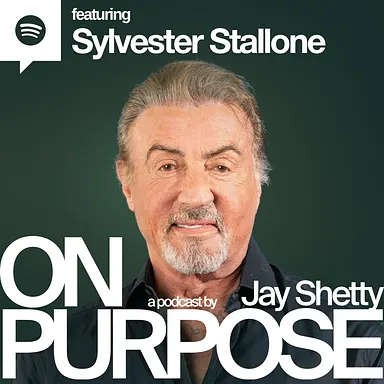
In this episode of On Purpose, Jay Shetty talks with Sylvester Stallone about his difficult childhood, his years of rejection and the writing that led to Rocky. Stallone describes his mother's distance, his father's deathbed apology, and the moment he turned down a large offer to sell the Rocky role rather than compromise.
He also reflects on health setbacks, an eight-year career slump, his long marriage and friendships, and what he learned after letting go of constant fighting. Listeners will hear his views on rejection, self-worth and aging, which he presents as personal reflections rather than universal rules.
In this episode Jay Shetty, Sylvester Stallone
This transcript of Sylvester Stallone's conversation with Jay Shetty was made with the technology behind HappyScribe's AI note taker.
Ads in this audio differ from the text. Tap the sentence you're hearing to follow along.
Synced: the text now follows the audio.
This episode is sponsored by BetterHelp, an online psychological counseling service. Looking back, it's easy to feel guilty and regretful, especially over smaller stuff—like accidentally forgetting to reply to a message, or buying a book or game you've had your eye on even though you promised yourself you'd save instead. But should you really let it weigh on you as much as you are? You can analyze those emotions and their impact with BetterHelp's psychological counseling. They match you up with a qualified, experienced German counselor based on your needs and preferences.
Take a closer look at your own expectations and recurring thoughts. BetterHelp makes it easy to find the support that fits your needs. 90% of German members continue working with their counselor after their first session as of May 2026. Our listeners receive 10% off their first month at betterhelp.com/jaystop3. That's betterhelp.com/jaystop3.
Willkommen zu einem Moment nur für dich und zu allem, was du liebst, bei Douglas. Finde einen Duft, der dich nicht mehr loslässt. Pflege, die aus Alltag ein Ritual macht. Farben, mit denen du dich neu entdeckst. Alles für dich am Singles' Day, jetzt 20% auf viele Artikel. Douglas, welcome to beautiful.
So, one of my best memories growing up—and I don't have a lot of those—was actually watching Rocky with my dad. And my dad introduced me to the franchise, and I know this for sure: I've watched the Rocky franchise, including Five and Barbara, after that, more than I've watched any other franchise in my lifetime. So I watch it back every year. There's only—there's only two things I watch to get motivated every year, and one of them is Rocky, so.
Oh, thank you very much. I appreciate it. I thought you were going to ask for a refund. Okay, great.
Hey, it's Jay. I don't know what your day's been like, but I was just thinking about you for a minute. And I hope you're being a little patient with yourself, because you deserve it. And yeah, I'll talk to you soon.
Sylvester Stallone, welcome to On Purpose with Jay.
Oh, thank you very much. Appreciate it.
I want to start off by saying I don't get to start every interview this way. I've had the fortune of interviewing lots of incredible people, people who've achieved amazing things, done amazing things. But it's rare that you get to sit down with one of your personal heroes.
No.
I wanted to ask you: you start this book telling us about the fortune teller, and I wanted to know why you start there. Why do you tell us what's about to happen?
I just think there's more things happening in the universe than we tend to give credit to. And I was at the very lowest level. I'm at that age where everyone's trying to find themselves in. And I think we have about 3 or 4 major crossroads that we have. And that's one that comes around 21 years old, 20, that you go, "What am I going to do? What am I going to be? How do I find the right path? What's going to trigger my journey?" And as I was walking down this gravel road in the mountains, I see, like, I said, it looked like the sign of a gypsy or something like fortune.
You saw a hand and some lines up here. It's either a bathroom to wash your hands or it's a gypsy. One of the two. So I went in there, and sure enough, it was like a real gypsy. And she spoke broken English, and she said things that came true years later. And I went, "Oh my God." So I've always believed from that moment on, even though I was born Catholic, you know, I went through the whole process of theology. But sometimes as you get older, you begin to question, you know, what is God?
What is the future? What is this? What is that? Yet we'll listen to a fortune teller, yeah, but sometimes we don't believe the church, but we'll believe some person in a little shack. Well, I did at that time, and I wrote down everything, and I would say 80% came true. Like, to the T. They said, "Well—" One thing is, don't do comedy. They were right about that. But also, a woman will bring you into the circle of attention.
And that was a woman named Jane Oliver who picked me out of this. For some odd reason, I had nothing going for me, but she says, "You have it." And she goes, "I know," because I felt I met people like Dustin Hoffman or whatever, and I—some people just have this thing. And then also, you will be famed by 1975, '76, which is what Rocky came. And so on and so forth. So there's many of these situations that came about from her talking to me in the mountains.
But luckily, I was writing everything down at that time, which I think is important. I think if people jot down their thoughts when they're very early and reflect back on them 20 or 30, 40 years later, they'll be quite astounded at how astute they were back then. Because I think when you're young, you're just—you're a sponge, and you're looking for some kind of pathway, doorway, a key, something that triggers a pathway. And that's what happened with me. It was just a thing that triggered it, and I never looked back.
What was the 20% that didn't come true?
Well, they said, "Be married three times." I go, "How do you know?" I mean, that's a pretty bold statement. They said, "You were protected by some actor from Beyond who had dark hair." I'm going, "That's just about everybody." So I couldn't take that one too seriously. I would say just about they all came true. Even I said, "Always remember that number 2 and 4 will be your lucky numbers." And sure enough, everything, even what I use on my Instagram or whatever, it's like 22.
It's whatever that number. See, when I go to a hotel, it's always room 22. I'm like, "Whoa, this is good and bad." You know what I mean? Next time I see 22, I hope it's not on, like, you know, like a bad omen. But yeah, there's certain things that just seem to trail people around.
Everyone's going to want the number of this fortune teller now.
Oh my God, it's 50 years ago.
Did you ever get back in touch with her during—
No. No, I shouldn't. You know, I should have. There's a few things like that that I truly regret, like not meeting certain people like Charlie Chaplin or Elvis. And I was invited, and I was too shy.
Wow.
I was too shy to meet Elvis. Can you imagine?
Wow. When did that happen?
1976, when Rocky came out. He invited me to Tennessee, to his home, and to go to a local theater and watch Rocky with him alone.
That's incredible.
And that's unbelievable.
That's awesome.
And so I go, "People, please don't live with these regrets that I live with. When opportunity like this, even though you may, 'Oh, I have a head cold,' go. I don't care if you're not feeling well. Go."
That surprises me, though, because when we read your book, we see you be someone who is always trying, always pushing. What was it about that particularly that made you shy?
What was I going to say to Elvis? Would I be tongue-tied? And I know I wouldn't be. Once I got there, like, I feel very at ease right now, much to your credit. Thank you.
Thank you.
But back then, I just felt like whenever I would meet Muhammad Ali, whatever, I go, "Oh, no, they don't want to talk to me." And then I end up becoming great friends with him. I even used his house in Rocky III. That was his home, his furniture, his everything. That was when I hadn't conquered fear. You know, the embarrassment. They say that perhaps one of the most—I'm using the word forbidding, but the things that people are so afraid of is public speaking.
Like, worse than spiders, you know? It's public speaking. And I've been through that, but I found once I got up there, I go, "What am I hiding from?" We're all basically made of the same element. No one's better than anyone else. Their experiences may be, but primarily, we're consistent of the same elements, you know, flesh and blood. So what makes me afraid of that person when he hasn't threatened me or anything else? Why not just go out there?
And sure enough, once you let it out, it's kind of like boxing. And it is true. I've sparred a few times, and as soon as you get hit one time, your fear goes out the window, and now survival comes in, you know? You sort of adapt at that moment. Same thing is once you walk out there, you go, "This was not so bad after all."
This episode of On Purpose is presented to you by Mazda. Peace of mind doesn't happen by chance. It's created through the habits we build before we ever need them. That's the philosophy behind every Mazda, with proactive safety features that help keep you more aware, more connected, and more engaged. Mazda helps you feel ready for whatever the road brings. It's why Mazda has been named Consumer Reports' safest new car brand. And as of July 2026, Mazda has won more 2026 IIHS Top Safety Pick Plus awards than any other car brand.
Visit www.iihs.org to learn more. A lot can happen when an accident doesn't. Visit mazdausa.com to learn more. Consumer Reports does not endorse products or services. I want to go backwards before we go forwards. Your life almost started with difficulty immediately. I mean, there were complications when you were born.
Yeah.
Speak to us about that. When you talk about it in the book, that was something I wasn't as aware of with your story. And when I read about that, I was thinking, "Wow." And there's a part where you literally say, you go, "This is what happened. This is how it felt. So be it." And kind of like, "Let's move on." And I was like, "Wow, that's really tough stuff." Can you walk us through what you experienced?
Well, at a very early age, I think I was born to parents that really were not qualified to be parents. Because I think when you fully understand that this is now going to be your project forever is you're responsible for these people and the way they grow up and the way they perceive the world and how they adapt to the way you teach them. They are basically, as I've said before, kind of like wet clay. You mold them, and if you mold them badly, that shape never quite evaporates.
They have those dents and indentations and malshapings forever. And so I grew up in that kind of situation where I was not wanted, not really appreciated, and I was looked at as a burden. And also, I believe—and they actually said it to my face—where you impeded on our life, you cost us our destiny. Our destiny would have been something else if you hadn't come along.
And I go, "That's probably quite true." And they somehow tried to eliminate that factor by moving me into different areas. Like, I lived in a boarding house. I didn't live with them for a while. They just moved me to this area in Queens, New York, where it was a transient house where salesmen came in and this and that. So I was raised around adult people. And so I didn't really grow up around children. I've never been able to mingle well with people my own age, at least up until, of course, as an adult, I was able to.
But I never knew what plain was. And plain is actually more—it's another word for exploration. And I didn't explore. So I developed very late in life. And I think I still maintain the immaturity to this day, which I now welcome. You know what I mean?
Yeah.
The older I get, the more immature I get. There's an old saying where, you know, aging gracefully. Really? You ever seen a 100-year-old stripper that's not aging gracefully? Or, you know what I mean? It's like a 50-year-old boxer. It's not a pretty thing to see. So I covet the fact that I never became overly mature at an early age. I had a world that revolved around fantasy and make-believe and of your own doing, of your own invention.
And that's where—I don't know where the writing came from. We'll talk about that later, but it was a lifesaver. But I think that all came from being immature and being lost in the world of make-believe. And I felt more comfortable. Reality, to me, was too real.
Yeah.
I didn't like my reality at home. It was very painful, very offsetting, and also made me very aggressive. Like, I thought that this is the way you treat people. You smack them around, or you get smacked and you hit back. So I was a very physical, physical person, really physical. And, you know, I grew up in a neighborhood called Hell's Kitchen, which was about as physical as its name. So that was almost the language.
People related physically rather than verbally. In other words, it was your toughness and your boldness that was your calling card, not your intellect. That's something that came as we moved on, hopefully. And I tell, you know, anyone can build muscles. Your brain is what your IQ—that's what you're born with. If you go to the finest school, you have a 95 IQ. It's going to be 95 when you graduate. That's it. It's not all of a sudden you're not going to be Einstein.
It doesn't work that way. And I found that out, you know, the hard way, that I was very physical, very combative, but I was also very—I just didn't want to deal with reality. So movies, cinema, became my church. That's just where I worshipped. And it paid off.
When you look back, do you feel hearing those things growing up about your worth, your value? You talk about even almost having to apologize for being unplanned in the book. And I think, how much of that do you look back and feel, "That really affected my confidence. It affected my self-worth." Or was the fight and the anger helping you break through at the time?
I think that comes with more or less analytical endeavor. As you get older, you become a bit more aware of that. But I think 100% it affects you. See, people say words—"Sticks and stones will break my bones." Words—yes, they will. Words are literally verbal bullets that will penetrate you, pierce you, scar your interior forever. You tell some kid, like a young girl, young boy, about their physical look when they're 8 years old.
Oh my God. They'll never forget that. When they're 80, they'll quote you. They won't quote the other things, but they'll remember that.
Yeah.
Because it just—your self-esteem is very, very fragile. They say, like, a woman's reputation is so fragile that once broken, it's never repairable. You know, you just cannot put it back together. Well, I think that goes for all people. It's not just women. It's just all men. It's tough as we can be. I've seen, and I've been that way too. There's somewhere, if someone says the right thing, it hits a fragile spot that you thought was gone.
You say, "Oh my God, I didn't think that would affect me anymore." It's there forever. The fact that I was treated so badly, it made me tough. That made me be able to stand up to what I was going to face at 22, 23, a complete rejection. I took rejection like as motivation. I didn't take it as setting me back. I said, "I know who I am. More importantly, I know my fault." And that's why I think a lot of people don't.
They know, "Oh, yeah, I'm really strong." But if you know your weaknesses, then you're really strong. A strong person knows his weaknesses. That's the ultimate in survival. I knew that early on because I was made aware of all my flaws or assumed flaws from a child, an early child.
Yeah, I see you as an expert in rejection.
I will.
I'm like, "You are an expert in rejection." You write beautifully in the book. You say, one of my favorite quotes I pulled out, "Rejection is your shadow at every step in this business. You have to find a way to make peace with it." And I was thinking about that, and I was wondering, when you're such an expert at rejection, how do you make peace with being rejected? I feel it's probably the biggest challenge of today that everyone's facing, whether you're young, old. I feel like the world's moving at the fastest pace it ever has.
People are experiencing rejection, chasing their passions, their dreams. When someone's going through that, how do they become an expert in rejection like you, and how do they make peace with it?
I used to, I guess you might say, a strategy called mirror therapy. I would actually talk to myself because I had so much time alone, and I spent so much time alone, that I would try to look at myself. And actually, when you're looking at yourself in the mirror, you're trying to find clarity in your eyes. And I finally felt as though I knew I was, like, talking to myself, giving myself my own therapy, which I thought was extraordinary.
We usually seek other people to garner therapy from them. But if you learn to analyze yourself, then I made peace with it because I realized I knew my strengths and I knew my weaknesses. So I realized why I would get rejected. Okay, I didn't fit that image. You know, when you go in for an audition, within 10 seconds, that person goes, "He's the right one.
He's not the right one." Already, you've been judged. And so I realized that, "Oh, yeah, I'm going in for a cowboy who's 6'4". You know, it's not going to work. So I go in there with the preparation that 99% of the time, they're not going to choose me because they have a preconceived notion of what they want. So don't be so hard on yourself. You were not right for that part, but there will be one that you will connect with.
And guess what? That didn't happen either. So I go, "Then you have to go to plan B." And sometimes failure is the greatest motivator. You got to have it inside. I mean, you got to have something inside. I don't know if everyone has it, but it's a combativeness. Like, "I know I can do this. I'm going to be terrible in the beginning." And I'm speaking about writing, which I find the most difficult of all the arts to perform.
It's the most revealing and the most painful and perhaps the least gratifying because quite often you read what you've done and you go, "This is horrible." But it felt like real brilliant at the time.
Yeah.
But that failure forced me, meaning acting. I just was a type that was not present at that time that would—people were not really interested in my type. So I said, "I got to do something on my own and begin to investigate writing." And then I started developing other characters. But still, I didn't know how to write very well until I wrote about Edgar Allan Poe. Because what happened is you keep writing about yourself enough already.
You know, it's like it gets repetitive. So when you start writing about someone else, now you're focusing on that person's personality. Once I did that, then I realized I'm ready to create a character from scratch. And that was called Rocky. Like, literally, I know everyone saw me as a bully, as a thug, as this, as not very—he doesn't look smart, so he must not be smart. And everyone was judging everyone because we do. We judge people. As soon as they walk into a room, we do a primary personality, I guess, readout of them.
Primary impressions are very, very strong. But you're wrong. You don't know what's ticking in that body. It could be genius, but because they don't look like a genius, they're not smoking a pipe and they have a certain ascot on. Oh my God, they're so sophisticated. That's superficial. When I wrote about Rocky, I wrote about a guy on the outside who's considered a complete loser and a thug, but inside, he's gentle. He really is gentle. And the only thing that brings out his ferocity is being underestimated.
Like, if you call me just about any name in the world, I could bounce it off. I was like, I was pretty immune to it. But if you call me stupid, now you push my button.
Why was that?
I don't know. Because that goes back to my father and my parents. "You're stupid. You're stupid. You're stupid. You're dumb. That's why you can't get anywhere. Why can't you be like that person who's got some brains? You got no brains." And I went, "Oh my God." That one never went away. But then again, that was motivation for proving I wasn't stupid by actually writing a screenplay that other people could understand and identify with.
So I wasn't stupid. I was just misunderstood.
That's really powerful. I feel like you have two choices. You either prove them right or you disprove them.
That's it.
And you disprove them by doing something that proved to yourself that you weren't stupid, that you were misunderstood.
That's it.
You don't do it by fighting for it, defending yourself.
No.
It's actually doing the thing.
You got to do the thing.
That proves to you.
Yes.
I genuinely, as I'm reading the book, I found it fascinating how you didn't take so much of this personally, whether it's from your parents or whether from the directors.
Oh, did it really?
Yeah. I'm just like, when you meet the agents and they're telling you, "Oh, you're more of an intimidating kind of guy," or, "You're more like this person," or, "You're not good-looking enough." And I just couldn't believe how many times you heard the same thing. And it's almost like if you hear the same thing, you start to believe it. So you must have been saying something else to yourself.
I was at that bridge or at that crossroad. I said, "Either you're right or they're right. If you believe them, go home. It's over." And that's why I spent all this time I'm telling you, talking to myself, looking in the mirror, thinking, "Could I be this big a fool? Am I this delusional to actually believe I could be a famous actor? Am I that far gone? Or do you really believe it?"
And I really believed it. I really believed somewhere, somehow. I never ever, and I swear to you, I never thought I would be here, ever. I just wanted to be adequate. You know, like, "Okay, I just want to get a C, grade C. Okay, I'm average, good average actor." That's where it was at. But I triggered on something that I think the majority of the world at times questions. What is it all about?
What is my real worth? And why am I not getting the opportunity? If I just had an opportunity to fail, what do I mean? I want an opportunity to fail. I know I'm not going to succeed. I probably won't. I'm never going to be the best basketball player or this, but I just want to try to see how good I can be. And then I could go to my grave going, "I had an opportunity." The lack of opportunity, I think, is what drives people absolutely nuts and forces them, "Well, I start drinking and this and that," because it hurts.
It's like I'm never going to get a chance to really show my worth because the opportunity didn't present itself. And it really doesn't. No one's going to go, "Hey, show me how good you are. See if you can lift that 100 pounds, and then I'll give you a job." Those opportunities are very, very, very rare. And that's why I think that Rocky touched so many sensitive nerves because of that situation and not being allowed to show if you got it or you don't.
Yeah.
I remember there was this guy came into the gym, and there was a fellow that training. His name was Jerry Cooney. He was a big, tough, ranked heavyweight. And the guy came in, was even bigger than him and tougher looking. He was the head of the Hells Angels in Boston. And he comes in, he goes, "I could kick everyone's ass. I'm the baddest of the bad. I think I could be heavyweight champion of the world." He goes, "I want to spar you around." So Jerry goes, "Yeah, get into the ring."
Guy gets in. You know, he's about 290 pounds. He's huge. I would say the fight lasted 11 seconds, including the count. However long it took him to walk across the ring and throw one left hook, knocked the guy out. But here's what I took away from it. He goes, "Thank you. Now I know I made the right decision. You completely proved me that, yes, I should have been a biker. I am a biker.
I'm a very successful biker. I might be the scourge of the earth, but I'm successful at it. I never would have been." So a lot of the time, to be able to have your dream even pop, like, "Oh, thank you, God. Now I know I can go back to doing my other job saying I made the right choice."
I think that's what differentiates you as I'm listening to you is that you were happy to start at being bad at what you did.
Yeah.
Like you were okay at starting from a place of, "This may work. It may not work. I want to give it a go. I just want an opportunity." And I feel like that's what's missing today because I think nowadays everyone thinks, "Oh, you've got to launch something that's worth a billion dollars," or, "You've got to launch something that goes to the number one on the box office." Like there's such a pressure to be the best at everything that you're not happy being the worst or the first. And so you never start.
No.
And then if you never start, then you're never going to get to be the best. There's that famous Zig Ziglar quote of, "You don't have to be great to start, but you have to start to be great."
Yeah, that's so true.
And you were willing to start at the bottom wherever someone gave you a shot.
Right. You know, I guess it's in the Bible, "Never put false gods before me." I never, and this will sound very egotistical, I never said, "Oh, God, I want to be him." That person, I covered whatever. I said, "No, you just got to be you and the best you can be. And if you're mediocre, so be it. That's it. You're mediocre. Or if you have something unusual." But I just never caught on to like, "Oh, wow, I want to be exactly like this person and talk like him and dress like him."
No.
And that helped you. Not having someone you were chasing actually helped you because there was no pressure.
I think so. I'm always shocked to, "Oh, yeah, I love this rock and roll singer. I've gone to 30 of his concerts." I go, "Why? Just buy the album, man. What are you, like, you trying to absorb him in a way? Are you trying to morph into him?" I never quite got that. And I don't know if that's a plus or a negative, but don't try to be someone you're not. I mean, you're not going to be that person ever anyway. You're just not. And so I just tried to follow my own, you know, stick with my weaknesses, like make them stronger, not try to be that dude up there who's already made it.
So how dare you presume? Like you're on that same path. You're not.
You were offered $360,000 to not play Rocky, but you were adamant that you had to play Rocky. That's a lot of money.
That's a lot of money.
Why were you so adamant that you had to play Rocky?
I had been told no so many times, rejected so many times. I never really ever fathomed being rich. I knew what it was like to be poor. I had mastered poorness. I had gotten that down to a science. So I was able to live on nothing. But I knew no matter how much, if this was going to be my gateway to heaven, if I sold it for money, I'm going to hell.
This is exactly what the story was about, is not being bribed. I almost looked at it as a bribe, but I know it sounds egotistical, but they said they didn't want me, so they continued to pay me. So are you bribing me? And I go, I just knew in my heart if I sold this and this thing became successful and this was what I had been building up to my whole life, I deserved the most miserable life.
And I would have been miserable my whole life. I would have hated myself. I would have never understood the word, the meaning of happiness, because I had sold out. Even today, to sit there and imagine, we're imagining right now, I'm watching TV and there is actor number X doing a great job at it. And that could have been you. That's what you were built for. I mean, this whole trial and tribulation, going this route and this and that and taking all these crazy challenges, they were leading up to this moment of, will you or will you not crumble?
Under the temptation of money, and it would have been a complete disaster.
Yeah. What an experience to be writing about a character who's not distracted by temptation and then to actually have to live it in your own life.
That's a whole other book, isn't it? Yeah, that's a bad one.
Was there ever in your life where you feel you did give in to temptation and it didn't?
Oh, yeah. No question. So I understood temptation and I got it, believe me. And sometimes I would have to take, like when I was in movies, taking tickets in a movie theater because I'm making $34 a week. And, you know, if you could pick up an extra $10, $15, well, you're living big. You can actually have half a chicken for this week, something like that. So I understood temptation, but I knew when the chips are down, this was more than temptation. This was that crossroad.
And this was crossroad number two. And the other one would be marriage and perhaps then birth of a child. Those are the four major crossroads, I think. And I go, "My God, if I do this, I'm going to, I can't even tell you the wrath I will feel for myself for being such a coward." And the fact that they also didn't want me really pushed my butt. You know what I mean? It was like, "Now, you know what? This is exactly what I've been facing for years and years and years of saying you're not good enough.
So I'm just going to play tough to get. That's it. I'm just going to," because I really felt I had nothing to lose.
When you started playing the role and obviously you were writing, directing, you know, you're involved so much, was there a sense of imposter syndrome? Was there a moment then where you started to lack confidence and started to question yourself while you were actually making it?
Yeah. Oh, yeah. Yeah, yeah, yeah. There was that, I'll never forget, it was freezing and I was not wearing my Rocky clothes, which were my real work clothes and work out. I just wrote Italian style on the back, but this is the junk I used to wear. And I said, "Now you got everything you want. Are you really up to it? Are you as good as these other actors? You're not really experienced." And then finally, then I made the guy outside, he goes, "Okay, Sly.
We're ready." I said, "Rocky, call me Rocky. From now on, I'm going to be that guy." And whenever I put those clothes on, I became that guy. You know, some actors, like everyone has a different method. They really do. Like there's no, like how many different ways do you interpret a character? What is your training method? I think it's really very simple. I think Daniel Day-Lewis said, he goes, "It's good acting and bad acting. It's truthful and there's not truthful."
You know, it's something like that. And that's really it. So I said, "From that moment on, I'm really going to actually believe I'm this guy." And we started talking like that, you know what I'm saying? And all these like things, I'd see these other fighters, they'd always be, you know, shifting their shoulders, like always imagining like they're ready to fight or just staying loose. And all these things started coming to me, what I call isms, little mannerisms. And it really was quite different.
I could literally remain in that character 24 hours a day. It was just, I really felt comfortable.
You're just saying that the idea of being true, I think when you watch Rocky, it feels very true.
Yeah.
It feels very real. It feels very honest and earnest as well. Like you really feel his pain. You really feel that what he's experiencing. And it's something you can relate to as well. I feel, to me, some of the most powerful scenes were between Rocky and Mickey.
Without a doubt.
Yeah.
The scene where I had written the scene and I felt it was too short, too mediocre. And then I said, "You know, I'm going to play this scene like what I've wanted to say to my father." And I never did. And that scene of me, what about my life? What about, you know, Yishu had a problem. I had nothing. That was coming from my soul. Because sometimes I know other writers will disagree with me. Some things can be beautifully written, but they're not as truthful.
In other words, you haven't lived them. You're writing about them, but you haven't gone through them. And I did that twice. Here's the first example. When I did First Blood, at the very end, I made sure Rambo didn't talk until the very end. He spits out everything that's been eating him alive. It's almost like an autistic person speaking for the first time. Now, I hadn't been to Vietnam. I had not had people die in my arms. So I'm writing from other people's experiences.
And Rocky, that was my experience. I was living that. So one I was acting and one I was like psychologically flashing back.
Do you believe that Rocky helped you grieve what you never received from your parents?
Unfortunately, no. No, no. It didn't. Because I still feel it to this day. And it's something that you never really get over completely. I guess it has to do with DNA and genetics and stuff that we don't even understand that bind us together with our parents. So you just try to come to terms with it. You try to have a better life with your family. And that's all you can do.
But scars don't go away. You know, you just can't laser them off because they're inside. They're not out here. Oh, yeah. Can you take the scar off? Hell yeah. Can you take the one off my heart? Sorry. That's there forever.
Yeah. I appreciate the honesty because, yeah, it's kind of like a romantic idea to think that you can heal those scars on the inside.
Yeah.
Whatever you said feels real. Yeah. It feels so true. And it's such a painful experience. And I've been watching this more and more, especially when I interview people who've lived decades of life like you have, real life experience. And you go, you look back at that experience and say, "That made me who I am today. That made you a fighter. It drove you to this incredible life. I got to meet your beautiful family today. Everyone's like the most sweet, kind, sincere family, like so hospitable, so welcoming, so warm, and made me feel so at home in your home." Like, I feel so, I'm like, "Oh, I'll move in."
It's fascinating that pain has to make that. And you go, "Is there another way?" And I don't know. I've been thinking about that. What have you seen from your years of life and friends and family and people you know? Like, is everyone who's done life well, gone through something painful?
I think so. I think they do. And I think it's just a matter of coping with it. And, you know, it wears its ugly head now and then. You might see something that reminds you of it. It triggers it. But again, it'll settle down. Because, you know, I've gone through some pretty brutal things. And you can keep a lid on it for a while, but of course, the lid does come off. And usually, hopefully, you're alone when that happens. And then it settles back down.
I call it volcanic. It's like volcanic eruptions in your soul. You have them. It erupts now and then. But it never goes away. But I'm sure you've gone through. How do you go through life without being beaten up? You know, you start getting beaten up the minute you're born. This is as easy as it's ever going to get for you right now. You're crying over a toy. Guess what? That's the easiest it's ever going to be.
It gets a lot rougher when you have to cry over serious things in life.
Were a lot of the monologues in Rocky pep talks that you gave yourself when you were younger? I know what you were just mentioning now, getting beaten up, obviously, in Rocky Balboa. You're talking about the scene with Mickey channeling emotions to your father. What are other memorable moments for you that felt like you were channeling your own inner pain and emotions into a scene?
I would have to say, like when I'm speaking with my son, that one just came so fast. And a lot of people say, "Was that written for your son?" I go, "That truthfully, I was writing about me." Like, "Are you going to live in the shadow of your father? Are you going to blame other people?" So I was writing about literally what I had gone through as a young man and how you don't do that.
That's not how winning is done. Get up, take the punches, and keep going. So it was like self-reflecting. It was almost like a lesson to myself, a reminder of what you have to do to get through this thing called life. You know what I mean? Just keep punching. Keep punching.
I love that you said that Rocky's more of a love story than it is a sports film. That's why I think I like it so much, too. What are the softer qualities of Rocky that you most identify with?
He's just so sensitive to her feelings that, like, when he does say things, you know, "Women, weak and lazy," and I got to stay strong. Then he feels terribly sorry for what he said. Or when her brother starts to say terrible things about her and like, "You slept with him. You did this." And that Rocky comes over and he has every reason to really destroy this horrible guy.
But he forgives him. He understands his pain. And then he goes, then he says to Adrian, "You want a roommate?" kind of thing. Or she says, "You want a roommate?" That's the difference. He understands other people's pain because he has been so torn apart by life. Oh, my God. I was going to write so much more, like about his father and about his mother and about, like, no one ever realized it, but in the movie, the Lone Shark was his brother.
And they made me change it. You know? Yeah. Like, he was even working for his brother. Like, even my brother used me as a thug. But the brother was also, he was kind to him, too. It was just interesting different dynamics and relationships that it was very biographical.
I mean, honestly, I want to say it's just so brilliantly written as well.
Really?
Yeah, genuinely. Like, I'm not just saying that. I grew up as a massive fan of autobiographies. It's my favorite genre of books. And so I grew up reading everything from, I grew up in London, so David Beckham and all the way through to Malcolm X and Martin Luther King. And so for me, I love reading about real life stories. And this one is just, I'm there with you. Like, I can picture the scenes.
Oh, thank you.
I can experience it.
I wanted to show it was going to work at all.
No, it's spectacular. Honestly, I mean that. It was gripping. I was there. I was just, it was so easy to read, too. It's just, you're just fully there with you, following the story along. But when I was reading it, I was thinking to myself, like, one of the hardest moments was when, and you've talked about this in other places, too, but like how your mom doesn't go to the Oscars with you. And I was thinking about how did that feel and did you ever feel she was proud of what you'd achieved?
No, never. No, it was a very odd thing. She had been raised horribly, too, and she was just passing that on. And I always thought, like, why would you have learned from that and, like, not be the same, like, have the same degenerating kind of, like, mentality that I'm going to make it even worse for someone else because someone was bad to me, so I'm going to show you. She was very witty. She was smart, but she never forgave me for, in her mind, destroying her opportunity.
Like, it's, I mean, I'll never forget. I didn't put this in the books. Like, I was late for school, as usual. And there was a play class window, like class. And my mother was like, "Hurry up, hurry up. I don't want you to stay home today. You're going to be late for school." And she pushed me through the window because I stumbled. And I literally got close to 60 stitches here. I could see my bone. And the only reason I didn't bleed to death is there were workers next door building a house.
And they came and took me to the hospital and, like, sewed me up. And it was so critical. They couldn't, at that time, give me Novocain or anything because it was that bad. I go, "Do you remember when you pushed me through the window?" He goes, "You tripped." I go, "You pushed me." Now, here's where I'm getting at with the story. In a lot of other ways, she just pushed and pushed and pushed me in terrible directions and very, very mean to people around me, mean to my wife.
And at the very end, when she was like 90, I said, "Do you regret anything?" And he goes, "No, never." In her mind, she never made a mistake. And I'm wondering, is that a gift from God that you're able to completely block out truth, that you can go to your maker with actually no guilt whatsoever? Or are you completely a psychotic?
You literally have lied to yourself so much that lying is the preferred format of how to conduct your life. I will just lie about everything until it becomes natural. And I'm just, and that's what it was. She literally had never told the truth her whole life that she became very comfortable. She never had a thought of, "Oh, my God, she's telling a lie." No, it was, all her lies became truth. And I saw that. Was that a gift?
Or is that a curse? I don't know. But anyway, you could see the effect has been long-lasting. I think it even affected my brother more because I was able to somehow turn it into something creative. Really, I do a lot of painting and stuff like that. And it comes out. It just pours out.
Why did you choose to leave that out of the book?
I didn't want to sit there and sound like I'm just whining and complaining and, "Oh, woe is me." The truth is everybody in this room has issues, has had moments. And if they haven't, they're really, really blessed. They really are blessed. But everyone has had to deal with this situation called dark side of life. And I just don't want to say, "Oh, again, you're not the only one sly.
There's people a lot worse than you are. A lot worse." I mean, I've been literally tortured to death. And so I just thought, "Let me just leave it at this relatable level. People can relate to this. But if you go too far, you know, because I could have gone, believe me. Oh, trust me. Oh, trust me. Oh, yeah. My family knows about it. It was really quite unbelievable. Yeah.
Thank you for sharing that. For what it's worth, I think you being that open about what you've been through and how much drive you had, I'm hoping that that's actually going to help a lot of our listeners find their motivation in their life. As you say.
It's very complicated because I'll tell you another story. It's very, very odd. My mother, for some reason, I always was still trying, always trying. And I never felt it was given back. Then when my father, who is also a tough cookie, he's dying. And he has a form of cancer. And she calls up hysterical crying, like, "Be nice to him.
Please show love and kindness like I gave to you. I'll pass it on to him." And I was literally just sitting there. I said, "Do you mind if I tape this? Because I can't believe what I'm hearing." Because you can do whatever you want. But please do something for your father before he dies. And I'm thinking, this is the woman that made his life hell, and he made her life hell.
And now they care about each other rather than their own children. And I thought that was quite fascinating that when you're really at death's door and how priorities shift. Like, this is the man you divorced 50 years ago and hated. You used to talk about him in horrible terms. Now you're shedding. I've never heard you sob heaving like that in my life. And then when I passed the word on to him, he goes, "Oh, please be kind to people."
And I said, "Do you have to be near death to feel like this, that you feel as though you should have been kind to everyone?" He goes, "Yes." And I went, "Wow." You see all the confusion. People are so complicated. And they are never going to be. They're beyond Rubik's cubes. They're made of flesh and bone. And that transitions all the time. It's always morphing. The same person you met at 10 is not at 20. And 20 is not the same at 30.
And they evolve. It takes a very erudite individual, quite perceptive, to sort of understand the mechanisms and the mechanics of how people will, they change. We're not furniture. We're not, "Oh, yeah, that antique's perfect." We're not antiques. We are slowly becoming aging artifacts of the past.
Yeah. This episode is brought to you by Mazda. Some of life's best moments happen because nothing went wrong. The drive home, the conversation that continues, the plans that stay exactly as planned. That's the feeling of safety. Every Mazda is designed with proactive safety features that help keep you more aware, more connected, and more engaged with your drive so you can feel confident on the road. That's why Mazda has been named Consumer Reports' Safest New Car Brand. And as of July 2026, Dave Wan Mor 2026 IIHS Top Safety Pick Plus Awards than any other car brand.
Visit www.iihs.org to learn more. A lot can happen when an accident doesn't. Visit mazdausa.com to learn more. Consumer Reports does not endorse products or services. Was it confusing to be at the moment when you were losing your parents?
Yes, it was. It was. It was very sad. Because, you know, you go, "Why does it take so long to have a realization of something so profound that my father was a very, very physical man, you know, big time." Like, I'm talking on the floor, let's go. And to have this revelation, I'm going, "My God, maybe he had that in him, but he just didn't know how to release it at the time."
So you start to go through all this stuff. And then it's like the Robert Frost poem. We all dance around and ring and wonder. And the answer sits in the middle of nose. And that's what drives us. That's what drives, you know, all intellect is driven on curiosity of not knowing what it's all about. So we all develop philosophies. And this is my interpretation. This is my religion. This is how I see it. You know, and each of us have a different proportional way of dissecting their lives, going, "This is the direction that works best for me," where it may work terrible for, like, "I'm going to be a tough son of a bitch my life, and no one's going to hurt me, and that's my route."
And that's what he did. See what I mean? Like, no one's going to crack this crust. But it did crack at the end, see? And I wonder if he blew his whole life by not being the really genuine person he could have been.
Yeah.
You know? And I always think about that because I have traits. I have habits that reflect his.
Yeah.
Even to this day, they come out of, I go, "God, that's him. He's so, you know, your parents, for better or worse, they're still alive in you, even when they move on. There's trademarks of them. The way you laugh, you laugh like a mother, you know, your hand gestures, it's like drives you fucking crazy. You know what I mean?
What do you do about those?
What do we do about this? Like, you know, get an exterminator? No. There's nothing. An exterminator for the soul? No. That's why it's so goddamn complex. And that's why our minds are always churning. There's, I mean, I used to study all these different kinds of theologies and even chanting and, you know, tantra this and so on and so on. And you go, "How do you clear out the mind?" Like, and it's, I think it's almost virtually impossible to be without thought.
I agree.
You know, just, I think it really is just to be, "Give me one minute of no thought." Well, that's a thought right there. You don't think you're thinking. That's a, it's just, it's wild. So it's how do you corral these thoughts and try to keep them under control? Some of them are destructive. They're there to, like, test you. It's really fucking a pain in the ass. Life is a pain in the ass. It really is.
I was going to ask you, you said your dad's, you know, version was almost like this, be this tough crust, this thick, you know, I'm stronger. How would you define your philosophy of life?
Oh, now you're getting deep.
I feel like you're a philosopher in this book. Your movies are philosophical. Like, everything has such an undertone of just, you know, life advice in everything you do. Like, it speaks to me.
I used to think that I'd like to confront things head-on. And my philosophy is, like, sort of not, not confront them head-on because, you know, like, sometimes it's not worth the battle. For example, when I wrote Rambo in the book, he was a homicidal maniac. And he was just running to violence. He couldn't wait to kill because that's what he'd been trained for.
When I took it over and started to rewrite it, I had him running away from everything, avoiding it, trying not to confront his demons. Just like, don't, I don't want to fight with people because I know I'm going to get crazy and take your life. So I felt as though I was very confrontational. And I think it wasted a lot of my life being angry. You know, that whole thing, the turn the other cheek.
I never turned the other cheek. I was just the most combative and looking for a challenge. And I always felt as though I had to compete with people that weren't even competing with me. I just thought that, like, I have to try to be the best. I have to try to be the best, you know, because I was always told I was not the best or that kind of thing. And it took me until maybe 70 years old to stop doing that, to just, like, let it lie.
Let other people have their moments. Don't always be competing. Don't always invent these friggin' dragons that you have to slay. There are no dragons. They're only in your mind that you just are looking for some reason to stay relevant. You're relevant. It's like you don't have to continue to battle and be also to be envious and jealous. That, in my profession, reigns supreme, you know, because people in my profession, when you're rejected, you're not rejecting a product or a car you're selling or rugs you're weaving or something.
You're rejecting the flesh on your bones. You are not good enough anymore. You're passé. You're leftovers. And actors go through that. And that's a terrible death. I've always said, you know, actors die twice. And the second one is a lot easier than the first one because you're being told that you're not valid or nobody wants you anymore. I've been told that, you know, like, when I was going to do Rocky VI, Rocky Balboa, it's a very interesting time.
My career was in a slump, like, for eight years. That phone had spiderwebs. It was a dead, dead instrument. And I thought, wow, the only way I'm ever going to get out of this is to write my way out of it. So I wrote Rocky VI. And the movie is about grief. And it's about loss. It's not about fighting at all. It's about pain, replacing old pain with new pain, something like this. Rocky couldn't live without his wife. And this situation here is something that I knew I had to do because no one was hiring me anymore.
So I said, let me write something like this. And again, the studio said, you're over and Rocky is dead. You're both finished. And I found one person who said, all right, let's just give it a try. And it turned out to be a very big hit. And I went on to do Rocky and Rambo and Expendables. But literally, it took something like that to dig yourself out of this. It's really remarkable when you're told, told, you're done.
Your character is done. You're finished in this business. Nobody wants you.
Which one was harder, being told you weren't good enough at the beginning or being told you were done after you'd had massive success?
After. Afterwards.
Why did you believe it more that second time?
Because you went through all the trials and tribulations. You were incredibly successful. You achieved all your dreams far. And then now you're worthless. I go, wait a fucking minute. Worthless. Now I'm back to 10 years old again. I'm back to reliving that whole chapter again after I've done. We won a award. We won the Oscar. Everything. You have no value anymore. So that, to me, was because you're a grown-ass man now.
You know, it's that kind of, it's like, it's so humiliating. It's one thing as a child, but as an adult and having done and climbed the highest peak in this industry, to be told that you're on your way to hell and there's nothing and you're gone. You just don't mean anything anymore. That's a rough one. See? It's not like, oh, we don't like your product. You're the product. So I feel great empathy for performers. And I feel that way with all performers, writers, dancers, anyone that they feel the impending clock ticking.
That's like I always put, like, 90% of my paintings, there's always a clock in it because I feel that thing, you know, that horrible impediment of time.
How do you value time today?
Time is more precious now than ever because I've put my body through a lot. I've had nine back operations, three neck fusions. I've had heart problems. I've had everything that you like. Always use the stuntman. That's my motto from now on. If I can pass on any knowledge to young actors, use the stuntman, okay? You know what I mean? Because it's going to catch up to you at the end. So I realized that I'm on borrowed time.
The average age is 77, 78. That's when you say goodbye. I'm 80. So I'm three years over the quota of where you should be saying sayonara to this life. So I look at it as very, very important. I mention it to my wife all the time. Like, you know, I got to keep living. I got to keep staying alive. I got to enjoy my life now more than those other 80 years. And I said, Jesus, if I could just get a few more out of this, then I'm going to understand what true happiness is.
Not manufactured, not semi, not partial, like full, real friends. I mean, really honoring your friends. I mean, friends are hard to come by. Really, really hard to come by. And I've had one friend, like, for 65 years. So you got to covet that. That's a very rare thing. And that only comes with age and age, you know, can play tricks on you. One time you just walking because I was supposed to pass away a couple of times, you know, because of just, you know, problems and just beating up my body so badly.
How close did you get?
Oh, I got close. I got, like, two heart attacks, you know, like, major. And then I go, come on. God, give me a break, would you please? I'll be a nice guy. I'll be all right. I promise I'll use my time to the best of my ability. Also, here's what's weird. And I don't know if this is just self-delusion. And you're a young man now, and you'll feel it, you know, when you, hopefully, when you catch up, which would be a longer time in your case, that you're doing your best work.
Now, you may not be writing your best or painting your best because I can see the generation in painters. You can say, oh, God, he was better. Picasso was better at when he was 40 years old than he was at 90, without a doubt. But I find that acting, I've had so many different dramas in my life, and I've taken away, and I've had my heart broken, and I've broken hearts. And I've done, in other words, you've done so many things that now when I speak, I'm not acting.
I'm not just saying the words. I'm feeling the words. And that's the difference in acting. Anybody can learn words, but to understand the words, you got to have lived it.
You're talking about friendship. How do you define a good friend?
A good friend literally will show up when you don't even need them. You know, he's just there for you if you can sense it when you're sad. Like, if a tragedy happens, God forbid, they're the first one on the phone or at your house. If you want to insult them, ask them, "Hey, do you need some money?" And they go crazy on you because that's not a friendship. That'll be the end of it, you know, that kind of thing that wants nothing from you, wants to give what they got.
That's a beautiful definition. And you have a 65-year friendship, you said.
Yeah, I do.
That's unbelievable.
I do.
How often do you talk?
Every other day.
Wow.
I know. Isn't it weird?
That's impressive. No, it's great. That makes me feel good. I talk to the best man from my wedding every other day.
Do you really?
My best friend. We've been best friends for 20 years.
Yeah, well, keep that up. Keep that up because he's going to know things about you that no one of your parents will ever know.
Yeah, exactly.
Yeah.
He's the only person in the world I can tell everything to.
Exactly.
And he won't judge me. And I don't feel embarrassed sharing something that I might feel a bit, you know.
It's amazing. You know exactly what's on your brain, how you think, how you don't think. I mean, it's just great.
Yeah. You've been married for 29 years with Jennifer, who I just got to meet, who's absolutely wonderful. What do you believe you had to unlearn from how your parents raised you through their marriage?
The greatest asset people can have right up there in the top three is I've always thought patience is not a virtue. I thought impatience to me was a virtue, like, let's get it done. Well, not so. When you have someone who has patience that is willing to ride out the storms without any shelter, just bear themselves to the volatility of your personality and all the baggage you bring, which I brought a lot.
And she was so healing. And the patience she showed, because, I mean, she inherited my parents. She inherited this whole thing. And it wasn't until, you know, they eventually moved on that I really said, this is the greatest woman ever born. This is the greatest. And I try to say it every day. You know, I never go to bed without saying, I love you, ever. Ever, ever. And that was never the case.
You know, it was just, I didn't know what love was. I really didn't. Love is the most complex word there is because there's a billion different kinds of love. And then when you hit on that one where you say, I can't live without this person, then that's it.
That's love.
That's it. You're done. Done. Go no further. You know, it's like what Cal Hill Gibran would say, love is the thing that can take you the highest and at the same time drive you to the lowest. It's a sword hiding within the opinions of the feathers of the angel. Like, in those feathers is also, be careful. There's a sword. So it's, I mean, let's face it. It's a one-word novel. You could literally write, and people have.
I mean, has there ever been a better writer than Shakespeare about love? And yet it goes on in everyone. So, but everyone has a different interpretation. Is it, will you die for this person? Can you not live with this person? Would you literally want to follow this person into the ground? That's the person.
You mentioned the word true happiness a few times in our interview. How do you define true happiness?
Oh. When your wife's happy, that's really happy. Because if that's not working, nothing's working. Trust me on that one. Because the woman, they transition as they move on. They become, now you're lover. Now it's your companion. Now it's your, like, boss. It's your mother. And it's your guide. You know, it's your woman that holds it all together. And, you know, I was just talking to my wife about that, about how the different stages.
A man, not as much as a woman, because they go through birth. It's like, oh, they're not going to be the same after that. You know, it's like, raise all these children. That's a lot of work. So they're going to be different than they were when you met them at, you know, 20. So as you can imagine, you have to somehow, and she brought this up recently, you have to adapt to their adaptation. Because that's not, you're not the same, but you weren't. No, I'm not. I was 20 years old, and I was carefree and happy.
Now I've had to live an entire life, support a family, support you, support this, go through tragedies, go through exaltations. I'm different. And you have to treat them different.
You're never married to the same person you're married to.
You're not. You know, you're definitely not. I go, God, whatever happened to that kid? Well, you lived life, and life changes you. There's no getting around it. It's like changing your, you know, your skin shed, well, so does your soul.
You mentioned in your documentary this beautiful statement that life before 40 is about addition.
Yeah.
And life after 40 is about subtraction.
It is.
What have you had to learn to let go of?
Well, up until 40, there's a sense of almost invulnerability, like, I'm getting there. And then I realized a lot of the relationships that I thought were good were business relationships. And any relationship based on money is not a relationship. It's commerce, okay? Period. And when that commerce stops, you wonder why your phone stops ringing. It's not complicated. And then loved ones start to go.
And that's where the pain starts. That's where you really want to hang on to your friends if you get them because they're going. We're on our way out. There is no maybe about, there's not a guessing. People always go, oh, I wish I could live forever. No, you don't. Not if your friends are all gone and your love is gone, your wife is gone, your children are gone. You really want to be a vampire? Does that sound good to you? Not to me. Sounds like the worst curse there can be.
You know, kind of a thing. That's when I really, when I wrote about Rocky, I said, this is, he's going to undergo the worst grief a man can undergo. And it was not aging. It was his life, his love. You know, the reason he woke up every morning and had someone, I love you, that's gone. There's a pillow next to you that will never be filled. Brutal.
Brutal, brutal, brutal. And that's what that whole thing was. That's why I knew that to me, Rocky I and that one was the best one because it was so true. You know, I'd come close to that a few times. I said, nah. So right now, it's the happiest because when you get to be a certain age, you kind of figured out all the mysteries. And you realize they weren't mysteries. They were common sense, but you were too stupid to realize it because you had the foible of youth, the invincibility.
Like, yeah, I know everything. Like, God forbid, if we had listened to our parents about, or our grandparents, they say, listen, don't do that. Fire is hot. Don't stick a hand to you, but I'm not going to feel it. You know what I mean? If we had just listened to some of those life lessons and avoided all those pitfalls, oh my God. How many, you know what I mean? Just, especially about love and relationships. That's not going to happen to me. Oh, yeah, it does.
Do you have any regrets?
I have so many regrets. It would literally take about another 10 hours for you. Yes, you have regrets because you took chances. And regrets are the failure of taking chances. You regret it. Oh, God. I went for that. You know, it was romantic here. You know, I tried to become the finest, you know, athlete. I know it was never. I was not good. I would fail. Regret, regret, regret. But more regret is where you've used your mouth in the wrong way and said the wrong words.
And that is really because you can't take them back. If someone's, like, willing to forgive, have patience, they understand you said that out of anger. That's not me. Well, it is you, but it's a part of you you don't want to bring out. You know, he was just in a bad mood. Well, that bad mood came from somewhere. He's got to learn how to control it. But yeah, that's all part of forgiving that because God knows.
She's forgiven me a billion times. Also, if you're complex, I mean, Jesus, be careful what you wish for. I want a complex person. No, you don't. I want a person with a single-track mind and like, yes, really simple. You get the complex ones. They're always questioning everything. And that's me.
Oh, so you're the complex one, you said.
Ah, yeah. Yeah. She's the balanced one, the straighthead, the honest one, the one that figures it out. It's really interesting. She says something all the time. It's very interesting. Math does not lie. You know, numbers don't lie. But when you're, she's pragmatic. When you're abstract, abstracts lie because you change it. You change the story. You tell the story 10 different ways. You embellish it as you get older.
It gets bigger and the fish gets larger. And like, it just, but when you're a pragmatic person, you just see things for black and white. And that's the right way to see it. Like, practical. I'm impractical. Like I told you, I bought this house without looking at it. That's not practical.
But it worked out.
It worked out because she did the investigating.
Right. So you need, it's a good balance.
Oh, my God. Are you kidding? So many things that you just thought you needed in your life. Like, why did I have to buy a bear trap? Did I really need that? Or why did you need 10 pair of red shoes? Like, stupid. I mean, I'm exaggerating, but we just do things. Whereas Shelby, think about it. In a year from now, will you burn those things? Probably yes. So why are you buying this? You don't need it. You don't need 30 watches.
You don't need it. Time is time. You don't need that. That kind of stuff. So it's common sense, you know.
Yeah, yeah, yeah. Absolutely. Last thing I wanted to quote from your book that really stayed with me. And it said, I had to calm down, and it's this part, and convince myself that dreams are put here on this earth to comfort us through the very dark storms that rage in our souls. And that was really powerful. I thought, how lucky we are to dream, to have the opportunity to dream.
Imagine without a dream. That means you have no aspirations to go any further than where you're going. And I also said in there too that sometimes people can get so lost in dreams, but dreams are also a cloud that will eventually dematerialize and disappear. So with that dream must come a solid vision of what you're talking about.
Oh, I dream I was rich and famous. How are you going to do that? Oh, I don't know. I'm not sure yet. That's when you need a vision. I'm going to go here. I'm going to do this for a year. I'm going to work eight hours a day no matter what. Sometimes I would sit there and I didn't feel it. And I would literally sit at that desk, put a clock there, and I wouldn't move. I said, I'm going to torture myself. If I don't come up with something, because I don't believe totally in writer's block.
I understand it. It does exist. No question about it. But how do you overcome writer's block? You block the block. You sit there and I'm going to outlast you. And eventually your brain will go, this is so boring. Come, and it'll come up with something. Something. You'll just start doodling before you know it. It starts to come out. And that's how I would get over writer's block. It's easy to get writer's block when you're not making any money.
So you're writing and no one's buying it. So what's inspiring you? Nothing. So you got to inspire yourself.
In your best days, how much are you writing? How many hours a day?
I used to write. I'd start at 11 at night and write till like 5 in the morning. That was mainly during Poe. And it was very, very dark and nihilistic writing, the subject matter. And then I started doing investigation. And the majority of writers would write in the morning. So I would write at about, oh God, 5 in the morning till about 3 in the afternoon, which is a lot. Yeah, it's a lot.
It is a lot. And also, if I didn't, it wasn't just because sometimes it's just not rolling out, then I would go back and rewrite. So I always had something to do because writers don't write. They rewrite. You know what I mean?
Yeah, yeah, yeah.
They really do.
Yeah. I can't imagine writing this book. How much was it cathartic? How much was it healing? How much was it painful to revisit?
Some was really painful. Yeah, some was.
What was the most painful moment to revisit and live through again?
When my father was selling me a car, a $40 piece of junk. And I was going to drive that to California. I was driving into the unknown. And he apologized to me, like for being a bad father. And I'm sorry. And I wanted to literally attack him. I said, please don't say this. Don't all of a sudden change my thoughts about you and this and that. And like, I felt as though maybe I did something wrong.
Whatever, I was a bad son. And you were, whatever it is. Just don't change the way a relationship is by making me feel so sorry for you. You know what I mean? And it killed me. It killed me. Whereas I never had that with my mother. And then as an adult, it was when I wrote Rocky and they were starting to tempt me with all this money and I needed it.
I went out in the back. I'll never forget because I almost broke my hand, my fingers when I started pounding this baked hard rock of a backyard from the sun. Because I said, God, it's like I was saying to God, like, give me the strength not to quit, not to buckle, not to be cowardly and give in. Just let me fight this fight until I win.
And if I don't win, it's okay. At least I have my pride. I'm willing to go the distance, but I don't. I feel like I don't have the strength at this moment. I need more. So I got the strength from somewhere to, because that was like $2 million today. It was like a lot. That's why in the beginning of Rocky, I start with the picture of Jesus and come down. There's a reason for that. It's like this fella has been chosen to do something very noble for other people to see.
Like he's this poor, broken, disguarded man is going to evolve into something because he believes. And you notice he always did give thanks.
Yes, always. Yeah. And he'd always run by and take the blessings before the fight.
Without beating the people over the head with it, you know, but just enough. Like if I get beat up, it's not too bad.
Do you still talk to God today?
I do. I think it's very therapeutic. And there's a point where you have to stop talking to yourself. Go to a higher power. So yeah, and I have this beautiful sculpture on my desk. It's literally life size of Jesus. It's powerful looking. Yeah.
Sly. The last five questions have to be answered in one sentence maximum. We ask these to every guest who's ever been on the show. The final five today is brought to you by State Farm. It's important to have the right people in your corner to help you live your best life. State Farm and their agents are just a call or click away to help you choose the right coverage for you. What's the best advice you've ever received?
You must face life with the eye of the tiger. That's an old Indian quote. And that is what I always have. The other thing is to be loved, to love and be loved in return is the greatest gift, like the song goes, that we can have. That is the greatest gift to love and be loved in return. Period.
Question number two, what's the worst advice you've ever had or received?
You have too many flaws to make it in the world of a professional. So stick to something like physical. Get a job like that. And like, in other words, learn to use your muscles, not your mind. That was the worst advice I ever got.
Question number three, if someone feels down on their luck right now, what would you say to them?
You got to be very realistic about your talent. You have to be really honest with yourself. If you're down on your luck because you're trying to do something you're not equipped to do, then it's your fault. If you're down on your luck because the opportunity has presented itself, it's to hang in there. But the most important thing is to thine own self be true. Your ambitions should never exceed your ability. Period.
And it does. You know, guys think that, why don't I the lead in that movie? Because you don't have the ability. You're not that, you know, it's a God-given thing. People ask me, what makes a star? Exactly. That's it. What you just said, yes. A mystery makes a star. It's a mystery. There is no formula.
Yeah, well said. Question number four, for the book, the steps, what are you hoping that readers will get from reading this book?
I'm hoping that readers get this, that they look at this as somewhat of a guideline of how a journey can eventually lead to a positive result, but understand a journey is all uphill. You're fighting gravity the whole way. So be strong, be tough. Your hands are going to get bloody, but keep clawing away until you reach the top of the steps.
That's definitely the message people are going to get.
Oh, really?
Yeah, very clearly.
Oh, good.
Very clearly. Yeah. While I was reading it, I was like, it was regenerating all these emotions of just like what it takes. Like I just, I haven't interacted with a piece of writing or film or television recently that's just like reminding you of what it takes. You know, I think, and that's so important to just remember what it takes because then you'll never quit because this will remind you that this is what it takes. There's no shortcuts.
No.
There's no easy roughs.
There is definitely no shortcuts. And if it is, it's going to be very ephemeral and quick. Oh, someone got you the job. It's that thing and it won't last. Because, you know, it's really, I'm sure you've been asked, like, how come you made it and this guy didn't? And, you know, you can be very vain and say, because I have more talent, but maybe you worked harder. That's just it. You were just hungry. You had the eye of the tiger. There's just something that wouldn't let you stop. But you also, you had the stuff.
You had the right stuff. If you don't have it, you can't manufacture it. Like my brother said once when he's very drunk, he says, he goes, you know, you can't be better than you are. I go, you're right. You can't be better than you are. You can really, I'm not going to be the best basketball player. No, thank God you were drunk when you said it because now I'm going to remember it. But it's so true.
Yeah, it is.
You really can't be better than you are. And some people spend their whole lives fretting over that. It's going, I know.
Yeah, you just put the ladder up the wrong wall.
Yeah.
Like there's another wall that you can put your ladder up against and climb up.
Yes, that one you might be able to climb. Yes.
And fifth and final question, we ask this to every guest who's ever been on the show. If you could create one law that everyone in the world had to follow, what would it be?
It's really funny because the laws of human nature are the ones that, like in the Bible or whatever, they're the ones that we're most prone to do. You know? You know, thou shall not steal, thou shall not cover thy neighbor's right. It's all the things that you write about, you see about, you watch TV today, streaming. These are the subjects. Has anything really changed?
No.
No. Not overall. Only yourself, only you. You have to be the architect of your life. You have to build it. You have to create it. And you have to live in it.
Today's final five was brought to you by State Farm. Having people in your corner for life's biggest milestones makes all the difference. With a State Farm agent, someone is there to help you along the way. You can talk to one of their 19,000 local agents in person, over the phone, through their easily accessible app, or at statefarm.com, whatever works for you. Like a good neighbor, State Farm is there. Sly, thank you so much for writing the steps, for walking the steps, for giving us this pathway.
I hope that this interview continues to inspire people for many, many, many years and many decades.
The fact that I sat down with you, my credit has gone up a thousand percent with my daughters, my God.
They're the best. We literally connected like years ago online and I'm so glad I got to meet them.
Thank you so much, my friend.
You're the best. Thank you.
Thank you.
So grateful and honored, truly. You're the best. Thank you.
Keep punching.
Yeah.
Jay sits down with Sylvester Stallone to trace the extraordinary journey from a painful, unwanted childhood to the creation of Rocky, and the $360,000 offer he turned down rather than compromise his self-respect. Stallone reflects on the decades of rejection, health struggles, and career setbacks that shaped the man behind the legend. He opens up about his mother’s emotional distance, his father’s advice on his deathbed, and the life philosophy he discovered only after letting go of the need to constantly fight.
With Love and Gratitude,
Jay Shetty
Mazda crafts cars for people who do more than simply move. Visit Mazdausa.com to learn more. Consumer reports does not endorse products or services.
JAY'S DAILY WISDOM DELIVERED STRAIGHT TO YOUR INBOX
Join 900,000+ readers discovering how small daily shifts create big life change with my free newsletter. Subscribe here: https://news.jayshetty.me/subscribe
Check out our Apple subscription to unlock bonus content of On Purpose! https://lnk.to/JayShettyPodcast
What We Discuss:
00:00 Introduction
01:09 The Steps
01:48 The Fortune Teller Who Predicted His Future
03:39 The Power of Writing Your Thoughts Down
05:10 The Regret of Not Meeting Elvis Presley
05:55 Overcoming His Fear of Public Speaking
08:30 Birth Complications & Childhood Hardships
10:00 Queens Boarding House
11:40 Cinema As Sanctuary
13:23 The Words That Left Internal Scars
14:54 Making Peace With Rejection & "Mirror Therapy"
19:15 Writing About Edgar Allan Poe & Creating Rocky
20:27 Using Cruel Labels As Motivation
24:25 The Hells Angels Story
27:59 Turning Down $360,000 To Sell Rocky
31:35 Imposter Syndrome & Stepping Into Rocky's Shoes
33:29 Channeling Real-Life Pain In Acting
38:00 Rocky As A Love Story
41:26 The Painful Relationship With His Mother
49:45 Parents' Final Days
53:47 Learning To Let Go of Anger
56:12 An 8-Year Career Slump & The Return Of Rocky
59:06 Health Battles, Borrowed Time & Aging Gracefully
01:02:20 What Makes A Good Friend?
01:03:25 The Key To 29 Years of Marriage
01:07:30 Life Before Vs. After 40
01:13:20 The Power Of Dreams & Concrete Vision
01:16:38 Finally Getting His Father's Apology
01:19:35 Sylvester Stallone On Final 5
Episode Resources:
The Steps | https://www.barnesandnoble.com/w/the-steps-sylvester-stallone
Website | https://sylvesterstallone.com/
Instagram | https://www.instagram.com/officialslystallone
Facebook | https://www.facebook.com/share/1FMjtjkWJA/?mibextid=wwXIfr
Learn more about your ad choices. Visit podcastchoices.com/adchoices