
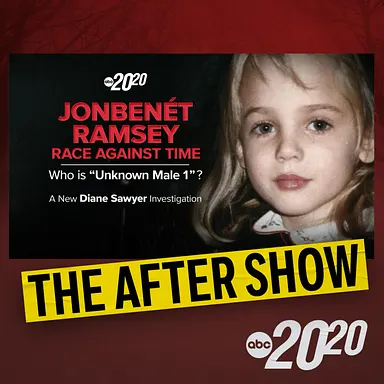
This 20/20 After Show episode revisits the JonBenet Ramsey case after a new special on the unidentified DNA profile known as Unknown Male 1. Host Deborah Roberts and ABC News correspondent Aaron Katersky discuss the investigation's early focus on the Ramsey family, which Katersky says new interviews with investigators call into question, and the ransom note that long fueled suspicion.
Katersky describes an FBI profiler's view that the note was meant to torment Jon Ramsey, and the limits of current DNA technology, including how SNP testing uses up scarce samples. Listeners will also hear how genetic genealogy has been used in other cases and why police have not yet tested the evidence.
In this episode Deborah Roberts, Aaron Katersky
This 20/20 After Show transcript on the JonBenet Ramsey Unknown Male 1 case was made with HappyScribe technology, the same technology behind Google Meet meeting notes.
Ads in this audio differ from the text. Tap the sentence you're hearing to follow along.
Synced: the text now follows the audio.
Hi there, everybody. Welcome to "20/20, The After Show." I'm Deborah Roberts, and I am so happy to have you with us today because we've got quite a program. We are going to dig into a story that has been one of the most haunting and heartbreaking unsolved murders that I have covered as a journalist. I mean, people have talked about this particular case all over the world. Who can forget that day after Christmas in 1996, 6-year-old JonBenet Ramsey was found brutally murdered in the basement of her family's Colorado home?
Well, it's been nearly 30 years now, and nobody has ever been charged with her murder. It has gone unsolved. I spoke with JonBenet's father, Jon Ramsey, on our podcast, and he told us that he could be we could be closer than ever to finding his daughter's killer, that he believes that it can actually happen and that DNA could be, in his words, the nuclear weapon in the battle to find the truth. Well, that DNA evidence was at the center of a "20/20" special that just aired on Friday night. JonBenet Ramsey: Race Against Time.
Who is Unknown Male 1? A new Diane Sawyer investigation. It also features ABC News Chief Investigative Correspondent Aaron Katerski, who is all over this case in ways that he always is with all of his reporting. Well, while many of us may feel we knew the story, Diane and Aaron brought to light what may be critical and new turning point evidence in the decades-old case. There were exclusive interviews with law enforcement, cold case investigators, finally opening up about speculation and accusations around the murder.
Exclusive details from those interviews are what we are going to dig into today, with the help of Aaron, who is here joining us now. Aaron, that was a long buildup.
I know. I hope so.
To give you a lot of credit for doing a lot of hard work around here. I was one of those early reporters out there in the cold, in front of the Ramsey household, covering this unbelievable story of this little 6-year-old. What do you remember from the days over the years about this story?
Well, I think what stuck with me is what stuck with everybody, and the long supposition that the family did it. It was the dad, the mom, the brother.
That's what people some people said over the years.
And a lot of people said it. Even the Boulder Police Department seemed to believe that. They never officially named a suspect, of course. And after 30 years, we've come to find out that that supposition may have colored the whole investigation over three decades, and it may not be true.
Well, let's talk about this, because this is one of the most infamous cases in the world. You say JonBenet Ramsey, and everybody all over the world knows who you're talking about. Investigators were not keen to talk that much over the years. We've heard from Jon Ramsey and his wife, Patsy, his late wife, Patsy, over the years about how they wouldn't give up. But you and Diane began digging. I mean, you guys took, you know, a magnifying glass to this case, really, and looking at today's technology, going back now 30 years to look at it, what was it like for you to actually now talk to some of these investigators who haven't really opened up over the years?
Yeah, and who's going to say no to Diane Sawyer?
Yeah. And Aaron Katerski.
Yeah, right. I think so many of them wanted to speak out because of what they've come to understand about the case, and that is that the belief that somehow the Ramseys did it doesn't comport with what they've seen in the case file. And so we talked to one of the FBI agents who was assigned to the case at the time in 2021 and opened up a cold case review. And she talks about opening up the closet full of evidence and finding a dusty mess and working to digitize it.
If you can believe that the most notorious case file, perhaps in recent American history, hadn't even been digitized for modern law enforcement techniques to take hold. So finally, the FBI comes in and gets that done. We talked to all of the living district attorneys who've touched the case, including the current district attorney.
And you say living because 30 years ago, some people have passed on since this case happened.
Alex Hunter, most notably. And there's still mixed views, but Mary Lacey is clinging to her exoneration of the Ramseys. And others say, well, there's still a suspicion there. And the current district attorney speaks to us about having to have evidence that will hold up in court because the suspect could be alive and could have to be put on trial at some point.
Yeah. And a suspect who they feel like is just out there waiting to be identified, this unknown male. Let's talk about what we know now happened to this 6-year-old girl, because Jon Ramsey gave such horrible details about what happened to his little girl. We knew that she was sexually assaulted, and we knew that she had been strangled or there had been something around her neck. What more did you learn? Because there were in the autopsy, there were details there, and some of us don't know all the details.
No, and the most glaring thing that we uncovered is right there in some of the lab reports from all of the DNA evidence that was tested. And it talks about this unknown male one, someone whose DNA was found on JonBenet's underwear and on her pajamas. And you'll see how we pose the question to one of the officials, in what scenario is there an unknown male's DNA on a girl's underwear and on her pajamas, and that's not the killer?
And by the way, that DNA does not match anyone in the Ramsey family.
Well, that was going to be my next question, because today they would absolutely quickly test the family. So that also gives credence to the exoneration of the family.
It does.
Jon Ramsey talks about this is a small police department. They, in his words, didn't quite know what they were doing. They jumped to conclusions.
And important to say, we do talk to the current Boulder Police Chief, who acknowledges those mistakes. And he said if he could go back to the beginning, Chief Redfern said he would absolutely investigate it differently. I think probably the most glaring is how the crime scene was handled. It was not treated the way you'd think a crime scene would be treated. There were people going in and out. It's part of the reason why so much of the DNA has mixed DNA, because everybody was traipsing through.
And people were allowed to handle the evidence without gloves.
One of the things people have been fascinated by over the years, and this may have solidified in a lot of people's minds over the years, that maybe the family was involved. That ransom note.
Yeah.
The ransom note that was written on Patsy's stationery, and it was aimed at Jon. And it was such a bizarre note. Talk to us a little bit about what you made of the ransom note and how it might have impacted the investigation.
That was, to many, the smoking gun, because it was her stationery. It had her DNA. It was on their stairs, leading to their kitchen. And who else is lurking in the house that could have possibly written it?
On Christmas Day.
Other than someone in the family. And the one thing that and you hear this from one of the district attorneys, until you can account for the note, you can't discount the Ramseys.
Right.
Now, there's a lot of other evidence, as we've said, that.
Excludes.
Points elsewhere.
Right, right.
But the note is confounding. And it has all these absurd movie quotes.
Quotes like, "Don't try to grow a brain, Jon."
From speed.
Yeah. "If we catch you talking to a stray dog, she dies."
From "Dirty Harry." "I don't care if it's a pink knees pissing against the lamp post, she dies." I mean, the quotes are oddly specific. And the question is, Patsy Ramsey seemed like the kind of person to you that watches those movies, action movies, memorizes those lines, and then puts them down on paper in a note that's aimed at tormenting her husband. It doesn't make sense.
So a bizarre note like this, left in the house, may have stalled this investigation in some ways or somehow led police in a direction that compromised the investigation?
We kept hearing in interviews the phrase "confirmation bias," where you get an idea in your head. And one detective who was on the case from the outset said she had a suspicion early on that it was the family. And that just sort of stuck and sat. And absent any other clues, sure, the Ramseys did it. But there's never been a motive.
What's so great about this special is you two get a chance to set the record straight with a lot of things that we thought we knew, and maybe they weren't exactly the truth. When you speak with these investigators and we talked about the ransom note just now, you talked to an investigator who had some new insights into what that might have meant, because at the time, we thought it definitely connected the parents. But the investigator you spoke with had some different insights.
Yeah, this is a woman who was an FBI profiler for more than two decades and specialized in violent crime and people who write ransom notes. And right away, she said that, A, it's not a ransom note because the girl was dead, and they're offering to return a girl who had never left the house. But also, its focus on Jon Ramsey. It's addressed to Mr. Ramsey. JonBenet is not mentioned by name. She said that this was something that was meant to torment Jon, and that also points to the kind of sadism of this crime.
And we only understand that maybe now in a way that we didn't look at the crime 30 years ago. Somebody who was so sick to be able to kill JonBenet in this way, it's hard to imagine any parent in any state doing that to their kid. But also how the note focuses so much on Jon that it just suggests maybe it's somebody who worked with him or who had a grudge against him that he may or may not have even known about.
Known about. You also, in your reporting, kind of hint at the idea that maybe somebody may have wanted to spend some kind of time in the house. They might have gotten some kind of a thrill.
And we know that now, again, in a way we may not have known 30 years ago, that sexual predators, part of the fantasy, part of the thrill, is actually being where their victims are. We think of the Golden State Killer lurking in the house of his victims, spending time with their possessions and their belongings. So the idea 30 years ago that there may have been an intruder may have seemed far-fetched then, but the way we understand sexual crimes now may make it not so far-fetched.
Yeah, yeah. Well, you mentioned something, the Golden State Killer, and I want to talk about that and how that actually what happened in that case might be connected to this case. So don't go anywhere. We're going to have to squeeze in a quick break, because we're just scratching the surface here. And when we come back, Aaron is going to take us inside the heartbreaking moments with JonBenet's family and so much more about this case. So don't go anywhere. Stay with us.
Welcome back to 20/20, the After Show. I am here with Aaron Katerski, taking a second look at Friday night's special that reveals explosive details about one of the most infamous murder mysteries, the case of 6-year-old JonBenet Ramsey. I remember that case so vividly. And of course, at the center of it all is a family that has spent nearly three decades living with unimaginable loss and, for years, intense public suspicion. Well, when I spoke with Jon Ramsey, he told me that he lived under a cloud of grief and suspicion for years, that it was something hard to deal with, but yet he had to go through it to try to find his daughter's killer.
Aaron, let's talk a little bit about that suspicion. What did you make as you started to sift through this and talk to the investigators about that suspicion? Clearly, today, if this case were investigated, it might be a little different because some things might be ruled out quickly. But when you look at 30 years ago versus today, what was your take on all of that?
There really was not an obvious motive. For a while, it was, well, she wet the bed, and that set Patsy Ramsey off. And we heard from Patsy Ramsey in an interview with Barbara Walters that she had been, at that point, a cancer survivor. She later died from cancer, but she had been a cancer survivor. And she said, "Do you think some bedwetting really is the kind of set me off at this stage of my life?" But those little things that people hung their suspicions on over the years in taking another look do seem to fall away.
Now, the family is not officially exonerated. The current chief, Steven Redfern, has taken a different tack and has even if he hasn't exonerated Jon Ramsey, is at least looking at him perhaps a bit differently now.
Yeah, a bit differently. And Jon actually told us, too, that having a different set of eyes, he thought, gives him some hope. Let's talk about Burke, because it was pretty remarkable that you all had a chance to visit with him in this special. And I mean, this poor 9-year-old boy loses his sister in the most gruesome, horrific way. His parents are under scrutiny. He's under scrutiny, whether he knew it or not at age 9. But he just grabbed hearts when he talked about how his parents tried to give him a normal childhood. He felt like they did.
What did you make of Burke?
Yeah, you feel for him. And Burke lives in a rather remote place that he didn't want us to name. He is just trying to be isolated from all of this. And yet he shares the family's passion for trying to solve it. And he says he wants it solved for his dad. And it's been Jon Ramsey's lifelong quest. And Burke told us he would pick up the torch if necessary, if it's not solved within his lifetime.
Well, because his father's 82.
Yep.
And this is something that he's determined to see the end to. But he said he's not sure that he'll live to see this case solved, which was so heartbreaking. What do you think? I mean, especially when we talk about DNA and what's available, and I want to talk more with you about that. But what do you think about the possibility that he may learn the answer and the truth?
He may. And it does seem like investigators believe they are closer than ever. And I think the special brought all of us to this precipice that the authorities are now on. We know that DNA technology has advanced far beyond where it was back in 1996, when it was really just starting to be a thing. And we now know that they've been retesting the evidence, not only using the traditional methods, but by using new methods that would render a DNA profile suitable for investigative genetic genealogy.
And that's what gives not only Jon Ramsey, but I think some of the authorities some hope. But the question is, is the technology good enough now? Is the sample really suitable for testing now, or is it not quite there yet?
And that's what I can't understand. And we're going to have to take another break, because I want to get into that with you, because we have done so many stories here on 20/20 where they've been able to take the tiniest sample and actually find a profile of somebody and distill it down to an ethnicity and so forth. So there's so much being done with DNA technology. And I want to talk with you more about that. But we're going to take a break first. And when we come back, we're going to unravel the extraordinary challenges that investigators are facing in this case when it comes to DNA evidence. And might they just have one shot to get it right?
We're going to talk more about that. So don't go anywhere. We'll be right back.
Welcome back to 20/20, the After Show. I am here with Aaron Katerski, who never ceases to amaze me with his reporting. And we're taking a deeper look at the case of JonBenet Ramsey, an investigation that Aaron and Diane Sawyer reported on in a special that just aired on Friday night. The most critical evidence in this case is DNA attributed to "Unknown Male One," which is what it was called in the investigative notes. There's been reporting about DNA found in multiple places. But what do we know about those findings, Aaron, before we start talking about what is possible to do today?
We know that there is DNA on JonBenet's underwear and on her pajamas, particularly the right-side waistband of her pajamas that match "Unknown Male Number One."
And that does not include the family.
That does not include anyone in the Ramsey family. So who is "Unknown Male Number One"? We know there had been, through traditional DNA testing, a profile developed and uploaded into state and national databases of criminals. It's not a perfect system, but the thought was that if somebody commits a crime, there would be a ping and a match, and they'd have their suspect.
Right.
That hasn't happened in 30 years. Now, there's new technology called SNP technology.
I haven't heard of this one.
This is what renders DNA compatible with forensic investigative genetic genealogy, where you're combining the power of DNA with family trees.
Oh.
So you can trace suspects through their relatives. But what makes it so cutting edge is the kind of DNA testing that it requires. This SNP testing enables investigators to try and use genetic genealogy, but there are a couple of limitations because the sample gets consumed. It's used up. So if you have a very small sample or a sample that you're not sure is going to yield a profile and you test it.
You're done.
And you're done.
Yeah.
And that seems to be the dilemma now facing the Boulder Police Chief.
They don't have a lot of DNA there to spare. I actually have heard of that. I didn't know it was called SNP technology, but we've definitely talked about that in our stories.
Sure.
A lot of your reporting, though, focuses on this. And you spoke with Steve Cramer. This was also fascinating in the program. You spoke with this former FBI agent who worked on the Golden State Killer case.
Yeah.
And this was one many people knew about, too, that the genealogy, the genetic genealogy helped identify this suspect. Cramer wasn't involved in this case, but he was able to talk to you a little bit about how this all works and how it could be a game changer in the case of JonBenet Ramsey's case.
And we've seen it in the Golden State Killer, in the Gilgo Beach serial killing, in the Idaho.
The Idaho murders.
Murders, that it's a technique where investigators are able to track down a suspect through their relatives. So if they're able to get DNA and they can figure out who it might match with, even if it's your fourth cousin, then they keep at it. And it's not a guarantee, but it's a method that has been effective. It takes a lot of digging and a lot of police work, and AI is eventually probably going to make it a lot faster.
The challenge is you need a specific kind of DNA profile, SNP, to do it. And if investigators can get it, the retired FBI agent Steve Cramer we spoke to said he would give the Boulder Police Department a 100% guarantee that the Ramsey case could be solved.
Could be solved. So the question becomes then, why not go for it?
Right.
Why not go for it? Even if you only have that small, why wait for technology to improve? I mean, we all get the impression, and we've done so many stories here with even some of these technology experts who've said, "We are now at this place where we think we can almost solve everything." So why wouldn't they go for it?
Two challenges, potentially. One is the size of the and amount of the DNA. If you do it now, you lose your sample.
Right, right.
And is it a guarantee? Because the technology is not ideal when a sample is a mixture. And some mixtures are better than others, but in certain cases, the mixture is too convoluted and tangled up and scrambled to really get a useful SNP profile. And that's the other concern, is the technology where it needs to be to unscramble what may well be scrambled.
Yeah, but then what do you do then? You wait another year or two or three or four? So whose decision is this ultimately? Because it's not Jon Ramsey's decision.
Oh, if it were Jon Ramsey's decision, I'm sure.
He would say, "Go for it."
It would be done by now. It's really up to the Boulder Police Chief, Steven Redfern. And he talked to Diane about those factors that are weighing for it and weighing against it. And the impression, I think, I'm left with in knowing him a bit is that he wants it solved. And he also wants people to know that the police department wants it solved. And the former chiefs that we talked to say the department at each step brought it about as far as it could go.
And now it's up to Chief Redfern to take.
To take it to the next step.
To take it to the next level.
Well, when Diane asked if the Boulder Police Department had sent the DNA to the lab for analysis, Chief Redfern told us, "We're actively engaging in conversations." That's as deep as I can get into that with you at this time without giving away too much. So he didn't reveal his hand here in any way whatsoever.
And there may be a couple of reasons. If a lab gets word they have the JonBenet sample, will they be as careful as they need to be? So I don't think he wants to reveal what lab or labs he's talking to and whether a sample has or hasn't been sent. And then the other thing is raising expectations, because getting the SNP profile is just the first step.
Then they have to do the genealogical work and find those relatives in the family tree. And then they have to somehow link it back to a suspect. And if they get somebody, there's more police work to do. Was that suspect in Boulder around Christmas in 1996? Is it a male? Is it somebody that they can actually provably put at the crime scene?
Connect to that area. It would seem to me the longer they wait, the harder it is to solve this. What was your overall take? You spoke with investigators. You dug into this case in a way that you and Diane did that nobody really has done. What's your overall take? Do you think they will solve this case? You all said that they're closer than ever, but will it be solved?
It has to be solved because it seems impossible. And I know Jon Ramsey probably feels this way, that in this day and age when authorities are solving cold cases that are more than 30 years old.
Oh, yeah. Oh, yeah. We report on them all the time.
All the time. That it has to be solved. And people want to know.
Right.
When we talked to John Andrew Ramsey, he said, "The only thing that's been missing in the case is courage." I think the police may disagree with him, but he says, "Do it now. Take the shot. Let's get it done, if it's possible."
If it's possible. That's the key phrase, if it's possible. Well, I think a lot of people are hoping that they will take the shot and maybe go for it. And maybe there's something being done that we don't even know about.
That's right.
As we talk. Well, Aaron, I know you'll stay on it. And if there's something that develops, I know you'll let us know. It was such a fascinating, fascinating report. And it must have been really thrilling for you to get a chance to work with Diane on this.
Oh, that's been a dream. And to work on a case of this magnitude, to see where it is and where it isn't, for sure. And we'll come back to you.
Yeah, yeah.
With news.
I'm going to hold you to that.
Please.
Okay. Great. Well, thank you again for coming by. Always, always a pleasure for you to join us. And always great to have you join us, too. Thanks for choosing to spend some time with us. And of course, you can find 20/20 on Friday nights on ABC, and you can stream episodes just like this one anytime on Disney+ and Hulu. Thanks for being with us. Take care.
ABC News' Aaron Katersky takes us behind the scenes of the new JonBenet Ramsey special, revealing fresh investigative details and why answers may finally be within reach.
To get ad-free episodes, early access to new true crime podcasts, and exclusive bonus episodes, subscribe to 20/20 True Crime+ on Apple Podcasts. Click here to start your free trial today. Terms apply.
Learn more about your ad choices. Visit podcastchoices.com/adchoices