
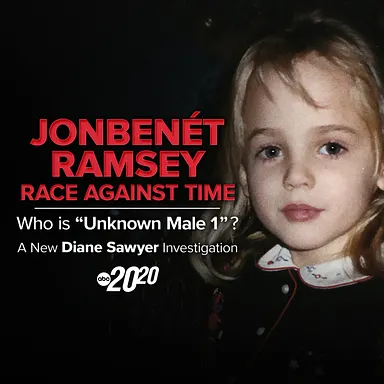
This 20/20 episode revisits the unsolved 1996 murder of six-year-old JonBenet Ramsey in Boulder, Colorado, and asks whether new DNA technology could identify an unknown male whose DNA was found on her underwear and long johns. Diane Sawyer and Aaron Katersky revisit the evidence, including the ransom note, police theories about the family, and the view of the late detective Lou Smith that an intruder was responsible.
Listeners hear from former prosecutors, FBI profilers, a forensic DNA expert and Boulder's police chief about snip testing, genetic genealogy and the investigation's next steps.
In this episode Aaron Katersky, Diane Sawyer, Burke Ramsey, Jon Ramsey, JonAndrew Ramsey, Julia Kelly, Karen Binder, Mary Lacy, Michael Dougherty, Mike Bynum, Nathan Lentz, Stan Garnett, Stephanie Benitez, Steve Bush, Steve Kramer, Steven Redfern
This episode's transcript on the JonBenet Ramsey cold case was made with HappyScribe's AI note taker.
Ads in this audio differ from the text. Tap the sentence you're hearing to follow along.
Synced: the text now follows the audio.
There she is, a little girl frozen in time. JonBenet Ramsey in family photos you've never seen before. A beautiful baby. Her second birthday. At the beach with Mom. On a golf cart joy ride with Dad. Hugging her big brother Birk. Playing dolls and dress-up. Learning to swim.
A little girl in denim overalls and pigtails in the grade school hallway. The everyday tenderness of a child with a sunlit smile. Her friends call her Johnny B. But tonight, above all, let us remember this: 30 years ago, a 6-year-old girl was savagely murdered. Strangled, bludgeoned, sexually assaulted. And that case has never been solved. So, ABC's chief investigative correspondent Aaron Katerski and I are on a mission: to ask about the evidence that could turn this case on its head.
The DNA found at the crime scene, not from the Ramsey family, but look at the lab report. The DNA of "Unknown Male One." What was this unknown male doing at the crime scene? Can we find him? And is the revolutionary new DNA technology that has been solving cold case after cold case the answer to solving this case after all these years? We tracked down all three living Boulder District attorneys who worked on this case to ask what they investigated and was anything missed.
Is there a new message hidden inside the famous ransom note?
My name is JonBenet Ramsey, and I'm 5 and a half.
And also, what is the story behind those unnerving images of JonBenet in the pageants? I'll tell you what I found back in 1997, when I was the first reporter to tour the Ramsey home with a camera. Are there signs an outsider was hiding inside the Ramsey house, waiting to make his way toward JonBenet's bedroom? And who is the man now in charge, the man who will make the decision about deploying new science to identify that DNA? The Boulder Police Chief sits for his first interview about JonBenet.
That is a promise. That is a promise.
If there's ever a case for trial, this is the experienced DA, whose office is also watching over the case.
We definitely are doing that.
And tonight, someone standing by you may not expect to see. We found JonBenet's brother, Birk Ramsey, 9 years old at the time of her death. He is ready to step out of his silence after a decade. And as we begin, a man I've met before over these 30 years walks into the room. JonBenet's aging father, Jon Ramsey, who has lived under a dark cloud of suspicion since his daughter died.
All these years, huh?
Yeah.
He has spent three decades of his life traveling the country, begging investigators to keep pursuing the case. Thirty years of time and memory written on the now weary face of a man who once sat with his wife, Patsy, to talk to Barbara Walters after their daughter was killed.
Do you dream about JonBenet?
Yes, I do.
What do you dream?
I dream there's my dreams are so vivid that I feel like I've spent the whole night with her. And when I wake up in the morning, then I realize that the day is the nightmare. The Boulder Police would like this to go away. They would like to just close the books on it, pretend that none of it ever happened. But we are not going away. We are going to be their worst nightmare.
Patsy and Jon Ramsey are hanging in there until the day we die, we'll be looking for the person that murdered our daughter.
Patsy Ramsey died of ovarian cancer 20 years ago. So I asked Jon Ramsey that question again: Does he still dream of his daughter?
Once in a while, I have this wonderful dream, and it's a little baby. And it's not I can't see that it's JonBenet, but it's his child. And it's a very wonderful dream. Not doesn't happen often, but but I've had that happen. And it's it's you wake up happy, you know, and joyful.
He says he is now filled with new hope that breakthrough DNA science can finally solve this case.
It's like a nuclear weapon for crime solving. And it solved I don't know how many, countless old, old cold cases that were literally ice cold, and they've been solved. This technology didn't exist even 10 years ago.
And until then, your quest goes on?
Yeah. It's not going to change my life. Today I'm as someone told me, you're playing on the 16th hole. Don't forget it.
What are you, you're 82?
82, yeah. And but it'll change my kid's life and my son's life and my grandchildren.
A father's legacy, a son's urgency. The oldest son, JonAndrew Ramsey.
Why do I do this is because I see this gross miscarriage of justice against my family. I'm very comfortable in this, and we'll continue to push this for until I'm 83 years old. I know we're going to find this person. This is a case that can be solved. You know, there's a mountain of evidence out there. We've got the DNA testing that's in our favor. It's not a question of if, but when.
Coming up, what are the secrets inside the DNA evidence of Unknown Male Number One? And next, we take you back to Christmas, 1996, to look for new clues in the events of that horrifying day. 1996, a nightmare is about to descend on this house in Boulder, Colorado. It's Christmas. Every room here filled with trees and exuberant decorations created by Patsy Ramsey, who would open the house for tours and parties.
Hello, I'm Patsy Ramsey. This is JonBenet. She's 4, Birk is 7. And we'd like to welcome you to our home and wish you a very Merry Christmas.
In 1996, a special reason for gratitude. Three years earlier, Patsy had been diagnosed with stage four ovarian cancer. After a terrifying fight with chemotherapy and surgery, she was proclaimed cancer-free. And this Christmas, Jon's children from his first marriage were coming, the whole blended family about to take a trip together. Still wrestling with the grief they had suffered five years earlier, when Jon's oldest daughter, Beth, was killed in a horrible car accident, her car slammed by a truck.
So this Christmas morning, JonBenet and Birk get up early to open presents. 6-year-old JonBenet gets a doll and a new bike she's been dreaming of. And Jon took a picture of his daughter, this one. He didn't know this picture of her would be his last. In the afternoon, the whole Ramsey family, parents and kids, head out for an early dinner with close friends. Jon says he doesn't remember checking the doors before going out. After all, they lived in Boulder, Colorado, famously quiet and safe.
Not one homicide in the city in the whole year. They arrive back home between 9:00 and 10:00 p.m. and head to bed. So a question: Is it possible, while the Ramseys were out, someone had slipped inside their house and was waiting to sneak to her JonBenet's room? Would anyone have heard them? Tonight, I want to show you something about the complicated layout of the Ramsey house, with its six doors and more than 15 windows on the ground floor. I was the first reporter to go inside with a camera in 1997 with the Ramseys' friend, Mike Bynum.
I start in the parents' bedroom here on the third floor of the house.
So this is where the bed was.
It's a large room, a converted attic a floor above the children's rooms. The back stairs from the parents' bedroom leads down to the second floor, where JonBenet's bedroom is further toward the back of the house, with its own balcony and doors to the outside.
I didn't know there was a terrace here.
And then I walked from JonBenet's bedroom down the now horrifyingly famous spiral staircase by the kitchen.
And then straight through the kitchen to this hallway, which is the entry to the basement.
Down these stairs?
Yep.
Off the kitchen, more stairs leading down to a basement with multiple areas, some for kids' toys, some storage rooms.
And straight ahead from this landing in the basement is actually the room where JonBenet's body was found.
So it's straight down this hall?
Yes.
At the end, a room that once had a door with a latch on it. But that door has been removed because of what happened here. It takes us back to that moment, the day after Christmas, when the silence in the house was broken.
911, emergency. Police.
Patsy Ramsey has come down the spiral staircase at 5:52 a.m.
What's going on there, ma'am? We have a kidnapping. Sorry, please. Explain to me what's going on, okay? Sir, we have a there's a note left in our daughter's car. How old is your daughter? She's 6 years old. She's blonde. 6 years old. How long ago was this? I don't know. There's a ransom note here. Okay. What's your name? Are you not. Patsy Ramsey. I'm the mother. Oh, my God. Please. I'm. Okay. I'm sending an officer over, okay? Please.
That note said their daughter had been taken and would be killed if the $118,000 ransom was not paid.
I just remember when I read, "We have your daughter." It just this overwhelming fear. And then I just screamed for Jon. Screamed.
The Boulder Police arrive in three minutes. The Ramseys also asked friends to come over and help.
I was praying. And I kept looking out the window, clutching this cross and just imagining that she was going to come running down the street.
But the police were not an inexperienced homicide unit. They didn't protect the crime scene or the evidence, like DNA. Officer Robert Whitson was at the scene.
And that was a mistake on my part. I should have told those people to relocate to the police department and got them out of the house.
And even more horrifyingly, when police search the house, inexplicably, they don't open the door with the latch, completely missing the murdered child on the other side. It's hours later when JonRamsey and a friend follow a police suggestion to look through the house again. JonRamsey looks around the basement and opens the latched door.
I knew instantly, instantly what I'd found. I'd found my daughter. She was lying on a white blanket. The blanket was wrapped around her. Her hands were tied above her head. She had tape over her mouth. I immediately knelt down over her, felt her cheek, took the tape off immediately off her mouth. I tried to untie the the cord that was around her arms. I couldn't get the knot untied. I picked her up. I took her upstairs and laid her on the floor and still had a hope that she was alive.
All you can do is scream. That's what I did.
Patsy said she heard his wail, comes in and sees her daughter.
I remember walking in and seeing her lying there in front of the Christmas tree. I knelt down over her and just laid my body on her body and my cheek against her cheek. And it was cold. And Father Rawl was there. And he started saying the last rites, I believe.
And I just kept saying, "No, no, you know, ask God to ask God to raise her."
But in a curious moment, the police detective on the scene, Linda Arendt, will later tell Elizabeth Vargas that she was immediately suspicious of JonRamsey.
We had a nonverbal exchange that I will never forget. And as we looked at each other, I remember and I wore a shoulder holster, tucking my gun right next to me and consciously counting, "I've got 18 bullets." Why did you do that? Because I didn't know if we'd all be alive when people showed up.
Within days after the murder, it was leaked to the media. Police had their suspects, Jon and Patsy Ramsey. And the leaks kept coming.
Somebody from within the police department was leaking information to the news media.
Coming up, the case against the Ramseys. And the question: Did police fully investigate an intruder? And still ahead will tell you the moment DNA points to the presence of an unknown male. Days after JonBenet's murder, the press descend.
We learned, I think, how animals feel in a zoo. Our home was surrounded most of the time by cameramen. Photographers stalked us. We were chased.
The Ramseys in the spotlight. So what was police evidence? They pointed out that JonRamsey found the body, and the ransom note was written on Patsy's notepad. Also raising suspicion, the Ramseys quickly got a lawyer. In 1997, I started asking why. I'm back with their old friend, attorney Mike Bynum.
So you're the reason they got a lawyer?
I'm the one. I was a prosecutor. I know how this works. I know where the police attention is going to go, right from the get-go. And Jon just looked at me and said, "Do whatever you think needs to be done." And so I did.
Then three days after the murder, the Ramseys go to Atlanta to bury their daughter in the family cemetery there. Police say the parents are avoiding a formal interrogation. So suddenly the Ramseys decide to appear on CNN. But they seem strange and groggy. It backfires.
We have to find out who did this. When we look back at it, we were so distraught and medicated.
The Ramseys reeling. So do police now have a motive? What are they saying? We're not going to go through all the 30 years of online theories and speculation. But one motive introduced by police was that the murder was staged, a cover-up for a ghastly family accident. Did 9-year-old Birk injure his sister in anger because she ate his pineapple snack? Did Patsy snap because JonBenet wet her bed, hitting her with a flashlight? The family repeatedly denied their involvement.
I'm a cancer survivor of stage four cancer. When you are standing on the brink of death with a terminal illness, your priorities suddenly line up in a row. And you know exactly what the important things are in life. And bedwetting is totally insignificant. I love my children. I wouldn't harm them for anything in the world.
Which takes us to perhaps the most terrible insinuation: that JonBenet was the victim of family sexual abuse.
Here we go.
Hal Haddon, JonRamsey's attorney for nearly 30 years.
What everybody was hearing was that parents who put their daughter in beauty contests must be guilty of child abuse, and therefore they must have murdered her. And that was the prevailing hysterical view, not only in the media but in the Boulder Police Department.
We'll take a closer look at those pageant images later. But back then, tabloids were publishing the child's medical information, 30 trips to the pediatrician. Was that evidence she was being abused? In 1997, with consent from the family, I got her pediatrician, Dr. Francesco Buff, on the phone to review his records of the past three years.
Before your call, I sat down with her chart and counted. It was 27 times. The majority of them were for sinus infections and for colds.
And by majority, you mean.
Probably 20 of the lot.
The doctor told me his big concern was that JonBenet might have asthma. So how many UTIs over those three years?
I counted three, in which he complained of some pain in urination.
Would that be unusual?
For a child that age, certainly not.
Did you see in any of these examinations any sign of possible sexual abuse?
No. And I certainly would have reported it to the social service people if I had.
I would have given my life for JonBenet in an instant. And I'm sorry that I couldn't have done it that night. To be accused of harming my child in any way is it's beyond comprehension.
But when police sit down for their formal interrogations of the Ramseys, they ask Patsy about the possibility that Jon had abused their daughter.
If you're asking me if I knew some information that JonRamsey was responsible for killing my daughter, honey, we wouldn't be sitting here right now. Okay. Why? Because I would have knocked his block off a long time ago. Okay? He didn't do it. I didn't do it. Birk didn't do it. We love that child. Okay? We're not involved. My life has been hell from that day forward. And I can't stand the thought of thinking that somebody's out here walking on the street.
God knows they might do it again to some other child. You know, quit screwing around asking me about things that are ridiculous unless I find the person that did this.
Police say they did interview other people in the community, even as they kept scouring for evidence against the Ramseys.
Their lives were put under the microscope for the world to examine. And yet nothing, no dysfunction in the family surfaced. In fact, everything came back just the opposite. I think the issue was that you realize that if that's the direction the police are going, that they're not actually pursuing the killer.
Later, that 2-and-a-half-page ransom note, was that a smoking gun? And next, proof of an unknown male at the crime scene. Can modern DNA science finally solve this cold case too?
So is this our moment?
It is still 1997 as police continue to pursue the Ramseys. The district attorney also has an investigation and asks a legendary detective to come out of retirement. Lou Smith, who had a headline-making career, credited with solving 200 homicides. The first thing Smith does is look at the story told by the body. The autopsy. We warn you, this is hard to hear. Six-year-old JonBenet Ramsey was strangled by a cord around her neck that could be tightened by a wood handle, a kind of torture device called a garrot.
That handle fashioned out of one of Patsy Ramsey's wooden paintbrushes. JonBenet's hair is caught in the cord knotted around the handle. The scratches on her neck could have been her attempt to loosen the cord.
Okay.
At his home office with his computer, Lou Smith decides to prepare a briefing on what the evidence was telling him.
I think she tried to get that ligature off. She was strangled brutally by that ligature. Somebody had to be very strong, and somebody wanted to kill JonBenet.
Next, Smith believes a second part of that paintbrush was used to sexually assault JonBenet. The coroner found injuries and foreign material inside her that could be consistent with wood chips from the paintbrush.
Material similar to the wooden shards that the paintbrush had found.
And then the autopsy reveals another brutal injury, a bludgeon to the right side of her head. An 8.5-inch long wound under the skin stretching from the back of her head to the forehead. A blow so staggering, someone said it was the equivalent of being dropped from a two-story building right onto your head.
Her head had been completely crushed. The bone is literally knocked into the brain. That shows a tremendous blow to the head.
Smith thought it was significant that the other items used in the crime were not traceable to the Ramseys' home. No sign of any cord, no sign of any duct tape.
No prior application of the duct tape was found. And the roll that came from Mr. Compton's house, where is it?
There was also a long rope left in the guest room. The Ramseys had never seen it before. Smith thought it was the type used for climbing.
This rope was found in the guest bedroom. It's not the Ramseys. Nobody in the Ramsey family can identify that rope. And it's a special kind of a rope. It's just not an every ordinary day rope. Leads me to believe that the killer just inadvertently left it behind.
And when he spotted two distinct marks on her cheek and on her back, he theorized a killer had used a stun gun to subdue her. An investigative memo at the time said four pathologists agreed with him, one did not.
The Ramseys did not do this. And if it's not the Ramseys, then it's an intruder. It's as simple as that.
But police questioned how an intruder could have entered the Ramsey house because JonRamsey thought all the doors were locked. But remember, there are six doors on the main floor of the house and a multitude of windows, many unlocked and at least one of them broken. Police photos show this window in the basement, a suitcase underneath almost like a step stool, a scuff mark on the wall. And we know there is a lot of debate and intrigue about items found near the body, including a leaf, a boot print. But what about entrance through that broken window?
Police implied it would be like an obstacle course for an intruder. Lou Smith made a tape showing it wasn't hard for him.
It really wasn't that difficult.
But another question: why would an intruder take the risk of entering a home, spending time there making a garrot, writing a ransom note? This is Julia Kelly, 22 years experience, the FBI's lead profiler in the case of the Golden State Killer.
Marker?
She studies the JonBenet crime and sees it as a practiced sadist executing his fantasy of control.
If an offender just wanted to, say, kill a victim and kill them by strangling them, we can just use your hands. Or you could use a ligature and you tie it tight and you don't let it go. But the point of fashioning a device that has a handle on it where someone can tighten it and loosen it and tighten it and loosen it, that gives the offender a tremendous amount of control over the life and death of that little girl. So why do that?
To me, that tells me that that is potentially part of an offender's fantasy.
FBI Special Agent Stephanie Benitez is a 22-year veteran of the force. She worked on the JonBenet Ramsey case.
Somebody knew this house. This probably wasn't the first time they were there.
And she says, remember, for some of these killers, the risk is part of the thrill.
These type of intruders don't come in and out. They find pleasure in being in the house. They could be in the house for hours before, hours after.
That Golden State Killer cased houses ahead of time, looked for unlocked windows and doors, and spent hours inside lurking in closets, going through drawers.
It's not the risk that a normal person takes or even a normal burglar would take. A sexual burglar wants people to be home. They want to occupy their space. They want to control that they're in there. They enjoy being in there. It's sexually gratifying to them.
And finally, take a look at another explosive piece of evidence that could undercut the whole case against the Ramseys. Right after the murder, DNA is found on JonBenet's clothing. The 1997 report shows the DNA lab found a blood stain on what they call her panties, her underwear. And in that stain, DNA from JonBenet, but also at least one other person. Who? Later, a more sophisticated test of the underwear reveals another major new development.
The DNA mixed in with JonBenet's is the DNA of an unknown male. And it is not anyone in the Ramsey family. They also found DNA under her fingernails, also male. But it was such a small sample, they couldn't develop a useful profile. And so we wondered, why didn't the existence of unknown male DNA on her clothing make more headlines? Did police doubt it, dismiss it? Was everyone focused on the Ramseys instead of looking for the unknown male?
Mary Lacey, who had been the head of the Sex Crimes Department in Boulder, has become the district attorney and her office takes over the JonBenet case. She was troubled by the lack of evidence against the Ramseys and stunned by the sadistic crime.
I had never seen a case like this that involved the violence. No, never seen. I'll ask you to do something very difficult. Put a child in front of you and hit her so hard on the head that it leaves a hole in her skull. And then take a paintbrush and jam it up her vagina. And then take a garrot and pull it as hard as you can, hard enough to cause a deep ditch in her neck.
And tell me that parents who have been described by every single person as loving, good parents with no psychopathy at all committed that crime.
Later, will new DNA science and the new Boulder police chief find the unknown male? And when we come back, my colleague Aaron Katerski picks up the story with that ransom note found in the Ramsey's kitchen, a surprising new way to see it. And a note: Detective Lou Smith died in 2010. He went to his grave convinced that an intruder had murdered JonBenet. On his deathbed, he asked his children to continue his investigation, and they have honored his wish.
For 30 years, some have believed this is the smoking gun against the Ramseys, the ransom note left on their stairs near their kitchen, written on Patsy Ramsey's notepad with her DNA found on the pages. The evidence suggests the author came from within. So even though there was no obvious motive, suspicion focused on the family. This is unlike any other note from any other crime.
Compare it to the 11-line misspelled ransom letter in the Lindbergh kidnapping and the one-page Weinberger baby kidnapping note with its distinctive sloping cursive left inside the child's crib. The Ramsey note is different. It is long, really, really long, nearly three pages, and filled with baffling details offering to return a child who had never left the house. Julia Kelly built her career investigating people capable of carrying out unspeakable violence and of writing notes like these.
They're prioritizing writing this note over potentially getting caught.
And at the outset, she wants you to know you've been fooled into believing this is a ransom note. This is a knife to JonRamsey's heart.
I think it's a note designed to torment Jon.
The note is addressed to Mr. Ramsey and is filled with insults and taunts. The two gentlemen watching over your daughter do not particularly like you. You are not the only fat cat around. Don't underestimate us, Jon. JonBenet is never mentioned by name.
The note itself is so focused on Mr. Ramsey, you almost forget that JonBenet is involved in this crime.
Throughout this haunting letter is a staggering number of villainous lines, stunningly direct quotes from movies, thrillers about kidnappings and killings.
And that starts right from the outset. Listen carefully.
Now listen to me carefully.
Listen to me carefully. Listen very carefully.
You listen real, real good.
So you have dirty hairy ransoms in the nick of time and ruthless people.
Boulder police simply would not deal with the movie speculation, would not discuss it, say, "Nope, that's not right, and I won't go there."
And there's this line, "Don't try to grow a brain, Jon." Sound familiar?
Nothing tricky now. You know that I'm on top of you. Do not attempt to grow a brain.
Don't try to grow a brain, Jon, is a reference to speed. The bad guy says it to the hero in the movie.
And this part?
If we catch you talking to a stray dog, she dies. If you alert bank authorities, she dies.
Can you place it? <spk:31> If I even think you're being followed, the girl dies. If you talk to anyone, I don't care if it's a pekinese pissing against a lamppost, the girl dies. Dirty hairy.
Again, not verbatim.
But stray dog, girl dies. It's pretty clear.
They've watched these movies. These movies resonated with them, resonated so much that when they sat down to write the letter, they reference it, the different movies several times.
Ransom hit theaters a month before JonBenet was killed. TV listings show Nick of Time was playing on Christmas in 1996 and Dirty Hairy was on TV that year. Something else stands out. Did you notice the money? $118,000? That's nothing. 20 years earlier, Patty Hearst's kidnappers demanded a ransom worth $400 million. And the gangsters who took the grandson of Jay Pal Getty demanded $17 million.
But $118,000 meant something. It's nearly the same amount as JonRamsey's bonus. Somebody knew him or wanted him to think so.
You're really going to be extorting people or wanting ransom. You're going to make it a lot more. And he certainly could have afforded a lot more. So to me, this is a message to him that I know something specific about you.
The community knew JonRamsey was successful. The local paper ran an article on his billion-dollar business four days before the murder. But how many people knew the amount of his bonus? Patsy said she didn't until she read the letter.
So this wasn't about the money. This was about something else.
It was the amount of his bonus.
Yes, yes. Very interesting.
How many people know that?
Probably not too many.
Does that point to an employee? Does that point to a business partner?
You're looking at someone that had a grievance with Jon.
Investigators wondered who could have written it and turned to handwriting analysis. We asked two former Boulder County district attorneys about the results. <spk:32> Well, I think there were six or seven handwriting analysis done. Only one of them showed indications of Patsy. And it was just indications. It was not, "She wrote this." The Secret Service considered the gold standard in handwriting analysis said Patsy Ramsey was not the author.
So did the Colorado Bureau of Investigation and three private analysts. One analyst said her handwriting looked different from the note, but he was unable to eliminate her.
Some experts have pointed out Patsy Ramsey's handwriting looks like some of the writing on the note. Is it possible it's her? Well, some people have said that. Other people issued an opinion that it was not Patsy. So no, I don't know.
So were the police really convinced Patsy Ramsey watched those movies and wrote that note? <spk:33> We're going to need movie rental records just to see if you rented Speed and Dirty Hairy or any of those movies. During an interrogation, police asked JonRamsey about what kind of movies he watched. <spk:32> I mean, there have to be ways to follow up on that. Who in the public knows someone who is I mean, it's obsessive. He knows the quotes. So someone obsessed with those movies.
Could that same person have left another signature at the crime scene?
If you prosecuted a lot of cases, in what scenario would there be an unknown man's DNA in a child's underwear and on her pajama pants and that's not the killer? I'm not aware of a scenario where that would make sense.
It is 2008 and a new chapter in this case is about to begin. For years, attempts to identify the unknown male DNA in JonBenet Ramsey's underwear have failed. They've searched the FBI's criminal DNA database, no match. But then District Attorney Mary Lacy learns about a new kind of DNA test called Touch DNA, which can recover tiny DNA samples from clothing even without a visible stain, extracting human cells left in the fibers.
D.A. Lacy sends the Touch DNA lab the underwear that's already produced unknown male DNA, but also the long John pajama bottoms JonBenet was wearing when they found her body. The theory: someone removed her long johns to assault her and then put them back on. Word comes back from the lab. They found a new DNA hit on the long johns, and the Ramseys are excluded. It is not their DNA. It's an unidentified male leaving his DNA on the right side of the waistband.
Then late in the evening, a lab technician makes a stunning discovery. That new unknown male DNA on the long johns seems similar to the unknown male DNA on the underwear. In the scientific language of the lab report, the unknown male number one in the underwear cannot be excluded from this new DNA. When the lab runs a statistical analysis of that similarity, the results are striking. The respected scientist, who was the director of forensic casework at the lab, goes on CNN to say this.
<spk:42> It's the same DNA. It's the same male that's in the underpants that's on the side of the long johns. Whoever committed this offense must have pulled down her long johns, but then they pulled them back up because she was found dressed. And you were able to compare it to the Touch DNA on her little long johns. And it came back. <spk:32> To match. An intruder, a third party, male. It was on the outside where you would pull down the long johns.
And most importantly, it was in a drop of blood in the crotch of the underwear. I did sex crimes for 10 years, almost all of the sex crimes in Boulder County. And finding DNA and blood in the crotch of the underwear of the victim, that's your perpetrator. And do you believe unknown male one is the killer? <spk:32> I believe the source of that DNA is the killer.
And so it wasn't a question of murky could be, might be. <spk:32> No. It was a match. Two separate pieces of clothing. I think what I said to myself is that there's only one right thing to do at this point in time, and I did it. Not without talking to people in my office. So there was agreement. It was fair. It was just. And it was necessary.
District Attorney Lacy writes a letter to JonRamsey exonerating the family. Patsy has died two years earlier. Her letter says, "We do not consider your immediate family, including you, your wife Patsy, and your son Burke, to be under any suspicion in the commission of this crime." She adds, "This evidence has vindicated your family, based firmly on all of the evidence, including the reliable forensic DNA evidence." Her letter was an act so controversial, the current district attorney, Michael Dougherty, says he would not have done it.
So you would not say that no family member is a suspect in this case?
I've never said that in any case I've handled in 30 years as a prosecutor.
You know that there are other former DAs and others who say, "You can't say that." It's just not the job to go out and proclaim somebody innocent. <spk:32> No, but my job was to seek justice in every case in my office. And we took that very seriously. And justice had been violated for a long time. And her successor in the DA's office, Stan Garnett, also criticizes her even today.
As I've said many times, district attorneys are not priests. Our job is to not forgive people. Our job is to evaluate evidence and to determine whether charges can be brought in court. Unfortunately, human beings do all kinds of horrible things to each other. Often human beings who you don't think are bad people will do horrible things.
One former DA says, "I just see people whom you don't think could do terrible things do terrible things all the time." <spk:32> Absolutely. You do. And when you see that, there's always some psychopathy, clear evidence, and a motive. Do parents kill their children? Absolutely. Would I go after a parent who killed a child? Absolutely. But in this case, none of that was present.
Well, I certainly have no belief that there's evidence to prove the Ramseys or anyone associated with the family is guilty. On the other hand, the crime scene is in their house. The ransom note was written on materials in their house. The body was found in their house. There is evidence that is significant. Of course, nobody, including me, has concluded that they're guilty.
And in an irony, the man who led Boulder police for nearly two decades as they pursued the Ramseys quietly seems to have shifted his position in 2015. Here's what he said in a newspaper. "The unknown DNA from JonBenet's clothing is very important. I'm not involved anymore, but that has got to be the focus of the investigation. In my opinion, at this point, that is your suspect." And now do we all wonder if it was the endless public fixation on those pageant photos that kept placing the Ramsey parents back in the eye of the storm?
The pageants. How do you explain that to people, the people who wanted to believe that Patsy Ramsey was a stage mother forcing her daughter to do this and that it was some sort of unnerving, if not eerie, activity for a kid? <spk:32> Patsy was a beauty queen. Her sister was in beauty pageants. This was normal for her. And Jon, he didn't like the pageants, but he was okay with the talent part of it because he was proud of that. The Boulder Police Department went all over the country looking for something bad about Patsy and JonRamsey.
You know what? They didn't find any. So looking back, even though this may have been considered unusual, unconventional by other DAs, you'd do it again in a second. <spk:32> It was the right thing to do then. It would be the right thing to do now. Coming up next, we look into those children's pageants and we wonder, was a stranger watching JonBenet?
Will new science be able to find the identity of the unknown male DNA? And later in this hour, JonBenet's brother, Burke Ramsey, just nine years old at the time of her death, speaking out.
Number 75. Name and how old you are. <spk:43> My name is JonBenet Ramsey, and I'm five and a half. Five and a half. Okay. Pick one. Two left. Okay. Size. Whoops. What is your favorite animal at the zoo? <spk:44> The monkeys because they laugh and stop and hang around. They laugh and hang around. That sums it up pretty good. Okay. And that was number 75. Thank you.
30 years ago, these images of a little girl in grown-up clothes and makeup were startling, unnerving, strange. <spk:45> I want to be a cowboy sweetheart. I want to learn to rope and to ride. Children's pageants weren't on our radar at a time with so many grown-up ones. In fact, full disclosure, I was in a teenage pageant competing for a crown and college scholarships. <spk:46> I'm Diane Sawyer. I attend Seneca High School, Louisville, Kentucky.
And Patsy Ramsey said she and her sister had so much fun competing in pageants too. <spk:47> It was the most wonderful time of my life. There she is as Miss West Virginia. And you can almost see her confidence grow from the first round of competition to her state victory. And then moving on to the Miss America pageant in 1977. <spk:48> Patricia Anne Poe, Miss West Virginia. <spk:49> I'm a junior at West Virginia University.
In her book, Patsy Ramsey said her little daughter, JonBenet, would break into song and dance in their living room. She also loved to play dress-up and knew those pageants had made her mother happy. Patsy also writes that after she got cancer, she feared she might not be there when her little daughter's grown-up dreams came true. <spk:49> It's hard to describe JonBenet. She was somewhat indescribable. She, in her own words, described herself as an up girl. She and Burke would always race to the elevator to see which one could push the buttons first.
And she declared that she would be the up girl. She was a ball of fire. She was always very caring and spiritual. She could stand on her head. She could hula hoop. She could roll her blade. And she just recently learned how to climb a rock wall. JonBenet was four on their summer vacation in small-town Michigan. She asked if she could enter the Little Miss Charlevoix contest. She won. From there, less than 10 pageants in total.
Sometimes the costumes were kind of over the top, at least one a little version of what her mother had once worn in 1977. <spk:45> I want to come on my head. But the family says most of the venues for JonBenet's pageants were modest private event rooms, and the audience was not what you think. <spk:49> Grandmothers, grandfathers, sisters, brothers.
Burke was in the audience. I mean, Grandpa, Burke. It was a. <spk:49> It was a Sunday family afternoon. 10 to 15 people, 20 people maybe. And they were all family. <spk:49> They all went home with a prize. It was all about making the child feel good about herself.
And remember, this was all before iPhones and the internet. No one was posting pictures. <spk:49> It's not unlike a father who enjoyed playing baseball as a child. He wants to impart that same love of the game with his son or daughter. There's just absolutely nothing wrong with it.
I remember the trophies in a room and all that kind of stuff, but I didn't think any much of it, right? I don't think it was a big deal. Just like Burke played Little League or whatever activity the kids do.
We would probably never have seen these pictures if the little girl in them had not been murdered. After her death, a pageant photographer made money by selling the photos to an agency who sold them to tabloids. <spk:49> The tabloids had a field day.
Oh, they made a fortune on a tragedy of losing a child.
As years passed, the Ramseys acknowledged they'd been haunted by doubt. <spk:49> Well, I think that is probably one thing that if I had to do ever again, would be much more cautious about. And part of protecting all the members of your family is low profile. Don't put bumper stickers on your car that announce the school that your children attend. Don't let photographers have complete carte blanche.
<spk:49> As you did. <spk:49> As we, yes.
There's no question we were naive. We were naive. And what we're telling people is, don't make the same mistake we made.
John Andrew Ramsey has his own theory about public criticism of his family, wondering if it's born out of every parent's fear.
The pageants, as I see them, is a way for people to separate themselves from our family, right? Because you can point to the pageants and say, "I don't do that. That's why this family found themselves in this position they're in now with these awful pageants." But no, this was not some big part of family life. <spk:44> JonBenet. She is the child.
As we know, there are still thousands of children's pageants all across this country. <spk:44> She has blond hair, green eyes. But it's always hard not to wonder if 30 years ago, an unknown male may already have had this little girl in his sights. Coming up next, back on the trail of a killer after all these years, will a science miracle finally solve this case?
Idaho, 2022. An unidentified killer of four young college students is on the loose. And then authorities say brand-new cutting-edge science helped catch that killer in 47 days. That man was Brian Kohberger. Gilgo Beach, New York. Eight women found murdered. But breakthrough technology finds DNA inside single strands of hair, one of them the murderer's. You know his face. And in California, the terrifying Golden State serial killer finally convicted of 13 murders.
It was the DNA superpower science that tracked him down through his distant cousin. A 40-year cold case solved in just months. And here is one of the men who solved that case, former FBI attorney Steve Kramer.
People would ask me if I was ever going to solve the Golden State killer case. And I told them, I'm like, "I'm 100% confident that we will solve it in five years." And they're like, "100%?" I'm like, "100%." And six months later, we solved the case.
Kramer and former FBI special agent Steve Bush say we cannot overestimate the magnitude of this new investigative technique.
Law enforcement's been given a superpower with this technology.
Kind of like a radar that's going to just continue to push you and push you and push you until you find the right person. And so there's really no limit to where that can stop. It allows us to identify almost anybody.
So how can we show you the enormous difference between the old DNA testing and the new? Well, think of yourself as sitting in a living room with an unfathomably big and mysterious jigsaw puzzle, and you only have a handful of pieces to solve it. But now look at what's possible today, the new technology that can hand you hundreds of thousands of pieces to solve the puzzle. And they're already arranged, sequenced in the right order. Which brings us back to the 30-year-old DNA of the unknown male at the center of the JonBenet Ramsey case.
This is the Mount Everest of cold cases.
Anytime we tell somebody what we do and they're aware of what we do, they say, "Well, what about the JonBenet Ramsey case?"
There is foreign DNA. I think we can all agree on that on the clothing of JonBenet. The question is, who is that male?
Kramer and Bush say from their experience with cold cases, you can often get a lot of new DNA samples from old items of evidence.
Here that we have the photos, right?
This is evidence you'll recognize.
Definitely anything that was used to kill her, alleged to kill her, I think that would be the most advantageous.
The cord around JonBenet's neck and the garrot used as a torture device, which we know the police inexplicably let people handle without wearing gloves.
Some ligatures were handled by people without gloves, which doesn't contaminate. I would still look at those ligatures. If they're untied, swab them.
The paintbrush.
The paintbrush.
It's a piece of the paintbrush. It's worth a new swab?
Yeah, absolutely.
We even wonder if there's a new way to test that complicated male DNA from under JonBenet's fingernails. Or maybe even another sample we don't know about at all. Kramer and Bush say the biggest hope is always finding DNA suitable for what they consider the holy grail of DNA testing. It's called snip testing. It's that revolutionary technique that can give you massive amounts of information for your living room puzzle by sequencing the pieces and setting you up to find a needle in a genealogical haystack.
This is just the past, right?
This is all the historical record.
So Aaron Katersky and I wanted to learn more about snip testing and DNA sequencing, what it can do, what it can't.
All right, I'll just show you how this works. So.
Dr. Nathan Lentz is a professor of biology at John Jay College of Criminal Justice, a leading expert on the human genome and a consultant on cold cases.
These are the photos from the original crime scene. This is JonBenet's bedroom. From these photos here, there's a lot to potentially test.
Dr. Lentz is not working on the Ramsey case, but he says in an ideal world, you would first find samples from the richest sources of DNA, which tend to be body fluids.
Semen is the most DNA-rich fluid of all because little sperm cells are packed with DNA. That's all they're there, little packets of DNA. So those would be the richest source of DNA. I see blood stains, and these would all be opportunities to extract DNA.
We know the principal DNA sample from JonBenet's underwear contains her blood and some other fluid from the unknown male. Not semen. One possibility mentioned was saliva. But does it matter that the DNA samples in the Ramsey case are 30 years old? Lentz says that's the advantage of snip testing and sequencing. Even if your sample is very old and has lost some of its detail, it's not too late.
But we kept hearing that as every day goes by, the sample is degrading on its own. It's just a natural function of the sample. So lying awake at night and thinking how many days have passed, what would you have left in terms of the integrity of the DNA taken then?
Well, that's what's powerful about DNA sequencing is the way the DNA ages is it fragments. So it gets smaller and smaller and smaller. But now we're using DNA sequencing. We can rebuild a whole chromosome, digitally speaking, and all the markers could be there.
You're telling us that it's fully possible that the DNA taken then doesn't have to be a new sample extracted, is still intact enough to read it.
Yes. Yes. We have sequenced a full genome of Neanderthals. So that's 35,000 years or more. So something like 30 years, we can do that.
And another advantage of snip testing, it can retrieve DNA from nearly impossibly tiny samples. Think of it this way. The smallest thing you can see with your naked eye is a grain of salt. But now imagine something half a million times smaller than that grain. It's 100 picograms. For snip testing, no problem.
These are tiny, tiny amounts. You're talking about the amount of DNA that might come from 10 to 25 cells. So way smaller than you can see with the naked eye. How much of the unknown male do you need? The beautiful part about DNA sequencing is we can sequence everything in the tube. We can sequence literally every DNA molecule that's in that tube.
But snip testing does have some limitations, and we'll talk about them soon in an interview with the man who is going to decide what to do next, Boulder's chief of police. And we are asking the question, even if there's a risk, is this the chance we've been waiting for?
The DNA is eventually going to catch up with you.
Exactly. DNA is always there. It's the silent witness.
You got to weigh two things. I think, one, are you worried about a killer, someone that's breaking into homes and murdering young children? The second would be, we just want to figure out who did this for the sake of knowing. I think where we are today with technology and what we know, I would try to do it now for both those reasons.
Rolling the dice for a little girl who never got to grow up.
I keep thinking there's somebody out there who knows something. Gradually, the circle is closing and tightening. And maybe this is the time to talk.
Coming up, if the new technology works, how will a genealogical database map the trail to a killer?
In 30 years, the Boulder police have never officially named a suspect in the murder of JonBenet Ramsey. They won't tell us who or how many people they've interviewed in the Ramsey neighborhood, at JonRamsey's workplace, or the hundreds of caterers, party guests, and workers who knew the layout of the Ramsey home.
Quite frankly, if you were in Boulder, Colorado, and were male on Christmas Day 1996, you were a suspect in my mind.
There were a number of other people who there were suspicions about, some who lived in the area. A couple of men had been sex offenders around the area. And some people, when they would get drunk, used to say, "I was involved in JonBenet's murder." And so they all got investigated.
And have you heard about another chillingly similar crime that happened nine months after JonBenet's murder and just two miles from the Ramsey home? The clear intent, the sexual assault of another child. Mary Lacy, then the head of the sex crimes unit, talked to the distraught father who was away from his home that night.
So he said he was gone, his wife was home, his daughter was in bed, house was locked. The wife wakes up to the child screaming in her bed. The mother runs into the bedroom. There's a stranger, an intruder there, and she scares him off. He runs away.
One more thing. That child had attended the same dance school as JonBenet Ramsey. Lacy says the father questioned whether police were aggressively pursuing it. Was there DNA from her attacker, a description of the suspect?
He said they came and took the report, and they never came back.
Boulder police dispute any claim they didn't investigate and say this is still an open case, just like the case of JonBenet Ramsey, which has received periodic reevaluations over the past 30 years. Stephanie Benitez was the FBI agent assigned to a 2021 review. She has never spoken about it until now. Do you know who did it?
I don't.
Do you have a guess?
Well, I'll tell you this. It wasn't the Ramseys. In my opinion, it was not the Ramseys. So let's get off of that for the last time. Get off of Burke, get off of Patsy, get off of John. It's someone else.
But who? Do you know who did it?
No, I do not. I think there was always a camp that believed that the family was involved. There was always a camp that there was an outside intruder.
Maris Harold was the Boulder police chief who ordered that cold case review.
When you inherited the case, did you find that everything had been done? Were there leads that went unfollowed?
Well, there was definitely investigative techniques that were not explored. And I think that it's been extremely hard for those men and women that worked this case that there is no resolution to this.
They took it as far as they could.
I do believe that.
Now Boulder police are weighing whether to use the latest DNA technology to take the case even farther. We know how hard it is for humans to find a needle in a haystack. What if the new DNA science can search the haystack and find it for us? The DNA of unknown male one was found in JonBenet's underwear and on the right side of her pajamas. Suppose that DNA could be reanalyzed to get a snip profile, which could be uploaded to a genealogy website. So many of us have used those sites, swabbing our cheeks to find relatives we didn't know we had or to trace our country of origin.
Investigators are now doing the same thing to search for criminals, looking for genetic matches, even a very distant cousin, which can then lead to other relations and maybe, through high-speed digital trial and error, directly to a suspect.
We identified somebody via the 12th cousin. Now, I mean, that's just incredible. But in general, these databases aren't really reliable after fourth or fifth cousin.
How many matches does one typically get?
It depends on the quality and the database. The databases that law enforcement uses typically will get 4,000, 5,000, 6,000, 7,000, 8,000 matches or DNA relatives.
Some genealogical databases like GEDmatch and Family Tree DNA allow users to opt in to law enforcement searches. Others, including sites with tens of millions of users, do not, citing privacy concerns. And that limits how many people police can compare to an unknown suspect's DNA without a warrant.
How many more cold cases could you solve?
All of them. On average right now, it takes just over 12 months to solve a genetic genealogy case for law enforcement. With those databases, it would be probably weeks, days and weeks in most cases. And so you would solve cases left and right.
Just recently, investigators in New York used genetic genealogy to identify two 9/11 victims 25 years later. Delicate tests of microscopic remains using new technology led to the discovery of their relatives.
If the Boulder Police Department asked for your help, would you give them the same 100% guarantee?
If they get a snip profile that's uploadable, 100%, we'll identify the contributor for sure.
But that new technology called the snip test has a few limitations. It uses up the part of the sample it's testing. So if your only sample is very small, you've got one shot to get it right.
Not every case is ready for IGG these days, but a really large portion of them are.
Karen Binder is an expert in IGG, investigative genetic genealogy at Ramapo College. She has consulted with law enforcement on solving other cold cases.
The problem seems to come in when it's a very, very, very tiny DNA sample plus a mixture. But I foresee in the next 5 to 10 years, the skills that laboratory analysts have to improve these DNA samples and deconvolute mixtures will grow by leaps and bounds.
We can't just sit around and wait and wait and wait for the perfect opportunity. We've got to be aggressive. We've got to push. That's what it's going to take, right? Here we are 30 years later, no results. The investigation today lacks that courage, that heart to push forward.
And do you want him to know you have the courage?
Of course.
Next, Diane sits down with the man who will take the lead on the decision to test the DNA, the Boulder police chief, his first interview about JonBenet Ramsey.
It was five months ago we first went to meet the new Boulder police chief, Steven Redfern. The first time a sitting chief agreed to do an interview about the JonBenet case. Redfern is a fresh face at the Boulder Police Department, an energetic presence in the Boulder community. He was just a teenager when JonBenet Ramsey was murdered, but he wants everyone to know how passionate he is about solving this case.
There are people in this building that truly, truly, truly care about this case and truly care about what happened to that little girl in our city. And that's not changed currently. And we would love nothing more than to solve this case.
He does not even try to defend all the mistakes that were made with the evidence 30 years ago. If you could go back and if there was one thing you could change and do differently, what would it be?
Well, there's more than one. In hindsight, it's 20/20, but there's clearly things that were not done right. There's clearly things that were not done in accordance with training. And overall, if we could go back and reinvestigate the whole thing from the first 911 call, I would love to do that. I mean, I fully acknowledge the mistakes were made.
And there's something else Redfern has done differently. For the first time, a police chief agreed to meet with the father of the murdered little girl.
They've been through five police chiefs since this happened, and I've asked to meet with each one. The first three or four produced nothing.
You talked to Jon Ramsey?
Yes. I looked Jon in the eye and tell him, "If we have a viable lead, we're following it, period." One of the things that we've been doing this year is going back and retesting items that were tested 30 years ago. And we will test things that have never been tested with current technology.
And what do you allow yourself to hope in terms of timing? That it could happen this year?
Well, that would be great.
So five months later, we sit down for a second interview with Chief Redfern. He wants us to know his hopes are still high. You had indicated you hope by the end of the year whom we talked five months ago.
Yeah. We're getting a little closer to the end of the year. I still remain hopeful. Whether that comes to fruition or not remains to be seen. But I don't think it's going to be an incredibly long time.
He says he needs to be careful what he tells me because small details can compromise an investigation. If he's determined to do it, he's determined to do it right.
Part of the criticism is, "Well, all these other cases are getting solved with this new technology. Why not this one?" And our profile is not simple. We must be confident that whoever we're partnering with, whether it's another law enforcement agency or a lab, has the same goal that we do. And it's to get justice for this case, not to advance a company or get good PR.
So you still haven't sent anything out to a lab?
We're actively engaging in conversations. That's as deep as I can get into that with you at this time without giving away too much.
Okay. I'm going to refine my question.
Okay.
Have you found a lab on which you feel the technology is sufficiently sophisticated and not all-consuming of the DNA that you can take a chance?
I think we're getting there. The conversations we're having are positive. They're not discouraging.
Does this mean he now has samples that are suitable for snip testing? Have you been able to obtain a snip profile on any of the DNA?
I can't tell you specifically today that we have or have not. I can't disclose that in that much detail of where we are in the investigation. But that obviously is something we've been working towards and are hopeful that we're going to have that success like we've talked about.
But you got to have DNA that can be tested in a way that allows it to be entered in those databases.
Yep. And that is a huge focus right now. Huge.
You can't say you have it.
I can't.
But are we right to think that the road to an answer in this case has to begin with the identity of unknown male one, unknown male number one?
Right.
That is your focus? That is your suspect?
The main focus, yes. We're incredibly excited about the DNA, and I've shared that. But we can't be so focused that we miss something else. We are moving as quickly as we can, but also while ensuring we don't move too quickly and ruin the potential chance that we solve this case or do anything to potentially harm a prosecution. And that's why we're hand in hand on this with the DA's office.
The prosecutor, if there is a trial, would be District Attorney Mike Doherty, who spent decades prosecuting sex crimes and homicides in New York and Colorado.
We need the DNA to be identified for us to prove the case against the killer. I don't want to have something tested and then lose the opportunity to do it in a year or two. And I also don't want to have it tested by a lab that doesn't hold up in court.
And we all have one most vivid thing, I think, about that little girl that we remember. Do you have one?
Oh, I always focus on her age and the pictures of her smiling and just how absolutely tragic it is for her life to have been ended so brutally so young.
And is it fair to say sadistically?
Yes. Definitely.
How can you convince our viewers that you're making progress?
That is one of the reasons I wanted to sit down and do this interview. I would love nothing more than to stand up in front of probably the world with the interest in this case and say that we've figured this out. That's the only way in my mind that we get justice for JonBenet.
Five months from now, if I come back to you, will you be shocked and stunned if you haven't solved it? If you haven't at least gotten the samples to a lab and it's underway.
Do I think there's a good potential that in five months, when you call, because I'm sure you will, that we have progress? I think there's a really good potential. Whether I can share that with you or not will be another story.
Coming up next, you'll remember JonBenet Ramsey's little nine-year-old brother, Burke. Where is he today? We'll take you to find him. Tonight, there is someone else with something to share, JonBenet's brother, Burke Ramsey, speaking for the first time in a decade.
I don't even know where to begin. You know? I mean, it's just taking a toll on all of us. Just to lose a sister and a daughter like that, it's one of the worst things imaginable to happen to somebody, and then to have the whole world turn against you afterwards. I can't really imagine anything worse than that. It's like, how can the world be so unfair?
The now 39-year-old tells us he lives a good life, but asks as a kindness if we would not reveal where he lives. He's a software engineer who likes to relax by skateboarding, snowboarding, and through all the decades has stayed close to his family. He says he wants to speak this one time to say his parents are the reason he made it through.
To think that anyone thinks that they could have been involved is just crazy. And it's sad. My parents were such amazing people. And that message needs to be out there, not this sensationalized junk. I mean, it's cruel. It's so cruel. We as humans should be better than that, but apparently we're not.
The police would say at one point Burke was never a suspect. It would have been impossible for a spindly boy to wield those horrible blows. But the accusations continued to play out in the press.
I remember seeing me on the tabloid in the grocery store. And I'm like, "What?" You know?
There was also a TV show that ran years ago suggesting he was responsible for his sister's death, but he sued. The network settled the case. You may remember Burke did an interview on a daytime talk show trying to help people understand his family. But he was so scared and nervous, it didn't help. But privately, Burke says he has a scrapbook of memories of life before that Christmas. Burke and JonBenet, happy kids, riding bikes, trips to Disney, dressing up for church Christmas pageants.
The pageant thing was just one side of her. I mean, she had this she would rough and tumble with us boys all the time.
Their older pal, Laney, helped Patsy and Jon watch the kids.
My memories of JonBenet and the family in general are singing karaoke by the bonfire. I remember the last summer before everything happened, we went to see the Babysitter's Club movie. And I just remember walking from the little downtown traveling movie theater, skipping, her singing. She was just a happy kid. I mean, she was kind of a tomboy. As a family, they were just normal. He was like your stereotypical little boy, nerdy into Legos.
And I don't think of him as JonBenet's brother. I think of him as my friend, Burke. It broke my heart that Patsy passed away without any cloture. And I want Jon to be able to put it to rest. I want Burke to be able to live a normal life. That's what I want.
Sitting next to Jon is wife, Jan, a designer. They married five years after Patsy's death. That's Burke there with them.
Since JonBenet was murdered, we tried to give him as normal a childhood as we could give him. We lived in a small town in the summer, and he could ride his bike. And we kept him out of the grocery store so we wouldn't see the tabloid articles on the front page, things like that. We had to figure out how to get Burke to his fifth-grade class in school without being photographed. We were afraid. We didn't know who was out there. And we didn't want him exposed for his own safety because he was little.
This is not that long after we lost JonBenet. He was putting a wire and a bell across his door opening to his bedroom, I think, to be an alarm. He has to think about something like that.
But he says still his mother, Patsy, would do anything to bring him joy, even help get a skate park built for all the kids in their town.
She got us involved right when we moved there. And before I knew it, there was a skatepark. It truly blows my mind to think of what they had to go through and to think that they still were able to raise me and give me a normal life.
A young man who could only give his dad love for the past 30 years, but gives him a promise for all the years to come.
I know he won't give up. And if it comes down to it, I won't give up either. I mean, but he'll never give up. And that speaks volumes. I mean, nor should he. And I just I want answers. I want my dad to see it solved, most of all.
So tonight, we end where we began, 30 years later, the story we can't get out of our minds and the family that has lived it every anguished day. I know over and over again, people have come to you for a life coach on how you endure through something over this amount of time. And everybody wonders if there are days you still buckle.
Early on, our minister said, "Now, today, members are going to be in pain. Eventually, it'll bring joy." And I've pretty much found that to be true. I really went through evaluating and examining my faith. I got to the point that, yes, there is more to life than what we see today.
JonAndrew Ramsey, admiring his father's grace but filled with a young man's urgency.
Part of what I'm after is some peace in life. And peace, to me, would be giving my father and the family confidence knowing that everything that can be done is being done. We don't have that confidence today, so we can't rest. It's a 30-year-old cold case. What's the rush? Right? It's the dead opposite. Our window of opportunity is narrowing, right? We're all getting older. We don't have another 30 years.
It's got to be now.
And he is not alone.
I believe Boulder PD and the District Attorney's Office can solve this case. I believe they can.
How much longer is it going to take?
Hopefully very soon. I hope very soon. They have all the tools they need.
It would provide answers to a community that's been searching and desperate for them on this case for so long, not just the loved ones of JonBenet Ramsey, but people all around the world to know that they have some answers as to what actually happened.
Let's drown out some of the noise and really focus on what we're trying to do. And it's to get justice for that little girl and provide answers. She should be here now. She should be a happy adult with her own children.
This has been in the media since I was a young officer. It is, I think, vitally important for all of us to get resolution on this case.
World's waiting.
The world is waiting.
As a family, we're not responsible for justice. We can't deliver justice. What we can do is serve as an advocate for JonBenet. Somebody needs to stand up for her and make sure that justice is delivered for her. And as a family, our job is to keep barking until somebody does that.
And the man who once grappled with his faith now believes the day this is solved, his family in heaven will share the joy.
I don't know anything about heaven, really, other than I believe it's true. I'm comfortable. And it makes me smile if I really acknowledge that I know JonBenet's in heaven. And I know Beth's in heaven. I know Patsy's in heaven.
And a poignant footnote, the former District Attorney Mary Lacey shared with me something she's never shared publicly before. A midletter she got from Jon and Patsy Ramsey was this one from Patsy. "Dear Mary, I'm getting ready to start six months of chemotherapy again, so I'm writing now before I start feeling bad. Please, please don't stop trying to find JonBenet's killer."
When she was on her deathbed, she said, "My consolation is that I will soon know who did this."
Who is "Unknown Male 1"? Diane Sawyer and Aaron Katersky's new investigation into the long-unsolved murder of 6-year-old JonBenet.
Learn more about your ad choices. Visit podcastchoices.com/adchoices