
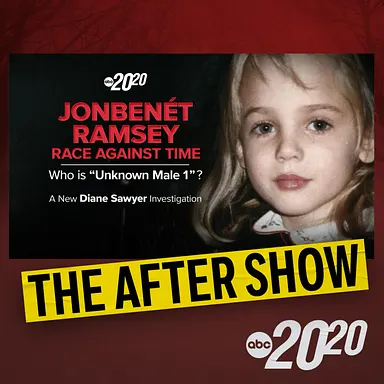
In this 20/20 After Show episode, host Deborah Roberts speaks with John Ramsey, father of JonBenet Ramsey, nearly 30 years after her murder in Boulder, Colorado. Ramsey talks about grief, the media scrutiny and suspicion his family faced, and the death of his wife Patsy before a district attorney publicly cleared the family in 2008.
He describes his push for the latest DNA techniques, including forensic genetic genealogy, and argues that the police handled the case poorly. Listeners hear his hope that the killer will finally be identified.
In this episode Deborah Roberts, John Ramsey
The transcript of this 20/20 After Show episode on John Ramsey's search for his daughter's killer was made with HappyScribe technology, the same kind behind the Microsoft Teams note taker.
Ads in this audio differ from the text. Tap the sentence you're hearing to follow along.
Synced: the text now follows the audio.
Hi everybody, and welcome to 20/20, The After Show. I'm Deborah Roberts, and I am really happy that you're with us today. We are going to take you back in time to a stunning and unthinkable murder of a young victim whose name would become known worldwide. You remember John Benet Ramsey. Who can forget that Christmas weekend 30 years ago? I certainly remember it when news broke that a 6-year-old girl, a tiny beauty queen, we would learn, had been viciously murdered, found dead by her father in her own home.
Well, this story was at the center of a 20/20 special that just aired on Friday night, John Benet Ramsey: Race Against Time. Who is Unknown Male One? It's a new Diane Sawyer investigation, and it also features our ABC News chief investigative correspondent Aaron Katerski. Well, many of us felt like we knew the story over the years. We knew the details of the story, but Diane and Aaron brought to light what may be a critical and new turning point in this decades-old case. I remember traveling to Boulder, Colorado back in 1996 for ABC News.
I was new here at this network, and I was among the first to cover this heartbreaking story of a family's inconceivable loss. I remember standing in front of the Ramsey home, this beautiful neighborhood, snow falling, feeling sort of the chill in the air, but also the emotional chill that so many people felt as we looked at this home and imagined what had gone on in there. Well, none of us could fathom that this killing had happened in such a peaceful place. There was a mysterious ransom note, chilling DNA evidence, a family that was thrust into the national spotlight.
And for nearly 30 years, John Benet's father, John, has lived with grief, unanswered questions, and even suspicion. Well, I sat down with him for our podcast to talk about the toll that this has all taken on him, the mistakes he thinks were made, and why now, after all these years, he's hopeful that his daughter's killer might finally, finally be found. Here's my conversation with John. John, thank you so much for being here with us today.
I can imagine that this is a subject that's still hard for you to talk about.
Well, yes and no. I mean, it's you get weary, but it's important that it stays active. And so I'm it's part of my role right now is to keep it active, keep pressure on the police, and hopefully they'll do their job.
Yeah, we hear that so often on our program here on 20/20. Let's talk about your little girl, John Benet, and I know some called her Johnny B.
Yeah.
She would have turned 36 this year. That's so hard to believe. Do you ever find yourself kind of imagining what she'd be doing right now, what her life would be like right now?
No, I really my memory of her is as a 6-year-old little girl that was by my side. I did meet one of her friends, little friends, who was little at the time, a year or so ago, who is now in her 30s. And I it was a shock in a way. Oh, wow. They grew up.
Mm-hmm. Because she's frozen in time to you, probably.
Yeah, she very much is.
Over the years, you have never stopped talking about her and the unsolved murder. And I want to talk more about her and learn more about that little girl that you did know. But you sat down with my colleague Barbara Walters, along with your late wife, Patsy. Everybody remembers that interview. It was the very first time you had decided to do that. That was back in 2000. Now you're speaking with Diane. And you've been speaking out over the years. And you're doing what other victims' families seem to feel, which is the need to keep their child's name and memory alive in these unsolved cases.
Is the hope for you that somebody will know something and come forward?
Well, that's always been one of the hopes, for sure. And we've had lots and lots of letters, leads, emails. And we look at all of them. But my real focus now is on using the latest DNA technology, which is available now, and is remarkable. And it solved many, many old cool cases.
I want to talk more about that and your hope about that. But tell us a little bit about your little girl and maybe what we thought we knew, but we don't really know.
Well, John Benet, when she was born, Patsy woke me up about midnight. Said, "It's time to go to the hospital." And so we jump in the car, and I'm flying down the road at literally 100 miles an hour. I thought, whoa, whoa, better slow down. Get to the hospital. It's like ready to go. And they didn't even give her an epidural and all that stuff. They just wheeled her right into the room, and John Benet was there. It's like, bingo, here I am.
That was her personality. It's like back to the doctor, and we lived maybe, I don't know, five miles from the hospital. And the doctor said, "Next, if you have another child, you better live closer to the hospital." That's the way John Benet arrived. And that was who she was.
Take us back to those early days when you were dealing with this horrible, horrible, unthinkable crime. And then also with the media scrutiny, too. There was so much attention. And then over the years, you've had to endure scrutiny and suspicion. People commented on you and Patsy and how you appeared on camera and all of that. Take us back to those early days and what that was like.
The intense media interest, and it was just there. As Patsy said very accurately, "I've been hurt as deeply as I can be hurt by the loss of my child. This stuff doesn't matter." And it didn't. My oldest daughter, Beth, was killed in a car accident prior to John Benet, about four years prior.
Ah.
And it was when I got a call on that, in the middle of the day, my brother called me and said, "Beth is gone. She was killed in a car accident." And that was like devastating beyond imagination. I couldn't do anything about it. She was gone. I couldn't get her to the best doctor. I couldn't get her to I couldn't go to her bedside and comfort her. It was over. John Benet wasn't over. And I really thought I could get her back if I kept my wits about me. So I was really focused on, OK, I've got to get her back.
I'm going to get her back. We arranged for ransom money, did all the things. And I was very focused on that. I really thought I could get her back.
And for you to have gone through that for a second time, too. And I think people didn't know that at that time. And ultimately, of course, John Benet's body was found, and the horror of what had happened to her was revealed. But the idea that people questioned you and Patsy and the fact that you hired a defense attorney, and they were going so far as pointing the finger at you, and then even some questioned Patsy. What was that like for you? And why do you think people looked at you and your wife that way?
Well, we were told again by the DA several years later that the police believed it was the parents just because we were in the home, and it's always the parents. And so how do we figure out which one? And so let's and their strategy was to bring pressure on Patsy and I both, intense pressure, so that the innocent one would turn the guilty one in. That was the whole strategy to solve the case. That was before any evidence came in, before we knew there was unidentified male DNA in her underwear. That was day one, literally day one.
In fact, I got a call, and I wasn't taking calls, but I got a message the day after John Benet was found from a fellow I worked with. And he said, "I got to get this message to John." And so that was relayed to me. And he said, "Tell John to get the best defense attorney he can get his hands on because they think he killed his daughter." And that's the path they're going down.
OK, we're going to take a quick break. And when we come back, we're going to have more of my conversation with John Ramsey.
Welcome back to 20/20, The After Show. I am here with John Ramsey, the father of John Benet Ramsey, the little girl who was viciously killed 30 years ago. You lived with not only the pain and the grief, but the suspicion for years. And then in 2008, Boulder district attorney Mary Lacy actually publicly cleared your family because people looked at all of you and thought things even about your son. She cleared the family based on touch DNA evidence, which is something we've actually talked about on this program before, too.
But Patsy had lost her life at that point to cancer. And she had vowed when you talked to Barbara, she had vowed that you two would, till your dying breath, would keep fighting for answers. And sadly, she got no answers. She died by the time the DA said that you all had nothing to do with this. I'm curious how you processed that, knowing that she wasn't there to learn this, even though you had your knowledge of who you two were. But the fact that she went to her grave under this cloud of suspicion, how tough was that for you?
Well, Patsy was a very strong woman. And she you know, after we lost John Benet, our focus really was on she was intensely focused on giving Burke, my youngest son, as normal a childhood as he could have, despite the circumstances. And so that really became our mission. One of our missions in life was to help Burke through this and try to give him a normal childhood as a nine-year-old little boy.
And so that really became a mission in a way. And but you know, Patsy's in heaven. I have no doubt about that. And she knows a whole lot more than I do, probably. And I once in a while pray and say, hey, can you let me know what you know?
What do you say to people today who still look at you suspiciously and wonder?
Yeah, well, I think they need to look at the evidence. And if they're just basing it on what they read in the tabloids 20 years ago, 30 years ago, then they're out of date. John Benet was sexually assaulted.
Ugh.
And her head bashed in. And the you know, a lot of this I didn't know. I never read the autopsy. I couldn't read it. And but the sexual assault, the torture, this was a demonic creature, pure demonic. And you know, to take a little six-year-old girl, child, from her bed on Christmas night and torture her and abuse her and sexually assault her, I hope there's not many people like that out there in the world.
But it's a very dangerous creature.
And for you to have to learn those details, too, and also to try to shield your son Burke, as you said, he was only nine years old. How do you cope with that, and particularly at that time, to know these horrific details? You don't want your son to know what happened. You want to give him a normal life, but yet you're living with such pain.
Well, I didn't know a lot of these details for years. I say I couldn't read the just physically, mentally could not read the autopsy report. I didn't want to go there. And these have come out, I guess, really when I could handle it in a way and accept it. And you know, I was asked early on by our attorneys. We knew the stun gun marks were there early. And to really confirm that, this was early in this process, our attorney said, you know, would you consent to have her body exhumed so we can 100% verify those are stun gun marks?
And I said, I can't do it. She's at peace. She's safe. And I just mentally could not allow that to happen. So that didn't happen. But you know, and the whole attorney thing, just to answer your address your question there, I didn't retain the attorneys. A friend of mine was an attorney. He was with us the next day in the home we were staying at. The police were there, or the detective. And we'd spent hours with her over two or three sessions in this home that we were in.
And it was surrounded by cameras and satellite trucks. And she said, well, we need you to come to the station. And we're like, Patsy's in bed sedated. I don't want to go out in front of all these cameras. You come here. Please come here. We'll talk to you as much as you want. It's important. No, no, no. We need you to come to the station. I said, why? Well, you got papers there. I said, well, bring the papers here. And so my friend said, time out to her. We're not going to the station.
And we'll get back to you. So he said, would you allow me to do some things that I think are necessary here? And I said, yes, I would. Of course. Next morning, he introduced me to my attorney. I wasn't rushing out to hire an attorney. But as it turned out, we needed one badly. I mean, you know, we were the police were convinced we were the murderers, and they just needed to wrap it up.
In this case, you really you needed somebody to help you kind of wade through what was happening. I'm always just in awe of parents when I cover these stories for 20/20, parents who have lost children in unspeakable ways, how you go forward, how you go on. And many of these parents have been advocating to try to get the cases solved when they haven't been solved, putting their pain aside. I've talked to other parents who've had other children they've had to deal with raising while they're putting their grief aside.
I just wonder how you've been able to keep going with this kind of pain, with this kind of knowledge of what happened to your little girl.
Well, you know, I've said, you know, the killer took away my desire to live for a while, and the police took away my ability to live for a while. But we were obviously devastated and bewildered. I mean, you're in shock. But we really had to protect Burke. He's you know, and we have two other children that were adults that needed us to be strong now, too.
They've lost their sister. And so we thought, you know, OK, we used to call it a pity party. When we luckily, when I was down, Patsy was up and vice versa. And there have been times where both of us.
You could prop each other up.
Yeah. And that's really important. But there are some times we were both down, and we'd say, OK, whoa, whoa, whoa. Let's not have a pity party here. Let's get up off the floor and keep going. And so it became a day-to-day process. And one of the best pieces of advice I had was from our minister. And he said, look, you get up, you deal with the day, you deal with it as long as you can, and then you go back and get sleep. I don't care if it's 3:00 in the afternoon. Go back to bed. So we just took a day at a time.
And we had a lot of people supporting us.
You told one of our team members that Burke was the true living victim. What did you mean by that?
He was villainized by the tabloid media early on. Brother did it.
How is Burke doing today? And how does he feel about your desire to keep pushing, to keep pushing?
He would like to help solve the case. He's matured now enough to feel like he should help if he could. And but he was so brutalized by the media, some of the media, that he's very skeptical of being involved publicly.
To step out publicly is pretty amazing for you to do. And I know you want to solve this case. You said you have your doubts about the police and the way they handled the case from day one.
Oh, total rest of judgment and very poor leadership.
We're going to take a break. When we come back, could new DNA technology, cutting-edge technology, bring us closer to finding John Benet's killer? Don't go anywhere.
Welcome back to 20/20, The After Show. I am here with John Ramsey, the father of John Benet Ramsey. Let's talk about the evidence because that was key in this new report. There were several pieces of evidence that struck investigators. And we all remember that bizarre ransom note that your wife, Patsy, found on the stairs. Seemed very personal. It was actually there were comments that were made about you in the letter asking for ransom for kidnapping a child who was still in the home.
I mean, it was very bizarre. What was your reaction when you even heard about this?
Well, we just we assumed that it was a kidnapping. And we didn't think otherwise. And that's that was what was driving us that morning was, OK, how do we get how do we get the money together? I went in for a phone call. The note said, I'll call you tomorrow. I didn't know if tomorrow was the day we were in or actually tomorrow. And I would have to go through torture of waiting another 24 hours for a call. But we were I really thought I could get her back if I kept my wits about me.
You told us that several leads are sent to you directly every month. You know, nothing has happened. The case is still cold. But what kinds of leads do you get? Do you think it's going to be anything significant that could actually lead to the real killer, to the killer, I should say?
Yeah, we always look at them and take them seriously. And we've had hundreds and hundreds of them. We they would typically and of course, we hired investigators pretty early on. And so we hired two investigative firm, private investigators, to do that. And so they they pursued a lot of those. And but you know, Lou Smith, who was a detective brought out of retirement, kind of a legendary guy in Colorado, solved over 200 homicides in his career, brought out of retirement by the Boulder DA to look at the case.
And Lou told me and he'd looked at it until he died. Lou told me, this case will be solved by DNA, period. And this was before all the technology advances in DNA. You know, yes, we had the killer's DNA. It was in CODIS back then. But he said, this case will be solved by DNA, period.
DNA.
DNA.
Well, let's talk about that. Many people wonder, how is it possible, 30 years later, that this case is unsolved? And now you are saying that DNA evidence in this case could be a nuclear weapon in solving your daughter's murder. There was DNA found on John Benet's clothing. We now know it belonged to an unknown male, male number one is what it was referred to as. So what needs to happen with this DNA evidence? We know that the technology is just absolutely sophisticated today.
Are you convinced that we're going to find your daughter's killer?
If they would employ this forensic genetic genealogy, FGG, yes. We have the killer's name, but it's in the form of a DNA code. All we got to do is match that code to a person's English name. And that is what FGG does. And it's very sophisticated. I don't know that the government has that technology yet. I've been told recently that the FBI may have that now. But the local police don't have it.
Right.
You've got to go to an outside cutting-edge lab, which there's, you know, a handful that can do it and would do it if they were invited and asked.
Well, let's talk about the police chief because the decision of what happens with this DNA is really in the hands of the new Boulder police chief, Stephen Redfern.
Yep.
So what are you hoping that he'll do? Do you want him to just send out whatever he's got? I mean, because it's a small amount right now that would have to be used.
You know, their argument has been historically, well, we don't have a lot of DNA. We don't want to consume it by more testing. I've met with Redfern four times, probably, in his staff. And they were brought in.
Well, tell me about that. That's important because there's a whole new team now involved in this case. And often when I do these stories about cold cases, somebody new is on the scene. How do you feel about the department today? Do you feel there is that will and that possibility that the case will be solved, that we'll know who killed John Benet Ramsey?
I've told Redfern, the chief of police now, the new one, and I like the guy. He's a decent guy. I said, look, you didn't create this mess, but you can fix it. And if you'll do all that can be done, which in my mind is employing the latest DNA technology, and we come up empty-handed, I will say, thank you. You've done everything you could do. There's nothing else we can do at the moment. But thank you. Till you do that, you haven't done everything.
Your late wife, Patsy, sadly went to her grave with no answers. You're 82 years old now. How much pressure do you feel with the passing of time? And do you fear that you may also leave this earth with no answers?
Well, it's somebody told me you're playing on the 16th hole. Now, don't forget. And I yeah, it's very important to me to get it resolved, close this chapter for the sake of my family. And I don't want to let up. And I don't want to run out of time.
Are you convinced that you're going to know something before you're too old to really be able to do any more about it?
No, I'm really not convinced unless I knew that the police were employing the latest DNA technology that's out there and available.
You know, many times, people like you want to speak to the public. They want people to know something. If there's somebody out there who knows something, what kinds of things did you have you said? What would you say to anyone out there who might know something?
Please help. I mean, this is this needs to be resolved. This is a dangerous, very dangerous person that's out there that preys on children. I hope to God that he hasn't preyed on other children since John Benet. Odds are he has. But this is a very dangerous person that needs to be removed from society. And you could make a contribution in that, a very serious contribution, save lives, perhaps, if you have information that and we'll follow it up.
Well, John Ramsey, we pray that you get those answers. You're a very strong and brave man. And our hearts go out to you and your family. And we hope, against hope, that you will get those answers.
Oh, thank you.
In the very near future. Thank you so much for spending some time with us. And again, all of our best to your family.
Thank you very much.
And thanks to all of you for choosing to spend some time with us today. And of course, you can find 20/20 on Friday nights on ABC. And you can stream episodes like this one anytime on Disney+ and Hulu. Thanks, everybody. Take care.
Nearly 30 years after JonBenet Ramsey's murder, her father John opens up about grief, decades of suspicion and his renewed hope for answers.
Learn more about your ad choices. Visit podcastchoices.com/adchoices