
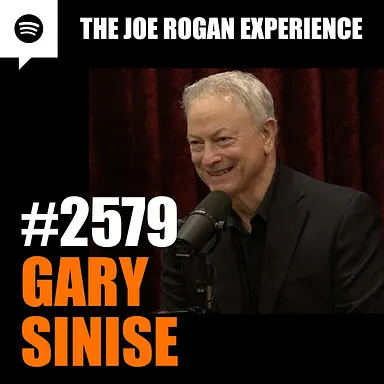
Joe Rogan talks with actor, musician and philanthropist Gary Sinise about his new book Graceful Warrior and the work of the Gary Sinise Foundation, which supports wounded veterans, first responders and military families. Sinise describes how Vietnam veterans were treated when they came home, why he began visiting troops after September 11, and his USO tours to Iraq in 2003.
The conversation also covers the Afghanistan withdrawal, which both men criticize, and veteran suicide statistics that Rogan cites. Sinise shares how the death of his son to cancer shaped the book's story of grief and perseverance.
In this episode Joe Rogan, Gary Sinise
This Gary Sinise episode transcript was made with HappyScribe's transcription service, the technology behind its automated speech-to-text tools.
Ads in this audio differ from the text. Tap the sentence you're hearing to follow along.
Synced: the text now follows the audio.
Joe Rogan Podcast, check it out.
The Joe Rogan Experience.
Train by day, Joe Rogan Podcast by night, all day.
Pleasure to meet you, man.
Thank you, Jim. Good to be with you.
It's always weird when you see someone, you meet them, and you're like, "Fuck, I've seen this guy in movies since I was a kid, and now here you are." You know, it's—
Yeah, I'm sure it's weird for you too.
I th-thank you. You know, when you meet people like that, like, you know.
Oh, sure. I've seen your show and, and whatnot, and some of the UFC fights and all that, and now we're here together. It's, it's great.
Yeah, it's very odd. It—like, I just want people to know it's never, it never stops being odd.
Well, I'm harmless, it's—
Oh, I know you are. You're a very nice guy, but it's just like, you've been in so many giant movies, man.
Some good ones, yeah.
Yeah. Oh my God. You were in both Forrest Gump and The Green Mile—two of my all-time favorite movies.
Yeah.
Those are amazing movies.
Yeah. The '90s were good. I, I did, uh, three movies with Tom that year, and they were all—they were all successful, all very good movies. Uh, Forrest Gump and Apollo 13 I did right after—that was Tom's next movie, and I, I did that after Forrest Gump. And then Green Mile was a few years later, I think, but, uh, only one little part, but it was a good part, good part, and it was a couple of days with Tom on the set.
It was a good part. And you were, again, you were—just to be a part of that. Green Mile's a huge movie. It's one of my favorite Stephen King movies.
Ah, very good. Yeah. Thank you.
Um, you write—you wrote a memoir. It was just like what everyone who's lived an extraordinary life should do at some point in time: write a memoir.
Well, I, I, I wrote a couple. I got—I—the first one was—is called Grateful American. That w—that came out in 19—or in 2020. 2019, actually. Um, came, came out that year, and it, it kind of documents how I got so involved with our veteran community and our first responders and all of that. I, I, I had been on so many tours overseas, USO, hospital visits, w-whatnot. I was encouraged by my agent, who I'd never—this is a book agent, and I'd never worked with her before, but she approached me and said, "Why don't you document some of this stuff that you're doing?"
And so I started to do that, and then it turned into an autobiography. I went back to the—through the history of my family, serving in World War I, World War II, Korea era, uh, my wife's side of the family, Vietnam, Cold War, all of that, Afghanistan. And then it just traveled all the way to the creation of the Gary Sinise Foundation, which I set up in 2011. And so it kind of tracks all of that. That book came out in 2019, and now I've got a new one coming out.
When did you first start getting res—involved with first responders and military? W-when did this all start for you?
Well, I, I think it was kind of different steps along the way. Uh, again, the family on both my side—the, uh, family of veterans on my side and my wife's side of the family. Um, back in the '80s, I, uh, because of my wife's brothers who had served in Vietnam and her sister's husband, a combat medic, uh, I started to get—you know, I started to spend time with them and, uh, talk to them quite a bit about what it was like for them to go and serve in Vietnam and then come home.
And of course, it was a bad time to be in the service coming home from Vietnam.
Yeah. Maybe the first time ever in American history where people were angry at you for fighting in a war.
That, that, that's right. And it was a very divided nation at that time, and the Vietnam veteran had to crawl into the closet and, you know, hide in the shadows. It was a difficult time for them, and I felt a lot of compassion for them after I started to actually meet Vietnam veterans through my wife. And so I wanted to help them. I started helping them in the '80s, and in the '90s, I got to play a Vietnam veteran in Forrest Gump. He was a wounded guy, so I started supporting our wounded after that through the Disabled American Veterans Organization.
And then September 11th was, uh, in, in the book Grateful American, there's a chapter called Turning Point, and everything up to that chapter is kind of teeing up what would happen after the attack on our country on September 11th. And that was a truly a turning point toward a greater level of service. I started raising my hand in all kinds of ways for the USO and just going out to the hospitals and visiting our wounded and, you know, having been involved with the DAV, Disabled American Veterans in the '90s, I was impacted greatly by the real-life Lieutenant Dans out there and wanted to help, you know, our returning Iraq and Afghanistan veterans.
And so started supporting them in various ways, and that all led to the creation of my own foundation, which is now in its 16th year. We've raised a lot of money and deployed those resources all over the country doing all kinds of things and overseas as well.
Well, that's phenomenal that you put so much energy and effort into that because Lord knows they need it, and they, they—I'm sure they appreciate it because it's, uh, it, it—especially in today's day and age, it's such a—we're—we have such a divided country, and at least we should be able to love and respect and take care of the people that sacrifice everything, put their life on the line to serve our country.
I mean, it's, it is the, the ultimate sacrifice, and it gets, you know, depending on what—whether or not you agree with the war or whether or not you agree with the president and whether or not you'd agree with the, the political movement of the time, you know, it—that's how people feel about the military themselves. And I think that's.
Yeah.
That's terrible.
I don't—I don't care a-at all about that stuff. Um, I remember what it was like to come home from Vietnam from these—I was greatly impacted by the veterans that I met coming home from Vietnam. I was, uh, 18 years old, uh, in 1973, the end of combat operations in Vietnam. Uh, and then I met my wife's brothers, and they started to really tell me what it was like to serve in Vietnam and come home to feel like the nation had abandoned them and crapped on them.
And.
Yeah.
All that is—that is the foundation. That is a motivator for me to kind of take up the charge with those who deployed in reaction to the horrific attack that we all witnessed on September 11th. We had a lot of people raising their hands after that and going off to serve, and they started getting hurt. They started getting killed. Families started losing loved ones. I was—I just felt called to try to do something to help them and to try to ensure that if they were going to return from war, that they would return to a grateful nation.
And you could see, remember, in 2004, 2005, initially, everybody was, like, behind the service member. They were, uh, responding to Afghan, uh, what happened, uh, with Osama bin Laden and the attack on our country. People were raising their hand. They were going to Afghanistan. Then we went into Iraq, and the nation started—it, it, it had come together after September 11th, and it started to divide and split again. And you could see one side was supportive of George Bush and what he was trying to do in Iraq, and then there was a whole other side that was, you know, really not in support of it.
Having so many Vietnam veterans in my family and remembering what it was like for them to get caught in the middle of that crap.
Yeah.
Uh, I didn't want that to happen to our Iraq and Afghanistan veterans. So, you know, at, at a certain point, I just started raising my hand and saying, "Hey, I want to—I want to go visit them and let them know that there are people that, that care about them and appreciate them." And that turned into just a, a life, life mission. I don't want—ever want somebody who volunteers to serve our country going to harm's way, you know, sacrifice, you know, limbs and lose friends and all of that, to ever feel like nobody cares about that.
You know, we should—we should protect and defend our, our defenders. They—that's—look at what they do for us. If we had nobody that wanted to serve in the military or put on a uniform, uh, as a police officer, a firefighter, w-what, what would we do? What would we do? We'd have to make people do it. That's what happened in Vietnam. There was a draft, and that split the nation in half. We don't have a draft now, so I'm, I'm grateful that we have people that are willing to do this work.
This episode is sponsored by BetterHelp, an online psychological counseling service. We all have something we regret. Maybe it's something small, like making plans with a friend you haven't seen in a long time, then having to back out at the last minute. But should you really feel guilty about that? Explore thought patterns like those and how they're affecting you with BetterHelp's psychological counseling. They match you with a qualified German counselor, plus everything's completely online and flexible to what you need. Take a closer look at your own expectations and recurring thoughts.
BetterHelp makes it easy to find the support that fits your needs. 90% of German members continue working with their counselor after their first session as of May 2026. Our listeners receive 10% off their first month at betterhelp.com/jre. That's betterhelp.com/jre. This episode is brought to you by Squarespace. If you're thinking about building a website, you should try Squarespace. I know because I use it.
That's right. JoeRogan.com is powered by Squarespace. It has all the features that you need to create a standout website, like an AI-enhanced website builder, SEO optimization tools, and seamless checkouts with mobile pay links. Head to squarespace.com/rogan for a free trial. And when you are ready to launch, use the offer code ROGAN to save 10% off your first purchase of a website or domain.
Willkommen zu einem Moment nur für dich und zu allem, was du liebst bei Douglas. Finde einen Duft, der dich nicht mehr loslässt. Pflege, die aus Alltag ein Ritual macht. Farben, mit denen du dich neu entdeckst. Alles für dich am Singles' Day. Jetzt 20% auf viele Artikel. Douglas, welcome to beautiful.
You know, I agree. I agree with you very much so. Um, I had my first experience with a Vietnam veteran when I was in high school. I had a history teacher that was a very nice guy, but he had a fuse that was this short, like, you couldn't light that firecracker. It was going to blow your fingers off. His, his fuse was so short. And it took me a while to figure out, like, what is—why is he—what is going on? Because he's normal, and then he would snap. Like, I remember one time a kid didn't bring a pencil, and, uh, he said, "Can I—can I borrow a pencil?"
And he pulls the desk out, grabs the drawer, yanks the drawer out with all the pencils in it, and slams it on the ground. He goes, "Get a fucking pencil. Pick up a pencil." And it was like.
This is the—this is the teacher.
Yeah, yeah, yeah. This is the teacher. Out of his mind. And we're all like, "Yo."
Something's going on in there.
100%.
Yeah.
And it took us, like, I—no teacher had ever done that before. Like, it wasn't that the kid was, like, starting fights or lighting a fire in the crowd. He just didn't bring his pencil. And so he pulls the drawer out of the dr—out of the, uh, desk and slams it with all the pencils. The pencils are scattered all over the place. And, and I remember sitting in class going, "Should I run?" Like, what the fuck is this guy going to do next?
He got everybody's attention that day.
Oh, he definitely got everybody's attention, but it was in a completely disproportionate way. But when we found out, you know, because we would, you know, and I'll go have lunch afterwards, like, what the fuck? I forget his name. Um, I wish I could remember it because he was really—he was a cool guy, a really cool guy. It was just—he had been through it.
How did—how did you know he was a Vietnam veteran?
Yes.
And then.
We found out from other teachers. We found out from other classmates. And, uh.
After the—after that incident or before?
No. I think it was along the way because it wasn't just that incident. The—he—his fuse was—he was ready to pop at any moment.
Yeah, sure.
It was like it would come out of nowhere. And I maybe it was a bit in response to unruly kids and teaching them how to get in line, but I went to a pretty soft school in high school. I went to Newton South High School, a really nice.
Where's that?
Suburb of Massachusetts, uh, Boston.
Okay.
Massachusetts. Very nice neighborhood. Very—no, no gang fights in my school. It was very, very peaceful. Great academic school. Everyone was nice. I mean, normal shit. Kids got in fights and normal stuff, but it wasn't anything scary. We weren't scary kids.
Yeah.
So when he would pop and snap, it was like, "Whoa, where's this coming from?"
It makes me—I grew up in the same kind of, uh, environment. Nice suburb of Chicago. Uh, great high school, Highland Park High School. It was a great high school. And it makes me think, I wonder if there were teachers at my high school who, uh, had gone through the war and then came, came home and, and taught. I never.
Had to be.
Never met any until my wife's brothers. I never met a Vietnam veteran until then.
Had to be. Now that I'm thinking about it, this might not have been in high school. It might have been in eighth grade.
Oh.
I have to be—I have to be careful with this because I don't really remember if it was so fuck—I'm so old. I'm 59 now.
You're not old.
But I'm thinking through it. I'm like, it might have been eighth grade, which makes more sense because I was in Jamaica Plain, and it was a little bit of a sketchy neighborhood, but I'm not sure. Uh, either way, this guy—this was my first experience with anybody that had been through Vietnam, whether it was eighth grade or ninth grade, different schools. But he was, uh, really smart and, and just I could tell even as a 13-year-old kid, this guy was tortured. You know, something had happened. And then as I got older and saw a bunch of movies on Vietnam and, you know, saw Apocalypse Now, and I was just like, "Whoa, Jesus."
Like, you just think of—we thought of war as World War II soldiers going over there to fight the Nazis and, you know, and stop evil from progressing across the globe. And we remember that photo of that, uh, the, the Navy sailor kissing that lady in Times Square.
Wow.
It's like one of the most iconic photos.
Wow.
In history, right? And that's what war meant. It was like, "We're the good guys. We go over there." And then you see Apocalypse Now, and you go, "Okay. Well, what the fuck is this?" Like, what is—is this really what they dealt with? And then you have these accounts of these guys that had to go into the, the, the tunnels and.
Yeah, tunnel rants. Yeah.
Jesus Christ. You're like, and then there's no reason whatsoever that we should have been there in the first place. You're like, "Wow. Okay. Well, this is war."
Yeah, yeah. And if you look at the—that's not the only movie, Apocalypse Now, from that era, right?
Right.
'70s and '80s produced Platoon.
Yep.
Casualties of war.
Yep.
Coming home. I mean, there were a lot—there were a lot of movies.
I think Platoon was a little later, right?
Platoon was '80s. Yeah.
Yeah.
'80s. Uh, Deer Hunter, another one.
Right. Deer Hunter. That was another great one.
What happens to Chris Walken at the end of that movie?
Oh, God.
So you, you look at all those movies, Joe, and if you look at all those movies, just like Apocalypse Now, you just wonder, "I don't think these Vietnam veterans are going to be okay at the end of this film," right?
Right.
Forrest Gump was the first time that a story about a Vietnam veteran was a happy ending story. We had never seen that story before. We'd never seen a Vietnam veteran come home, process all his anger, process, you know, isolate himself through booze and, you know, loneliness and all that anger, all the things that were going on with Lieutenant Dan. But what happens at the end of that story? He's standing up again. He's got legs. He's moving on. He's successful in business.
Uh.
Yeah.
He forgives himself. You know, we hadn't seen that positive story about a Vietnam veteran. I think that's, in some ways, why so many Vietnam veterans kind of appreciate that story because, yes, there were those who came home from Vietnam and isolated themselves. My wife's one of her brothers was like that. He just—he just, you know, had, had a lot of trouble after Vietnam. And we heard that story over and over again, but we never heard the story of the guy who came home from war, was able to kind of process the war years and move beyond them.
And that's—that was—that's, of course, that's the story we want for anybody who.
Yeah.
Who goes off to war. We want them to come home and be okay.
We do. And we, we like when that happens. And I think part of the reason why we like it is because we know it's so unlikely because it's so difficult to come back from that and, and reemer—and just reenter society. And they don't get any help. And this is the thing that I found most shocking. When, uh, I got older and I, I met a lot of, uh, military guys, specifically through jujitsu, through martial arts, met a lot of military guys. And the thing that astounded me the most is how little help they get in reemerging or reentering into society.
And that you go from being involved in firefights every day and breaching buildings and shooting terrorists, and then all of a sudden, you're back in regular life. And it doesn't make any sense. And you—no one's telling you how to deal with this. No one's giving you tools. You can get a little bit of counseling. That doesn't seem to help. They can put you on medication. You want to—you want to numb yourself to the whole world? You could do that. No one wants to do that. And then no one wants to talk to you about it. It's—and it's crazy to ask that of people.
Yeah.
To take a regular person and just put them through boot camp, put them, you know, give them some training, and then have them go kill people. And then a few years later, here they are back working at an insurance company, just sitting at a desk. Like, what? How do you process that? It's hard to process regular life. Like, regular life is baffling to people. I mean, how many millennials and Generation Z kids are just, like, so confused about life itself? Imagine that.
Yeah.
Think Draft Kings isn't available in your state. Think again. The cage is set, and Draft Kings keeps the full card at your fingertips in one sports app live in all 50 states. Once the cage door closes, everybody has a pick. Draft Kings keeps you close to the pay-per-view card from the first walkout to the final horn. Make your calls as the card unfolds. Download the Draft Kings sports app and use the code ROGAN. New customers can spend 5 and get 200 in bonuses within 21 days.
That's code ROGAN, spend 5, get 200 in bonuses. In partnership with Draft Kings, the crown is yours.
Gambling problem, call 1-800-GAMBLER. 1-800-MIARESET. Connecticut called 888-789-7777 or visit ccpg.org. On behalf of Boothill Casino in Kansas. Vet tax pass-through may apply in Illinois, 21 and over. Void in Canada. Event contract trading with Draft Kings predictions involves risk of loss. Availability varies. Predictions offer void in New York. Bet to get bonus bets that expire in seven days. Trade to get predictions dollars that expire in one year. $50 in rewards issued every seven days via click-to-claim for 21 days. One non-refundable reward redeemable. Terms at dkng.co/offer.
Limited time offer. Nationwide based on sports book predictions and free-to-play sports contest availability. Varies by state.
Yeah. Thankfully, I mean, even with things like that that do happen today, think back to what it was like to come home from Vietnam and have.
Right.
No services at all and have the nation.
People spitting on you.
Be completely, uh, you know, I had people that had bags of crap thrown on them when they got off the airplane.
Yeah.
And whatnot. Today, there are multiple services provided. You know, there are thousands of nonprofits that have emerged since September 11th, 2001, that are out there trying to fill the gaps where the government kind of falls down and we, we don't have enough support. So there is support out there for a lot of people. Unfortunately, many of our service members that come home, they don't seek it out. They don't seek that help out. They isolate. And we, we don't want them to do that at the Gary Sinise Foundation.
We try our best to be very, very proactive if we hear about anything. We don't wait for them to call. We call them. We try to—we try to reach out. Mental wellness is a big part of what we do at the Gary Sinise Foundation. And I know a lot of people that are in, in, uh, in that business to make sure that, uh, like your, your teacher who's.
Right.
Who's containing all that stuff. He's not talking about it. He's keeping all that in. We want to provide opportunities for them to tell their stories and come out. The more they talk about what they've been through, the more the, the, the, the better it is, the better the chance that we save somebody from doing something bad to themselves.
Yeah, absolutely. Yeah. I'm—I mean, um, it's one of the things that I've learned through jujitsu, um, in particular, is so many guys who came over there and needed something to really, like, push them and test themselves and just, like, release the demons and get out all the, the pent-up anxiety and that extreme physical exertion in jujitsu. And also the camaraderie of jujitsu really helped them with a lot of that.
Yeah. It's hard. It's—it's hard. You know, if you.
Yeah.
If you've seen a lot of buddies go down, you know, you've seen a lot of bad stuff, and you come home and just try to go on with life, uh, I, I think it's difficult. The, the one—the one thing that I will say is I had—my wife had two, two brothers. One, one died of cancer in 1983, but he, he was a West Pointer, uh, two tours in Vietnam. Uh, went as a platoon leader, uh, uh, uh, lieutenant, then went back as a captain, a company commander, came back, taught at West Point as a major, was teaching at Fort Leavenworth.
He was just rising the rank. He would have been a four-star and he would have been involved right along—he was Tommy Franks's age. So he would have been involved with General Franks and, and serving in Iraq. I have no doubt about that. He did better than the younger brother who came back and got out, right? He did his tour and got out.
Mm-hmm.
And he didn't have the community around him.
Mm-hmm.
You know, my old—the older brother had the military community around him.
Right.
All these guys had served in Vietnam. They're all around each other. They're still serving in the army, whatever it is. But the younger brother came out and he got out of the service and tried to do exactly that. You know, go work in a—you know, he ended up being a prison guard and ended up doing these—just trying to get a job. He tried to go to college. He, he never adjusted properly. So we want—we want people to, to know that there are services out there constantly, uh, available to them. If they're—you know, if anybody's listening to this, you can go to the Gary Sinise Foundation, but there are multiple services out there that, uh, can be provided if somebody is in need of help.
So for.
We want them to know that.
People listening to this, uh, your website, what is it? gary sinise foundation dot com? Is that?
Dot org.
Dot org. Okay.
Yeah.
Just to let people know to go there. Um, yeah, it's just like the—just the task of coming back and reintegrating completely makes sense that someone who stays in the military can adjust to it much better. You're just used to being around other.
Mm-hmm.
There's a lot of camaraderie and community. People being around other people that are experiencing the same thing you're experiencing.
Or experienced, you know, because they went to war together.
Right.
You know?
Right, right, right. Support each other.
Yeah.
Yeah. It's, uh, it's, you know, it just—it's the most demanding thing you could ever ask of someone, ever, by far. Risk your life, go kill others. And, and then when you come back and you find out, like, "Hey, maybe we shouldn't have even really been there." You know? And that's.
And people are questioning.
Yeah.
Yeah. People question, "And what did I go through for?" I mean, think about our Afghanistan veterans, you know?
Right.
20 years in Afghanistan, and we give it back to the Taliban along with $80 billion of, you know, hardware.
Yeah.
American military equipment. And you've got a lot of Afghanistan veterans who lost a lot of buddies, saw a lot of bad stuff, went through difficult, difficult things saying, "Why did we do all that? What was it for?"
The extraction, the lea—the leaving was one of the most insane things I think I've ever seen.
Terrible. Yeah.
It, it, it made no sense. It was like the—I mean, I don't—I want to look at this as charitably as possible, but it was one of the stupidest fucking decisions I think I've ever seen to just leave all that stuff there and just abandon and just do it all in one sweep.
Yeah.
Where people are climbing on top of airplanes and falling from the sky. And this is a lot of these people are people that cooperated with our troops while they were over there. People who were translators, people who helped them, people who worked with our troops.
Yeah.
And then they just abandoned those people there.
They abandoned them. Yeah.
And a lot of them were killed. A lot of them were killed and probably tortured by the Taliban.
Terrible.
Yeah. It's, it's insane. The, the, the just the desperation to climb onto a jet that's on the runway, climb onto the wheels, and watching people fall from the sky.
Crazy.
Whew.
It was a—it was a—it was a, a botched withdrawal, as they say.
Well, it doesn't even make sense.
It was nuts.
It's like—and then leaving behind all those tanks and helicopters. Look, at the very least, blow them up.
Yeah.
At the very least. What the fuck are we doing?
Yeah, it was crazy.
Where you have these parades now, where the Taliban does parades.
With our equipment. Yeah.
With our equipment.
Yeah.
Billions of dollars of tanks flying overhead with Blackhawks. It's crazy to watch.
It was bad. Imagine being one of those service members who used to drive in those—in that—that equipment.
Yeah.
You know, and just seeing that happen.
No, just absolutely insane. It doesn't make any sense. And then the—you know, you get into the conspiracy theories. Like, they want to keep them armed. They want us to be able to have some sort of a reason to go back over there. And you're like, "Please, God, I hope that's not true."
Yeah.
I just hope that's not true.
You, you, you hope not. It was like, "We're going to get out by September 11th. That's going to be our date, and we're going to withdraw no matter what." And that's what it was. And we set a date of September 11th and, and get out.
How about pick another date, first of all?
Yeah.
Maybe, maybe pick another day.
That's the date they picked.
It's—I mean, just because it's September 11th, don't do that.
Yeah.
You know, that, that date means a lot to this country. I mean, to, to leave in a terrible way on the day that marks the reason why we went there when we shouldn't have even really been there.
I have—I have very good friends, uh, you know, special forces guys, uh, who were very involved in trying to do something to get people out of there during that time, during, uh, my buddy Scott Mann, uh, Lieutenant Colonel, uh, he, he served over there, had a lot of Afghan allies that he was a special forces guy. So they worked in tandem with our Afghan allies and whatnot. And all of a sudden, he's, he's out of the service, and he's sitting back here. And he jumped in with something called Operation Pineapple Express to try to get a lot of people out of there.
They did their best. And they were, you know, they were really hurting. I mean, these guys were hurting, and they, you know, they didn't know what to do. And they did their best to get people out, uh, through various networks and, and whatnot.
Yeah.
Uh, it was, you know, and they did get some people out. And that, that was important, but they felt terrible for the ones that they couldn't get out. And it was just a very, very sad and tragic thing, I think. You know, so you got a lot of Afghanistan veterans that are in a lot of pain. And we, we want to help them through. We, we don't want them to think that their service, you know, was in vain or anything. There were—there were people that were free for a period of time because they were there.
Right.
And that's a good thing.
Yeah. Um, my buddy Evan Hafer, uh, he runs Black Rifle Coffee.
Yeah.
And, uh, you know Evan?
Yeah.
Do you know him?
I, I may have met Evan, but I, I love them.
He's the best.
They're fantastic.
I love him to death. Uh, he employs a lot of people from Afghanistan. Afghanis work for him, uh, in his pla guys that he worked with overseas.
Yeah.
He brought them and their family to America.
That's it.
When they helped us. Because he—and this is before the extraction. So it was before everything went completely sideways. But, uh, he.
It sure did.
Yeah. It's just, I mean, why would anybody trust us after that? You know, if you're in a country that Americans come in, they say, "Hey, uh, work for us. Even though you live here, work for us, and we're going to help you get rid of this terrorist organization that's running your, your country." And then we're like, "Actually, we're not. We're out. See ya."
Yeah.
You're, you're on your own.
Yeah. Good luck.
Even though you worked for us for 10 years here.
Yeah.
Yeah. Bye-bye.
Good luck.
Fucking insane.
Yeah.
Insane. And then to leave all those weapons behind, all it's like, this is the most chaotic thing. It just, like, makes you question everything of your leaders. Like, if you're willing to do that, if that's your decision, that's the you looked at all the possible options. This is the best way to handle this.
Yeah.
That seems insane.
H-hard, hard, hard to think that that was the best way to handle it.
Yeah.
Sure.
It seems like even if you wanted us to not be involved in there anymore, you just by virtue of the fact that we were there for 20 fucking years, you've got to maintain some kind of a strong presence there. You have to.
Yeah. Uh, I mean, there were—there were better ways to do it for sure.
Yeah.
You know? Um, and, and I, you know, I want these people to know that, okay, regardless of, you know, government decisions that may have gone wrong and, and whatnot, uh, and they may have been affected by those things, there are grateful Americans out there.
Yes.
You know, that are involved in support. And you should always know that. Uh, that was one of my great motivators back in the early days of, you know, after September 11th, is to make sure that they knew that they had support services and there were people that were that cared about them. And you could see the nation starting to split and divide once we went into Iraq and things were and all of a sudden, you know, it was a bad time to be in the service.
Yeah.
And the news was always bad news and everything like that. I was going over to the war zones at that time, and I was seeing a completely different side of what was going on when I went there. For example, um, in '03, I, I went to Iraq twice in '03. And first tour was a something called Project Salute. And we were on a big entertainment tour. Kid Rock was on, on the tour, and, uh, LeAnn Womack and Paul Rodriguez and Dallas Gumbo with cheerleaders and all.
I mean, football players, basketball. It was a giant tour. Northwest Airlines gave us a 747. We all flew over there. And we split up into three groups, and we covered a lot of ground in a week and saw a lot of people and lifted them up. This was about remember when that statue got pulled down in the square? That was in April of '03, the Saddam Hussein statue.
Mm-hmm.
Well, in June of '03, I was I was over there, and we were doing the first big USO tour. And I went back six months later in November, and I was in a convoy, and they took me out to show me a school. I was with Wayne Newton. I was with Chris Isaac. Remember Chris Isaac?
Yeah.
And I was with Neil McCoy, uh, country singer Neil. Great guy. It was a great group. And they took us. They wanted to show us an Iraqi school that they had rebuilt for the for the for the kids. And we pull up in a convoy, and we're driving down the road, and we got helicopters and, you know, a lot of protection. Driving down the road, we pull in, we start getting out, and the entire school of kids just runs out to the soldiers and starts hugging them and loving on them and everything.
This is.
Wow.
This is November of 2003. So I had not heard about anything like that going. It was all bad news.
Right.
We were getting a lot of bad news. You see these kids just hugging on these soldiers and the soldiers picking up the kids, and it was just it was very heartwarming. Um, the four of us ended up singing "You Are My Sunshine" to a classroom full of kids, and they didn't know what we were saying, but they were laughing at us. And it was very positive. I saw a lot of kids.
There it is right there.
Like, yeah, that's, that's, that's, that's the trip. That's the school right there.
Wow.
So that's Neil right there next to next to me. There's Wayne over there. There's Chris. And this is, uh, the Abu Hassan School in Balad, Iraq, in November of 2003. And it was a beautiful, beautiful day. These soldiers had they had all been out there before. They had refurbished the school. The school was in disrepair. So these kids and these Iraqis just loved our soldiers. And we weren't hearing anything about these stories, you know, these kind of civil affairs stories about our troops.
So I came home from that trip, and I started a school supply program. And we started shipping school supplies over to those soldiers, and they would take them out to not only that school. First, it was that school. Because I saw these kids, they're, they're like, they had these long desks in the classroom, and there'd be four kids to a desk, little Iraqi kids. And they'd have one little half pencil, you know, that they'd be sharing.
Oh.
No, no. They had nothing. Absolutely. So we started sending paper and pencils and crayons and erasers and stuffed animals, all kinds of stuff over. Soccer balls, sending all that stuff over. We started a program called Operation Iraqi Children. Eventually, we turned it into Operation International Children because we were shipping to Afghanistan and Djibouti and Haiti and all these different places where our troops were deployed. The, the motto of it was helping soldiers help children.
We wanted to provide these materials for our soldiers to take out into these communities that could be very hostile. Let's say, you know, the convoy moves in and guys with guns get out, and the community is, like, very suspicious and very hostile. But when they pull in and start unloading all these boxes of stuffed animals and school supplies, all of a sudden, the community comes out. And we had people write us letters saying, "Your supplies helped to save lives.
Your supplies we delivered your supplies to, uh, to an Iraqi village." And two days later, we were going down the same road, and the kids ran out and waved and stopped our convoy and pointed down the road. And there were bombs on the road. And the kids that got those supplies just two or three days later.
Oh, wow.
Saved that convoy from getting blown up. And we, we got a lot of letters like that from people that, you know, were serving in our military who were very, very grateful that the American people supported Operation International Children and provided these, these school supplies. You weren't hearing anything about these kinds of things.
No, you don't.
At a certain point during Iraq. You were just hearing the bad news, you know, another convoy got blown up. Uh, things are going bad. Things are going terrible, you know.
Yeah.
And all that. And you could feel like the nation's starting to really split and divide over whether we should be in Iraq or not. And I could just feel the service members over there just getting caught in the middle of that. And I did not want that to happen. So I just kept ramping it up and doing, doing what I could to let them know we appreciated them.
That's really beautiful. That's, that's really cool. And it say what you want about who decides where we go to war and what happens. I can't think of another army that would do that other than the American army that would go in and bring school supplies and set up programs to try to help kids.
Yeah. Well, well, it's sort of.
Regardless of whether or not you think we should have been there or you think it's a good idea to be in that war, that's, that's a very uniquely charitable thing to do.
It kind of reminds you of the GIs going through the German towns that we just decimated with, with just multiple bombs everywhere, carpet bombing everywhere, and then walking through those, those towns and handing out pencils and chocolate and, you know, trying to trying to engage the community. This was very much a hearts and minds project, you know, just trying to provide our troops with something that would let them know that we're thinking about them back home and we're sending them these things, but also that would help them, you know, engage, uh, with the communities that they were that they were going through over there.
It was a very positive program.
What was it like for you to have been there and see things like that, but then come back and see the news and see this version of it where it's obviously, especially the news on television, there's a very limited amount of time. Obviously, there's a lot of different things going on there all at once. And the things that are going to get people to pay the most attention are the horrific ones.
Yeah.
It's casualties.
Bad news.
Bad news, things that people are going to get upset about, whatever it is.
Yeah. I remember well, here's one example. Uh, we had a convoy going out with our supplies to a school, and, uh, a news crew was with them, right, uh, documenting, uh, for the nightly news or whatever, our program going out there and providing all these school supplies to a school. Um, it was it was beautiful. The footage was great. The kids were happy. They got all these supplies. Uh, the convoy left, and it was attacked on the way out, you know.
I mean, it left the school, and down the road, it gets attacked. The gunfight was on the news that night, and the whole purpose for the convoy never made it to the nightly nightly news. So we were you know, the, the, the part of the story that said, "Why was the convoy even where were they going? What were they doing?" Well, they were delivering school supplies to a to a school. They were trying to help a school. We weren't seeing that, you know. And it was unfortunate. I remember feeling, uh, I just felt pretty bad about that, you know, that the purpose for the convoy was eliminated from the story, but all we saw was the gunfight.
And that was that that's the way our troops were feeling. Like, "Hey, we're doing a lot of good things over here to try to help people through this difficult situation." And all it looks like on the on the nightly news is that, you know, it's all going to hell, you know, nothing's working. So I felt, you know, I can't control what the decisions that are made or what somebody's going to tell them to do. But as a citizen, I can control, you know, trying to help them through that experience.
And, and that's what our programs were like. And I think, you know, as I said, you know, we heard from a lot of people that the programs were very, very helpful. Uh, that, that particular school supply program lasted for about nine years. It was, uh, it was a program that started in 2004 and went to whatever that 2012 or something, something like that. And, uh, it was a very, very positive program. And there were lots of programs like that from people here on in the States that just felt like they had to do something to help these, these service members through a very, very difficult situation.
Yeah. It's got to be extremely frustrating when you're over there and you're seeing the news and you see this one version of what's happening. And part of it, I think, is almost inevitable because the news, just the format of what they're doing by covering a certain amount of things over a one-hour period of time, they just don't have any time. And they have commercial breaks.
Right.
And it's like and then you have editors. And the editor's job is to get the most ratings possible. The most ratings. What does that mean?
Yeah.
Make things exciting. Put a bunch of bunch of crazy music, lights, graphics.
Show the guns going off.
Keep people locked in.
Mm-hmm.
And then show them something disturbing. And then if the sort of the narrative in the country is that this war is a disaster and everything's going wrong, the last thing you want to do is show a positive story from the war, you know.
Yeah. It's not dramatic.
Right.
You know, I guess.
It doesn't fit what they're doing.
I remember doing an interview with one news, uh, national news outlet. I said, "Why aren't you reporting this, you know, any of these good things that are happening?" He was very honest with me. Bad news sells. I mean.
Hmm.
That's what he said.
Yeah. The Don Henley song.
Yeah. That was that was hard for me to hear because I was I felt like one role that I had to play was to, to talk to people about what I saw firsthand by going to the war zones and going to the hospitals and meeting and engaging with the troops and the and the people that were serving our country. You know, I you know, not everybody can go over to the war zone and, and visit the troops and everything, but I could. I, um, you know, I'm in entertainment. Lieutenant Dan showing up on a military base was uplifting to the troops.
And then I could come back and talk about what I'd witnessed and all the courageous things that I'd seen and the and the good work that I saw them doing. And I wanted people to know about that. And I felt the way that I could serve was just by talking about what I saw.
That's, uh, a very noble thing. It is really kind of the opposite of what a lot of people think of when you think of Hollywood movie star. You think of someone who's very selfish, very self-centered, egotistical, googling their name all day.
Well, let's see.
You know what I'm saying? I mean, that's what people think about instead of someone who does something that's very selfless and is probably way more rewarding and, um, it probably enriches your soul, like who you are as a person, far more than anything you're ever going to get from.
Celebrity can have a purpose beyond yourself, you know. I, I, I I'm, I'm grateful that I had, you know, you know, I've had good, good opportunities and fun opportunities. You, you talked about some of them earlier. Great opportunities in the movie business. I was on television for 11 years, CSI New York, and then I did Criminal Minds Beyond Borders. Hollywood's been, you know, I, I had a lot of good, wonderful experiences with a lot of great, great folks.
And thankfully, I, you know, I had some success and I did, did well, uh, made some money, uh, had a have a public profile that I can talk about things. And I'll, I'll tell you though, um, you know, I've been doing this a long time. It's, it's a long it goes back a long time. But in the beginning, uh, and I've told this story before, but I really wanted to go to Iraq after we first went in there. And I told you I went on this trip with Kid Rock. Well, I had done some movies, you know, Apollo 13 and some of these different movies.
I hadn't done CSI New York, where you're on television every week for nine years and people get used to you and that kind of thing. But I remember calling the USO after we went into Iraq. I had wanted to go to Afghanistan, uh, but I was I was caught up doing a lot of movie stuff. And now I want to, you know, we went into Iraq and I really wanted to go and support. And I called the USO and I left a message on their machine and said, you know, "It's Gary Sinise. I want to I want to go on a tour. Uh, I want, you know, want to support the troops.
Please call me back." And I didn't hear anything. And then I called again. I said, "It's Gary Sinise. I'm leaving a message again. I really love to go on a if you're going on taking a tour over to Iraq, please call me. I really want to do " I didn't hear anything. And then I started thinking, hmm, well, I'll call them back right now and leave another message. "Hi, this is Gary Sinise. I'm the guy who played Lieutenant Dan in Forrest Gump. I'd like to do a tour."
And then they called me back. So, so they didn't know who Gary Sinise was. I hadn't done that many movies, I guess, you know.
Well, it's probably very young people working there too.
Maybe, you know, this was so this was in 2003. You know, I'd done Ransom. I'd done Apollo 13.
That's true. Yeah.
But I was still kind of a character actor, uh, who the supporting guy, all that kind of thing. But everybody knew who Lieutenant Dan was. And I sort of figured out, okay, they they're not sure who Gary Sinise was. So, so they called me back and I ended up on, on the next tour that they it was the first big tour to Iraq that they sent over there.
Well, good for you for being persistent. What was, uh, that first big tour like?
Incredible. Um, yeah. They called it Project Salute. A lot of there were a lot of sponsors on this tour. The USO, um, the Intrepid Foundation was one. Uh, the Intrepid Foundation, uh, is based in, in New York City. Um, Vanity Fair, I believe, was one of the sponsors of that. Tribeca Films, I think. I think Robert De Niro had something to do with being a sponsor of that tour. He ended up on that tour as well. Kid Rock was on the tour.
Um, I think I mentioned Leon Mormont, Mac Paul Rodriguez. There was another band named Nappy Roots was on that tour. Uh, football players, basketball players, Dallas Cowboy Cheerleaders. And I was Lieutenant Dan, you know, and I would just go out and shake hands and take pictures, uh, sign autographs, you know, Lieutenant Dan, you know, tell them stories and sit with them and visit with them and whatnot. And we were all over the place. We went into Baghdad. I remember my, my first trip was, uh, we, we did a lot in Kuwait, and then we got on a C-130 and we went up to Baghdad and we landed at the airport and Kid Rock was on that C-130.
Uh, there were there were other singers. Nappy Roots was on that. And we pulled up. The airplane pulls up and there are thousands and thousands of troops lined up from the airplane where the airplane put all the way into this giant hangar where there must have been 5,000 troops in there sweating. It was 140 degrees. It was June. I mean, it was hot. It was messy. And we walked this gauntlet all the way into the hangar, uh, and got up on a stage.
Thankfully, they had some equipment up there because they had kind of an army band, like, playing, entertaining people until we got there. So Kid Rock grabbed a guitar and, you know, John Stamos was with us on that tour and he jumped on the drums, started playing. Kid Rock's guitar player grabbed a bass and they all started playing. And we just put on this impromptu USO show. Nobody really knew we were going to even do that, but we just started entertaining and thousands of troops.
There's footage of, of all of that. We have we have footage on my on my website, garysinise-foundation.org, our YouTube, where you can see, like, there was a we put a video out, 20th anniversary of my first trip to Iraq. That was the first big trip. And it was it was incredible that day to do that, go and see. And then I got home that night and we get a call, Tommy Franks, General Franks, who was running the whole war in Afghanistan and Iraq, uh, wants to take a small group back up to Baghdad.
And he wanted me to be on that on that trip, to go on that trip. So it was a handful of people. De Niro was there. Uh, Stamos, John Stamos and Rebecca Romain Stamos were there. Uh, handful of people were on that. Uh, and we went up and then we went into Baghdad proper, right? We spent that whole day at the airport the day before. We went in and we went to the palaces and we saw the palaces that we were now occupying. And that was eye-opening. We saw a lot of troops, did a lot of handshaking, picture taking, all that kind of stuff.
That was that was that was incredible to be in one of Saddam Hussein's palaces. And that wasn't the only time. I went back, you know, four more times to Iraq after that and, you know, got to see a lot of a lot of stuff and meet a lot of people.
What was it like being in Baghdad? Like, what is what is that? It's got to be like a completely different world.
Yeah. Yeah. Yeah, it was. It was. There's a big memorial there. I don't know if you've ever seen it, but those big giant sabers over, uh, over one of the highways. And every everywhere you went at that time, there were statues and photographs and paintings of Saddam Hussein. You couldn't go anywhere in that country in that city that we were in anyway. You couldn't go anywhere without seeing Saddam Hussein.
So he had a lock on that on that country. It was incredible. There's one palace that we went to that had giant, giant Saddam Hussein heads on every, like, post and you're pulling in and you see just Saddam's head. It was just like.
I want to see some of those Jimmy Saber photos.
You, you could probably find them. It's, it's.
I want to see the sabers too.
It's incredible. The sabers, you know.
The sabers over the highway.
You can see the, the, the trip into the hangar and all that stuff. It was incredible. And we had so Tommy Franks is in on that trip with us. He's the general who's running the whole thing. And he flew on the C-130 with us up there.
There's the saber there.
There they are.
That's crazy.
That's incredible. So Tommy Tommy Franks is with us. We're in a convoy. And surrounding us in that convoy were gunships. We had I remember looking out the window. I had a helmet on, flak jacket, all that stuff. And gunships are just flying along with the convoy on both, both sides. There must have been four or five gunships protecting the convoy.
How did that feel? What does that feel like?
It was surreal. I mean, I it was hard to believe that, uh, well, I knew I was there and everything like that. I thought I was just going to do these entertainment type things like we did the day before.
Right. These statues.
Yes. There you go. You know, everywhere everywhere you went, you had you had Saddam Hussein everywhere.
Wow.
Yeah. There, there's the heads right there. Yeah. It's pretty it's pretty crazy. And there's the statue coming down. Uh, and I was there just a short time after that.
I've read a bunch of stuff about his sons.
Crazy. Yeah. Insane.
They are some of the most horrific stories I think I have ever read about, like the evil son of an of an evil king.
Yeah.
Doing terrible things.
Oh, yeah.
That they would just find a woman who was getting married. They would take her from her husband, kill her husband, take her, rape her, feed her to dogs.
Yeah. Yeah. Yeah.
Feed her to dogs.
And they would watch, you know, they would have like a ceremony. I was in a soccer stadium where they used to torture people.
God.
Yeah. Crazy stuff. I mean, it was that kind of intimidating the population to the point where they just submit and they'll they're just living in fear all the time, uh, of the supreme leader, you know.
There's, uh, an account, I can't remember if it was a book or just a long article, but I read a, a passage from it where there was a doctor who was treating whether it was Ude or Kuse, I don't remember which one, got shot a bunch of times and he had to get a bunch of physical therapy. So some doctor was going over there and taking care of him. And the doctor told it was like he acted completely normal, like you would never know he was a monster. He was very polite. And then you hear the stories of the things that him and his brother did and you're like, "Good Lord."
Crazy, crazy stuff.
Like Joffrey on steroids. Joffrey from Game of Thrones on steroids.
It was pure, pure evil.
Pure evil.
It was it was evil. I was in a, uh, one of the palaces. There was a swimming pool in there and there was blood on, you know, it was drained, but there's blood on the side of the walls. They used to take people down there and just kill them and torture them.
They could do whatever they wanted. They had no.
Pretty much.
Yeah.
"Hey, pull over. There's a pretty girl." You know.
Insane amounts of money, completely evil and sociopathic. Their father's a monster. And, and that's how they were raised. And they had all the money in the world and all the power in the world. And you watch that, you would hope that one of them would be like a Jesus figure, like one, you know what I mean? Like, you'd hope one of them would realize, like, this is wrong. I'm going to reject all of this. I'm going to, you know, study Buddhism or something, you know.
I think they were living high, you know, they were living high at that time. I went to one of the one of the palaces that he was building. It's called the this is surreal. And you could you could probably look this up too. This is weird. Uh, one of the problems, uh, the palaces he was building at the time of the invasion, he called the Victory over America Palace. Victory over America.
It's kind of wordy.
Yeah. And it was very, very strange because outside of the Victory over America Palace, it was under construction when the invasion happened, were French construction cranes, you know, so a little, little, little weird. You remember some of our allies were not too keen on us going into Iraq at the time we did.
Right.
French construction cranes outside of the palace. We go into the palace. A lot of it is bombed out. Uh, I have some weird pictures of me, uh, sitting in the rubble and in a in a golden chair and all this stuff. Come in and there's a there's a. Yeah. That's the Victory over America. And you, uh, I remember sitting, you know, being on a balcony and there it is that I walked in there.
I was right in the middle of that. Uh, that was like the big one of the big ballrooms and everything. Um, walking in there was very surreal, uh, during a time where, you know, it had been bombed and they had it closed off, right? It was surrounded by fence. So not a lot of people got to go in there. But you see all this water around it. There was so much water around his palace that some of these farmers out there didn't have any water. He was taking all the water.
To make a moat.
Yeah. To make his, his beautiful little thing. And you can look up on, on the opposite side of that water there, the Flintstones was one of his favorite shows. So for his grandchildren, he built a Flintstone village for them to play in. And you could probably find that. That, that was the weirdest thing. There it is.
Whoa.
You can probably yeah. Flintstone Village. And that was for just.
What a great grandpa.
Simply for his grandkids to play in the Flintstone Village.
Wow. That's insane.
It's football season and Uber Eats is delivering deals every game day. This week, get 10 free boneless wings from Wingstop on qualifying orders. Game on, flavor on, Wingstop is here. So if your fantasy league is coming over for some in-person smack talk, order Wingstop on Uber Eats and get 10 boneless wings free. It's the perfect way to keep everyone fed tonight so you can focus on the game. No matter who scores big tonight, you'll score a great deal. Order now and get 10 boneless wings free from Wingstop only on Uber Eats.
Offer valid from November 2nd to November 16th. Order minimum before taxes and fees is required. See retailer storefront for details. Taxes, fees, and terms apply. Product availability varies by region. Exclusions may apply. See app for details.
It was insane. And I, I saw all that and, you know, standing there and, and we had, you know, we had a tour guide. They didn't let a lot of people go in there. There it is. It was right across from the palace, the Flintstone Village over there. They didn't let a lot of people go in there. Um, but they, they took me in so I could I could see it. And, uh, I, I had a crew with me at that time that was documenting some of the things that I was doing for the troops. And so we put some of that on a film in a documentary that's called, uh, Lieutenant Dan Band for the Common Good.
And they were making a movie about all my band concerts for the troops and the work that I'm doing and everything like that. Thankfully, we got some of that on film.
Well, that's cool. It had to be very weird being in the Flintstone Village that Saddam Hussein created for his grandchildren. How I mean, how.
Totally bizarre.
The energy in that spot must have been very strange.
Yeah. You're kidding. And you got you have farmers that got led in after that. And I remember one soldier who was showing us around told me that the farmers would just come in and see this palace and see what he was building while the people were starving.
Right.
And, and, and the farmers didn't have any water. And they didn't even know that some of that water was there. But they came in and saw that palace and saw all that water, water that they didn't have, the water, their own crops and everything like that. And they would just break down and fall down and cry. And it was such rage, you know. He, he really was an oppressor.
He really was an oppressor. And he's not unique in history. That's what's really crazy is that there's so many people when they get to that kind of a position. Or is it the type of people that get to that position in the first place are just like that, which is horrible. It's a it's a horrible idea that the only kind of people that are going to rise to power are ruthless, driven psychopaths.
Yeah. Hard, you know. I've, I've, I've also stood on the border between North and South Korea.
Another example.
Yeah. There.
Yeah.
You know, I'm standing on the border. You probably seen remember President Trump and he stood.
Yeah.
He stepped across the border and went into North Korea.
Yeah.
Well, I've been there. I've been to that spot, you know, and you can you, you could easily step over. It's just a little like cinder block thing that's on the, you know, that's separating the two, two sides. And you've got the rock soldiers, Republic of Korea soldiers behind you here staring just like this, staring at the North Korean soldiers who are right over here. And very, very easy, you realize, you know, they're free over here. These guys behind me are free.
And these guys over here, they're, they're slaves. They have no idea what freedom is. No concept. They've been born into oppression and they're there to serve the supreme leader. And that's the way they've been raised. They have no concept. One, one Korean soldier walked up to me and all that's, all that's between us is this little cinder block thing about a foot high. And I'm standing there and he's standing right, you know, this close, you and you and I. And I'm staring into the eyes of this slave.
And he's got no idea. And he starts taking pictures of me. You know, he came down. There's a building up here and they spy on you. Yeah. There we are. Oh, right there. And that's, that's, that's the guy who started taking pictures of me.
That's the same guy?
Yeah.
Wow. So he's got to document whoever is on the other side.
Yeah. He was looking at us through the window. There he is. Yeah. That building straddles the border, right? Half of it is on the North Korean side, that blue building there. And the other half is on the South Korean side. And there's a table in the middle of it, in the middle of the building. And the South Koreans can come in and sit on their side of the table and the North Koreans can come in and sit on their side of the table and they have little meetings and things like that.
That, that's it.
There it is, right there. That is so insane.
Yeah. I took my band over there. We, we that's, that's a bunch of my band members there. We've been there, you know, I don't know, four or five times. Uh, there's the table there, there. And that's, that's the North Korean building. That's, that's right there.
How could they not work that out?
Yeah.
It's so weird.
You know. Yeah.
Also, you're all Korean. That's what's even more crazy.
Yeah. And they, they don't and they don't, they don't have any concept of what's going on, you know, in the free world. They.
I had a woman on my podcast a few years back. Her name is Yeonmi Park and she escaped from North Korea when she was really young. Do you know her of her?
I've heard of her. Yeah.
Yeah. It is a heart-wrenching story. It is it's insane what her mother had to do to get her out and what her mother endured. She saw her mother endured, what she endured.
Terrible.
She went into China and then eventually made her way into Europe and then the United States. And it's like and, you know, her, her stories is like, this can happen. This can happen when people get into positions of power. And you have to be very careful of who gets into positions of power. Very careful what you give up. Very careful what rights you give up, what concessions you make. Because one of the, the big premises with North Korea was give up your land, the state, so that everyone will have food.
What a great idea. What a great idea. Oh, this way the farmers can't, you know, wrench us over or rake us over the coals for the price of crops. The government's going to be in control of that. Everyone will have food. Wonderful.
Leave, leave the government in charge.
How's it go? Well, the leader gets fat and rich and everybody else is basically starving to death because that's the only way he can maintain power.
And the military gets fed. The military gets fed well.
Exactly. So you should probably join the military. It's a lot better than being a farmer because they'll steal your crops.
Yeah.
And then on top of that, you like you everyone has to rat on everyone else. It's a part of the culture. Like you have to tell on people. People went to jail because when Kim Jong Il died, they didn't cry hard enough.
Yeah.
So have you ever seen those videos of performative crying? Jamie, pull up those videos of performative crying.
Yeah. No, they're standing there the entire crowd.
Months.
Yeah. It's crazy.
Months. They had to weep and wail in the street. And if you didn't do it right, if you were like, man, sucks that he's dead. No, sucks for you, motherfucker. They just put you in jail.
You're, you're going.
They probably kill you.
Yeah. Terrible.
Like they could do whatever they want to do. It's and it's just complete fear. And again, a culture of ratting on everybody. Everybody rats on everybody else. No one has any power. No one has any money. Communism, folks, that's what it really boils down to. That's where it goes. Don't let it happen here.
That's what the Nazis did.
That's what the Nazis did.
Yeah.
Here. So here, here's the performative crying. I mean, it is absolutely crazy. These poor people.
A bunch of actors there. Yeah.
I mean, it's just really crazy.
You're not freaking out enough.
Yeah.
No, Wade, you're not.
I don't like that guy. Lock him up.
Yeah.
Yeah. It's.
I remember that really, really well.
There's a guy named Robert Sapolsky. He's a is he a what is his exact Sapolsky's work? I know he's a, a biologist.
Neuroscientist and primatologist.
That's it. Um, he believes in determinism, you know, and he thinks that it's going to be one of the, uh, the, the big things that we look back on this day and age and with, uh, punishment and the way we treat people. He doesn't believe in free will at all. He believes that human beings are the product of everything that's ever happened to them leading up to that moment. You don't really have free will. And I think it's a really interesting intellectual sort of exercise, like this idea that you are a product of everything that's ever happened to you and it's determinism.
Like all these things have taken place, your genetics, where you're born, what you experienced, all these different things that lead you up to that point. It's you're laughing.
Yeah.
Yeah. Because I don't believe that.
I don't either.
I don't. Well, but I don't think it's not a factor. This is what I think. I think the idea of making that a binary distinction that's one or zero. I don't think that's accurate.
It can be a factor in a society like that.
Yes.
Where you are raised with nothing else.
Right. And you have zero free will.
That's right.
Right. And so it's not a coincidence that all those people have the same kind of lives.
They don't know. They don't know anything.
They don't have free will.
That's why we have to be so grateful.
Right.
You know, I'm a grateful American. That's I I wrote my book, Grateful American, because I am grateful that I'm here in this country and I'm grateful for the men and women who provide that freedom for us so that, that I can I've, you know, been able to pick and choose some of the things that I wanted to do in this life. Uh, there are, you know, we have a military that is there to protect that. Whereas a military like the North Korean military, they are there to take that away from you.
They are there to oppress you.
Right.
Uh, and militaries can be used for that. They're not the only, uh, country on earth that, that does that.
And through most of human history, that was the norm.
Yeah.
Yeah. That's right.
The king, you know, or the, you know, the emperor or whatever.
This is the rare exception.
Yeah.
We have to protect you. Yeah. And, and, and it's not a coincidence. This is the only country that has like the real, other than the Greeks, the first experiment in self-government.
That's right.
And this idea that you can really figure out your own path in life. That's why that whole determinism thing. It's like, so does Saddam Hussein take no he has no fault in all the things that he did and all and his sons, his sons are a product of determinism. So that's the idea like if you were Uday Hussein, you would have like killed those people and fed women to dogs. Really?
Sure.
Is that it's hard to believe. It's hard to believe. But I mean, I have never lived as the son of a dictator that has unlimited resources and is exposed to evil and psychopathy from the moment I'm very, very young. So who knows? I don't, I don't know. I we don't like to believe that. Everyone likes to think that they are, um, capable of not ever falling into these traps that you see so many human beings fall, that we're all uniquely wise and uniquely different.
Yeah. Just, just imagine, you know, on those kids being raised by a psychotic dictator like that, you know, I mean, they had no choice, really.
In a lot of ways, right? I mean, if you you kids very uniquely imitate their atmosphere and you have children, I have children, it's, uh, you watch them, you watch like cool things that they do. You're like, oh, I know where they learned that. And then if you're a murderer, you know, then they, they think, oh, it's cool to kill people. It's fun. It's fun to just pick somebody up off the street and say, today's the last day of your life. Boom.
Yeah.
And just laugh and go have a beer.
Feed them to the lions.
And yeah, feed them to the lions and no consequences. I mean, we all would like to think that there's no way that you would enjoy that. There's no way that you would become those people.
Yeah. I mean, you, you, you hope, you know, I mean, we are free here in this country. We don't, we don't have to go down that road clearly, you know.
What is it like just being in his castle? I have a buddy of mine who sent me a picture of him using his toilet. He Saddam had a golden toilet and he's sitting on it.
Probably more than one.
Oh, yeah. I'm sure he had a ton of golden toilets.
It was, it was like Bad Vegas, you know, when I went, I walked through, I see this kind of gaudy looking stuff around and.
What is it about dictators who love gold? Everything's got to be gold.
You know, well, I mean, it was just there, there's, there was one of the palaces had this giant chair. Everybody liked to get their pictures taken in this giant Saddam. There it is. There it is. You, you grabbed that really fast. That was so I've got, I've got pictures in that chair.
That's a cool thing to the right of the, or the left rather of the chair.
In one of, in one of the palaces, I've, I've got a, there's a picture of me somewhere in that chair.
What is that thing to the right of it?
I don't maybe like a.
It's like Aladdin's lamp.
Yeah. Genie bottle.
Oh, is that what it really is?
I don't know.
Wow.
I'm going to sit in this one because it's right up front.
It's pretty cool looking.
Everybody wanted a picture in that chair.
Of course. Look at that.
I've got a few. Look at that.
That's that's like a USO tour somewhere.
Yeah.
And that's in one of the palaces, one of his main palaces in Baghdad. I've got pictures in front of that. Those missiles are actually pointed at Israel. Wow.
That's what I was told. I've got a picture in front of that.
He's got for people that are just listening, he's got these comic book looking missiles painted on the wall behind his golden throne.
Yeah.
And the missiles are shooting up into the skies.
And, and I was told they're, they're shooting up in the direction of Israel.
Makes sense.
That's, yeah, that's what they, that's what they said.
Wild.
It's, it's strange stuff. That's inside the palace there that was, was bombed out.
It's also interesting because this is kind of the first time in history where we get a real detailed look inside of like the palace of an evil dictator. Like you really get to see inside of it. Whereas in history, we just have stories. We have stories of how people lived and what they did. But this, you get to see his throne, see the pictures on the wall.
Yep. Now that's one palace.
Right.
So, you know, that's not the Victory over America palace. He needed another one just down the street. He's going to build another one. But he had palaces in multiple cities around, around the country.
Of course he did. What do you know, want him to have one palace?
No, he had to have. He had to have. I, I was in the, I was in the ones in Baghdad. Those are the ones I went to. But I went to multiple cities around the country and visited our, our, our troops and did a lot of traveling around and, you know, I, I, I did, uh, I did five different trips over.
There must have been a lot of laughing when the people were inside the palace. Must have been a lot of like, what the fuck?
It was surreal for everybody. I just.
I'm sure.
I mean, people are looking around and all of a sudden we're occupying the palaces.
Right.
And the dictator's on the run. He was on the run at that time, you know.
How much, how long after that did they catch him?
Not, not, not too long after. I was there, uh, in '03 and, uh, the, um, the, the fourth ID from, uh, Ford Hood, uh, actually, uh, they were the ones I believe that captured him under General Ray Odierno. And I went to, uh, Ford Hood in April of 2004 and that, and the fourth had just come back and they were the ones who found him in the spider hole and, and dug him out and, and got him, you know, and they, they captured him.
So it, it was some, somewhere between November of, uh, '03 and April. I don't know. You could probably find the date. Hmm?
December 13th.
December. Yeah. So just after I was there, they found him.
What is it? That is a surreal video. The video of them pulling him out of that hole in the ground.
Oh, yeah. And remember the pictures of me. Now he's got a beard and crap, you know, he just looked like a rat.
Well, how long has he been hiding in there for?
In the spider hole?
There he is.
There he is. Yeah.
Look at that dude. Hey, mom.
Yeah.
Gotcha.
Terrible.
Yo, take a picture of me.
That's yeah.
Yeah. He looked crazy. It looked really crazy. So and everyone's taking photos of him smiling. It had to be so strange.
The fall of the king.
And that was the hole?
Terrible.
Wow. And how was he getting?
Yeah. There he is. That's the, that's what they had on the hole. They pulled that up and they found him in there.
Wow. How was he getting food and water and everything down there?
Yeah. He had people helping him, you know, hiding him, protecting him.
And how did they wind up catching him? What was the story behind that?
You know, I'm, I'm not completely sure. Uh, but they were, they were on the hunt for him, you know, everywhere.
For sure.
And remember the deck of cards? You remember that? I mean, the, the military made a deck of cards that had all the Saddam and all his leaders, all his top generals and everything, all their faces on these cards. And they handed them out to troops all over the place. This is who we're after. We're after all these guys.
Yeah.
We'll find them.
Yeah.
Yeah. They found a lot of them.
Well, I'm sure once people knew that this fucking evil dictator was, uh, not in power anymore, they're probably willing to talk.
Yeah. And, and he had to, he had to have, uh, like an inner circle of people that were helping to protect him because.
Here's a real brief, uh, they had two different spots they were going after. They codenamed them Wolverine One and Wolverine Two. 600 soldiers went after it, didn't find them at either spot. And then someone kicked something.
What?
Yeah, the spider hole. There it is.
Kicked a piece of flooring to one side, exposing a spider hole, prepared to throw a grenade into it in case it led to an insurgent tunnel system when suddenly Saddam appeared. Soldiers struck him with a stock of his M14 M4 carbine, disarmed him of a Glock 18C. Wow.
Saddam surrendered.
Wow.
Yep.
He had a million dollars in cash on him.
That's crazy. $750,000 in US bank notes recovered from the spider hole and a Glock. Wow. Where was he going to go?
Yeah.
Wasn't that, that was also the story where he was in a tunnel? Didn't his sons, didn't they try to leave the country with like a million dollars in cash too?
I stumbled across a picture of like the proof of death that they posted like the New York Times of one of his sons dying when I was looking for photos earlier.
Yeah, I've seen that. It's rough.
But I didn't see where they were when I was looking up.
I think one of them tried to flee the country with a lot of cash too.
It was a crazy, crazy time.
Yeah. Well, it just, I mean, throughout history, there've been people like that that have ruled over the country. Like for people that don't think that a military is important, you live a beautiful life in Williamsburg, Brooklyn. Okay. I'm sure. I'm sure you got a great coffee shop you go to. I'm sure there's a great local theater that you like to attend. I'm sure you're a wonderful person, you know? I'm sure you got restaurants you really enjoy. I'm sure you're great. I'm sure. But that's not the whole world.
Yeah.
There's parts of the world like North Korea. There's parts of the world like Kuwait or Afghanistan or where they're in trouble, where there's people invading them, where there's all kinds of shit going on. We're just extraordinarily lucky that we're separated on oceans on the east and west coast.
Many parts of the world.
Yeah.
It's hard to believe. There are still slaves in the world, you know?
There's more slaves in the world today than there were before we abolished slavery in America.
It's a bad thing.
It's crazy.
Yeah.
Well, that's like the Libya situation. Libya is the craziest one. Like that story, that photo of the, uh, Americans with Saddam Hussein. I mean, for him, bad day. Very bad day. Not as bad day as when the rebels captured Gaddafi.
Gaddafi. Yeah.
That, that video is crazy when they stick that banana up his ass.
Yeah. Bad stuff.
Ooh. Just the look on his face of horror that he's being captured by these rebels.
Just hated him. Yeah.
And then afterwards, uh, Libya essentially becomes a failed state and, uh, you have open air slave markets. Like you could watch open air slave markets on YouTube for a while. What I understand, people have contacted me from Libya and they said it's gotten a lot better since then. So I want to say that, you know, people that live there said it's not a failed state anymore. Like, okay.
Okay. Good.
Noted. But for a while, pretty fucking horrific. And, uh, the idea that human beings are still willing to enslave people in 2026 is insane. That, that, that, that is still a problem. So for people that don't think a military is necessary, for people that it's maybe not necessary in your neighborhood, right? But just understand the, the world is a, a very dangerous place still and not much less dangerous out there than it was a hundred years ago or 200 years ago in a lot of places.
And I'll, I'll support them. You know, these are, these are our defenders, right? We have young kids who raise their hand right out of high school or right out of college, uh, raise their hand to go defend the country. And they, you know, they, they want to do that work. We're, we're grateful and we're glad that we have people that want to do that.
Yes.
And so we need to support them no matter what. We don't have any control over where they go once they sign up, but we do have control over how we treat them and how we support them.
Unfortunately, this country is so oddly divided left and right, um, that for a lot of people, support for the military and support for veterans is a very right-wing idea. Whereas Hollywood is a very left-wing place. Did, did you ever experience like some pushback or some weirdness that you felt because you were involved with so many veterans?
You know, and I guess I never, never did. I just, you know, I was, I had a television show. I was doing well on the TV show. I got the TV show, uh, CSI New York, right around the time I had just, I'd done my first trip, uh, first two trips to Iraq in '03. Uh, in '04, I was heading over to Korea for my first trip over there. And I had been offered the lead role in CSI New York. And I, I remember being on that trip trying to decide if I wanted to go into a television show or if I wanted to just keep doing movies.
I didn't know what I should do. But when I got back, I decided to go into CSI New York. I had that show for nine years. And it came right at the right time because I wanted to, in, in my book, Grateful American, the chapter is called Perfect Timing. And it's the CSI New York timing, uh, uh, chapter, which I talk about ramping up everything I wanted to do for the military and trying to do my best to help them through and at the same time having this public platform on a weekly television series and how perfect that was at the time.
And I just kept, kept working, kept working hard, uh, on the TV show. Didn't feel a lot of, you know, I, I tried to tell everybody, hey, I'm going on a trip next week. I'm doing this, I'm doing that. I'm playing concerts on military bases all around the country and overseas. Uh, my hiatus from the TV show, I'm overseas doing some kind of trip. I come back, I talk about it. I never really felt, I don't think that people didn't think that that was a good thing for me to do. They may have had a lot of, uh, difficulty with George Bush at the time who was, you know, when I was first really getting involved and going on trips, he was the president.
And there were people in, in the business that didn't, didn't like him or, you know, didn't agree with him or whatever. But I wasn't going to let that dissuade me from supporting the troops because I remember what it was like, again, for our Vietnam veterans to get caught in the middle of all that political stuff. And I didn't want that to happen. So I just ramped up and did my thing. Um, and I, I don't recall ever feeling, you know, like the community turned its back on me or anything like that.
I just was doing my thing.
Well, that's great. Well, you'd already been very established by then too. That helps. It also helps that you're on a cop show. I mean.
It was, and I was playing, you know, it was great. My detective on that show, Mac Taylor, um, was a, a Marine, you know, and he was a Beirut veteran, you know, who was at the Beirut bombing in 1983 when we lost 241 service members. And we made him, I wanted to make him a Beirut veteran. So, and we even had episodes where I talked a lot about what was going on there. And he was not only a Beirut veteran, but he was a 9/11 family member.
I wanted to make him somebody who had lost his wife on, on September 11th at the World Trade Center. So I felt honored to be able to represent those 9/11 families and also veterans that, you know, we forget about what happened in Beirut, but that was a very, very bad day for the country during the Reagan administration when we lost so many to an Iranian terrorist bomb bombing. And, uh, you know, I just wanted to draw some attention to that. So I've been able to use the platform for, you know, to, to do some good out there.
That's very cool that they let you put that into the storyline. Um, I had forgotten about Beirut until you just brought it up.
Yeah.
You know, I, I didn't remember that attack. What year was that?
1983.
Yeah, I was in high school. I was in high school when that happened. I remember it.
Yeah. And I was, I was working on a play about Vietnam veterans to, in Chicago at the time that that happened. And I remember that day and I got all these calls from my cast members who are now focusing on our military and our veterans and, and whatnot. And I remember, I remember exactly where it was in my apartment when I heard about it. It was terrible. And since then, I've met, you know, Beirut survivors, people that survived that bombing and, uh, you know, they, they go through a lot of, a lot of pain on those anniversaries for sure.
Yeah, for sure. Um, most people in this country aren't even aware of how many times we've been in conflict with Iran other than like what's going on right now. Like a vast majority, especially young people, they don't know about what happened during the Carter administration with the kidnappings.
Right.
You know?
Yeah. That's been going on a long time. You know, we've lost a lot of people over the proxies and all, all that that they've supported over the years. You know, look, I, again, I just want, I just want anybody who serves our country to know that there's grateful people out there and we don't take what they're going through for granted. We want to help them through and we want them to be okay. That's what we do every day at the Gary Sinise Foundation.
That's a beautiful thing that you do, man. It really is. And that sentiment, I can tell is honest and real. And that, that's really what you're doing. That's your real focus. That's awesome.
Thank you.
It really is. It really is awesome. And again, especially from someone who's a movie star. Although I got to say, having these conversations with people like, you know, I mean, I've talked to so many actors on this podcast that turned out to be really cool who I was, uh, a little hesitant, you know, I was like, because I've had, I've had very good experiences with, uh, actors in Hollywood, but also some ones that weren't so fun. And, you know, but that's just.
You don't have to tell me who that is.
I won't. But you could, you could say the same about comedians or athletes or anything else. There's good people everywhere, but there's people that have, uh, it's a very uniquely weird situation to be a movie star, you know, and much like being a dictator, you can kind of get a big head.
You know, I mean, I, I come from Chicago. I scrapped around in theater. It didn't make any money for the longest time. Building a theater company there, Steppenwolf Theater. It's over 50 years old now.
Oh, wow.
Yeah. We start, we started with absolutely nothing.
And you started it?
I was 18 years old.
Wow.
When we started. And now it's a, and, and if you go to Chicago, it's an entire city block in, on the north side of Chicago. It started with nothing. We didn't even charge for tickets. We would put a, I remember bringing a shoebox in one of our first plays that we did. I was like 18 and I wrote donations on the side of the shoebox and we put it in the lobby and hope people would throw some money in so we could, you know, do another play after that. And now if you look at it, we've done hundreds of plays all over the world, you know, won a lot of awards.
We built a building from the ground up. It's an entire city block. There's three theaters in there. There's restaurants, bars. I mean, it's classrooms. It's, it's giant. When you look at it and you think that was started by kids, you know, here in this country, we can do some great things that we just, we just bear down, right?
Yeah.
You bear down and you put your, you know, I didn't go to college. I, I just wanted to start a theater company. And that's where I learned how to act. I ended up making a living at it. Uh, and I'm, I'm, I feel blessed, you know, to have grown up in this country and certainly grateful to the men and women who provide our freedom for us.
How old were you when you first got interested in acting? Was it?
16.
16.
Yeah.
So two years later, you started a theater company. You had a lot of get up and go. I'll tell you that.
Yeah. I was a sophomore in col in high school when I did my first play. And then I graduated from high school when I was 18. And I didn't want to go to college. I, I was just really struggling as a student. And, and in fact, I had to go back, uh, to high school for, for an extra semester because I didn't have enough credits to graduate. So I went back for another semester, did another play. It was great. And I, I loved it. Graduated and didn't want to go to college.
And so I just started doing some plays, you know, in a little church. We found a space and we went in there with a bunch of kids and we did plays for free. We, nobody made any money. We didn't charge for tickets. It was all free in the beginning. It was just a passionate desire to kind of act. And I loved it. And then, then the theater company started. And if you look at the early history of Steppenwolf, it goes, that's 50 years ago in 1976, I teamed up with, uh, the co-founders of the theater are Jeff Perry and Terry Kinney.
But then they went to college with John Malkovich.
Wow.
Uh, Lori Metcalf.
Wow.
Uh, Joan Allen, who was nominated for like three Oscars. And my, my, the woman who would become my wife just five years later, Moira, she became, uh, one of the members. We had an original nine people in the company and then it just grew and grew and grew. And now so many great actors have come out of Steppenwolf and it's, it's really doing very, very well. Uh, you know, still, still going strong. I, I'm going back in a couple of weeks to do a book, uh, book event for my new book there.
Uh, but they are running it well and a lot of people are coming and it's, it's, you know, it's hard, hard to be in the theater business now after COVID things got really rough.
Sure.
But Steppenwolf has a great reputation. It's doing real well.
So when you were 16, when you first took this theater class, were you interested in it before that? Did you, were you inspired by movies? Was no?
No, no, no. I was, I was playing in a band. I, I was, I had a rock band. I got a, I got a guitar and I was playing in a band. And, um, we, I've told this story where I was standing there, I'm probably ditching class or something. I'm standing in this hallway in the high school, Highland Park High School, and I'm with the other band members and we're all looking pretty scruffy and ragged. And, uh, the drama teacher walked by and she turned around, she looked at us and she told us she was directing West Side Story.
You know, West Side Story about the two gangs. And she said, you guys look perfect for the gang members. Come and audition. So, so, you know, I laughed at her and she walked off down the hall, but I was curious and I went to the audition after school and there were a lot of pretty girls walking into the audition. So I just kind of wandered in there. I didn't know what an audition was or what to do. They gave me a script and said, read this part, you're on. And, you know, I got up there and I, you know, just stumbling through it.
I was, I was really interested in the girls and I wasn't interested in the script, but I didn't take it seriously. I was just goofing off and I got a lot of laughs and I looked up the teachers laughing at me and everything. You, and I don't know if you ever auditioned for a play, but the next day you go to the drummer department and you look at the list, the cast list. You, and every, I come in and everybody's huddled around the cast list looking to see if their names on the cast list, if they got cast. And I went down and there's my name.
And I got a little tiny part in West Side Story. And that changed everything. I mean, it was, it's like destiny or something, you know? Remember the feather in Forrest Gump floating around?
Yeah.
Forrest Gump talks about destiny and all that. I think I just, God put me in that hallway at the right time and that teacher walked by, told me to audition for the play, and I ended up making a living at it.
That's incredible. What a great story. So what, so when you did West Side Story, what, what, what did it feel like the first time you performed that in front of an audience?
Spectacular. I mean, I didn't, I didn't have a big part again, but I, I became friends with a lot of the kids in the theater department. I, again, I was a kid who was really struggling, going through, you know, some kind of crazy stuff as a kid, playing in a rock band, not doing well academically. I was about to get kicked out of school, probably, probably. And I stumbled into the theater department and I made all these new friends in the theater department. We rehearsed. I just loved it so much.
I signed up for all the theater classes. I wanted to take all the theater classes after that. We start performing the play and you basically, you do like, when you do a high high school play, it's like Thursday through Sunday and you do like four shows. And I remember the last show, uh, I don't know if you remember this, but in West Side Story, Tony, the lead guy, gets shot and he dies at the end.
And the two gangs have been at each other's throats, just fighting and everything. And at one point, the American gang, they go, two guys go to pick up the body of Tony and carry him. And he's kind of heavy. And two of the other, the Puerto Rican gang come in and they grab him. And the two gangs carry Tony off the stage. And that's the end of the show. And I was one of the guys that got to pick him up and lift him. And he, he had become my best friend, the guy that was playing Tony.
And I pick him up and I'm carrying him off and I just burst into tears.
Wow.
I, I remember it. I get choked up thinking about it. I just burst into tears. I get off, I, I put my buddy down, he grabs me, he's hugging me. I'm just crying like crazy. The show is over, you know? Very, very dramatic. And then we have to go out for the curtain call. And, you know, I was just a kid who didn't, you know, who was struggling and the entire cast knew that I, something had happened significantly to me during the course of that whole thing. And I'm standing there crying, you know, and all the lead characters, right?
Tony, Bernardo, Maria, Anita, they all go and they stand in front of all the rest of us and they take their bows. And my buddy who played Bernardo, after he took his bow, he reached back and he grabbed me and he pulled me up to the front to stand with all the lead characters and take a bow. Nobody in the audience knew what that was about, but everybody on stage knew that the kid crying who was barely making it through high school had, had had my life changed in a significant way.
And from that point on, I just, I just wanted new plays and I became, you know, a top theater student and, you know, got a lot of good parts in high school. And then that's where Steppenwolf came from. We teamed up with, with my pals and we just, we started a theater company after that.
So that one moment where that lady came up to you and said, you should audition. What a crazy fork in the road.
That is, that is.
What a crazy fork in the road. If you've ever imagined what would have happened if you had zigged when you should have zagged and you weren't there.
Yeah. I, you know, we can all sort of look at those moments, you know, that there's somebody that stumbles along, just happened to bump into you and, you know, changes your life in a significant way. She did. And I remember when my first book, Grateful American, came out, she was living in Nashville and I stayed in touch with her over the years. I mean, without her, I don't think Steppenwolf Theater would have existed because she fired us all up and I just wanted to do plays. And then now, now you have a giant building on the north side of Chicago and it started with high school kids.
And I remember my book coming out, Grateful American, and I was on a book tour like I am now. And, and I, I called her up and said, I'm coming to Nashville. I'm going to do some, some press. Let me take you out to dinner. And I picked her up. We're out to dinner. I, I think I had just done the Huckabee show. He had used to have a TV show there. And we're driving in the car. I get a call from my publicist and she says, and I'm sitting here with the woman that remembers me as a high school kid who could, I couldn't even spell or write or anything.
I could barely read, but I somehow could memorize lines. And I was really a struggling kid academically, but I had kind of an intuitive, I don't know, I just, I just took to the theater. And I'm sitting here with this woman who kind of remembers all that, right? And the call comes in that, uh, Grateful American hit the New York Times bestseller list at number three. And I'm sitting here with her at the moment that I hear that. And I turned to her and I said, I'm a, I'm a bestselling author.
And she, she was just burst into tears. She could, she remembers when I could barely read and write. And here I am sitting with her telling her at the moment that I hear this, this great news. And it was, it was really just a beautiful, very poignant moment. I mean, it was very special.
That's making me tear up.
It was something special.
There's, um, a lot of people out there that just need a thing, you know, they need a thing where they can put their energy into that rewards them and shows them that they're valuable and that they can contribute and that they can really make something beautiful. And so many people never find that thing or they're never exposed to it or life gets too complicated before they ever get a chance to spread their wings and take a chance with something like that.
You're very fortunate if you, if you're, uh, if you find something as a young person.
Yes.
You know, because so many young people, they, you know, they're, you know, they search for a long time to figure out what they want to do and, you know, and, and, you know, thankfully and hopefully they find it. I was fortunate. I was 16 when I fell in love with what I ended up being able to do for a living. And that's, that's, you know, that's a rare thing, you know?
It's a very rare thing. It's a very beautiful thing. But I think, I think it's possible for a lot more people than ever to experience it. And I really wish there was more things like that out there and more, uh, just some guidance, some direction, just push people in certain directions because there's so many people out there that just, they just get stagnant and they don't know what to do. And then they spend all their time partying and hanging out with their friends and they never, they never find it.
You know what's heartening? I've been to all the, um, all the military academies. I've played concerts for the kids, you know, these students who cadets or, uh, midshipmen, whoever, I've been on all the, all the academies. Uh, and it's, it's, it's very heartening and hopeful when you meet a lot of these youngsters who are going to West Point, who are going to Annapolis, who are going to the Air Force Academy, Merchant Marine Academy, Coast Guard. I've been to all of them.
And every time I come away just feeling, wow, there's an impressive group of young people out there. And I'm sure it's not only at the military academies, but that, these are, these are folks that knew what they wanted to do coming out of high school, right? They wanted to go into an academy. They wanted to be a part of that service. They know that when they come out of the academies, they owe the country, you know, they owe the country four years. And some of them stay in the service for, make it a career and go on and become great, great leaders.
Some of our great leaders and some of them, you know, just, they get out after, after four years or, or whatever and move on to something else. But they've got such a substantial background by going to the academies, which are very, very impressive. And, uh, that, that, that gives me a lot of hope and does give me a lot of hope. And at the Gary Sinise Foundation too, we're, we're trying to, you know, one of my objectives there is, is to nourish and nurture a new generation of grateful Americans and to teach them about service and volunteerism and what that can do for you as a person, you know, gives life great purpose when you reach out and touch somebody and lift them up and help them.
That's what I've tried to do at the foundation and, and just in, in many decades of life, just trying to give back to people that I feel, you know, that, that are deserving of that. And so we take, um, one of, you know, one of the programs that we had, uh, at the foundation is called Soaring Valor. We've taken hundreds of World War II veterans down to the National World War II Museum in New Orleans. That's where our National World War II Museum is. Very, very impressive, very special.
I, anybody who's going to New Orleans, I always tell them to go to the National World War II Museum. Well, we've sponsored probably 15, 1600, uh, World War II veterans along with American Airlines who provides all the travel for us. We have a great partnership with them. They really are dedicated to our veterans. We put them on, we did 33 charter airplane trips with World War II veterans. We put them on the airplanes. And then I wanted to add a component where we pair them up with high school kids.
Oh.
So if you're a 16-year-old kid, you meet Mr. Johnson and he, he served at Iwo Jima. You're going to be a travel buddy with Mr. Johnson for the next three days. We're going to take you down and you're going to, you're going to spend time with him. That is a life-changing experience for a lot of these kids. And we've, like I said, for 10 years, we, we sent World War II veterans and students down to the National World War II Museum. Now we send them, uh, we send them to Ground Zero in New York, uh, to the Trade Center.
We send them, uh, to the Pentagon to learn about what happened at the Pentagon. We send them to Shanksville, Pennsylvania. We send them to the Medal of Honor Museum in, in Texas, in Arlington. Uh, so we want, we want to teach them about service and volunteerism and what it takes to keep us free. So they come, come away from those places feeling like, gosh, why didn't I know really that much about what happened on September 11th? 'Cause they're not getting, they're not learning about that significant event and how that changed the landscape for so many of us.
Because, you know, many of them, I mean, they weren't born then. So now it's up to us to kind of educate. And, uh, we want to be a part of, you know, just nourishing. This is a good country. There's a lot to be thankful for, for living in this country. And we want, we want to look at that and we want to, we want to tell this young generation, this is not a bad place. This is a, this is a good place. We're lucky. Go, go to some places that aren't, aren't so good. You'll have a different, uh, opinion and a different perspective on it.
Yeah, absolutely. Look, it's not perfect. People aren't perfect. It's not possible to have a perfect country.
Why would, yeah, why would we expect that?
But I think that there's something about the incredibly challenging environment of the military that is an amazing vehicle for developing young people. And it, because I think young people in particular need to be challenged so that they understand their potential. And there's a, a lot that comes out of that where these guys that come out, they can do things that other people can't do. And one of the reasons why is 'cause they learn.
I met, I met some impressive people. One quick story. Landing on the Ronald Reagan aircraft carrier in the Persian Gulf, right? I'm on, I'm on one of my tours. I'm going here and going there. I land on this carrier.
Helicopter?
Uh, no, it was a COD. It was like a 20-person airplane. Lands on the, lands on the deck.
Wow.
Yeah. Lands on the deck. I get out. Uh, this is my first, uh, first Afghanistan trip, 2006. And I go up on the bridge and they're showing me around and, uh, I look over and, you know, got the big wheels steering the boat, right? This is the, the 5,000 people on this aircraft carrier in the Persian Gulf and steering the boat. There's this young guy and I walk up to him and I said, how old are you?
And he said, 19.
Whew.
And I said, you're, you're 19.
And you're driving this thing?
And you're driving this boat? Are you kidding? What are your buddies doing back home right now while you're out in the Persian Gulf driving this boat around?
Driving a 5,000-person boat.
Yeah. That's a lot of hardware there.
Holy shit.
And so you have to imagine like what caliber of person was that that he impressed the leaders so much on the ship that they would entrust him to take that job and, and do that job. It was, it was impressive. It was very, very impressive. And I've met so many, so many people like that who are very, very impressive. I've been to the war zones, I've been to the hospitals, you know, I've been on military bases all over the world. I've done hundreds of shows, uh, you know, concerts and whatnot and met some of the most extraordinary people we have serve in our country.
And I just feel blessed and fortunate and lucky that we have people like that, you know, that want to do that kind of work. I, I wonder, I often wonder what happened to that 19-year-old. Did he stay in? Did, you know, what, what happened to him? But for that moment in time, he can always look back and say, I got to steer the Ronald Reagan around the Persian Gulf, at least for that moment.
That's incredible. 'Cause I mean, think of the average 19-year-old today. What the fuck are they doing?
In comparison to that guy.
I mean, that is a insanely difficult thing to just to be responsible for. You're responsible for 5,000 people on a boat that you can land a plane on.
Yeah. You wonder if they said, just hold it here and go straight, you know, don't turn.
I mean, how long do you have to train? It's like, that seems crazy that you could be 19 and have already trained your way to the position where they let you steer that thing. That's an extraordinary person.
Standing on the deck of a carrier while the airplanes are coming in and going on, going out is so impressive. The, the operation is awesome. Watching our people in a very dangerous situation on the aircraft carrier.
Yeah.
You know, uh, just doing their thing, getting the planes ready to take off, to launch, to catapult off the deck, or to land. And that's a dangerous job out there. And I got to stand there and watch these, these people work. It was very, very impressive.
Incredibly dangerous job, incredible responsibility, and the work ethic that you have to have to be a part of that, that is just in the culture. It's just like, this is what it is. That makes extraordinary people. And I think extraordinary people gravitate towards those kind of challenges, but going through those kind of challenges makes extraordinary people.
You can develop.
Yeah. And I just don't think that resource is used enough or gets enough credit. I mean, it's one of the things my friend Evan from Black Rifle Coffee really emphasizes is that they hire veterans, they use veterans, they, they, they give to veterans, they, they give to a bunch of different veteran causes and organizations, first responders. They, they're involved in a lot of different things just to like sort of emphasize that and to let people know that we care and we understand and we, we support you.
And there's are some great programs out there. Transitioning from the military, if you've been in the military for a long time and you're used to that lifestyle and all of that, transitioning out of the military into the civilian sector and kind of just, uh, you know, figuring that out, that can be challenging for folks. And there are some great programs out there that are helping our veterans kind of navigate that transition from, you know, 20, 30 years in the military to something new.
Right.
Uh, we want them to be okay. We're, we're, we're grateful out there and we want them, want them to know that we are and we want them to be okay.
Well, I'm really glad that you do what you do 'cause it, and, and that you have this message and you continue to spread this message on all these different interviews that you do because so many people just kind of don't appreciate it or understand it. And, um, I think it's just, it, it, it, without it, we're fucked. Like without those people, they're like some of the best people that we have, best young people that we have in this country.
We need a strong service.
Yeah.
We do. We are, uh, the, where would we be if we, if we didn't have the American military? Where would the world be without that? Think about it. You know, there's a natural disaster or something like that. Uh, you know, we send aircraft carriers, we send ships, you know, we, we, we don't just fight wars.
Right.
We, we do a lot of things, uh, that the military is very highly qualified and capable of doing.
Well, this is also one of the reasons why people get so upset when the military's used in what people consider to be an unjust way. Like, like Vietnam. I mean, that's why there was such a giant shift between, you know, 1945 and then the 1960s in, in the Vietnam. It's like 20 years later, you have this complete polar opposite reaction to military.
I think, I think we learned some hard lessons from what happened to our veterans when they came home from Vietnam. That's why there's thousands and thousands of nonprofits that have popped up after September 11th and our deployments to Iraq and Afghanistan. Uh, I think they, they like me, they were motivated to ensure that what happened to our current day service members deploying to those war zones would not happen like what happened to our Vietnam veterans when they came home.
Um, do you know Marcus Luttrell?
Yeah.
Yeah. Marcus is a friend of mine. We, we're actually texting today about some stuff.
I'll give him my best, please.
He's involved in this IBAGAIN initiative that they're pushing through.
Yeah.
And with Rick Perry and Brian Hubbard. It's a really amazing thing. And, and this is one of the things that I went to the White House to talk to Trump about, about pushing it through, about getting that. And, and there's so many veterans that have had that experience and it's helped them just sort of reenter society, helped them deal with their demons, helped them overcome alcoholism and addiction to pills.
I know some, some people, that's been very helpful for them. Yeah.
Yeah. And, um, it's, uh, it, that I think is, uh, it gives me a lot of hope that that's going to be available to more people. Just I know so many people that have come back from that and had just nothing helps, nothing worked until they did that.
Yeah. And, and you, you have several people that are just dealing with a lot of bad stuff, you know, and they, you know, we're, there's a very aggressive and it can never be too aggressive, I don't think, uh, effort to try to address this terrible suicide problem that we have, of course, in the services and, and in our veteran community. A lot of people are focused on that. Uh, we, we support a lot of programs at the Gary Sinise Foundation dealing with mental wellness and, uh, you know, initiatives.
It's very, very difficult problem though, because you have, you also have a lot of folks that won't ever reveal what's really going on.
Right. They think of it as a weakness.
Yeah. They won't ever, they won't ever tell you. And that's why you hear, gosh, you know, somebody took their life and even their wife, you know, wasn't, didn't know what was really going on or best friends didn't know or whatever. There were no signs whatsoever or something like that. So how do you combat that when somebody's dealing with something that they won't reveal or I think, I think it's up to, uh, peer to peer, uh, you know, support. We have, you know, you have battle buddies in the war that you're close with when you get home, those battle buddies and when they're, when they're with you and they're still with you and checking on each other and all of that stuff, that can be lifesaving.
Yes.
You know, those battle buddies.
Absolutely.
I know a lot of folks that are constantly checking on their buddies to make sure they're okay and getting things right.
That's one of the things Marcus does. He sent me a text today. He just checks in on you.
Yeah. Are you doing okay?
Have a good week. Checking in on you. Have a good week.
Yeah.
It's beautiful. It's nice 'cause it's real, you know?
I'm always glad when somebody checks on me.
Yeah. It's nice. It's never bad. It's nice. And, um, I think that, uh, the culture of, uh, for lack of a better term, you know, manhood, that men think that it's better to be stoic and to try to like keep it all to yourself and just deal with it and seek help. Seek help. Talk to people. Let people know that you're struggling. Yeah. Because we all have had someone who we didn't know was struggling, who took their life. And it leaves you with this horrible feeling that I could have done something and you, you don't know when, when, when do you act?
When do you say something? When do you leave it alone? What do you say? You know, how do you, do you, do you fuck it up worse by talking to someone about it? Do you make them think about it more? Are you helping them by telling them you love them? And you don't know. Like when someone does take their own life and you feel that's is a ter, it's a terrible feeling to feel like you could have done something.
Yeah.
That if I had to just talk to them, if I'd been there, I think I could have prevented it.
Many, yeah, many feel like that. And, but you don't know. You don't know if you could have, you know, it's a, but if we're proactive, you know, that's, that's the thing. Proactive with trying to make sure that somebody knows that there are services out there.
Yeah.
We're, we're dealing with people all the time at the Gary Sinise Foundation who are going through difficult things and we have multiple services, uh, that we provide or, and if we don't do it at the Gary Sinise Foundation, we can provide, uh, information about other organizations that are very deeply committed to ensuring that, uh, you know, uh, service members that might be dealing with something, uh, difficult, know that there's a place for them to turn. We don't, we don't want those sad stories and we have to be proactive in, in what we do, you know?
And so that's one of the things that I can do, you know, I can talk about things to on, on radio and television and podcasts and, uh, you know, all of that, let people know that there are services out there that can be provided. And, uh, I, you know, I, I hope that by doing that, that's a way that I can serve the community just by passing on information and letting people know that they are cared for, they're appreciated, and we don't want them to, to struggle by themselves. We, they're not alone in this whole deal.
No, no, no question. It's a service and no question it helps people because just having people know that someone cares is a lot. It means a lot.
One of our great programs at the foundation is for, uh, the families of our fallen. And there are thousands of these families, thousands of children who've lost a mom or dad in military service. And we have some great programs at the Gary Sinise Foundation. One of those programs is called Snowball Express. And we will take, we're about to take over a thousand kids next month, all expense paid, paid to Disney World. And we've been doing this for years.
We, we did it at, in Orlando, uh, in Anaheim at Disneyland. Then we moved the event, uh, because American Airlines is a big travel sponsor of the event, our presenting sponsor. We, we moved it to their hub in Dallas. And then in 2018, we brought Snowball into the Gary Sinise Foundation as a program of the foundation. I have a great relationship with Disney World and Disney because of movies and narrations that I do for them. And so all of a sudden we started bringing all these kids to Disney World.
And when you bring a thousand kids together that are all going through the same thing, I lost my dad, I lost my mom. When those kids get together and they engage in that community and they see that there, there's a big community out there of kids that are all going through the same kind of thing, they're, they may cry a little bit, of course, you know, missing their mom and dad, but they're hugging each other and they're bonding with other people that are going through the same thing. It is profoundly impactful for these families.
And we do it for families of fallen first responders too, firefighters, police officers that are lost in the line of duty and, and leave children behind. And we bring them to Disney and do the same thing for them. That's one of our, one of our big programs. Of course, it's expensive to take these kids to Disney World and get the hotel and we take over an entire hotel and we've got hundreds of volunteers. It's a big, it's a big thing. But when you see what happens to these kids and they can feel forgotten, right?
That, I mean, you know, maybe you've got a child whose dad or mom committed suicide and they're with a bunch of other kids who dad or mom got killed in combat or something like that. And you're the, you're the suicide kid. Well, you're worthy of our attention because your parent served our country and, and they, they had fatigue. Something happened to them and they were a casualty of war.
Yeah.
And so we want these kids to know that, uh, that we don't forget about them. And this program has helped a lot of children, a lot of families go through a lot of who are going through a lot of difficult things. And I show up and I play my band plays for, for the kids every year. I've been doing it 20 years now. And it's, it's a big rewarding thing to be able to take these, these families. And again, we have hundreds of volunteers, corporate sponsors who volunteer and bring their, you know, bring their materials and everything.
A lot of big sponsors for this event. It's, it's very, it's, it's very rewarding to see what people can do when they just care and they just want to do something to help somebody.
That's beautiful. It really is. I, I, I think a lot of people are unaware of the suicide crisis of how many veterans have taken their own lives. And I, I think what is the statistic about, uh, veterans versus the amount of people that died in combat in Iraq and Afghanistan?
It's more.
Yeah. It's quite a bit more, I think.
I don't know the number, but it's, it's, it's, it's a lot more.
Jamie, I'll put it into Perplexity and find what the number is. But it's, it is, it is shocking when people hear about it. It just obviously something's going on. Obviously these people aren't getting the help they need and obviously something's not being addressed and they have been forced to endure something that most people couldn't even imagine, which is combat duty.
It's tough.
Yeah. It's unbelievably tough and very few people can get through that unscathed.
But, but we can make a difference, you know?
Absolutely. So here it is. US troops and veterans comparison is roughly four to one.
Yeah.
Wow. So university cost of war study estimated that 30,177 deaths by suicide among post 9/11 service members and veterans versus 7,057 US military deaths in post 9/11 war operations. 4.3 times as many.
Holy shit. It's tough. They're, they're all casualties of war.
A hundred percent. Yeah. Yeah. A hundred percent. And that's, uh, that's the right way to look at it, you know? Gary, you're an awesome guy, man. You really are. Just.
I, I appreciate that.
The way you, uh, are able to dedicate your life like that to service is like really incredible. Is that the book?
Great. Oh, yeah. Here, here you go, bud.
Great. Graceful warrior, Gary Sinise. Um, it's really inspiring, man. Um, I hope people go out and buy your book 'cause you're awesome. Really. I just, you're, you're a real genuinely good person and that's, uh, a beautiful thing to experience.
The book is about my son and we, you know, I, I, I've been through a lot with families who have lost loved ones and that are going through grief. And I've learned a lot from them, uh, over the years, just seeing how they persevere through great challenge. And we hit, we had our own challenge there with, with our son. He was diagnosed with a very rare cancer called cordoma in 2018. He worked for the Gary Sinise Foundation, was a, just a, a great spirit, a wonderful guy.
He was a great musician. There are albums of his music, Resurrection and Revival, series of three records of music that he kind of wrote and tucked away in his files. And I discovered it. We lost Mac on January 5th, uh, 2024, after a five and a half year battle with this devastating rare cancer. And, uh, after he died, I started to discover all this music that he wrote.
And so we, he had done an album in the final years of his life. The last year of his life was 2023. He went to work on an album, uh, because he wanted to finish a piece of music he wrote in college and never finished. And he finished it and created an entire album of music. And, uh, and I found, I started going through his laptop and his iPad and, and I started to find all these mu all these pieces that he wrote and beautiful, beautiful music.
And I, I brought together all his collaborators who worked on the first album with him. And we did a second album, Resurrection and Revival Part Two. And then I found more music in 2025 and we did Resurrection and Revival Part Three. And I tell the story of, of that, you know, going through loss and grief and the loss of a child is, you know, it's the hardest, hardest thing to lose a, a son and for my daughters to lose their brother like that.
And so, uh, but the way he fought and with such grace and courage, uh, was inspiring. And I learned a lot from, from him. After he died, I just started putting pen to paper and writing some things. And then it turned into this book, Graceful Warrior, the true story of a son, a father, and a family who carried each other through. And this is a, it's a family story.
As you can imagine, it's a very personal book. Um, it's not a book about cancer, fighting cancer as much as it is about persevering through great challenge. And I, like I said, I've seen hundreds, if not thousands of families go through a lot of different difficult, difficult things in their lives, uh, in military service, wounded folks that are so banged up that they're never going to recover, you know, the way they want.
And their families just courageously persevering through each day, getting them through the next day and the next day after that. And they've inspired me so much over the years that I know that in some ways I was being prepared for what we would face in 2018 when, when we found out our son had this, this orange sized tumor on his tailbone that was really painful for him. And we didn't know why he was experiencing all these, this pain.
He was a great drummer and he was drumming, but he, he was on tour after college and he was having all this pain just drumming. He finally, we finally sent him to my wife's spine surgeon. She had had multiple spine surgeries. And I asked her, uh, her spine surgeon to look at Mac. He put him in the CT scanner and saw this giant tumor on his tailbone. And that was tough. That, uh, that was in August of 2018. By September of 2018, he was having that tumor taken out.
And in May of 2019, we found out the cancer came back and it started to spread. And that, you know, this is an incurable rare cancer. Maybe only 90 people per year are diagnosed with metastatic cordoma. You've never heard of it. I'm sure you haven't heard of it. Most people haven't. It's very, very rare. Maybe 300 cases per year in the US. And that began our journey of chemo and radiation and multiple surgeries and Mac going through the most challenging time of his life.
He was disabled by cancer, couldn't write music anymore, couldn't play music anymore. But what was miraculous about it is what he did in the final years of his final year 2023 of his life where he created this album of beautiful music called Resurrection and Revival. And he wanted to make some vinyls. And he said, "Dad, I want to give these vinyls to people. And if we ever sold any, I want the proceeds to go to the Gary Sinise Foundation to help our mission."
He loved the foundation, loved the mission. And, uh, we continue to sell those vinyls at gary sinise foundation.org. And now the book comes out, uh, November 10th. Uh, it, it's, uh, it was two years writing this book. And as you can imagine, it was a, it was a, it was a hard one to write, but, but a good healing one to write for me to be able to focus on it while at the same time I was putting the music together and producing the records.
So the past two years have been spent on that. Um, he we're almost, we're almost to the third an anniversary of losing him. It was tough, but I, I want people to know it's not a book about cancer in, in as much as it's a person about, uh, uh, about hope and courage. And Graceful Warrior comes from an interview I did with somebody who was asking me about him. And that's how I described him. He never gave, gave up the fight.
He wanted to keep going. Uh, you know, his sisters, the family rallied around him. We pulled each other through the most difficult thing. And he was, he fought it with such grace and courage, you know, just like I describe it. Remember the movie 1917?
Yeah.
The World War I movie. Remember?
Yeah.
At, at the end, they, the two guys go on a mission. They've got to warn the, the battalion not to attack the Germans because it's a trap. And they go, they one of them gets killed and the other one gets to the trenches where the battalion is just about to come out and attack the Germans. And the trenches are so clogged up with people that he can't get through the trench to go down here and warn everybody. So what does he do? He jumps out of the trench and the bombs are raining down and he's running through the bombs and he's getting knocked down by the bombs and he keeps getting up and he won't quit until he gets there.
And I describe Mac as, as that guy running through the bombs, getting knocked down and getting back up. He just kept getting back up as much as he could. Even though he was paralyzed from the chest down, his spirit was soaring. And it was beautiful to witness. And I, I feel so privileged as a, I mean, you've got kids. Just imagine. I, I feel so privileged to, to have had Mac in my life for 33 years. We all do at our, uh, we all do in our house. And, and November 10th, the day the book comes out, will, would have been Mac's 36th birthday.
So it's a, I'm, I'm just talking about this book right now and, and, you know, trying to raise awareness. I think, you know, I got a lot of, I wrote a story six months, uh, six weeks after he died and posted it on the Gary Sinise Foundation website. And I got so many wonderful messages from people, fathers who may have lost a child themselves and have, like our service members, kept that stuff in. And I remember reading some of these messages from fathers who read the story and said, you know, reading this story is making me want to share what's going on inside me that I haven't talked about.
I thought I would just push this grief away and keep it, keep it away and try to move on. And so I was encouraged by that. And I think that's one of the reasons, not only for writing it for Mac and writing it for the family, but for any family out there who may be going through something tough, who wants, you know, maybe some encouragement, maybe some, you know, some just some to find some strength and courage, you know, as they go through their own challenges in how we faced it and persevered through it.
The grief will never go away, right? The, the hole is always there. But you can learn to manage it, manage it a little better as time goes on. And certainly if you feel like sharing your story is going to help somebody else. And that's something I, I'm always talking to our veterans about, right? Share your story, tell your story, get that stuff out, talk about it. It's going to be healing to not only you, but to somebody else who might hear something you said and find some inspiration and courage in that.
Uh, if sharing this story can do that for somebody, I know that Mac is, is going to be smiling about that. And, uh, go, go for it, Dad. Do that.
I'm sure it certainly will help. Let everybody know. Graceful Warrior. This is it. Is there an audio version of it?
Yeah. Yeah. It comes out same day.
Did you read it?
I did the reading. Yeah.
It's obviously.
Yeah.
Thank you very much, man. It was a pleasure to meet you. I really enjoyed this. And good luck with this book.
Thank you, John.
And everything else.
Thanks for having me.
Bye.
Gary Sinise is an Academy Award-nominated actor, musician, director, author, and philanthropist. His new book, "Graceful Warrior," is available now.www.nelsonbooks.com/books/graceful-warrior/www.youtube.com/@GarySiniseFoundationwww.garysinisefoundation.orgwww.garysinise.com
Perplexity: Download the app or ask Perplexity anything at https://pplx.ai/rogan.
Don’t miss out on all the action this week at DraftKings! Download the DraftKings app today! Sign-up using https://dkng.co/rogan or through my promo code ROGAN.
Download Uber Eats and order now. https://ubereats.com
Learn more about your ad choices. Visit podcastchoices.com/adchoices