
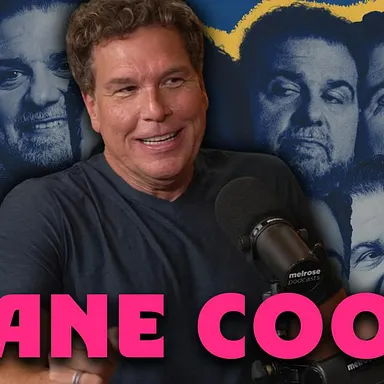
In this South Beach Sessions episode, Dane Cook discusses the family betrayal at the heart of his Netflix documentary Funny Money: The Dane Cook Story, in which his older brother stole millions from him. He describes his childhood in Arlington, shaped by his father's alcoholism, his mother's anxiety, and the acne that influenced his early stage presence.
He also traces his rapid rise from selling CDs out of his trunk to MySpace success and Comedy Central, and recounts a panic attack outside Rockefeller Plaza that cost him an SNL audition. Listeners will hear his reflections on shame, forgiveness, faith and failure, presented as his own perspective on painful events.
In this episode Dane Cook
This transcript of the Dane Cook interview was made with the technology behind HappyScribe's meeting minutes written by AI feature.
Ads in this audio differ from the text. Tap the sentence you're hearing to follow along.
Synced: the text now follows the audio.
You are listening to Draft Kings Network.
I can also show people that, like, even somebody who looks like they got it all together and—like, I don't. I still don't. I still have a lot of the things that I gotta keep in check there, but also the worst possible public trauma. Like, you can figure it out. You can come back from it. You can be better from it. And I wouldn't change a thing from it, which is the craziest thing to say. I would not change a thing. I want to be sitting here doing this now.
Welcome to South Beach Sessions. This man has been at the mountaintop, arenas, tours, movies, but that's not what he's here to talk about. He's here to talk about something that feels a little more like the bottom. The documentary is "Funny Money: The Dane Cook Story," and instead of telling your story, your life, you've decided to talk about how your brother stole a lot of money and other things from you, because I imagine the heartbreak in that was difficult. But I will begin in the obvious place. Tell me about that one year at Minuteman Tech School in ninth grade.
Okay. Two things just happened at once. First of all, it started to feel like we were on, like, the $100,000 pyramid. It was like amping up for a lightning round. But you're realizing, oh, these are not answers that are going to really necessarily equate to winnings. And yet here we are. I'm excited to launch into those things. Minuteman.
I surprised you.
Wow.
I knocked you off balance there. You thought you were going to talk about having your money stolen.
Can we switch?
Yeah, let it fly.
Holy shit.
Yeah.
I am a Minuteman Tech. My freshman year, I went to Lexington. I was born and raised one—well, I was born in Cambridge, raised in Arlington, and then my high school years started at Minuteman Tech. Do you want to know why?
I don't know why.
My dad, who—my parents got separated, but he was still living in the home at that time—he knew I was not. He was a BC college graduate. He was very, you know, mindful about business, and he was an athlete. Broad shoulders. Boxer. Football player. Basketball. Tenacious. Had a lumber yard. Had a window business. You know, my dad was like.
Man's man.
Man's man. You know, had the hands to prove it. Had the workbench in the basement of 101 Wright Street in Arlington.
His son was not these things.
Only son. Born of a mother who—name a phobia, and it was like, you know, spin the wheel. Particularly when she was pregnant with me, she was sort of agoraphobic. Didn't want to leave the house. Didn't want to go outside. And so I was this kid who was sort of born into fear. You know, in a womb. A womb of fear. But with this ability, I would later learn, not at this point, that I'm a pressure player.
I am a participant of the game of sport, but in a different way. What does that mean for Minuteman Tech? They knew I was not going to be the college kid. I was so scared of crowds. I was so scared to go to school. I was scared of everything except for being, you know, at home in close proximity to my mom and just safety. So they decided, "You should go to Minuteman and learn a trade, because they'll teach you that at Minuteman." Arlington High School is like the flotsam and jetsam can roll through Arlington, but.
So I was like, "Okay." Begrudgingly, I went, and I learned in one year, the one year I spent there, I took graphic design, graphic arts, where I learned Photoshop 1.0. Like, the first Photoshop I learned. At the end of that year, I told my mom, who was then separated from my dad, "I would like to switch to Arlington High School and do drama, because I want to be a stand-up comedian." She said, "Absolutely."
My Minuteman years were over, but what I learned in that one year in graphic design and. Cliffhanger it, but it would help me much later in life. So, yeah.
I mean, your whole career blossomed at the advent of the internet with whatever your internet skills were.
Yeah. Internet 1.0, Photoshop 1.0, Dane Cook 1.0. I too needed some upgrades.
I caught you totally off guard. You were.
Bamboozled and kerfuffled.
Holy wow. It seems like you're a little nervous to talk about this subject matter because it's taken a long time to get to the telling of this story.
Can I be honest? It's not. I learned this in my therapy many years ago. Fine line between anxiety and excitement. And when I learned that, it was like, like, "Eureka." I'm very excited to talk about this. I'm nervous about articulating it because it means so much to me.
So for those who don't know, because I was expecting to watch it and get your story, but this is a very specific part of your story.
That is correct.
The whole thing is about a family betrayal of your older brother stealing from you all of your money.
Yes. Hilarious.
There's not a lot of funny in the movie. I was actually disappointed by the fact that there wasn't more funny in the movie.
There's funny when I think it needs funny, and yet this is a very—this is a cautionary tale. This is a drama. This is—there's a lot of moving parts that I think make a person whole, and sometimes it's absolutely what smashes you into a million pieces that's essential to you becoming a whole individual.
Without.
This is my Empire Strikes Back middle, you know, version. We get there. We talk about my career and my brother and how he was, you know, proximity, but we really do focus on this moment.
But you've already, though, sort of articulated something I've always thought from afar without even talking to you, which is some of the things that have happened to you is because in some ways you're a little boy. You didn't grow up. It's jokes. It's funny. You get very young to success, and so you don't have to actually grow up. And now when you explain the closeness with your mother and the fear of leaving the house and everything, it makes sense that you didn't mature until later.
Very, very much so. Yes. Yeah. And handing the reins over to my only brother, my older brother. You know, I mentioned my, you know, his dad and my dad went through, you know, their own sort of capsizing moments that impacted their families. And so for a 16-year-old version of myself that desperately wanted friends, that definitely wanted a brother, I went to him and said, "Why don't we be like the dads for each other?"
I think I said almost exactly that. "Why don't we be for each other what we didn't get from them, and we'll do that?" And he was like, "Okay." And so it began.
One of the things that I recognized this could have happened to me just because I was so focused on my career when I was young that I allowed my father to handle everything and didn't.
From where? I always like, where did you come out of? Where were you growing up?
Miami. I'm coming out of Miami.
Okay.
But I just was concentrating on sports writing, on journalism, on my career, on.
I understand.
On making something creative out of my life, and I just handed over everything to him and never thought about it because I wanted—to my lopsided detriment, I would say—I wanted to just be successful at this one thing.
I understand that.
It's what happened to you, it sounds like, because for your brother to steal at least $12 million, probably more.
Right.
Without you noticing means you weren't paying attention.
I didn't think I needed to pay attention because for who I was at that moment, I could focus on the business of stand-up and what that meant to cultivate a routine and the man hours that, you know, there's a lot of time, effort, energy to get something funny, but then to thematically build an act that could then be sold in the business of HBO at the time, which was like our Netflix today. And so for him to say, quite literally, "You take care of the comedy and I'll take care of paying the bills and your car insurance or whatever," the deep breath, "I've got a brother.
I've got a friend, and now I have somebody who is going to protect me."
I was confused. The documentary created some questions for me. I was confused as to why it is he had to steal all of it. Why couldn't he just steal some of it?
Right. Yeah. You know, some people have said, like, you know, he had it so good and things were only seemingly getting better. I mean, a career is, you know, topsy-turvy, but I was gearing up for the next big idea. And I think he recognized what I had earned this confidence, which is like, "I'm going to go through the spanking machine of this industry, but I'm a maker. I'm going to make something. I'm going to come up with the next idea. I will zeitgeist again.
I will find a way to be relevant with my fans, maybe beyond, but I have this core." And so he knew I was, you know, idea man, and I would turn the corner at some point and go, "All right, what's next?" So I know he saw that in me, but for reasons that people are pontificating about when they watch The Doc, various, you know, hypotheses of like, "Why? Why?" It's still a question I ask. I have my own understanding and theories now, but yeah, why do you think he did it?
It was confusing to me. I don't think it was simple greed without giving away too much of the movie that people haven't seen. I'm still not sure how much his wife did or didn't have to do with what those temptations are. That's left up to interpretation.
A lot of interpretation. Yes.
I have a number of questions, though, about this because I'm curious as to how it happens that you aren't paying attention at all to what's happening with your money, because in my case, once I got to the things I wanted in my career, they had nothing to do with money. Money wasn't one of my goals. I just wanted to make enough to be able to do it.
As the son of George Cook, a brilliant businessman with a terrible disease of alcoholism. And for many, many years, my mom would say to me, "Be the best parts of your father." I heard that a lot. I've never had a drink in my life. I'm 54. I've never had a drink or a drug ever. I never popped a pill. Nothing. That started as, "All right, I'm going to not imbibe," because when the Cook DNA imbibes, and I saw it wasn't just my dad, it was, "Okay, maybe I can sort of, like, change a little bit of history here."
But would you believe it if I said, and I'll kind of speed date this version of the other side, I was so underwhelmed by who I was in comparison to my dad, the BC graduate. Business. Business. Even my dad sat with me, "Do you need help with the business?" And for a lot of years, I would divert it because I didn't allow myself to realize I can be more of my father.
I can be a businessman. I'm business-minded. I know about branding. I can build websites. I can, but why can't I sit with the paperwork? And I can look back now and there were moments where I wanted to know more. Some of it, my brother could keep me a little befuddled, but then a lot of it was just me getting in my own way and not saying like, "No, now's the time that I would like to have a better understanding of how some of these things go." Like, here's a small but easy example. Like, I would like to have known, "Hey, what states am I benefited more for tax purposes or when I go to Canada, and should I book more of these states because it'll benefit the bottom line?"
Versus, like, that's my niche in business, but I would like to have sat and known that so I could better roadmap a tour, right? Just little things like that. But through the documentary, through the experience, I could look back and go, "Oh, man, I really punished my father by not being a businessman like him because I didn't want to, at that time, give him so much of, 'I am like you,'" because of hearing my mom say, "Just be the best parts of your father."
If we had tripled the amount of life, I'd be saying, "You know, I'm going to BC now and I'm going to, I would be more of my father. I just wouldn't be those other parts."
Take me through the process of making the documentary. How afraid of the subject matter were you? How ashamed of the subject matter were you? And why did you decide to share it with everybody?
Like, goosebumps, man. Wow. Like, you know, the cliché of this doc is, and it's one that I still, like, wave the banner on. It's like comedy and tragedy. It really is. It's stand-up comedy. I'm on a generational run. I'm ushering in a new era. I'm at the front, and yet on the other side is like this biblical Shakespearean brother-on-brother, you know, tragic betrayal of love, trust.
And so when it first happened, of course, two things I remember. I was like, I was on the floor of my old apartment and I had never felt that broken in my life. I had never felt I was such a, I had so much humiliation as a kid. I had a lot of self-loathing. I had cystic acne. I hated myself. I would be very cruel to myself, physically, sometimes cruel to myself, emotionally, very hard on myself.
And I remember being after I found out everything and it was coming to light, you know, really, it really is happening. This really did happen. The humiliation that I thought I succeeded past was like I was still that kid. The money wasn't, the money was scary in some ways. It was what he did to me publicly that made me feel like that feeling of the kid with the acne.
He made me feel very ugly and very ignorant and humiliated. And, oh, man, and humiliated, you know, like, you know the, what were they called? Like, remember back in the day, if you, like, petty crime, they'd put you on the gallow. What was it? The gallows?
Oh, yeah. They put your hands in there.
Right. Something.
And they throw tomatoes at you.
That's right. And everybody could come by and they would say like, "That's worse than jail," because like, you know, your aunt is going to come by and be like, "Oh, Jack, you, this is with the tomato. Let me wipe it." And you're like, "Get out of here, auntie." It's like, but when you think about like, yeah, no, I would never, I felt like I was there. That's me with my head and I'm like, "Wow, I'm on the other side of this career now. Things are settling and I think I'm safe and okay for maybe the rest of my life."
And I'm the opposite. I'm not. So that moment was like, I never want to leave this puddle that I've broken up into a million pieces in. And then pretty soon after, the answering machine message that's in the documentary from my brother.
The one where he's very emotional, but it seems totally fraudulent.
Correct. When people hear that, when you hear this message from my brother, I'd gone to the gym. Thank God for Richard, who's in the documentary, my real brother, I call him. He brought me to the gym. "You got to get out of this apartment." I came back and I hit play and he left me that message when I was away. I never heard from him before. I never talked to him since, but he left me that voicemail message.
What have you done? What have you done, Dane? What have you done?
What have I done?
What have you done?
What have I done?
What have you done bringing the FBI into this?
That's right. Right. This caustic, theatrical, and it's filling up my apartment and I'm staring at that answering machine message. And the first thing I thought of, maybe the second, because I know I was like, "I need to call my attorneys. I need to save this because I know this is a piece of a story." So it was the first time I was aware of like, creatively.
The scales had fallen from your eyes at that point too, right?
Yes.
Like you're hearing that and you're like, "This is total bullshit."
This is, I'm going to like, make it flowery. This is my story. None of this shit I've been doing in stand-up and like indicating and projecting, like, this is who I am.
I'm going to go to the center of my pain and this is where it starts.
Couldn't have, that's it. That's exactly everything that I felt. And then years and years go by where all I'm trying to do is circumvent it and, you know, I'm going through therapy and I'm faithless at that time. I am out of my faith. Yeah, I'm rogue. I had some choice words for the man upstairs who I really had a loving relationship with early in my life, but I digress, but it's like, so I'm faithless, I'm loveless, I'm not lonely.
I'm just sort of like rock and roll for a while and like living off the fame that I had and I'm that, you know, but I'm really not present. I'm in the past. I'm not only in the past of what my brother did and hurting. I'm really still the kid. I'm Minuteman. I'm that kid. And I'm looking forward in all the wrong ways. I'm putting things out that are just negative.
Just negative. And so there was a lot of work to be done and getting sort of past that for a moment. The doc finally, I talked about it on Tom Segura podcast. It was the first time I sort of went into like some of the details and production company heard it, called me up. They said, "We can get you a grant for so-and-so. Are you ready to tell the story?" I said, "Yes, I'm ready to tell the story. I'm not only ready to tell the story, but I'm ready to really relive it and on camera to figure out how do I feel?"
So what you're seeing is really me sitting and saying like, "I don't know the questions that are coming, but I'm ready to like profess and confess and refess."
It's going to be really therapeutic for you as you do some of the promotion here because you're going to keep rummaging around in this bin and there's going to, did you have any outlets other than therapy then? Who were you? Were you so ashamed that you didn't want to talk to anybody?
Stand-up. Stand-up comedy is my, stand-up comedy gave me a life. Stand-up comedy saved my life. I can promise you that whether you see me perform, if I perform tonight or even in that time, the moment my foot steps on the stage, I feel purpose. I feel absolute purpose.
But that's not an outlet for this conversation, though, that you weren't finding the funny in any of this.
I am sliding bits.
Now, though.
No, even then, even then I'm like little flex of, you know, oh, and by the way, and sometimes I'm ringing it out in something that you don't realize I'm talking about my brother, but I'm talking about crying and I'm talking, there were ways that I was using the stage as like an outlet and then like my lifestyle after the show as a means of hedonistic escapism and comfort. But not until I sat in therapy did I really sit and start going like, "How has this changed me?"
You turned him into your father by your own admission by, so if you, that size of betrayal from your father, even more painful than having the real father be an alcoholic.
Very different, but yeah, very, adding to that, the stack of reasons to be humiliated was also like, man, I picked the worst possible person to love me and can find, it's like, yeah, no, you can, we can spin a wheel and pick like, well, how did I beat myself up over, you know, decisions that I made at that point? It was like, like bad idea of the day and I was beating myself up quite a bit.
So when the shame makes an appearance, is the shame of it that I was such an idiot? Does that feel even bigger as a humiliation than the betrayal?
It's on par because I had so much pride when I would put my armor on my brother and say, "I did it, but he was there to, you know, he's, you know, we sold merch together at the first merch tables and we packed the boxes in the car of the CDs that we didn't think anybody would ever.
But it could be such a beautiful story if he were actually just along for the ride with you and just doing that job.
Oh, 100%. Yes. I mean, a beautiful boring story that maybe most people wouldn't know, but beautiful for me.
But yeah, it's beautiful in terms of love and family. Yes. It's not a documentary anybody will want to watch.
It's a canceled reality show on PBS. No, it for sure was, there was a lot of, I put myself through a lot of punishment and turmoil, but it wasn't just because of what happened with my brother. It was also because I hadn't properly understood my own personal constitution and truly who I was from that kid.
So it was like, oh no, I have to do all the work. I have to do the work of I'm an adult child of an alcoholic. I saw violence in my house. I didn't know till years later I could now simply describe to somebody. I lived like on a, like, you know, a boat. It's like I was, it was always skewed because we didn't know who was coming home that night from the DAV where he'd stop and have a couple of pops after the window. So I thought everybody lived, you know, sort of sliding down.
I didn't know until I had my own home and really understood what it was like to have like, you know, level ground. I had to do all that work. I had to really rebuild my whole foundation.
Let's talk a little bit about your upbringing and what you were just saying. A follow to what you were just saying. You were doing physical harm to yourself because of the acne?
As a kid, yes. I would go into the bathroom and I would, you know, if I had like cystic acne is like, you know, pimples on pimples and, you know, like over here I had like a canyon of, it was, I felt like, I remember that there was that movie The Elephant Man growing up on HBO. I'd always end up seeing it like late at night and like I was, I felt like that. I didn't want kids at school to look at me. I didn't want to be looked at. I was really, really like very, very hard on myself because of the acne.
And so yes, I would go into the bathroom and sometimes I would come out like, you know, bloodied or having to, because I was trying to, you know, make them go away, but really I was, you know, being cruel and unusual to myself because I felt, you know, gross.
Was that happening because your mother's afraid to leave your house? The dad, your dad's an alcoholic? Because you talked about.
Like stress, are you saying?
Well, you said it was self-loathing, it was insecurity, it was anxiety. You didn't want to leave the house.
I don't know. Those 80s cereals that we were eating and I was, you know, it was probably a lot of the ingredients that were making waves.
Sugar, radioactive sugar.
I ate horribly. I ate crap. I will say from all my mom's love and she was my champion and my compass, but she did not like, she'd throw hostess donuts in front of you and it's like whatever. And I was also so finicky, she would sort of like make me what I wanted. And when I look back, it's like, yeah, terrible diet and made worse because I'm depressed because I don't look presentable in any way. So yeah, no, just insult to injury.
And comedy ends up saving you here, like giving you confidence.
Wow. Okay. So I realized something that I never in three decades, something came to me the other day just out of the blue. I wasn't, I, people always say like, you're so energetic on stage and I had like a genuine affinity. I loved the Jerry Lewis types and the Martin Shorts and I really loved Go For It, John Ritter on Three's Company. Like I just loved.
Physical.
Physical, brave, really brave. Really, it's brave to, you know, corral a room like that. But check this out. I told my wife this. I said, "When I first got on stage, when I first did stand-up, I think a lot of that energy was so you couldn't look at my face." And I just realized this. I was moving around because if I stood still, you might see scars or, you know, or acne or, you know, even though it was clearing up by then, I got some great medicine.
I was with a dermatologist. I still like felt, but a lot of that physical, I've never said this before. I've never known this till recent.
It was a costume.
It was movement was like stillness means you're really seeing me. And the movement and the physicality was like, you can't see me. I'm all over the place. Whirling dervish up there. And so that was part of a safety mechanism, but I loved, loved making people laugh. I mean, I knew the first time I did it, I said, "This is what I'm going to do for the rest of my life. I love it."
So all of this happens at the same time. You lose both of your parents to cancer. Your brother is stealing from you.
Years later into the career. Yes.
And you're reaching the heights of greatness.
I'm there.
Like, and, but so all of it happens together.
Yes. Yes.
And so are you able to enjoy it? Like when all of these, like these seems like seismic events.
Yes. I was enjoying the shit out of it. I was loving it. I was reveling in it. I was celebrating with my fans who put me on my map and I'm doing SNL and I'm on Billboard charts all because of me. I did it. I created the albums. I could identify at that moment like my wild, fantastical notions and absurdities and irreverence and all these things. Love of vernacular from my dad again was like a wordsmith.
Physicality again, naturally from my mom. It wasn't just a put on, but it was definitely like something I did to maybe keep you from honing in. 2000, like one, two, three, four, five before my mom told me she had cancer was like just gold. My brother's my brother. My parents are healthy and watching me do what I said I was going to do. My fans that believed in me from the beginning.
Not what you said you were going to do, wildly beyond where your expectations had to be.
And beyond. Yeah. I was like, I would hit a finish line and then I would take it to a place that I'd then call my mom and say, "Remember how I said I was going to do that thing? Well, they want me to do it too." And by the way, then getting a phone call, "We want you to be the lead in a film. Your big Irish head is going to be on the big screen in a lead of a film." And to call my mom and say, "I'm doing this," you know?
But my brother, for the years that I was like, no one's ever, I'd say to him, and it's in the doc, no one's ever going to want to look at my face on a, maybe on TV, on like a small TV, but like I'm not going to be a movie star. I'm not going to be, and yet I got it. I'm going to do it. Mom, I'm going to be a lead in a film. So for those years, it was, it was music and celebration. It was awesome.
Walk us through it. We'll go through the bad stuff, but walk us through those four years.
Yeah. So it starts with like, I'm in no business for a lot of years. Hollywood is like, "Yeah, no, we already have somebody like you. We don't need another one of you." You arrive here. I got here in '97 thinking like, "I'm going to, this thing's going to lead to that." No, I got here. I was on a TV show where Betty White played my grandmother and Marie Osmond played my mom. And I was discovered for this role in a San Francisco, The Punchline. One of the producers saw me and said, "We want to add some energy to the show and you'd play Betty White's grandkid.
Have you ever done television?" I'd never done television. I did like a little musical theater. I said, "No, but you know, I study it and I'm a fast learner." I come down, I do the show. I end up staying here in '97, but I think I'm just going to like, "Now I'm in." No, it's like, now I'm languishing and I'm on a show that was considered terrible and canceled, but Betty White was awesome. Stories for another day. The best. Oh, the best. And so now.
You slept with her, right?
I remember Betty every day driving in onto the Disney lot in a beautiful yellow Buick. And God, I was like, "I'm working with Betty White."
That's pretty great.
She was pretty awesome, man. Yeah. And she was a hot ticket. She liked dirty jokes. So now nothing's happening and this new internet thing is starting to take off and I'm quickly realizing as a like a homebody geek, when I'm not on stage, I'm home. Like as a kid, go home, safe. I'm safe at home. And I'm like, "Wow, this is a place where I can be close to people without having to be."
Close to people.
Right. Exactly. This is a stage, but I'm still a million miles away, but I'm right there. And I will tell you, I've told this before and I sort of love, this is like maybe one of my pat myself on the back moments. Like I knew within two weeks of being on like MySpace and seeing like I got 3,000, I went, "If I can get 3,000 followers from zero in three weeks being who I am, well, watch this." And then what happened was over those years, again, no business. Comedy Central, they didn't want to give me one of their half hours.
They didn't want to help me out in any way. Pass, pass, pass. Had a manager who really, you know, finessed it, got me in there. And then not only was that special, it was called the Comedy Central Half Hour Comedy Hour. Not only was that a like boon and changed everything, it was the most aired anything ever on Comedy Central. Twice a day, every day. My college numbers start going from a few hundred to a couple thousand to six, seven, eight thousand.
Young people make everything popular.
It was like that was underground cool. I was just starting to get a little mainstream from Comedy Central. People knew it, but I was just in that sort of like, "All right, things are starting to like, I'm feeling it," you know, the trajectory. And then I would say like 2002, '03, '04, '05, making money, access to like, "I'm in the locker room with the players after the game and they're fans." And so all the good time Charlie stuff is really happening up until, you know, when my mom got sick.
When my mom got sick, that, everything changed at that point. But for those few years, man, it was like, like I think I put on my MySpace picture, it was a posted. What now? Question mark with the fans. Like what do we want to do? Where do we want to take this? So it was awesome.
All right. So take me through though, how surreal it was. Give me a snapshot of four or five of the moments that you found yourself in during that time period where you're like, "How the hell is this Boston redneck able to do this?"
Yeah, yeah, yeah. This kid who for many years, and this was in my act, full disclosure, I used to say, "I always thought we were lower middle class. I later learned we were upper poor." And it was like, "Yeah, no, first of all, I've got money to take care of my family, right? My mom first. You know, where do you want to live? Where do you want to, you know, is there a nice coat?" You know, like all the things, you know, the tropes of like taking care of mom, right? And dad, but not so much. Dad was still a little bit old school and like, "I got it.
I don't need your help anyway." So take care of mom. And man, there's a lot of things I could point out, but I will tell you that selling that first album out of my trunk for a couple of years, I edited it myself. I, you know, made the font that I learned at Minuteman Tech. I learned how to create the vectors and the shapes and layers. I learned layers and I made my album. I made that first album. I hand drew the entire track listing, which I love.
There's still secret hidden things in there in the original that people find sometimes because I would hide little, you know, little quotes or something. You had to turn it a certain, "Oh, that says something." And so the track listing and poured my heart and soul into that, sold it out of my trunk for a couple of years. So the moment that I would say first is Comedy Central calls and says, "We're doing an, we're starting a record company. We've got Dave Attell's Skanks for the Memories and we'd like Dane Cook Harmful If Swallowed." And I got my first record deal. So that was a moment where I went from like, "Wow, all right, selling this out of the trunk and now I'm going to be on store shelves."
So that's one of a few.
But you were also cool, right? So you're getting the opportunity to just meet an assortment of people that you would have no access to if not for this time period, correct?
True.
So who are some of the people or the situations that you're finding yourself in that you think of as the happiest ones?
Heads of networks, heads of, you know, Jack Vaughn was the guy that was going to run the comedy division at Comedy Central. Lauren Michaels coming out to see me perform, bringing with him, I didn't know till after I got on off stage. He came and saw me at the, this is before I didn't host yet. They were contemplating bringing a comic in like they did with Billy Crystal in the early '80s to be like a stunt year. And they were contemplating doing that with me. Like, well, Brandy, his popular, he knew I was huge with the college kids and they wanted that audience.
And even though that didn't work out, he came to the comic strip one night. And when I came off stage knowing Lauren Michaels was there, again, just that moment alone, Lauren Michaels is here. SNL, Martin Short doing Ed Grimley. The guy that made that is here. And my buddy Matt runs up, "Do you know who he brought? Do you know who he brought?" I said, "No, who'd he bring?" He brought Steve Martin. And Steve Martin came up to me. And now I'm meeting the guy that really was like the first arena comic, the guy that gave me the idea at all. Like, I guess comedy can take it there to that big venue.
So to have Lauren not only see me then, but I think it was about a year later, Retaliation, my second album, sophomore album, which is supposed to be Sophomore Slump. Uh-uh, no, we're going to go even higher. Higher charts, record breaking. Lauren Michaels calls me at my hotel. I'm at the Las Vegas Comedy Festival. Phone call for Dane Cook, Mr. Lauren Michaels. "Hello? Dane, yes, you're hosting." And he just offered me right there, "You're hosting."
Gave me my date and I was going to host SNL.
Weren't you offered the job to replace Adam Sandler that went to Fallon or no?
I was not. Nope. I actually never went in, I never went in to the meeting that would have potentially put me in the running. So I had an anxiety attack out in front of Rockefeller Plaza, like full on, like I'm crying. I'm sitting on a bench and I can't breathe. I'm hyperventilating and I'm bawling. And I find a payphone. I call my manager. I go, "I can't go." And he goes, "You have to go in. You can't blow SNL off." And I said, "I'm not going." And I didn't. So I thought, "Oh man, not only am I missing my moment from fear, but I may never get it again because they're going to be upset."
The anxiety attack was because it seemed too big to you? Something that would have been a dream?
Oh man, the anxiety, you have good questions. The anxiety attack is because my manager had also managed a couple of the comics that were on and I had learned from some other comics in the village that I'd been performing with that my manager managed that it was real cutthroat. See, comedy is very competitive and more than even people think. And as the broad-shouldered son of George, I hoped and wanted it to be athleticism, that if you're in front, everybody goes, "He's in front because he does."
It's not. It's real hardcore. It's real rough comedy. And I knew I wasn't going to, I knew that if I can get on stage, I'm good. Once I'm on stage, I got it. I know what to do. Fighting to get onto the stage at SNL, I was not ready. I was very beta and I was not able to fight for my ideas at that time.
You were too anxious to audition for them?
Yes. Yes. I remember the morning of Marcy Kline, who I'm still great friends with to this day, you know, calling and saying, "All right, we've got you coming in. You're going to go up third and it'll be in front of like, there'll be like eight of us, maybe some of the cast watches." And I got myself ready, ate a good lunch, did everything, walked around, called my family. I was, "Ah, I'm doing it." And then as I walked toward Rockefeller Plaza, I had a fucking full-on collapse.
I was like, "I'm not going, I'm not doing this." My dream, my everything. And I'm like, "I am not." No, it wasn't like, "I might not do this and maybe you can talk me into it." It was like, "No, I'm not doing this." Like, "This is the end of this dream right here." And I didn't go in.
How physically far were you from where you were supposed to be?
I know the bench. I still see the bench sometimes. It's funny, I walked by the bench, I went to the 50th, they invited me to the 50th anniversary night and I was by myself. I flew back, told my wife, I was like, "I got to, I go back alone." I walk up, one of the local cops goes, "Dane, fucking guy!" Like, "What are you doing?" And I go, "I'm trying to walk over to SNL." He goes, "I'll walk you this way. Come with me." And he like brought me some. And I said, "Oh, wait, man." I said, "This is where I sat." I said, "I sat right here." I'm telling this cop and, you know, dark night in New York, raining. And I said, "Man, I sat on this bench.
My whole life I thought changed for the worst because of what happened on this bench." Later would find out, of course, it was the best possible thing because I was going to start my journey and not have to be on any, you know, it'd be a beautiful thing to be on that journey and look what Jimmy's done with it. Beautiful life, career, family, but that was not meant to be my journey.
Had you had an anxiety attack before that at any point in your life?
So, oh man, okay. So the worst one, I had one at school one time, which was real brutal. And oh man, I was so scared too because I didn't want people to know. So I'm like in a coat room and I'm like, and I don't know any steps to like, I don't know, I put my feet flat on the ground. I'm not doing any.
No soothing techniques.
Oh dude, it was like, you know what it was like? In New England, there's like, you'll play these like shit gigs coming up and there's always like a painting of like the ocean at its worst, like an evil ocean, right? With a lighthouse and a guy in a yellow slicker. Like I felt like that painting.
The Robin Williams painting in Good Will Hunting.
I felt like, oh man. So that was the bad one. The Rockefeller Plaza one was probably maybe the second worst. And then in Nice, France, I had one that was so bad that I was like catatonic where I couldn't move. I'd never had that happen. That was really scary. Like I couldn't physically move for like what felt like an hour. It was probably the 17 or 18 minute of, but it was scary because I was like, "Oh, I can't move my hands.
I'm barely shallow breathing." But beyond that, no, just like traditional bad anxiety, but not like where if I was driving, I'd be like, "I can't operate this vehicle."
Did you understand after getting up off of that bench what you had done? Did you feel like a coward? You couldn't have been very easy on yourself.
I think it wasn't until maybe like a year later where I was in like Shitzville, nowhere on a terrible gig where I remember looking at the TV and probably saw a promo for SNL and I'm in this, I just looked around and I was like, "Oh no, oh no. Like what did I do?" You know, I'd lost hope for like the '98, '99, like those years on the road.
And also too, because like I just, I'm fine now, but like for those years, I don't know how I did it because leaving the house was already hard enough, but to like get on a plane or a train and go, it was like, yeah, no, it was the worst feeling in the world being alone out in the middle of nowhere and realizing, "Oh man, I was this close to my dream and now what did I do?"
Do you think that you have anywhere in wherever hereditary is, if these things are hereditary, whatever your mom had about leaving the house? Like do you feel there's some imprinting there?
100%. Like that was absorbed, I think, in me. Because the interesting thing, I think is interesting is like, and even with the doc, even with like when I look at it now, it's like, and I know my brother knows this. Whoever he really is, I know he knows what I'm about to share with you, which is like, I am my father's son and I am a fierce competitor with myself.
I like to compete with you if we're playing racquetball. Like I like to compete, but not as much as I like to compete with me hearing myself say, "I don't know." And then me saying, "Oh yeah." Like all happening here. And so I think it's like that pressure player of seeing SNL, being in the middle of, "Oh, whatever." And then somewhere in that next day or two, being like, "No, I'm not in the middle of fucking nowhere.
This is part of the story." And believing that, the same way with the doc, when that happened, I finally went, "No, no, no, no, no." This is like, and now I say this a lot to people that I'm like mentoring and just like trying to build up. It's like nothing's ever falling apart. It's only ever falling together. And I really believe that in my heart. Things only fall apart when you stop and don't move past it. Then it did. But if you keep momentum and you keep moving, it's always a learning moment and it's always like, and I believe now in my faith, because I'm full of faith, I'm not faith lost or faithless, is, "Oh no, this was a beautiful obstacle that led me to a destination that I was meant to be at."
What are the scars you wear from your dad being an alcoholic?
The first thing that I, it's not the answer that you're looking for, but the first thing that I just have to say because it's what came to me.
I'm not looking for a particular answer.
It's just like, it's the scar of not just finding forgiveness for him and understanding what he went through as a kid and what his dad did. It's just not getting there soon enough. I did get there and we had a really lovely renaissance, my dad and I. And it involved sports and it involved the Red Sox and it was kind of like our field of dreams. But a lot of lost years.
And then when cancer got him and he was 72, you know, even though I was grateful that I had those moments with my dad, the scar is like, "Oh man, I spent a lot of time trying to punish him with my success to go, 'This is what you could have had if you were better to my mom and better to us, better to yourself. I'm sure you could have done all this.'" That was like sort of like keeping him in timeout for as long as I did is the scar that I wear.
That's interesting that you don't forgive yourself for being more forgiving.
Yeah, no. Yeah, no, it's not like, yeah, I guess that's just not how I processed or.
I mean, it makes sense that you would be angry at him. It's very human.
Yeah. I'm in this very interesting place in my life and again, in my wife and I's journey with faith of just believing there's something more beyond this life and all of these things and even the missed moments are not to be, what is that word? Ruminated on to the point of exhaustion. It's like it was what it was or appreciate you had what you had and it's all something I've learned to take forward and hopefully share it or in the doc or with people that I meet.
It's like all stuff that I go like, "Oh, I just want to bring this back out and now be as close to people as I can." It's funny because now it's like, "I want to know, I want to be closer. I want to be in, I want to see each other face to face. I want to know what your scars are, the way you're delving into some of these things that I've not spent a lot of time really looking at until today." So yeah, I lost the plot a little bit.
It's very adult of you though. It's very like you, if I'm saying that from afar, you seemed like a little boy who didn't grow up when you consider love, marriage, faith, trusting your wife to lead you a little bit in the places where you're broken and she accepts those vulnerabilities and loves them up. Like it's adult of you. That's a very adult answer to say that the scar I wear is the regret of not forgiving him sooner so I could have had more time with him because I allowed all of that human bullshit to get in the way of what should be love and God and connection.
So it's cool that you would arrive at any form of forgiveness. Some people take that resentment as poison, hoping to harm somebody else and go to the grave with it.
When my dad was on his, I hate the term deathbed. I'm trying to find a joke in there or like a term that's like my, you know, I'm way too tired to get up bed or something else.
You're trying to find the deathbed joke.
Trying to find the deathbed joke. But there was my pop and I had understood, listen man, he went through some real terrible abuse. It made me understand not only why he drank, I even understood how he drank because the dreams he had for himself, he didn't, they didn't, he was this close and he imbibed and was destructive on purpose. He really did, I think, choose alcohol because his dad hurt him.
His dad loved what he was about to do and it was like, "No, fuck you. I'm going to hurt both of us." And so I found forgiveness with my dad and we had these beautiful sort of father-son moments, but it was really when he was there in the final moments of his life where, you know, I had a great, great, you know, I just, he lost his ability, he had a stroke and he had like some form of like, I guess you call it like a locked-in syndrome of like verbiage.
He was repeating words and he couldn't, he would say like, "School, school, school, school, school." It would just be one word that he'd say over and over. That was one of them. "School, school, school, school." And he'd be frustrated because he's only saying school and he thinks he's saying, "I could eat something." And I just started talking sort of like at him to say like, you know, "I love you, Dad. Let it go. It's okay. I understand. I know your value. I know what you gave to me." And I just kept, I just wanted him to pass knowing it's, "You're good.
We're good." So we had all those. And you know what's amazing? Oh man, my dad was a very strong guy. Like brick shithouse builder, you know, old school Boston guy, like this solid. And the stroke, he was very weak, but his left hand, he reached over and he grabbed my hand and we're like sort of talking and praying and it's this moment where I'm saying, "So like I know what you want to say and I know if you want to say like, 'Yeah, you know, I could have been better to my daughters. It's okay.'" I'm sort of saying for my dad what I think he and he's squeezing my hand.
Holy shit, he's strong, man. He could have broken my hand. He was squeezing it so hard. I'll never forget. I say to Courtney, my sister, who's also in the doc all the time, "I'll never forget how strong he was." As a matter of fact, something else I don't know if I've ever shared, he was moments away from, you know, the last moments and then yet he put his that strong hand and he made me help him up because he wanted to stand with me one more time. And he held onto my shoulder and gripping, you know, that.
And man, I'm telling you, it's like I feel like he could have snapped my, he was the strongest he'd ever been in that moment. And he did. He stood up and I kind of stood there and I let him stand for a second. It was all he wanted to do was just stand on his own. And so I do have those, I did have those moments, but I also knew that once I walked out of that room and I moved back towards the very things he raised me to do, take care of business, this is before my brother, just take care of your business. Made him proud. Dad, I signed a contract. He didn't care what it was for. He liked that I signed a contract.
That meant I was doing business. So when I left there, being the person who's maybe just by good luck, I had a few of the seeds already to go like, "This I can leave here now. It's time to move forward. I can't carry all this stuff with me until it's time to share it for hopefully the betterment of a conversation or whatever." But yeah, so.
You mentioned that comedy is unbelievably competitive. It's unbelievably cruel. The Norm MacDonald quote is, "Comedians are bitter and jealous and don't want anyone else to have success."
You said that really?
Yeah.
I didn't know that one.
Well, I believe you're sort of the embodiment, right? Because I believe that while you're beloved, you also had a lot of comedians who weren't exactly rooting for you as you were on this rocket ship past all of them.
Yeah. And yet there I was still because I wanted to have that community. I really wanted collaboration and just being on the playground in a sense was all I wanted. And here I was now, I'm like alone on stage at the helm, even lonelier. And at the top, super lonely. Colder, the food's better, but everything else is like, it's not all it's cracked up to be. But then I'm a target and all these other comics are hearing for years is like, from Morning D, "Why don't you do a Dane's?" Like it's that easy.
But there I was, I was still just like, I would share my playbook with anybody and everybody. And all I wanted to was to feel like I'm leading the community in a way that like, "Hey, if I'm winning, it's probably good for everybody because comedy's in vogue right now." And so to me, putting a win, again, I'll bring it back to my dad, athleticism. What's ingrained in me is like, "If I win, by proxy, people are going to win around me." And then maybe if you see how I won and it's different from your competitive method, maybe you learn something from my base core beliefs that makes you go, "I should implement one of those, not the rest, just the one."
And maybe you're helped. And that's what I feel like I'm here to do. Entertain people, inform people, champion people. And I want to make you laugh past your cares, but I hope with this documentary, I can also show people that like even somebody who looks like they got it all together, like I don't. I still don't. I still have a lot of the things that I got to keep in check there, but also the worst possible public trauma. Like you can figure it out.
You can come back from it. You can be better from it. And I wouldn't change a thing from it, which is the craziest thing to say. I would not change a thing. I want to be sitting here doing this now.
You wouldn't change anything because the pain on the other side of the pain is growth, right?
I would not change a thing except I miss my brother. I miss that guy. I miss the way like in seasons of your life, I'm sure you, there's some people now you go, "Why aren't I friends with Tom anymore?" And you go, "Oh man, I miss Tom." But if I said, "I'm going to set you and Tom up for two weeks, you're going to fucking hang with Tom for," you might be like, "I don't know if I really need to hang with Tom." But you miss the idea of who you were and who Tom was and what you did together.
Oh, but my brother was my best friend. This was your closest, like this was your.
I miss that guy. I miss those conversations. I miss the minuscule world building before it became a bigger, exciting business and one that I do love to, I like the tools, but I liked when we didn't have many tools and we were cobbling. I miss that guy. I like that this documentary, it isn't just an attack, it's a celebration of love with that guy in this moment in my life that helped me to get to where I needed to be.
One of the most stunning things in the documentary to me is that you offered him the forgiveness of the $12 million debt in exchange for participating in the documentary and he declined.
That is true. Yeah.
What is that?
I don't know. I think in the offer I'd offered to sit with him like this. I think that was part of the offer. So maybe he blanched at that because I want to sit. That part of the interview will be him and I. Because remember, I'd only seen him and I explained this in the doc and I hope people really, for the portion that we spend on this was when I had to do what's known as, I had to go into the courtroom to see him. That footage of the courtroom and like that's Darryl sitting there and I got to walk in and I have to read what's known as a victim impact letter to the judge and to the state.
And that would be the first time and last time that I would see my brother. And so, yeah. Yeah. I can see his eyes right now as I'm sitting here. I can see that look that he gave me. I could do a sequel based on the look and what I was thinking in that moment and who was he in that moment.
And I remember what, and by the way, I said the only way I'll come in, I had a letter in my pocket. I said, "The only way I'll come in is I just, I don't want you to call me a victim," called an impact letter. Because at that point, I'd already started to realize like I'm not a victim. I am, and years later I could look and go, "Yes, I am a victim of it." But I didn't want to put myself under his thumb even with that word. I wanted him to remember that, and I said it in the letter that I read to him, "You could take whatever, but you can't take what's in here."
You know? I think he wanted maybe what's in here. I think he wanted to feel like he had the idea that would later become the thing. Because he was always of service to that idea. I was the one who went, "I tell you what I'm going to do. I'm going to build this." And he went, "All right, what do you need?" And he was sort of like a worker B, but I thought he loved that role. So that was our conversation. That's how we did it. But I do, when I think of his eyes and I think of them talking about this quite a bit lately, is that look he gave me.
Almost like he was still looking for what he didn't have. Almost like he really was still looking at me like, "Say mom, I don't know. Why don't I have that?" My mom would say like I had the sparkle. Even when I was like, "Who am I, mom? I'm nobody. I'm nobody. I have no friends. I'm not picked for anything. I'm like nobody." And she'd say, "But you have the sparkle. That's why they don't pick you." I'd say, "Well, what the hell are you talking about, lady?" "Mom, what are you talking about? I'm literally the wall flower and even the wall doesn't want me hanging with it."
She said, "Nope, I'm telling you, Dane, they want what you got." And I chose to believe that. I wonder if maybe my brother hearing that with her right next to him was like, "Hmm, where's my sparkle?"
It's possible that he resented all of your success.
It's possible. It's possible. There's a lot of things that are possible. There's a lot of things that I can't wait for more people to see the doc to be able to say like, "All right, let's hear your prognosis."
Well, it was weird though too, though, to have it theorized that somehow he felt like he deserved the money. I didn't quite understand that part. Why would he have deserved all of the money?
Well, he had a lot of good bad ideas as well. I think that, you know, I guess, you know, when it's, you know, I have to say like jokingly in, you know, I guess it's whatever you want to deem, dark humor or whatever, like I say to people, "If you're going to betray anybody, go with love. Betrayal with love is the best one." He picked, for what he is, he picked good. That's the one I would have used on me as well. Betrayal. Which one should I use with Dane?
Love. And so he played the right fiddle of nefarious. And I just tapped my toe and went right along with it. Sad for him that he would do that and need to do that. But then when we start like looking at these pieces of it and go like, "All right, but wait, who was around him?" You know, again, I'll let other people sort of like throw their theories my way. And you know, it's not the end of the story. Because he's out there. We're not talking about a guy that's not in the world.
He's out there. This story is not over yet. This is the beginning, I think, in some ways.
It sounds though like you still have questions. Like you still, while this is a form of closure maybe that you're aiming for, it sounds like you still have things you want answered.
I still have questions. I still, you know, I made a promise to my mom. Actually, the four of us did, because he's got a sister, Kelly. Darryl and Kelly from my mom's previous marriage. Courtney and I are from George and Donna. I made a promise to my mom that we'd stick together. You know, before she passed away, even though she had some insight on who he really was and tried to warn me, you know, I remain, I don't know if the word is optimistic.
Maybe that's not the right word. I remain, there's an invitation for closure beyond what we do in the documentary.
Your mother on her deathbed, which we still haven't figured out how to make funny, she also warned you.
She got caught. There we go.
She warned you. She warned you why, like she warned you why and how that keep an eye on your brother.
Yeah. I'll let people sort of see what we investigate there in the doc, but really a lot of it came down to she knew who James McCauley was and I would later learn who he was. And he was not a good person. And a lot of that McCauley DNA is very questionable DNA. And so I'll sort of let people look and say, "All right, well, you know, it's not that you can't, I broke Cook's legacy of drinking." Darryl's son, Cody, I'm very close to my nephew still.
He was 15 at the time, 30. Great man, good person. It's like I'll let people sort of see that conversation with my mom and I and there's a few different ways to sort of skin it, but for the sake of this conversation, I think really what my mom was saying is like, "I saw traits in his father that I sort of get with him and you got to be careful of that." I wish she had just said, "It's time to really grow up and know you can handle anything."
Not just what you had to do with the career, which was hard. You can really handle anything. I just wish she said that like one time leading up to that. It wasn't just about what you can do with prowess on stage. No, you're ready to handle any pain or personal strife. You could do that as well.
You came up and add names to this. You came up with Attel, Chappelle, Bill Burr. Give me some of the other names you came up with that are of the most majestic.
Patrice O'Neal. I miss him. He was probably one of the guys that like you're naming that, except for Attel, like I really feel like Patrice impacted the culture of stand-up comedy. Certainly impacted my life with him and road years that I was hanging out with him. When I think Al Delbenny is in the documentary, Al Delbenny I went to junior high school with. He was the first friend, you know, in school, anywhere that I said, "I want to be a stand-up comedian."
And what did he say back to me? "I want to be a stand-up comedian." I said, "Are you serious?" I said, "I want to be on SNL." He goes, "I want to be on SNL." So we had the same dream.
Did we just become best friends?
We became, you know, and talk about like Goofus and Gallen, it was like, "I'm the, I don't drink and I'm, you know, I'm the quietest, I'm like a meek." And yet he drank, you know, Jäger before school and had to be drunk all the time because of things that he had experienced in his own life. So unlikely friends, got into drama together when I finally switched back from Minuteman and go to Arlington High School, meet my mentor, Frank Roberts, changed my life. Absolutely. But Al, who's in the documentary, like it was really him and I starting in stand-up and, you know, just staying motivated with each other, driving to gigs and all that stuff.
So from Chappelle and Attel and Bill Burr and Patrice O'Neal, who was the funniest amongst you?
I think Patrice, I guess I got to say pound for pound. I know that's a joke at Patrice, but no, truly, it's like he could make you laugh even when he wasn't trying for the crowd. Like he could, we could be in the back and be like, "I know what he's doing here tonight." So he was ahead of his time. And I think Chappelle, I mean, Chappelle is like, Chappelle is Chappelle. Like when people go, "Who's the best comedian?" Like there's comedians, there's all of us and there's like Dave. Dave's like on his own planet. He's a phenom.
He really is. Like how he came up and his story, like is amazing. But watching Dave in New York when I got there was a masterclass. And being alongside Patrice as we came up, I felt like I had, I felt like he just knew things. He'd picked up on things that when he'd share them with me, immediately sort of penetrated. I was like, "I need to do that in my stand-up. I need to add that quality. I need to add what he, he was just very no bullshit."
And so those two guys really helped shape me early on.
What have you learned from your wife, Kelsey, about love?
Everything. The first real love in my life besides, you know, your mom, a very, you know, unique love. Real love, deep, meaningful. It's funny, when I met Kelsey, I instantly saw in her a lot of things that I felt I had experienced.
Like sort of like she was like very quiet and not insecure, but like just real. But my nickname for her early on was like, I was like, "You're like a little bullet because anything you shoot yourself towards, I know you'll get it." And Kelsey, Kelsey and I had a conversation that was like, it felt like going on for days, like sitting on the porch and like talking about who we were and growing up and her parents and she shared some very, very turbulent personal things that she'd gone through with her, with her parents that I understood and that really spoke to some of the things that I'd experienced.
By the end of this very long conversation that again, I know it wasn't dating, it felt like we were out on this porch for hours and hours. Like I knew that I genuinely was like in love with the person. Like I felt like a real something that I had never felt. A few years later, Kelsey would bring God. Kelsey is the conduit to everything that would then be like the adhesive and the real glue of what I believe your life should be, which is like your spirituality and faith.
And man, and I'm still learning, but, and there's still so much that I want to learn. But it was a, I'll share it real quick. Super beautiful pivotal moment where I knew like this is the girl.
You don't have to be quick. You don't have to, you don't have to rush through this.
Well, because some things you think are like only really interesting to you. You know, there are moments, I've been performing for a lot of years. You start to know like, all right, now I'm talking for me.
Oh, so what's interesting to others versus what's interesting to me? I just asked you about what you've learned about love.
No, no, no, no. Okay, okay. Point, counterpoint. I got you, I got you. The long version was I had said to God many years ago, and I felt like even in my life, like I had prophetic experiences. I felt like God had put, you know, you can call it whatever you want, like angels or something, you know, signs that were very obvious to me that he was trying to get me back on his team. And I was like, yeah, no, no, no, we're done. You took my parents, you know, again, a lot of blast.
You took my parents, my brother stole from me.
Yeah.
You're shaking your fist at the sky.
My career is like, you know, I'm coming down, you know, it's a big mountain to come down the other side of. And nobody in this industry is like, let us, we've laid down a beautiful net. And it's like, you know, no, if you're not making money this year, out of sight, out of mind. It's not friends, it's show business, right? Bob Sugar, Jerry Maguire. So I said, you know, skyward, you know, at some point after my parents and brother, like probably again around 2009 or '10, like probably, no, probably earlier because my mom was sick and I was like, why would you do this?
And you know, this, you know, it's just, I was ranting at the Lord. And so I said, if you want me come find me, I have found you so many times. You come find me. And I was just like telling him off.
Your Lieutenant Dan on the storm on the ship.
That's a great one.
On the top of the ship.
That's probably the closest. Yeah, yeah, yeah.
You got no leg.
That plays into the ocean picture. Maybe this is, you know, maybe this is all sort of like semi-patico. So, and by the way, you know, full disclosure, like I knew that I missed my faith, but I also realized that it had, you know, I ran rickshaw and was like, yeah, no. The chip on my shoulder was like riveted there. So there I was saying like, you come find me. I have located you so many times and on my knees and blah, blah, blah.
Probably something very selfish, you know, looking back now, help me, what do I want from me, you know? I'm in pain and, you know, just all the, you know.
I'm so narcissistic that I insist that God come to me. I'm done going to you.
Well, it wasn't, it was really more of just like.
It's raised.
Show me that, show me that, you know, I am of your flock. And yes, I have strayed and I know I'm far off over into the pasture, but you know, with some for unlawful carnal knowledge words in there as well, I was letting him have it. And then I was sitting with Kelsey, living together, and she said to me, I think we're about to be engaged, and she says, would you be opposed to me leaning into my faith?
Instantly I said, no, you absolutely should do that. Yes, that's, you know, we have our personal things that we want and we have things that we want together, but like that's a very personal journey and you don't even need to ask me that question. Yes, I would not. And quite simply, I walked downstairs seven or eight months later. She was sitting with her back to me. She had her Bible. She was doing Bible study and she makes copious notes. And I said, God is in my house.
He's here. Instant sat down with her. I said, what are you reading? What are you learning? And I was back. I was like, I asked for this and he's here. She has brought God back into my home.
Through the portal that is love for your wife.
100% of the love that I had and that Kelsey and I were giving to each other, which was, let me make it as corny as possible because it is. No one will ever touch it. Our love and our life experience together is fucking awesome. We love life. We love it. We love our dogs. We love her family. We love my family that I still have. We love world building. We talk always nonstop all the time.
And it's just icky and gooey and it's love. But that moment of sitting there with her and realizing like, I want to be on this journey with her and for me was like the documentary, everything came from really that moment. Her trust, her reinforcement, and me getting back to a place where God is in my home, he's in my heart.
That's lovely. How do you deal with criticism in general? And is it any different than dealing with criticism of your relationship with her?
Criticism at first of my relationship with her, it's funny because I was the first to not criticize, but I had this idea, I think just because of my break in trust, you know, because of my brother, I think I thought, and I'd had relationships that went belly up that I thought were going one way or the other. And I think I had gotten to a place where I was engaging in this relationship with her like this. Like this will probably end in a couple of years, but here's what I want.
This is where like the competitive conversation with me where I go, I don't know if this relationship's gonna last. People don't believe, but okay, but wait, what can I do to reinforce a win? And it was simple. When it ends in a couple of years, because it's probably going to, I want her to say for the rest of her life that Dane Cook loved me, gave me so much trust and belief in myself. I appreciated that. And so we get to two years and then it's like, are we gonna keep, now we're at three years, now we're at four.
So all I'm doing is re-upping my subscription to this idea of like, now I have four years of the best love I've given somebody, healthy, loyal, meaningful, raw, open about my own flaws, but still celebrating the things, championing our gifts. I'm like, now it's four years. So by the time we get to year five, I'm like, I'm marrying this woman. This is forever. And she was like, I'm not going anywhere. You know that, right? And so it was that. It was just this idea of like, let me just make it the best thing ever for the time.
And even though it'll hurt more when she's like, hey, listen, I'm out of here. I can say, but I know she knows. And I put the win inside me of like, I loved somebody to the hilt. For the rest of my life, I can say, I loved somebody truly with trust, with fervor, with romance, and I did. And I still do. Here we are coming up on almost close to 10 years, three years married in September, and it's the best.
It's a lovely testimonial. I'm not sure it answers my question though of how you deal with criticism in general.
I go to her. Okay, a couple things about criticism. Her and I are, you know, boom. It's like wash our hands of it. And then next thing you know, we're laughing at it. We find our, we are fast to the humor of human frailty and like how somebody who doesn't know us has a very strong opinion. Like we find the humor in it. We can find, so that's an escape hatch. But somewhere in the last 10 years, post therapy, working on the doc for about six years, I became more Neo in the matrix where those things don't, I've had things people don't like.
I've had things fail. And it doesn't, nowhere close to shattering me. It doesn't, I'm not going to say I like failure, but I can tell you I'm very interested in failure. And when it happens, I don't sweep the pieces up so quick. And I speak sometimes, I'll do some, you know, seminar kind of stuff, low key now and again.
And I tell people like, when you're at rock bottom, don't be so quick to take a beat. I know you're down there and you're already, you want to go up and get that gulp air. Look, I go, there's gems down there. Get them, come to the surface with them. And because you start to realize that like the good stuff comes from the capsizing and the trauma and like I know it's like, what? Trauma? Trauma's not good. No, I know. I know. And things happen that are unacceptable, but they humanize you and they make you a magnet in your vulnerability, in your pain.
You become more of a beacon for people. So if you can hold onto your pain and then share it, you can actually become a beacon for somebody who may not have the wherewithal to get past the rocky, let's use the ocean. You know, you could be the very thing that gets them to the dawn and the next bit of light that they needed because of your fucked up thing that really is horrible that it had to happen to you, but I would ask you to explore it to go, are you stronger than it?
And when you go, well, yeah, because I'm here, okay. Then that was put into your life for you not to sit by it and stare at it and die from it, but to win with it.
I've taken to saying that failure is just learning in disguise, but I would think that you as a comedian, because you guys are always refining your acts before you take it in front of people, there's a ton of failure in it. So like it just, and it's in front of people and it can be humiliating and everything else. And so I would think that you have gotten an uncommon sort of familiarity with the reps of failing is learning.
Perfect. Yeah. And then actually starting to enjoy, like I like a set that's off kilter and, you know, ships leaving the shore. And I love it. Again, I don't go looking for failure. I'm not trying to like crash my car every day, but I find more often than not, like the math of the breakdown moment when I'm helping other friends or I want to go like, oh, wait a second, let's look at this for a second. And you're out of sorts. Ah, no, this is the word.
I get it. I know, I know. I've been there. I was in that puddle of sadness and sorrow. And yet something inside of me was like, if I can share this someday, maybe I can help somebody else. And maybe I can just even at the very least entertain you, make you laugh, escape your problems for a little. That's enough. But if something in what's happened to me makes you go, I want to win with this. I'm going to carry this to the wind.
What is that? That's a beautiful thing.
What is the story that you most like to tell about your movie career? Mystery men, by the way, criminally underrated. Criminally underrated.
Oh, boy. Well, I got to do a film with Kevin Costner. I think we brought up Field of Dreams.
A more serious film.
Yeah. I mean, still we had a lot of laughs and I got to work with a hero and certainly as a, I love behind the scenes.
You may have had a lot of laughs. There weren't a lot of laughs in that movie. You were doing a very serious movie with Kevin Costner. He was a murderer. He was a serial killer.
Well, you got to hit this levity and there's, you know, you got to, you know, the in-betweens when they're setting up lights. You can't, you know, stay in those characters. And so what I found was I was talking about the Untouchables and talking about, got a lot of dances with wolf stories out of him. And he said something to me one day that was a talk about like a defining moment was my mom was sick. She was in Delray Beach, Florida, where she was, you know, succumbing. And I was on set in Shreveport shooting that film. And I would go home every day and call my mom and be like, guess what happened today?
And I felt like my stories were keeping my mom alive. That was also part of it. I felt like every good thing I accomplished, talk about like wanting to like hit like hyperspace on like mom, not only am I gonna do the things that I'm gonna do more, stick around kind of thing. You know, I really believed, you know, in my gut that like just the immune system being happy and excited. So I call her every day. And then one day I was having a rough day and Kevin said to me, what's going on with you?
And I said, I don't want to share like, it's like we're on set. And he goes, no, no, tell me. I can.
I said, oh, my mom is, you know, dealing with, and he said, let me tell you what I've learned. If you're the kind of person who's gonna take big bites out of the universe, every once in a while the universe is gonna take a big bite out of you. And I was like, wow. And it reminded me of like what she raised me to do. Like I'm out here and I'm swinging for the fences and this hurts and I don't want to lose her, but I just gotta make every moment I have with her another celebratory moment of like we did this together. Look where we were trapped in the house when you couldn't even walk me outside with a stroller because you were so scared.
And now we're on the biggest stages in the world. That's what was cool. This has been delightful. I appreciate you being so open. I'm about to speed this up on you by asking you some rapid fire fill in the blank questions.
Oh boy, okay.
Are you ready here?
I'm not good at like, I think sometimes.
You're not good at being quick and funny? I don't believe that. I refuse to believe that.
No, no, no, no. I'm more expansive within the comedy jargon we call LPMs, like laughs per minute. I'm better like long form, but I will do my best to.
Well, no, you don't have to be fast. I'm going to be the one that's just asking quicker questions that don't require as much of you that before this I was asking a lot of you, right? I'm not asking you to give the people the entirety of your story.
Before you start spitting your ciphers at me at rapid speed, I just want to say I really appreciate this conversation. And these are the conversations. I don't know, I'm gonna be doing a lot of talking about this, but how I feel by way of what you've, you know, asked and answered and I just have to say it. I want to acknowledge that this is where I think I always hoped I would be sitting and how I would be feeling post, you know, the saga that I've experienced.
So just fire away and thank you.
Well, thank you for that. What you're about to embark on is both brave and therapeutic. You're going to go and do the rounds here in promoting this and you're gonna get a lot of those goosebumps as you do this. This is gonna be empowering to you and it's going to be affirming to you as well that you made the right choice.
I'm ready for all of it. And by the way, even if it's not those things, even wherever the journey of this takes me, if it's not by completing it is everything, nobody could take away how I already feel about I did it. I'm sharing it. So wherever it goes from here, I'm often leading something in my career. I told my wife this. I said, for most of my career, I'm either rolling the boulder or I'm, this is the first thing in over a decade where once people really get to see this, I get to follow it.
I get to follow in its wake where this story is now gonna take me. I'm very excited about that. So thank you.
But it's also cool, right? When you talk about the mask that you've been wearing, even in your physical comedy to protect the little boy who had the acne face for you to give this particular vulnerability to everybody when it's something that you've kept in the dark and are now sharing with everybody like that, you should be proud of yourself.
I'm proud. It doesn't mean that I'm not still sometimes when I've had to watch it a couple times and it's still like, like nobody's seen me like this. You know, like me, it's me, but I'm like, I'm putting this thing out there that I really realize is very revealing. But I'm saying thank you because I'm realizing in real time that what I'm receiving, even in these few early moments of talking about the film, this is how I hoped I would feel in communicating it.
I'm not gonna let you thank me more than I'm thanking you. I'm gonna thank you more than you're thanking me.
Okay, okay, okay.
I'm gonna do the same thing to you that you did when you did three hours and 50 minutes at the Laugh Factory to beat Richard Pryor's stamina record.
No, no, no, no.
And then Chappelle beats you by doing six hours.
I told you, Jasmine, they always bring this up.
And then you come back and do seven hours. I'm gonna thank you more than you're thanking me.
All right.
What do you mean? Who always brings this up? Who always brings up? People always bring up the Chappelle, the back and forth of doing seven straight hours at the Laugh Factory?
It's just an old story. But I love Dave. So when people bring up Dave, I smile. So thank you for bringing up Dave.
Your biggest pet peeve is blank.
I'll get to that.
The thing you're toughest on yourself about is blank.
Oh. Overworking.
If Kelsey were sitting here right now, the thing that she would say is the most annoying thing you do is blank.
Snoring.
I feel like you had something else there, but it was a little too close to the bone. It's just snoring.
No, it was actually, no, it's like she doesn't like if you're, she doesn't like that. She doesn't like a clear your throat kind of thing, but it's in tandem to snoring. So let's go.
The most recent time you cried is blank.
The most recent time I cried was about three weeks ago. I found pictures of my mom that I didn't know I had. And I was sitting at my desk and I just started sort of talking out loud to her about the documentary. And next thing you know, I found the tears were flowing.
What were you saying to her?
It was a version of, it was a version of, it was a version of, you don't need to protect yourself because you're being protected. Like in other words, like I think I'm still, there's part of me that's insecure about shit. This is very personal and I know it is. And even though I'm excited, it's anxious and excitement. I think it was a conversation with my mom where I know from what she used to tell me that she would say, honey, you're safe.
You're good. This is making you more powerful. This is making you more, and I don't mean powerful in a power like I'm in a castle looking, no, just like for me, for my strength, my personal strength. Yeah.
Poster you had on your wall growing up.
I had the Farrah Fawcett poster where she was very lovely in the red bathing suit. It probably wasn't my poster. I wonder if Darryl had, we shared a room. I had a Trundle bed with him in a room. And then I had a lot of, it wasn't a poster, but I had those Empire Strikes Back cards. Those are my favorite Star Wars. And I pinned them. And so they were sort of all over my wall. I loved, isn't that funny that here I have my dark middle story about the worst things that could happen to all our heroes.
And those were the stories that I was most sort of enchanted by.
Someone who awes you.
Someone who awes me? Like that I look at and I can't.
That you're awed by.
Oh man. Well, every once in a while I put on Mick Jagger at like the 2017 or '18 Grammy Awards where he came out and did a rendition of I Want You, You, You.
In like his 80s.
Yeah. And he ripped the, he did everything. He hit every corner of the stage and he showed everybody in that room that he was the best.
You love the physicality of it, the rock star of it.
I love the physicality. I love that I knew he could have sat on a stool and done a version. He's earned that. And instead he went, no, I'm gonna blow the doors off this place again.
The biggest influence for you is blank.
I have to give credit to Frank Roberts. I brought him up, my teacher in drama. He was the first real man in my life when my dad wasn't there to say, yeah, go for it. Go for this thing in the arts that he didn't quite get. And so, yeah, the influence of preparedness, meaning like for plays. Also, he was the person who said to me, when you come into a scene, make sure that you touch the hat and put it on the, he said, because when you become one with your environment, you really are there.
You really are, I forget exactly how he said it, but it was like he was teaching me that the audience will connect with me if I'm connected to the situation I'm in. I took that into life. So when I go into a situation, I want to feel like I'm really here and I try to ground myself with the environment. That's what I learned from Frank.
The most rewarding part of the job is blank.
That final applause when you know you gave them the show that they came to see, that last applause and ovation.
The worst show of my life was blank.
Early Boston Garden. I was in a comedy group in front of 15,000 people. They put us up late in the night when we thought we were opening the show. Fans were there to see the band Fish. And next thing you know, we were being pelted with lighters. Like they booed us off and the whole Boston Garden was like chanting, chanting, you know, good night, get out. And I remember like lighters hitting us and stuff. And man, I stayed in bed for three days after that. We didn't want to leave the house.
An irrational fear you have is blank.
An irrational, there's a couple of crows that are around my house that are scaring the crap out of me lately. They're getting louder. I feel like they're talking directly to me. And sometimes when I'm laying, I swim every day. And sometimes before my swim, I'm like, oh, it's just scared they're gonna come down. And they're huge too. These are not like mean-teer.
And they're killers.
They're taking creatine, these crows. These crows are, they're doing something special.
The balcony of my apartment has like other bird parts on it because those crows are killers.
They're huge, man. Yeah, so the crows.
The name of the movie is Funny Money, the Dane Cook story. He's brave in telling it. Thank you for sharing all parts of it with us here today.
So excited to talk more and more about this, but I think that this is really the anchor conversation. And I think from here, knowing that how I feel based on this, I am oddly overjoyed to be finally sharing this.
All right. Well, that was what I was going for.
Yeah, you did.
So good. All right. Thank you. Congratulations. That's you thanking me again, I feel like. Thank you, sir.
I'm not thanking you, but thank you.
Dane Cook made millions making millions of people laugh - until he discovered his own brother stole millions from him.
Dane opens up about the family betrayal that cost him more than money, and the humiliation and heartbreak behind one of comedy’s most unlikely cautionary tales exposed in his Netflix documentary, “Funny Money: The Dane Cook Story”. Dane also shares his meteoric rise from selling CDs out of his trunk and making it big on MySpace to having a panic attack on a bench outside Rockefeller Plaza and missing his shot at SNL. Pretty funny, right? Dane doesn’t shy away from all the chaotic headlines and finding purpose now after years putting everything back together. Get tickets to Dane’s 2026 tour at DaneCook.com and stream “Funny Money: The Dane Cook Story” only on Netflix.
Learn more about your ad choices. Visit podcastchoices.com/adchoices