
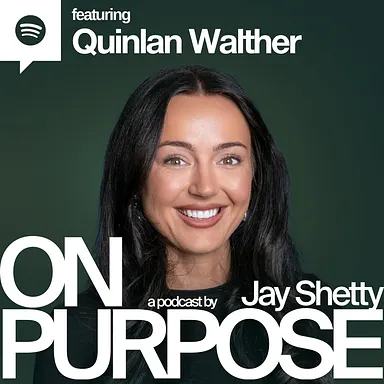
In this episode of On Purpose, Jay Shetty sits down with relationship creator Quinlan Walther to explore how people can tell when they have found the right partner without settling or holding out for perfection. They discuss how dating apps and an abundance of choice can fuel the fear of choosing wrong, and why building a relationship may matter more than finding a ready-made match.
The conversation distinguishes standards around character and care from preferences about appearance or resume, and looks at healthy risk, emotional maturity, and the difference between excitement and warning anxiety. Walther argues that compromise concerns preferences while disrespect should not be tolerated, and offers advice on asking for needs without sounding critical.
Listeners will hear practical ways to assess whether they are settling and how to approach stalled or uncertain relationships.
In this episode Jay Shetty, Quinlan Walther
This episode's transcript on Quinlan Walther's dating advice was made with HappyScribe's technology, the same tool behind its video to text service.
Ads in this audio differ from the text. Tap the sentence you're hearing to follow along.
Synced: the text now follows the audio.
Hey, it's Jay. I don't know what your day's been like, but I was just thinking about you for a minute. And I hope you're being a little patient with yourself, because you deserve it. And yeah, I'll talk to you soon.
Hey everyone, welcome back to On Purpose. This is the place you come to become happier, healthier, and more healed. Today's guest is back by popular demand. The last time she came on, it got hundreds of millions of views. The clips went insanely viral. I had to have her back on the show. I'm sitting down with my good friend Quinlan Walther, also known as Q, a relationship expert and content creator known for her honest, relatable advice on dating, emotional maturity, and building healthier relationships.
Today we're talking about how to know if you're settling in love, what you should never compromise on, and how to recognize when someone is truly right for you. Q, welcome back to On Purpose.
Jay, top-tier intros. Absolutely unmatched. Thank you for having me, and thank you for making me blush all of 10 seconds into the podcast.
Q, we've got some big news. Last time you came on the show, I was blown away by the response. I was blown away by your incredible insight. People have asked me for many, many, many years who I'm excited about in this space, who I believe is doing really meaningful work, who I believe is a really genuine, heartfelt, purposeful thought leader. And I'm always asked to put names forward. And for me, without a doubt, I really believe that your voice is so needed for the next generation.
And I'm so grateful and honored that you gave me and my company, Perfect Strangers, the opportunity to produce your podcast, which we're announcing on this show, launching. And honestly, I was so happy when you said yes to being able to do that together, because I'm so excited for you and your career and your service to the world and the work you're doing and how you effortlessly impact and help so many people that I know—friends of mine, my family, people online.
It's unbelievable to watch. And so to get to be a small part of your journey is an honor and a gift. And I feel so lucky that we get to do this. So congratulations and welcome. This is exciting.
There's no one I—no one I would rather partner with, truly. When we discuss this, pinch-me moment doesn't even begin to cover it, especially considering the career that you've built for yourself, the show that you've built, the impact that you've had, and the businessman that you are. I don't—I don't think you get enough credit for that either. So to have so much expertise that you can share, and the leadership, the wisdom that you're willing to work with me on, I just—I can't thank you enough. And this podcast is incredible.
Tell us the name.
To be honest.
I love it.
To be honest with Q.
Subscribe right now. So I want everyone listening to go and follow, subscribe, like. If you don't already follow Q, obviously, but follow To Be Honest and subscribe on Spotify, Apple, any platform that you listen to podcasts. I want you to do that right now before you listen to this episode. Tell us about it.
So To Be Honest, the podcast is a place that I want to go to dig deeper. Love social media, love creating content, but you can't get a lot out of a 45-second clip. And this is where I want real context, real nuance, to be able to speak with the experts that I've learned from, to be able to hear from them specifically, to be able to ask questions that I've been wondering for so long, and to really share all of the wisdom and all of the knowledge with the rest of the world, with the rest of my audience is a dream.
An absolute dream.
I'm so excited that people are going to be able to listen to you for like an hour now. And as a fan, I'll be tuning in as well. But when we launched Perfect Strangers, we knew what kind of host and talent we wanted to launch with. And you embody this principle better than anyone I know. Our goal and vision was to make people feel less alone. And we wanted to work with people that we believed make people feel less alone in their pain, their stress, their challenges. And when I watch you on any of your social media platforms, I feel like you make so many of my friends, family, people I've met through work feel less alone.
And I can't wait for this podcast, To Be Honest, to do that for millions and millions of people. So honestly, I'm so excited. It's going to be a wild ride. I'm encouraging everyone who follows me and supports me and loves my show to go and support Q, because we're fully behind it and really excited about it. And so I cannot wait.
Launching it into the world.
Yes, it's happening. We're here. Congrats.
Thank you.
I wanted to start with this statistic that I read: that 56% of Americans are more worried about ending up with the wrong partner than they are of never meeting anyone else, ever. So 56% of Americans are more worried about being with the wrong person than they are about never finding a partner, which means we're more scared about us picking the wrong person than finding someone. Why are we so scared of picking the wrong person?
It reminds me of the issue we're having with dating apps right now, frankly, where we believe that there's always something around the corner that will be better than what we have right now. So the anticipation of the next thing, of the next thing, of the next person, of the next person. Maybe they'll be better. Maybe they'll be better looking. Maybe they'll be more successful. Maybe they'll be more attractive. Whatever. And in part, you have to understand what's going on, which is your brain is being overwhelmed with choice, with option. And there's the paradox of choice, this idea that there's so many other people, other options, other relationships that are bigger, better, and more worth your time.
And the reality is, that just simply isn't true. And at this point, it's kind of a cliché, and I'm glad that it is, but the right relationship for you is the one that you choose to build. There's a lot that goes into that. But the reality is, if we're always looking over our shoulder at the other thing, the other option, the other person, the other life that we could be living, of course our dissatisfaction will continue to haunt us.
You said, "We're too overfocused on finding the right person," when actually we need to be focused on building the right relationship. And it's the person that you want to build with and that wants to build with you that is the right person, not the person that seems to embody and have all these qualities and values already ready-made for you. Is that right?
Absolutely. It's the magic of falling in love with someone, is that there's a different human that you're going to opt into a relationship with, and you're going to build a life together. And that other person will be different from you. They won't show up ready-made for you perfectly. You build together, and that's really part of the magic. And look, I love that we are growing more content with the idea of being by ourselves and building a life that's really meaningful to us, even without a relationship, whether we have one, want one, don't want one, whatever.
But the fact that we are more comfortable, even more fulfilled being alone, is a really beautiful thing. But it does hurt my heart to hear that there are people that are so worried about finding the wrong person that they would rather be alone completely. Because building a relationship, a happy, healthy relationship, is a wonderful bonus to a life that we love.
It's almost as if we also don't trust ourselves.
You're totally right. This idea of what happens if I choose wrong, what happens if I pick the person, the wrong person, invest in the wrong person, you're never going to be able to know with 100% certainty if the person that you're with, the person that you're choosing, is the one. You're never going to know. Some people will fight me on that. That's okay. I'll take it up in the DMs. But the reality is, you will never have 100% certainty, because that's life. You might in hindsight—right, hindsight is 20/20—but for you to be able to trust yourself to enter into a relationship with someone, trust yourself to pick based on what you've seen, what you know, to really make the best decision given the information you have at the time, commit to being the person, the partner that you want to be, and then see what happens, like, there is risk in that.
And all that you can do is trust yourself enough to show up, support yourself, and be the person that you want to be in that relationship. Not dependent on outcome. It's a matter of, do I trust myself to be someone that I respect? Do I trust myself to figure out what it is that I want before I enter a relationship, learn as I go, and be kind to myself as I make mistakes, as they make mistakes? All of this to be said, needing to trust yourself is imperative for not only a happy life, but a happy relationship too.
Yeah, and I think that's the hardest part, because when you're in a relationship with someone, you're in a daily exchange of trust. And that's why you're saying you can never know. And I agree with you, because it's earned and lost every day. And that's very rare, because every day you get to come together again and say, "Do we trust each other? Do we repair? Do we care? Do we build, or do we not?" And their answer is not based on yours, and your answer is not based on theirs. It's an exchange of trust.
And so you can't have a guarantee in the way that you're saying, because someone can change their mind, and so can you. And that's what makes relationships so beautiful and difficult at the same time, because it's wonderful to feel chosen, and it's horrific to be rejected. And you can go through both of those with the same person who tells you they feel deeply about you and then changes how they feel about you.
And love is inherently risky. Living is inherently risky. I think that we should actually lean into the risk rather than becoming more averse to risk. Especially in today's society, we don't like friction. We don't like risk. We want things to be easy and seamless and optimized and efficient and all of these things. And that's not a relationship. You're entering into a relationship with another flawed human, another imperfect human, another messy human, just as you are, just as I am. And I think if we can look at love and relationships through a lens of, "What can I learn about this person?
What can I learn to appreciate about this person? What do I want to build with this person?" rather than, "How can I streamline this process?" it would do us all—do us all a lot of good.
Yeah, that actually connects to a statistic I read that said 56% of women who struggle to find dates say it's because no one meets their expectations.
Expectations is an interesting word. It can carry a lot of weight, and it can carry next to no weight. If we can replace that with standards, as in standards of how someone treats you, how someone is willing to show up, the character that someone is showing you, that to me is far more important than expectations. A lot of time, expectations—again, you see this on online dating, you see this on social media, which is like, "What is the resume of this person? How tall are they? How much money do they make?
How attractive are they?" It's like a resume of a human that you're trying to build a life with that just doesn't lead to an embodied connection, which is what we really want. But if we're looking at standards of care, how someone is going to show up and care for you, those are standards to abide by that I don't think anyone should ever lower. But the standards that we confuse with preferences that are actually just expectations of the resume of the person, that's something we need to be a bit more flexible about.
What's the difference between having high standards and expecting perfection?
High standards should always apply to how a person shows up and cares for you. It is the character of that human. Do they have integrity? Are they reliable? Are they honest? Are they kind? That to me is pretty black and white. There isn't really any arguing with that. When it comes to perfection, that's like, "What's the package that those standards are going to come in? Are they taller? Are they shorter? Are they wider? Are they thin? Are they purple, blue, black, brown, yellow, gray?" It's like the preferences don't really matter.
The package doesn't really matter at the end of the day. How the person cares for you and the standards that you have regarding the human that they are, those are things that I don't think we should debate on.
When it comes to expectations and standards, how do you think men and women are approaching it differently? What are you noticing? What are you seeing online? What are you hearing from when you're working with people?
More than anything, I think people are having a really hard time figuring out how to establish connection in a world that is teaching us to evaluate the other person, especially with so much connection, quote unquote, so much relating being done through a screen, through profiles. It's really difficult out here. And I mean, just as I was saying earlier, we have this need for ease. Like, we're averse to friction, right? We want to optimize. We want to make things as effective and as streamlined as possible.
And there is no way to optimize your way out of the discomfort of connection. No matter what way you spin it, even if the algorithm hands you perfect options, you still have to talk to them. You still have to go up with your nerves, clenching your fists, and try to say something nice, something engaging, something that will make them laugh. You still have to show up and be a human. And so I think that we're really trying to navigate an interesting terrain, an interesting territory, which is dating in today's day and age.
Yeah, I really resonate with what you're saying about evaluating versus connecting. That really hit me, because that's a completely different mind frame. And I think about evaluating as being a work term, right? You evaluate someone's performance. You evaluate whether someone should.
Quarterly evaluation.
Yeah, join your company, your quarterly evaluation. And when you think about love, you think, "Wow, if love becomes an evaluation, then everyone's always on a performance review. And then everyone's performing and pretending and working." And that's why love starts to feel like work. And it's funny, because what you're saying is love is hard and does require work and effort. But when that's in order to connect, it feels meaningful. But when it's in order to be evaluated, it almost feels uninspiring. And Alan de Botton had this beautiful quote that I took out, which I really wanted to kind of break this down with you, because it really resonated with me when I read it.
Alan de Botton said, "Compatibility is an achievement of love. It shouldn't be its precondition."
I've heard a lot of people speak on it now. A lot of brilliant psychologists and experts will talk about how compatibility isn't necessarily one of their necessities, if you will. It isn't as important as they once thought that it was, this idea that you come in to find the person who is most compatible with you. And I totally agree. When you're looking at compatibility, can you look at the person and think, "I would like to spend the rest of my life with them just in the way that they exist in the world?" The way that they spend their time, their attention, their energy, the life that you want to build together, how much closeness you want, how much distance that you want, what you want to pour your heart and souls into.
That could be considered compatibility. And I also think that those are things that ebb and flow and change over time. And they're also things that you come together and decide on as a team. So I completely agree.
We've constantly told people that the more compatible you are, the more likely—and what that says is someone the way they are is either compatible with you or not. Now, there's truth to that. There are some people that you're going to connect with better than with others, for sure. But I love the idea that compatibility is the ability to constantly respond and connect with each other and repair with each other and build with each other, which proves you're compatible over time. Compatibility is not something you can prove on day one and then see how it goes.
It's something you earn together where, "Hey, yeah, we had that argument, but hey, let's repair it. Hey, you know what? I want us to adapt in this way. Hey, you know what? Maybe we should plan a vacation here together. Hey, what about I know you don't find this comfortable. Can we talk about this?" Like, that's what compatibility is. Compatibility, the way we look at it, is almost like we make sense on paper. When I think of anything making sense on paper, I often think of sports. And I think about just how many teams have perfect players, but then they don't perform well on the field or on the pitch or on the court.
And it's almost like you can have everything make sense on paper. And I think people feel that with the apps. When you come back to what you were saying about evaluating, you look at the apps and someone looks perfect on their profile. And then you meet them and it doesn't feel that way at all. But then think about all the people that look imperfect on their profile and you rejected them. And you think, "Wait a minute, we didn't even give that person a chance." So I guess what I'm saying is it can lead to a lot of overthinking and confusion. How do you encourage people to go out there and set their standards and be really clear about what they're looking for in a world where we don't want to have expectations and we want to have standards?
Well, again, be firm on your standards. Be flexible on the packaging that those standards come in. The idea that you want a partner who will treat you well, who is kind, honest, reliable, who has integrity, that's pretty straightforward. So go out into the world knowing that's the kind of person that you want, and then be open to how that will show up. Will it show up in the grocery store? Will it show up at work? Will it show up at a park when you're going on a walk with your dog on a Saturday morning? Will that show up at a wedding that you're attending?
It could be anywhere. It could be everywhere. The idea is that you stay open to the people around you, that you're willing to engage with the world, with the people that are just in your life. And then you're surprised, hopefully, happily so, when someone shows up in your life and you're intrigued by them. You want to have another conversation with them. And then you want to spend a little bit more time with them. And then you're like, "Maybe we need a formal date." Like, being open to the possibility of love and relationship is something I think we're really missing.
Like, the ambiguity there of the what and the when and the how. People want an equation for that. Like, just tell me exactly how to get it. And the magic is in the ambiguity that we don't know when it's going to arrive and we don't necessarily know how. So to answer your question, be firm on your standards. Be open to how those standards will arrive.
Isn't it funny though that when you're attracted to someone, you'll find excuses for their bad behavior. But when you're not into someone, you'll find reasons for why they're not the right person.
Well, notice how I didn't say go out, find your preferences, and then let the rest unfold. No, no, no. Go out and find your standards and then let the rest unfold.
But it's fascinating to me how much we convince ourself that someone has the standards we want and we give them the benefit of the doubt when we're into them.
Do you think that they actually live up to our standards or we're convincing ourselves that they do? Or are we seeing that they aren't and then we send ourselves off into a fairy tale as to reasons why?
That second part.
So it's this idea, "I see that they aren't being honest. I see that they aren't being reliable." I know that in my gut, right? You know that. You feel that. But, "Oh, you know, they had a really long week at work. Oh, you know, they had that thing last year that they're still trying to get over and this, that and the other. Their car broke down and they got a flat tire." Mm-mm. You know what you're doing. You know when you're making excuses. You know when you're seeing behavior that doesn't feel good to you. And you have to be really honest about the times that you are gaslighting yourself into seeing potential that has not actually come to be.
There's my soapbox. I think that we know.
You're right. We know. And you're right. It's not that we're convincing ourselves. It's that we see it, but we make justifications and excuses for it. And I feel that's what misleads a lot of people.
You can obviously tell in hindsight. You can tell in retrospect. I shouldn't have given that third try, that fourth try, that fifth try. I gave out too many chances. But you know in the moment when you're giving out those chances, you do know. And you're hopeful because we want love and we're wired to want love. And this is all so important and absolutely. But we need to be far more honest about what's going on when we give out that second, third, fourth chance rather than trying to convince ourselves that we're going to show how caring we are. We're going to show how patient we are.
We're going to show them how good we are so that they'll show up as the person that I want them to be when in reality they aren't meeting your standards. And by standards, I mean integrity and showing their character.
Talk to me about if we take a scale of risk from 0 to 10, and 0 is I don't take any risk because I'm scared, and 10 is I take all the risk. What's healthy risk? And what does it actually look like?
Well, some people would think approaching a stranger in a coffee shop is 10 out of 10 risk. Other people think that jumping out of an airplane with no parachute is 10 out of 10 risk. So we're looking at very different things. Some people will feel far more comfortable asking someone out, but they won't be able to be honest about their feelings when they're having a really hard day or when something is really disappointing to them. Other people will really struggle to ask someone out on that first date, but once they have a connection and have established a sense of emotional safety with someone, they are more comfortable opening up and being vulnerable.
So how much risk should we take? I think we need to be aware of the areas of our lives, areas in relationships where we're leaning away from vulnerability and where that conflicts with the kind of relationship and the kind of life that we want. That's the risk that I would lean into.
And so it's different for everyone.
Absolutely. Absolutely.
Yeah. It's not like we're all trying to get to one version of risk.
Yeah. Well, some people are really comfortable flirting. Some people are really comfortable, right, having a cute chat and they're charming and it's funny and it's quippy. But don't ask them about the real deep stuff. They can't go there. That's too risky. Other people could never date. They'd fall dead of a panic attack before they'd be able to get out the first sentence of that flirt. But they could have a real deep, meaningful conversation with someone that they love and trust. So understand where your risk is and then work on leaning into that, because it will look different for everyone.
What do you think people should never compromise on in a relationship?
I don't think that people should compromise on character. I've said it a hundred times before. I've said it 10 times now, and I'll say it a thousand times more, probably just in this week alone. But the way that someone shows their character is going to be the same character that gets you through the worst days of your life. It will also be the same character that will be the other half of raising your children if you want them. It will be the same character that cares for your sick parents one day, if God forbid that comes to be. It's the same character that will pick you up on the best day of your life.
The character is the consistent variable in all of this. It's not sexy. It's not fun. It's not charming. It's not super clippable. It doesn't go viral because it's kind of boring, and that's the point. It's reliable and it's trustworthy and it's safe. And that's the kind of thing that you never want to compromise on.
How do we understand someone's character through connection, not evaluation?
Pay attention to who they become when things get tender, when things get emotional, when things get stressful, when there's no one looking, when they don't think there's anything to prove, right? You're relating to this person, understanding the parts of their heart, the parts of their pattern, the parts of them that you can really only notice if you're close enough to truly see who someone is.
That's the connection. That's the character through connection that I would pay attention to.
I feel like you're really lucky if someone shows you early on what they're like under stress and when they're in pain and when there's something difficult. And again, like you said, you're not evaluating them and giving them a score out of 10. You're just seeing what it feels like to relate with that individual in that moment and how that feels for you. I find that it's so easy for people to be in love when everything's great. And it's so easy for people to run away or turn into a different human being when things are difficult.
And the challenge with our mind is we over-amplify the one good date night we had with that person and devalue the week of ghosting, gaslighting, and avoidance that we experienced after it. What do you do when your mind can't get out of that loop and cycle that constantly reminds you of the good and doesn't let you focus on the reality that is in front of you?
You really have to understand what you're putting yourself through as you move through the cycle of the hot and the cold, the up and the down, because it takes such a toll. It takes a toll on your heart. It takes a toll on your mind. It is so draining. And anyone who's been through it, you know the cycle of you get your hopes up and then they ghost you and then you get your hopes up because they text you at some inappropriate hour and then you don't hear from them for a while. But then you see them in person finally and it's so good. Like, the exhaustion that you go through from these cycles, it's not worth it.
And so it's really a sobering conversation with yourself that says, "We're going to do this again. We're going to put ourselves back into the ring of fire. We know how this is going to end. We know how this feels. You don't deserve that. I'm not going to do that to you." And by to you, I mean to yourself. You have to really care for yourself. There's a real sense of, "How is my behavior contributing to the circumstances in my life that I dislike the most?"
Oh, that's good.
It's radical accountability, radical responsibility. So you may not be causing the strife in your life, but are you contributing to it? So you may not be the one that's going ghosts, that's playing hot and cold. But are you allowing people in your life that do? Because that's contributing to the circumstances in your life that you really don't like. And I hope and pray that everyone who's been through that builds the self-respect and the self-love to say, "We're not going to do that anymore because I care about you." And that's not what people who care about themselves put themselves through.
Yeah. That ability to really take, as you called it, radical accountability for the patterns that may even be repeating in our lives. If you're someone who finds yourself constantly back in the same place after dating someone or getting to know someone, it's not that it's all your fault and you're weak and there's something wrong with you. It is important to know what part you played in getting back to that same place. And did you avoid the same patterns that you always see?
Did you repeat a pattern that your parents had that you're not even aware of? Did you get triggered by a pattern that you had in an ex-partner? And did that come back all of a sudden? And it's fascinating how much we think we learn in relationships about how much we really do need to be aware of those patterns and conditionings that are almost like puppet strings and just like pulling us in all these different directions. What I really want to help people with is how do you know?
How do you know if someone's your person?
You don't. Especially not in the beginning. I want to say this over and over and over because we're looking for like the one signal. What's the one thing I can rely on that just tells me, "This is it. I found the one and it's all going to work out." And the reality is you find someone, you learn who they are, you learn how the two of you come together in this relationship, and you take it to the next step until you're there for a little while.
And then you take it a few steps further and you leave room for the relationship itself to come to be. And again, the standards and the character, if all of that is there, then it comes down to how do I feel around this person, right? This is like it's an embodied human connection that you feel. It does come down to feelings. Do I like the way that I feel around this person in addition to the character and the standards? That's all there too. But do I like the way that I feel around this person?
That's going to tell you. If you can look at the person and think, "I respect them. I admire them. I like the way that they do what they do, whatever that is." I like the way that they're hardworking or really kind and patient. I like the way that they interact with my family. I like the way that they value their family. I just like the way that they order food at a restaurant. And I like the way that they say thank you too many times. And there's a magic in that that you feel in your bones.
And that's the signal, if any. And it's hard because it isn't something that we can say, "Do A, B, C, and D and you'll be able to know for sure." It doesn't work like that. At some point, you have to say, "I really love this person. I can envision the life together. I love who I am when I'm around them. And I'm going to take the leap. I'm going to take the risk and I'm going to say yes and I'm going to commit to saying yes for the rest of eternity." If there's one litmus test that I come back to time and time again, it is this.
If you want to know whether or not someone is right for you, you have to ask yourself, and maybe even ask them, "Do they care about how their actions make you feel?" This ties back to their character and their standards. When they hurt your feelings, can they apologize? Can they not only apologize, but first ask, "Let me make sure I really understand what your experience is, because my intention was not to hurt you, but I want to know more about the impact there. So I really understand your experience."
And then they can apologize. And then they can take responsibility. That is, in a lot of ways, just the basics of emotional maturity. But you should absolutely have that in the person that you're going to spend the rest of your life with.
Yeah. That willingness, that openness to understand, to really see you is vital. You were talking about a few moments ago, the patterns we end up in, in this up and down with people and what role we play in that. How can we tell the difference between the excitement anxiety that we experience when we like someone versus the warning anxiety that's telling you, "Be careful"?
I think we need to pay closer attention to what's going on in actuality. Like, add context to the excitement or anxiety. Are you feeling anxious because this is the fourth time that they've canceled a date, but they keep texting you, leading you on, telling you how wonderful you are, and they can't wait to see? Like, then clearly your anxiety is in response to a situation that is uncertain, potentially hurtful. That, I would say, is an excitement. That's just adrenaline and dopamine. You're anticipating this high-high or a low-low.
Or have they been relatively stable and you're excited to get to know them more? You're liking what you're seeing. You're liking what you're hearing. You're liking who they're showing you that they are. Be excited. How could you not be, right? You want love. You want a relationship, I'm assuming, if you're going on dates and looking for a person. But the excitement has to be compared to the context of the situation. Or the anxiety needs to be compared to the context of the situation in order to really decipher which is which.
What happens is we often get excited by, "Oh, they canceled, but they messaged me and they were really good about it." And then, "But they did it again." And that's what that pattern is. It's almost like the excitement is the anticipatory experience, not the experience with them. Like, that's how I like to think of it.
If the most impressive thing that they've ever done is text you consistently, we've got a problem.
If the time you feel the most excitement about someone is in the build-up to being with them, that's not working. Because being with them should be better than the excitement of wanting to be with them. And I think sometimes people miss people with more joy than they do actually experience that person's presence. So they're happier in the feeling of being with that person than they are actually being with that person.
Look, anticipation is a hell of a drug, right? We project this idea of what will be and how magical and how wonderful and this like fantasy that's going to come to life. And in a lot of ways, we kind of set ourselves up for failure because, again, this is a person who may be absolutely incredible. They may be the love of your life. They still have some flaws. They still have issues. They're still going to piss you the heck off at least a hundred times if you're going to spend substantial time with them. So the anticipation is fun. And I do say lean into it, but it should not be the highlight of the entire thing.
I totally agree with you.
You talked about emotional maturity. I'm intrigued. What does it look like to be in a relationship with someone who's emotionally immature?
One of the clearest signs of emotional immaturity is egocentric behavior, which is this idea that the world revolves around you. The only thing that that person can see is their wants, their needs, their fears, their desires. It's all about them. Children are very egocentric, right? When you take a toy from a five-year-old, they throw a tantrum because they can't understand that their friend also wants to use the toy. And there's nuance in the situation and we have to be patient. Something that they wanted was taken from them and they can't have it.
They can't stand it, literally, psychologically. So there's this egocentric nature in emotionally immature people where everything is about them. Their feelings are fact. Their beliefs, their fears have to come first and foremost. And it's really, really difficult to build connection with someone who is constantly focused on themselves. Incredibly difficult.
I'm fascinated by that because sometimes we're so attracted to those people because they're prioritizing themselves and maybe we're good at not prioritizing ourselves.
Well, not if we're secure.
Talk to me about that.
Now we're getting into attachment theory. But if you are securely attached, if you are an emotionally mature person, you won't find that self-centeredness attractive. In fact, you'll be very turned off by it. Just like love bombing, if someone comes in and starts telling you how incredible you are, how wonderful you are, you're the greatest thing since sliced bread, you hang the stars in the sky, and you've only known them for 30 seconds, you're going to think, "This is a little strong. This is a little much. You don't really know me like that."
Like, "Thanks. Yeah, I'm pretty awesome." But no, right? You'll be able to sense that there's something off there just in the way that you will with someone who is too self-interested. It won't come off as confidence. It will come off as arrogance. It will come off with this aloofness that to a secure, emotionally mature person is not attractive.
For most people, their actual experience of that is, "Oh my God, someone who finally sees me." So there isn't a sense of, "Wait a minute, that's a bit strange." When someone shows you that much love, you kind of go, "Oh my God, this is what I've been waiting for. This is what I wanted," right? When people get love bombed, a lot of the time that's their reaction because?
A lot of the time when we are projecting our wants onto a person that we don't really know. So in this case, the person who is love bombing us, we are hoping that they will finally give us the love, the attention, and attunement that we have been begging for since we were young. And you can feel it. Anyone who has experienced this, it is like in your gut, "Please see me and love me. I will do anything. Please." So when someone comes along and starts telling you how wonderful and incredible you are, even though they don't really know you, part of you thinks, "Oh my God, they get it.
Like they see me. This is the thing that I've been waiting for." There's like an antenna waiting and attracting, sensing the people who will give you that even when it is disingenuous.
What's the difference between emotional intelligence and emotional maturity?
They're kind of like chips off of the same block. And they're also two different schools of thought, two different frameworks, which also makes it kind of difficult to compare and contrast. But emotional intelligence is a set of skills that allows you to manage the emotions of yourself and others. So it's a set of skills. And then the emotional maturity is, in essence, a consistent practice of those skills. I'm simplifying it, but that's an easy way to look at it. In emotional intelligence, one of the skills is emotional regulation, which is essentially, "How do I react to this emotion in an appropriate way?"
Which is emotional maturity, right? You are reacting to the world around you in an appropriate way. Even when you're stressed, even when you're upset, even when people around you are stressed and upset, emotional maturity allows you to show up in a respectful, appropriate, mature way.
On the flip side, what are the signals and signs that someone is actually emotionally mature or intelligent in relationships?
So when we're in a relationship with someone who is emotionally mature, they want you to meet them in the relationship emotionally, mentally. They want to know your experience. They're curious about your experience. They can empathize with you. They understand that their reality may not match your reality, meaning I could have really enjoyed something. I thought our conversation went great and you're thinking, "Oh my God, they hate me." And then we want to bridge the gap there. Emotional maturity really allows you to deal with the complexities of relationships, of the world, which is that things are not typically black and white.
Things are often quite nuanced and quite complex. And you have to build the psychological structure in that, a real sense of self in order to navigate it.
I didn't really think about the difference between the two.
Dr. Mark Brackett is an emotional intelligence expert. He's wonderful for anyone who wants to dig deeper. And Lindsay Gibson is one of my favorite experts when it comes to emotional maturity and immaturity. So if anyone wants to go to the doctors for that, they're great psychologists.
How much should you expect your partner to change for you?
I don't think you should expect your partner to change for you. Look at it this way. If you're sitting around watching the clock, hoping, praying, waiting for your person, your partner to show up differently, that's not a relationship. It's a science experiment. Think about that. You're in a relationship with someone, switch those roles, who is waiting with bated breath for you to be different, to be a different person. The question of how much should someone change for you? Well, in my opinion, I don't think that we should expect it.
Now, here's the caveat. Relationships will change us. They should, hopefully for the better. The Gottman's work has shown time and time again that accepting influence from your partner, meaning considering your partner's feelings, making changes for them, indicates a happier, healthier, much longer-lasting relationship as things go on. But that doesn't include sitting there waiting, trying to gauge how much someone will become the person that you want them to be. A lot of that includes accepting them as they are.
And I feel like that's one of the hardest things for people because they've committed time, investment, energy, money to be in this relationship. And then they realize three, five, 10 years in that, "I don't feel this is the right person, but maybe they can change for me." And people start thinking about how much someone can grow and evolve and what that would take. How do you know when you're settling in a relationship?
Take a gut check. Take a real good look at, "Do you want to be loved like this for the rest of your life?" If nothing changed about this person, about this relationship, would you want to be with this person for the rest of your life, for the rest of time? That's a way to gauge whether you are actually in the relationship or in this fantasy of what the relationship could potentially be if only they would change. Right? That's typically where the settling comes in. Are things going to be like this or can I get them to be like that?
And if your gut isn't telling you, "Yes, I'm settling. We can do better. We need to do better. This isn't it," then take a look around. Truly, like sit down and have a conversation with your partner and speak about the things that you'd like more of. Make requests. And a lot of people, I hear this a lot, a lot of people will say, "Well, I think that I'm settling." Okay, why? Well, just there should be more. More what? Like, let's get really specific here. Do you want more adventure?
Do you want more novelty? Do you want more passion? Do you want more intellectual intimacy? Like, get really clear and really specific because you may go out and find someone else. You may say, "Okay, I'm settling. I can do better than this." And you can go out into the world and maybe you'll find someone who has 80% of what you're looking for, 95% of what you're looking for. Maybe. Or maybe this relationship here, you'll get just as much from the other relationship over there, except you'll have the back and forth time and the stress and the rumination and all of the things. If you can, try pouring into the relationship that you're in now by being clear, by being kind, and by asking for more of what you want in the relationship.
And then they build up resentment because they never said it, the person never did it. And now they're like, "Well, I've been nice to you this whole time." And so you end up creating this echo chamber of stress and pain because you simply didn't have the skill to ask for what you wanted. How do you ask for what you want in a relationship without making the other person feel less than and making yourself feel weak?
Asking for what you want is one of the most underrated versions of vulnerability. We don't often think about that as a vulnerable encounter. To actually put yourself out there, say, "I'm really longing for this. I would really like for this to happen. And I'd really like for this to happen with you. I'd like to have this experience." The other person could laugh in your face or ignore you. And that, I mean, it's heartbreaking thinking about it. So for one, I want to point out that it is actually very vulnerable to voice what you want and very difficult.
A lot of times we're better at being kind of passive-aggressive about it, maybe making an offhanded comment, right? Throwing out a little jab, making little tests or leaving little breadcrumbs of information. Not a great way. If anyone's hearing that and thinking, "Yeah, that's me," that's one of the signs of emotional immaturity that we should work on. So why are we here? The request for what you want should be exactly that. "Hey, this is what I've been thinking about. I think I want a little bit more time with you, but more than just time with you.
Like I really want connection." We used to walk around the neighborhood for hours and we'd like laugh. And it was one of my favorite things that we used to do every Sunday night. And I'd really like that back. I'd like to do that again. Can we do that? Maybe not Sundays, but how about Monday mornings for 10 minutes, whatever. Actually making the request that says, "This is what I would like more of and this is why," how could we work that into our lives? Not, "You've been ignoring me. I haven't been getting enough time or attention.
You must not care. Fix it." That doesn't really work. Criticism doesn't create change. It creates defensiveness. So make sure that you're genuinely asking for what you want and making a request as well as inviting the person into a conversation with you.
Yeah, I agree with you. I feel an invite gets a response, a request gets a response, but a demand gets defense and criticism gets defense.
Again, criticism is one of the clearest signs of emotional immaturity. Think about that. You have to have tact. Like being critical does not ever effectively communicate a message in a way that elicits change. Someone can't hear you when they feel like you've already made a judgment on who they are. And not only is it a judgment, but it's a belittling, demeaning judgment. To be able to communicate effectively, firmly, but effectively means you have to regulate whatever frustration you're feeling and choose to show up to the conversation in a way that the other person can hear you.
And that is so hard. I know that is so hard, but it is one of the truest and most important skills that we learn and that we build with emotional maturity.
It's hard because you think you're the emotionally mature one because you're like, "I see where the gaps are. I want to do this." But then being able to communicate it in the right way makes all the difference. And at the same time, if you love someone and you vulnerably tell them what you need, and if they love you back, they'll listen. But if they reject and push back and make you feel like you're too much, there's a chance that they're not able to actually receive it.
And I feel like a lot of people feel like they're just too much in a relationship because their partner makes them feel that way. What should you do if you feel like your partner makes you feel like what you want is too much and what you need is too much?
Well, for one, that right there should be communicated. Hey, I feel like every time that I bring something to you, it gets shut down. It gets dismissed. To me, it feels like you don't, maybe you don't care. And I know that I'm assigning intention there, but to me, it just, it feels like every time that I ask for something, you can't meet me there. Talk to me about that. I mean, have you been having the same experience or do you feel like you've been doing great meeting me in these requests and in these moments?
And if they dismiss, if they shrug that off, if they hit you with a, "You're being dramatic," or, "You always have something to complain about." Here we go again. This is a whole nother thing. Again, emotional immaturity. There's not a lot that you can work with there. You can tell someone that it's hurtful. You can tell someone, "Hey, I'd love more of this or I'd love more of that." You can be patient and you can be kind. And I think that you always should. But if you are consistently, time and time again, being shut down, being dismissed, being treated as if your emotions, your experience are worth nothing, consider whether or not that's a person you really want to be in a relationship with.
And I think that's what's hard is because we know relationships require compromise and they require some sort of back and forth. But how do you know if you're compromising in a relationship or abandoning yourself?
Compromise refers to preferences. Compromise refers to, "I want to eat dinner at five o'clock and he wants to eat dinner at 7:30, which is going to mess up my bedtime and it's going to mess up my routine." But you know what? It's what he wants. So three nights a week we're going to eat at 7:30. Right? That's compromise. Not, "You shut down my feelings every time that I bring up an issue in this relationship." Not, "You call me names." Not, "You meet me with sarcasm and ridicule every time that we get into an argument."
Absolutely not. That's the line in the sand there. Again, compromise has to do with preferences. You're self-abandoning, you're settling, you're tolerating treatment that is blatantly disrespectful. Absolutely not.
Yeah, it's good to know the difference because I feel like we get them all too confused.
Someone worth being in a relationship with is going to care about how their actions make you feel. They will worry more about their impact and less about their intentions. It's a really good telltale sign whether or not the person that you're with is someone worth compromising with or someone who is really going to add a lot of strife to your life.
And it requires us to be so still with ourselves to actually know the difference because it's at those moments where we usually say to ourselves, "Oh, but they're really good with the kids. Oh, but you know, they're just, they were so great last week. Oh, but you know." And it's like we let go of that very deep feeling of, "Yeah, I'm not sure if they care about the impact." Because when I tell them how I feel, they just have an excuse ready. Or even if it's not an excuse, they have a reason ready. Rather than saying, "I would never want to make you feel that way.
I'm really sorry that you felt that way," regardless of if they have an amazing reason for it. And I think we're so quick to just let that be okay because we're like, "Oh, it's okay, but they're good at this." And how much can you transfer good and bad into each other?
There's always going to be give and take. But again, the give and take is not how much respect am I willing to tolerate before I get a warm, kind moment from you. The give and the take is, "You're really stressed out. You've had a lot going on at work. Maybe there's trouble. Your mom's been sick and the dog's been giving us flack and all of that." Right? And you're really like, "You're running on E," which means I may not get all the enthusiasm from you. I may not get all of the real attention and eagerness to be here.
Like, I'm going to be understanding of the nuance and the context of that situation. That's the give and the take. So we have to get clearer about what are circumstantial difficulties and what are character flaws. What is blatant disrespect? And then you get firmer with yourself about not tolerating that. And that is difficult because if you're 10 years down the line with someone and you're realizing like, "Crap, it's been like this since day one," you got 10 years of stuff to figure out and potentially untangle.
Like, I don't mean to simplify this down into like, "If you check half of these boxes, pack your stuff up and let's go." I want to be really clear. I understand this is nuanced and complicated. And you also don't need to spend the next 10 years of potentially the rest of your life trying to make better what just 10 years could have been. There's a lot of love and a lot of light out there and you deserve to create that for yourself.
And I think people don't believe that.
Why do you think that is?
I believe we doubt that there's someone in the world who loves us how we want because we haven't yet experienced it. So we have no assurance that it exists. And when you look around, it's hard. So there's not a ton of examples around you, whether it was in your family or your friends, that you see that, that people are happy or heading in the right direction.
And so I think it's really hard to know you'll build something when you haven't seen it built around you and you've never experienced it before. But we have to remember that the person who built the first city didn't ever live in a city. And they had to visualize and envision what a city could feel like. And they did it. Now, cities aren't perfect. Cities have all sorts of issues with them. But now if someone wanted to build a city, we'd be like, "Of course you can build a city.
There's so many cities all across the world." And so I think we have to talk about these things more. I think we have to learn from our friends more. I think talking about relationships needs to be less taboo and the good and the bad needs to be shared more often. I think a big part of it comes from just having people learn from a much younger age how to respect and treat each other. I just feel like if you didn't see the right thing in your home and you didn't learn the right thing at home, it's very unlikely that you're going to build a home with someone else that has those values.
And so so much of it starts so early. And having the willingness to have two people who want to unpack their baggage and finding someone who's also patient to watch you unpack your baggage at the same time, that's rare.
I feel like I spent the entirety of our last episode talking, if it could be summarized, it's like, "Take a look at your side of the street."
Yeah.
I just kept bringing it back to, "And make sure you're showing up the way that you would want your partner to and make sure you're taking accountability and make sure you're taking responsibility." And I agree with everything that you just said because it can be so difficult when you've never seen it before. And there's no instruction manual. There's no roadmap there on how to build the perfect relationship or how to be the perfect partner. And even just to be a good partner, even just to be a steady, caring, empathetic person, you grow up and you, like empathy is so paramount and it can also be so messy and so difficult.
And in a lot of ways, I think that empathy is one of the reasons that people stay too long. Discernment specifically is important when you're looking at this because you have to make sure that your empathy comes with boundaries. And by that, I mean, you may be able to understand exactly why someone does what they do. You may be able to see the bigger picture, put all the puzzle pieces together. They were raised in this kind of household and they've been through this kind of past and this kind of pain and this is going on. But that doesn't mean that you have to continue tolerating the disrespectful, belittling behavior.
So your discernment is going to be the thing that says, "My self-respect is stronger than my empathy and I'm not going to allow my empathy to override what I know is unacceptable behavior."
Q, we have a new segment on the show, which is questions from our audience.
Let's go.
Here are their real-life challenges, scenarios, things that they're moving through. So I'm dating someone who's kind, consistent, emotionally available, and everything I say I want, but I don't feel the intense spark I felt in past relationships. How do I know if I'm settling or if this is what healthy love feels like?
There's a reason why all of those intense relationships came to an end. Kind of just answered your own question there. Truly, right? If you know that what you had previously didn't work, it's probably an indication that what is now unfamiliar to you, but is working, is the thing to go with. And just ask yourself simply, "What kind of relationship do I want to have? One that is intense and sparky and up and down and unstable? Great. Then go find more people like your ex. This person seems more reliable, more steady, more healthy, if you will.
And if that's the kind of relationship that you want, then lean into the unfamiliar and reframe that lack of familiarity as just that. Not that something's wrong, but it's unfamiliar and unfamiliar is good because you want the kind of relationship that you haven't experienced before.
Experience number two. My relationship is good. We love each other. We rarely fight and there are no major red flags. But I still wonder if they're really the person I should spend my life with. Is that normal doubt or a sign of something missing?
I'm going to hate this answer, but only you know that one. Only you know that. And the reality is you could probably build a pretty good life with that person. You probably could. If that's the choice that you make, then commit to that choice. But do not spend the rest of your life in purgatory wondering whether or not you should stay or go. And before you know it, it's been 15 years of you wondering. My recommendation is suit up or get out. One of my favorite quotes of all time from Dr. Ellen Langer, "If there's no obvious right decision, then make the decision right."
She gets randomly choose and then go with it. And I agree. I mean, the reality is anything that you convince yourself of as far as outcome goes, "Well, if I choose this, then I'll be miserable. But if I choose that, then I'll be miserable in the other ways." You don't know. You don't know. Maybe yes, maybe no. But make the decision that feels right to your gut. Commit to it and go all in. That's my recommendation.
My partner completely shuts down whenever we have a hard conversation. I'll try to talk about something that's bothering me and she either gets defensive or stops talking altogether. She's a great partner in so many other ways, but I keep waiting for her to get better at communicating. How long do I wait for someone to change?
Have a conversation. Absolutely have a conversation at a neutral time, at a time that you aren't fighting and that energy levels are good. And I would bring it up to her like, "Hey, I'm really struggling. That fight we had the other day, still thinking about it. I didn't get much from you. You kind of went quiet. It really hurts when you don't hear me. It feels like you check out, whether intentionally or unintentionally. Can we do something there?
Do we need time and space? Do you want me to give you the issue and we can take some time and then come back together? Can you give me a heads up when you're starting to feel overwhelmed and shutting down? Can you clue me in? Can we create a game plan here? This is really difficult." And I would start with that conversation. And kind of like we'd spoken about earlier in the episode, if you get nothing, that's not a good sign. If you're bringing this up from a place of, "Hey, please hear me. I want to share my hurt," and you're not met with any empathy or curiosity, not a great sign.
But if you are and they're willing to hear you and meet you there, come up with a game plan and try to improve it together. Be patient and love each other.
I've been with my partner for five years and lately it feels like we're roommates. We don't really fight, but we also don't talk much beyond work, chores, and what we're having for dinner. I love them and the thought of starting over terrifies me, but I also don't want to wake up five years from now feeling exactly like this. How do I know if this is just a rough patch or if we've grown apart?
Right there. Let's start talking. Let's chat. Let's muck it up. I mean, you can add in some novelty. What would you like to do? What would you like to experience together? Start with an activity even. Maybe we don't dive right into conversation, but start with something fun.
Break the pattern.
Yeah, break the pattern. Absolutely. Asking for what you want, bringing this to the table. Maybe the other person will think, "Oh my gosh, is something wrong? Did I do anything? Are they really dissatisfied with me?" And you're like, "No, I just want things to be like they used to or I want things to be better." It can be quite vulnerable. But my answer to that question would be break the pattern. Dive in and it can find some fun. It sounds like we need fun in there.
Yeah. It's almost like in a relationship, if you're wondering whether to stay or leave, first do everything you can. And if you've already done everything you can, then you already know whether you should stay or leave. It's interesting because I think we spend a lot of time thinking, "Do I stay or do I leave? Do I stay or do I leave? Do I stay or do I go? Do I stay or do I go?" And you won't answer that question by asking that question. You will only know the answer to that question by trying to build new patterns, having vulnerable conversations, doing uncomfortable things, trying new things.
And when you do all of those things, it'll become really clear to you whether you stay or you leave. And I think that's the funny thing is that we're more lost in the question than we are in the action that will give us the answer. It's like you're not going to find the answer by asking the question. You're going to find the answer by taking action and then seeing what lands.
And if we want one right answer.
Yeah.
One right answer. We want the, "Tell me yes so I know that I can go off and be happy for the rest of my life," or, "Tell me no so that I can go off and be happy for the rest of my life." And the reality is that's not how it works. I wish that I could find the genie in the bottle that could pop out and tell me all of the answers to the universe. That's not how it works. Learning to find comfort in the uncertainty is absolutely annoying and 100% necessary. Learning to find some level of steadiness, even when it feels like nothing is for certain and everything is scary, the only way through is through.
You can't find the checklist that's going to make the decision for you. You can't call up an expert and have them make the decision for you. You can't pull all of your friends and your family and have them. It doesn't work like that. Groundhog Day will not do this for you. But building the relationship with yourself that says, "This is what I want and this is what I'm going to commit to and I'm going to go all in and try everything that I can," that's probably the most for sure way.
My boyfriend says he wants marriage and kids, but every time I ask when, he says he's not ready yet. I'm 32 now and I know I want a family, so I don't feel like I can wait forever. How long do you stay when you want the same future, but not on the same timeline?
I would share how difficult it is to be stuck in limbo. And I would share it from your perspective, not accusing him of doing something wrong. But it's so hard. My clock is ticking. We've agreed that we want these things and I feel lost and I feel unsupported. I feel like I'm trying to plan this future by myself. And I don't think you're doing it intentionally. You're trying to figure things out. Can you let me in? Because all that I'm getting is a, "I don't know, sometime later."
And that's so difficult because having children is so important to me. That's the conversation that I would have.
And going back to everything we've said and everything you've said today, because that person cares about how their actions and words impact you, knowing that you feel that way, they won't hopefully give you a blasé answer of, "I'm not sure. Maybe sometime next year or next three years." They'll be really thoughtful with you about how they can alleviate that anxiety with you.
And clarity is kind.
Yes.
Clarity is kind. Assuming that this person is a kind person, they're going to give you the most honest answer that they can. And maybe that answer is still, "I genuinely don't know." I don't know if I'll be ready in five years. I don't know if I'll be ready in 15 years. And if that's the answer, then you have that really difficult decision to make. How long are you willing to stay in that I don't know? Maybe it's one more day. Maybe it's 10 more years. But I think there's some questions and some things to communicate in that situation before we get to, "Are we going to stay or are we going to go?"
One thing I wanted to ask you is, I hear that lots of women want emotionally vulnerable men, but then when men are vulnerable, women feel uncomfortable. What's going on there?
When we aren't good at vulnerability, we then become very uncomfortable when other people expect us to lean into their vulnerability. And oftentimes we confuse having emotions with being vulnerable, when in reality the vulnerability is really sharing the tender belief feeling underneath the big explosion of emotion. So it's not the angry outburst. It's not just the sadness and the tears. It's, "I'm really scared and I feel really uncertain or I'm really insecure.
I feel really helpless." Whatever. It's the tender story underneath the emotional reaction. So when we don't have much practice actually leaning into the vulnerability and sharing the tenderness, then when other people do, we don't know what to do with it. It's like, "Well, let me give you a solution and here's what you're going to do and here's your plan," or we dismiss it. You're making a big deal out of nothing. We'll just figure it out. We'll just get it together. What do you want me to do? A lot of times we don't even understand that we're doing it, but we aren't that good at vulnerability.
Yeah.
So I think that when it's then handed to us, we don't know how to receive it from someone else.
That's a great take. I never thought about it like that. Yeah, the idea that emotions are not vulnerability. I just saying to someone, "I feel sad or I'm not feeling good about this." That's not even really the vulnerability. The vulnerability is, "I'm feeling like I'm not even sure who I am right now because of what we used to have and what we have right now." That's what vulnerability is.
As a man, when's the last time you did tell someone, "I feel really sad"?
Well, I think men are scared to tell women how they feel because they feel they'll be perceived as weak.
And how often do you tell your friends, your male friends, how you're feeling?
I'm lucky. I do that a lot.
Frequently?
Yeah, I do it frequently. Yes.
And have you always?
Yes.
So even growing up, even when you were younger?
Oh, no. Oh, no, no, no. As a kid, I would say probably started if I was lucky at college, if that maybe, probably not even. Probably not even at college.
Let's say 15 years, maybe 10?
For the last 15 years, you mean?
Yeah, for the last 15 years.
Yeah, maybe.
So a relatively new practice, relatively, that you feel comfortable doing with a select group of people who hopefully can relate and can hold your emotions and help you and support you and all of that. And then imagine taking that to someone who hasn't ever shown you before that they can show up for you, support you, and hold that vulnerability. It is really scary. And so I'm looking at it from both sides. I'm looking at it from this lens of a lot of men don't have practice in sharing vulnerably, really leaning into vulnerability.
And then we also have women and men alike too, but that aren't all that good at vulnerability to begin with either. We have a lot of emotions and it's more socially acceptable to show those emotions, but the emotions aren't the same thing as vulnerability.
One last segment. It's called, "We Want Your Take on This or That." So chemistry or compatibility?
I'll mix up both. 50-50. I'm not choosing one.
I knew you were going to say that. Someone who challenges you or someone who makes you feel safe?
Someone who makes you feel safe. You can challenge yourself. Life is challenging. Find someone you're safe with.
I agree with that. I think the point is someone should make you feel so safe that you feel safe enough to take on any challenge. That's what you want.
I love that.
Because if someone only challenges you and doesn't make you feel safe, you'll be so scared to start.
Yes. And ideally, someone that you feel emotionally safe with, like you're saying, kind of supports you enough that you want to go do these things and you respect them enough to know that when they bring something to you, like, "Hey, you should go try that. I think you should get in there again. Pick yourself up." You're like, "Oh, okay."
Is it better to be with someone who loves you more or that you love more?
Someone that you love more because ideally you both feel that way. And then it's a match made in heaven.
Yeah, it's interesting, isn't it? Because people always think they want to be with someone who loves them more. But if both people go into it with that mindset.
Sounds like someone who's scared of vulnerability. I need to be with someone who loves me more. That sounds like a cop-out.
Yeah, it's a game.
That sounds like a way of saying, "I don't trust other people. I don't trust myself." And granted, it can be scary to get your heart broken. I totally understand. But to have two people who feel like they're getting the better end of the deal, to have two people who feel like, "Man, there's no way they could love me more because I love them so much," and you both feel that way, sounds pretty good to me.
Keith, thank you so much.
Thanks, Jay.
I always love these conversations. I learn so much from you. I love going back and forth on so many important topics and themes. And I'm so grateful that you came back on the show.
Oh, I'm so happy to be here. Honored. Truly cannot thank you enough for all that you've done in our relationship, our friendship, but also for the world. It's incredible.
Thank you.
Self-development and relationship creator and podcaster Quinlan Walther returns to discuss how to know when you've found the right partner without settling or holding out for perfection. She breaks down how dating apps fuel the fear of choosing wrong, the difference between genuine non-negotiables and superficial preferences, and how to tell excitement from anxiety. Quinlan also explores why character matters more than chemistry when life gets hard, how to compromise without losing yourself, and how to communicate your needs without sounding critical.
With Love and Gratitude,
Jay Shetty
Learn More. At https://chase.com/sapphirereserve
JAY'S DAILY WISDOM DELIVERED STRAIGHT TO YOUR INBOX
Join 900,000+ readers discovering how small daily shifts create big life change with my free newsletter. Subscribe here: https://news.jayshetty.me/subscribe
Check out our Apple subscription to unlock bonus content of On Purpose! https://lnk.to/JayShettyPodcast
What We Discuss:
00:00 Introduction
01:16 Launching Her Podcast To Be Honest
05:07 The Fear of Choosing the Wrong Partner
07:10 Building the Right Relationship, Not the Right Person
11:40 Core Standards vs. Superficial Expectations
18:10 Holding Firm on Character
22:03 Defining Healthy Personal Risk
23:50 Non-Negotiable Character Traits
24:47 Observing Reactions Under Stress
28:58 The Litmus Test for Knowing Your Person
32:05 Excitement vs. Warning Anxiety
34:51 Spotting Emotional Immaturity
38:02 Emotional Intelligence vs. Emotional Maturity
40:13 Should You Expect Your Partner to Change?
41:49 How Do You Know If You’re Settling?
44:16 Why Asking for What You Need Feels So Hard
48:05 What to Do When Your Partner Dismisses Your Needs
49:49 Healthy Compromise vs. Self-Abandonment
53:40 Balancing Empathy With Boundaries
57:02 Can You Be With the Right Person and Still Feel No Spark?
58:15 Questioning Your Relationship When Nothing Is Wrong
59:36 What to Do With A Partner Who Stonewalls
01:01:09 When Your Relationship Starts Feeling More Like Roommates
01:04:19 What If You Have Mismatched Timelines on Marriage and Kids?
01:06:14 Authentic Vulnerability Beyond Emotional Reactions
01:09:33 Quinlan on This or That
To Be Honest with Quinlan Walther Resources:
Spotify | https://open.spotify.com/show/2M0hyTF8xELbMNQzQ3Ehmh
YouTube | https://www.youtube.com/channel/UCE5Lzq_OIV1uuykqsViQ8fg
Instagram | https://www.instagram.com/quinlanwaltherpodcast
TikTok | https://www.tiktok.com/@quinlanwaltherpodcast
X | https://x.com/quinlanwpodcast
Quinlan Walther Resources:
Instagram | https://instagram.com/quinlanwalther
TikTok | https://www.tiktok.com/@quinlanwalther
Facebook | https://www.facebook.com/p/Quinlan-Walther-61563056880927/
YouTube | https://www.youtube.com/@QuinlanWalther
Learn more about your ad choices. Visit podcastchoices.com/adchoices