
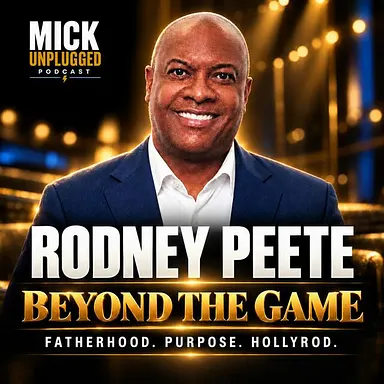
“Rodney Peete: Seeing the World Through His Son's Eyes | HollyRod Special” was turned into text by HappyScribe’s speech recognition. Related tool: AI note taker.
Ads in this audio differ from the text. Tap the sentence you're hearing to follow along.
Synced: the text now follows the audio.
When it's time for hibachi, my protein comes from ButcherBox and ButcherBox only. Go to butcherbox.com/mick to get $20 off your first box. Hostinger's AI builds your website in minutes. No coding needed. Go to hostinger.com/mick and use code MICK for 10% off. Join the millions who are already banking fee-free with America's number one choice for banking. Head to chime.com/mick. Go to im8health.com/mick. Go to www.mytheroad.com/mick right now or click on the link in the description and use code Mick for a free welcome kit, 5 free travel sachets, plus 10% off your order.
My God, I'm doing everything wrong. Once I started to realize that I had to start to see the world through his eyes as opposed to my eyes, our relationship drastically changed.
Ladies and gentlemen, welcome back to another exciting episode Welcome to another episode of Mick Unplugged, and this one is the bucket list of all bucket lists. Some people make their mark on the scoreboard, others make their mark on people's lives. Every once in a while, you get someone who's done both. I'm talking about a USC football legend, All-American quarterback, Heisman finalist. But what makes him special? What makes him extraordinary? isn't what he accomplished under the lights. It's who he became when life called for a different kind of strength. This person, to me, honestly, for autism and advocacy, is up there with what Magic Johnson meant for AIDS and the AIDS community. I'm talking to none other than the one person I wanted to be my entire life, Mr. Rodney Peete. Rodney, how you doing today, brother?
Mick, I'm doing, I'm doing well, man. Thanks for that intro. I really, I really appreciate it, brother.
Man, I appreciate you more than you know, man. And we're gonna get into a lot, but I wanna start this show off just by talking about what you mean, not just to me, what you mean to a lot of people for the man that you are and the man that you became. And honestly, for the prototype, man, like, like a lot of fathers, Yeah. don't have some strong examples. And we have to watch other people do things and make their decisions and how they handle adversity that makes it easier for us. And you were that guy for me, man. Like, I'll never forget just how you make conversations easier, how you made understanding better, and what you've done for the autism community, what you and your wife Holly and the Holly Rod Foundation do. for not just autism. It's just I've needed you all my life, and I just wanted to tell you I appreciate you, dude.
Thanks for saying that. Thanks for saying that. I think that when we're, when we're given gifts, man, we got to find a way to give it back and, and repay it and share it. And that's the, you know, that's what Holly and I do. And it's the way I was raised and I was fortunate to have 2 great parents, a great mom and a great dad that were, that were role models for me, man. And, and I just try to, I try to make them proud every single day.
Yes, sir. And you definitely do that. I can, I can, I can co-sign on that for you, man. And Rodney, I love asking my guests this initial question, right? Like Simon Sinek taught us to start with why, right? And a lot of people will ask, what's your why? I like to take it a little bit deeper and ask, what's your because? Right? Because if I ask you, what's your why? And I say, but why? Or why is that important? That sentence usually starts with, well, because, and I care about that. So if I were to say, Rodney Peete, man, it's 2026. You've accomplished a lot. You do so much and you give back more than most people ever will know. What's your because? What's your mission? What's your purpose today?
Because I was given so much, because I was gifted, because I have been blessed so much in my life. And I can remember growing up and, you know, watching my dad or other people that inspired me growing up and them taking the time to teach me lessons or to talk to me or to coach me. And a lot of times when they weren't getting rewarded for it, and I didn't understand it at the time, but as I am now older and are able to do that with my kids and other people that I come in contact with, I understand it is a— it's more rewarding when you're able to to share something or give back to people that, that need it, whether it's words that people need to hear, whether it's actions that people need to see. I get more out of that than, than I've ever gotten. And so it is, it's almost, you know, you almost feel guilty because I do feel that when I've, I've been able to touch somebody's life or I've been able to to make a difference in somebody's life, the reward that I get is, is greater. And I know it sounds crazy, but greater than what I'm giving them.
So I, I, um, it's because I've been blessed that I, that I give back.
And you do it tremendously, man. And I want to talk about these gifts that you have. Like, I think from a communication standpoint, like, I learned a lot from you when you transitioned from football and like how to, how to talk, how to keep people's attention and, and how to let your words matter. And then I saw you with nonprofit work and I was like, man, like, this dude is so talented in many ways. But I'd be remiss if we didn't go back to the beginning, man. Like, I visit the state of Arizona a couple of times a year, and I promise you, you are the son of Arizona, right? Thank you. You can't go almost anywhere without people talking about you and that illustrious career in sports and academics, right? Like, I don't know too many people that's been drafted in baseball multiple times like you have been and the things that you did on the gridiron. When did you know that athletically you had that gift or those gifts, I should say?
You know, it's an interesting question because I think And I believe that you will hear it from a lot of people that have gone on and played at the highest level or done things at the highest level at some point in their life, that I always believed that I could do it from a very young age. I think I was, again, going back to blessed to be in a household where, you know, my mom and my dad believed that I could do anything and kept telling me that I could do anything. That I could be any— anything I wanted to be. And them repeating that over and over again really instilled that confidence in me. And then on top of that, the most important part of that was, okay, you can be whatever you want to be, you can do whatever you want, but are you going to work at it? Are you going to work to get the things that you want? Because a lot of people have talent. A lot of people are gifted with, with so many blessings. But what are you going to do with it? And, you know, the thing for me is what I saw every day.
A lot of people think it's just, you know, you can talk, talk, talk and tell people this and tell people this is the way to do things. Mm-hmm. But I was fortunate, like I said, to be in a home where I watched my dad get up at 5 o'clock every day and go to work and do his thing and not complain about it. And every day he got up, he treated it as a blessing. And without saying much, it was really what I saw, and I saw in him. And, you know, to— from an athletic standpoint, to see him work, and then as I got older, to know that he was one of the few Black coaches in college, especially in the state of Arizona. I started to realize more and more how difficult a journey that was and how much harder he had to work. And that's kind of where I got it from. And so as I got older, I always felt— my mom was the one who always told me this— that you got to be 2 times better than the next guy for you to get noticed. So I worked that way.
And every step of the way, I always felt that I was, in athletics, the best player on the field. I always felt in, in the classroom that I was going to figure it out before someone else. I was going to understand it. I was going to work till I understand the problem. And, and I wanted to, I wanted to compete. And on top of my parents, I had a, I had a great older brother who was 3 years older than me. And he would, he would— He would push you? dragged me along with him and allowed me to hang out with him and allow me, especially in athletics, to play against older competition, play against his friends. And a lot of times, you know, when you're the younger brother, the older brother's like, oh, stay back home, or don't do this, or you can't come with me, I'm hanging out with my friends. Yeah. But he allowed me to hang out. So, you know, in those competitions, it was tough love and he didn't take it easy on me. And so I had to learn to compete at a higher level when I was young.
And then as you get older, you start to continue to compete. But I believed it my whole life since I started playing athletics. But I think it was really in high school, Mick, that as I was able to do some things as a freshman that some of the seniors couldn't do, Mm-hmm. And then I got to be a sophomore and I got better. And then junior, I got better. By the time I was a junior in high school, I knew I had a real shot to further my career in athletics. And then it turned out to be football and I was able to play 16 years, man. So it came, started with the belief that I could always do it.
Dude, I mean, to hear that from you, gives me chills, man, because all the things you're talking about showed, right? Like, you talk about talent sometimes isn't enough and a lot of times isn't, right? Like, there's always somebody, for the most part, that's more talented than you, right?
Yes.
But it's that— I call it that dog, right? Like, like, am I willing to compete? Am I willing to, to want it more than others? And a lot of times, and you know this, right, in the locker room, It's your teammate that you got to be the most competitive against. Right. And you being the quarterback, naturally you're the leader. Talk about that dynamic of you're competing to be the best. But then especially at the collegiate level, the NFL level, now you got to convince 53 in college, 90 to 100 people that not only should they believe in you, you're going to give it your all for them, right? Because I don't think most people understand that dynamic of being the leader of the team.
Yeah, it's, uh, it definitely takes a certain personality and type of person to be able to do that and to take it on their shoulders. And I always felt that way that I wanted, I guess I wanted to be in control, right? It's why I played quarterback. I was growing up, I was a shortstop in baseball. And I just felt that because I believed so much in myself and when I saw something in someone else, that I could bring out the best in them. Mm-hmm. And whether that's pushing them through, you know, physically by working out together or pushing them emotionally and spiritually and mentally by helping them believe in something that they didn't believe in themselves. And so I always felt that I could bring that out in people, and which is again why I played quarterback. But I always believed that, like, when people look at me, I wanted them to see strength. I wanted them to see confidence. I wanted them to see that anything is possible. And I always say this when I talk to kids growing up and wanting to play quarterback, and I always ask them the same things is, You know, you said, why?
I said, why do you want to play quarterback? And so I wanted to be that guy that when you're in that huddle and it's 3rd and 12 and you're on your own 10-yard line and you got no timeouts and it looks bleak and you need a touchdown, that when they step in the huddle and they look in your eyes, they know you're going to get it done. They know we're going to get it done. And so I, I believe that. And, you know, it doesn't happen all the time. But if you go in and have belief and all it takes sometimes is one other guy believing in you and you're going to get the best out of that person. So I made sure I let everybody know that I believed in them. And you can, you can do amazing things, not only if I believe it, but— You gotta believe it. And so that's where that leadership came in. And maybe it was a little bit of a control thing, but yeah, I wanted to be the guy that could control the outcome. That's why I chose those positions to play and believed it. You know, it wasn't just, I wanna do it 'cause it's glamorous or it's all these things.
I believed that I could do it. And I believed that there was nobody better in that situation that could handle it than I could. And you talk about the athletes, man, I— we all have this story that it's always that, that one or two or group of athletes that you grew up with that were just naturally talented, right? That had it all. And, and my, my guy was Jerry Johnson, man. Jerry Johnson was— he was a guy who was 3 years older than I was. And from the time I was like maybe 7 years old, everybody in the neighborhood heard about Jerry Johnson. He was, he was the guy. He was faster than everybody else, bigger than everybody else. He could do all these things. He was a great athlete. Jerry Johnson, Jerry Johnson. Had all the natural talent in the world. And, and so it was like he was a guy that I was chasing. Right? And, and so as I got older and started to chase him and figure out, okay, how can I get to that level? I want to get to that level. Um, I kept working because I wanted to beat him.
And thank God, like I said, I had a brother that was pulling me along. And, you know, what's crazy about that is that he had all the natural ability, but he didn't have the work ethic. And so as I got older, Jerry stayed here and I went past him.
Yeah.
Right? Because again, you can have all the talent in the world, but if you don't work at it and you don't have the work ethic, um, talent's not gonna get you there. Talent alone is not gonna get you there. And like you said, you gotta have that dog. You gotta have that dog like, nobody's gonna stop me. And, uh, and, and that's what I, I at least believed I had growing up.
Absolutely, man. And I'm, I'm about to give you some flowers real quick. Um, I was having this debate slash conversation, but you know, when family's around, right? Like in football season and we start talking about the greatest this and the greatest that. And we started talking about the greatest college quarterback ever. And you know, it's like me and my first cousins, some uncles, everybody's kind of going around. And I'm the last to go. And I said, Rodney Peete. And all of a sudden you saw everybody go, ooh, Rodney Peete. Because here's why. And this is what I'm going to say. These are the words of Mick and Mick only, because I know how humble my guest is. If Rodney Peete played in today's college football era— and ladies and gentlemen, remember, he went to Running Back U, right? So he went to Running Back U. Yeah. But if you played in this era, Rodney Peete would've been the first quarterback to throw for like 7,000 yards in a season. Mmhmm. Because you were that surgical with the ball. And, and you talk about the normal now being 3 and 4 wides and tight ends that, that can move vertically down the field.
Bro, I, I've never seen a better passer of the football, but also someone who controlled the game with their mind than Rodney Peete. So I'd love to just get your take on that. Like if you were playing in today's college era, You would've been that. I mean, you already were that dude, right? You were first-team All-American, but you would've shattered records that I don't think would ever be touched because today's game was meant for a Rodney Peete. Not gonna lie.
Yeah. It's interesting. Yeah. I, you know, you look and watch the game today and it's, you feel, you feel like, man, I was born way too soon. But I've talked that with other quarterbacks out there and we talk about that often and I'm not, you know, look, I appreciate you saying that, but obviously there was a— there were a lot of guys that played in college that had they played in this era would have been phenomenal. But yeah, I look back to—
I'm not being surgical like Rodney Peete. These are the words of Mick and Mick only.
All right, I'm gonna leave you— I'm gonna leave it there with you, Mick. I appreciate it. But, but yeah, I mean, I look back and look, if you in college and, and, you know, probably the first 6, 7 years of my, of my NFL career. If, if you, you know, completed 17 passes and attempted 24 passes and threw for 275 yards, that was a great day.
Most efficient dude ever, right?
That was a, that was a great day. Now, you know, throwing for 300 yards is, you know, if you don't throw for 300 yards, it's a, you know, you're not doing your job. You're not doing it. It's a very average game. Um, and, you know, guys now throwing it for 40, 40 times a game. And, and so, and then you, then the rule changes are, are obviously different now where you, you know, when I played, you could get hit. Quarterbacks were getting hit and you had to stand in the pocket and there was no, very little roughing the passer penalties that you're seeing today. Right. Uh, and also with the receivers too, you had to be accurate with the receiver because going over the middle, the one thing, you didn't want to hang your receiver out to dry, so you wanted to be accurate and make sure you hit him in the chest, because if he had to reach, a guy like Ronnie Lott was going to knock his head off, right? Right. But you don't have that today. There's not really that fear of a receiver going across the middle. So yeah, the game has changed, but that's, you know, that's, that's the evolution of sports.
I'm sure guys in the, in the '50s and '60s will say the same thing about the era that I played in and go, God, if I played in the '80s and '90s, Man, I could have did this and could have did that, but I just appreciate the time and the guys that I played with, man.
Yeah. Yeah. Well, you know, I want to switch gears a little bit here, Rodney, because again, you changed my life with the advocacy that you started with autism. And I've told people this and I said it in the opener, right? Like, I feel like you are to autism, you and Holly are to autism what Magic Johnson was to AIDS, about the awareness. Because growing up in certain communities, and I don't mean a Black or white thing, right? I just mean in certain communities, we all grew up when autism wasn't what we called the di— I hate saying the word diagnosis, but it wasn't the condition. It wasn't what someone was living with, right? Like, we all remember— Mm-hmm. Going to school And, and people being in different classes, and, and we didn't know what to call it. I remember you were the first person that made me look up, well, what's autism? Oh, okay. And then you, you were able to, to bring that awareness, man. Like, I'm so appreciative to you and Holly because it made me appreciate people, right? Mmhmm. Like, like, I heard you talk about You know, people with autism, their world is just as normal as our world is, and we've got to be able to appreciate them and integrate ourselves into their world.
But if we were to go— if we were to take a step back and we talk about, you know, a Men's Health article that you had, and I have this article still saved because I go to it, you said it wasn't autism that stood between you and Rodney Jr. It was your ego. Talk about that a little bit. Talk about, you know, and, and, and we all know the book, right? Like, talk about what that was like for you when you said, wait a second.
You ever open the fridge and think, what's for dinner? After a full day, that decision ought to be easy. That's where ButcherBox comes in. ButcherBox delivers 100% grass-fed beef, organic chicken, wild-caught seafood, and more. All sourced to standards they can actually tell you about. They've already done the research and made the tough sourcing decisions, so all you have to do is decide what's for dinner. When it's time for hibachi, my protein comes from ButcherBox and ButcherBox only. Every box is customizable, so you can choose the cuts and proteins that fit your routine. Whether you're grilling for friends, feeding the family on a Tuesday, or trying to avoid another expensive takeout order, you've already got great protein ready to go. If you're looking for an easier way to get great meals on the table, Give ButcherBox a try. Go to butcherbox.com/mick to get $20 off your first box, plus ground beef, steak tips, or chicken breast in every box for life, with free shipping always. That's butcherbox.com/mick. Again, that's butcherbox.com/mick. Be sure to use our link so they know we sent you. You work hard for your money. Paying fees just to keep it somewhere? That deserves a second look.
Chime is changing the way people bank. They're not like traditional banks that charge fees and gatekeep perks and rewards. Chime offers the most rewarding, fee-free banking. No overdraft fees, no monthly fees, no minimum balance fees. Get 5% cash back on Chime Card in a category of choice, like gas or groceries, while building credit through regular, everyday spending, with no credit check. Grow your money faster with a savings rate that's 9 times the national average. And in a pinch, SpotMe lets you overdraft up to $200. Fee-free. Join the millions who are already banking fee-free with America's number one choice for banking. Head to chime.com/mick. That is chime.com/mick. Sign up now. It only takes a few minutes.
Chime is a fintech, not a bank. Banking services and Chime Card provided by Chime's bank partners. Qualifying direct deposits required. Terms and limits apply. Go to chime.com/disclosures for details.
It, it, it's not. autism, it's me, right? Walk us through that, brother.
Yeah. And going back to what you started with when it came to autism, when my son RJ was diagnosed, it was— I didn't know anything about it. I hadn't heard about it. It was, you know, at that time lumped into every childhood disorder that you could think of, right? It was ADHD, or he's a little slow, or, you know, you remember, at least I'm older than you, so I remember, you know, people used to make fun of the kids that were on the short bus, right? Or kids that had to go to, you know, that special classroom, you know, in school and learn. Right. Special ed was, was, you know, was the class, but it was also a derogatory term that they used to call and bully kids back then as well. well. And we all know, you know, several of those kids growing up that it was like, you know, man, this kid is, at least the way from my perspective, this kid is, I like him a lot, but he's just a little, something's a little off, something's a little different, something's a little, something's going on with him. And it really wasn't a term or it really wasn't a diagnosis for it, at least in my world growing up.
And, you know, and even in families, right? Families were, oh, that's just JoJo. That's just so-and-so. That's just the way he is. He a little this and he a little that. And he'll be all right. He'll be all right. Well, you know, fast forward to us, it's a real thing. Autism is a real thing. And it took me a while. It took me a while to get on board. And thank God I had you know, a wife that was relentless and a super mom when it came to our kids. And she, you know, I'll tell you the story is that we got the diagnosis of RJ and we went to this developmental pediatrician because our doctor, our pediatrician was like, they're twins, you know, boys, they sometimes develop a little bit later than girls. Mm-hmm. And he'll be all right, just don't worry about it, don't worry about it. Well, you know, as a man you're like, okay, I hear you. But as a mom, she was like, oh no, something, something else, something else is going on. And that's that mommy gut that was telling her something else was going on. And so we went to a specialist and, and sure enough, the developmental pediatrician says, oh yeah, he has, he has what they call autism, which means he processes things differently.
His brain works differently. He's going to, uh, you're going to have to get him some special education, some therapies, um, and it's probably going to be about 30 to 40 hours a week of therapy you're going to have to, you know, provide for him in order to, to help him, quote, live a normal life. And, and then she went through a list of, I just want to prepare you guys that these are things that When I see kids on the autism spectrum like this, I want to prepare the parents because their child may not grow up the way you see some other kids growing up. So be ready for this. Be ready for him probably never to be in mainstream schools. Be ready for him not to, uh, not to really drive at any point. Be ready for him not to go to college. Be ready for him never to, you know, never to really have a good group of friends. Be ready for him never to have a romantic relationship. Be ready for him never to have a job. Be ready for him to never— and this was a kicker— probably he'll never show emotions and say I love you.
And she went through a list of about 15 things, Mick. And as she's going through them, I'm just— I'm not really taking it in because after the third one, I'm sitting there going, I'm getting angry and more pissed off. And my wife is starting to cry and we're listening to this and she's telling this to us about a kid that's 3 years old. And say, how do you know this about a 3-year-old of what his entire life is going to be? I mean, I was never brought up that way. I didn't grow up around, you know, autism or anything like that, but I knew growing up in my household that when somebody told you you could never do something, that just gave me more incentive to do it. To get it done. And so how do you tell someone at 3 what they're not going to be at 15 or 21 or 30? I just didn't believe in that. And so I was angry more than anything else, whereas my wife, Took that, angry for a minute, wiped the tears away, rolled up her sleeve and started educating herself about autism. Started reading, started understanding, started talking to the different doctors, started talking to people that may have had kids that were on the spectrum or knew people or kids with, with, uh, that had the diagnosis.
So she got all this literature. And for me, I was just steeped in denial. I didn't believe it. I didn't want to believe it. I, like, wanted to say, look, this is my son. I know him more than you do. I know him better than you. I'm going to, as my dad would do, I'm going to coach it out of him. Right? And so I went into my own, as I put it, my own ego, like I could coach this out of him. And I didn't need to read the literature. I didn't need to understand it. I just was gonna do it my way. And that was the worst thing I could have done because I didn't understand what that world was all about. And even my wife would send me books and send me articles and send me all these notes about, you know, what to do, read up on this, read up on that, and I wouldn't do it. And And so there was a period of time from that diagnosis for about a year and a half where I started to lose a connection with my son. And because I didn't understand how to communicate with him, I wasn't utilizing all the tools because we had got him into therapy, but I didn't want to go to the therapies with him.
I didn't want to listen to the therapist about what we should be doing at home. And I was continuing to try to do it my way, and it just wasn't working. And eventually it got to a point where there was a collective meeting with all the therapists, and he had about 4 of them, and they all were trying to tell me, okay, let's see what you guys do at home with RJ. And they got me in there, and I was trying to pep him up and play catch with him and do other things and play with the car with him, and he just— He didn't want to do it. did not respond to any of that. And then one of the therapists got with him and she got on the floor with him and started looking him in the eye and started instructing him a certain way. He started laughing and playing and having a good time with her and, and just really interacting. And I looked at that and my first reaction was I was pissed off. I was mad that she had a better connection than I did.
Yeah.
And I had to take a step back and go, Man, you know what? I am going about this the wrong way. And I'm shortening the story because Holly and I, we butted heads. I mean, it was some knock-down, drag-out fights that Holly and I had. And she was basically, you got to get on board or you got to get out because I can't handle both of you. I got my hands full trying to help our son. Right. And here you are steeped in denial. You're working against us. So you got to get on board. And so I heard that, I was like, yeah, you're absolutely right. And it was a moment where he was, he was on the floor with the lady that I was like, oh my God, I'm doing everything wrong. And once I started to realize that I had to start to see the world through his eyes as opposed to my eyes, Our relationship drastically changed and we became close and I became the father that I wanted to be to him because I could interact with him. And I put away my ego and started understanding the tools of how to understand him at his level, as opposed to trying to bring him into my world.
And my wife has a saying that she always says is that, um, I wouldn't change RJ for the world, but I would change the world for RJ. And I think that's so perfect because that's exactly right. He is who he is and he's comfortable now in his own skin. He just turned 29 and he's extremely comfortable in his own skin and who he is and always has been. And we just have to get comfortable in his world.
And those are lessons that I learned from you, man. And I'll go back to The first time that I read Not My Boy, and I'm going to have links to that book by Rodney Peete, it taught me leadership lessons, right? Mm-hmm. Like, I'm a leadership guy. And when I read the book, like, yeah, I got fatherhood moments, but I really started to understand acceptance. I got to understand ego. I got to understand inclusion. And those things helped me become a better leader. through a book that wasn't written to be a leadership book, but I would classify it as one of the best leadership books that are out there because it helps you understand uncomfortable truths that we don't want to accept about ourselves as leaders, that we don't want to accept about ourselves as parents. Yeah. So I applaud you for, for writing that book. And I've always wanted to ask you on a personal level, man, like, did you understand the impact that that book would have outside of the autism community, outside of fatherhood? Because like I said, I think it's one of the best leadership books out there too.
You know, when I was, when I was writing it, I, I went through obviously several, several emotions and, and just things about myself that I learned about myself and that I was, that I was going through. And yeah, it's, it wasn't just about autism. It really was connecting and compassion and being able to understand that we're all different and we shouldn't, you know, to steal a cliché, judge a book by its cover. Man, when you really take time to understand people and when you really take time to understand where they're coming from, then you can be more compassionate. And so it's taught me patience. It taught me so many things working with him, but also writing the book and understanding that this is— these are lessons that I think a lot of people can take away and go, if I just start to slow down and pause and really embrace everything instead of jumping in to a conclusion before I've had a chance to, to let it sink in, then I'm going to make the wrong choice or I'm not going to understand this particular situation or this particular person. Let me step back and understand where they're coming from.
And when I do that, then I will have that compassion and understanding. So yeah, I, I got it after I wrote it and the feedback, because one of the things that, um, in writing this book, which I thought— the reason why I wrote it in the first place is that we were— once we did come out and tell our story about RJ, there were a lot of men's groups that I spoke with that men didn't know how to deal with it. And that was, that was a typical thing because we all have this idea, especially when it's a son, of what we want our son to be. And this is how we want him to grow up and do this, and we want him to follow in our footsteps, and we're gonna We're going to direct his life and we're going to direct his path. It doesn't always work out that way. He's got his own path and you got, you got to see that, understand that, and then grow with him, not try to force him to do something you want him to do. And, and so that works in every environment, especially when it comes to, to men and fatherhood.
Yes, sir. Yes, sir. I know you're very busy. And before I get to my Unplugged rapid-fire 5 questions that I've been dying to ask you all my life, I want to take a moment and give the floor to you and the Holly Rod Foundation and, and the things that you're doing for, for Parkinson's and, and for other diseases that are out there, man. Like, I want to know how we can contribute. I want to know what the foundation has going on because I'm a huge supporter of, of you and Holly and the things that you all are doing. And this is one of my favorite foundations to be a part of.
I appreciate that. I really do. Look, we, we're going on 29 years that we've had the foundation now. And we originally started the foundation because Holly's dad was diagnosed with Parkinson's, early onset Parkinson's, in his 40s, actually before I even met Holly. And I, again, I didn't know anything about Parkinson's. That was another situation that was kind of lumped into everything. Is it Alzheimer's? Is it dementia? What is Parkinson's? And it's really specific. And so as I got to know that through my relationship with Holly's dad, I understood what Parkinson's was and how the need for help and understanding and resources. And we were looking up going, hey, we have the ability to talk about this, to help not only Holly's dad, but help others in terms of resources and services and things like that. So we started the foundation for that purpose. And then fast forward 3 years and my son was born and then diagnosed with autism. So we morphed it in together because they're very similar. And so we started out really talking to families and helping families because when you get that diagnosis, whether it be Parkinson's or autism, And a lot of people throw their hands up, I don't know what to do.
Where do I go? What do I, you know, I don't know where to start. And again, we were lucky enough to have resources to be able to call and get the right help, but a lot of people don't. And we've been able to provide services for people along the way and provide them help and resources. And that's been really, really fulfilling. You know, one of the programs we We started and have a partnership now with American Airlines, and it's Cool to Fly American, where we had so many issues when our kids were younger, especially RJ, of being in a place where it's sensory overload, right? Where the kids can't handle crowds or noise, and going on a plane was a nightmare. And Holly, when I was playing, they were born when I was in Philadelphia, And she was working at the time, so she would work on her show for 3 weeks and then for 10 days would come out to visit me and, and bring the kids along with her. And those trips would wear her out. She would, she would need like 3 days of rest after that trip to fly back east because it was hit or miss whether RJ was going to have a good flight or not.
You ever open the fridge and think, what's for dinner? After a full day, that decision ought to be easy. That's where ButcherBox comes in. ButcherBox delivers 100% grass-fed beef, organic chicken, wild-caught seafood, and more, all sourced to standards they can actually tell you about. They've already done the research and made the tough sourcing decisions, so all you have to do is decide what's for dinner. When it's time for hibachi, my protein comes from ButcherBox and ButcherBox only. Every box is customizable, so you can choose the cuts and proteins that fit your routine. Whether you're grilling for friends, feeding the family on a Tuesday, or trying to avoid another expensive takeout order, you've already got great protein ready to go. If you're looking for an easier way to get great meals on the table, give ButcherBox a try. Go to butcherbox.com/mick to get $20 off your first box, plus ground beef, steak tips, or chicken breast in every box for life, with free shipping always. That's butcherbox.com/mick. Again, that's butcherbox.com/mick. Be sure to use our link so they know we sent you. You work hard for your money. Paying fees just to keep it somewhere? That deserves a second look.
Chime is changing the way people bank. They're not like traditional banks that charge fees and gatekeep perks and rewards. Chime offers the most rewarding, fee-free banking. No overdraft fees, no monthly fees, no minimum balance fees. Get 5% cash back on Chime Card in a category of choice, Like gas or groceries while building credit through regular everyday spending with no credit check. Grow your money faster with a savings rate that's 9 times the national average. And in a pinch, SpotMe lets you overdraft up to $200 fee-free. Join the millions who are already banking fee-free with America's number one choice for banking. Head to chime.com/mick. That is chime.com/mick. Sign up now. It only takes a few minutes.
Chime is a fintech, not a bank. Banking services and Chime Card provided by Chime's bank partners. Qualifying direct deposits required. Terms and limits apply. Go to chime.com/disclosures for details.
Whether he was going to melt down and cry the whole trip or kick the seat in front of him. And then, then you got to deal with the other people on the plane who have no patience or no compassion for what you're going through. And so that was very difficult. So we created this program with American to, to really provide safe space for people that travel with kids with special needs. American's got a great program. There are sensory rooms in certain airports where kids and families can go and just be calm, and then special services that allow them to get on a plane and travel, and then also to teach kids how to travel and what the plane rides are all about. So it's, uh, it's been really cool. to be a part of that program and then being able to spread the word. And again, to have a lot of this going on and be able to raise funds to help families in so many different ways is what the Holly Rock Foundation does. And we've had a lot of help along the way, a lot of angels on the path, Mick, that have really helped us.
And we like to celebrate them. We have a big gala coming up on November 7th. Uh, the website is hollyrod.org. You can go there, find out all the information and all the things that we do. And, uh, it's, it's been really, really rewarding to be able to give that back.
I love that. And I love that so much. Like normally when there's a good book that I enjoy, you know, I tell people the first 20 to 50 people that message me X, I'll get them a book. So I'm going to do something different. The first 100 people that message me Holly Rod, I'm gonna make a $100 donation on your behalf to the Holly Rod Foundation.
Um, it will be— I appreciate that.
For you, from me, because it's that important. And then I'm also going to match that number too, personally. So—
My man.
Um, it, it just means that much. The work that, that you and Holly are doing, and, and I know that there's, there's teams on the Holly Rock Foundation. So, so your entire team, man, and your entire family of the organization, I just want you to know that you have a huge supporter and a rock. And if there's anything that I can do, I don't want you to ask. I just want you to tell me. And, and I mean that from the bottom of my heart. Thank you. my soul because you've taught me so much personally. Um, there's never enough that I can do for what you've done for me. And I think there's a lot of people that are just like me that you and Holly and the foundation and your family have inspired, that it's the least that I can do.
Well, I appreciate that, man. I really do. Thank you so much, man. You got a good heart, brother.
No, it's all you, man. You taught me that relationships are the most important thing that you can have. And I want to be that back to you, brother.
Right on.
Yes, sir. All right. I'm gonna get you out of here. Rapid fire. Top 5. You ready?
Yep. Let's do it.
All right. So I know you went to USC and now we're in this NIL deal. You ain't got to tell me the bag, but who was second place? Where were you going to go if you— if USC didn't give you the bag?
If you— you said— Yeah, you know, there's certain things I can't say. You almost did. I know, I almost did. I almost went there. I almost went there. Um, I was gonna go to Stanford. Okay. Yeah, I was, I was gonna go to Stanford, man. I, um, my, my mom was in love with Stanford. She was a schoolteacher and, you know, made sure I got good grades and all that. But I, I was gonna go to Stanford, and at that time When I was in middle school and junior high and high school, John Elway was the quarterback at Stanford, and I was a big fan because he was another guy that could throw it, but he could run around and he made a lot of moves with his legs and a lot of things he did running and throwing. So I was a fan of his, and Stanford threw the football a lot. And so I wanted to go to Stanford too. But then again, I walked on campus at USC and I was sold.
There you go. I get it. I get it. Who's the one defensive player that you hated seeing across the line in the NFL?
Reggie White. Reggie White, the late, great Reggie White, who played for years in Philadelphia and then played in Green Bay. He, I would, he and Lawrence Taylor to me are the 2 best defensive players I've ever seen. Lawrence Taylor obviously played on the outside as a linebacker. Reggie White was an interior defensive lineman, but he was a guy that you always had to know exactly where he was. We— you could double-team him, triple-team him, he was always going to find a way to the quarterback. He was, he was a guy like you call, he had that old man strength, right? Yeah. I don't even know if Reggie lifted in the weight room, but he was as strong as anybody on the football field and just relentless. But the best part about Reggie was that he was the nicest guy off the field. He was the nicest guy off the field, but you got in between the lines, he was as nasty as they come. And hated to see him because you knew, not only— he may not sack you, but you were going to get hit by him. And so he was definitely a guy that I, that I just like, oh man, it's gonna be one of them weeks playing Reggie.
Yes, sir. Yes, sir. All right. In the household, and I know she's, she's listening and watching, who's the better cook, you or Holly?
Oh, it's Holly without a doubt. Without a doubt. I mean, I, you know, fell in love with her, number one, but number two, when she started cooking for me, and that was early on, um, because it's, it's like therapy for her to cook. Oh, it was absolutely over. She put, she put her, she put her foot in so many, so many dishes, man, and loved to do it and did it with passion and with love. And she loved to, loved to cook for me and still does. So yeah, she is definitely the better cook.
Okay.
I got about 1 or 2 dishes that I do and that's about it. Yeah.
What's, what's the one thing about fatherhood that no football coach could have ever taught you?
Ooh. Ooh. God, it's, it's, it's so related. And when you say football coach, I gotta— I, I go back to my favorite coach, which is my dad.
Willie Pete. Yes, sir.
Yeah. Is that— and I think it's relatable— is that Everything is going to be okay. I think we put too much on getting or panicking in the moment. You know, I say to my kids, and I would couple that with, with being honest and honesty, integrity. Because my dad used to always say, we can always work it out if you just tell me the truth. And being able to do that, like I tell my kids nowadays, just tell me the truth. And I used to be, I can remember being scared to death when I started to drive. And if I got in an accident or bumped a car, there was a dent in it or whatever, And my dad would be the calmest guy in the world and just say, that's why we got insurance. That's why we got insurance. And so being able to be, be calm in the moment and understand that there's always a way to work something out.
Okay. I love it. Last question. When the memoir is written, the last paragraph on the last page, The last sentence, the, the one word you want to define the legacy of Rodney Peete is what?
He got everything out of his ability.
Yes.
I didn't leave anything on the table. Yeah. That's what I wanted to say.
Yes, sir. Rodney, brother, again, I appreciate you more than you know. Um, I've got links to the foundation in the show notes, in the description. Everybody please click. I— the first 100 people that message me Holly Rod, like I said, I, on your behalf, I'm sending in a $100 donation and then I'm personally gonna match that as well. Um, bro, just thank you for all that you are, man.
Hey, Mick, I appreciate it, man. It was a great conversation. And, uh, again, anything you need from us, man, I'm always here for you, brother.
You got it. And to all the viewers and listeners, remember, your because is your superpower. Power. Go unleash it.