
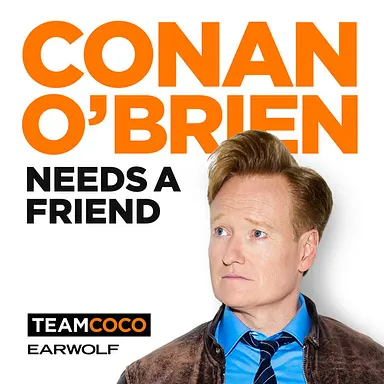
Conan O'Brien talks with actor Dustin Hoffman about his memoir Look at Me, covering his early years, his job as a toy salesman at Macy's where he used acting exercises to build characters, and his path from being the family's designated failure to Hollywood fame. They discuss The Graduate, the casting and making of Midnight Cowboy and Marathon Man, and his memories of working with Laurence Olivier.
Hoffman reflects on the anxiety and hunger he believes successful artists keep. The conversation is loose and comedic, with the hosts' tangents mixed in.
This is part one of a two-part interview.
In this episode Conan O'Brien, Matt Gorley, Sonam Ossession, Dustin Hoffman
This transcript of Conan O'Brien's conversation with Dustin Hoffman was made with HappyScribe technology, the same technology behind HappyScribe's AI note taker.
Ads in this audio differ from the text. Tap the sentence you're hearing to follow along.
Synced: the text now follows the audio.
Hi, my name is Dustin Hoffman. And I would feel great about being Conan O'Brien's friend if we ever hung out. And he is not called yet.
Uh-oh.
To be fair, Dustin.
Yes.
I call you many times. Someone who sounds a lot like you picks up the phone. When I identify myself, that person says, "He's not here," and then hangs up.
Here, you can call me up.
Yeah.
I literally—
Ring, ring, ring, ring, ring. Hello, is Dustin there? This is Conan O'Brien.
Who is this, please?
That's the person!
I am his housekeeper. Either he's not here or in the bathroom.
Okay. I'm going to call cut on this right now.
Fall is here. Hear the yell. Back to school. Ring the bell. Brand new shoes. Walking blues. Climb the fence. Books and pens. I can tell that we are going to be friends. Yes, I can tell that we are going to be friends.
Hello, and welcome to Conan O'Brien Needs A Friend, joined by Sonam Ossession.
Hi.
And, of course, Matt Gorley.
Hi.
And I am the aforementioned Conan O'Brien. I want to right up top say that apparently Sonam has had a life-changing orgasmic experience.
You are glowing.
You are glowing.
I'm a different person.
Right now. Tell us what happened.
So three of my best friends and I went to Vegas this past weekend, and we met new kids on the block.
And this is your group? I mean, you've talked about this for a while to me over the years.
These are my homies. So me, Christina, Veronica, Angina, we went to Vegas, and we met them and watched them. They have a residency, and it was just the greatest night of our—although Veronica's not a fan, so.
Wait, what?
And you're outing her here on the podcast.
Yeah, I know. Yeah.
Did she meet them? Did she get a picture with them?
She did meet—she was kind of—we kind of like just brought her along.
Did she say out loud as you guys were taking the picture, "I am not a fan"?
No, no. She was actually really cool about it.
But now they're listening to this, and they're thinking, "Wait, what's wrong with her?" Because that's how I would react.
Well, what is wrong with her?
Yeah.
That's true. What is wrong with her?
Any of these women piss?
Yes, Christina.
Okay.
You call her piss.
Yeah, I call her piss.
Okay, classic group.
Her pissy.
Okay, so let's talk through this, because I know new kids—some of the new kids lived near my parents' house in Brookline, Massachusetts, for a while.
Yeah. Okay.
And I used to see groups of young women waiting outside, hoping to get like a glimpse of Joey, and they'd have signs and stuff for Joey. And then I may have mentioned this once before, it doesn't matter. One time, one of the ladies drifted over to my parents' house. I happened to be there at that time, visiting them. This is after I've been doing the late-night show for a couple of years. And they were outside my house, just one person. And I went outside, and she said, "Yeah, things are pretty slow over at the new kids' house, so I thought I'd wander over here."
You're like a consolation person.
I was a consolation house to hang outside.
Oh my goodness.
And then I said, "Well, if you want, I could, you know, I could take you and your friends out to dinner." And she said, "We're good." No, I'm kidding. I didn't say that. But anyway, it was—they were a big deal.
They're huge.
I don't know their songs. What are some of their big hits?
I mean, "Step by Step" is their big one.
"Step by Step". How does that one go? We got it.
"Step by Step". Yeah, "Hanging Top". "Hanging Top".
Yeah.
And the Right Stuff.
Yeah.
There's "Cover Girl".
Oh, it's time to go do it. It's time to go do it.
No, it's not. "It's time to go do it" is not—they were actually wholesome, because they were, you know, young.
Right, right, right. "You're My Kinda Gal". Is that them?
You would be terrible in any kind of boy band. You would be really bad at it.
I got the rizz.
Stop trying.
What?
Just stop trying. But because we talked about it on the podcast, their team, this guy Marcelo on their team, was like, "Come to Vegas and we'll hook you up." And he did.
So describe what the situation is, because I don't know what the equivalent would be for me, you know? But.
Well, to give you an idea, my friend Christina wrote a letter to them when she was eight.
Piss.
Piss. Wrote a letter to them when she was eight.
Uh-huh.
And she didn't send it out because she was too nervous, so she brought it with her and gave it to Jordan. And it was like really sweet. She's like, "I am Christina. I'm eight years old. I love you guys, especially Jordan." She spelled his name wrong. And it was really sweet. But like, they were our first crushes. You know, we loved them. And then they were on stage gyrating, and our like eight-year-old selves were like, "Oh my God."
You lost your minds.
Yes. And our 40-something-year-old selves too.
Yes. And so they—were you listening to new kids on the block music all the way to Vegas and all the way back?
Yes.
Yeah.
Yeah. And Veronica was like, "Can we put on Tool?" And we're like, "Shut up, you bitch."
Tool?
She went to see Tool like days before.
Okay.
But yeah, no.
Wow, that's a nosebleed.
Yeah.
Oh my God. From Tool to new kids on the block? You know, most people just like that.
There's nothing like that classic rejoinder.
Shut up, bitch. That's why Sonam's, when she argues in front of the Supreme Court, it doesn't go well. "I would like to shut up, bitch."
I'm saying that to Clarence Thomas.
Yeah, Justin. Yeah, Justice Kagan. "Shut up, bitch."
Bitch, shut up.
He could use a shut up, bitch.
No, it was one of the best nights of our lives.
Wow.
It really was.
And so that was it, a photograph and some chit-chat.
Some chit-chat. Yeah, they—I mean, they all knew that I was affiliated with you. They were all fans of yours. Like, "Bustin".
Yeah, you've got that accent down all right. "Bustin". Yep. That's how the Hulk talks when he visits Boston.
You know, Donnie Wahlberg was in Band of Brothers. He played Sergeant Carwood Lipton, and he's like the emotional center of that thing.
Yeah.
Yeah.
Good actor.
I know. He was really good at it.
Good plug. I don't know why you're getting the word out on a new kids, guys.
I was just trying to.
On Band of Brothers.
Yeah.
Let me see. How can I phrase this?
You're trying to connect them to me.
Well, not only that, but I was also trying to have a moment with you. But I should have known better than that.
No, no, no, no.
I should have.
No, I saw a chance.
Why would I do that?
I saw a chance to put you down, and I took it without even thinking about what a good guy you are.
Yeah.
And I should.
Let me try it again.
You were trying to be kind and.
Hey, yeah. I was trying to be kind. You know Donnie Wahlberg, right?
Sure.
Fuck you.
Hey!
Hey, buddy.
All right. Hey, bitch.
You're my ride or die now.
All right.
Well, that's a nice experience you had.
It was.
It's interesting to, you know, because I was doing something recently where they were showing me like incredible Beatles stuff. I can't say too much about it right now, but I was getting to see some things that most people don't get to see. And it's going to be for this project that's upcoming. And I was trying to explain, David Hopping was there, and he could see how exciting it was for me. And I was trying to explain to him what this meant to me. And I said, "I guess for you, it would be like if you got a chance to hold Tate McCrae's thong."
Oh my God.
And he got so mad at me. Everyone in the room laughed really hard. I think it's the way I said it. I said, "Imagine if you get to hold Tate McCrae's thong."
I'm impressed that you pulled out Tate McCrae.
Who is Tate McCrae?
There you go.
Yeah.
Who is he?
It's a she.
It's a she.
I think she's one of the new ladies that.
She was one of the, like, from Dance Moms, I think. She was one of the young dancers, and then she grew up. She's an incredible dancer.
Great dancer.
She's a great performer. Yeah.
Yeah.
Yeah.
And she, you know, she's got a body for days. She's tight.
For weeks.
No, it's not the same.
No, no, she's booked it for weeks.
No, but weeks isn't—it's not—you're messing it up. It's days.
Your body for a millennium.
No, my God. And why is your voice sounds weird?
Got a body for an eons.
Stop doing it. Just stop. But you know what else I remember? I remember that time you—Buddy Holly's Amp. And you were really excited about that.
We were—you and I were in Nashville. We went to Gruin's, and they said, "Hey, Conan, we know you're a huge Buddy Holly fanatic." They showed me one of the last amps that Buddy Holly owned. They took off the back, and you could see once you take the plate off the back, you could see that Buddy had written his name into the back. Then they showed me Tate McCrae's thong.
God, this just reminds me of that time I got to get my hands on a skein of Harris Tweed yarn.
Oh, I love that you're playing into the role I've cast you as, unfairly. All right, let's do this. We have a very important show today.
Yeah.
Yeah. My guest today is a Hollywood legend who has starred in such iconic movies as The Graduate, Rain Man, and Tootsie, just to name a small percentage.
Oh, yeah.
It's mind-boggling how many iconic films this man has helmed. He now has a new memoir titled Look at Me, I Am Honored. He's here today. Dustin Hoffman, welcome. Dustin Hoffman, it is an honor to have you here.
Thank you.
I know you don't like that kind of compliment, but it just is. It's an absolute thrill for all of us to be in a room with you. And I am elated because I read your autobiography, Look at Me, this weekend, and I loved it. It's fantastic.
Thank you for reading it. Are you a quick reader?
I am a quick reader. I'm a fairly—no, I want to say I'm not that quick, but I go back and reread things a lot because there are certain stories here in this book. Not certain stories. There's maybe 75 stories in this book that are just absolutely fantastic. And there is so much to talk about. I want to say, I want to tell you one thing, which is I had an encounter with you that really makes me laugh. You and I were at a Bat Mitzvah together. And it was Adam Sandler's daughter was having a Bat Mitzvah.
Yes.
You were sitting on the table. It was a big table, and you were opposite me. And I'm sorry, but it's a big deal when you're sitting at a table with Dustin Hoffman. I grew up adoring all of your work. And I'm like, "Oh my God, it's Dustin Hoffman." I'm sitting next to David Spade's mother. And David Spade's mother is so thrilled that you were sitting across the table. And she says to me, "That's Dustin Hoffman, Conan. That's Dustin Hoffman." I said, "Yes, Mrs. Spade, that's Dustin Hoffman." And she said, "I'm going to go over, and I'm going to tell him how much I love Tootsie.
It's my second favorite movie ever." And I said, "Okay, great." And she said, "My first favorite is Amadeus. And I can't wait to go over there and tell Dustin Hoffman my first favorite movie is Amadeus and my second favorite movie is Tootsie." And I said, "Mrs. Spade, just go up to him and say, 'I love Tootsie. It's one of my favorite films.'" And she went, "That's not the truth. The truth is Amadeus is one." And I kept telling her how to say it. And then she gets up and she walked over to you.
And I can't—the beauty is I couldn't hear anything. I could just see her talking. And I could see you getting the news, "My favorite movie is the one you're not in. My second favorite." And it was a joy for me. You were absolutely delightful to her. But it was just hilarious.
How old was she then?
I think she was 107.
I think I went with her.
Yeah, you did.
And I think that's her getting even.
Yeah, it was.
She said you were an item.
One date.
Yeah. You were a big item in 1955, she said.
That's when I graduated high school, actually.
That was the year.
And we have things in common, by the way, because I looked you up.
Uh-oh. Uh-oh. What did you find out?
We're both from LA.
No, I'm not from LA. I moved to LA. I'm from Boston originally.
That's right.
But I moved to LA.
Well, Sonam and I are from LA. You must have been thinking of us.
You're probably looking us up.
No, no, it wasn't. No, I think it was.
Dustin, I'm going to say this. I don't think we have anything in common.
Are you not six foot five?
Yes.
So didn't you get teased as much about being the tallest, and I got teased for being the shortest?
Yes.
See?
Yes.
And it was painful.
It was painful.
Yes.
You're going to think I'm kidding, but I'm not. I always look for points of commonality. How can I relate to this person who's accomplished so much? And there are real things that we have in common. You start this book by proving one of my theories, which is you are cast. It's your big break. You're cast.
Can I just hold one second?
Yeah.
I won't do this because those who have a thing, it'll hurt.
Oh my God.
No, I'm sorry. I'll tell you why after you finish your story.
It's going to be a 40-minute story. You should probably hydrate before we get into this story.
One of the things about being my age, which is 89, is that you lose the sensitivity at the tip of your nose. So it's dripping, and you don't know it.
Oh.
That's why many times I carry this, and I just do this, especially if I'm on the air. Because if it's dripping and you don't know it, people think it's because you're old. It's not. It's because you don't know you're dripping.
Right.
Okay, go ahead.
I have that, but it's not my nose.
Oh.
Excuse me.
Killer, right?
No.
No, my anal glands.
Oh.
What did you think I was talking about my dick?
Oh God.
Okay, let's clean this up. This is on you guys. And that's not an edit that's staying in.
Why is anal associated with being a, what is it?
Like super type A.
Super type A fussy.
Like seeing your.
Why?
Isn't it from anal retentiveness?
Yes. And I think it's probably a.
Speak for our experience.
Probably a Freudian stage. I think anal retentive meant you're holding it in. You're tight.
Yeah.
Yes.
So what's the opposite of anal? Oral?
Yes.
Does that mean you don't hold it in?
Oral.
Oral expansiveness is when you are just as chill as you can be.
I'm sorry. I am looking through my notes, and I don't see this area anywhere. I'm looking through Dustin Hoffman questions. I don't have anal and oral in here.
That's because it's in his book.
You were getting "Get Your Big Break." You're cast in a Broadway show. You are burned in a kitchen accident. This is how you start the book. And you try everything you can to hide the fact that you've been injured because this is your big break. You're going to be on Broadway. They finally find out because you're in terrible pain. You're really hampered. You're not able to do your thing. They let you go. You think, "Oh my God, it's over for me." And then you later realize, because you didn't do that play, you did The Journey of the Fifth Horse.
That's the play that gets you noticed. Mike Nichols sees you. That's what gets you The Graduate. The thing that happened that you thought was the end of your career was the propellant, the thing that puts you where you were supposed to be. I have found that to be true many times. Have you? And it's amazing. Yes.
Propellant.
Yeah, propellant. Yes. I thought you were accusing me of something.
Don't point.
Don't point. But isn't that an amazing thing?
Can I ask you a question?
Yeah.
Are you a speed reader?
No, I'm not. I read at a medium pace.
Because you got about 60% of what you said correct, which is not bad. You kind of just scanned each page. It's a question. I don't want to hurt your feelings because I know you're six five.
We have no more time. This is the shortest podcast. What did I get wrong there? I believe that I was correct there, but let's just say the gist of what I said is correct. Is that fair?
Can you look up gist?
What would you guess? German? Is it German, or would it be?
Jeez.
I love that you can look up words now, and you can get it immediately. What would you guess gist is? British?
What the root is?
Gist, yes. Yes.
It does sound German. It sure does.
It does sound German.
I feel in German.
You got the gist.
The geist.
Is it like geist?
The geist.
The spirit?
You got the geist.
Is it?
What? What am I doing?
Why are you saying it like that?
I don't know. I think I'm auditioning for Dustin Hoffman. I desperately want to be in a movie as a German guy who says gist all the time.
I can guarantee it.
Comes from the Anglo-French legal phrase, say action gist, meaning this action lies.
Gist.
That's gist.
So that's the gist of it.
That's the gist of it.
Yes.
But do you agree that.
Learning so much.
You started this book with this story of you encountering this terrible obstacle, but it all ends up leading to you having this iconic breakthrough in your career.
The first thing I'd like to say is there is a woman who is a co-writer of mine, and if she wasn't there for me, this would never have happened. I have written maybe others here. Can I say how many people are in this room?
Yeah, sure.
One, two, three, four, five, six, seven, counting both of us.
Yeah.
If you've ever tried to write a memoir, you get about a page or two.
Yeah.
And then so I have like 20, 30 notebooks because I kept trying over the years. And I always thought it was the notebook. If I got a different notebook, I would do it.
Yeah.
But you don't.
It wasn't the notebook, was it?
It wasn't the notebook. So she was extraordinary, and it was written with her.
Yes.
And she was absolutely, at that time, the most important person in my life, Ariel Levy. And what made her brilliant, have you ever thought of having a memoir?
Yeah, I do think about it because I have some kooky stories, yeah.
You got to get Ariel Levy if you can for two reasons. One is the brain. You remember certain things. And she would ask me questions, and your brain kind of has stock answers to those questions because you've been asked before.
Yeah.
So I would give her the answers. Then she would ask me questions about my answers. And that was suddenly, you know what short-term memory is?
Yeah.
Well, there's also long-term memory, which comes in when you're old. And suddenly I remember it's Ms. Sutcliffe, who was my third-grade teacher.
Yes. Yeah, yeah.
Is that true?
No, it's funny. Often, people think they don't remember. And you are in this enviable position, which is you have made an absurd number of iconic films. And you've met everyone, and you've participated. You've been such an important person in the culture over many, many years. And then suddenly you're supposed to remember all of it.
Yes.
But what happens is you start talking, and someone says something that's incorrect, and you go, "Wait, no, no, no, that was Ms. Sutcliffe, third grade." She drove a Saab. It was green. And suddenly all these things are coming out that you didn't realize you could access.
Do you remember the first teacher that knew that you should be a comedian?
You know, that's interesting. It took a long time. There were many who said, "Don't do that." I actually remember that I had a camp counselor. I went away to a camp. I didn't have any friends there. I wasn't that happy. I would have been at that time maybe 11.
Okay.
And I was very lonely. And then on some long hike, I just started babbling this crazy story about a giant bird that lived in the woods and adding all these details. And this counselor started laughing so hard he was crying. And he kept making me go more, more, more. And then when we got back to the camp, he started walking around telling everyone, "This kid, the weird kid with the red hair, with the bowl haircut, that kid is really funny." And.
I think it was pre-puberty.
It was.
Do you remember if you had hair under your arm yet?
No, it's just.
Dustin I hit puberty during Obama's first term. Okay? All right? I remember.
And puberty rejected him.
Puberty said, "We're good."
Yeah, but we all remember that. It's funny because you talk about your father in this book. And I've always had a saying in the back of my head, "Show me a successful, creative person, and I'll show you someone who had a complicated relationship with their father."
Right.
Your father wanted to be in show business, ended up working in props, but he did not have success. And he had a hard time being generous initially about your success.
Yes.
And he had this line when you got The Graduate at the age of 30 and overnight became a cultural icon. In the book, you say your father said, "Do you know how lucky you are?"
That's exactly the words.
Yeah. And I.
But he was right.
He was right.
Because I'm Benjamin Braddock, six feet two, debating squad, and I'm the short Jew. And Mike Nichols didn't even change the name from Braddock to at least some non-Irish Catholic name.
Do you realize how many people don't know because your performance is so iconic, they don't realize that the book initially, Benjamin Braddock is blonde, blue-eyed. He should be played by a Robert Redford.
That's who he wanted.
He wanted Robert Redford.
Yes, yes.
When he casts you, many people think, "What is he doing? What is Mike Nichols doing, including you?" You were very insecure during the making of that movie.
It's the worst experience of my life. Working, in fact, when it was over, I said, "I'm going back to the theater," which I had been doing for years and years. I'm not, you know, I'm ethnic.
Yeah.
I'm not in a town that's had a facelift. You know, I want to be back with my people. And they did make a big mistake, you know, because Nichols, just before he died, and I'm still sorry, he died, I just thought of something else. Who was it? The George Burns on his 101st birthday. He said, "If I knew I was going to live this long, I would have taken better care of myself." Not a bad line. But Nichols, he really abused himself.
And he was sorry that he did because he admits it in his own autobiography. And this is interesting, I think, is that he didn't know he had been looking for two years for this character, Benjamin. No, Redford turned it down, I think. And he asked a lot of other people. And then he realized that when he was writing his own memoir, and he only had four, he knew he was terminal. He knew he had an incurable illness. He confessed things.
And this was shocking, which I never knew. He was a cocaine addict. And I realized that's the reason he was so nice to me. And you know, because when he was high, it was one or the next day when he's on a downer, he was abusive. And he admitted it. He said in the book, he said he worshiped Bob Sertes, who was this legendary cinematographer.
Yeah.
And he overheard Bob Sertes say something because they had to do it over again or something. And he heard Bob Sertes say to his crew, "That's okay. It'll be over soon." And I think it had to do with the drugs. Poor guy.
You say in this book that during the most memorable scenes in The Graduate, which are all enshrined in the American Film Institute, in those great scenes, you at times thought, "I don't know what the hell I'm doing." And that was a disaster. That's what you're thinking as you're making it.
Yes.
Which is very hard to believe, but I believe you. I believe that that's true. That's how you felt.
I can ask you, how many times when you started telling jokes, did it not get a laugh?
There's no record of me ever not getting a laugh. Dustin, we've looked into it.
Got it.
Over 7,000 hours. You know what's incredible? What's that?
You have it wrong. There's no record of a laugh.
Oh.
Yes.
I got it backwards.
You did.
No, and it's interesting because I routinely would leave the set after a show and feel terrible inside. That didn't go well. I didn't connect. That was awful. And people would say, "That was really good." And I would think they were lying, and I'd be upset. So.
And maybe they were.
I'm sorry. You're a terrible person. I'm realizing that now. And I regret that you're here, but you're here, and we're going to get through this. You.
I have to interrupt. Family at all?
I come from, yeah, my father, I think, was about, yeah, I think my parents were tall. I'm taller than my parents. I have a brother, Justin, who's very tall. And so, yeah, there was genetics there. Definitely.
Same here. Same here. I am the tallest one in my family to this day, including people that married other people who were not in the family. I'm literally the tallest person. I used to find that an interesting thing to say, and I don't, as I'm saying. I'm going to strike that.
No, no, you're not going to strike that. That's really funny. And also, I could see that. It must be nice when you're a towering giant when you hang around these relatives of yours. That must be, yeah, it's a good feeling for you.
Is that redundant?
Yes, it is. Yeah, I'm sorry.
There's no giant that isn't towering.
I don't want to be here. I just don't want to be here.
I do. I'm loving this.
I'm enjoying this.
You live, I've always wanted to ask you about this because it's insane to contemplate. But you grew up in LA. You moved to New York. You want to be an actor. You're doing a lot of absurd, odd jobs. You're working at, is it Macy's where you're selling toys? You sold toys at Macy's.
Adult games, which was different in those days than it is now, or adult toys. They were toys for adults. In fact, what's that thing called?
The, yeah, like foosball or hockey that we.
Yes, hockey.
Yeah, the little, where you moved the little guys.
Yes, and I had it on my side, and then someone would come just shopping or whatever, and they would take the other one, and I would use it to try to beat them. And I started to get good at it. And because I'm an actor, this won't be a long answer, I looked up and I realized that there were a lot of hockey players that were French, and a lot of them got hurt playing hockey. And I tried to be a retired, hurt French hockey player, literally.
In the next boot, no, I did, and I am injured.
French accent?
I had a bad French. I never was good at accents, but I won't even try. But Gene Hackman was right there at adult games also.
What?
Yes.
You know what I love? So this is the thing I was getting to. First of all, when I was reading the book and it said, "For a while, I sold adult toys," and I thought, "What?" And I just pictured you with, you know.
Dildos, et cetera.
I wanted you to say it. I thought you were a dildo salesman.
Can we look up dildos?
And then I was crushed. Yeah. Would you like a dildo?
What do you think? Is it French or German dildo?
I think Latin had dildos.
They had them back in the day.
They had dildos back in the day?
I'm sure they had.
Oh, they go back thousands of years. The early ones were made of stone. Not fun.
Thousands of years.
What's that? So, excuse me, Sona, please. I'm trying to conduct an interview with a legend.
First appeared in English print in the late 1500s.
1500s dildo.
English print.
1500s.
Shakespeare's day.
Yeah, it makes sense, doesn't it?
So you're working, your job at Macy's is just to sell the toys. All they want you to do is say, "You might like this. It's a hockey game. Here, I can show you how it works. Isn't that fun?"
What's a French accent?
But you decide, this is you, you decide, "I need to become a French hockey player who's been badly injured and is now down on his luck and selling toys at Macy's." And you use it as an acting exercise. The second craziest thing to me is you go home to your roommates, and they are Gene Hackman and Robert Duvall. The three of you live, it's like I'm picturing a bunk bed with three levels, and you guys are snoring in unison like the Three Stooges.
That's what I'm picturing. That's crazy that you all live together.
We didn't live together quite like that. But did you?
In my mind, you did.
Okay, you can. Did you live ever? I'm guessing because you said that you yourself at some point in your life lived in a bunk bed. And did you want, because this tells me a lot about your personality, if you had your choice, did you want to be on the upper or the lower?
Yeah, are you a top or are you a bottom?
I'm a top. I'm a top.
I always wanted to be on the top. I thought that would be cool. I never got to sleep in a bunk bed until my freshman year of college when that's what they gave us is bunks.
But you chose the top.
I chose the top. I wanted to be on top. I've always wanted to be on top.
You're saying it a little, but.
My greatest thrill would be to be on top.
Okay. It's a little.
You guys aren't understanding me. My erotic fantasy.
Yeah, no, we got it.
Okay.
We got it. No, we got it.
Well, you certainly don't want to be on the bottom if the top is 350 pounds.
Again, I'm looking through my notes. I'm not seeing this anywhere. I'm seeing all these things to talk to Dustin Hoffman about. Father, odd jobs, roommates.
Top, bottom.
Fame. I'm going to go with fame. You had an interesting experience, which very few people have. You became famous overnight at the age of 30. You make The Graduate. You're an unknown. The movie doesn't just become a hit. It's a cultural phenomenon. Many people think that it ushers in the death of the studio system, a complete new kind of film. It is endured as a classic. And then you don't know how to handle this.
One second. Sorry.
You get two more of those, and then that's it.
I'm not doing that to try to get attention.
Sure. By the way, your book is called Look at Me. So I think you'll do anything to get attention.
We all do.
I don't think you need to blow your nose that often. I know what you're doing.
But I am dripping. I am dripping. Go ahead.
You're dripping.
I told you about the dripping already.
Yeah. You were not happy about suddenly being famous.
Well, but the truth is that I was miscast. I mean, did I say this part already?
No, no, you mentioned that you're the only person in this room that thinks it was a mistake for you to play Benjamin Braddock in The Graduate.
What do you think that, sir? I can say sir.
Yes, you can.
Sir, what are the odds of someone being in basically their first film with the best director of all time at that moment? I mean, who would you compare him to today? Maybe, what, Spielberg or something? That was Nichols. I mean, he was a god. He was the god. And to be cast in that, and not only is it a hit, but as you said, it becomes this phenomenon. What's the odds? A million to one?
Two million? I mean, it has to be.
So suddenly people are coming up to you. You can't go anywhere. People come up to you. They want your autograph. The least it's before selfies, so no selfies. But.
That's right.
You had a little bit of an allergic reaction, probably, to just suddenly this is your reality, that everybody knows who you are.
Do you always want me to answer the first thing that comes to my mind?
Sure.
Like in analysis, you're supposed to.
Yeah. I am your therapist now.
Okay. Allergic. I have had a life, my first reaction, I've had lifelong acne, literally. I mean, I take Accutane three times a week, or else I'd look like a 15-year-old. I mean, there's an upside to that, testosterone, but we don't want to belabor that. And I'm 89, and I still have lifelong acne. So I said, I will never make another movie again after that.
And I went back to the theater in New York because it was a horrible experience. I was fighting acne. I was short. He thought he made a mistake. As I said, you know he told all his friends, you know I miscast the lead, which he did.
Mike Nichols is telling everyone, I made a mistake.
Yes, yes. And he's not really dealing with it because of his.
Addictions.
Yeah.
So you thought, I did that film. It's a big hit. I don't want to do that necessarily anymore.
At all.
And then you proceed to make, there's almost too many to mention.
We were just naming our own generation's favorites, and every one of our generations has a number to pick from. There's so many.
But it's interesting. It's Marathon Man, all the Presidents' Men.
Tootsie.
Kramer versus Tootsie, Kramer versus Kramer, Hook. I mean.
Midnight Cowboy.
Midnight Cowboy. Sona comes in ranting about Hook. She's a completely different generation.
Yeah, so is Eduardo.
And Eduardo.
We both are big Hook fans.
And so you've managed to make these movies for every single generation. It's very interesting to me that after The Graduate, you're thinking, well, that's it for movies for me. And then you proceed to have this streak that I don't think is rivaled by anybody.
Well, I'm not sure. Maybe you're right. I can't tell. But I do know that I was supposed to be, as I say in the book, I was supposed to be the failure in the family.
Yes.
My brother was an AAA student, was an athlete. He was asked to be on a major baseball team. When he graduated, he chose college anyways because he thought he'd have a longer career. And I was supposed to be the failure. I was the designated failure. I was very comfortable with that. And I even failed at that.
It was your failure to be a failure.
Yes.
It's your true failure.
Yes.
Wait, you can do that?
Yeah.
Oh, no.
And that was painful, actually.
You say in the book, I think it's a quote, you said, "I cannot stress this enough. Nobody expected anything from me." You were a very bad student.
The worst.
The only reason that you got into acting was because someone told you, it's like PE class. You can't fail. So.
Nobody fails acting. I mean, nobody fails gym. I mean, you get a C, right?
Well, okay.
You failed gym?
I failed gym. Yeah.
Aw.
Yeah.
No, you couldn't.
I made that up. I just thought it'd be fun.
Six foot five, my God.
Yeah, guess what? No coordination. That's the problem. I had the height, but not the coordination. And again, no testosterone in my body until Obama's first term.
What about your sport? What was it?
I was a runner for a while.
It's six five.
Yeah, it was a mistake. They made me a distance runner, and I looked like sort of a red-haired gazelle, but a sickly one, like a tubercular gazelle running across.
Why not basketball?
Because you need to care where the ball is. I never cared where the ball is. So they would toss a ball to me, and I'd say, I could grab it, or I could think about this funny bit that's in my head.
You know, I said, give me the ball, give me the ball.
Oh, I didn't want the ball. I would say, no one give me the ball. I didn't want the ball. I still don't want the ball.
Right.
It's a waste of time to have that ball.
You have to have a sport today, though, right?
I think everyone has to have a sport.
Really?
Yeah.
Yes, I'm late.
You have to have a sport. There's this, it's such an insane picture, but it's a famous picture. You finish The Graduate. The Graduate comes out, massive success. You were paid $3,000 for your role as Benjamin Braddock in The Graduate. $3,000. Now, I know that went a lot further back in the late '60s, but still, $3,000. You didn't have any money, and so you went back to the unemployment office. And someone at Life Magazine took a photo of you.
Yes.
The most famous face in America at the time, waiting in the unemployment line to get a check.
Yes. $50.
$50 check.
$55, I think, was the most you could get.
Yeah. And so.
Which you could live on. I mean, you could live on.
Back then.
Yeah, 200 a month was.
Now that's one smoothie at Erewhone.
Yes.
And not the good one. You have so many great stories about your co-stars, people that you worked with over the years, and your process for making up these characters. After The Graduate, you have this chance to play Ratzo Rizzo in Midnight Cowboy. John Schlesinger, the director, was going to make the movie Midnight Cowboy. He needed to get financing.
Yes.
So he said.
He couldn't get it.
He couldn't get it. So he said, and he probably told, if you cast Dustin Hoffman, who's now a big star, you can make this movie. He didn't want you. He thought, because he saw The Graduate, that that's who you were.
Yes.
So you have to convince John Schlesinger. And again, just like you at Macy's, you decide, I'm going to become Ratzo Rizzo and convince this director.
Now, don't, oh, I shouldn't interrupt. I'm sorry.
No, no, go ahead. You may interrupt me.
Okay. Well, since I am, you're taking a drink out of a cup with a deer on it.
Yeah.
Is that an accident?
No, I chose this mug. I love this guy. I love this mug. And.
Have you ever, you can tell it with that very, have you ever shot an animal?
I never shot an animal.
Never.
Never.
Never took a bow and arrow to a deer.
No. I threw a hammer at a rabbit once.
That's weird.
That's weirder.
An arm's length. Wasn't a long throw.
And you know what? The rabbit was doing nothing to bother me. And if I can go further, it was a petting zoo.
Oh.
Jesus.
I'm sorry, Dustin.
Aw.
Yeah, I needed some time for that. It's okay. We all pay for our crimes. Where the hell was I?
Did it die instantly, or is it somewhere, is there a crippled rabbit?
No, he was.
He missed.
No, I got him. He just hurt his leg, and then there was lawsuits. And the rabbit showed up in court.
That's why they always stood up on twos. There's some guy with a hammer in their body.
Listen, we're not going to get into why I used to go to a petting zoo and throw many times hammers at small animals.
Okay.
That's my thing. That's how I get off.
Now.
Yes.
If I may.
Yes.
It wasn't just John Schlesinger. It's funny because you're still you, even if you become a star. You're still you behind that. And I was very angry that the public did not think I was anything but Ratzo Rizzo.
Benjamin Braddock.
Oh, that's.
Yeah, yeah. You were mad that people thought.
They're thinking.
You're thinking, I'm an actor. I'm trained. I do a lot of work in method. And.
Which is another subject, but go ahead.
Yeah, but I mean, you, and suddenly you have a little bit of a score to settle because you want to show people, no, I'm not Benjamin Braddock. I became Benjamin Braddock for The Graduate. Now I'm going to become Ratzo Rizzo.
That's why I took the part.
Yeah.
Was to get revenge against the world.
Yeah.
I wanted to prove.
Yeah.
Because that's who you are behind everything.
Yeah.
You're still trying to prove that you're an actor.
Yeah.
And I hated humanity. And that's why I took, and in fact, Mike Nichols calls me up. It's one of the great moments in my life. And he says, what are you doing? And he's talked in that sing-song.
Yeah.
What are you doing? And I said, but he says, you're playing this, what do you say, this.
Tubercular, limping.
Yeah, this detestable character. And it's not even the lead. It's a supporting part. Why? And he said, why are you trying to destroy? I made you a star.
Ah, yeah.
And it was, I loved the fact that he had said that because that is the reason I didn't work for a year. I didn't want to be a star. I only wanted to do good work.
Yeah.
I never, I didn't because I was the failure of the family. My brother was the star.
Yeah.
And there are people, there's a basketball player, who was that legendary, the guy who's Jalen Brunson.
Yeah, Jalen Brunson, yeah.
He said a great thing. He says, if you're ahead by 30, 40 points, why do you still care? That's what he said.
Yeah.
You're still trying as hard as you can. He says, I wanted, the reason I do the next shot, he says, because I want to see what I did wrong. I want to correct what I did wrong. That's a great answer.
That's cool.
So it's got nothing to do with anything, but the moment I want to, I want to correct the mistake I made so I don't make that mistake again.
Yeah.
But that has to be true with you too.
Well, I think it's a hunger that doesn't go away. And I remembered once.
It's a good way to put it.
I think we used to have young people come in, sit in the audience at the late-night show, and ask me questions. They were students and interns. And they would come in and they got to just ask me questions. And I remembered one woman who might have been, I don't know, 19, 20 years old, said, when do you stop worrying and being anxious? When does that stop? And I said, I got bad news for you. You know, and at the time, I was in my late 40s, and I said, it doesn't. It never does.
Correct.
You need to be hungry. You need to be scared. Not terrified, but you need to be scared.
Yes.
And we're all pushing for that. We're all digging into that. And I think your decision to take that role of, or to try and get the role of Ratzo Rizzo is you saying, I have now given myself a whole new challenge. Most people would say, I just did The Graduate, home run. Aren't I great? You said, no, no, now I really have something to approve. And it became fuel for you.
I wanted revenge.
Yeah.
I wanted revenge against everybody.
Yeah.
I loved that he said it's a supporting role.
Yeah.
It's, but I don't, as I said, that's, I think, not getting a laugh. You want revenge because you want to get the laugh.
So you end up meeting Schlesinger in Times Square in a dive coffee shop. You haven't showered. You're dressed like a bum. You're dirty, and you show up to prove, this is who I, I can be this guy now.
Yes, and I don't know if it still exists because everything changes, but anybody from New York here? You know what an automat was?
Oh, I do.
Oh, yeah, those vending machines for food.
You put a quarter in and you get a sandwich.
Yeah, and some of them were on 42nd Street, when 42nd Street was 42nd Street. It was literally open 24 hours. And I said, meet me at Hornet, because I had been there at 3:00 in the morning when I was literally trying to research the character. That's one of the places. I followed one guy who had, you know, actors are crazy, just like, you know, comedians. And, you know, you're looking for the right limp, you know, forever.
You're following different people.
So you're trying to figure out what's the right limp for Ratzo Rizzo.
Yes.
And you're following people.
Yes. And the guy who wrote the book, James Leo Hurley, he literally said it in the book. He says, you're like the fifth wheel. He says, it's like, it's, you're like this.
It's wobbly. Yeah.
Yes. And that's the limp. And so I was trying to get that limp. And I saw something that was extraordinary, which everybody who knows New York knows. For some reason, New Yorkers are waiting for the signal to change. And for some bizarre reason, why there can be like 20 of us there, want to be the first to cross.
Yeah. Yes.
Why is that?
Still true. Still true.
They want to be the, for what? I'm, look here, I got here before you guys. And I thought that that was Ratzo, that he would not only get across, but with his limp, he wanted to be the first one.
Yeah.
And I, you start to learn from little things like that, you put together who this guy is going to be.
Yeah.
And then I even thought the concentration camps, and he was a survivor. And you didn't ask yourself, why and how did he become a survivor?
Yeah.
Because we know that there were some people who came, became a survivor by giving up other people.
Yeah.
But the point, and I thought, that's Ratzo.
Right.
He doesn't give a shit.
Right.
He really doesn't. He just wants to be there. So it becomes more three-dimensional.
So you're.
He's not a good guy.
Yeah.
And I said, and it's very easy to be heroic or something when you think about that, but you don't know what you would do if you were faced with instant death.
No.
But they were going to let you live if you gave up.
Someone else.
Yeah.
The.
Very easy to be heroic in the.
Well, people love to armchair quarterback later on and say, I wouldn't do that. None of us knows.
That's right.
Who we are when there's a gun pointing at us.
That's right.
And we hope not to find out.
That's right.
So.
Did you ever have a gun?
Wait, what?
Oh, I'm sorry.
What?
Did you ever have a gun?
I know you're thinking of, because you're thinking of killing me at some point. No, I'm just thinking, I know what you'd be like with a gun to your head.
Please, please.
That's very.
Take Dustin Hoffman, don't take me.
A lot of tears.
Did you ever have a gun pointed at you?
I've never had a gun pointed at me.
I didn't.
Have you had a gun pointed at you?
Yes, I did.
When? And props don't count.
I was having, this is in my youth, youth.
Yeah.
I was having an affair with a married woman.
Oh.
And she thought that once her husband went to sleep, that he stayed asleep.
Oh.
And I was invited to come over after he came, he went to sleep. And there we are, having a festival of sorts. And he walked in with a gun.
Oh.
And he pointed at me. And he said, I remember what he says, get out, get out. And when you have a gun pointed at you, first of all, that hole is much bigger than the actual hole.
Yeah.
And you realize how any second, any second, he's going to pull that trigger.
Yeah.
Because his finger is on the trigger. And you think any second, he's going to, and you realize, it's it, it's it, it's it. You're going to, I'm going to die. I'm going to die.
Yeah.
The next second, the next second, the next second. And you do anything. You will do anything, you know, to avoid.
Yeah.
Getting killed.
So you jumped out the window, you ran away. Continue the festival?
No.
Sir, could you come back in five minutes? I need, make it seven minutes. There's a story in here of you making Marathon Man with Sir Laurence Olivier. And I never realized how sick Laurence Olivier was during the filming of Marathon Man. He's essentially dying. He's on a.
And he knows it.
He knows it. And he's on a lot of medication, pain medication. There's cancer throughout his body. He had trouble getting insurance for the film. They finally get him insured. And you're shooting one of these iconic scenes. I'm going to use that word 700 times in this interview. You're shooting a scene with Sir Laurence Olivier, and you're doing the wide coverage. Cameras are far away. And he's kind of acting out to the rafters, like he's projecting, you know, the diamonds, the diamonds. It's very loud.
And you think that's okay. The cameras got, got, it's a master.
Yeah, it's a master.
And it keeps getting closer and closer.
He keeps getting closer and closer.
And he keeps reaching for the balcony.
And the director, again, John Schlesinger, says to you.
I go up to his ears, he says, I know, I know. He said, I know he's over the top.
Yeah.
Is what they say.
Yeah.
He says, but I'm not going to tell the greatest actor in the world.
Yeah.
You know, if you want to, you can.
Yes. Isn't that great?
Oh.
I'm not going to tell Sir Laurence Olivier he's overacting a bit.
Right.
If you want to, you can. So you go up to him.
Yes.
And you try and do it in this very polite way, right? You have that suggestion about, you know, we could try one where we, maybe we use a little more of the way we're rehearsing, where we're just doing lines. We could try one like that.
Like we're just doing lines.
And he knew exactly what you were talking about.
Yes. Because of the medication, I mean, here's a guy who had three parts in repertory, committed to memory, you know.
Yeah.
What, Hamlet, Macbeth, King Lear.
Yeah.
Literally in repertory, knew all three of those word by word. And here's a guy who can't put four words together because of the medication.
Yeah.
And so we prompt him when we're in wide shots and we get closer and closer and closer. And he, we're at a break. And I go up to him. And I, again, as I said in the book, I, people called him Larry. And I could not call him Larry.
Yeah.
And I didn't want to say, you know, sir. So I called him Lordage, you know.
Lordage. I love that. Yeah.
And we were, I says, you want to just run the lines a little bit? And, you know, while we're, you know, just for the, to try to keep him in his head.
Mm-hmm.
And we went behind, it was outdoors, so we went behind a tree or something. So he'd have some privacy. And we're doing it. And then I'm kind of coaching him.
Yeah.
And he's just standing there. And I said, let's just, let's just run the lines, you know, just for, you can even look at, you know, the script for the day or whatever.
Mm-hmm.
And he gave me this long look. And he knew.
Because you were encouraging him, let's try it some takes. Now that the cameras are closed, let's try some takes where we kind of take it down, just as a fun exercise.
Like we're talking right now to each other.
Like we're talking right now. Let's try it like that. And he knows what you're doing.
And a very long look.
Yeah. And he said, so you think I'm, I'm playing it a little too big?
Yeah, am I over the top?
Yeah. Are you a little over the top? And what's amazing is, he looks at you and he says, thank you.
After a long beat of eyeball to eyeball, and it makes me emotional.
Yeah.
And he says, thank you.
Yeah.
And we were very close after that. It was awful what he had.
Yeah.
He knew he was dying.
Yeah.
And he, Bob Evans, who was the producer, some, he had a genius when there wasn't coke coming out of his nose, you know.
Yeah, yeah.
Because he, and by the way, he was, that was a time when you went to a party and there were lines of coke, you know, on the table. Everybody snorted, you know, I did.
Yeah.
And it was, it's, by the way, it's the greatest drug in the world.
Yeah.
There's nothing, there's nothing. And I thank God.
Let's get that word out, by the way. No qualifiers.
It's just the greatest drug.
Thank God.
I'm allergic because I couldn't breathe after that. I was allergic to it or I wouldn't be here now.
Yeah.
But because you're right there. You're right, and I mean, coke was, in Coca-Cola, coke was in it.
Yeah, in the original Coca-Cola, there's cocaine in there.
Yes.
And then some idiot took it out.
Yes, yes, yes.
The original Twinkie was pure methadone.
Cocaine used to have coke in it.
Can you believe that?
Had Coca-Cola in it.
Oh, okay.
Yeah.
You're an idiot. And so am I. And that's why we get along.
That's fair.
Okay. This merits two parts, because there's just way too much to talk about. And that is your fault. I am thrilled that we're doing this. Stay tuned for later this week when we have part two of my incredible chat with Dustin Hoffman.
Hey, let's dig into the voicemails and hear from one of our listeners.
Okay, let's do it just because you said that.
I don't understand.
I don't, I'm trying to think, is there another reason we could do it?
I know. We, you said we were going to do it, and then you said, yeah, let's do it, because you said we were going to do it.
But anyone just listening to the podcast just hears you say, now let's do that. And so, yes, we will do that. I was trying to think of the natural response. That was supernatural.
That was not natural at all.
You just stated that this is what we will do, and now we're going to do it.
And then you restated it.
No. You're the Pharaoh saying you must leave Egypt, and now we will leave Egypt.
I have that kind of power?
You do.
You are fired.
Yeah.
Okay.
It sounded like you were.
Enjoy those locusts.
Were you trying to insult him?
No.
I don't believe you.
I think he was.
Because I think you were.
Okay.
By the way you said it.
He was making a comment. He was kind of mocking the way I did it.
Yeah, yeah.
Well, you did it in a very, you know, you will now fasten your seatbelts for we are landing. And I think that was a crime in its own way.
I see.
What?
Yeah, okay.
Come on in.
I'm spiraling fast.
I know.
All right, let's.
I know.
Let's just go ahead and play the voicemail for Christ's sake.
Hi, my name is RC Graham. I'm from Akron, Ohio. So my intent, as inspired by a video from the University of Illinois, they made a couch you could drive around. And my intent is to make a desk you could drive around, a la the reoccurring bit on late night. Now I looked at a site, more specifically, it was an article about the option for the last late night desk. And I got the dimensions at about 48 inches by 24 inches by 29 inches. But if I could get some more details, that'd be great. Like, what is that plywood?
What are you using to finish that? Because while I'm not a woodworker, I'd want to make it kind of nice, at least like a lot of your desks going through. They had a kind of a nice finish, but kind of, as I understand it, late night desks are kind of crummy on the inside. I don't know if you can relate. Anyway, my intent is to kind of get an idea for the dimensions, get an idea for the weight, figure out the overall material. And as an engineering student, my goal is to use it as kind of a vehicle to practice the mechanical aspects while I'm currently learning the electricity.
Feel free to answer as you please. And I hope that you're all doing okay over there.
Wow.
Have fun and stay safe. Bye-bye.
Wow.
Okay. I put a lot of thought into my, all my desks that I had over the years on the talk shows. I would always insist on ash. And then I would use birch. I would sometimes use a studding, which was made of mostly a durable old English oak.
You, I'm sorry, you, you were using these to make your own?
I was giving the specifications.
Oh, okay.
I was giving the specifications.
Okay.
You were close. It wasn't 48 inches, it was 48 and a half inches.
Oh, okay.
I always make sure that each desk, after the woods were applied and resin with a high density polymer, that they were baked in a kiln for seven hours. The desks were valued by Lloyd's of London of having a worth of about $600,000 each.
Okay.
They are prized possessions. Let's face it.
Okay.
I don't know anything about these desks.
Where, where, where is it really up for auction?
I don't know anything about these desks.
It does seem that it was up for auction. I found the picture here.
Did anybody buy it?
I'm not sure.
That's kind of crazy that your late night desk was up for auction.
Yeah, it was up for auction. And then when no one bought it, they threw it in a dumpster.
And the final bid was $26,000.
Wow.
Wow.
Yeah. First of all, I don't know who would, who would auction that off? Like, who took it? Who sold it?
I mean, NBC.
I mean, I'm looking at this auction site, you know, when you think of auction sites, you think of like Christie's.
Sure.
Sotheby's.
Yeah.
Julian. This is.
Big Mark.
RL Spear Co., Incorporated.
I'm just curious. I'm wondering if, who's got the sticky fingers over there at NBC?
I would have stolen it.
It's also funny. This is lot 78. It does not say your name. It just says host's desk from early era of popular late night talk show, approximately 48 by 24 by 29.
He said popular.
Hey.
Starting bid $1.
And then the question is complicated because yes, there are some of my desks out there, I guess. There was a thing that you could do at the NBC store for years and years, because Andy and I would do a bit where we would get behind my desk. And using green screen, we would have all these adventures driving.
Yeah.
I remember that.
Yeah, yeah, yeah.
And that was a lot of fun. Then NBC, the NBC store turned that into an experience where you could sit and ride the desk with me.
That's cool.
And so I've met many people over the years who said, I was 15. I visited New York with my school. I waited in a line, and I drove the desk with you, and I still have the tape, which is fun.
That's nice.
That's cool.
How much do you think this desk would be?
This desk, as, did you make this desk?
I did not make it.
But first of all, Eduardo, again, props to you for designing a studio. You are a master.
Thanks, sir.
But I don't know who made the desk.
Eric.
This is Eric Boors.
Eric Boors made this desk.
Eric made it.
Yeah.
It's beautiful.
Yeah, Eric's awesome.
Yeah. I can't wait for someone else to have this desk in a few years and auction it off for $800,000.
Is that how much it is?
No, it's not going to get that kind of money.
Who knows?
I am curious. RC asked if the inside of the desk, like, obviously the facade looks.
Yep.
Fancy. Does the inside of the late night desk look crappy?
This is custom made for you, I'm assuming, right?
Yeah, it was custom made.
Yeah.
Because, yeah.
You know what I will say about, that's a good question that Adam asked. The outside of the desk had sort of a nice finish because it was on television. It's HD cameras, lighting. It has to look good. Not HD when we started, by the way, for years.
Yeah.
But then we went to HD, as all shows did. But what's really fascinating is, if you saw the reverse angle of the desk, and where my legs went and everything, it was, I mean, it was just about as down and dirty as it gets. It was just like a wooden slot for me to put like a handkerchief in or something and a pen. There might have been a, like a sort of crude trash can back there that was nailed to the side, but no finish or anything. It really was looked like.
It's a set piece.
It was a set piece. And my side of it looked like the thing had been made in five minutes by a bunch of drunken rabbits.
That's cool.
Anyway.
I'm, I'm, I'm looking at this, and I'm seeing a walnut veneer on top.
Okay.
And then with a little walnut on the outside with a birch ply inset on those surfaces.
Do you think that's what it is, RC? Because you're be my guess.
You're quite good at that.
That's be my guess.
It's actually very good looking. And I'm wondering why we didn't bid on it. That's good. That's nice looking.
It is a great looking desk. And I'm surprised you don't want it.
Can I just.
Or you just didn't, not that you don't want it.
No, we didn't know about it.
Yeah, I know.
I didn't know about it. I, I, I didn't know that it was, I mean, it was not my property. I guess it was NBC property. And my guess is someone came along and said, I'll take that.
But look at the difference in this, this kind of stark lighting photo. And then when you see it under the stage lights.
Yeah.
It looks so gorgeous.
It was a really beautiful desk.
Yeah.
You know what? Let's try and get it. So it's been sold to someone. Blay, how long has it been sold for?
26. I'll, I'm going to, I'm going to do a little research here, and we'll see if we can get it for you.
Yeah, I mean, I'm not going to put up any money.
Oh, okay.
But you, you just want it?
Well, I think we're going to find out where it is and steal it.
Just a heist.
Oh, heist.
I think he's talking about a heist.
Let's do a heist. Stolen it when you could've.
A desk heist.
I'm surprised you didn't steal more stuff.
I didn't know.
I didn't know.
Let's do a heist.
What's our specialties?
Late night, you didn't just grab a bunch of stuff?
No, I didn't.
You should've.
I had my Eisenhower mug that was on the, has been on every talk show desk I ever did anything with. It's, and that, that I kept.
You still have that? And that's still.
I still have that.
Never broke or anything?
It got a little cracked, and we made a fake one to sub in for it.
Oh, wow.
But I have the original.
Oh.
And that other mug, Greg made you.
Greg Daniels made me a mug that was always on my desk.
Yeah. That's sweet.
I still have that.
Good friend.
Yeah. What says, I hope you fail on it.
And, and the Eisenhower says that too, doesn't it?
Yes.
That was from Joseph Stalin to Eisenhower.
Yeah. Wow, okay. Well, I, I don't think we helped this guy with any of his questions.
Ah.
Good luck to you. Go online, look at that desk, and do the best you can. And I do, I will say Matt Gorley is very talented, all around, very good at woodworking. So your guess is about what it's made of are probably correct.
It's a guess, though. I can't tell totally from that, because it's, it's clearly been like built and then stained, but for kind of TV. It's not, it's not necessarily like a.
Also, remember, to match my overall vibe, it probably looked okay on camera, but it's rotten to the core. All right, good luck to you, sir.
Conan O'Brien needs a friend. With Conan O'Brien, Sonem Obsession, and Matt Gorley. Produced by me, Matt Gorley. Executive produced by Adam Sachs, Jeff Ross, and Nick Leo. Theme song by The White Stripes. Incidental music by Jimmy Vavino. Take it away, Jimmy. Our supervising producer is Aaron Blair, and our associate talent producer is Jennifer Samples. Engineering and mixing by Eduardo Perez and Brendan Burns. Additional production support by Mars Melnick.
Actor Dustin Hoffman would feel great about being Conan O’Brien’s friend if they ever hung out.
Dustin sits down with Conan to discuss his new memoir Look at Me, using his job as a Macy’s toy salesman as an acting exercise, going from “designated failure” to Hollywood icon, and his experience working alongside Laurence Olivier.
For Conan videos, tour dates and more visit TeamCoco.com.
Got a question for Conan? Call our voicemail: (323) 362-2295.
Get access to all the podcasts you love, music channels and radio shows with the SiriusXM App! Get 3 months free using this show link: https://siriusxm.com/conan.
Hosted by Simplecast, an AdsWizz company. See pcm.adswizz.com for information about our collection and use of personal data for advertising.