
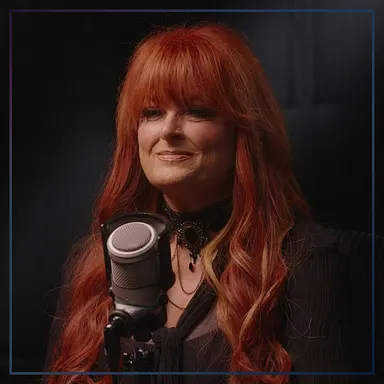
In this episode of All There Is, Anderson Cooper talks with country singer Wynonna Judd about grief, loss and the secrets that shaped her life. Judd describes growing up poor in Kentucky under a mother who pushed her toward music, her suicide attempt at seventeen, and learning at thirty that the man she called father was her stepfather.
She talks about her biological father, whom she never met, and about the suicide of her mother, Naomi Judd, in 2022. The conversation also covers her estrangement from her daughter Grace, her decision to raise Grace's daughter, and how writing songs for her album The Hard Truth has helped her live with grief.
In this episode Anderson Cooper, Wynonna Judd
The transcript of Wynonna Judd's conversation about grief was made with HappyScribe's human and AI transcription.
Ads in this audio differ from the text. Tap the sentence you're hearing to follow along.
Synced: the text now follows the audio.
Welcome to "All There Is," wherever you are in the world and in your life. I'm glad you're here. I sat down last Wednesday with Wynonna Judd. From a distance, she's always seemed kind of larger than life to me, but sitting across from her and talking with her about the losses in her life and the grief work she's been doing, I was really moved by her and by her honesty. Wynonna is 62 and got her first record contract with her mom, Naomi Judd, when she was 18. She's been through a lot in those years, a lot of highs and lows, and she's not only talking about them now, she's singing about them as well.
Her new album, "The Hard Truth," is deeply personal. She co-wrote most of the songs, working alongside her husband, Cactus Moser, and you'll hear a bunch of them that we'll also talk about because they tell a story of loss that's beyond words. Wynonna was born in Ashland, Kentucky, in the Appalachian Foothills. She grew up poor with her mom and sister, Ashley, who was on the podcast several seasons ago. Naomi Judd died by suicide in April 2022, and we'll be speaking about that in this interview. Wynonna says the depth of her mom's mental health issues was kept secret over the years.
There were a lot of secrets in Wynonna's life. The man she thought was her father was actually her stepfather. Wynonna wasn't told the truth until she was 30, and she says everyone else around her always knew, and they just lied to her. When she decided to try to meet her biological dad, he'd already died. Wynonna is also going through a lot with her estranged daughter, Grace, who's battled drug addiction throughout her life and is currently incarcerated. Wynonna and Cactus are raising Grace's 4-year-old daughter, Kalia. Here's my conversation with Wynonna Judd.
Thank you so much for doing this. You won't remember this, but we met once before. It was an album release party, I think, in New York, and watched you play and you were incredible. And then afterward, you were like upstairs on like a dais, and I approached you and I was so nervous. And what I remember you saying to me, you said, "Anderson, some days you just got to put on your armor. You just got to put on your armor."
Armor? I like your accent. What did you do?
I don't know where that accent came from, but it's not really yours, but it's the only Southern. My dad's from Mississippi. But that idea, weirdly, has stuck in my head.
Interesting.
I cannot tell you how many times, like I'm brushing my teeth in the morning, look at the mirror and be like, "Anderson, you just got to put on your armor."
That's awesome.
I feel like I have a relationship with you through that.
We're connected.
Yeah.
Oh my gosh.
Is that a line you use?
No. I don't know where the heck that came from.
It's such a good I was like, "Oh my God, you're so right." Yes.
You're right.
But I think it's also good to take off your armor.
I agree.
And so that's what I'm trying to do on this podcast.
That's what we're doing today.
Yeah. Is grief something you have felt, been aware of feeling for a long time?
Since I can remember. Since I can remember. I think I've always felt grief because on some level, Anderson, I just knew that I was born into such a chaos. I just knew on some level that I was sort of the chosen one with one set of grandparents and then in the way on the other side kind of thing. So I think there was a sadness, a grieving, if you will. And I knew how distracted and overwhelmed my mother was because she was so young, 17 when she got pregnant, coming out of high school.
Wow.
So back in 1963, women didn't get pregnant without having a partner. And I knew that mom was overwhelmed.
How did you figure out a way through?
I recently read a book called "The Highly Sensitive Person," and it changed my thinking because I did everything I could to not cry or not upset anybody. And I became such a codependent early in my life because I knew how to alter my state so that I wouldn't upset the system. I couldn't really be myself. I couldn't be the highly sensitive kid I was.
Did you cry as a kid?
Oh, a lot. I still do. I cry a lot.
You do?
I do because I'm grieving still.
I buried it so early on. I just wanted to build a life raft and I just tried to push forward.
I did too.
Do you still feel like you're doing that or do you feel like you're turning to that grief?
I'm turning to it and I use it on stage as well as off stage. And I have a partner. Cactus is my companion in a way that I've never had that experience with a man before who was so loving and even walking up here, he prayed over me. So I have such a support team, people who say, "Lean into it. Let it come."
I've been trying to develop a companionship with grief, like a relationship with it rather than running from it. And like I feel the little boy that I was back then when I came up with all these strategies and plans.
That makes me want to cry. That's so sweet.
Do you feel the little girl you were?
I do. I do. I did a lot of work around this. I did a lot of work. I did 42 days in sort of a treatment program. I wrote letters to myself and they talked about protecting the little girl and letting her be and seen and heard, which I wasn't as a child. So I've worked really hard at getting that companionship like you're talking about.
Was that helpful?
It changed my life. It changed my life.
It's changed my life. I'm almost embarrassed to talk about it because it seems so like cliché. I'm like, "Oh, okay, the little child within you." But like it's been incredible.
Nobody was around to protect me in a sense. Everybody was distracted. So I had to take care of myself. And then when Ashley was born, I knew on some level I was responsible for her.
You're also in this situation as a kid where your mom, as you've said, wants to be famous. And here's your voice as a way to propel everybody out.
It was a way out of the holler. She knew.
When did you know that she had that idea in mind?
I was probably 12. I would say somewhere between 8 and 10, mom started to hone in on the gift and really set me up for success. She raised a champion in Ashley and in me to go for it. And I think she was living through that with me and started singing with me. I would learn songs. Joni Mitchell, I was doing Bonnie Rait and Linda Ronstadt. I wanted to be them. And she started to harmonize. And it was so otherworldly that people started to notice.
And I remember getting that high knowing that we had some kind of power over people because when we would sing, this harmony was just like an angelic thing. It was just marvelous. And people started to notice. And so I think somewhere around 12, she knew.
There's something incredible about having this gift and also having somebody who sees it and encourages it. There's also something that's a lot of pressure and you're 12 years old. How did you start to feel about it over the years as a kid?
I was very shy, very introverted, to the point of terrified to sing in front of people by myself. I could do it with mom really easy. But doing it on my own, my stepfather would make me sing at parties and I would be mortified. And I remember thinking, "I can't do this." But somehow with mom, I could. So she became my absolute barometer for, you know, happiness and joy and all the things that you feel when you're making your parent proud.
I knew. I knew that she was proud of me when I did the singing thing. So you can imagine how much I wanted to fulfill that fantasy. Thank God mom was as ambitious as she was.
She took the lead on.
She was the boss. I worked for her.
And that's what it was. It was work.
It was work because it was too much for me as an introvert. I was so green and I couldn't even balance my checkbook hardly. I just wasn't a business person. I just wanted to sing. I didn't care. She loved the fame. Loved, had the wave, wore the outfits, twirled on stage, loved an audience. And I just wanted to rock with a band. I didn't care about all that.
You get signed at you're 18. At 17, you had thoughts of suicide.
Yes. I attempted.
You attempted.
I was thrown out of the house and I went to live with my stepfather and he told me I was going to college, that the singing thing wasn't going to happen. And I think I went into a real depression. And one night I took the car and I went drinking and I tried to run into a tree and it didn't work. But that was my goal. And I ended up 360 facing the opposite way. It's a God thing for sure.
And I just was done. I didn't think I was going to be in music anymore. And he wanted me to cut off my he cut my hair off and wouldn't let me wear makeup because I looked too much like my mom.
Wow.
Yeah. So I was living just in this state of hell on earth, knowing that my dream was over.
Did you really want to?
Yes. I was done. I was done. I had such a tumultuous relationship with my stepfather. And now I know why. But at the time I didn't. And for him to be that in my face about not singing was taking oxygen from me. I was just overcome with grief and sadness and anger. And I just didn't want to be here anymore.
You thought he was your biological dad.
Yes. I would learn at 30 that he's not.
Other people, not just your mom, but other people knew.
Everybody knew.
They lied to you. Everybody did.
Everybody did. Ashley knew since she was 11.
Really?
Yeah.
And she didn't tell you. No one told you.
Ashley ended up being the one to tell me. Mom couldn't. She was crying too hard. And she just couldn't. She couldn't do it. So Ashley finally blurted it out. Michael Simonella is not your father, biologically.
When you heard the truth about your dad, you're 30 years old. What do you do?
First thing I said, Anderson, was, "Mom, it's okay. Talk about codependent." I was.
Did you believe that or did you just want to make her feel good?
She was crying so hard. It was sort of all about her in that moment.
It says a lot about you that you find this devastating news and you want to comfort her.
I've always been that way with her. People don't believe me, but I've always thought of her first. And that's because I always knew that I was her light because she told me so.
Did you feel responsible for her?
Yes, very much so. I knew at an early age that my mother was not well. And I just felt this unimaginable sense of struggle to keep us going. We were so poor, food insecurity, barely able to pay the rent. And thank God for welfare back then because we made it. But I just knew that I had to get her out of that on some level. I just knew that I was responsible for that.
That feeling is an awful feeling.
It is an awful feeling. I will tell you this, and I've never said this in an interview before, but at a very early age, my mother looked at me and I'll never forget it. I was probably four. It was when Ashley was being born and she said, "You're, you know, momma's little helper." And she bought me an apron that said it. And I have a picture of me doing the dishes. On that level, I knew that I was responsible for her. And it never stopped.
And there was a sense of resentment because I couldn't be a kid. I think at age six, I had a meeting with myself and said, "Okay, time to buck up, put on your armor." That's probably where that came from. And it's time to get this family out of depression and poverty. And I just knew, you know, that I was responsible for Ashley. I just did. I was left with her so much by myself that I learned to cook. It's terrifying. I learned to cook when I was six.
My mom had a picture by some artist and underneath it said the strong child. And in my mind, I always said to myself, "I am the strong child." I still have that print hanging on my wall in my closet where I see it every day. And I say to myself.
That's quite a burden, my dear.
It's messed up. But.
It's okay because we're not victims.
Well, that's for sure.
Yeah.
To be on the road and working and have this incredible success, but to have that feeling of, "I got to do this because, you know, because you're the strong child." That's a lot.
It is a lot. I'm the firstborn. So I was put in a position of being strong from a very early age. And I was the sad kid who was emotional and sweet because I wanted people's love more than anything in this world. It was oxygen to my brain. So it was just a sadness of not being able to go outside and play because I had to do chores. But it also made me the strong woman I am today.
Did you want like, "God, I wish somebody would just step in." Like, isn't there an adult who can come in here and help?
My mamma did.
Your mamma did.
Michael Simonella, my stepfather, his mother took me into her arms at age 12 and said, "I love you. I have always loved you since I knew you were going to be born and I will always love you." And she was telling me then, "You're going to find out that I'm not biological and you're going to know that you were loved and chosen."
She wanted to implant that in you.
Absolutely. 100%.
When did she die?
1985, '86, somewhere in there. And I'm still to this day in denial. I just can't believe she's gone. She raised me and loved me and let me sing anytime I wanted to sing. And nobody did that. She was the one that said, "Sing to me." And she let me do it authentically. There was no performance, right? Because you know how kids learn to perform and get attention. This was love unconditionally.
I wanted to actually play the song from the new album that you wrote about your dad.
I didn't know my daddy. I guess he was proud. That's the first two lines.
Yeah.
It's a heavy song.
It's a beautiful song.
It's a beautiful song. Your arms are cold, but my heart's hollered out like the spot where they found you watching me on TV on your couch with your last breath. Did you finally see I was always ready for you to love me? I can't help but feel mad at these words that I read.
How can a headstone in Pine Hill know you better than me? Better than me? Better than me? I was ready to find you. You were ready to leave.
The girl who could see. Before you left, I didn't quite get your last name. Did you hear the same lies that kept us away? Two worlds apart. I'm crying there. He wouldn't let me fix the vocal.
Who I was to you is still a mystery to me. Was I ever really your daughter? I didn't know my daddy. I guess he was proud. The block turns in Coal Mine, Kentucky, where he sleeps in the ground.
It's beautiful. What an extraordinary thing to be able to turn what's in here into that and give that to people. It's extraordinary.
Thank you.
Sorry.
There's no sorry.
Yeah. I try not to do sorry anymore. When you found out his name, did you try to find him?
I did. Charles Jordan is my biological father. I found out what he looked like in a tabloid because someone had taken a picture of him. I was going to go meet him and he died two weeks later.
You saw him for the first time in a tabloid.
Yeah.
So this is him.
That's him.
Do you know much about him?
I don't. I'm going to start the process of learning more. I met my brother six years ago.
His son.
His son. So I now have a brother that I'm very close to. Very close to. He's my light.
You question this in the song.
Did you ever buy a ticket?
Did he ever buy a ticket?
Did you come to a show?
Yeah.
He knew about me. Everybody knew about them. And on some level, mom talked to Michael in a way. And I still don't know the whole story about this, but he really thought he was the father. So he married mom. And he didn't find out. He didn't hear the words, "You're not the father," until Ashley was born.
When you heard that and you saw all the clips, newspaper clips and People magazine clips.
I don't even know words that can define it. I think I was just despondent for a while. You know, here I have everything, Anderson. I'm the American dream. You know, I can do anything I want to do musically. I can go wherever I want to go in the world. And yet I don't know who my father is. And this isn't something I can fix. There was no choice. He died. So it was over before I could do anything really. And I was terrified that he was going to be the guy that, you know, just wanted to be around me because I was famous.
So I put it off. Please don't put things off, people. Make the phone call. I regret it every day.
You knew who he was, but you didn't try to find him early.
Correct.
By the time you tried to find him, he had already died.
Correct.
And that's the regret.
That's the regret. I grieve that still to this day because I think, of course, you know, what if? What if he was a good guy? What if he knew me? He would love me. It's a mystery to me.
Yeah.
He was the missing piece in the family because it's so dysfunctional. I was in the middle of, you know, two families that knew that I was not Michael's biological daughter. And there was a lot of fighting and arguments over me.
My mom's dad died when she was 15 months old and she really knew nothing, very little about him. And she always had a fantasy her entire life that he had written her a letter and that someday this letter was going to kind of show up somewhere.
I totally get that.
Yeah, I know. I get it too.
The night and shining on her.
Yeah. Of course, there was no letter.
There was no letter.
Well, I hope you find some more answers.
I know. I do too.
We'll have more with Wynonna Judd in a moment. Your mom had talked publicly about depression, but she didn't really go into the full scope of the level of pain that she was in.
She never did. She was so shamed.
That's why it was shame.
Shame and guilt. And I think she was very fragile and she didn't want to ever reveal that. Very tender and sweet sometimes, but then very strict and very hard on me. So I think she battled with that dynamic so much because she wanted to be entertaining and fun and she wanted to be famous.
It's exhausting though. If you're struggling with depression and mental illness, to have that facade to maintain is a lot.
Yep. She was definitely let down by the pharmaceuticals and the doctors. She got what she wanted from certain doctors. She battled pretty severely in the end. And I knew it and it broke my heart over and over again because she just never got the help she needed. And it was debilitating.
For you to also have to keep the public facade on to protect her, the secrets she wanted to keep, that's also exhausting.
It is exhausting. That's why I did this record. These songs are my testimony. I'm literally standing in front of the church giving my deepest, darkest moments before God. And I'm just begging to be understood and heard at least. Because if it wasn't for this music, I don't know if I would have made it or not. Because my heart was so broken.
I'd like to play a little bit of Broken and Blessed.
Yeah. Probably going to cry again.
That's all right. Me too.
I'm here. I'm ready to live in this day. I'm not alone at all. It brings my way because I know who I am. I am here. Broken and blessed, my worst and my best. I sing no matter the shape that my heart is in. Hey, it doesn't have to be black or white.
When I lay my body down in the dead of the night, ooh, I'm just praying for the light. When I'm somewhere between hell and hallelujah.
Does singing help?
Yeah. It's everything. I think about these songs constantly. When I say I'm somewhere between hell and hallelujah, that's every day. That gives me the permission to keep on trying, to keep on walking. Find something that you're so passionate about that you cannot not do it. And that's what I did with this record.
That line is great.
I just love these words. And each song has such a meaningful place in my grieving that the words literally helped heal me.
I must say, since I heard this, I stopped saying to myself in the mirror, "You got to put on your armor." And I've started to say, "I'm broken and blessed."
Yes. It's true. I am broken and blessed. And everybody's confused about that because I don't know if people really know that you can be both in one second. You can. You can live with the pain. You really can. You really can. If you're willing to let it ebb and flow. And broken and blessed, I feel like both in any given moment and every day.
It's really only in the last year I've been saying to myself, like, "I am so broken." And I'm kind of okay with it. Like, it's kind of nice to acknowledge.
It's not a weakness.
It's not.
It's not for me anymore. It used to feel like that, but I don't feel that way anymore. I can be broken-hearted on stage and say, "Man, I'm feeling broken-hearted today." My daughter... Or what it's like to raise a kid at 62 or whatever. I can say it now. And I'm like you. I don't feel the shame of it because it's part of who I am.
It's that old line, "You're stronger in the broken places." Andrew Garfield was on this podcast and he talked about the wound is the only route to the gift. And I think that's a great way to think about it. I rejected the wound. I didn't want to feel it because I didn't want the pain of it. And by doing that, I deprived myself of the gift, which is feeling and feeling the people who are dead, feeling them still alive inside me and feeling the love that I had for them.
I wouldn't go to, you know, these retreats and stuff for the longest time because I literally thought I would die of a broken heart while there. I went to a six-day intensive. It was just me and a group of people at a facility in Nashville. And I did the work and I didn't die. I made it through and it worked. And I trusted the process. And to this day, I'm like, "I'm not going to die of a broken heart.
I'm actually going to be okay." It's called Onsite. It's in Nashville. And it's where my journey began in 2006.
I think grief feels so lonely.
It does feel lonely.
And yet it is this road that generations of people who you come from have walked down. And everybody who has ever lived will walk down at some point in their life.
Absolutely.
When my brother died by suicide, it was a complete shock to me. I subsequently learned it maybe shouldn't have been. And there were a lot more signs than I realized and things I didn't know. Was it a shock to you that your mom died by suicide?
No. She talked about it a lot, even to her grandson, who's a deputy, about jumping off a bridge. And she talked about it so much with me. I don't know who else besides Ashley, but she talked about it a lot. And I think I got to the point where, "No, no, no, no, no, no, you're not going to do that. You have too much to live for."
Do you remember the first time she talked about it and how you felt about it?
I don't remember the first time because she talked about it so much. But I do know that she was always watching those shows, those damn shows on TV about stuff like that. And I just remember thinking, "What is she doing? I don't understand." And she'd call me and say, "I don't want to be here anymore." And I'd go over and spend the night with her. And it was awful. It was really awful. She was really struggling in the end.
We'll be back with Wynonna in a moment. Your daughter has struggled with drugs. You've been very open about that. I think she's incarcerated right now. You have a song about the drive you were making to visit her while she was incarcerated, the three-hour drive there and back. And you are raising her daughter who's now four. That's a whole other kind of grief.
It's ongoing. It never leaves me. I'm aware of Grace every minute of my day. And my heart breaks because she the money run out and she cut me off. And it's the letting go and it's the hard love, tough love, all those terms come to mind. And she's really mad at me right now.
She is not communicating with you because.
Because I said no. I enabled her so much that I've spent a fortune on her recovery trying to save her. And it doesn't work that way. And I finally get it. Finally get it. And when she had Kalia, she was still using. And I stepped in to save Kalia. And now she has type one diabetes. So that's a 24/7 kind of thing where we have to check on her even in the middle of the night. So I just stepped in because she wasn't sober. And she's really mad at me right now.
And that's okay because Grace has a destiny and I'm waiting. I'm a mother and waiting. I sit every day and think about it all the time. What could I have done differently? I feel like I have failed her in some ways. And then yet I gave her money to buy a car and she used it to buy meth.
That's the drug she's using now. It's an awful drug.
It's debilitating. She's been using since she was about 12, which I didn't know. Not meth, but she started out with dope and pills and stuff like that and here and there. And in jail, you can get as much drug as you want. So it doesn't mean you're sober when you're incarcerated. Going to visit her in a prison, I had two hours with her and I could hug her once, which in itself was, can you imagine not hugging your kid?
But I went every week and sat and listened to her. And she wants to be well and I want her to be well. But the grief of that is hard to explain. When mom died by suicide, the next morning I went to the Country Music Hall of Fame and got inducted into the Hall of Fame. And I still don't know how I did it, but I did because it was the next right thing. And I kept breathing and I thought, "I have a destiny too." So that's how I get through stuff is I realize Grace has a destiny.
I'm part of her story, but she's 30 years old and she cannot continue to blame me forever. But I'm just going to start taking better care of myself and say no. And that's what I had to start doing with her. And it almost killed me.
You mentioned that the day after your mom died, we have that video. Is it all right if I play that?
I'm going to make this fast because my heart's broken and I feel so blessed. And it's a very strange dynamic to be this broken and this blessed. This is the first time I've talked since saying goodbye to her. At 2:20, I kissed her on the forehead and I walked away. And this is the first place I've been. So the last thing we did together as a family with her was we all gathered around her.
And we said, "The Lord is my shepherd. I shall not want. He maketh me to lie down in green pastures. He leadeth me beside the still waters." Surely goodness and mercy shall follow me in all the days of my life. And I will dwell in the house of the Lord forever.
That's lovely.
I don't even remember doing that. No, I don't remember hardly any of it. But I did it. And I'm really grateful. I think that's probably where Broken and Blessed got started.
I was wondering.
Yeah. That's probably where it got started.
You also wrote a song. This is to your mom, All Downhill from Ashland.
Hey, hey, mama, can you hear me now? I'm far from heaven, but I'm screaming loud. You held the curse from your mama's hands for me to wear around me like a family brand. Ooh. Well, I was left here in the space between where you couldn't love you. So how could you love me if you left your demons back in the holler? Why the hell you're dragging me into the mud and waters?
Kentucky roots burning deep in our blood. And there are some things that you just can't rise above if we don't know the beginning was the end. We should have known. We would have known the truth is. It was all downhill from Ashland.
You held the curse from your mama's hands for me to wear around me like a family brand.
Some deep stuff there, brother.
It sure is.
Generational curses, things that pass down from generation to generation.
You feel that? You believe that?
I believe that with all my heart.
I've started to believe that too.
I do. It's like an alcoholic. If your great-grandfather was an alcoholic and your grandfather was an alcoholic and your father's an alcoholic, the chances are good that you could be too. It's just a thing that's passed down from generation to generation. Do I believe in breaking them now? Hell yeah. That's why I'm breaking the cycle with Cactus and raising our granddaughter. I'm breaking the cycle. I am emphatic about raising Kalia differently.
Do you talk to your mom? Do you talk to the people you love?
Yeah, I do a lot. I do a lot.
Do you do it in your head or out loud?
Both. Well, I bet you love that, mom. You know, or, "Hey, I've lost 20 pounds."
Does she talk back?
No, not yet. Not yet. What about you?
I talk to my dad.
Do you?
A lot. And I feel him for the first time, which I because I ran from it. I didn't really feel anybody, but I do feel him. I had a nanny who was really my mom for the beginning of my life. And in May, she was Scottish. I talked to her all the time.
It's comforting.
It is comforting. It is.
Very comforting.
Yeah. I can't. Yeah. I can't talk to my brother and I can't see him. Like, I don't. There's something about the way he died that all I see is that.
Okay. I'm at that place where all I see is her laying on the floor and her body. And I get it. I know what you're saying. That grief is so deep and wide.
Yeah. It's so. The violence of it and the horror of it is shocking still to me.
I hear you. I wish I could give you a hug.
It's okay.
All this is important, though, to share with people.
Yeah.
Because we're not alone.
Yeah. Somebody said this to me. Somebody who dies by suicide, they're obviously in tremendous pain and they just want the pain to end. But the pain doesn't actually end. It just gets transferred to everybody else.
Amen.
Yeah. This is probably the weirdest interview you've done, right?
Yeah.
Were you like, "Wait a minute, he's doing a whole show on grief?"
I wanted to do this.
How long is it?
I wanted to do this.
Yeah. Well, I'm grateful.
Grief is something that we should look at so differently and we don't. I love when I can sing with a broken heart because I give it everything I've got. Like I'm literally begging for my life through a song. When Cactus and I are on stage, we're singing, "Love Can Build a Bridge." And I'm feeling my mother and I'm looking up at her and I'm just feeling this Holy Spirit moment. And I look out in the audience and someone's crying. It's a language of love for me on stage that grief is part of who I am.
And people, you know, their comments are, "I thought Wynonna was so strong. She has everything. She's made it. You know, what is she crying about?" Well, I'm crying about all this crap that's happened to me and it's made me feel grief. But I'm not going to give up. I'm going to walk through it same as you. That's why you're doing this podcast, to help others. If I can help one person not commit suicide, if I can help one person get the help they need and reach out and not do it alone, then I've done my part.
I just want them to feel like they can do the same thing that I did in terms of moving forward, but not to do it numb. To really feel and embrace every aspect of life. And I'm marching through the storm. Literally like, "Good luck, you know, getting me down today, devil." I think there's a moment at the end of the day where I'm like, "Well, son of a... I made it through another day without being a victim."
I don't feel that way anymore.
I saw a quote you said, "The pain of losing mom on 4/30 to suicide is so great that I often feel like I'm not ever going to be able to fully accept and surrender to the truth that she left the way she did. This cannot be how the Judd story ends."
No, I don't feel that way as much anymore because I now know that there's such a stigma when you say mental illness, nobody wants to talk about it. And there is so much shame and guilt about carrying the secret that at the time I just, I couldn't believe it. Obviously, I was in denial and I went through that. So I passed that stage and I'm now in the place of acceptance. I accept it for the first time in four years. I'm now at a place where I can forgive her and love her in spite of it.
I have pictures, glorious pictures of the two of us. And in one picture, I'm holding her and just the tenderness on my face. You know, that's my mom. That's my sweetie pie. And she's my love. And I love her so deeply that I can see her as fragile and not the way that I would when she was strict and in her manic state. I can see her in the sweetness. There's a sweetness that happened no matter what was going on in life.
When we hit the stage, we would look at each other and everything is okay. And it worked for a long time.
There's a video of you guys. I think it was the last time you were on stage together. Is it all right to play that?
Sure. It's our last performance.
Last performance.
Yeah. I gladly walk across the desert with no shoes upon my feet to share with you the last bite of bread I had to. I would swim out to save you in your sea of broken dreams when all your hopes are sinking. Let me show you what love means.
Love can build a bridge between your heart and mine. Love can build a bridge. Don't you think it's time? Don't you think it's time?
This is really happening. In spite of it all, we still could sing.
Is there something you've learned in grief that would be helpful for others?
For me, I embrace it. Sometimes I even plan a day around it.
Really?
I just X out the day and say, "I'm just going to spend time." Her ashes are down at the lake on our farm. And I go down to the lake and sometimes we fish, sometimes we just sit there and look around. And I'll just go down there and waste time because it works for me.
Do you feel her there?
Yes, very much so. Her farm was right next to mine, so her land butts up to mine. I do feel her a lot. I think she would be proud of me for making this record because it was hard. But grief for me means embracing it. I use it for my art, writing these songs. I'm able to be a better grandmother because I embrace the grief and I'm not ashamed of it anymore.
Thank you so much for doing this.
Oh, I love you. I'm just so proud of you for doing this. I think it helps a lot of people.
Oh, I hope so.
I know.
It helps me and it helps me to talk to you. So I really appreciate it.
I hear you.
If you have thoughts you'd like to share about my conversation with Wynonna, you can leave us a comment on our grief community page, cnn.com/allthereis. And if there's something you've learned in grief that would be helpful for others, we'd love to hear from you. Leave us a voicemail at 404-827-1805. On Thursday, October 22nd, I hope you join me at 9:15 p.m. for my streaming show, All There Is Live. It's on every other Thursday and you can watch new episodes live on cnn.com/allthereis and it streams for free on our community page for a week after it airs live.
To watch all the episodes, subscribe to CNN All Access at cnn.com/allaccess. Thanks so much for watching.
Wynonna Judd is a country music superstar who got her first record contract at 18 singing with her mother Naomi. In this moving conversation, she talks with Anderson Cooper about her mother's suicide in 2022, grieving the father she never knew about until she was 30, and her estrangement from her daughter. For more of “All There Is with Anderson Cooper” visit cnn.com/allthereis.
Host: Anderson Cooper Showrunner: Haley Thomas Producers: Emily Williams and Kyra Dahring Video Editor: Eric Zembrzuski Technical Director: Dan Dzula Bookers: Kerry Rubin and Kari Pricher
Learn more about your ad choices. Visit podcastchoices.com/adchoices