
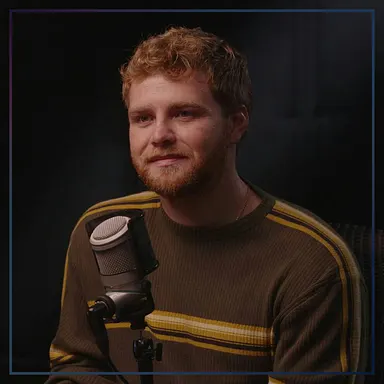
In this episode of All There Is, singer-songwriter Alex Warren talks with Anderson Cooper about losing his father to cancer when he was nine and his mother when he was 21. Warren describes growing up feeling alone in his grief, how he came to know his father through letters, videos and recordings, and how his music, including the album Wild Child, keeps both parents' memories alive.
Cooper shares his own experience of learning about his father after his death. The conversation also covers the difficulty of talking about loss, and the guest's view that speaking openly about grief can help others.
Listeners will hear how the two men approach memory, family and healing.
In this episode Anderson Cooper, Alex Warren
This transcript of Alex Warren's conversation with Anderson Cooper about losing his father was made with the same technology HappyScribe uses for meeting transcription.
Ads in this audio differ from the text. Tap the sentence you're hearing to follow along.
Synced: the text now follows the audio.
Welcome to "All There Is." We've had a lot of really memorable and moving guests this year, but the conversation you're about to hear with singer-songwriter Alex Warren is probably one of my favorites. Alex is 26, and he's been selling out arenas around the country. He was nominated for a Grammy this year for Best New Artist. You probably know his big hit, "Ordinary," which he wrote. Here's some of it.
I'm in the world of the ordinary. You got me kissing the ground of your sanctuary. Shatter me with your touch on love and time and death.
What I didn't know about Alex when I first heard that song is that he lost his dad when he was just 9 years old. His dad's name is James Ward Hughes, and he died from cancer. Alex's mom, Lisa, struggled with severe alcohol addiction and was abusive to Alex. She kicked him out of her house when he was 18, and she died 3 years later from liver and renal failure. Alex talks about his losses during his concerts, and every show he plays, he says he still looks out into the audience hoping somehow his dad will be there.
To this day, after losing my dad and my mom, when someone dies, I can stand here and be strong, but I feel so alone.
Alex has just released his second album called "Wild Child" and will play some of the new songs from it that he's written about loss and grief. And we'll also hear from his dad, who left videos for Alex that he's just now started to listen to. We sat down together earlier this month in New York. Were you always able to talk about grief, about loss?
No. Growing up, I was surrounded by so many people, yet I felt so alone. It almost felt like everyone wanted to console you, but they just didn't know how. They didn't understand what you were going through.
So do you let people console you?
That's a great question. I don't know. I think I was so focused on figuring out what losing my dad meant that I didn't really have time for anything else. At 9 years old, I just wanted to make sense of it all. And I think going through something that traumatic, it doesn't hit you until much later. I think I was like 13 when I realized it.
My dad died when I was 10, and I remember a friend of mine from school wanted to come over, and I was like filled with shame for some reason. I was angry that anybody would see and would like see my pain. And I remember not letting him come over because I just didn't want anybody from school to kind of know, even though obviously they all knew.
Yeah. When I returned back to school, which is like a week and a half later, I walked in and everyone stood up and clapped. And that was really strange for me, and I just bawled my eyes out and walked away. And I think I just didn't like the idea that that was kind of the solidifying thing that my dad was gone, that people were giving me different attention. I was really, really confused after that of just being a heavily bullied kid to all of a sudden everyone like stopped. I kind of was angry it stopped. It made me different.
Were you able to talk about your dad?
Every time I tried, everyone would go quiet. I wanted to speak about my dad, and it always just kind of went the wrong way until the point where I stopped talking entirely. I just didn't want to bring it up. I didn't want to be that kid who quieted the room that way and inevitably forgot him. My dad was diagnosed with terminal cancer, and he was given a certain amount of time to live. And I think I put myself in his position a lot. I think about what your life would be like if you knew you were dying. And he had 4 kids, and he wanted to see them grow up as fast as he could.
And so we just got talent shows and surfing and doing all these things. And it's so scary, I think, where he had to like leave subliminal messages on tape recorders and write us letters. And he left me a letter, and it's so devastating reading it. He was so in denial. He did not think he was going to die. He thought he could beat it. He thought he could do anything. And in this letter, he finally admits defeat. And instead of saying, "It's been a pleasure to be your father," he said, "It was so nice to get to know my son."
And I thought that the way that he had said that was so definite of, "I'm not no longer going to be your dad." Oftentimes, I think when I talk about my dad, I say it's my he's my dad, not he was my dad. And I often think about grief. I think about the kid who was scared to talk about it. It's not promoted in a beautiful light because anytime you get to talk about it, it's kind of this melancholy sad thing. And I think that grief is almost beautiful as well. I've seen this reiterated so many times, but you get to grieve because you got to love.
Grief is love. When something happens in my life, I measure how exciting it is based on how happy my dad would have gotten when he experienced it, you know? I'll play a show and one of my dad's like frat bros who I never met will be in the audience with a sign being like, "I went to a fraternity with your dad." And they'll be like, you know, he would have bought out this entire row and been so excited to watch you play on stage. And I enjoy it so much, yes, because it's a dream of mine, but also because I know that my dad, no matter how many shows I've played, would be in that audience every single night. He would quit his job and travel the world with me.
It's the coolest thing in the world to realize that whoever you've lost has shaped who you are today without even being here.
I've heard you say that you still look in the crowd looking for him.
Every night. Yeah, I'll never see him. But it's like you learn how to ride a bike and you look back and you look to say, "I did it." And I think for me, they died before I could say that. And so for me specifically, my dad introduced me to music. He introduced me to my favorite musicians. And I hope that one day maybe I it's so stupid to say out loud, but I would hope one day I saw him, you know? And it's just it's never going to happen, which is the sad truth of it.
I recently made contact with a woman who turned out to be my dad's closest friend, and she actually had saved all the letters he had ever written her. And so I've been able to go through and read all these letters. And it's so incredible because it's I'm hearing his voice like I didn't remember my dad's voice. And I'm hearing it in these letters. And he's writing about me a lot and my brother. And he knew he was going to die like your dad did. My dad died of heart disease at 50.
His dad had died at 50. So he always knew. And he'd had a heart attack like 2 or 3 years before he died. So he was desperately like trying to hold on until like I was 8 or 9 when he thought I'd be I'd be old enough to like not be kind of really damaged. But it's so incredible to kind of hear his voice in these letters and learn about him in a new way. It's like meeting him. And it's the most extraordinary thing. It's such a beautiful thing.
I have a better relationship with my dad now because I was, you know, 8, 9 years old.
Our stories are so similar. This year is the year that I decided I'm going to start to get to know my dad, which is such a funny sentence to say out loud. But I think my entire life, I I wanted to forget really badly. I didn't want to attack these feelings that were coming at me as a kid. And now that I feel like I'm getting ready to be a father, it's kind of bringing everything at me in a way.
Wait until you actually have kids.
I I'm going to ball like a oh. But I read these letters and I have the same handwriting as him.
Wow.
I say psyched. That's like one of my favorite words. I'll be like, "Dude, I'm so psyched." And he writes that just like me. And sadly, I did not know my father. And as I grow every single day, I learn something new about him. I find his old friends. I read these letters he wrote his friend, and they bring them to me.
So you've been reading his letters.
Yes. My my dad's best friend. He knows how much I I love learning about my dad now. He brings me these letters and he's like, "Your dad loved writing me letters. It was his favorite thing to do." And he loved his kids. And my annoying thing is I haven't found a single bad thing about this guy, you know? And like that's the thing is like he's been a superhero in my life. As time has gone on and as I learn more about him, it's almost and I think you might relate to this. He felt like someone to look up to, but not someone who was real. Like my dad, I learned so much about him and how great he was.
We grew up in Philly. There's a he had an apartment in Jersey. And so I went to his apartment on my off day here. He loved the beach. And there wasn't a beach in Jersey. So there's this makeshift pool that they have and it's got beach on it. And I went there and they kicked me out. But I was sitting there like being like this is where my dad walked. And it's just so cool to get to know someone and realize that I am that person's son and who this person is even years after he died 16, 17 years ago. And somehow I smile like him and I write like him and I talk like him and I say these things like him.
I don't know my dad, but I'm learning about him. And I I think that's the coolest thing about loss. I was driving the other day and I was thinking about this and I had imagined if he was in the back seat of my car right now. What does he say? I just started bawling thinking about it. I don't know what I would say.
Would it be you, the 26-year-old, talking to him, or would it be the 9-year-old?
I think it'd be the 9-year-old.
I think so too. It would be the 10-year-old because I would I would crawl on my dad's lap.
Yeah.
This is sad.
It's really sad. But it's um it's healthy. I think that these are the questions and also the conversations that people don't have. And I think that oftentimes no one's willing to have, you know?
Yeah. That feeling of being in my dad's lap, which I vaguely recall, but he wrote about it. So I remember it in that way. When I think back, that's what I miss the most and have sort of been searching for, I think. My dad was such on a pedestal for me. He was this extraordinary like raconteur. He was born poor in a town in Mississippi, educated himself, and was just funny and a great storyteller.
He would have definitely like been the king of all podcasts.
I feel like our dads are best friends.
Yeah. It sounds like it. But what I so love about reading these letters is that I also now see him as as weak in places and I see him as insecure. And you know, I viewed him as this incredible success. He wrote a book. He was a writer. Not many people read the book and it crushed him. I see his insecurities and his sense of failures and loss and disappointments. And I I like that.
They're endearing.
Yeah. I like that. It makes him more real.
Attainable.
Yes. Yeah. And it makes me feel less like I got to strive to be the best little boy in the world. And I also see what an incredible parent he was because my mom drank, not to the extent that your mom did, but enough so that I did not bring friends home because I didn't know what the situation was going to be.
Yeah.
Dinners were very.
Very.
Awful a lot of times and a lot of silences. She just was pained and she just became slightly a different person.
It's almost like you had to mourn two people at once.
Yeah, totally. But just how good a parent he is and was comes in in these letters. And I'm so glad I had that because it was lifesaving.
It is pretty nuts to think that, A, our stories are so similar, but B, I think that it's such a unique situation that you and I are both in because oftentimes when people lose someone, they're of age that they're cognitive enough to understand it. I think when I lost my dad, I was trying to figure it all out. I still haven't brought myself to watch all the childhood videos.
Really? I heard about these. Your dad made videos talking to you in the future.
My dad knew he was dying. He had beaten kidney cancer once. Then he beat the second time and then it got into his lungs. And once it's lungs, it's terminal. And he would film these videos because every time he got it, someone was like, "It's it's you're not going to survive it." And he survived it. So he got this sense of invincibility that he could beat this. So he started filming these videos, talking with us, showing us the kind of person he was. And he loved pranking my mom. He loved surprising us with like going to Lego Land in the morning because I was right next to our house. Or he'd wake me up at 4:00 a.m.
because he had work at 7:00. He'd take me to the skate parking, surprise me with donuts, and we'd go to the donut shop together. That donut shop is down the street from my house. I still go to this day. Same people who are working and everything. There's a picture of my dad up and it makes me happy every time I walk in there. But what's special about it all is that once he got terminal, he's talking to me and there's this little kid and he's like, "Alex, don't give up and you're doing amazing. I'm no longer in the frame."
And you start to realize that he's not talking to 8-year-old Alex. He's talking to Alex who's watching it on the screen. And he ends it with, um, "Alex, I love you and I miss you." And it's it's so horrible because you watch these videos and you watch this kid who has no idea his dad's dying. I mean, how should he? My dad hit it. And you watch this kid. He saw a camera come out and he just does flips. He's trying to impress his dad.
But my dad's like looking at me going, "Alex, I love you." And I'm not giving him any attention. I'm looking somewhere else. And you don't know how badly I want to reach through the camera and shake this kid and say, "Tell him you love him." Which sucks. And I know he knew it, but I can't imagine how scared he was to leave and and know that my mom was an alcoholic. And before he passed away, he asked his best friend to watch over us because he found alcohol under the seat. And just to know that there was a sense of safety for your kids that you couldn't provide and you were dying.
And it was just so scary. And I I I just wish I could have said that. So it's beautiful. It's also terrifying. It's like I get to watch his videos, but I also can't help but to just be mad at myself, you know? Like it's not my fault. I was a kid. Yeah. But it still would have been nice that my dad could have died knowing that his kids loved him, which he did. But you know.
Yeah. He's right if I show.
Please. Yeah.
Okay.
Okay. We've got our new Alex's formula we just got for his birthday. He turned five today. Right, Alex?
Right.
How old are you today?
Four.
How old are you?
Four.
Four.
Me, five.
Five. Okay. Let's see you do it, bud. Oh, cool move.
I like that.
Look at me. Nice job. Comes Alex. He's a wild man. All right. What kind of trick are you going to do? All right. Whoa. Hey, you okay?
Yeah.
Turn around. You all right?
Yeah.
You are tough. Okay. Goodbye. All right. Bye, guys. Say happy birthday, Alex.
Happy birthday, Alex.
Happy birthday, Alex.
Happy birthday, who?
Happy birthday, me.
All right. Say thumbs up. Okay. Bye.
It's so cool because like I've never seen that. My team has seen all the videos. And so when we played the show, my live show, I have a bunch of childhood videos of me and my dad's voice in this entire album. And when I played the show for the first time, I had never seen the clips. And I just bawled my eyes out. It's so funny because everyone's like, "Oh, there's not a perfect guide on how to be a parent." I think that there is. And I think it's the videos that my dad made. And so when my wife gets pregnant, I'm going to sit down and watch all seven years' worth of footage that he had filmed.
And I think that that's the perfect how to guide on how to be the perfect father because I think that my dad was.
On the new album, you have a number of audio recordings from your dad that you put together. And it's an interlude on the album and it's called Are You Having Fun, Alex?
Yeah. I forgot what his voice sounded like. And I thought these recordings were gone because my mom, when she passed away, my family walked into her house and it was just utter like things were everywhere and we thought we lost the footage and they ended up finding it. I was on tour and my producer surprised me with the interlude, which is my dad's voice for the first time.
Is it all right if I play that?
Please.
Comes Alex. He's a wild man. All right. Whoa. Hey, you okay? You all right? You are tough. Say happy birthday, Alex.
Happy birthday, Alex.
Happy birthday, Alex.
Happy birthday, who?
Happy birthday, me.
All right. Say thumbs up. Way to go, Alex. Way to go, Alex. Way to go, Alex. Woo. All right. Nice job. What do you have to, Alex? Are you making music?
It's pretty incredible. It's pretty everything. It's hard not to think that he's in the crowd when you hear that.
Yeah. Are you making music, Alex? How did it sound to you?
Familiar. It was just like he was talking to me. And maybe you can relate to this. I think that I'd be on stage and like I said, I'm looking for him, but I also like have him in my ear of what I thought it was. And even though I forgot what he sounded like, it was almost like I'd always wished that he had said those words. My mom growing up, the alcohol changed her and it was abusive and it was an environment that promoted any of this. And my dad wanted me to be a musician. And when I finally did it and I had a a Grammy nomination, everything, I just wanted to call him and say like, "Hey, I did it."
You know? And so this tour was my first arena tour. My this moment that I I really was like, "Damn, he would have loved this." And this was the conversation I wish I had. I just felt like it was something I needed to hear. This is sad.
Is it too much?
No, this is awesome. What I like about this so much is these are things I think people should talk about.
Yeah.
These conversations you learn about yourself. I don't talk about these things. Like I'll be on stage and I'll talk about my story in hopes it helps other people, but I don't get into detail this much. And I think that after this conversation, there's a lot of things that I learn about my grief that I didn't before. Whether it's therapy, whether it's a loved one, whether it's Anderson Cooper on his podcast, you need to talk about these things. I think it's special.
Yeah. The loneliness of loss and grief for me has been crushing.
Yeah.
For a long time. I had no video of my dad. And then just last year, I got a email from a lady in public television in Jackson, Mississippi, and my dad had done a public television interview and they found it and they digitized it and she sent it to me. So I want to show it to you.
Please.
It's my dad.
I'm at home anywhere I am. I really am because uh whether I'm in a big city or in the country, I am the same person. And and in the city in New York City, for instance, my kids and I go into the park and and Central Park in New York is a marvelous place. We have a spring that belongs to us. It belongs to us because only we know about it. We go there and we clean leaves out of the mouth of the spring. And when the water gurgles gratefully out and goes down the thing, we have affected this.
So we have had something to do with the soil and with growing things. And that exists in the city as it does uh in the country.
What's so crazy about that is I had no memory of that thing that he was talking about about going to Central Park and clearing the stream. And as soon as I saw it, I remembered it. And a couple months before I got this video, I have a place in Connecticut and I'd been out in the forest with my kids and we'd found a stream and every weekend we'd been going back to the stream and clearing for reasons I'm not entirely clear.
We'd been going back to the stream and clearing leaves out of it. And I remember watching the water flowing out into the larger lake that it was attached to and thinking, "Oh, that's so cool." Like seeing the water gurgling gratefully onward. I think as my dad said, the cycles of history that repeat in families through generations I think is so fascinating.
Well, what's interesting is even with that accent, you have the same timbre, which is like in your voice, the way you talk, you have obviously inflections and things like that, but you and your dad have this similar tone and timbre that really? Yeah. Like when I hear that, I can hear your voice just in a different way.
That's so funny.
Yeah. Like it's pretty nuts.
What is a tone and timbre?
So like you talk from the same place in your voice as he does. It's interesting as a singer, you notice those things because obviously you start to add those things. You and I do the same thing with my dad. Like the way that I talk right here is exactly how he spoke. And it's just interesting where like you probably have no idea how that happened.
Yeah, that's nice.
It's so interesting.
The song Wild Child, you wrote this from your dad's point of view.
My dad's favorite artist was John Mayer. Favorite artist. I get in the car and we start playing Room for Squares, that entire album. And when he passed away, I got back in his car and that album was playing. And forever, I just had thought of John Mayer as this connection to my dad. When I wrote Wild Child, I left a minute and a half guitar solo because it had to be John and it could only be John. And I had never spoken to him a day in my life. And I DM'd him and I said, "John, you're holding up my album and I'm never going to put this out unless you do this.
And I need you to do this guitar solo that I I put this spot specifically for you." And he responded and he said, "I'd love to do it." And he's a mensch, dude. He's the best. I put my dad's voice on the song so I could give him credit. And if you look at the credits of my record, it says my dad's name and John Mayer's right underneath it. And this song that is in my dad's perspective, it's my dad. It's his voice and it's his favorite musician. That song will live forever. That song will outlive me. That song will outlive generations of me.
And the fact that that's kind of a beautiful way of controlling something that you can't control is so cool. People die twice. They die when they die and they die when you stop telling their story. And so every single time I write a song, every single lyric that I write, every single song that I sing, every single video that I see, I think of my dad. I can't control the fact that he died, but I can control how his legacy is looked at after that. The coolest thing to me is like he's a part of my businesses. My LLC is my dad's name, James Ward Hughes. And so whenever someone asks me who James is, I love to tell them the story.
Wait, is that a tattoo?
Yeah, it's my dad's name. What was your dad's name?
His name is Wyatt, which is my son's name.
I love that.
Yeah. Well, more with Alex in a moment.
My wife has been a huge part of my grieving in the sense of she's kind of.
Man, you looked I mean.
Brother, you were in a car and she was like, "Yeah, that's no problem." No, seriously, I'm not kidding. I don't understand the person who's like, "Oh, I have to I have to go do this with my wife." It is I get to do this with my wife. My wife is the best cook I've ever met. The best person I've ever met. In her free time, she saves horses. She's quite literally a real life Disney princess. My wife is the coolest mother I will ever meet in my entire life. And I will stand on that 10 toes down that that person is like my person.
She knows how much my dad means to me. And so for my birthday, she surprised me. My dad, when my mom got pregnant, had to sell his dream car, which was a Mitsubishi 3000 GT from 1994. And my my wife found the car and surprised me with it.
Not the actual car.
The actual car. Wow. There's not a better person in my life. And I will say this to the day that I die. My wife is the reason why I'm able to grieve. She's the reason why I don't feel alone anymore. She loves it when I talk about my parents. She slept in a car with me when I was 18 years old. She didn't have to. She moved from Hawaii. She had a family back home that she could have been with. And she chose to sleep in a car with me, not knowing where the next place was. Not knowing.
You had you'd been kicked out of your house.
Yeah.
You'd left your house and your mom was abusive and you were in a car.
Mhm. My mom, the minute I turned 18, came into my room and she goes, "It's time to leave." And she just starts wailing on me, just like full, like just starts punching me and everything. And my brother, who just came home from military, he's a Marine. He didn't no one believed me that my mom was abusing me. And that grew a a strain with my my family members. He heard the noise, he got up and he came into my room and he saw my mom and I refused to hit her. So. I've always was just like this. My mom's just wailing on me and he puts her in a choke hold and he goes, "You're not going to do that anymore."
And I remember I just ran away. My mom had said, "Never come back." I don't think she realized I actually wasn't going to. And she sent the police after me and told them that I had abused I hit her and all these things. And it was this thing of me hiding from the police and hiding from my mother. And eventually I I got a a salvaged Volvo and it was like this $300 car that I was able to buy off of a a friend. And that's what my wife and I slept in. Coolest girl in the world.
There's a lovely wedding video. And I just took an excerpt from your vows. I just want to show that.
When I was young, I learned quickly that the things you love can be gone in an instant. And ever since then, I made myself a promise to never let anyone get close to me. But then I met you. When you found out I was sleeping in my car, most people would have run away. You jumped in the passenger seat.
You jumped in the passenger seat.
I don't care what. I will never write a single thing better than that. Oh my god.
But that is also something you did. You told yourself you were on your own.
I think that you lose enough people that you start to just think that it's inevitable, you know? And I think I was so cynical. After losing my dad and going through that with my mom, I genuinely was just thinking that like there's certain cards dealt for certain people, you know? And I genuinely believed that. I thought that my life was supposed to be like that. And I think my wife changed my perspective on what life was supposed to be. Everything that has happened to me in the last few years with this career, with my wife, with my friends, I have everything I could have ever wanted and more except for my parents.
And I often think that there's some trade that I made or that this isn't meant to be or that I that this is all going to disappear one day instead of just thinking that this is my life now. And I think it's this horrible mindset that I have to get over, but it's something I've kind of been conditioned with in my life. Things like this don't happen to me. And every single day I have a sold out show and I go to people show up thinking just one day they won't. Just thinking that none of this is supposed to be mine. And it's this weird thing where I feel like I'm living someone else's life.
I understand that 100%.
I don't get it.
I completely am of the mind frame everything will be taken away and nothing is safe. That has been my worldview my entire life. But it's awful.
It's horrible. But I used to think it was just me and it's nice to know. I mean as shitty as it is it's nice to know.
I think I think I would guess anybody I mean I think with early loss.
Right. But there's early loss and there's your life falling apart. And I think that it's hard to separate the two. I think that losing my dad felt like I lost something. And I think everything that came after that, especially grieving it, felt like my life fell apart.
If you grow up not being able to rely on the adults around you, either because they've died even and or they're abusive and drinking and you know.
Not being a parent.
Yeah. Not being a parent. In my mom's case, I mean my mom was an amazing person and like not not at all abusive and she was a wounded child. She had a terrible upbringing and knew nothing about being a parent and desperately wanted to. And I was sympathetic to my mom. I was very much the parent and like wanted to do everything I could to help her.
Question for you.
Yeah.
Growing up and practically raising yourself, how has been fatherhood for you in that retrospect? Is it healing in the sense that you're able to provide your children with a life that you thought you could have never had?
I mean, it's healing in every regard. There are moments where I'm like, I'm amazed at how unedited and carefree they are. And I'm so grateful for that. I see my brother's face in my four-year-old because he looks like my mom as well. And I know how much my dad would just love that I had these two little boys. And my dad really wanted boys and I really wanted boys. And it is the most healing, incredible experience. I just want to play it a little bit of eternity because I just think it's so beautiful.
That's my favorite song I've ever written. What I wouldn't sacrifice. Why'd you have to chase the light somewhere I can't go as I walk this world alone?
It feels like an eternity since I had you here with me, since I had to learn to be someone you don't know. It's really sad.
Yeah. I will say that that is probably my favorite song I've ever written. It's my favorite song to sing. Oftentimes when I play the show, like that's the one where I kind of just tell everyone that, you know, every night I sing as loud as I can, hoping my parents can hear me. And tonight all I ask is that you sing this song as loud as you can, hoping whoever you've lost can hear you. It almost unifies the room. I felt so alone, yet I was surrounded by so many people. And I think that when you're at a show with 15,000 people around you, it's so easy to kind of be like, well, I don't know if I'm safe here, you know?
And we do this segment in the show and I I I would love to have you one day where I literally just ask everyone if you've ever lost someone to raise your hand and the lights come on and you see everyone in that room raise their hand. I think it's so powerful for everyone else to see something that I think that took us a very long time to understand is that you are not alone in those feelings. I thought for a very long time that it was just me and then later realize how selfish it was of me to think that I was the only one capable of going through that. There's something so wrong with how everyone views loss.
And I think it's because socially we've just been taught that it's something you don't talk about. It's my private business. Why do you need to know who I've lost? And I think that that's a recipe for someone to go down the wrong hill. I have three other siblings and I've watched grief hit them all different ways. Grief is beautiful, but it can be wielded so dangerously. And I think that whether you talk to a professional, you talk to a friend, you talk to someone you love, it's important that you just talk. And we're in a society right now where I feel like it's not promoted to talk regardless of who you are and what your gender is and you almost just don't want to talk at all in fears that you are not safe to.
Talking is the only thing I think that really helps with it.
This is helpful. This last year has been the most emotional part of it. Somehow at 26, yet I lost him 16 years ago. I can't imagine what you're going through as well. This conversation.
I talked about it.
But even this conversation, seeing those videos like this is just me. I feel like it's just so helpful.
I have a video of you on stage talking to the crowd about this. And I and I I was so struck because it's just not talked about. So let's play you on stage talking.
I lost my dad. Grief is unexplainable. How do you tell a nine-year-old that the most important piece of them is gone? I just knew my life was different. I didn't I thought it would get better. I thought it would get easier. And people told me it would and it never did. Loss is one of those things that no matter when it happens, who you are, how many times it happens, it sticks with you.
To this day, after losing my dad and my mom, someone dies, I can stand here and be strong, but I feel so alone. And it's something that's so strange because he's surrounded by so many people, but that that feeling's gone of one day knowing that person, one day being able to hang out with that person. I can't tell you how many times I forget the way my dad smells.
I forget the way he looks. I forget the way it's like to hug him after a long day and need help. What's cool about this room is I I explain it to myself and I explain it to a lot of other people too. And I'd love to take my own advice, but I want everyone to look at me and raise your hand if you've ever lost someone. Look around. This is a room where you're not alone.
It's beautiful.
I said it and I'm still crying.
Yeah. I think I give advice a lot. I give a lot of advice about loss and I don't take it. And I think that um it's hard, man. It's really hard. I think that it comes in waves and I don't know. I wish I could explain it better. I play 190 shows a year and every single one of those shows I talk about that and none of it's ever planned. I just start speaking. Sometimes it's horrible and sometimes it's great. And it's the one time I think that someone looks at someone on that stage and views them as human.
When I was growing up, I didn't have someone like that. I wanted someone like that so badly to tell me that this is normal what I'm feeling. And to be able to do that for 15, 20,000 people every single night and be able to tell them that you aren't crazy, you aren't different. You know, this is something everyone will go through eventually. And to see a room full of people raise their hands and know the person you're sitting next to who maybe you haven't even spoke to that you share this bond with them is an extraordinary thing.
What people don't realize is I can see everyone. I think growing up you go to concerts and you think that that artist can't see you for some reason. Now when I play these shows I can see everyone. And so when everyone raises their hands. That's one thing until I see a nine-year-old kid raise his hand I just start bawling. And I think that that's one of the most important parts of my show. The biggest thing for me is healing is being able to see everyone kind of understand and go through something. In the beginning of the show, like I asked all the guys who were dragged here by their significant other to raise their hands and they raised their hands and they've got a beer in it or whatever.
And I think it's fun because at the end of the show you start to see that those guys who were obviously just like, I wish this was Zach Bryan, all of a sudden be crying at this moment or learn something about themselves. And that's the whole point. If I can get out of 15,000 people, at least three of those guys be like, you know what? There's something I haven't explored here. I think that it's a win.
We'll be right back with Alex Warren. There's another beautiful video of you on stage singing "Save You a Seed."
And I cry every time.
Where you cry and where the audience picks it up for you. And I just want to play that.
Please.
It made me cry when I saw it.
I cry a lot on stage.
I realize that. Yeah, that one's hard. That song specifically too. I'll save you a seat next to me.
You're always at the table. I hope you're proud of what you see. Watching with the angels. You're written in my soul. It's your blood that I believed. Wherever you are, wherever I'll be, I'll save you a seat. I think it's important. I saved them a seat at my wedding. They were at the front row and it was just two empty seats. It's important to keep them a part of your life. When I hold my baby for the first time, I'll save them a seat there. And whether it's figuratively or physically, I think that that's so important.
And my kids are going to know who their grandparents are because I'm going to talk to them about them, you know? And something I was so scared of is something so beautiful now where I get to keep them alive. And my kids will tell their kids about their great-grandparents and play them the songs. And I don't know. I think that this is something I can do that will keep their legacy alive is make music. These songs will live forever past me.
You wrote about having a child. You said this is an I miss you more.
Will she have your eyes? Will she make me realize all the things that you had once?
Will I be ready when the day comes when the world fits in my arms?
When I have a kid, they're going to have things about my dad inevitably. My brother is a spitting image of my dad, which is the trippiest thing ever. People are like, "Oh, you sound like him." It's just like this thing where it's inevitable and I don't know what to make of it. I'm so excited to be a dad. I think that I'm going to be the best dad. And I know for a fact my wife's going to be the best mom.
You talk about your first album as it feels like a man who's broken and this is one as a man who's trying to heal. Do you do you feel like you are trying to heal?
Actively. I feel like it wasn't possible for me to grieve or to get to know my dad in a sense because I just wasn't willing to. And I think that as I mature and I'm married and I'm getting ready to start a family, I think that there's a level of me that wanting to get to know my dad is so important. And now that I've done that, I've kind of opened Pandora's box in the sense of just now everything's happening. I've even had a different perspective on my mom. I think that it's so easy to look at someone like my mom and be like, "Okay, well, that person inherently was bad." And I don't think my mom was bad at all.
I think that my mom was so in love with my dad that when he died, she also did. My mom died the day my dad did, you know? And I think that whoever she was after that was just broken, you know? And she knew she was dying. She knew she was killing herself. The perspective I have on my mom is that she loved my dad so much that she wasn't willing to live in a world without him, whether that was leaving her kids.
And I think that there's a level of I don't know what I would do if my wife died. I can't ever judge someone for that. I also can't judge a woman who had to raise four kids by herself in the middle of a recession after losing the person she loves. As a son who went through that, I have to be like, "You're not a good parent." But there's a level of grief that I can understand. As we're sitting here talking about our grief, how am I supposed to judge someone else's? I think that is someone who's trying to heal, not someone who's broken.
Do you still feel a lot of anger?
No. I I haven't felt anger towards my mom for a very long time. I remember before she died, I just was driving and I randomly just thought of my worst fear was dying alone. I'm at a stoplight and I remember this so vividly. I go, "My worst fear is dying alone." And I went to text my mom thinking that she could be. I don't know why I thought about my mom. I don't know what happened. And I said, "Hey, thinking about you." And I sent her a picture of me in Rome and I was like, "I think that you would love this."
And I never got a response. Turns out that my mom was dying alone. And I think that there was this feeling of anger and this feeling of loss. And I was angry at myself and I was angry at her and I was angry at everyone. And ever since then, I just have mourned. I've mourned the loss of my mom. And I've also tried to learn what that looks like compared to my dad. My mom had a disease and so did my dad. And why am I so quick to be like, "I love my dad and I miss my dad," but so quick to judge my mom?
And I think that there's something that I need to work out there that I don't have it figured out yet. I think that my mom was an amazing person, but she was a different person when she drank and she just drank all the time.
Did she drink before your dad's death?
She drank when he was diagnosed terminal. My mom and dad would post on these forums. My mom specifically was in like these grief groups where she'd post and I read them. And my dad was so in denial. My dad did not believe he was dying all the way to the end.
He would not.
No.
Accept that.
No. He like flew to France trying to get experimental treatment. There's videos of him on the news where he's trying to raise awareness towards his cancer, trying to battle this. And he was so in denial and my mom just wanted help. And I think that that made my mom feel so alone as my dad was just so like, "I'm going to beat this." And I think my mom wanted to try and figure out what to do. And it was just two people at a standstill who couldn't figure it out, who couldn't figure out what to do when you're dying.
And and she started drinking and started drinking and driving. She started taking her kids to school drunk. She started staying up till 6 7:00 a.m. drinking and going to bed in the middle of the day and missing pickup and we had to walk home and yeah, you had to grow up alone. You had to raise yourself.
I heard you say somewhere that your relationship with your parents is stronger than it's ever been. You feel that they are watching over you.
I talk to them every day. I wake up, I go to bed, before I eat, before I go on stage, before I I do anything, before I fly, before I drive, before I surf, I talk to them every day. Whenever I'm back in town, my mom and dad are buried at the same place and I'll go and grab their favorite food and I'll go sit down and before Grammys, before any award show, I'll sit down and I'll tell them as if they've missed everything.
You actually like talk to them.
Yeah. I'm the crazy guy at the grave who is sitting there for an hour just telling them what they've missed. And my wife, again, the best person in the world. I I started bawling cuz there wasn't flowers there and I didn't have time to go. And without telling me, she she hired a service that would clean the grave and bring flowers every week. Just didn't tell me.
So like every time I go, there's flowers and it's clean and I used to clean it myself and I just bawled one day and she just randomly did that. And yeah, how I go and I I eat lunch and I talk to them and I give them updates on my life and Grant and Ashley and Lauren and it's cool. It's like hi parents again.
It feels like that.
Yeah. I had this religious thing that I was just battling in my head with if God was real, why would he take all these things away from me? I was like 12. And now it's just something where I think that my relationship with my parents and with God and everything has just been so strong cuz I just I just talk.
The question of why did terrible things happen? Is that something you wrestle with or is that something you've found peace with?
I always wrestle with it. I always I mean look at the world right now. Why do terrible things happen? I never get an answer on that. And I think that for me, everything bad that's ever happened in my life has led me to where I am today. I would say the best thing that's ever happened to me is my wife. And I would have never met her if my parents didn't die. And I think that that is so heartbreaking that I had to lose the two most important people in my life to find what I would argue is my life.
And it's a thing I battle with every day of, you know, like everything bad that's ever happened to me has led me to something amazing.
You said on Father's Day, you said, "Dad, you taught me everything I know today except how to live without you." You may be gone from this world, but you're still everywhere in mine.
Yeah. I think um sorry. How did you learn how to live without him? I haven't. I like I said, I talk to him every day. Everything I do is with him. Every show that I play, I'm thinking about him. Every lyric that I sing, this whole entire album's about him. I don't know how to lose him, nor do I think I should. I talk to him and I I like can imagine him talking back and I have these full conversations in my head.
One minute I have this awesome conversation and then I think I wish I could see you and then I start bawling my eyes out because he's gone and it's just this weird whiplash of just you're here and you're not. I'm talking to you and I'm not. I just want I just want advice. I just want someone to talk to. I just want my dad. I can't imagine like if when I have a kid, dad, how did you do this? How can I how can I be like you? How can I you you were this perfect person in my head and why am I not?
When my dad died, I ask everyone about him and everyone says that he was the nicest guy in the world and he could make a friend anywhere and he always had the greatest perspective on things. And so every day I wake up and I go, "How could I be more like my dad?" And so my perspective on things, how I treat people, what I do, how I do things, everything I do is to be like my dad. So I don't know how I could lose someone if everything I do is because of them. I mean it when I say all I do is think of my dad.
What would my dad do?
Is there something you've learned in your grief that would be helpful for others?
The one thing I'll leave everyone with is I think that you should talk. Talk to yourself. Just set up a camera and just speak. Imagine you're you're speaking to someone. Just say how you feel. I think that so many people when you lose someone, whether it's because of bad reasons or good reasons, you kind of just move on with your life cuz that's what you're taught to do. And whether it's a professional, a friend, a family member, a random person on a subway who you just randomly go, "Well, my dad has that." I think that regardless of what it is, just talk.
Thank you so much.
Thank you. Thanks for having me.
If you have thoughts you'd like to share about the conversation with Alex, you can leave us a comment on our grief community page cnan.com/allthereis. You can also leave comments on our voicemail box or if there's something you've learned in grief that would be helpful for others, we'd love to hear from you there as well. Leave us a voicemail at 404-827-1805. On Thursday, November 5th, we're not going to have an episode of our streaming show All There Is Live, but we will have another episode of the podcast. We'll be sharing my conversation with rapper and producer Lil Jon. His 27-year-old son, Nathan, died in an accidental drowning in February.
When I finally got the news that he was found, it felt like a part of me had been ripped out of my body. Part of me is was gone. Every now and then knocks me back. I just cry, you know, just to know that you can't have the conversation anymore, that you can't hug him, you can't kiss him. That's what hurts the most. I know he's gone, but I just can't accept that he's gone.
That podcast will be released Thursday, November 5th. Thanks so much for listening. Wherever you are in the world and in your grief, you're not alone.
Singer-songwriter Alex Warren was nine when his dad died of cancer. His mom, who struggled with alcohol addiction and was abusive, died when Alex was 21. Alex and Anderson talk about getting to know their fathers through the things they left behind, and Alex shares some of the music he’s written to keep his parents’ memories alive. For more of “All There Is with Anderson Cooper” visit cnn.com/allthereis.
Host: Anderson Cooper Showrunner: Haley Thomas Producers: Emily Williams and Kyra Dahring Video Editor: Eric Zembrzuski Technical Director: Dan Dzula Bookers: Kerry Rubin and Kari Pricher
Learn more about your ad choices. Visit podcastchoices.com/adchoices