
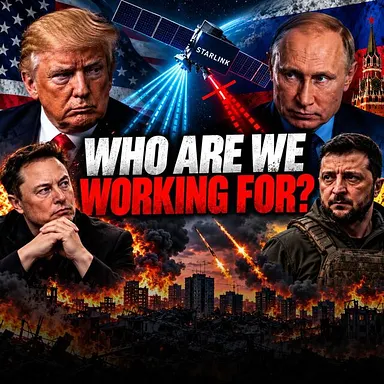
This transcript of “Did America Just Switch Sides on Ukraine? | EYES ON GEOPOLITICS” from The Team House was made with HappyScribe’s speech-to-text technology. Related: convert video to a transcript.
Ads in this audio differ from the text. Tap the sentence you're hearing to follow along.
Synced: the text now follows the audio.
This episode is presented by Vaer Watches. Go to vaerwatches.com/theteamhouse. Hey everybody, we're back. Welcome to Eyes on Geopolitics. I'm here with Jonathan Hackett, Mark Polimeropoulos. Milburn might be joining us, I don't know yet. Hopefully he does. If not, we will carry on without him. Uh, a lot happening over the last week as usual, nothing really different. Um, the big story from The Telegraph, I have it pulled up here because I'm prepared for these shows. Musk approached Trump to slow down Starlink in Ukraine, and that's from Joe Barnes at The Telegraph that came out a couple days ago. After this went down, Musk was saying that the president and the DOD asked him essentially to do this, which— so it seems to be like people are pointing the finger at each other. See, you know, I didn't do it, I didn't do it. So what happened was, it seems that the Starlink or Starshield internet access in Ukraine was throttled. And so their military couldn't use it to target or do whatever— or not target, it was just— it was actually defensive. Um, and the way they tested it too, because it came out of Ukraine, is like they went over to an EU country that borders Ukraine.
I'm guessing it's Poland. Is it Poland? I don't know, whatever, it doesn't matter. Went to a, uh, EU company— EU country, and once they went over the border, the internet started working perfectly. They were going up to 180 kilometers an hour and it was working fine. They jump back over the border to Ukraine, it doesn't work again. And we did see over the last few days a pretty huge bombardment of Kyiv by Russia, over 100 Shahed drones, like 30+ ballistic missiles hitting anything and everything they can. So there seems to be a huge, huge rift going on. And before we started, I was saying like, I wanted— what are we going to name this episode? Like, you know, did we switch sides to Russia now? Because it seems like we're doing a lot to help them out. Couple this with the diesel deal, you know, basically we had the Lindsey Graham Act that sanctioned Russia and Trump wrote up an executive order to ease those sanctions and like kill, like strip what was in that bill, which I don't know how that's fucking legal, especially because he signed the bill into law. But riddle me that.
This administration loves to be in contempt of Congress and break the law. Seems like they do it as easy as breathing. So This is where we're at. Clearly, you know, I don't know how you're not a European country or an allied country that's like, we could trust America with anything anymore, because the writing seems to be on the wall. So, Marc, let's— you talk to me about it. What are you thinking? What are you tracking?
So there's— let's talk big picture, because you wanted, you know, the title of the episode. And so you could— you can title it 2 ways. You know, has Trump switched sides to Russia or, you know, was he ever on the good guy side? So, you know, I'm being a little snarky here, but, you know, there's a couple things which happened this week, which it's going to be hard for the GOP defenders of Trump who are pro-Ukrainian. There are some, but it's going to be hard for them to kind of maintain the line that Trump actually has done anything good for Ukraine, despite, you know, there is continued intelligence sharing. And there is continued the Pearl Program in which the Europeans buy weapons from us and then they provide them to the Ukrainians. That is going on as well. And so, that's what the GOP defenders of Trump say. But the last couple days have been pretty stark in what's happened. And I want to go to Jonathan in a second so he can actually describe, because no one can get this right, so maybe he can, Star Trek, Starlink, Star Wars. It's fucking maddening. Starship Troopers.
Rubio, I'm joking, Rubio got it wrong in a presser as well. And so Jonathan, I think, will be really helpful in unfucking that. But the 2 big things are the diesel deal, which really means Steve Witkoff and Jared Kushner win. That's just the overall notion that there is somehow money to be made for the Russians, and that's going to entice the Russians to settle. Now, I met with someone yesterday who's close Closely tied to the White House. That is their thinking. There is a logic to this. It's wrong, but that's their logic, is that Russia will never give up, and the only way to get them to the table is to entice them, to bring them into the fold more. I don't agree with it. That's their thinking, and that thinking has won out. And in essence, that is, in my view, a betrayal of Ukraine. And then the other piece, and let's just put it very starkly, Jonathan's going to decipher what happened. really specifically with, in essence, the satellite systems. But we have decided to withdraw a force protection measure for the Ukrainians that resulted in the deaths of Ukrainian civilians. And at the same time, by withdrawing this force protection measure, the US government doing so, I don't care if it's Musk, if it's Trump, if it's Bridge Colby, whoever it is, someone on our side did this.
That led to not only the deaths of Ukrainians, but our US personnel at Embassy Kyiv were at grave risk and the thousands of American citizens, US citizens, by law, FBI, others, we're supposed to protect them, they were at risk as well. And what I think you need from that is a Gang of 8 briefing. That's the leaders of Congress. They can demand this. We've done this before. Congress is out of session. They're all going to come back after the midterms. You're going to need a preservation order for all records on this. You're going to need hearings. There has to— this is an extremely serious matter in my view, again, because it's not restricting the Ukrainians' ability to hit targets in Russia. Right. Fine. That's a debatable issue. This is defensive measures. And so to me, it was absolutely egregious. Something that I'm actually surprised at. If you ever think the Trump administration can surprise you, this is one of them because you're talking about putting men and women of the US government at risk on the ground. Okay. God bless the Ukrainians and what they've gone through, but I'm trying to get through to the MAGA world.
Maybe you have some people in— I'm sure you have lots of people who vote Republican in this podcast and they, fine, they should. It's America. Just think about that. The men and women, there's a lot of veterans here, people in the US military, intelligence services, State Department at Embassy Kyiv could have gotten killed because of something the US government did. That's crazy. So anyway, that's my thoughts on this. But big thing for Jonathan, I mean, literally Rubio this morning, or last night, was on a press release on the way to, I think he's on the way to India. He gave some convoluted thing about what occurred, and then everybody responded back, well, he's wrong on that too. So Can you tell us what exactly happened or could have happened or what these systems do? Because there's 2 separate systems as well, I understand.
Yeah, so there's Starlink and Starshield. Starlink is the commercially available, like commercial off-the-shelf low Earth orbit data provider, essentially. And then Starshield is a separate defense-oriented system that uses the same backbone, but it's for a defense consumer, which means it's going to have less restrictions on its use. It's going to have some more access to different bands of satellite communication because, you know, there are different bands like L-band, X-band, X-band is specifically only for military use. This is part of how the US regulates the global satellite system that we have. You know, there's, there's different satellite systems, by the way. There's the US one, the Russian one, the Chinese one. There's a European one, especially when we're talking about GPS positioning. There's the one that Ukraine is using is a US-based backbone system. That's kind of the key here, because if Ukraine was using a European provider, this wouldn't be happening. But Ukraine is using a US-linked provider, which is Starlink. Low Earth orbit generally is a newer kind of thing that's gaining traction. And when I say newer, I mean the last 50 years as far as satellite communication goes. Low Earth orbit satellite constellations were initially going to be something that the military would use with their, with the guys on the ground, you know, geographically dispersed, able to communicate with direct-to-cell communication in their positions on the ground to other people at command and control.
That's what low Earth orbit's for. But this, this commercialization of it is kind of how the internet was commercialized. You know, it was initially a government thing invented by DARPA back in 1960s, '70s, and '80s, and then became commercialized. And so that's what we're seeing with low Earth orbit satellite communications. And what we're witnessing is the tension between that transition from a military system to a commercial system where commercial users are going to want broader, faster, more reliable access than the military was accepting. And Musk is closely linked with the US government on this because this thing is not completely privatized yet. This, this, this section of the atmosphere that these satellites are operating in, which is very low Earth orbit and still regulated quite heavily by the US, which means the US can interfere with it if they want to. The US can turn it up, turn it down, do things to it, manipulate it. And that's exactly what we're seeing this week. And this shouldn't be looked at narrowly. It shouldn't be looked at as a single You know, satellite communications being interfered with. It should be looked at as a wider US policy vis-à-vis Russia and Ukraine because of the Iran war.
Because what's happening domestically inside the United States is that diesel is very expensive, gas is very expensive. The Republican Party is concerned about the price of gas at the pump coming up here in about 3 weeks, 2 weeks at the midterm elections. Trump is flailing around trying to find a way to reduce the diesel price because he sees that as a— not just him, but, you know, strategists see this as a key problem for votes in swing states and purple areas to get under control if they want to have the votes go red. So this is kind of a last-ditch effort on the US domestic politics side to pressure Trump to go talk to Russia to get a concession. And when I'm looking at this, I'm seeing the US is asking Russia, please give us diesel. Russia is saying, okay, we'll do that if— and here are our conditions. Many of those conditions involve Ukraine. Things like the ability for the Ukrainians to communicate in rapid movement on the ground with low Earth orbit satellite constellations. That's one thing. Turn it down, throttle it. And we saw that happen. Another is the intel sharing. So when last, let's say, 48 hours, there were 2 strikes, major strikes in Kyiv that you were just talking about, Mark.
The US normally shares intelligence about those strikes ahead of time because we have very sophisticated ways of knowing that those things are going to happen. And we provide sanitized versions of that intelligence to our partners. We have the duty to warn, and actually we do it not just to our partners, but to anyone that we have a relationship with. We have a duty to warn them that we know about an impending attack. We did not share that intelligence in the last 48 hours with Ukraine. This is a new development that I think is underreported or not as widely discussed as it should be, because this is a conscious decision on a US policy level not to tell our partner that they were going to be attacked, even though we knew about it. This was a very large attack on Kyiv. And as you mentioned, there are Americans in danger of these attacks as well. So we were willing to allow Americans to be harmed and killed for this policy position.
I mean, so, so Jonathan, you're, you're former, former US military, correct? I mean, you know, I was former CIA. Like, that makes me crazy when I hear that. I mean, what is your reaction to that?
It is crazy. I mean, we have shared information with our non-allies and non-partners before about attacks happening to them.
Have you ever seen something like this in your career? Yeah, me neither. That's the thing that I— that's why I'm kind of throwing a fit about this with congressional involvement. And I mean, obviously flailing for something to try to investigate what happened, because I just, I mean, I've just never seen anything like this. It's, I mean, it's hard to even fathom that, you know, I mean, there's, you know, you can be a cynic about politics, but this is something else. I mean, if I was at Embassy Kyiv now, I'd be like, What the hell just happened? And by the way, if Embassy Kyiv was warned and we didn't warn the American citizens in Ukraine, that's a massive violation of the statute as well. And if they have been hurt, they are possibly— you're going to law school there. I think there are some possible liability issues. Like, it's nuts what happened. And I don't know if this administration is just incompetent and just did it because they, you know, like Trump and Musk talking about it, or if actually any lawyers at the NSC or someone like that actually okayed this, 'cause that actually is pretty wild as well.
Yeah. Maybe I tend to think they didn't do that because everyone's running away from this, because I think people realize this is bad. So everyone has disavowed this.
Yeah. And, you know, back to the legal point too, on especially the diesel sanctions waivers and all this stuff. So when the Lindsey Graham Act was written and passed, the reason that it was able to pass on a bipartisan level is because of Section 115 of that act that gives the president the ability to weasel out of the act.
So, D, that's your answer. There's no violation of the Lindsey Graham Act. No. There was written—
And it's mentioned actually in the executive order, the 3rd paragraph of the executive order. It's a very long executive order, actually. It's longer than usual, which means they actually put some thought into it. That 3rd paragraph says Section 115 allows us to waive anything in this bill.
And you remember, Jonathan, some Democrats were opposed to the bill and they were opposed to the bill and everyone's like, well, hold on a second. We've wanted this thing to pass so much. And they were opposed to the bill exactly for this reason. As it turns out, Those who voted for it and got a lot of heat actually may have been right because they basically said, this is toothless, this is stupid. Trump's going to do it. And he did it.
Yep. There was a loophole built into it from the beginning.
Yeah. Sounds like par for the course for Congress, you know?
But this was, I mean, the cynics in everyone should say, like, again, so it became just theater. So this was not a very enforceable piece of legislation. It's not the original kind of Lindsey Graham bill. There are these caveats in there why the White House agreed to it, knowing full well they would do this. And, you know, it's actually interesting because in the South Carolina Senate race, this is now an issue too. I mean, Lindsey Graham's sister, who has been running around saying that, you know, obviously she's there to honor her late brother, kind of hard for her to justify this. And she did. She actually basically— I mean, it's just, it's the whole thing is just—
So she has absolutely no fucking idea what the hell she's doing. Let's be real. You saw that debate clip, you know, asked a pretty simple foreign policy question and she balked at it like completely, which, you know, I don't really focus on foreign policy. I don't really have an understanding of foreign policy. Meanwhile, Lindsey Graham's whole fucking thing was about foreign policy. You know, he didn't do a fucking thing for the people of South Carolina, let's be real. Um, I'll edit—
I think that's one thing that everyone— I think many Americans can agree on is that the Russians are not our friend, and they have not been our friend even during World War II when we were allied against the Germans. That was an alliance that was required for the time. That was not because we were friends. In fact, in the 1920s—
But Trump does not agree with that. Trump actually, that's where he differs so much from the majority of the American people and seems to have gotten away with it. I mean, the idea that there was a Russia hoax, all that is getting proven. I mean, it's getting just the Russian— there was no hoax. It's being disproven because Trump has just outwardly turned towards Moscow. I mean, it's something that Ronald Reagan's rolling in his grave. I mean, And, you know, we always follow all this stuff on social media. There is a group of pro-Ukrainian members of the kind of the Republican Party foreign policy class. And it's getting to be very hard for them. In fact, I mean, you know, the National Review, the National Review is probably the Bible for the conservative movement. And who is it? Andrew McCarthy came out today and basically said Trump should be investigated for his ties with Russia. I mean, that's pretty shocking. Did you guys see that?
Yeah, I was gonna mention that. And saying about like Congress should investigate this and see what's—
The National Review.
Yeah, it's pretty wild. They— I mean, Congress won't do shit.
But that's not me saying it, right? Crazy person from MS Now. Even though I'm a centrist, nobody believes that. But I am not like D, who is a radical leftist. We have an Antifa member on our podcast. But no, but it's the National Review, for God's sakes. I mean, I saw that. I was like, I don't— I just hit like repost, not even a comment.
Yeah, it was kind of crazy to see for sure. I mean, but I could totally see like, you know, the National Review types, the neocon folks who are going to start bucking up against this, but it's going to fall on deaf ears. They don't really have any kind of WASPs in the Republican Party anymore.
Well, I think what's important is that— well, I mean, there's a couple things. So yeah, it might fall on deaf ears. But it does go, I mean, it does go in line with this notion of corruption. And if you look at the opinion polls, we're talking politics now, diverging from foreign policy, but corruption is the biggest issue in the minds of voters. And so when you get to, hey, we want to have rapprochement with Russia for business deals, and you have Jared Kushner and Steve Witkoff negotiating them, and they are some of the basis of people's complaints about corruption, I think it does tie together a little bit. And the other thing too is, you know, winter's coming. The Democrats win, you know, that means, and the administration might not listen to subpoenas, but the congressional oversight's gonna go into overdrive. And so, you know, all this stuff is gonna come out. So if you're smart, I mean, you're, I mean, here's the thing to look at. And, you know, I had a gleeful 2 weeks of covering the Kim Guilfoyle, US Ambassador to Greece meltdown. And that kind of stuff matters because there's no way she would've survived anyhow, but she wouldn't have survived Democratic Congress.
Howard Lutnick, I don't think he's going to stick around. Kash Patel might not either. There's some people who they're just going to be— Pete Hegseth is going to get impeached. I mean, I'm completely convinced the House will impeach him, probably the first thing that they do. And so ultimately, there's going to be a lot of unpleasantness coming. And so I think that You know, some of these things, when the National Review comes out and says stuff like that, investigate Trump for Russia ties. Yeah, that's— we're getting down a road where I think that there will be some accountability. It's, I mean, at least the beginnings of it. I hope so.
God, nothing. All right.
I'm a centrist. I don't get political.
Yeah, sure.
You already got political in the beginning. You basically said— you said Trump and whoever did this has blood on their hands.
Yeah, they do. War is politics by other means.
I mean, they do. And so, you know, there was something that popped up that drove me nuts this morning. Now I'm going to get Jonathan. I'm going to ask him. I mean, David Petraeus came out. Someone asked him on a show, does Trump— it was, I think it was Sky News, a British show. It said, does Trump have blood on his hands? And he was like, eh, kind of mealy-mouthed. Just fucking say it.
Yeah, I don't get why people are so scared.
Just say, if true, yes. It's not hard to
do. I mean, you can just point to the Americans who died in the Middle East during this conflict. They would not have died but for a presidential action, a war action in the Middle East, and that there's, there's a direct line to this.
But even more so than that, because sadly, people die in wars and presidents start wars. This is a force protection measure that someone pulled.
Yeah, I think actually the intel sharing thing is the biggest, like, exclamation point to me, although the throttling of the Starlink, all this other stuff, that's, that's bad. But like, the fact that we deliberately did not warn American citizens inside of Ukraine of an impending known casualty event to give them time to evacuate, to move, to do whatever. We didn't do that. And that is an intentional choice we made to harm Americans.
Just say it. You did. I'm just— if you were David Petraeus, I would be saying—
Yeah, I don't get what David Petraeus is— I mean, I get it. He's a fucking talker, man. Cash money, baby.
More corporate boards than you could ever imagine. I mean, I have so many friends who have told me that they have to be very careful what they say. They've been warned by their companies who have massive contracts with the US government. They got to be careful, which is why I have nothing. I have you, D.
Thanks. I'm glad to be here for you, bro.
I have you. But I'm serious. I mean, so, you know, and again, that's kind of unfortunate because we are supposed to live in a democracy and have a right to free speech. But a lot of people don't feel that way. I mean, this goes back to the conversation that Mick and I went at a long time ago. I mean, Aside from kind of Ben Hodges, who I love, there's very few former US military generals who have spoken up, although Admiral McRaven has, which I thought that was very good. I mean, come on, what are we doing? And so, you know, this— and I understand the need or the desire to be apolitical in the general sense, but not in extreme circumstances like this. Like, we are— this is a country that has a policy. We have a pro-Russia policy now. If you're a Cold Warrior, if you served in the— I just don't get it. How are you quiet? If you can't say something now, when can you? And it's late, that's fine. And as my buddy from MS Now, Joe Scarborough, says, Baptist conversions, we'll take them anytime. Take them late. Come on the train.
I mean, other people would be like, it's too late. But—
Well, the thing with generals too, like 3 and 4-star generals, those are political appointments. Those are advice and consent of the Senate. political appointments. And it's strange that suddenly after they retire, they are no longer political. You know, like the whole point of their position was to be a policy advisor on military affairs in various capacities.
Interesting.
It's almost like they have a duty to Americans to continue being in that capacity. They, you know, they were there. They owe us something, especially the price that Americans pay in war. They have a special duty, I would argue, to continue informing Americans generally Because the Congress, which is the people, elected them through advice and consent, right? So like, there's some remaining or lingering duty they have to stand up and actually say what's going on.
I don't care who better—
who is better positioned than a military general that actually saw what was going on behind the scenes to come and say, here's my interpretation of this thing for you, the American people.
Hey, Jack,
what's going on?
Guess who our new presenting sponsor is? Tell us about it.
We've heard a lot over the last few years about whether it's possible to build things in America. Our presenting sponsor today, Verra Watches, is putting that question to the test. Verra was founded in Venice, California in 2016 with a simple goal: to rebuild US watchmaking while producing watches tough enough to withstand the toughest outdoor environments. Today, Verra is the largest independent watch assembler in America, assembling watches, in California, Arizona, Rhode Island, and Alabama, while also manufacturing its leather straps in Illinois and Florida. Every Vehr watch is built for active use with a guaranteed waterproof warranty, scratch-resistant sapphire crystals, and high-quality materials and components throughout. That combination has helped Vehr earn more than 10,000 5-star customer reviews, including thousands from people who rely on their watches every day in demanding professional environments. All of us here at the TeamHouse have been wearing our Vehr watches for a while now, And you can check mine out right here. This is the Meridian diver watch in navy blue. It's very classy watch. And this is the actual rubber, um, dive watch band if you wanted to, you know, take it in salt water. But it also comes with a normal, uh, silver band and a nylon band if you prefer that.
And, uh, D, what kind of watch are you wearing there?
I have the C4 Tactical Field Watch. It's solar powered too. I'm loving it. And it's funny because I had this laying on my coffee table the other day, actually, and my homie came in and to watch football or whatever. And he's a watch guy. And he's like, oh, is that that Vare one? He— I'm not even making this up. Like, I'm not even bullshitting. I'm like, holy shit. Yeah, like they're gonna be presenting sponsor for the team house. And they sent us all a bunch of watches. Like, yo, I love this watch. And I literally Sold the watch. I sent him the link, the Team House link. And I'm like, yo, buy a watch from this, from this link. Because if you do buy a watch from that link, which is verawatches.com/theteamhouse, you— when you purchase a watch, you get a free watch roll that you could fill up with 3 watches. So you could travel with your watches and stuff like that. It's really cool. It's leather. Yeah. And I was so excited when he was like, yo, is that that Vare watch? I see it all the time. I was like, so amped that he came up with that.
Yeah, it
It's nice. I really like the, like, nice big watch face.
You can find them at vaerwatches.com/theteamhouse. That's vaerwatches.com/theteamhouse. And if you use our link, you'll get a free watch roll worth $59 with your purchase. Also, Vaer does offer a 20% discount for active duty military veterans and law enforcement and first responders. So you could check that out at any time if you are any one of those. Yeah, I'm excited about this sponsorship. So I really hope people go and check out Vayr.
Yeah, absolutely.
Question, you guys spoke a little bit about what it would be like if you guys were still serving, right? What do you— what do you like if you're Ukraine, or if you're another NATO or a European ally? What do you think in seeing this shit go down? And I have a follow-up question too for Jonathan, I'm sure you can answer. Is Europe equipped to handle doing the Starlink, Starshield stuff, and for Ukraine to completely decouple from the United States outside of hopefully some still intelligence sharing? Let's do the first.
I mean, I think we should— I mean, the overall question, not the capabilities part, Jonathan can handle that. Overall, they should, and they have. I mean, we are in a different place now than we were a year ago. In fact, the French have been providing a whole bunch of battlefield intelligence, you know, not as good as the US, but they're doing that. The Ukrainians in terms of their indigenous kind of industrial capability for drones and other systems, fantastic. The Europeans are stepping up. I mean, I think if I was Zelensky, do you want a total break from Trump? No, but he kind of did that because he's had enough. I don't blame him. And so I think the Ukrainians are close to being able to handle themselves on their own. And That's sad as a former US government practitioner, but we're not reliable. We're not necessarily on the right side right now, because with this, whatever this shift is. So my answer would be yes, shift. And I think that's happening already. And I think there's all— you don't see any panic right now. The Europeans are not rushing to get on their knees in front of Trump that they did before.
Mark Rutte, the Secretary General, the NATO Secretary General, is not rushing, doing an emergency trip. I think there's a lot more like, you know, this sucks, but this is manageable. I think the part that's really unfortunate is there's going to be a lot of civilian casualties this winter because the Ukrainians have run out of interceptors. But that has nothing to do with the battle. There's a difference between what happens on the battlefield where they're doing well and there are civilians, kind of the strikes that Russia is going to incur on civilians, killing a lot of Ukrainians. But I don't think there's a sense of panic. Maybe I'm wrong, but I think there's just a different dynamic now. Jonathan, what do you think?
Well, I'm thinking about NATO and about the question, can they defend themselves? And NATO was a US-designed thing to put a US nuclear umbrella in Europe so that there wouldn't be nuclear weapons hanging around Europe outside of US control. That's kind of the original intent of NATO from a realist perspective. And we have France, the UK, perhaps Germany, other states with the ability to host or produce or use nuclear weapons in Europe now. And that was a major reason France left NATO back in the day. If you'll remember, NATO lost France and France rejoined. And this was over the nuclear issue about nuclear sovereignty per state. And I think Europe has long been kind of maybe not a cacophony, but at least a concert where with different people playing different instruments at different times, but they create kind of a symphony. Symphony in their defense system where they're defending each other in various ways against various enemies, especially if you look at like the Napoleonic Wars and, you know, going back in history about how, how there was the First Coalition, the Second Coalition, the Third Coalition, all these different states that were enemies coming friends.
This is part of European history. And I think Europeans look at what is the threat right now? Can we fight that threat? I think the answer is yes, especially when you have Germany rearming, reinvigorating its defense industry in western Germany, in the Ruhr Valley. You have France also doing the same thing with its aircraft, especially, you know, there have been long challenges with, with air superiority and developing an independent non-F-35 alternative for Europe. And France and Germany both have been developing those alternatives well. And that's besides Russia-Ukraine conflict. That's been a European continental question since Brexit when the UK left. So there have been these long questions in Europe about how do we defend ourselves in case UK or US is not there. And I think that has just become more obvious that that needs to be answered in the affirmative these days because the US is not there. And the US can't even— if you look at the tension between the US and Europe, the US cannot even land a Lancer on the continental European airfields because of our behavior and our relationship with Europe that we have designed for ourselves. This was not an outside issue.
This was the US creating this problem for ourselves. And now it's coming home to roost and it's just underlining to Europe, minus the UK, that Europe needs to be able to defend itself if it has to. And I think states like Poland, Estonia, Latvia, Lithuania are essentially pushing the rest of Europe to say, please make sure that that's true. And on the question of, on the question of low Earth orbit satellite direct-to-cell communication, this is not a fancy special technology. Any, any private company with the right capitalization can produce these low Earth orbit satellite mesh networks and send them up into space. And especially you've got a lot of European satellite communication private companies. You also have Official state-level SATCOM capability that, that France and Germany especially can launch and manage. They could help Ukraine and they could help the European state, like the, the EU in particular. So I, I think this is less of a concern. It's more that the market right now has Elon Musk ahead of it. He, he has flooded the market with this technology, so he has the capability, but it's not precluding other states and other private entities with the right willpower to launch this.
I would actually be more concerned and realistically concerned that China would launch an alternative as well that's very cheap, that Europeans would purchase because it's cheap. And then a Chinese-controlled low Earth orbit satellite constellation is now over Europe. And then in the event of actual open hostilities with Russia, China would come to Russia's aid and essentially do exactly what Elon Musk just did in Ukraine. They would do it to Europe. This would be a bigger concern that I would have that would push me to tell the European Union to get your own indigenous satellite mesh network up there now, before China gives an alternative that you can't refuse.
Yeah. And just for anybody who's, uh, you know, because I wrote something pretty flammable, inflammatory, uh, on Twitter.
No way.
Yeah, me. Yeah, I wrote that Trump's a piece of shit because he is. Um, And some people were saying, you know, some people were coming back at me and stuff because there's obviously a lot of cult members. But let's not forget, like, Russia is actively providing Iran with, like, intel and information and where our bases are. Americans, right? So let's not— yeah, we're— it's real simple now. Like, you need to pick between good and evil. You have to pick a side. Like, is it— are you for Ukraine and they're fighting for their own sovereignty and freedom and democracy? Or are you for fucking Putin who's been in power for 27 years now? And who's, you know, trying to be an imperialist fucking scumbag? Like, it's a real simple— like, this shouldn't be hard.
I mean, right. So I mean, it's just that's— but everything is thrown up in the air. I mean, the idea of a Republican president being pro-Moscow is, you know, Ronald Reagan's rolling in his grave. I don't know what else to say.
We've also backed ourselves into a policy corner because this— the war with Iran, the way that we've prosecuted this war, we've backed ourselves up into this diesel price issue because we didn't end the war the way that it could have been ended. You know, we entered this lukewarm phase of tit for tat, which is just causing prices to run away instead of either not going to war in the first place or having a decisive end to the war. We chose the third option, which is this middle option of just stagnation. which now we are stuck with the diesel price issue at the midterms, and that's causing these choices that the president is making that he otherwise wouldn't even be faced with.
But Jonathan, it's not even a choice. I mean, it's stupid. No one thinks it actually would work. The other point is that what he's decided to do on the diesel issue with Russia, actually no one says actually would have any effect on diesel prices. That's the crazy thing. I mean, it's even just a bad bad policy. Maybe it's designed to just waive overall sanctions entirely. I think that's what the whole thing is. But the idea that this would actually have an effect on the price of diesel is nuts. And again, Ukraine war has nothing to do, as you said, with the price of diesel. It has to do— everything has to do with Iran. One thing, back to the Iran war, I was talking to someone yesterday and it was, you know, there's obviously a line of thinking, and Jonathan, you're an Iran expert, so, you know, in terms of You know, we're in this kind of sort of, you know, I don't know what you want to call it, a hot peace with the notion neither side wants to escalate before the midterms. But there also is a lot of kind of churn out there, and you see movements of assets.
There'll be 3, you know, about a week before the election, I think there'll be 3 carriers on station. You do see an airflow of tankers going back. to the region. And there was all these reports that a course of action that has been briefed or will be briefed to the president has to do with this MOAB, the mother of all bombs, or whatever. Basically, it's just giant munitions used in Iran. And so what this individual was telling me was one of some of the concerns is that actually the escalatory piece, even though neither side wants it, is not what we have all been talking about, which is a possible Iranian terrorist attack. The escalatory piece is misunderstanding. If the Iranians actually think that Trump will or may decide to strike before the midterms, that whole notion of not doing so goes out the door and they might preempt. And there is talk on this. And if you talk to people in the region, people are speaking about a concern. At first, I thought, that's crazy. Why would the Iranians do that? But they would do it because they actually may believe, incorrectly, but they may believe that Trump might do this before the elections.
And so now you have this, this, this, the escalatory piece is miscalculation based on signals that are misinterpreted. What do you think of that notion as something to worry about?
Well, it worries me because I look back to Able Archer 1983, which I encourage listeners to read about. That was the closest we ever came to a nuclear war with Russia. And that was because the US was doing an exercise in Europe. And the Russians interpreted that as a first strike and almost launched a second strike. And the reason I bring that up is because, you know, key goals of intelligence, there are a couple of them. One of them is to reduce strategic surprise, inform decision makers, and reduce miscalculation because you just don't know exactly what's going on on the other side. So you have to make assumptions that are informed, but if you lack access, you're going to make poorly or less than perfect, you know, decisions. poorly shaped decisions. And that, that could be what exactly you're describing, Marc, because first of all, we lost our access to human intelligence sources inside of Iran years ago. We're relying on Mossad, a second-degree actor, to tell us things that has their own interests. So like that stuff's shaped already before it's reaching our table. We've gutted our own intelligence community. We've lost our ability for intelligence oversight that we used to have.
There's less strict analysis going on here, clearly at the top, where things that were low probability but possible are being interpreted as probable and being taken as facts, which is, you know, not a good intelligence analysis outcome. A lot of these things are kind of floating around, reaching a poorly formed NSC that's basically not functioning to a group of a small, like half a dozen individuals that are not intelligence professionals or, or, you know, career politicians coming together and saying, that sounds like a good idea and just doing it. That's on the US side.
Yeah.
That's not to mention the Iran side, which has recently gutted involuntarily over the last 8 months. And you're left with people that perhaps don't have the expertise to even think about these issues at all. Right. So now we have both of those sides in a perfect situation to make a miscalculation, to make a misstep. And the problem is you could make one small misstep, but to save face, you have to do more things after that, following it, even though you shouldn't and you know you shouldn't do it. And that's for both the US and Iran and other actors in the region. Let's say Israel, who has an election coming up in 10 days. Right. So there's a lot of different actors ready to make a lot of mistakes. And I think this is a very sensitive time, especially bringing those aircraft carriers into the region. It does signal something. It sends a message. That's what deterrence is. You know, the, the adversary has to know that the capability is there. They have to know that you're willing to use it, and they have to know what it is and where it is for the deterrence to actually, like, be ready as a recipe to use.
The problem is it can be interpreted too much. Yeah.
That's right.
The, the other side can look at that and say, oh, no. That's not just deterrence. That is a threat, and we need to do something about it. So there, there's a lot right now kind of simmering, and the temperature could be turned up very rapidly by accident.
And so, and if let's say, say the Iranians are— if the Iranians assess we're going to strike before the midterms, they then try, they start making plans to preempt. We pick that up and then we have to then preempt the Iranian preemptive strike.
Exactly.
I mean, so, I mean, it's so easy to see that scenario kind of cascading down. I just hadn't thought about that as much. I was more concerned about, you know, an RAF, you know, the terrorist attack against like the RAF base in the UK. If that succeeds, then it's game on. Because when you just think about it, the idea that President Trump would actually strike Iran before the midterms is preposterous politically. It makes absolutely no sense. And so, but maybe that just doesn't matter because things can kind of spiral out of control. We'll see.
Well, there was even that social media post that I don't know how credible it was the other day that said that apparently the Trump administration secretly asked Iran to symbolically strike Pickaxe Mountain, and Iran publicized the request and said no.
You mean Israel? No. Iran was going to strike their own mountain.
No, we were like, let us hit it. Let us hit it symbolically.
Yeah. So the reason I mention this as—
Oh, that's funny. We've done that before with Iran.
That's why I'm saying it is actually believable, because we've done it several times in the last 5 years. Actually, right after the Soleimani strike was the first time that was made public that we did it. and let them strike al-Assad airbase. Like, we've done it. We've allowed both sides to do this, right? So this isn't totally incredible to me. I mean, there is some degree of possibility.
God, the cynicism.
But that could also be— that could also be Iran signaling, saying, hey, we see that you're doing things. We're trying to publicly signal that we don't accept it. Even if that never happened, if the president of the United States never sent that message, they could be making this statement as an information operation to try to signal to the U.S., like, hey, we are interpreting what you're doing and this is our, our potential response to that. And I should also mention that there was around a 30-page document that the IRGC published in English targeting US voters that they put out to try to make Americans read this thing. And it basically puts out all of the IRGC's policy positions about why Democrats should be reelected and should be elected during the midterms. And it's kind of fascinating because it was written— it is by the IRGC. This is not like a US-made thing. Yeah. But it basically says, like, if you can elect Democrats, this war will be over and so on and so on and so on. And it's just kind of an interesting thing, like the way the information environment is being used right now is very fascinating to look at.
You would think the IRGC would know better than to send out a 36-page thing for Americans to read, because you know that they haven't fucking read it.
Yeah.
I know, really? Right.
Well, they're relying on us to interpret it and they listen to what we say.
Makes sense.
But so, so here's the bottom line on all this. You know, I had to do a, I did a little corporate gig where I got paid some money to talk to some, some corporate clients about what I thought would happen in the Middle East. And I don't know if I was very good because I just said, I don't know. I don't— I mean, how do you put any percentages on this? Yeah, I've— you know, it's— there's, there's so many unknowns. You have a wild card— well, you have wild card in the Iranian leadership, you have a wild card in our office, in, in our— in the White House. Um, you have external factors like the Israelis. I mean, it's— to assess this situation, um, I would just say, you know, just continue on with left-of-boom planning because, you know, it could happen. But at the end of the day, it's very hard to figure out, you know, what's, uh, what's going on here. And I kind of laugh when I, when I hear people make some kind of strong predictions because that's just— you're going down a bad road doing that.
Well, I actually was giving a lecture this week, and, uh, one thing I mentioned was someone asked in the audience, you know, very similar question, like, oh, what's going to happen? How's it going to end? And I said, I don't know. Also, I don't know. But I said, there are no straight lines in nature. And when you look on a map, if there is a straight line on a map, like between Iraq and Syria, for example, or between Jordan and Syria, you can probably imagine that the conflict is not over yet while there is still a straight line on that map, because that, that means that some third party put that line there. The people that have those countries did not draw those lines, which means there's some unsettled challenge here or challenges that is yet to be resolved. And until that is resolved through violence, diplomacy, something else, you're going to continue seeing that. And I actually raised the issue of Libya and Chad Because if you look at the border between Libya and Chad, it's hundreds of kilometers of a straight line over the desert, completely unenforceable at all. And there are many conflicts back and forth over this territory because it's an unresolved imposed third-party straight line.
There is no straight line in nature might be the thing I take from this. I'm going to borrow this from Jonathan.
Yeah, that's why camouflage works.
Like that.
A little bit, not really off topic, but what do you guys make of the Israeli settlers beating the shit out of the I mean,
that's something that is continuously catastrophic for Israel's reputation. The West Bank is out of control. I think in the Israeli kind of internal electoral dynamics, there's been people who I think have been very smartly condemning this, including the Israeli president. Netanyahu can't. And I think that's what certainly ultimately disqualifies him as a leader. But elections are coming out and guess what just happened? As you guys, I got the stink eye from D because my phone went off. Trump just endorsed Netanyahu. So there you go. So that's, I just want to turn my phone off right now. But no, that was egregious and that can't happen. The West Bank is out of control. There is the settler terrorism there. It is It is wrong. It is immoral. It's also incredibly stupid as support for Israel is cratering internationally. I mean, what else to say about this? And Netanyahu is responsible, period. You know, you can't have vigilantes running around there. And so, you know, nothing else to say other than this cannot happen. It's simple as that. Horrible.
I think actually using the word terrorism is actually great right now because who uses this word in the West Bank narrative, look at who says this over time. It's very fascinating to see, like, when is it okay in the mainstream to call settler violence terrorism? There are moments in time when this is true and moments when it's not true. Right now, actually, Ambassador Huckabee, not the most anti-Israel figure we have in the US government, mentioned that it was terrorism. I thought that was a very interesting thing to see that he decided to say that publicly. And also the opposition party, the main opposition party to Likud, is calling it terrorism, as are former Defense Ministry individuals in Israel that are not running for office.
Yeah.
So, so there's a lot of vocal opposition in Israel to this behavior. And again, remember back in 2023, before October 7th, there was a lot of opposition to exactly these types of policies that enabled West Bank settler violence to happen in the first place, especially with, you know, Smotrich and other fellows that were very pro-West Bank settler behavior. So I think that's kind of, you know, what do we have, 10 days until the election there?
9.
I think the 9 days, these things are not fortuitous. You know, this has been going on for a while. And the fact that it's only now becoming a controversy is kind of sad.
Well, they've been beating up Palestinians, which is horrible, but now they're beating up foreign diplomats in CNN.
Well, they also, they also beat up an American citizen journalist that had journalists on her shirt and broke her arm and broke her back. Yeah.
She's in her 60s, I think. Yep. So, yeah. Yeah, we'll see what happens in 9 days. I mean, if you, you know, I think the future of US international support for Israel is at stake. They got to get this shit under control. So.
What are the polls looking like?
Any idea? It's very complicated. You know, who knows? I mean, it should be a referendum on October 7th, but the Israeli electorate certainly tilted towards the right. I mean, it's It could be kind of a— there might be a requirement for coalition governments. I mean, if— so we'll just, you know, we'll see. I don't even know if we're going to find out that the next day or not, but it's going to be close. And let's— I mean, the reason why I was distracted is like, now I was thinking like, all right, what does Trump's endorsement of Bibi actually mean? Now, Trump is enormously popular or was enormously popular in Israel. Bibi has been desperate for this endorsement. But, you know, we'll, we'll see. By the way, what the fuck is the US president endorsing foreign leaders for? Like, my head's going to explode. But anyway, that's—
I mean, I mean, this isn't exactly like a normal American president. I think that's safe to say.
What are we doing here? Are you kidding me?
Yeah, I think that's totally— I mean, I try to wonder what you guys would be thinking, like, working. I know you mentioned it a little bit.
Like, I would have, I would have resigned. I would have quit.
Really?
Yes. I could not serve this government. I'm sorry. People could be pissed at me. Now, I would not say that if I was a GS-12 case officer, but in the position I would have had right now, it would have been very senior and I could not have done that. It's just, you're too close to the totem pole. And so people don't leave because they say we have to try to protect the institutions. But I think at this point, I could not represent us at a senior level. What am I supposed to say? Because by the way, if you tell the truth, You know, it's going to get back to Washington.
Yeah.
And you're sitting there lying, your interlocutors are going to think you got a dick growing out of your forehead. Now, if I was a, you know, a just, you know, 11 or 12 case officer on the ground in XYZ country, I'd put my head down and probably try to keep going. But at a senior level, the level that I was, I would not. I would have retired. And that's why all my friends have retired. Everybody's gone. Not— I mean, it's not— I don't know anybody essentially who's left. And when they leave, there's a giant sigh of relief because this is just completely— and these are, you know, 3 quarters of these people I'm talking about have voted Republican their whole life.
Yeah, I mean, they're working for the CIA, but like—
Jonathan, what would you have done if you were still—
Well, I did retire. I mean, I retired the very day that started. So, and I was overseas.
You should have not
retired. Yeah. Well, I mean, the thing is like, when you're sitting in a room and you're saying, why are we doing this? And the we includes you making the policy execution choice. That's when exactly this decision that you're talking about, Mark, has to be made. Because there are guys, lower-level guys, like, you know, when I was a staff sergeant in Afghanistan, I would say like, why are they making these policies? But there's a time when it's not they anymore.
It's you.
It's we.
Yeah.
And, and that's, that, that's a blurry transition period, but there is a time when you are there at the table and you're actually making that execution choice. And that's when you, that's when you have to make a decision. Like, do, am I part of this problem or am I gonna step outside of it?
We used to be the good guys. I mean, I hate, you know, listeners, viewers are going to hate this, but, and, and we can be in the future. This is, this, this is a, this is a giant anal wart on the United States, what's happening right now. D likes that, don't you? The view of the anal wart.
Yeah, that was a good analogy.
Yeah, but, and it, and, and it can be cured with some ointment, drugs. But, you know, so, and we can get back to the idea of American exceptionalism. I mean, you know, there's, there's things that we can do in the future to You know, it's gonna take a while to build back, but— and this could be under a Republican administration, but we've got to get over this current one because this is just beyond the pale in so many ways.
Yep. So there's gonna be a lot going on over the next week. I'm sure this story is just starting out too. Also, an interesting little fact is they put out— the Trump administration did put out the executive order, like the press release for the executive order, like on Friday afternoon. Which is like take the trash out day. So in terms of like media—
I know, D, though I'm retired, so I never pay attention to those things. Every day is kind of a Friday afternoon for me.
Yeah, that's true. That's a good point.
Yeah, I don't know. Also, what day is today now? Sunday. I gotta go pick— I bought a new suit. I actually, I didn't have a suit. I have to go to a couple weddings coming up. So I actually bought a— I gave away all my suits when I retired. I went and bought a suit.
Well, now, yeah, you lost weight too. So you got to get something nice and custom made.
Yeah, so I'm very excited. I'm gonna go pick it up at the mall right now.
Also, fun fact, Mark did pay for our lunch at Vienna Inn the other day.
I did, I did.
Because me and Jack were down in AUSA.
I went back yesterday too.
That place rules. I was very impressed. I loved it. I'm a former restaurant guy. So like once you see a restaurant that's packed at 12 PM, at noon on a Wednesday, I'm shocked. You know, it's a good restaurant and people like going to it.
Yep. You saw the hat I wore in Afghanistan up on the wall?
Yep,
we got a couple of little bling courtesy of the, the VI. They gave you some t-shirts to walk away with, right?
And that's the Vienna Inn hat I've always had.
Yeah, right. But I think— but they give you a free t-shirt too.
I know, I felt appreciated.
There you go.
All right, boys, anything else? We did it all. All right, do us a favor, check out John's books right there, right? Shadow Weapons and The Theory of Irregular War. Those links are in the description. Mark P, of course, all those links are in the description. Go to Patreon, patreon.com/theteamhouse. And that's it. Thank you, guys.
Thank you, guys.
Hello, everyone. If you're hearing this, you are not a member of the Patreon. You can get your hands on ad-free episodes that come out early. And you can ask us questions, maybe we'll answer them. You can also watch The Team House Podcast Completely ad-free and early, and you can also watch it live as we interview our guests. And it's the best way to support the channel. So if you can, if you're open to it, you can go to patreon.com/theteamhouse. That link is in the description. We appreciate the supporters and we hope you would consider being one. So it's patreon.com/theteamhouse. Thanks, guys.
We break down the reported throttling of Starlink in Ukraine, the Trump administration’s shifting Russia policy, and whether U.S. decisions are now putting Ukrainians and Americans on the ground at greater risk. We also discuss Europe’s ability to operate without U.S. support, the danger of a new escalation with Iran, and growing unrest over Israeli settler violence in the West Bank.VAER Watches ⬇️https://www.vaerwatches.com/theteamhouse get a free watch roll with your purchase.20% for active duty, veteran, leo, & first responders Support the show on Patreon:⬇️https://www.patreon.com/TheTeamHouseJack's news outlet:⬇️https://thehighside.substack.com/Find Jon Hackett here:⬇️Jon's Twitter:https://x.com/jonathanhackettJon's LinkedIn:https://www.linkedin.com/in/thejonathanhackettJon's books:https://www.amazon.com/stores/author/B0C5L659N5?ccs_id=e11a2062-f8d3-498e-bfd7-7d2f3869caf6Linkedin: https://www.linkedin.com/in/thejonathanhackettTwitter: https://x.com/jonathanhackettCheck out Mick's new podcast here:⬇️Apple Podcasts:https://podcasts.apple.com/at/podcast/pub-and-porch-applied-stoicism/id1836955475Spotify:https://open.spotify.com/show/1k3QPmkAMwnGJxMLDwUSSd?si=n6piIu8XRcag1Z0K43A3bQYoutube:https://www.youtube.com/@UCd0Hq6QFk8CoTu5j-VU0Ong Find Mick Mulroy here: Fogbow ⬇️https://fogbow.com/Lobo Institute ⬇️https://www.loboinstitute.org/Twitter ⬇️https://x.com/mickmulroy?s=21&t=-Ze3F_Ix2vlJ18KFvORTCALinkedIn ⬇️https://www.linkedin.com/in/michael-patrick-mulroy-31198b52/Whitefish security summit ⬇️https://whitefishsecuritysummit.comFind Marc P here:https://x.com/MpolymerFind Andy Milburn here: Twitter ⬇️https://twitter.com/i/flow/login?redirect_after_login=%2Fandymilburn8LinkedIn ⬇️https://www.linkedin.com/in/andrewmilburn2023Substack ⬇️https://amilburn.substack.com/Andy’s book ⬇️https://www.amazon.com/When-Tempest-Gathers-Mogadishu-Operations00:00 – Start00:21 – Did the U.S. Throttle Starlink in Ukraine?01:07 – Russia’s Massive Strike on Kyiv02:37 – Has Trump Shifted U.S. Policy Toward Russia?03:54 – The Diesel Deal & the White House’s Russia Strategy05:03 – Did U.S. Policy Put Americans in Kyiv at Risk?06:33 – Starlink vs. Starshield Explained08:50 – Why Diesel Prices Are Driving U.S. Policy09:46 – Did the U.S. Stop Warning Ukraine About Russian Strikes?10:50 – “I’ve Never Seen Anything Like This”12:02 – The Loophole in the Russia Sanctions Law13:03 – Was the Lindsey Graham Bill Just Political Theater?14:01 – “Russia Is Not Our Friend”14:17 – Conservatives Begin Breaking With Trump on Russia15:09 – Calls to Investigate Trump’s Russia Ties15:57 – Corruption, Kushner, Witkoff & Russia Business Deals17:43 – Why Former Generals Stay Quiet18:37 – The Intelligence-Sharing Decision That Crossed a Line20:32 – Do Retired Generals Have a Duty to Speak Out?21:25 – Can Europe Defend Itself Without the United States?23:47 – NATO, Nuclear Deterrence & European Rearmament26:13 – Can Europe Replace Starlink?27:38 – The Risk of Europe Becoming Dependent on Chinese Satellites28:53 – How the Iran War Boxed Washington Into a Corner29:58 – Are U.S. Forces Preparing to Escalate Against Iran?31:54 – The Risk of an Iran–U.S. Miscalculation33:45 – How Deterrence Can Become a Threat34:30 – Could Iran Preempt a U.S. Strike?35:15 – Reports of a “Symbolic” Strike Proposal36:04 – Iran’s Information War Aimed at U.S. Voters37:05 – Why Nobody Can Predict What Happens Next37:55 – “There Are No Straight Lines in Nature”39:04 – Israeli Settler Violence & the West Bank40:28 – When Does Settler Violence Become Terrorism?41:24 – Israel’s Election & the Political Fallout42:14 – What Do the Polls Say in Israel?43:11 – Could Senior U.S. Officials Still Serve Under This Administration?44:23 – When “They” Becomes “We” Inside Government45:05 – Rebuilding American Credibility45:44 – What to Watch Over the Next Week47:10 – Closing ThoughtsBecome a supporter of this podcast: https://www.spreaker.com/podcast/the-team-house--5960890/support.