
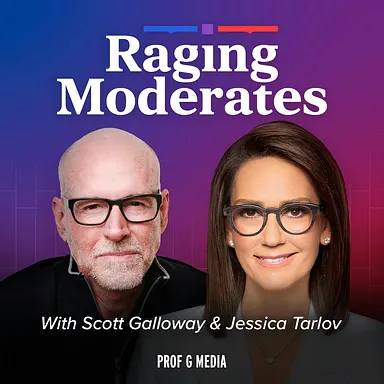
Scott Galloway and Jessica Tarlov discuss Donald Trump's trip to Asia and the fallout from Nvidia chips reportedly reaching China-linked buyers, including a loophole that allegedly let Chinese firms access advanced chips through overseas data centers. They debate whether the scandal around Nvidia's ousted CEO Jensen Huang and a reported affair matters for national security, and whether the company can survive without him.
The hosts then cover a week of technology outages affecting air traffic control, United Airlines and major banks, the U.S. losing its measles elimination status, Joe Biden's new memoir defending his 2024 reelection bid, and a shift among podcasters away from Trump. Listeners will hear the hosts' arguments, which are opinions rather than settled facts.
In this episode Jessica Tarlov, Scott Galloway
This episode on Trump's China strategy and Nvidia's leadership crisis was made with the technology behind HappyScribe's AI tool that takes meeting notes.
Ads in this audio differ from the text. Tap the sentence you're hearing to follow along.
Synced: the text now follows the audio.
Welcome to Raging Moderates. I'm Scott Galloway.
And I'm Jessica Tarlov.
Before we get started, make sure to subscribe to stay up to date and support the show. All right, let's bust into it. Let's turn to Trump's trip to Asia, where the fight of America's AI advantage is becoming increasingly complicated. Trump has arrived in Manila for a high-stakes meeting with Xi Jinping, where trade, tariffs, and access to advanced AI chips are all expected to be on the table. He'll also be navigating a fragile trade truce, I'll say, with Beijing and trying to secure China's cooperation on everything from rare earth minerals to nuclear arms control. Meanwhile, the administration is moving to close a loophole that has allowed Chinese companies to access advanced Nvidia chips through overseas data centers, a move that could create new friction with Beijing.
It's also exposing a growing divide inside the White House, with Treasury Secretary Scott Bessent pushing for tougher restrictions while Commerce Secretary Howard Lutnick has been accused of going easy on Nvidia. And then there's Jensen, that saucy little minx. Trump says he'd be open to reinstating the ousted Nvidia chief even as questions swirl around the alleged Chinese intelligence operation involving the woman he had an affair with. Those questions are especially sensitive given reports that Trump owns Nvidia investments. They're now supposedly worth $62 million.
Kallashy has the odds that Jensen continues serving as CEO at 11%. By the way, I think it's 1%.
Yeah.
Today, Nvidia announced that it's creating a new board-level committee to oversee national security policies, export control compliance, and global trade risks ahead of its earnings call later in the day. That's a great idea, and it should have happened five fucking years ago. Anyways, how much leverage, Jess, do you think China has over the United States in the AI race? And could these new restrictions backfire?
It seems like this is a big old mess. I mean, I don't know how to put the percentages of the amount of leverage that they have, but it certainly seems advantage China at this rate. And I saw Commerce and Treasury announce a joint statement that basically said a whole lot of nothing. And hardworking reporters who were digging into the backdoor channel to mega-speed, which is what Scott Bessent was mad about, right?
This idea that Commerce is saying, like, no, we're not doing anything wrong, and that Alice Wong, who was having the affair with Jensen, had set up this back channel going through mega-speed to make sure that these chips get to China. And the reporting also on her relationship with her husband, who's involved in this. I'd be very curious if all of if the affair was relationship-sanctioned, you know, like this makes sense for us because we're going to be making a shit ton of money off of this and able to get the chips through to China. But reporters who've looked into it now, that the Commerce Department says that since June of 2025, Nvidia placed mega-speed on its no-sell list, that actually there's a subsidiary of mega-speed called Speed Matrix that continued getting large shipments of chips, moving up to $800 million worth, including the Blackwell chips and the H200 chips.
So it looks really bad, and it seems to be really bad. And I've been aggravated, to say the least, because we talked about it yesterday on the Five, kind of willful ignorance about the implications of this story and subverting export control law to give our enemies our best technology. People are like, who cares who he sleeps with? I don't care. I don't think it's nice. I've made it clear on this show many times, not into infidelity, but like, I know it happens.
It especially happens with powerful men. No offense to all the powerful men on the call or who might be listening, but like, that they are still head in the sand about what this story is and the enormous implications. And I can't really understand, besides the grift aspect, and you mentioned the up to $62 million for Trump and Nvidia and Cantor Fitzgerald, they've been downsizing, but Nvidia was at 1.7% of their portfolio, and Howard Lutnick's kids run Cantor Fitzgerald.
So I'm hard-pressed to see an argument for this besides lining wallets when you consider the national security implications.
Yeah, look, so on the you're right. It's not a board's job to be the morality police and judge infidelity amongst its employees. It is their job to have certain standards, like from an HR standpoint, where the CEO doesn't create an environment where he has so much leverage over someone in a relationship that that person ends up maintaining the relationship even though they don't want to, and their career gets compromised, and it creates just the entirely wrong atmosphere. That's why almost I would believe every public company has standards around relationships between senior executives, including the CEO, and subordinates, especially people who report to this person.
And they usually have one or two rules. One, you have to report it, or two, you can't do it and you get fired. And the CEOs of Nestlé, Intel, McDonald's, and on and on and on have been terminated immediately for not disclosing relationships. So one, that in itself is, you know, go straight to jail, so to speak, or you're out, if you will. Then there's the much bigger issue, and that is it looks as if we sold one and a half million Nvidia chips that they reached Chinese despite these quote-unquote import-export controls.
So there's a violation of import-export laws, which is a pretty serious crime. And the fact that he looks as if he was compromised by an alleged Chinese asset or Chinese spy is the real I mean, there's meaningful violations here that in any other company he would be fired for. And then there are profound violations of what feels like national security. And just to kind of bring it home to what this means for Americans, everyday Americans, we spend one and a half trillion dollars on defense each year.
There are 150 million households. So on average, every household is paying $10,000 for defense. And now what are they paying for? They want advantage around our weapons. They want advantages around our surveillance. There are a lot of people out there who do not have our best interests at heart and would commit acts of cyber terrorism, which we're seeing, acts of collateral damage. They would, quite frankly, like to kill Americans. And we not only want to protect the homeland, but we want to sometimes impose our values and take the war to them, if you will.
And in order to do that, it's very expensive. And we make huge investments to maintain an advantage on the battlefield and around our surveillance and our security. And we don't know if we gave up a week, a month, or 10 years, or $100,000 of every household's advantage by giving them access to the technology that powers our surveillance systems, that powers our drones, that aggregates all our surveillance data and puts it into distillable action items for our security apparatus. This is it's just shocking to me.
And again, I'm constantly in this administration in America where I feel increasingly, you know, to be blunt, sometimes I just feel out of touch. This movement to reinstate Jensen, and I actually think it's quite niche and it's been dialed up on a specific platform, but I just I was in Los Angeles yesterday and I rolled by the veteran cemetery and I think of all the people who, at a very young age, gave their life or they were injured or they were away from their families because they believed in this experiment called America and that it was worth defending.
And I wonder if any of them could quote-unquote come back to life if we said to them, yeah, you died on the beaches of Omaha at the age of 19, never had the chance to have a family, never had the chance to, you know, experience life, see what you would do with your life. And but 80 years in the future, there's a CEO who, because of his reckless behavior and poor judgment, cedes military and defense advantage to our adversary. But he made a lot of money for shareholders, so they're going to forgive him.
I just think if you took any veterans who, you know, 42 million people have served in uniform, 1.4 million have died in uniform, and said to them, but wait, all is forgiven because his stock is really high. I feel as if we have just a generation or a class of people that don't feel any fidelity toward our gratitude for the millions of men and women, the trillions of dollars, the incredible sacrifice our nation has made to become the premier military and defense power globally.
And yet some people are like, all is forgiven if he can create shareholder value. I have another theory here, but I want you to respond to that, Jess.
Yeah, I was going to say that Senator Jim Banks, who is not usually particularly animated, has been about this, and he served in Afghanistan and made exactly that point. Says, you know, I didn't go to war so that we could hand over our most important assets to the enemy. And if you think of it in that framing, it's pretty clear what the deal with the devil is that these folks are willing to make. And you see, it's rare that Republican opposition to anything breaks through, but you see it on this front.
You know, obviously not from Lutnick, but from certainly the veteran class, what Scott Bessent is doing. And Scott Bessent never liked Howard Lutnick. So, you know, this goes back to the warring over who would be Treasury Secretary. And Maggie Haberman was on with me yesterday talking about a long-held grudge in that department. But I thought it was really important what Senator Banks was talking about. And to your point about how much of an advantage we lost because of this, Chris McGuire, who's the he's a fellow in China studies and emerging technologies at the Council on Foreign Relations, he was asked on CNN, is there a way to quantify the cost of Nvidia selling advanced chips to companies tied to China?
And he said that it's probably cost us a year of advantage in the AI race, a whole year in this. And when you think of how fast it's moving and how that could get exponentially larger quickly, it's pretty concerning stuff. And I wanted to get your take on all of these problems, these outages happening at once. You said, rightfully so, that the Kallashy odds of Jensen coming back at 11% seemed high. I'm curious, and you talked about it a little bit last night when you were on with Caitlin Collins, but in terms of the culture at Nvidia, do you think that it can survive at this level without him?
Because that seems to be the panic, right, from the Silicon Valley types that want him back. Like, they're not particularly attached to him as a human being, but they clearly think that their money might be set on fire if they can't get him back.
I have worked with quote-unquote some of the most impressive indispensable people in business. The graveyard is full of the indispensable. There is no such thing as business Jesus. I remember I was on Bloomberg Television when Steve Jobs passed away. He actually passed away. It was breaking news. And I was on, I forget, with Tom Keane and Stephanie Rule back then when she worked there. And the general consensus was that Apple was done, that Apple would go on and be maybe an okay company, but the heyday was over for Apple at being an important influential firm because without Steve Jobs, that was it.
It was over. By the way, the same calls when Bezos left Amazon. How would Amazon ever survive? Amazon was Bezos. Bezos was Amazon. How on earth would Microsoft survive without Bill Gates? Okay, Apple went on to 15X its valuation under Tim Cook. Amazon has thrived. Alphabet has thrived. You know, Netflix went on to do very well until it didn't after Reed Hastings left the company. You cannot build a firm like this with amazing people, and this is credit to Jensen, up and down the food chain.
There are probably a half a dozen people who can run this company right now at Nvidia, and I would suggest they go internally. And if they put together a list of the 100 top tech executives in the world and called them all and said, Jiboun Shin being CEO of Nvidia, that's like getting a call saying, would you like to be shortstopped for the Yankees? Everyone returns that call. The underlying fundamental business has not been threatened here. Now, they might lose 20% of their revenues when they say, hey, maybe it's not a good idea to ship stuff to China because it ends up powering their hypersonic missiles of an adversary.
But they're going to have no problem finding a CEO. And this whole Jesus Messiah complex is an effort by the tech bros. And it's a real tell because a lot of the tech bros aren't calling for his return. Like, Satya and Sundar are not going to ever say, yeah, he should come back. I don't think because they're like, this is ridiculous. But the people calling for him to come back want to create this notion, especially one person, that certain people are above the law if they create value in the stock market, specifically value in tech, that these are our new gods and that we deserve to live by a different standard.
And if I turn off technology, the results in death and destruction in Kyiv, it's okay because I can land rockets on scissors and have created a lot of shareholder value. There's this weird techno-narcissism among a small group of individuals running tech firms that I am the Jesus of crypto. I am the Jesus of e-commerce infrastructure. I am the Jesus of autonomous automobiles, which means I am above the law. And also, the dangerous thing here is this group of people no longer has a vested interest in the success of America.
They're not at risk from cyber attacks. If America goes down the tubes because of debt, because of an adversary, because of cyber attacks, because they now have our chips, they can peace out to Milan or Dubai or New Zealand. They have their own transportation. They have their own education for their planes. They have their own security. They're fine. They don't need like 99.9% of us the protection and benefits and rights of a nation. They have their own nation-states by virtue of their wealth.
And yet they have managed to convince a cult of people that the new religion is tech, and these are our Jesus Christ and shouldn't be held to the same standards. I think I find this whole thing so disturbing on so many levels. And I come back to the notion of we need more history, American history in our high schools so that young people understand the commitment and the sacrifice people have made for this type of defense advantage. I think we need mandatory national service so people can see how wonderful other Americans are and feel more fidelity to the flag.
But this is unfurled. And granted, I think it's been blown out of proportion because I think the majority of people, if you look at Kallashy, he's not coming back. But the majority or a lot of these people who are advocating for this are not only the most blessed and benefited most from this commitment and sacrifice of our armed services, but they have the least gratitude. It's just I'm trying to think of a group of people who have been more blessed and at the same time have less gratitude and understanding of the commitment that has come before them, of the shoulders they stand on.
Anyways, that's my indignant wrap. Any comments, Jess?
I think that it's very fitting for the moment that we find ourselves in. And I just want to think better of people in positions of power. And then stuff like this keeps happening when you understand how we got to a place where we had this midterms that was really all about the top versus the bottom, right? Or the elites versus the everyday, you know, Joe or Jill. And it was one of the questions that I asked Hakeem Jeffries last week when I was interviewing him about this particular scandal and the investigations that would come from it because I felt like it was such a perfect encapsulation of what people are upset about, right?
It has the uncertainty aspect of what happens to our life as a result of AI and Jensen being the poster child for, you know, all gas, no brakes, right? Whereas you have Anthropic and OpenAI saying, you know, like, let's cool it a little bit. We're okay with some level of government regulation. Jensen's like full blast on it. It has, you know, people self-dealing, people making levels of money that's difficult for your mind to comprehend, abuse of power within the government.
And it has this war element, this, you know, it might be a new age kind of war in that it doesn't happen on the battlefield in the same way that it did for Senator Banks necessarily. But they are an enormous geopolitical foe in China. And Leader Jeffries committed to investigations to look into this. It's so ripe for it. But I imagine to the average person who is blown away by their grocery bill every week when they go to shop and have made big concessions in their lives, you know, maybe they had to pick another protein à la the Scott Colome ad.
Pick another protein? Shit. I'd rather pick another senator instead.
That they're looking at all of this and thinking, God, our country is so fucked up.
I do think it'll make a prediction here. Once the media really understands what's going on here and has a chance to digest it, and once, I think, even the staunchest defenders of Jensen start to start scattering from him. And already, you know, as you mentioned, members of the Cabinet are already distancing themselves from this situation and specifically Lutnick. I not only think that Jensen is not going to return, I would bet within 12 months, the majority of this board is gone.
Oh, really?
This is just such a failure of governance. The fact that they did not have these security protocols in place, the fact that all of these affairs were going, and let's be honest, if he's having affairs with three women that have come out in the last two weeks, it's at least a dozen. You don't think there's people he hooked up with on a trip to Taiwan who've said, let's just keep it on the down low and they don't want to have their lives. They don't want to have an autopsy on their lives right now. Three people in a week at his company and all these CEOs saying, you know, bring him back.
And they're CEOs of public companies who have called for him to be returned. Does that mean they are saying to their employee base, it's okay if the CEO has numerous affairs with direct deports? That's okay as long as the stock is up. Are we not subject to import-export controls? It's okay if we give an enemy an advantage here as long as your group is making money. So I think this is I think the arc of justice in America is jagged, but it bends towards the righteous.
I think as Americans and the media have had a chance to digest and absorb what exactly has gone on here and the cost to Americans, not only in terms of defense advantage, but just how much money they've been taxed that has likely been wasted or eroded or is less effective now. Not only is Jensen, in my opinion, going to be testifying in front of a congressional committee, I think at some point he's likely going to be testifying in court. And these board members have all lawyered up if they know what's good for them and are going to decide to just fade into the distance and hope that they can hold on to the average $80 million in board compensation that they have received.
So this is I think this is just going to get so ugly. And I don't understand why Trump would think, okay, it's okay to call for this. I thought they were sequestering it or trying to ring-fence it, but now the calls to bring him back, they just look inconsistent. And it's going to these calls to bring Jensen back are going to age really poorly. And Jensen in 50 years will be remembered for one thing. He will be the 3D animation and the face on every Wikipedia when you type in useful idiot.
He will go down not as an AI, you know, icon. He'll go down as the ultimate useful idiot in an era where our national defense was monetized. We're monetizing everything. We've decided to monetize healthcare. It's no longer about the healthcare of America. It's about hospital systems and pharmaceutical companies that develop competitive advantage to extract more rents from consumers such that their shares go up. We've monetized addiction with opiates. We've monetized teen depression and loneliness through Meta and through gambling apps and through dating apps.
And now we monetize the White House. You can get a pardon for a half a million, a million bucks. You get to skirt all crypto or SEC trading laws or ethics laws as long as there's money. We'll trade off geopolitical advantage. We'll ship chips into the UAE if you invest in my son's crypto company. And now we're monetizing national defense. It's okay to erode our massive investment in defense as long as you are selling more chips, which takes the stock up. It's the monetization of absolutely everything.
Let's move on. It's been a rough week for America's aging technology infrastructure. Just days after a nationwide FAA ground stop exposed vulnerabilities in the country's air traffic control system. United Airlines grounded departing flights Monday because of a technology outage. JPMorgan Chase also reported problems processing transactions, leaving customers at several major banks dealing with disruptions. Meanwhile, the FBI is taking possession of equipment at the center of Friday's aviation meltdown as questions grow about what went wrong and whether a nationwide ground stop was even necessary.
Both JD Vance and Mark Wayne Mullen pointed fingers yesterday. Let's take a listen.
And so I started talking to the tech industry and one guy that's very smart with tech, he asked not to mention his name. No, it's not Elon. So let me just put that out. But I said, what could be causing all these separate outages? And he says, I believe that it's the SI. He said, because these programs aren't designed to work as fast as SI is. And so when they put in a program that's able to write codes and it causes these systems to be overrun that weren't designed to run as fast as the SI technology is today.
The problem, Laura, is that we're dealing with 50-year-old technology. Sometimes you have to work on a patchwork of solutions to keep a 50-year-old system up and running. Why do we have a 50-year-old system in the first place? We should have a new system and we need to rebuild it.
You guys have been in charge the last two years. Why hasn't it gotten fixed?
Well, a lot of the stuff that needed to get fixed, we have been working on and we have been patching that stuff, Laura. But in terms of rebuilding the infrastructure using 21st-century technology, that is something that Congress needs to reinvest.
Okay. The overrun of the technology, it's not 50-year-old technology. It's 80-year-olds who don't understand technology who don't hire competent people to oversee these agencies that have large components of technology. You go first, Jess.
Well, I share a lot of your frustration. What sticks out to me perhaps the most about all of this is nobody can say, I'm sorry that your lives were disrupted like this or that you couldn't access your money. Like I was waiting in the green room to do the five yesterday and there's a cybersecurity expert who's there and I've seen him a few times. He comes to New York every couple of weeks. He lives in Silicon Valley. And I said to him, you know, we already went to the bank to take out money.
That's what Brian did first when the outages started so that we would have, you know, some money at home. And I said, what else should we do? And he said, have you screenshotted all of your bank statements? Because if everything does get wiped out, you need proof of how much was in your accounts. Now, do I think that this is happening right now? No. Do I think you should do something like this? If when a storm is coming, you go and buy water and peanut butter, I think it's worth taking a screenshot of your bank statements and heading in there and getting a few thousand dollars if you do have it in your account.
And I understand this is also a time when a lot of people don't have money hanging around to spare because we could have a crisis like this. And I was bold over I mean, Trump starts yesterday by lashing out at reporters asking him about these outages and if he'd take any responsibility. And of course, he was particularly racist, as per usual, to Yamiche. He loves Alcindor, who he loves to be horrible to, you know, talking about how she wouldn't recognize dirt and then citing broken windows.
It's like, yeah, you're talking to a black woman and you're bringing up broken windows policing, but taking no responsibility. And then in Manila, he's asked about the outages. Are you concerned about them? And he goes, no, it's life. It is not life. It's not. What happened on Friday? There hasn't been an outage like that since 9/11. Again, stupid PR work to be citing the fact that we haven't had an outage like that since 9/11 and what has happened with Outlook and now what happened with the banks and United.
It's not life or it shouldn't be, at the very least. The numbers don't add up when they're bitching about the amount of money. I mean, they even have put in the Trump administration itself has put a pause or frozen $5 billion of the FAA modernization money that came through the big beautiful bill. They originally only asked for $5.5 billion and they got $14.4 billion. So they're freezing their own money about this. The whole story still seems ridiculous to me that one router in Arkansas can take down the entire country.
And Mullen on CNBC this morning says, nothing is 100%, but I can tell you with 98% certainty this isn't a cyber attack. 98% certainty? And he's supposed to be the upgrade in the DHS secretary. Can you imagine what Kristi Noem would be like right now, though?
She'd be doing photo ops of her on a runway somewhere holding machine guns or look, it is a bipartisan failure. A budget is and I think I got this from you. A budget, a government budget is a reflection of our value system. And investments in infrastructure are investments in the middle class. They make it such that there are a lot of people who come into I think Manhattan swells. I think there are two and a half million people on the island of Manhattan at night and also nine million during the day because there are these arteries of infrastructure where people can come in and make this incredibly productive barter town of the information economy that creates ton of economic value.
And yet those people can still come in to work in what is the most expensive place in the world because they can take the Long Island Railroad or the New Jersey Transit back to a reasonably priced home, not an inexpensive home, and have a decent life and get home in time for dinner. That's infrastructure. You want to go home for Thanksgiving, you can fly inexpensively to go see your family. You can have a yard because we have highways. You can understand that, okay, if somebody has a stroke, I can call 911 and really talented, thoughtful people are going to be at my house in two minutes or less.
This is an investment. We can't afford to send my kids to a private school, but our public schools are decent because we make investment in this infrastructure. Investments in infrastructure are a nod to the middle class. And over the last 40 years, we have decided slowly but surely to transfer opportunity and growth and prosperity for the middle class such that we can cut taxes on the wealthy and cut taxes on corporations. And we have underinvested in our infrastructure. And at some point, when you're not maintaining the refrigerator, you wake up one day and all the food is spoiled.
So 40 years of underinvestment in infrastructure and then you wrap that with incompetence and senior officials that just want to blame everybody that don't want to get to the bottom of things. And also, I just can't help it. All of these things happening at the same time. If Secretary Wayne Mullen or whatever his name is, had come out and said.
Mark Wayne.
If Secretary Mark Wayne, if he can't say this wasn't a cyber attack, it means they're worried it was. Notice how he said 98%?
Yeah.
This is not a measured administration. And also, it's not conspiracy theory to wonder why this is all happening at once and to recognize that we have taken the war, we have taken the fight to the IRGC. We have killed all of their leaders. We have bombed their infrastructure. The Iranian people are a very skilled, intelligent, and technologically literate people. That 2% that it might be a cyber attack, boss, it's probably more than 2%.
It just seems a little random or not random that all of these things are happening at the same time. And if I were the IRGC and I couldn't beat us kinetically, you can bet I would be spending a lot of time trying to figure out, quite frankly, how to create collateral damage in America via cyber attack because they don't have the weapons platforms, they don't have the aircraft carriers, and God, we hope they don't have the terrorist cells here. I do think our national security apparatus does a really good job protecting us from attacks that we never hear about.
But this does feel the 98 number was really telling. If they knew this wasn't a cyber attack and they should be able to figure it out, he would have said it wasn't. Full stop. It wasn't. But he's given himself, you know, he's given himself an excuse here. And the fact that all this happened at the same time, I mean, I think we're going to find out. And it could be just what it seems to be, a lack of investment in infrastructure with an incompetent administration that values failed to overconfidence up and down the supply chain here.
But this is what poor infrastructure means. It means you can't get home. It means that the economy takes what was supposedly a billion-dollar hit. This hurts the economy and quite frankly, it doesn't affect rich people. They have domestic care. They just call their nanny and say, okay, I'm going to be late. And they can go check into a hotel and they don't get fired if they miss a day of work and they don't, you know, if they don't make their sales quota, they're fine. So this is a much larger problem compounded by what is an incompetence at a government level.
Should we talk about measles? Speaking of incompetence.
I was going to say, let's talk about who you think should go first of these cabinet secretaries and we have to throw RFK Jr. in there. So yes, let's do measles.
Yeah. I mean, this is a neck and neck race. So a major setback for public health in America. The U.S. has officially lost its measle elimination status for the first time in 26 years. More than 5,400 cases have been reported this year with 10 deaths. And new research shows the outbreak is particularly dangerous for pregnant women. More than 100 have been infected over the past years with nearly a quarter requiring hospitalization. Jess, if old white men got measles, do you think this would still, my guess is this would still be a disease that had been eliminated?
Your thoughts?
I think so. I think it's a good way to put it. No one's going after the Viagra. So I'm just floored by this. And I was thinking back to when we were talking about RFK Jr. during the confirmation hearings and watching Bill Cassidy feign indignance and upset at the things that he was saying and pouring over his record of nuttiness and vaccine denialism and all of the backdoor ways that Elizabeth Warren brought to light that he was making money off of these claims, these dirty law firms preying upon people and that he still got through and that Bill Cassidy, a doctor who purports to care about the nation's health, voted for him and is now again all hot and bothered about it.
Even if you wanted to put yourself in the mind frame of a politician who cares about nothing but getting reelected, did Bill Cassidy think after he voted to convict Donald Trump on the January 6th insurrection impeachment trial that there was going to be any chance that he was long-term going to survive? I would have looked at that as the end of my political career, essentially. I don't know what day the end was going to come, but it would be Donald Trump standing over my body, which is what happened when he supported a primary challenger.
And now you're sitting here with measles on your hands. And my colleagues have pushed back about the outbreaks in measles saying, you know, there was a period during COVID where a lot of people missed their immunizations. I am sure that is true to some degree. There are people who did not make it to the doctor, people who fell behind. It was also when this, you know, uptick in the quote-unquote health movement was happening where more people were, you know, considering the vaccine schedule and were becoming more hesitant about it because of the COVID-19 vaccine, which saved millions of lives.
And we could obviously do a whole other episode about that. But that does not explain losing your measles eradication status that we've had for over a quarter century. If there are a few people who miss their appointments or there are a few people who are nut cases. And this is really, really dangerous stuff. And I'm very upset about it.
You know, you'll see when you have teenagers, you find that their first defense mechanism always is they never take responsibility and they blame everything. Nothing is ever their fault. And so you're constantly saying, you know, making a mistake is bad, not owning up to it is worse, right? That's one of the first lessons you import part as a parent on your kids because they have a defense mechanism. They don't want to be wrong. They don't know how to process being wrong. This administration is literally adolescence that can never admit there was mistakes here.
Sure, I buy that during COVID, a lack of vaccination around measles or inability played a role here. But so does having our top, the nation's top healthcare professional who isn't a healthcare professional, who is distinctly anti-vaccine. And he can go on TV shows and say, I'm not anti-vaccine. But when he keeps removing the protocols for who gets what vaccines and creating and participating in this maha movement, it's really whenever the far left and the far right agree on anything, watch out.
You know, it's a fucked up in the head idea. The anti-vaccine movement was actually started on the far left where don't put corporations serum into your body, you know, all this bullshit. Vaccines are next in American middle class, the greatest innovation in history. And measles is really ugly. And the fact that we have gone from a first world country to a second world country or a third world country through poor healthcare for vaccines that are nearly free, nearly free, and have been proven safe and have had tens of millions of cases to look at is such a blight on the country and our reputation and preying on absolutely the most vulnerable and the weakest.
It's just, it's so upsetting that, you know, your government is here to prevent a tragedy that commons, and this tragedy that commons is unfurling. It's just, you know, Hegseth is probably the most dangerous man abroad and RFK Jr. is the most dangerous person domestically. And the majority of his damage will not be felt probably until after he is out of office.
I think it's directly correlated also to the types of electives that people are picking. You know, we have this wave of doctors coming in and then there were already, you know, a few fantastic health professionals like Lauren Underwood already in Congress. But like in Ohio, for instance, the Republicans thought that they could hang Amy Acton's experience during COVID around her neck to make sure that she didn't get elected. Obviously, Vivek gave her a big help, though she was already leading with that monstrous ad using her mother.
But people looked at what Amy Acton did during COVID and saw a professional person who maybe in their mind, you know, it went too far. The governor, Dewine, was one of the only Republican governors that was actually in favor of the shutdowns, at least at the beginning. But they saw somebody that knows something about health and who gives a shit and is trying to keep them safe. Same thing with Dr. Annie Andrews, where I feel, you know, maybe it's just about how bad Darlene Graham is, but there's a treasure trove of evidence and posts and, you know, tweets, TikToks, whatever it is where Annie Andrews is saying stuff that you could see would be a problem for her in South Carolina.
But no, people see her as somebody that actually cares about people. You look at Abdul El Sayed in Michigan, same thing. You know, they wanted to fight about physician versus doctor. No, they saw an epidemiologist who runs towards the fire during COVID, right? And is trying to keep people alive. And I think, you know, folks are over it. It's not enough to tell you that they'll get red dyes and yellow dyes out of your food. If you're telling people that it's not safe, you know, to take Tylenol during pregnancy, that you shouldn't be adhering to your vaccine schedule.
And all of these governors, it's why they're becoming so important in this. They're having to run their own countries, essentially, within their states because you can't rely on the federal government for anything, for the help, certainly not for the guidance. And they make it worse. Every press conference that they give makes it worse.
All right, let's talk about something brighter. Let's talk about Joe Biden and his new memoir, Promise Me. And his new memoir, Promise Me, America. I thought it was just Promise Me, which sounds more like a Hallmark love story of a recently divorced woman who.
Or Danielle Steele.
Handsome young widow. That's how it plays out, right? The former president revisits one of the most consequential decisions of his political career, running for reelection in 2024. He stands by that decision, claiming his top advisors were unanimously behind him, but also admits he knew almost immediately after his disastrous debate with Trump that he had screwed up. Jess, do you think President Biden understands how much damage his decision to stay in the race did to the party?
I think depending on the day, he understands, you know.
Good days and bad days.
Good days and bad days. Promise Me aging. That's what happens in this. But I generally feel, you know, the guy has cancer. He had cancer while he was in office. I don't know how these health challenges got missed. You know, he said that if, you know, they had known and he and Jill gave a couple joint interviews, I think I'm thinking about the one with people that, you know, if they had known and that that could have been a factor in his debate performance, they definitely wouldn't have run. I don't know. They seem pretty full steam ahead.
And what he is recounting from his conversation with Nancy Pelosi, who was, you know, the final nail in the proverbial coffin of his run, where she said, "There is not a poll that exists that is going to show you that this is going to be fine. There is no way for you to win." And Mike Donalden, you know, they were all in on this. His inner circle continued to amp him up to the idea that he was going to be fine in this and he alone can fix it. And we maligned Trump for that perspective, this idea that you don't even need good people around you in order to do this job.
And a lot of these anecdotes and even the way that he recounts these stories. And I think Joe Biden is a fundamentally very good man. I think this is a good person, an amazing public servant, cares deeply about the country. But a lot of this does come off as narcissism when you think about how high the stakes are and that he understood that. And maybe part of it is, what do we do if I pull out and there's not time to have a nominating contest and can Kamala Harris do it?
You know, it seems pretty clear that he didn't necessarily think that about her, but it makes me angry. And I think the timing of it also sucks. Like we just had the best midterms, you know, since Watergate, essentially, and we're talking about this. And I know he needs to raise money and he has a presidential library to fund, but I kind of just want to be high on my own supply right now and this is ruining my high.
Yeah, look, the first thing to go, we need age limits. I've been saying this forever. The first thing to go in cognitive decline is your ability to recognize cognitive decline. For President Biden not to look at that debate or in the middle of the debate go, "Wow, I have no business commanding the Sixth Fleet and having my finger on the button and trying to figure out trade agreements." It's just age comes for all of us. And, you know, there are always going to be exceptions. My 15-year-old can drive a car like no one's business, but the government has decided that he does not have the physical or cognitive ability or the judgment to operate an automobile.
And we've decided that 30-year-olds do not have the judgment to run for Senate and a 34-year-old does not have the judgment to run for president. The notion that we can let an 81-year-old or whatever he was, 80, what was he, 81 running for president? It's just insane. And it's such a shame because he had such a legacy, not only as a good president, not only as a good man, but as a really good father. He's a great role model for fathers. Just unconditional love. Like it might have embarrassed you in your career, but that's not what takes president here.
What takes president here is demonstrating, always demonstrating your support and your love for your son. He's a tremendous role model for young men. And the exclamation point or the punctuation point on his entire legacy is a giant question mark. Like, quite frankly, what the fuck were you thinking? And I always go back to the same thing. Don't these people have friends and family? There's no way the family of Mitch McConnell should be allowing him to humiliate himself like this.
There's no way the family and friends of Joe Biden and Nancy Pelosi, who's seen as like his enemy and they haven't spoken with, she was his friend to tell him, "Look, boss, this is going to be painful for you and for your family and for the country." I think, and also the book, quite frankly, if he'd been more reflective and said, "Look, in the distance of time, I recognize it was a bad idea. It was just, you know, you get caught up in the power, everyone around you is telling you to do it." Instead, the book might as well be called, "I was right" or "I was right to run."
No, you're not. The premise of the book, instead of celebrating his life, the premise of his book starts from a false truth that there is any excuse and any rationalization for him running. But in better news to cheer us up, did you hear Melania Trump is getting another project on Amazon Prime Video?
You know, I did hear that. I wonder why.
This is very exciting. This is very exciting. The first lady's executive producing a two-part docuseries, Melania. The series, which premieres November 20th and follows her in the days after Trump's inauguration. It comes just months after Amazon spent 75 million acquiring and marketing her feature-like documentary, which brought in about 16 million at the box office.
I'm not great at math, but it seems like they're spending more than they're getting out.
Yeah, it doesn't hit. Yeah, this is a weird one. And the more interesting news in media is it appears the podcast bros have all of a sudden woken up with a nose ring and a feathered earring and have decided they're Democrats and that they did not really mean to support Trump and that all is, you know, they all should be forgiven. And by the way, I think they're sincere and I think at least they're calling balls and strikes. I actually think this has a pretty big impact because if you're talking about Joe Rogan, I would argue is probably the most influential person in the world right now as it relates to young men.
I just think he has their ear. He does a really great job in podcasting and he has just an enormous, enormous footprint. So I do think this is sort of a big deal. The Melania Trump thing will make for great SNL sketches, but the more important thing in media is this seems to be a shift away from the president among the majority of podcasters. And what's also interesting is the right-wing media seems to be really going through a tough time right now with many of the right-wing or conservative podcasts way down. And some of the cable networks were known for being conservative, coming off, you know, pretty substantially in terms of viewership.
Any thoughts on the media's kind of, "Oh, we're no longer into Trump"?
Yeah, I have a lot of thoughts of it since I work somewhere where there are a lot of people in the media who are into Trump. Part of this, I think, is licking wounds after a loss like that. And this trend line started even before the election and then the election was the cherry on top of all of the anger and resentment that traditional viewers of either podcasts or cable news were feeling towards an administration that clearly didn't care about their concerns and was just blowing it.
I want to say though on the Joe Rogan front, and this goes for like Andrew Schultz when they had Trump on Flagrant, for instance, which has a huge footprint as well. Theo Von, Nelk Boys, et cetera. I think that modeling the ability to take responsibility for something and to also change your mind is important. There are too many people, especially men, who act like you have to dig in no matter what. We're seeing this with the FAA problem, right?
That they can't take any responsibility for it. They can't say, "I'm sorry, we made a mistake. We should have done this," et cetera. But I think that this is also a statement on the idea that you can just have a hang with someone like President Trump. And it's one thing to interview him, right? To show up with questions and to be prepared for it. But the way that Rogan does things, and it's part of why people really like him, is that it's so casual, right? And he has the guy that's constantly Googling things, "Oh, I didn't know that."
And that there are moments like when Shane Gillis is on and he's giving them, you know, a history lesson and Rogan's like, "I didn't know that. I didn't know that." Or they're talking about policies and the implementation of immigration policy or what's happening in the foreign wars, et cetera. But there is a casualness with which the media ecosystem treated President Trump that hurt America deeply. And it's all well and good to now say, "I was wrong about this," or, "He's not doing what he told us that we would." But all of this was entirely predictable.
Donald Trump has been the same person since he came down the golden escalator and started talking about a Muslim ban and the bad hombres. And he has a supporting cast that has made it more aggressive with Stephen Miller as the mastermind behind this. But I don't know. I don't give free passes on this when you normalized him in a way to a very influential audience that came out and voted in 2024. And it doesn't mean you had to be shitty to him or, you know, treat every interaction as a, you know, "I'm only interviewing you and I'll cut you off if you say something I don't agree with" or "I have the fact checkers ready to go and making it adversarial."
But they were so lax with him and made him seem like such a chill dude. And, you know, one who wouldn't be rounding up people who have been here for decades at Home Depot that they bear some degree of responsibility for this outcome.
I like that. Let's move on to listener questions. We just have time for a couple. Question number one comes from daniels.8788, who asks, "How does the Jensen investigation directly affect Americans' lives? I'm worried it will distract from the reasons Dems were elected: inflation, the war, tariffs, jobs, et cetera." Jess, do you want to go first?
Yeah, I mean, I'll just take a piece of this, which I think I got to a bit in the reasons that this has to be investigated, that it touches on all of the things that folks are thinking about when they go to vote. So they're thinking about the rich are getting richer and I'm not able to earn a decent living. And it's part of this oligarchical class that is untouchable. The AI race is a big part of this. I mean, every 44 or 45 ballot initiatives on data center moratoriums, for instance, passed.
That's related to this. It is an opening for Democrats to have, you know, good legislation that protects Americans on AI, but also makes sure that we don't fall behind in the race. National security links to the war as well. This is just a war on a different front. So those are just a few ways that I think it links, but they certainly need to do the cost of living proposals. Like we were talking about permitting reform to lower energy costs, reversing the tariffs. All of that is, you know, Hakeem's been saying, first 100 hours, it's, you know, certainly the first few days that that stuff needs to be put forward.
Yeah, I think the problem is we don't know the extent of the damage. So we don't know if the nation is going to be less safe. We don't know if our defense systems are not going to be as robust. We just don't know what was compromised here. What we do know is that if you have Nvidia in your portfolio, it's down probably needlessly because of the behavior of the CEO. And also AI is powering the economy right now in terms of incremental GDP growth, incremental earnings growth. And this threatens it because effectively what happens is you become Germany.
And that is Germany says to great German manufacturing companies, BMW, Daimler, Volkswagen, come produce here in factories and we'll subsidize them. But then they steal their IP and they start building a knockoff for 40% of the price and selling it back into Germany. And slowly but surely Germany's manufacturing base is being hollowed out by what is effectively IP theft or industrial capture by the Chinese. And the Chinese having access to our most sophisticated AI chips, quite frankly, just closes the delta between their AI and our AI, which has been a huge source of competitive advantage and shareholder and economic growth.
So the problem is you don't recognize that things are more expensive. Well, you do, but you can't attribute it. You can't attribute the fact that your 401(k) is down and the fact that there's not as much job growth and not as much economic growth and everything's more expensive here and more and more money leaves our shores and goes to other technology and other countries. It just happens incrementally and you wake up and you're a meddling economy. So also, I think it erodes our trust in institutions.
It reflects poorly on our government. It creates questions around whether there's a superclass of billionaires or trillionaires that aren't subject to the same laws as the rest of us. So yeah, I think it is damaging for the country. And it also, I think, gives comfort to our enemies that they can commit this type of espionage and not face consequences because, look, they're not even going to fire the CEO or there's calls to bring the CEO back. So I think there's a lot of things here, but unfortunately, the greatest damage done is the damage that's hardest to attribute to a specific action.
It's like kind of a slow burn. Anyways, Jess, what do you say we leave it there?
All right, let's leave it there. I will see you Thursday.
That's right. Thanks everyone for tuning in. Make sure to subscribe. We'll be back on Thursday at 10:00 a.m. Eastern Standard Time. Have a great rest of the week, Jess.
Yeah, you too.
Scott Galloway and Jessica Tarlov break down the latest political news: Trump’s trip to Asia, more fallout from the FAA ground stop, and a series of other digital infrastructure problems.
Trump arrived in the Philippines ahead of a crucial trilateral meeting in China. His meetings with world leaders come as tensions brew over advanced AI chips illicitly sold by Nvidia. How will concern for America’s technological advantage complicate negotiations with Xi Jinping? And how much leverage does China have over the United States in the AI race
Meanwhile, it’s been a rough week for America’s aging technology infrastructure. After a nearly-unprecedented hourslong FAA ground stop last week, many banks and individual airlines experienced new problems with their online services. Plus, a major setback for public health in America: the U.S. has officially lost its measles-elimination status for the first time in 26 years. Is RFK Jr. to blame?
With the pending release of his new book Promise Me, America, former President Biden defends his decision to stay in the 2024 race as long as he did. Amazon MGM has greenlit yet another media property centered on (and executive produced by) First Lady Melania Trump. And, in a shift in a certain niche of independent media, Trump seems to be losing the support of a key part of his 2024 coalition: podcast bros. What caused such a shift, and is this a bright spot for Dems?
For ad-free episodes, exclusive livestreams, and to connect with Scott, Jessica, and the Raging Moderates community, join us at ProfG+ on Substack: https://ragingmoderates.profgmedia.com/
Get The Monday Rage newsletter: https://profgmedia.com/s/monday-rage/
Follow Raging Moderates on IG, Tiktok, and Facebook:
https://www.instagram.com/ragingmoderatespod/
https://www.tiktok.com/@ragingmoderates
https://www.facebook.com/ragingmoderates
Follow Jessica Tarlov on Instagram, Substack, and Bluesky:
https://instagram.com/jessicatarlov
https://substack.com/@jessietarlov
https://bsky.app/profile/jessicatarlov.bsky.social
Follow Scott on Instagram, Substack, and Bluesky:
https://instagram.com/profgalloway
https://substack.com/@profgalloway
https://bsky.app/profile/profgalloway.com
Subscribe to our YouTube Channel: https://www.youtube.com/@RagingModerates
Learn more about your ad choices. Visit podcastchoices.com/adchoices