
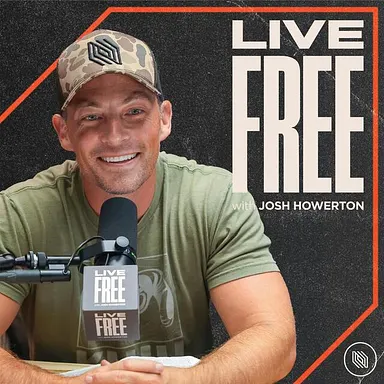
This Thanksgiving bonus episode of Live Free has Pastor Josh Howerton reacting to a 60 Minutes interview in which Ross Douthat asks President Donald Trump what he believes happens after death and whether he could forgive his enemies. Howerton explains what he reads in Scripture about death, judgment and the Lamb's Book of Life, and argues that being religious is not the same as being born again.
He contrasts salvation by grace through faith with salvation by works, and says forgiveness shows a changed heart rather than earning salvation. Listeners will hear how he interprets Trump's answers and why he believes bitterness can be released.
In this episode Josh Howerton
This episode's transcript, a discussion of Trump's answers on heaven, hell and forgiveness, was made with the tool HappyScribe built to transcribe audio to text.
Ads in this audio differ from the text. Tap the sentence you're hearing to follow along.
Synced: the text now follows the audio.
You will never be able to forgive them until it dawns on you: "Look what I put Him through." By my sins nailing Jesus to the cross. When that becomes bigger in your heart—what you put Him through—than what they put you through, that will be the moment that you are released from the prison of bitterness.
Well, hey, Lift Free Nation. Before we jump into the episode, this podcast is recorded right here at Lakepoint Church in Dallas, Texas, but the Lift Free Nation is spread all over the country and all around the world. So if you've been watching and thinking, "Man, I wish I could be part of something like this," we want to invite you to take a simple next step, and that is: join us for church online. Every weekend, we stream our services live on YouTube, Facebook, and our church online platform. And it's more than just watching a service; there are live hosts in the chat, prayer teams ready to stand with you, and people all around the world worshiping together in real time.
And so whether you're exploring the faith, coming back to church, or just looking for a place to start, church online is a great way to jump in and experience what God is doing here at Lakepoint. We would love to see you in the chat this weekend. And now, enjoy the podcast.
All right, ladies and gentlemen, welcome to a special Thanksgiving bonus episode of Lift Free. It's really fun to do this on a very, very special week. Let me just go ahead and get this out of the way. We got a really interesting one today. I think what we're about to see is the most significant journalistic moment of my entire lifetime, and I am not kidding. And I'm going to explain why that is. It's also the clearest moment that I have ever seen that answers the question whether or not President Donald Trump is a genuinely converted Christian.
So this is actually really interesting to me, and there's a whole lot here. I'll just give you a heads up: whether you love President Donald Trump or you hate President Donald Trump, you will find things to both love and hate in the next few minutes of this episode. It's going to be great. I also just want to always go ahead and get this out here: anytime that we do these bonus episodes, especially when we kind of react to what we're doing here, I'm going to shoot you straight. I'm always trying to figure out if the juice is worth the squeeze because it is a decent amount of extra work while we're busy pastoring churches and all the things.
So if you could, if you're like, "Hey man, this is really helpful," please keep doing it. If you could like, comment, share, especially on YouTube, very honestly, we really do pay attention to that, and it helps us know that this is helpful to you, and it's like a signal to do it more. So that's a way to vote for more of this. And if you hate it, then just don't. That'd be great. Okay. So without further ado, I would like you to see what I believe is the most significant journalistic moment of my entire lifetime. Now, here's a backstory on this.
It was about two weeks ago that the characters here are obviously President Donald Trump and a journalist, if you're unfamiliar with him, named Ross Dalfitt. Ross had worked for The New York Times for many years. A lot of people would make a little joke: Ross was very lonely at The New York Times because he was one of the only, quote-unquote, "conservatives" at The New York Times. Ross is, and you're going to see it in this interview, Ross is a very seemingly genuinely converted, convictional Catholic Christian man.
And he does something in this interview that you virtually never see in American media. He takes his faith and he does what I call "assumes the center." He doesn't act awkward about it. He doesn't sort of make an argument for it. He just assumes his faith is true, and then he conducts about three minutes of this interview assuming that his faith is true. By the way, that's what Christians should do. Okay? So this is what you'll see here. Now, one of the things that you're going to see is he's just going to go right in and ask President Trump about death and what President Trump believes will happen to him when he dies, with a little Catholic confusion thrown in just for the fun of it.
So without further ado, Ross Dalfitt interviewing President Donald Trump about what will happen to him when he dies on 60 Minutes. Here we go.
Let's talk about death. You have survived multiple assassination attempts. One came very, very close to you. I imagine that that had some kind of effect on how you think about mortality. What do you think happens when you.
By the way, I'll just say this: I'm not at liberty to share the whole story, but I do know that moment had a very significant on the president's thoughts about death and the necessity of understanding what happens when he dies. So Ross is asking an insightful question.
Die.
Oh, you need to hear the question.
What do you think happens when you die?
There's the question. Now, he just straight up asked the president, "What do you think happens when you die?" I will just pause and gently say this to you. Around the holidays, people think about it more often, but I do just want to point out to you, listen, especially the older you are, that is one of the most important questions you will ever answer. There is a spiritual reason that most people—I like to say it like this—that only a fool goes through life unprepared for what's inevitable. There is actually a spiritual reason why most people, they just never think about the reality you are going to die.
Side note, don't have time to do it. Satan's original lie, the first lie that he ever tells mankind, is this: "You will not surely die." And for thousands of years since then, that lie has implanted itself in the spiritual DNA of the human race. And even though your head knows that you are going to die, your heart almost never operates with the emotional reality you're really going to die. So when Ross asked this question, he's asking a very profound question.
Now, let me say one other thing, and then honestly, I just want to take 60 seconds and tell you exactly what's going to happen to you when you die, and then you hear from the president. One of the reasons I'm saying this is the most significant journalistic moment of my lifetime is there is a man of faith who is asking the president of the United States in a prophetic manner to consider spiritual realities. Now, we don't really have time to do a theology of this. Biblically, what happens in a spiritually healthy nation and society is whoever is the king or the king equivalent—this is really interesting.
People never pay attention to this in the Bible. Whoever is the king or the king equivalent, there is always a corresponding prophet assigned to that king. And humble kings seek out the prophets and ask, "Is there a word from the Lord?" And arrogant, godless kings, they rebel against the prophets and they reject them. So I'll just—for you Bible nerds, you may have noticed this pattern. For people who have never noticed this: Pharaoh has Moses, Saul has Samuel, David has Nathan, Ahab has Elijah, Hezekiah has Isaiah, Herod has John the Baptist.
I think this right here is why in Acts 26, the Apostle Paul keeps appealing to Caesar. I think the Apostle Paul might, in the book of Acts, be having a prophetically strategic strategy. And listen, I'm going to speak the prophetic word to the king, and I'll just gently point this out. For the vast majority of our nation's history, this has been true of presidents. Billy Graham essentially functioned as the national prophet for every single president of the United States until about three ago.
Now, last thing I'll say: I'm going to talk in a second. I can't tell you what it is now because he's going to say something that reveals it. I think President Trump reveals where he stands spiritually, and I'm going to tell you where that is in just a second. What I do want to point out, and I don't like telling these stories because anytime I tell these stories, then everybody starts accusing me of just doing things to get photo ops and talk about being at the White House. So I just never post any pictures, and I never say anything about it. I will say there was one time that I was there that I was pulled down into the—I'm having a brain lapse.
There's like seven offices. The West Wing was pulled down to the West Wing. And this is very interesting. As you walk past the chair where anyone—a foreign dignitary, a foreign king, or president—where anyone sits to wait to consult with the president of the United States, President Trump specifically asked for one picture to sit right in front of that chair. And it's a picture of him being prayed over by a group of pastors in the United States.
Now, whatever thoughts you may have about President Trump, the reason that he did that, I was told, is he wanted everyone to have a reminder that there is a king of kings and that there is an authority above the authorities. When Dalfitt asks him the question, "What's going to happen to you when you die?" he is reasserting the reality that there is a God above the government. This is a healthy thing. Now, let me just real quick, because I don't want to drag this out too long.
For you that's listening, what I'm realizing is we have a huge number of what I'm going to call—I call them God-fearers, and I'm going to tell you why here in a second—people that aren't Christians, but they respect Christianity and they're trying to figure it out. We got a huge number of you guys, especially young men that listen to Lift Free. I'm going to answer this question for you: "Is there a word from the Lord?" Here's exactly what's going to happen to you when you die. Step one: you will breathe your last, and your soul and your body will separate. Step one.
Step two: you will then enter an intermediate state is what theologians typically call it. If you are a believer, we have a promise from the Lord that to be absent from the body is to be present with the Lord. And so when I do a funeral for a young woman in our church that unexpectedly dies and leaves behind her young children, the great hope that we have in life and death is that when she breathed her last, her soul and her body separated, but her soul is absent from her body but is present with the Lord.
That's what will happen to you if you are a believer in Christ Jesus. If you are not a believer in Christ Jesus, the second your soul and body separate, you will go to an intermediate state that one of the Gospels refers to as Hades. There's a whole reason for that. I don't have time to go into that. It is a place of—listen to me—of conscious, just torment. That's where you will immediately go. But that is neither the final destination for believers or unbelievers. Both believers and unbelievers in the intermediate state are awaiting the future resurrection and final judgment of Jesus Christ.
This is what we say in the Apostles' Creed: "From then he shall come to judge the living and the dead." Now, step three: the day will come—Lord, haste the day—when the last trumpet will sound and every eye shall see him. He's going to crack that sky. Jesus Christ will return, and the bodily resurrection of both the just and the unjust, the bodily resurrection of Christians and non-Christians will happen in that moment.
And then step four, final: I'm going to read to you straight from the book of Revelation what is going to happen to you. You are in the passage that I'm about to read to you that's answering Ross Dalfitt's question. This is going to happen to you. And if you have not yet bent your knee to the Lord Jesus Christ, I'm going to plead with you in the middle of a stupid React episode on Lift Free about what to do. But believer or unbeliever, this is what's going to happen to you. Revelation chapter 20: "Then I saw a great white throne and him who was seated on it.
The earth and the heavens fled from his presence, and there was no place for them. And I saw the dead, great and small." By the way, when it says "great and small," it's talking about our positions of authority on earth. So it's saying President Donald Trump, great on earth and small, homeless guy in downtown Dallas, everyone will be judged the same. They will all stand before the throne and listen real close. And then books, plural, that's interesting, were opened.
And then another book, singular, was opened, which is the book of life. "The dead were judged according to what they had done as recorded in the books." But then I'm going to skip down to verse 15 or 14. "Then death and Hades were thrown into the lake of fire. The lake of fire is the second death. Anyone whose name was not found written in the book, singular, of life was thrown into the lake of fire." Now, let me just condense all this down and let's move on.
So you're going to stand before the great white throne. That moment is coming for you. On one side, there's going to be a pile of books. I think it's going to be higher than anybody can see. And what's written in the books is everything that you've ever done in public or in secret, good or bad. Everything you've ever done is recorded right there. And then next to that pile, it says there's not books, plural, there's a book, singular. And in that books, there's no actions recorded. There's only names. I don't know why this is choking me up a little bit. There's only names. And whether you are judged, you're going to either be judged according to what is written about what you did in public or in private, good or bad, written in the books, or you'll only be judged on whether or not your name is written in the singular book, the Lamb's Book of Life.
And can I just say something to you? You do not want to be judged by what you have done on earth that's written in the books. There is no one righteous, no, not one. All have sinned and fallen short of the glory of God. But for people who—and here's the question you're going to be asked. You're going to be asked some question like this. President Donald Trump will be asked some question like this. The question will be, "What did you do with Jesus Christ?" And your answer to that question will determine whether you are judged by what's written in the books or whether or not your name is written in the book.
And if your answer to that question is, "I gave him my life," or something like, "I trusted that somehow, in some way, the cross counted for me and that Jesus Christ was raised for me." If you say something like that, then what God's going to do is he's going to—I just picture it like this—he's just going to scoot aside all the books, and he's not going to judge you according to what you did. And then he's going to grab the book. And on the cover of the book is just—it even says the title of the book is the Lamb's Book of Life.
So on the cover of the book is just the name of Jesus Christ, the Lamb of God that takes away the sins of the world. And if you're not judged by what's written in the books, then you're not going to be judged by what you did, but what Jesus did. And he was perfect. And God will open up that book, and he'll find your name, and then he'll go enter into life. Now, can I just say something? That's the most important question you'll ever answer. "What did you do with Jesus Christ?" Okay? That'll determine that.
Now, before you hear how President Trump answers this, I want you to watch really, really close. There are only a few things that when he talks about them, you can see that sort of a facade of strength. It begins to melt away for just a tiny second, and you can see a vulnerability on his face. Watch really close how he answers this question.
Well, I hope I missed.
No, I mean to you.
No, but I mean I hope I missed.
I understand. I mean to you.
I think I've done a good job.
What do you think happens to Donald Trump when you die?
Well, again.
Not your memory, yourself.
He's not understanding the question. You mean where I go?
Exactly.
Well, I'm a religious person, so in theory, I go to heaven.
Do you think you're going to heaven?
I hope so. I don't want to go to hell.
Honestly, just look at his face. Look at his face. He did the same thing in October of 2025 when he said, "I don't think I'm going to be able to do anything to make it into heaven." His direct quote was, "I don't think I'm heaven-bound." That's what he said. And then right here, it's one of the only times that a man who projects, "I can do anything," strength. You can just see there's a tiny little twinge, in my opinion, of vulnerability here. First, I just want to honor him. That is a man that in some sense believes in heaven and hell, and he knows he's gone to one or the other.
Check mark. That's wonderful. What I would say to a guy like that is he gave the wrong answer. I'm going to talk about that in a second. But what I would say is you are not far from the kingdom of God. And I'll just gently say this: you and I want a president that actually believes in hell. So here's why I say that. Karl Marx has that little quote that religion is the opiate of the masses. That's one of the stupidest things ever. Actually, there's a guy named—it's hard to pronounce his name.
He's Polish. Czesław Miłosz is how I think you pronounce it. He was a prisoner during World War II. He pointed this out, that religion is not the opiate of the masses. Here's what he said. He said, "The true opium of the people is a belief in nothingness after death. The huge solace of thinking that for all our betrayals, our greed, our cowardice, and our murders, we are not going to be judged." So I'll just point this out.
We need leaders who believe in the reality of heaven and hell, and it forces them to put their head on the pillow every night and go, "How did I do today?" If you subtract God from the equation, then the government is the last highest authority, so the government becomes God. So there you go. I like my president believing in hell. Awesome. Now, what the president said is he said, and it makes me sad, is he said, "I'm a religious person, so I hope I go to heaven.
I don't want to go to hell." Now, let me just say a couple of things right here. At a personal level, I know for sure that the true and saving gospel of Jesus Christ has been shared with Donald Trump. I know that to be true. One of the questions that people have been asking for a long time, Carolyn Leavitt, if you're like a political junkie, Carolyn Leavitt, the previous press secretary, she was asked by a group of children, "What's the president's religion?"
And she just said, "The president is a Christian. He believes in Jesus." I actually think in one sense that's true, but whether or not President Donald Trump has actually been born again is a question that people have been debating for a long time. I think that if you take his words at face value right here, this answers the question that currently the answer is no. Now, I just want to shoot you straight, man. Here's the category that I would put Donald Trump in. Now, let's do a little theology really quick.
When people read the New Testament, they typically think of people in two categories in the New Testament. They'll kind of go, "Man, there are the self-righteous Pharisees, and then there's the irreligious Romans." Okay? Those are the two types of unbelievers. Angry self-righteous Pharisees, irreligious Romans. There's actually a third category. Go read Acts chapter 10. You're going to see this category there. I think this group of people is mentioned, if I remember right, it's around six times in the book of Acts.
And it's a little phrase. They're called God-fearers. God-fearers. Now, in Acts chapter 10, for you Bible nerds, there's a dude named Cornelius that the Bible says was—listen, it says he was a God-fearer, a devout man. He gave alms to the poor, and he prayed continuously. Describes him as a God-fearer. So he was a very, very religious man. In fact, he was a better man than you. He was probably more religious than you. And yet in Acts chapter 10, God gives both Cornelius and Peter a vision. He sends Peter as a prophet to this devoutly religious man.
And Peter's response to a devoutly religious man is, "I'm here to tell you that you're very religious, but you must be born again." And if I could say anything to the president, what I would say is, "Man, it's wonderful. It's actually a wonderful thing that you are a respecter of Christianity." I think the president respects Christianity. And it's a wonderful thing that he wants to be a religious man. What I would say is, "You must be born again. And religion will not get you into heaven."
Number one, I'll point out Acts chapter 10, the necessity of Cornelius, a religious man, to be born again. Number two, I'll just point this out. In Matthew chapter 7, a passage we're going to come back to in a second, Jesus gives a vision of the end times and the final judgment. And he says, "Not everyone who says to me, 'Lord, Lord,' will enter the kingdom of heaven, but only the one who does the will of my Father who is in heaven. And many will say to me on that day." Listen really close. Honestly, most terrifying verse in the entire New Testament, in my opinion. "Many will say to me on that day, 'Lord, Lord, did we not...'"
And then he lists a bunch of religious things. "Didn't we prophesy in your name and drive out demons in your name and perform many miracles in your name? And then I will tell them plainly, 'I never knew you away from me.'" Remember, the only thing that matters is not whether you're good, and it's not whether you're religious. The only thing that matters is, "What did you do with Jesus Christ? Did you bend your knee to him as a Lord to have a face-to-face, listen, relationship with him?"
He wants to, quote, "Know you." So to put a bow on it, if I could say anything to the president, what I would say is, "Mr. President, thank you so much. But good people don't go to heaven, and religious people don't go to heaven. Forgiven people go to heaven. That's your only shot." Now, you're going to see how that specific thing, forgiveness, plays out in his heart. And listen, I don't want this to sound too harsh. You can probably hear the respect that I have while I'm talking.
What he says in the next one minute is one of the most honest and profound insights into what I believe the nature of hell will be like of anything I have ever seen. Watch. So I watched your Charlie Kirk's memorial service.
Yes.
And Erica Kirk, his widow, got up and gave some very moving remarks about Christian forgiveness, how you have to forgive your enemies and your opponents.
This is such a good question.
And you followed her. And you said, and I know this was a little bit of a joke, but I think facts come through jokes. You said, quote, "I hate my opponents, and I don't want the best for them." Let's say you pass away. You're entering the next life. And all you have to do to enter paradise is feel love and forgiveness for James Comey, Nancy Pelosi, anyone who you have expressed hate for over the years.
Do you think you can do it?
Well, then I—what a question. What a question. Okay, let me say a few things here. First of all, great question. I'll gently pull out a fly in the ointment. Also, a very Catholic question in the way it was worded. I always give my little preface. We love our Catholic friends, but we are very Team Protestant over here at Live Free. So I'll just point some things out real quick. What Ross does, and it's a very Catholic thing to do, is he essentially goes, "If to get into heaven, you had to do this thing or feel this thing, if you had to do a work, could you do it?"
That is one of the central divides, in one sense, between Catholicism and Protestantism. So we just finished October. We just finished Reformation month. The thing that was like the crux of the matter in the Protestant Reformation, we won't go all the way into this, were two primary things in the five solas. Those are five Latin phrases for theological statements that divided Catholics and Protestants during the Protestant Reformation. Two of them were sola fide, that means salvation by fide, faith alone. And the other one was sola gratia, it means by grace alone.
So the divide was clarity on the reality that salvation is by faith alone through grace alone, apart from works. Okay? And I'll just quote it. All that is, is a restatement of Ephesians 2. "For it is by grace you are saved through faith. And this is not of your own doing. It is a gift of God." I'll just gently say this, in all respect to Ross. People ask me all the time, "Josh, you think Catholics are saved?"
I think a lot of people who call themselves Catholics are totally saved. But honestly, I think a lot of times it's in spite of official Catholic doctrine and not because of it. I'll just read one thing, and then I want to comment on this. This is from one of the canons of the sixth session of the Council of Trent. So this is like an official council of the Catholic Church. And it says this, "If anyone saith that man is truly absolved from his sins and justified because he surely believes himself absolved and justified," so by faith, "or that no one is truly justified except he who believes himself justified, and that by his faith alone," yep, we're big fans of that guy, "absolution and justification are affected," so in other words, that by faith alone, absolution, forgiveness of sins, and justification, the imputed righteousness of Christ, are affected.
They are imputed to you is what they're saying. It says, "If you believe all that, salvation by faith alone through grace alone," it says, "let him be anathema." That's another way of saying, "Let him be a damned." Okay, the big problem with that skippy is Ephesians chapter 2 basically says exactly that. Now, let me go back to what Ross is saying right here. Here's where he is getting this question, so I want to lend some grace. So he's going, "To get into heaven, you have to feel forgiveness for the people who have most wronged or committed injustice against you."
Here's where he's getting this. And this trips a lot of Christians up. In the Sermon on the Mount, in fact, in the Lord's Prayer, let me read part of the Lord's Prayer. Jesus prays, "Give us today our daily bread," and listen, "and forgive us our debts as we also have forgiven our debtors." Then, as soon as he finishes the prayer, Jesus gives a commentary that seems to say the same thing that Ross is asking. Jesus says, "For if you forgive other people when they sin against you, your heavenly Father will also forgive you.
But if you do not forgive others their sins, your Father will not forgive your sins." Now, that seems to be saying the same thing Ross is saying here, but it's not. Okay? So let me explain this and then comment on what the president is about to say. Honestly, because getting the relationship between faith and works right in your heart is going to mean everything to your sanctification. I mean, it's how you grow in Christ Jesus and is the crux of your justification. How are you saved?
How do you become a Christian? What Ross does here is most people, they invert the meaning of the Sermon on the Mount. So let's zoom out and do a little theology. The theology of the Sermon on the Mount is Jesus is taking external actions that people can see and do. And then he's going, "Hey, that's not enough. You've got to be born again. It's not about behavior modification. It's about heart transformation." And he starts applying it to their heart. And his controlling analogy, it's at the very end of the Sermon on the Mount, is that your heart is like the root, like the tree that the fruit of your actions grows off.
Now, that analogy alone tells you which one causes the other. Fruit does not cause root. Root causes fruit. Now, if this is not making sense, just track with me. This is why Jesus begins the Sermon on the Mount, if you read the whole thing, he does this. "You have heard it said, but I say unto you." And he takes an external action, and then he applies it at the heart level. "You have heard it said, you shall not murder. But I say, man, even if you call somebody a fool or you curse them in your heart, you're guilty of murder.
Even if you hate your brother, you're guilty of murder." So he takes an external action and he applies it to the heart. And what he's doing is he's saying, "You can't do external good works, fruit, until you change the root of what your heart is." I'll read a quote from the end of the Sermon on the Mount. Jesus says, "A good tree can't bear bad fruit. A bad tree won't bear good fruit. By their fruit, you will recognize them." What Jesus is saying, and this is going to apply to Ross answering this question, he's saying that good works, including forgiveness, are not the cause of salvation, but they will always be the evidence of it.
This is what he's saying. Now, dude, I'm going to give you one of the most misunderstood verses in the entire Bible, but to put a bow on it, here's the perfect example.
Hey, Live Free Nation. We just launched a limited edition Christmas sweater. Let's kick this pig. Hey, we expect this to sell out like super quick. So because it's Christmas, we're not necessarily thinking about restocking this. We shall see. So this is your one and only chance to get this exclusive Live Free Christmas sweater. Go to livefree.shop. Go get it. Let's kick this pig.
So in the Sermon on the Mount, there's a very famous verse where Jesus says, "If your hand causes you to sin," he's talking in the context of lust. "If your hand causes you to sin, cut it off and throw it away. And if your eye causes you to sin, gouge it out and throw it away. For it is better to enter into heaven without a hand or an eye than to be thrown into the lake of fire." That's what he's saying. All right, now, a lot of people, they hear that and they're like, "Oh, okay." Jesus is saying that we should be willing to commit radical acts of amputation. We should be willing to cut off things in our life that give sin an avenue into our life.
And first of all, he is saying that. That's one implication. But dude, there's something way underneath that that most people mishear. What Jesus is saying is he's cutting to the reality of the relationship between root and fruit, heart and actions. All right, so check this out. Jesus is saying, "Imagine a man who reaches the conviction that the sin of lust is killing him and enslaving him, and he just wants to be set free."
And so the man makes a pact with himself that he's going to try to cut off whatever part of his body causes him to lust. And so the man commits a lustful action in his life, and he literally cuts off his hand. But then the very next day, he's walking around town, and he looks lustfully at a woman, and he realizes, "Oh, my eye caused me to lust." So he gouges out his eye. Well, then the next thing he does is he says something lustful with his mouth.
And so then the man cuts out his tongue. And then he realizes that he can listen to things that incite lust in his heart. And so the man goes home and he cuts off his ear. And then he realizes that he can walk to places where people are doing lustful things. And so he cuts out his feet. And imagine this man in his despair. He keeps chopping off body part after body part after body part that caused him to sin until he finally realizes, "Man, I just can't cut off the part of me that causes me to sin."
And Jesus is saying, "In order to do that, you're going to have to cut out your heart." And then Jesus says, "And I can do that for you." Ezekiel chapter 36, "A new heart I will give you. And I'm going to put a new spirit inside you. I'll remove your old heart of stone and give you a heart of flesh." Jesus can do that. Christianity is not primarily about behavior modification. It's about heart transformation. Now, to take it back to what Ross is saying, here's reality.
If you can't forgive someone for the rest of your life, you hold on to that grudge and that bitterness, that is a sure-fire sign that you have never truly understood how much you have been forgiven at the cross. Now, the president's answer to Ross's objection is one of the most profound and honest things I've ever heard somebody say. And sadly, I think it is a window into the reality of what hell is and will be like for people.
Listen close. So Ross is like, "You couldn't do it, even if it meant entering into heaven?"
Well, then I wouldn't be real. I mean, if I said to you.
I want you to hear it.
The years. Do you think you can do it?
Well, then I wouldn't be real. I mean, if I said to you, "Sure, the easy answer to that's, oh, yes, I could forgive."
No, I don't think it's an easy question at all.
I found them to be extremely dishonest people, very bad people, very bad for our country. I love our country. I will just say, some people can't forgive, and this may be what's going on, and I want to lend some benefit of the doubt. The reason some people can't forgive is when you ask them to forgive, they think you're asking them to do something that you're not asking them to do. So what he might be saying is, "Man, are you just asking me just to sort of let them off the hook and not try to prosecute the consequences for their actions legally?" Let me just say, that's not what forgiveness is. Forgiveness is not failing to seek justice.
We don't have time for this whole Bible study. There's a difference between the role of the individual and the role of the state. That's why in Romans 12, the Bible says the role of the individual is not to seek vengeance, but to forgive. And then in Romans chapter 13, it says the role of the government is to avenge, be God's servant for vengeance upon the wrongdoer. So you can both forgive someone in your heart and release them from their debt to you personally and report them to the proper governing authorities because that's the role of the government. So I just need to clarify that. Some people struggle to forgive because they think you're asking them to do something you're not asking them to do.
I love our country far more than I can love people and people like that.
Is the answer no?
The answer is no. I want to be honest.
Before the judgment and throne of God.
Before the judgment. No, I think they were very bad people. And I dislike, I can use the word hate. I do hate some of my enemies. I think they've been terrible. Look what they put me through. The.
I just want to say this. Did you hear what he said? Look what they've put me through. Some of you right now, you're a slave to bitterness in your life, and that's the only thing you can think about. And let me just say, I understand. And the only thing you can think about is, look what they put me through. You will never be able to forgive them until it dawns on you. Look what I put him through by my sins nailing Jesus to the cross. When that becomes bigger in your heart, what you put him through than what they put you through, that will be the moment that you are released from the prison of bitterness.
Weaponization. I guess I did.
Mr. President, Mr. President, you have had the most charmed and remarkable life of any American in my entire lifetime. And you are telling me that before the judgment throne of God, you couldn't find it in your heart to forgive some of your enemies? I just want to say, I think that's a little ignorant because Ross is just conflating. Are wealth and power blessings? Yes. I'll just shoot you real straight. I mean, this is a guy that's obviously been shot. He said many people tried to kill him. He's been prosecuted. I mean, half the country tried to make the guy's life hell.
And you may agree or disagree about whether or not that's fair, but it's just a reality. I just want to say, just because somebody's rich or famous does not mean that their life has been charmed. As a pastor, you see this all the time. Some of the least happy people you will ever meet are wealthy and powerful. So I think this is a little ignorant from Ross, but let's keep going.
After all that's been given to you, come on, help me out here. I mean. It's such an easy answer. All I have to do is say, "Yes, I can."
Again, I don't think it's an easy answer.
Can I be honest? I probably cannot do that, no, because I do hate some of my enemies, and I always will.
I do hate some of my enemies, and I always will. In one of the most honest statements I've ever heard, what he's saying is, "Even if that's what it took for me to get into heaven, nope, that grudge is going to stay." Now, one, part of that, I think, is because if you know anything about this guy, one of the things he values most is strength and winning. And there's especially dudes, a lot of dudes struggle with genuinely forgiving somebody from the heart because they're like, "Forgiving them will make me feel weak."
And I just want to say this to you. This may release something in you. Holding a grudge does not make you strong. It makes you bitter. And forgiving somebody doesn't make you weak. It sets you free. It's not a weak thing to forgive somebody. It actually requires a tremendous amount of nobility, dignity, and strength. Now, here's what I want to point out. He just said, "Even if it took forgiving those people to keep me out of hell and get me into heaven, I'm never going to forgive them." One of the most honest things I've ever heard. Now, let me explain this real quick.
I have a strong suspicion that every single person in hell will have at least one sin that if their hearts were completely laid bare and they were totally honest, they would honestly say, "I would rather burn in hell than give up that sin." This is like a legitimate belief I have. I seriously think this. I think every single person in hell would say that in some area of their life. Let me just point out a couple of things. First of all, the Book of Thessalonians defines hell as this, that hell is separation from God.
So who's in hell? The people who spent their lives going, "I don't want to have anything to do with God. I don't want to obey God's commands. I don't want to have intimacy with the Lord." Basically, in hell, they get what they wanted on earth, separation from God. Number two, I'll just point this out, little nugget for you. When Jesus tells the parable of the—actually, I don't even want to say parable. I'm going to say the story or the event of Lazarus and the rich man. And there's the rich dude that's in hell. He's in Hades. He's where he is, the intermediate state.
A lot of people miss this. The rich man asks Jesus or God asks him to send Lazarus to him to give him a drink of water. But he does not ask if he can cross the chasm to be where Jesus is, where God is. Very interesting. It seems as if the passage is implying the guy's like, "I don't even want to be over there in heaven." Interesting. Why is that? Now, let me go a layer deeper.
C.S. Lewis wrote a book, I think towards the end of his life, called The Problem of Pain. In it, C.S. Lewis, he's commenting on the pain of hell. How can the pain of hell be just? I'm going to read you like a deep cut C.S. Lewis quote. And there's one sentence in here that is very profound, and I think it applies to what you just saw from the president in this interview. So a little longer, just track with me. C.S. Lewis, "I willingly believe that the Damned are, in one sense, successful rebels to the end."
Now, here's the fire quote, "that the doors of hell are locked on the inside." In other words, Lewis is saying he thinks people in hell, they want to lock God out. What do I do to stay away from him? Now, listen to why he says that. "I do not mean that the ghosts may not wish to come out of hell in the vague fashion wherein an envious man, quote-unquote, wishes to be happy, but they certainly do not will even the first preliminary stages of that self-abandonment through which alone the soul can reach any good.
They enjoy forever the horrible freedom they have demanded." In other words, while on earth, they demanded, "My will be done. I do not want what you want. I do not want intimacy with you, and I do not want to submit to you." So they got the freedom they have demanded and are therefore self-enslaved, just as the blessed, forever submitting to obedience, become through all eternity more and more free. Bro, this is fire. In the long run, the answer to all those who object to the doctrine of hell is itself a question.
Bro, this is fire. Is itself a question. What are you asking God to do? To wipe out their past sins and at all costs to give them a fresh start, smoothing every difficulty and offering every miraculous help? But he has done so on Calvary. Are you asking him to forgive them? They refuse to be forgiven, Lewis says. To leave them alone? Alas, I am afraid that is exactly what he does.
Now, bro, listen. What President Trump just did right there is something almost no one I've ever seen will actually do, but you see it in people's lives. They just won't admit it. He actually admits, if you take his words at face value, even if that's what it took for me to get into heaven, never. In the end, to paraphrase Lewis, there are only two kinds of people on earth. People who say to God, "Thy will be done."
And people to whom God eventually says, "Thy will be done." Only two types. That's what you just saw. Now, Dowthat finishes asking one of the most profound questions that anyone will ever be asked, and I want to give you the answer that you need to be able to answer.
Lots of presidents are remembered with a single line. He freed the slaves. He won the Cold War. A hundred years from now, while you're working out your situation in purgatory.
Wrong. Do not pass go. Do not collect $200.
What is the line that your presidency is remembered with?
I'm not even going to play you his answer. I just wanted to give you the answer that every Christian man and every Christian woman wants to be able to say about their life straight from the Book of 2 Timothy. You want the line that defines your life to be, "I have fought the good fight. I have finished the race. I have kept the faith. And now there is in store for me the crown of righteousness, which the Lord, the righteous judge, will award me on that day." Ladies and gentlemen, welcome to a bonus episode of Live Free.
Enjoy your Thanksgiving. Live Free, brother. Well, hey, thanks so much for listening. Lakepoint Church is a movement for all people to know Christ, live free, and change the world for God's glory. If you're already a member of a local church, we want you giving there. But if you'd like to make a donation to help this message go further, faster, it genuinely helps us boost getting out to more people. If you'd like to make a donation, you can text the word GIVE to the number 20411 and then just choose Church Online from that dropdown menu. To find out more about Lakepoint, you can visit lakepoint.church.
Is President Donald Trump really a born-again Christian? And what does his answer about heaven, hell, and forgiveness reveal about his faith?
In this special Thanksgiving bonus episode of LIVE FREE, Pastor Josh Howerton reacts to a revealing interview between President Donald Trump and journalist Ross Douthat. When Trump is asked what happens after death and whether he could forgive his enemies, his answers spark a deeper conversation about salvation, judgment, and the condition of the human heart.
Pastor Josh examines what Scripture teaches about eternity, why being religious isn't the same as being born again, and why forgiveness is evidence of a transformed heart—not something we do to earn salvation. Through biblical teaching, he challenges us to examine our own faith, bitterness, and relationship with Jesus Christ.
What you'll learn:
What the Bible teaches about death, heaven, hell, and final judgment.
Why being a good or religious person doesn't guarantee salvation.
The difference between salvation by grace through faith and salvation by works.
Why forgiveness reveals the condition of our hearts.
How bitterness can enslave us—and how Jesus sets us free.
Stand firm. Think biblically. Live free.
🎄 “Let’s Kick This Pig” Sweater drops on Black Friday! Visit https://lakepointe.church/shoplivefree
📦 Free Shipping on orders over $100 - Use code FREE100 at checkout