
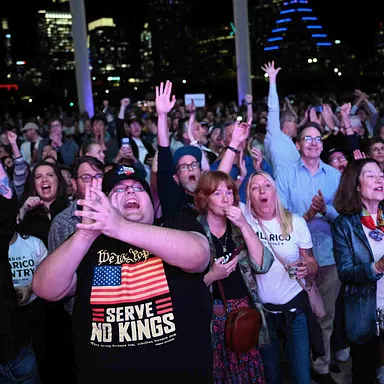
This Up First episode of The Sunday Story looks at the Democratic wave in the 2026 midterm elections, with NPR correspondents Barbara Sprunt and Domenico Montanaro. They discuss how voters' concerns about prices, the economy and immigration shaped the results, how Latino and young voters swung, and why mid-decade redistricting in Texas backfired.
The conversation also covers candidate quality in Southern races, the future of the Republican Party after Trump, Democrats' strategy in a divided Congress, and the 2028 field. Listeners will hear the reporters' analysis of these questions, presented as their own interpretations.
In this episode Ayesha Rascoe, Barbara Sprunt, Domenico Montanaro
The transcript of this episode on the midterm elections and the Democratic wave was made with HappyScribe's Teams transcription technology.
Ads in this audio differ from the text. Tap the sentence you're hearing to follow along.
Synced: the text now follows the audio.
I'm Ayesha Rascoe, and this is Sunday's story from Up First. This week, voters sent a loud and clear message at the polls.
Democrats sweeping both chambers of Congress as voters delivered a sharp rebuke to President Trump and his agenda.
The Democratic victory in this year's midterm elections was not only bigger than anyone foresaw; it was the biggest we've seen in modern memory.
Look, this election was in large part a repudiation of Donald Trump and of a Congress that had done nothing to hold him accountable.
So what comes next? How are candidates going to deliver on what voters want?
I will be an independent voice, ready to work with anyone to do what's right for this amazing state that has given me so much.
I promise, as your congresswoman-elect, that our door, our phone, our email will be open for you.
We have to hold this administration accountable, but we should also work with President Trump to deliver for working people across this country.
Today on the Sunday story, we look at how this blue tsunami happened and what it means for the future of the country.
I'm not going to Washington to be something; I'm going to Washington to do something.
Stay with us. I'm Ayesha Rascoe, and this is the Sunday story. I'm joined now by NPR Congressional Correspondent Barbara Sprunt and NPR Senior Political Editor and Correspondent Domenico Montanaro to break down this historic midterm election. Barbara, Domenico, welcome to the podcast.
Thanks for having us.
Thank you.
Yeah. So, you know, what a week. What a week. What are your thoughts on what was ultimately driving this historic election? I'm interested to hear, because I wonder, is there some nuance? Like, was this primarily a vote against Trump or a vote against something else?
Yeah. I would not say that, like, this was a win for Democrats so much as a loss for Republicans. You know, I think it's clear that this was a referendum against the president, against his policies. Everywhere I went this cycle talking to voters, even Republicans and independents who tend to vote more conservatively said that they were looking for reasons to support the Republicans on the ticket, but they just felt so unheard when it came to their concerns about high prices of gas and the economy and housing, and the administration had not been responsive to that.
Well, let's stay with that and break down the vote. We saw huge swings, as you said, especially from Hispanic voters, but also from young voters. What do you make of that?
It's very important. I mean, it was a really humongous win for Democrats with young voters, 18 to 29. They won by 48 points. That is, for context, a bigger margin than in 2008 when Barack Obama was fueled to victory in his first time around. Now, there were a higher percentage of people who were 18 to 29 who showed up in 2008, so they mattered maybe a little bit more, but it's still a humongous margin. Also, you know, white voters. I mean, this Democrats split white voters with Republicans.
Just for context on that and how eye-opening that is, a Democratic presidential candidate has not won white voters since 1964, OK? This is not a group that generally sides at all with Democrats. And look, I think Latinos and independents were two huge swing groups. We pointed to that before the election. We were seeing the numbers in polls saying that Latinos and independents were very down on Trump. And guess what? They voted that way and really wound up hurting the Republican Party.
Well, Barbara, were you talking to Latino voters? What were they telling you?
Yeah. I mean, I think the message on the economy was resonating with them in a very big way, and that's what I heard again and again. I don't think this is so much about Latinos returning home, so to speak, you know, to the Democratic Party. I think the data shows that Latino voters generally vote on their top issues, not allegiance to a party. And so Democrats are going to have to continue to, like, really listen to this demographic and make sure that they're putting an agenda forward that really speaks to them.
I will just tell you, my mouth was on the ground two weeks into Trump's presidency when he said that he didn't think the economy is what pushed him over the finish line in 2024, that it was immigration. And I just thought, wow, that's so wrong.
What a misread.
I mean, the fact is, Latino voters who Trump, you know, he got 46 percent of Latinos in 2024, was the highest percentage that a Republican presidential candidate has ever gotten with Latino voters. And they said in the exit polls in 2024 that prices were their top issue. So for Trump not to hear that, and then to go forward to pile on top of that harsh deportation tactics that left Latinos in communities where they are in the country legally having to walk around with their passports out of fear that they could be detained or deported, that was a recipe for complete political disaster, and it certainly showed up that way at the polls this time around.
Yeah. I feel like the overreach there in terms of the way that the Trump administration pursued its immigration agenda and deportation agenda was just also completely, to Domenico's point, was a complete misread. You know, because when I talked to Latino voters, many of them told me, like, we're on board with securing the border. We're on board with legal processes that people should follow to come here legally. Many of them said, like I did.
And to deport criminals.
And to deport criminals, which was what President Trump had said from the beginning. But that's not how it unfolded. And, you know, a lot of the people that I spoke to said, that's just something we can't get past.
Yeah. Well, and now Stephen Miller, the architect of Trump's immigration policy, is chief of staff.
Which tells you another thing about Trump not really understanding what happened in this election.
Well, I got to ask you, because the Republican Party undertook this major mid-decade redistricting that was supposed to help their efforts, it ended up not working. Tell me quickly why it didn't work, and then I got another question on that.
Great. Well, I will tell you, only one of those districts that they redrew to be more Republican that they actually won. That is wild. We had talked about beforehand that there's the potential for what's known as a dummy mandate instead of a gerrymander, where you wind up losing seats because you water down the strength of a solid district that then maybe in a tsunami could be taken out. Now, we thought that might happen in a few South Texas seats, especially if Latinos swung the way they did.
And boy, did it ever. I mean, when you take a district that stretches from Austin to the Mexican border, those are very far away from each other, and you make it almost 80 percent Latino or 75 percent Latino because they voted for Trump and they swing all the way back, well, guess what? That's how a Trump-plus-17 district becomes a Democratic seat.
Well, so then my question is, do people look at gerrymandering different now, or do the Democrats say, let's do something on our end because we now got some Democratic governors? Does this change the calculus?
Well, it worked for Democrats, right? They did it in California. They also, voters in Maryland voted to give stronger ability for the state to be able to go and gerrymander. So I think you're going to see more of that on the Democratic side where they try to maybe potentially remake some of these seats. I would hope, personally, because I don't want to have to cover it that much anymore, that they would stick to doing it after the next census and not do these mid-decade redistricting fights.
Yeah. And, you know, the one thing that I'll add there is I was surprised by the number of people that I met out and about who tied the idea of redistricting, gerrymandering to corruption. Just like affordability was a major through line in this cycle, so was the idea of corruption, the elites corrupting and the government isn't working for you, it's working for all these rich guys. And it was interesting to hear that so many people tied that kind of theme of corruption to the idea that, like, even our districts aren't our own.
You know, they're even trying to mess with our districts.
Well, now on to the South. South Carolina rejected Trump's pick, Darlene Graham, the sister of late Senator Lindsey Graham. And Mississippi, which has one of the most restrictive voting systems in the nation, is still too close to call for the Senate. And we could have a black Democratic senator from Mississippi, which hasn't happened since Reconstruction. What is going on? Is this a reaction to the gutting of the Voting Rights Act, like a backlash?
I think What is Going On could be your next podcast, Ayesha.
I want to.
Let's be guests.
Yeah. I mean, the fact is here, you had what looks to be high black turnout in the South. That's the only way that you wind up winning in a South Carolina if you're a Democrat, to do as well as Scott Colom has done in Mississippi. It's really fascinating. I mean, that's how big this wave really was, where you fired up all these different groups who then went to the polls despite whatever the voting restrictions are and went for candidates who they saw as more authentic, right?
When you talk about corruption, another piece of corruption that people have talked about is sort of the nepo politics where, oh, Darlene Graham gets a seat because her brother was in office, right? I mean, that's another piece of that. She was kind of absent from the campaign trail. You have these perfect storms of people who are not great candidates who kind of didn't look over their left shoulder, and then they get taken out by better candidates and voting groups that say, we're fired up by this other person.
I think Domenico has such a good point about candidate quality here, because this is the thing that I heard again and again, and it cut both ways, right? It was criticism that Republicans had fielded poor candidates, and then it was like, oh, look at all these great candidates that Democrats have fielded. And for years, I've talked to, like, the recruitment folks on both sides, and they always say, like, you know, we really want to put forward candidates who are representative of their community. We want doctors and firefighters and the church pastor. And, like, you take a look at who Democrats put forward this cycle, that's who they did.
They reached that critical mass, and I think it paid off.
When you have the right candidates for the right moment, then you can win. Democrats definitely talked about authenticity. And one of the things I want to say about Scott Colom in Mississippi, he got a lot of attention for this ad that he ran about proteins, right?
Yeah. Because Cindy Hyde Smith had said, you know, because the price of hamburger, I mean, it's like $10 a pound, or it's close to it in my grocery store. I can attest to that.
She said that.
There's so many proteins.
There are so many proteins to choose from. And then they cleverly used that to say, I don't want to pick another protein. I want to pick another senator.
Pick another protein. She done lost her damn mind. I'd rather pick another senator.
Pick another protein. What the?
Pick another senator instead.
And they had it with multiple different types of Mississippi voices. You had a white guy in his backyard grilling. You had a black woman at a restaurant. Like, what Scott Colom said after being asked about this on ABC, he said, you know, when I saw that ad, I just thought, this isn't political. This is cultural.
I think there's, like, a thing about feeling like you got to be in on the culture and on the moment, and Democrats seem to do a better job of that this cycle.
Well, and Democrats have had problems looking like elite, right? That they're like, you know, limousine liberals, you know, latte drinking liberals, Subaru driving, like whatever. But what they decided, and they knew that they had to do, especially learning the lessons from the last few presidential elections, is they got to look and sound more like their communities if they want to win in these red places or formerly red places.
When we come back, we'll look at what comes next for both parties. Stay with us. Welcome back to the Sunday Story. As we take a look at the fallout from the 2026 midterms with NPR Congressional Correspondent Barbara Sprint and NPR Senior Political Editor and Correspondent Domenico Montanaro. OK, so voters have spoken loud and clear that they are not happy with the direction the country has been going in for the past two years.
Does this mean that Trump's grasp on the Republican Party is gone?
Well, I think it's going to be interesting to see how many more Republicans start to speak out about what their vision is for the United States of America post-Trump, post-Obama, post-Bush, post-Clinton, post all the legacies that we've seen for a long time. Amazingly, the Vice President of the United States had a very long post talking about how, oh, it was the Iran war that was to blame. He wasn't doing that two weeks ago or two months ago in criticizing the war. You're seeing people like Ted Cruz, the only now Republican elected statewide in Texas, though he wasn't on the ballot this time around, and who knows if he would have survived, you know, talking about what he thought were the problems for the party.
Or Ron DeSantis, the governor of Florida. I feel like I hadn't heard from Ron DeSantis in a year, and he's out there talking about how this was an extinction-level event for Republicans. The only reason he's out there doing that, and I hate to sound like a jaded political reporter, is because he wants to revive his presidential ambitions. And you can guarantee now what has happened, it's not so much that Trump is the kingmaker, but the field is going to widen for a lot of these Republicans to sort of step up to the microphone in 2028.
And on the Hill, too, for so long, you know, we've seen Republicans sort of get ushered into these side rooms in the Hill off of the Speaker's office and take a phone call from the President. You know, he acted like the enforcer, right, in a lot of ways to keep the party in line, keep the members in line. So, I mean, all those 2028 guys are going to, like, try to, as Domenico said, step up to the mic and make their case that they are the one true way forward for the Republican Party. But we're going to see it on the Hill, too.
I doubt we'll hear it from Republicans in the House very much, because what happens in a blue tsunami is that you wind up taking out anybody who was moderate to even potentially moderate, and you're going to have a whole lot more conservatives who are super dug in and super pro-Trump.
But Trump is not a regular president, right? And we've never seen him at a point where he could be irrelevant. Talk to me about the Trump factor, which I feel is different. Most presidents will allow distance because they understand, I am weighing everyone down. You can go on and live your life. Trump is not that guy.
Yeah, I think that he's the wild card factor in all of this. You know, I don't think that, like, the normal political gravity rules apply to him. And I'm really curious to see how he plays ball or not with Democrats in Congress.
Well, look, Trump is not somebody who wants irrelevance, right? This is somebody who has slapped his name on the sides of buildings for 40 years, right? You're going to see him try to continue to push for this ballroom to be built.
It's going to be one of the greatest. I would say it will be the greatest facility of its kind ever built, by far.
You're going to see him continue to push to have this arch built and whatever he can do to get his name on things, because he's 80 years old, right? And he's thinking about his legacy. I mean, anybody who's 80 years old looks back on their life and wonders, what did I accomplish and what am I leaving behind? He wants something that's lasting. He wants a bronze statue or a white marble statue or something with his name on it.
Gold.
Yeah.
Gold.
Leafed in gold.
Yes.
Like, that's why the day after the election, he signs an executive order saying that the Oval Office is a historic place, trying to limit what presidents can do to change the decor in there that he's put in place.
What about Democrats? Because we talked earlier about how Democrats succeeded in getting candidates who were authentic to the places they were from. So how does the Democratic Party then bring all these different ideas together where in Michigan you have Abdel El-Sayed who wants Medicare for all, and then you have others who are not looking to make huge progressive changes?
Look, they're going to have to balance, like you said, this very progressive side that wants retribution and accountability for the Trump administration, along with the people who weren't part of that but were just thinking about how they wanted things to cost less and for them to be able to have access to buying a house.
There's been so many conversations this year, right, about, like, is the Democratic Party really a big tent and how big is it and what does that mean? And this is going to put it to the test. I do think the fact that there is a very comfortable majority in the House makes a big difference in terms of the headaches for Democratic leadership, because say it had been a small majority. I mean, Mike Johnson right now, the current speaker, has the smallest majority that you can have. And you have seen time and time again the very far right Freedom Caucus flank of his party be a thorn in his side and really, like, thwart some of his priorities and kind of throw that chamber into chaos.
Yeah. And in the House, when you have a big majority, the speaker can just bulldoze through, right? Like.
Yeah. I mean, they can do what they want to do. They just won't be able to, like, completely upend the agenda.
They're not going to control the floor. So I have to ask about the Epstein files. We haven't mentioned them yet. Can we expect those files to come back into the news cycle?
Yeah. Yeah, this will be a primary target. Democrats are going to look into Epstein and other figures, including the president. I think the Epstein of it all, to me, provides a really interesting framework for the way that Democrats can approach their power in divided government. Because if you recall last year, there was this big push to release the Epstein files, and the Republican leadership tried really hard to keep it from getting to the floor. There was this little legislative maneuver to kind of work around it and force it to the floor.
And then once it was on the floor, almost every Republican voted for it. You know what I mean? And so that framework of thinking, how can Democrats wield their power when, you know, there's a Republican in the White House? Actually, you know, they get to set the agenda. They can put popular things on the floor for Republicans to vote for it, and you never know what will happen at that point.
There will be some who will be pushing for this idea of retribution. Congress is supposed to provide oversight, so you're going to have oversight. Do you think there will be a push for impeachments?
No. Well, I should say yes and no. I don't think that Democrats will pursue impeachment of the president. I mean, they've been there, done that a few times already.
Done a few times.
And I think that they're wary of I think impeachment of the president takes up all oxygen in Congress. That being said, I do think that there will be plans to impeach at least Pete Hegseth, the Defense Secretary, and perhaps some other Cabinet members.
Democrats do have to be a little cautious about how far they wind up going with some of these things, because, again, the issues that got them elected were not necessarily to go and impeach Trump or other people. I mean, you still need 67 votes to remove, right? So why go through with that entire process if there's no path to actually getting there?
And, you know, you mentioned, like, retribution, the idea. And, like, you know, I've heard people, like, on the right talking about, like, it's going to be just vengeance all the time. And I think what's going to be important for Democrats, because they do have a long list of investigation oversight targets, you know, into corruption, looking into ICE conduct, for example, the Epstein files, as you mentioned. I think what's going to be important for Democrats strategically is to be able to tie those investigations to core issues that matter to the public, either affordability or corruption.
As long as they can thread that particular needle, they might be able to sort of evade some of the accusations that they're just going over for vengeance.
Yeah. And look, when you talk about vengeance, we're talking about anger. And I think the anger that we're talking about here is a populist anger. And it's not just in the United States. We've seen it around the world, globally, where populism has really been a thing. And at the core of that is income inequality, the fact that it's harder for me to afford to fill up my gas tank or buy groceries for my kids or to pay for health care. And then you watch someone like Elon Musk, the first trillionaire, be able to spend, oh, $300, $400 million in this election like it's a rounding error.
Well, we often talk about what is the Democratic message, but I have to ask, what is the Republican message on that? Where does the Republican Party go from there? Because at this point, they are the party of Elon Musk. They are the party of a lot of billionaires. Not that there are no billionaires who are Democrats, but it has really become hand in glove with the ideal of the Republican Party.
So where do they go from here?
Yeah, I mean, look, it's you don't want to be the party of the oligarchy, right, in this day and age when billionaires are looked upon as people who are calling the shots. And Republicans are going to have to figure out where they come down on this as an issue. How do they reappeal to the people that Trump had picked up and to say that, OK, not just tax cuts, right? They're not just the thing that is going to fuel this party anymore. And they're going to have to figure out post-Trump now, what party are they?
And I think it, frankly, is exciting to watch. Both parties have to figure out what they are, who they are, how to keep the coalitions on board. You have this massive funneling that takes place, and someone's going to win out. And it's going to be because of a vision that they put forward that a majority of people or majority of electoral votes believe in.
I mean, it's really interesting that, like, it's not just one long night of the soul for one party, right, trying to figure out where they go from here and who they want to be and what their core messages are. It's both. And they're happening at this.
Everybody has to come to Jesus.
Everyone's doing it.
Figure out what how they're going to make it.
That's right.
To the other side.
That's right. That's right.
I got to well, you know, it is 2026, but as people who cover politics, elections never end. So what do you think 2028 will bring?
A million candidates.
Yeah, that's one thing. And remember, a lot of what happens in these campaigns happens the year before the election because you're going to see the primary ideological fights play out. So it's coming, and it's coming quick.
And, you know, I think the idea of a lot of Democrats on stage with different visions for the future of the party, I think it makes the base very excited. At least that's what it sounds like.
And Republicans will have a lot of people on stage as well. I mean, they're going to have a wide open field as well.
Well, I think it's a wider field now than it would have been, you know, if the election went differently. If the election looked like Republicans held up, they held the Senate, Trump still looked like the big dog in the party.
It would be J.D. Vance and probably Marco Rubio and yeah.
Yeah. And I just don't think that Trump is going to be necessarily the kingmaker. Now, look, he still has a huge slice of the pie in the party, and people are going to have to walk that line. But, man, it's going to be really interesting to see what kind of vision these folks lay out.
Well, Domenico, Barbara, thank you both for this insightful dive into the midterm results after such a crazy week. It felt like I was back on the Politics Podcast again, just, you know.
We miss you there.
I hope you both have some good plans to charge and relax. Thank you so much.
Thank you.
Thank you.
That was NPR congressional correspondent Barbara Sprunt and NPR senior political editor and correspondent Domenico Montanaro. You can find more of their election reporting on npr.org. This episode was produced by Andrew Mombo and edited by Jeanne Schmidt and Liana Simstrom, engineering by Anle Wong. The rest of the Sunday story team includes Justine Yan, Sharon Mashihi, and Maddie Barron. Our executive producer is Irene Noguchi.
I'm Ayeshah Rasgo. Up First will be back tomorrow with all the news you need to start your week. Until then, have a great rest of your weekend.
What drove the Democratic blue wave at the polls and what happens now? This week on The Sunday Story, we dive into the lessons from the midterms and talk about where the country goes from here.
See pcm.adswizz.com for information about our collection and use of personal data for sponsorship and to manage your podcast sponsorship preferences.
NPR Privacy Policy