
Up First's Sunday Story examines New Mexico's universal free childcare program, which launched in late 2025 and now covers every family with a child age 5 and under regardless of income. NPR reporter Julie Depenbrock describes how enrollment surged, leaving many families on long waitlists, particularly for infants and toddlers, while childcare centers struggle with capacity and low wages.
The episode also looks at how the program is funded through oil and gas revenue, why it is running over budget, and what lawmakers debate about whether it should be universal. Listeners will hear the arguments of supporters and critics, and learn what a copay trigger tied to inflation could mean for higher-income families.
In this episode Ayesha Rascoe, Julie Depenbrock
This transcript of the Up First episode on New Mexico's universal free childcare was made with the technology behind HappyScribe's AI note taking.
Ads in this audio differ from the text. Tap the sentence you're hearing to follow along.
Synced: the text now follows the audio.
I'm Ayesha Rasco, and this is the Sunday story from Up First.
You guys are doing good on these puzzles.
I found Nemo!
You found Nemo!
It's a hazy August morning in Santa Fe, New Mexico. Juden Martinez has just dropped off her 3-year-old daughter at daycare, a place called Kids Campus, at Santa Fe Community College.
It's an amazing school so far. She loves it, I love it. Everyone's nice. She's learning, growing already.
Martinez is a single mom, and she just started nursing school at the college. She says she was able to do this because New Mexico has something no other state offers.
I'm really grateful for the universal childcare because I wouldn't have been able to send her.
Just over a year ago, New Mexico launched universal free childcare.
The blueprint for education in America is happening right here in New Mexico.
This is Governor Michelle Lujan Grisham announcing in September of 2025 that moving forward there would no longer be any income requirements for free childcare.
I'll tell you that there are so many people across the country that say that that's impossible. Not impossible.
And just like that, the barriers were gone.
It took us this long to realize it, but by golly, we did.
Well, in theory.
I'm 97th on a multi-hundred person waitlist, I'm 75th on something, and some I'm not even getting calls back on that.
Lilia Doyle lives in Santa Fe. She's been trying to get her 2-year-old son into daycare.
I have great belief in this program, but as it currently stands, I think the rollout needs a lot, a lot of help.
It's been more than a year since that rollout, and only about 50% of eligible children, 5 and under, are enrolled in New Mexico's free universal childcare program. Today on the Sunday story, reporter Julie Deppenbrock tells us about the promise of free universal childcare in New Mexico and why getting something like this off the ground is neither quick nor easy. Stay with us.
We're back with the Sunday story. I'm joined by NPR's Julie Deppenbrock. Julie, thank you for being here.
Thanks so much for having me.
So, Julie, free childcare, I mean, that's the dream, right? But is childcare really free for every family in New Mexico?
Yes. Every family with a child age 5 and under is eligible for free childcare and pre-K. Before and after care for kids up to the age of 13 is also covered. In New Mexico, around 258,000 kids fall into that age group, which is a lot. The state told me that this is saving families around $12,000 per child per year. So imagine if you have multiple children, how much a program like this would help?
Well, I have three, so I can imagine, right? I can imagine. And they cost a lot of money. But there have to be some requirements for this, right?
Yeah, there are some. The families must be residents of New Mexico. Adults in the house must be working, looking for work, in school, or unable to work. Foster parents and grandparents can also participate. And immigration status isn't disqualifying.
So what was the immediate effect of this announcement? Were families like suddenly eligible overnight, or was there like a process, you know, like a waiting process or something?
Yeah. So the program officially launched on November 1, 2025, and there was a surge in enrollment. I should say New Mexico has been chipping away at income limits on childcare for years. Even before this, a family of 4 earning less than $129,000 was already eligible for free childcare. And Ayesha, of the children who were eligible under those generous earning limits, just over a third were actually enrolled.
Now, part of that discrepancy has to do with some participating in other free programs, like New Mexico Pre-K and Head Start. But still, it seems that some folks who qualified for this free care either didn't realize they could enroll their kids or just weren't taking advantage of it. But with last year's big announcement that the program was expanding to cover everyone, there was a lot of press coverage, and families started coming forward. I spoke with one mom like this, Veronica Ramirez.
I found myself in the situation of needing childcare and decided to dive in and investigate and figure it out.
Ramirez is from Oke Owinge, a federally recognized tribe in Pueblo in northern New Mexico. She works as an outreach coordinator for a pregnancy center. And she told me that before getting her daughter into the free program, childcare had been a problem.
I was like balancing, juggling, finding either somebody to watch her, me or my partner watching her, or taking her with me to work. But it was just like not feasible, and it was just getting kind of harder. Yeah, and I was like needing more hours, and so now I'm able to work more, make more money, and support my family a little bit better.
And she said it's made her daughter's life better too.
Being able to be around other little human beings that are her age and social skills and those things. Like I've seen her go up to other little kids in public and like say hi or like just start playing with them, and I'm like, oh, wow. Like she's social now. She's like not clinging to mom only.
Well, I mean, that's a big deal. I mean, it sounds like the program has really helped Ramirez get back into work and do what she needs to do to support her family. Was that part of why it was a priority for New Mexico? What were the reasons for pursuing this?
Well, for years, New Mexico sat close to the bottom of state rankings for children's education and well-being. Local politicians and a lot of nonprofits and grassroots organizers really wanted to turn that around. I spoke with Governor Michelle Lujan Grisham for this story, and this is what she said.
I think childcare is a game changer for every single thing that a state ought to deliver for its families.
And she told me that she wanted to make sure that families had a choice, especially mothers who might want to work but are left out of the workforce because they can't find childcare. And you know, Ayesha, there have been a lot of studies into how childcare helps women. One policy expert told me that this kind of program pays for itself in the number of women who are able to return to the workforce. And that has a domino effect. More jobs are created and more income tax and sales tax generated.
An initial study of New Mexico's program released in September reports that low-income mothers have seen significant gains since this was enacted. For them, full-time employment has increased by 23%.
That's huge. But universal free childcare cannot be cheap. So where in the world is the money coming from for this program?
Yeah. So New Mexico is a very rural state. It doesn't have a lot of industry, but it does have vast oil and gas revenue. And a lot of funding for the state's program comes from that, from taxes and royalties on oil and gas production. There are other funding sources too, including an endowment from old COVID relief funds. But to answer your question, Ayesha, yes, it is expensive. In the first year, New Mexico spent over $500 million.
For this new fiscal year, it's projected the state will spend well over $600 million. It's important to note that both of those numbers are way over budget.
Okay. Well, Julie, how does this work? Like, do parents get vouchers they can use, or do they just show up at the daycare and say, I know you have to take my child because it's free? So how does it work?
Yeah. So the state doesn't use the term vouchers to describe the program, but they told me it does function in a voucher-like way. Once a family finds a participating childcare provider, the state reimburses them on the family's behalf. The state pays these providers an average of about $12,000 per child per year. The state also offers incentives to providers who operate full-time and pay competitive wages.
Okay. That makes sense. But at the top of the show, we heard from that parent who said that her kid is at the bottom of this like nearly 100-person waitlist. So how common is that?
So, Ayesha, it's hard to say how many kids are on waitlists, since the state isn't tracking individual providers in that way. I spoke with early childhood educators in Santa Fe, Albuquerque, and Las Cruces, who all told me that they were at capacity, and some had even stopped accepting new applicants.
I mean, that has to be really frustrating. I mean, even in states where it's not free, you often hear about people having to get on waitlists just to get into a daycare. And so, you know, but in this case, you're trying to get something that I guess, you know, is your right by being in the state, this promise of universal childcare, but it's not accessible for everyone.
Right. It's worth saying that those in a position to afford childcare can usually get it. There are providers who haven't opted into this program. That means they can charge more. And there are parents who pay. But for those who need help and are counting on free childcare, it can be hard. Lilia Doyle, the parent whose son was on several waitlists, was pretty frustrated when we spoke.
I'm really displeased that they're saying this is universal childcare. You can go back to work when you want. We have everything covered. And that's not true.
Waits tend to be especially long for infants and toddlers, like her 2-year-old, who require more care.
And those are the kids that you really need in daycare. The babies and the 2-year-old up to 2.
Yeah.
That's when you really need some help.
Yeah. And they're the most expensive and challenging to care for. Doyle told me that without consistent childcare, she hasn't been able to return to work.
I just will wait, and hopefully our finances will be able to absorb it until he is taken into childcare. So we are living on one income, and there aren't jobs that make a tremendous amount of money. So we'll just, we'll buckle down and we'll make it through, but it's not ideal.
Doyle said, as far as she can tell, the capacity just isn't there to support so many kids.
I don't think our state and the program really modeled this based on the real demand and the real numbers that are occurring.
When we come back, we hear about how New Mexico is trying to expand capacity and cut down on those waitlists, and about how childcare workers are handling the increased demand for their services. Stay with us. We're back with the Sunday story and NPR's Julie Deppenbrock. So New Mexico says all kids 5 and under are eligible for free childcare.
Julie, what's it been like for childcare providers trying to meet this demand?
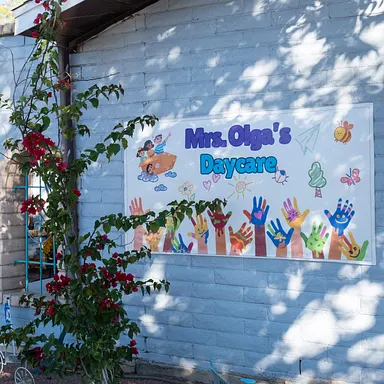
Well, Ayesha, I spoke to a lot of educators while reporting on this story, and most were very excited about this program. Olga Graves is one of them. I met her when she was trying to get her kids lined up to go outside.
Spaghetti arms. Show me. Spaghetti arms, spaghetti arms, spaghetti arms. Touchy.
Graves runs this idyllic childcare center out of her house in Las Cruces. She's turned her living room into a classroom with these cushioned fall-safe floors. She's set up an outdoor space that's part playground, part oasis.
So I have a garden, and the kids help with the garden. They can play with water, with dirt, grass. They help me pick up everything that we've grown. We grow potatoes, garlic, onions, corn. We have a peach tree, a plum tree, pomegranate, lemons.
She has children in her care who really benefit from the peace of her oasis, including kids in foster care and kids with disabilities.
I started this, and I just started seeing such a big difference on the kids that have like emotional problems. I just bring them out here sometimes, depending on their mood. And when they go back inside, they're a lot more calmer, you know? And so I think it's beautiful to bring them back to nature and get them away from the tablets, get them away from all that screen time. And I mean, we have everything we need, right?
Graves has been in this field for more than two decades. She sees it as a calling.
I think that what we do is a gift. I really do. That what we do is a gift. And I feel like you either have it or you don't have it.
At the moment, she cares for 12 children at a time, which is the maximum the state allows for a home-based facility like hers. She told me since the launch of free childcare, she's had more and more people trying to enroll. Now she has a waitlist of four kids, which doesn't sound like a lot, but the waitlist doesn't really budge. And when kids age out and go off to school, often their siblings are taking those empty spots.
Yeah, I have a list of people who are waiting. And so we also have a group here in New Mexico of just over 40 providers. And so every time somebody calls me, you know, I put their name and the age of their kids in that group, and I'm like, does anybody have openings?
Other childcare workers told me that they're dealing with the same problem. Here's Dayaneta Contreras, the director of Kids Campus in Santa Fe. She says they have a waitlist of close to 700 kids.
There's still a big need in our community. I mean, we're receiving like phone calls every day about our waitlist statuses or stuff like that. And it's just hard to try to explain to the families, oh, I'm sorry, we're at full capacity. We don't have a spot for your child.
So why isn't there more capacity for these kids? Can the daycare centers not build out or build more of them or something?
Yeah. So a big reason for these capacity issues is that childcare workers have been historically underpaid across the country. So it's not easy to attract people to the profession. Here's Olga Graves again.
The pay is really not, it doesn't go with the amount of work that we put into what we do, right? It's not valued enough.
Remember, providers are getting paid about $12,000 per child per year. So depending on how many kids you're taking care of and all of your expenses, that may not be enough to live on. The average pay for a childcare worker in New Mexico is about $36,000 a year. And some childcare workers told me that low pay really comes down to people seeing them as babysitters and not the educators they are.
Well, even if the, I mean, babysitting is important too, but I do know that they're learning all these things. You know, it's not just playing with the kids. It's actual education.
Absolutely.
So, Julie, how is the state trying to address the shortage of providers and this issue of low pay?
So New Mexico has been working on building capacity for a number of years. And when the state announced there would no longer be any income limits, it also set a goal to create 12,000 new spots in the first few years of the program. Right now, they're more than halfway there. But the reality is not all of those slots have been for infants and toddlers who are the most challenging to care for. State officials are aware of this issue, and they're offering low-interest long-term loans so daycares can hire more staff and expand capacity.
They've also been working to raise wages. In fact, according to the Bureau of Labor Statistics, New Mexico is growing wages for childcare workers faster than any other state. And Graves was actually part of a task force that pushed for better compensation.
We were able to get $60 million for increased wages for providers. It hasn't been implemented yet, which is really sad and frustrating. But I mean, everything takes time.
A new law also makes it easier to open up childcare facilities by loosening zoning requirements, and in particular, getting rid of some of the red tape that can make it harder to open these home-based centers that often help address childcare shortages in rural areas.
Okay. But everything that we're talking about, it sounds like it's going to cost more money. So how is that landing in the state, especially if they're already over budget?
Yeah. So as I mentioned before, the program is costing more than was originally expected. Projections suggest there will be big cost overruns in the second year of universal childcare to the tune of over $50 million. In order to cover this, the state legislature will have to pull money from other budget lines or get new allocations during the next legislative session in January. For some, the cost overruns are evidence that free universal childcare just doesn't make sense.
By calling it universal, all we've done is add it. Add the wealthier folks.
This is Steve Lanier. He's Republican state senator representing the rural northwest corner of New Mexico. He's on the Legislative Finance Committee, and he actually sued the governor over this free universal childcare program, a lawsuit that was ultimately unsuccessful. And he told me he actually does support childcare assistance, just not for everyone.
You know, my daughter's a schoolteacher. She has two young boys. She gets free childcare. From a personal view, I see where it is needed. I mean, that helps her and her family immensely. But somebody that's making $450,000, $600,000, do they really need that assistance?
Well, I mean, that is a question, a reasonable question. Like, why is the state subsidizing childcare for people who seemingly could afford to pay for it?
Yeah. I asked people who support this program why they think it should cover every family. New Mexico's Speaker of the House is Javier Martinez, a Democrat. He told me that initially he felt similarly to Lanier. Why should this program be free for the wealthiest New Mexicans? But then he realized that it actually might be the best way to ensure the program's longevity.
If you make something that is perceived to be for only certain parts of the population, specifically lower-income people, it is very easy when budget times get hard to pull back the benefit. Look at Medicaid. Medicaid is considered healthcare for low-income people, quote unquote. And every chance they get, they cut. Meanwhile, you look at Medicare or Social Security, which is universal, and no one dares touch those entitlement programs.
They may talk about it, but they never actually do it. And so when it comes to universal childcare, the best way to protect it in perpetuity, long after people like me are gone, is to ensure that it applies to everybody.
So that's one point of view, Ayesha. Then there's Catrin Allred. She's the head of the Early Childhood Center of Excellence at Santa Fe Community College, where Kids Campus is based.
To me, I think it's a mentality of early childhood is a public good. Nobody questions a wealthy family sending their kids to public school. And it should be the same for early childhood.
But as you said, Julie, the program is way over budget. So maybe lawmakers can cover the cost this year, but it's not sounding like the program in its current form is sustainable.
Yeah. So it still has a lot of support, but it's true that costs are a big concern. The program does have some built-in safeguards in case economic turns make it harder to pay for. For instance, if oil prices decrease or there's a slowdown in state revenue or high inflation, then some of the wealthiest New Mexicans will have to pay a copay for their kids. And Ayesha, already one of those guardrails has been triggered.
Oh, wow. What was that?
Yeah. So one of the contingencies of free universal childcare was based on the annual consumer price index. It had to stay at 3% or less. Right now, U.S. inflation exceeds that. So what that means is that some higher-income families are going to have to start paying copays for childcare. The department says this change will only affect about 1 in 10 enrolled families.
So in that case, though, it will no longer be universal free childcare.
Right. For now. And once triggered, copayments remain in effect through the fiscal year.
You know, it sounds like it's really hard to make all of this work, whether it's getting the capacity up and the waitlist down, and to just make it affordable for families and feasible for childcare workers. I mean, this is a lot to juggle and, you know, the cost of it all.
Yeah, that's all true. But this idea is really taking hold around the country. Vermont, Oregon, Connecticut, Washington, D.C., and New York City, they're all trying some variation of free childcare. State and local leaders are watching and trying to learn from New Mexico's experiment. And Ayesha, in the midterms, New Mexicans again demonstrated that they're invested in the state's efforts. They chose Deb Holland to succeed Michelle Lujan Grisham.
Holland is the first Native American woman elected governor in the United States, and she says she's all in on New Mexico's ambition.
Our state legislature is already leading the nation. Leading the nation by providing universal childcare and early childhood education.
So leading the nation, though, it may take a while to get to the finish line.
Well, Julie, thank you so much for bringing this important reporting. It really does touch us all, whether you have kids or not. You know, what's happening with them affects everybody. So thanks for doing that.
Yeah, you are so welcome, Ayesha.
That's NPR reporter Julie Deppenbrock. This story was supported by a reporting fellowship from the Education Writers Association. This episode was produced by Renee Svornoski and Maddie Barron and edited by Jenny Schmidt. It was fact-checked by Greta Pittenger. The engineer was Kwesi Lee. Special thanks to Nicole Cohen. The rest of the Sunday story team includes Justine Yan and Andrew Mambo. Our supervising senior producer is Liana Simstrom, and our executive producer is Irene Noguchi.
I'm Ayesha Rosco. Up First will be back tomorrow with all the news you need to start your week. Until then, have a great rest of your weekend.
A year ago, New Mexico became the first state to offer universal free childcare. Parents who have successfully enrolled their children in the program say it's changed their lives. But many families have yet to see the other side of a waitlist. On this episode of The Sunday Story, NPR’s Julie Depenbrock reports on how the demand for childcare is outpacing providers’ capacities and the state budget. Can New Mexico catch up and bring the program to the finish line?
Support public media with NPR+ and enjoy perks for over 25 podcasts like this one. This show’s perks include sponsor-free listening. Learn more at plus.npr.org.
See pcm.adswizz.com for information about our collection and use of personal data for sponsorship and to manage your podcast sponsorship preferences.
NPR Privacy Policy