
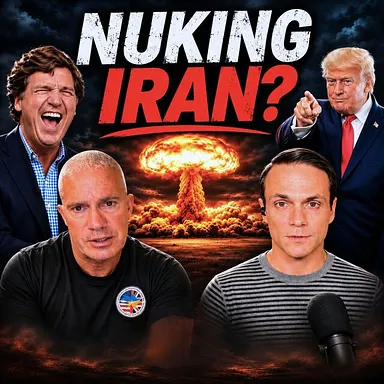
The episode examines Tucker Carlson's claim that the United States could use a nuclear weapon against Pickaxe Mountain, a deeply buried Iranian site where Israeli intelligence reportedly believes enrichment has restarted. The hosts and guests argue that tactical nukes are far less precise than they sound, that granite and layered rock blunt penetrating bombs, and that any blast could spread radioactive material over nearby populations.
They also weigh whether the leak might be deliberate signaling, why another short air campaign may fail, and why diplomacy with Iran may be the only realistic path forward. Listeners will hear the military reasoning behind these views, which the speakers present as their own assessments rather than settled facts.
In this episode Dee Takos, Andy Milburn, Jonathan Hackett
This episode's transcript on the nuclear strike debate was made with the tool HappyScribe built to transcribe audio to text.
Ads in this audio differ from the text. Tap the sentence you're hearing to follow along.
Synced: the text now follows the audio.
This episode is presented by Vaer Watches. Go to vaerwatches.com/theteamhouse. Hey everybody, welcome back to another Eyes on Geopolitics. We have breaking news. We've just nuclear— we've just attacked Iran with a nuclear weapon. Or that's what's in the news. I'm here with Jonathan Hackett and Andy Milburn to try and make sense of it. We have not attacked Iran with a nuclear weapon. It's going to happen Wednesday morning, 12:01 AM, after the polls are closed completely everywhere. That's when we'll start dropping nukes. As I'm assuming most folks have seen this tweet by— I don't even know how to describe this guy, but Tucker Carlson himself.
He's a steep journalist.
There you go. That's a great way to put it for some people. Tucker Carlson. I'm going to read some of it, just the top, Bill. Under pressure from Israeli Prime Minister Benjamin Netanyahu, the Trump administration may be within days of launching a nuclear strike on Iran. The target would be Pickax Mountain in central Iran, where Israeli intelligence claims the Iranian government has restarted its nuclear enrichment program. No conventional weapon in the American arsenal can penetrate 300 feet of solid granite to destroy the tunnels where enrichment is supposedly taking place. The only military option is a nuclear strike. Netanyahu has been pushing hard for this one. Bibi calls Trump about it every day, says an informed observer. It goes on. I'm sure most of the people have read this tweet. It's gone super viral. I'm not a Tucker Carlson fan, clearly. Obviously, if you've listened to even like 5 minutes of the show, you know that. I will say this, the guy has sources inside this White House for sure. I would not put it apart— I put it like, I would not bet against the fact that President Trump has been briefed about this. I'm sure there was, you know, people there briefing on what it would take and what nuking or tactically nuking Pickaxe Mountain.
It's insane. Couple this with like all like the doomsday stuff that's been going on for like the last week, I could see why this is picking up steam. Um, for everybody. So I want to talk about with you guys how— what the reality is basically of this, and how is this even plausible? Would we ever do this? Obviously there's a plan in place, like a briefing. They brief— they plan to do almost anything, right? The American military, that's their job. Um, you guys have been in the American military and special operations and conventional. What are your thoughts? Why are you laughing?
Oh no, I mean, it's just such a— it's a great topic, right? On top of everything else. So, okay, I'll launch into this. So, you know, I say let's do this. Okay, we'll go through some of Tucker Carlson's claims and then take a step back and talk about Pickaxe Mountain and what has happened so far, right? Why this is still an issue. Okay. So, you know, I think, I mean, my personal opinion, very unlikely that this is being presented by anyone in the military as a plausible course of action, very unlikely. And we can talk about that. I know John's got some good facts and data. John, how about putting you on the X that way? That shows there's no such thing as a tactical nuke, right? I mean, the downside is it's a huge downside. The central claim, as you pointed out, is Trump may be days from a nuclear strike on Pickaxe Mountain. There's all this anecdotal stuff to back it up that Trump constantly talking about Pickaxe Mountain, saying, we've got, you know, um, uh, we've got a— we, we have that planned, um, it'll take a few minutes, uh, and then, you know, who was it who was briefed on— who just had a stroke?
Chris Murphy, senator from Connecticut.
Uh, who, who appeared blanched, you know, white of face, after being briefed of this, of a plan that he said was— I forget the term he used, but basically crazy. Yeah,
he said
it was insane. Anecdotally, it all seems to be coming together. But let's just go through very quickly what Carlson's saying. Carlson's right that no conventional bomb can be sure of reaching tunnels that are 80 to 100 meters down in In granite. Ironically, neither is a tactical nuke, and we'll talk about that a little bit later, right? So tactical nuke causes massive destruction. And as I've said, there's no such thing really as a tactical nuke. And when you look at the kilotons involved in tactical nukes, you understand why. So there's a massive downside. But ironically, nukes aren't great at penetrating deep granite, which is the one reason why you would use it here, right? He's wrong about, hey, this is the only military option. Okay, he may just be quoting Netanyahu, but the point is, it's not. There are conventional answers. I mean, even if the GBU-57, even if 2 of them dropped one after the other, can't reach the centrifuges, which reportedly, as I said, 80 to 100 meters down in granite, and that's entirely likely that they can't. Right? Because we haven't— we've already tried this. And again, we'll talk about this a little bit later.
But even so, I mean, there are things you can do to halt production. You can close that site down. You can seal it. You can collapse the entrances. You can destroy the ventilation. You can cut off power. You don't actually have to reach the centrifuges to neutralize that site. And, you know, I mean, look, Netanyahu, there's— here's some points, and I'll turn over to John in a moment. But here's some points from— I mean, Carlson's got tens of millions of followers, right? He doesn't— he doesn't— you know, he's a bright guy. He doesn't get that number of followers by just spouting constant bullshit. But what I'm saying is he's mixed in some nuggets of truth here with stuff that just sounds nebulous. I'm not saying he's lying. I'm just saying. that the stuff here just doesn't ring true. Okay. It is true Netanyahu is pressing Trump to strike Iran. He says Bibi calls Trump almost every day. Who knows? I mean, it appears it could be likely Pickaxe Mountain, the target, probably.
He also said that Netanyahu put the screws on Hegseth and CENTCOM Commander Brad Cooper. My guess is because they visited Israel recently, right?
Yeah, that's right. And, you know, potentially there appears to be not first time, kind of a split in the— certainly as far as the rhetoric's concerned, Rubio's talking about negotiations. There's discussion of, for the first time, both from Trump and Rubio about, hey, maybe we just need a guarantee that they don't make weapons. It's no longer, hey, we're going to put a stop to their nuclear program altogether. Right. So yeah, I mean, there's undoubtedly Netanyahu is pushing for a strike. Maybe Netanyahu did say, hey, we need to nuke it. Who knows? I mean, that part is perhaps feasible. Whether it is actually a plan for us on the table, I very much doubt it. You know, there are people who will have explained to Trump exactly what a tactical nuke does and doesn't do, right? And the ironic thing about this is it's unlikely, it's ill-suited for this particular task, but it's very well suited to cause massive widespread destruction. And we'll talk about kilotons and everything in a moment. So, you know, I don't— Oh, one last piece, right? So, Tucker said that the US has rewritten its nuclear doctrine to make battlefield nukes easier to use, right?
Open source back in August, you know, DOD or DOW apparently is drafting a strategy that gives more weight to the use of tactical nuclear weapons in a conflict with Russia or China, right? But that's quite a different matter than using them against Iran, a target such as this. John, I'll turn over to you now. I know you've got a lot to add. The last thing, you know, we talked about before I turn over, we talked about the fact that tactical nukes are not tactical and that they're ill-suited for this job. But you've also got to think about the ramifications of what about our peer competitors, Russia and China, right? We use a tactical nuke here. Table's open. John, over to you.
Yeah. So there's a lot to talk about on this because as you mentioned, the name is tactical nuclear weapon, but the tactical is almost irrelevant because the word nuclear is in it. And any use of a nuclear weapon of any scale, even a tiny, like let's say kilotons rather than megatons, something just destroying a desert environment is enough to make the entire world react to that. in various ways. And we can talk about kind of the, like, political philosophy of nuclear weapons, if you like. We also need to talk about what weapons does the US actually have? And what would those weapons do in various scenarios? Because you don't just drop a bomb. There are different ways to deploy a nuclear weapon, whether it's tactical or otherwise. And there are some weapons that we've been doing research and development on that we haven't actually used in the real world yet that could also be in this optionality. And the other question is, what happens to the material inside of a deeply buried facility like Pickaxe Mountain or Natanz if it's destroyed? Because the whole point of hitting Pickaxe Mountain is that there's uranium hexafluoride there that's already been enriched.
So you've got near weapons-grade enriched uranium buried there. What happens if you blow it up even with a conventional weapon like a MOP or, you know, a Daisy Cutter, GBU, whatever, and you blow it up and it becomes aerosol? What happens then? You know, so there's a lot of like different questions here. And I think another important point is that Even if Trump was briefed on this, I think it's important for people to understand that, like as you said, D, the president is given options. So there he's going to ask a question like, "I want to see every option I have to do something to Iran. Give them to me. I don't care how extreme it is." And sometimes in the intelligence community, they'll actually purposely do this where they have the analysis of competing hypotheses, which is a technique to actually bring in some like really different ways to solve a problem, and then let those different ways to solve the problem actually cancel each other out or create a synthesis of a new idea because they're so extremely different. So there may be like let's say ground. Forces, limited ground forces, maximum ground forces.
You're going to have nuclear option. You're going to have a tactical nuclear option. You're going to have a sea-based option. You're going to have an air option, a combination of those, like all these different courses of action. And there's going to be an actual planning process that comes toward it and say, okay, the amount of resources and risk involved here are X and Y, and these numbers are all in here with these systems. And the military planners are going to actually present that input in addition to the option itself. They're going to say, if you choose option A, B, or C, Here are the possible outcomes. Here's the likelihood of those outcomes. Here's what we think Iran will do, what Russia will do, what China will do. Here's what we think the effect on the economic situation will be, the oil markets. All these things will be presented as a set. It won't just be nuclear attack. Same thing happened back in 2020 after we assassinated Qasem Soleimani. There were a lot of these wide range of options, like a menu of options presented to the president because there was reaction from Iran, and we weren't sure exactly how they would react.
So the president had this wide range of very extreme options, some of those including destroying Persepolis, which is a cultural site that predates Islam and is very important to Iranian culture and Persian culture. This was on their list of options to do. We didn't do it. But this was something presented because the president asked for like the most wide range of options to use in a variety of scenarios. I think that's important to put there is that Even if Tucker is correct and actually heard this from someone that actually said this, it doesn't necessarily mean like this is the next operation that's going to happen. Instead, it's this is one of the options the president requested, and it could be that it's like not even likely. It's just something that was put on the table, and he can look at that. But with that said, let's just make the assumption that this was chosen. Okay, what would happen next? What weapons would we use? What would the effects be? I think that's a good way to have the conversation, because if you think about what weapons does the U.S. have? If we take the tactical nuclear weapon title literally and use the doctrine of what that is, we actually only have 4 of these weapons and 3 of them are only operational.
The other 4th one is not operational. So we've got the B-61 and a lot of variants of the B-61 depending on what it's supposed to be used for. And the whole point of the B-61 is that it's this really variable, adaptable system, a weapon system. So it's a, it's a dumb bomb that can have guidance if it needs to. But it's it's old. We've not used it, obviously, ever in combat. We've only used it in testing. The key here is that we have about 200 of them roughly, but 100 of them, so about half of them, are in Europe, in NATO countries, defending NATO or for the nuclear umbrella in NATO. The other half are in our arsenal. They're old. They're aged. They have very different efficacy. So, for example, the like the B61-12. Is deliverable by aircraft and has a very specific kiloton yield, like 0.3 to 50 kilotons. That's called a dial-a-yield. So you can actually change the yield on it on each individual bomb dropped. Then you've got the B61-11, which is a penetrator that can only be delivered by a B-2. So that the first one I mentioned, the 12 variant, can be delivered by like 5 different types of aircraft, whereas the 11 can only be delivered by a B-2.
So like, this is important. Now we're all already seeing constraints On how this would happen, because now you're thinking about which airframes can we use. If you remember, we just removed all of our B-2s from RAF Fairford because of the attack that might have happened that we, you know, was disrupted with the British MI5 and the counterterrorism police against Iran outside of there. So now we can only launch those from either Diego Garcia or from US bases.
But John, we had B-2s or B-1Bs at RAF Fairford.
So you could put B-2s at Fairford. You could, but now we can't. So we've lost that basing access and overflight that was important to get closer to the target site. So now we'd have to go down to Diego Garcia or launch from US facilities. Now that, that's important because now those constraints are there. But we have sea-launched capabilities, cruise missiles, like the SLCM, which is the W80, the Whiskey 80. This has never been used that we know of, or even tested. But it exists. We don't know what the kiloton yield is. It's a very new— it's the newest of these tactical nukes. So it's possible, just like in World War II, when we use the 2 bombs in Nagasaki and Hiroshima, that the weapons test was the attack, right? Like the plutonium and the uranium bombs we used then, that was the first time they'd ever been used. And we actually— the test was the drop of the bomb. And it's possible we could do that here with the SLCM, the W84 variant, where we could drop it on Natanz or on Pickaxe Mountain. And that's, that's the test is to see like, did it actually do what we thought it would do?
And we don't know because we are part of the Nuclear Test Ban Treaty. which we now are removing ourselves from because of current political things. So we haven't been able to actually test that. So all that said, these are all small weapons that have a relatively small yield in the kilotons. The highest yield is a 400-kiloton, which is kind of small relative to the giant weapons that we have in our, like, strategic nuclear weapons arsenal.
But it's like Hiroshima was what, 15 kilotons?
Yeah. And then if you look at— that's a great point. So non-nuclear explosions, like in Beirut in 2020, in August 2020, that the the ammonium nitrate that blew up in the port of Beirut, massive destruction. That was about 2, roughly 2 kiloton yield of ammonium nitrate. Some of our B61s have that same yield. That was an airburst or equivalent surface burst explosion, non-nuclear, obviously. But if we had something like that with this B61, the damage it's doing is like minimal. And that's at the surface. You'd have to first penetrate to get down there. And I can talk about the mechanics of penetration and how that would work and what kind of weapon stack you would need for that. But that's important to point out because even a 400-kiloton explosion, which is at the higher end of our tactical nukes, would not be enough to actually destroy anything under the ground. I'll pause there because we can get into a lot of different tangents there, but that's kind of the framework on the kind of tactical problem of these weapons.
Yeah. So, and it was a study, right? I was reading the, the, um, I forget, it was in 2005. but it was a US study that you would need hundreds of kilotons to penetrate a target deep in hard rock. And hundreds of kilotons would kill tens of thousands to millions. I mean, obvious point, right? So the kiloton yield, the difference, of course, I mean, you can talk about the explosions in terms of kilotons, but the problem, of course, with using a nuclear weapon is It's dependent. The death rate continues, right? And it's dependent on the weather and all kinds of things. You just really can't come up with it. And that's why we're talking about these are not tactical weapons. I mean, Mattis said as much recently. So I know, I mean, my feeling is, I agree with you, John. I think, you know, maybe this was an option on the table. All right. So, but what a throwaway COA to put out there, a throwaway course of action. And I think that I would like to think that among those in uniforms, they're in that uniform, there are enough checks and balances of people to say, no, I'm not doing that before we came to this because it would be disastrous, I think, for US policy.
But it gets a lot of— it gets a lot of looks on tweet, on, on, on X, right, on for a tweet. But I think, you know, let's go back though. And I would say and look at, well, why? I thought we destroyed their nuclear program twice. You know, why we— why didn't we?
We obliterated it.
And what can we do now?
Yeah. So, I mean, they— we saw satellite imagery actually after the opening strikes where they were moving stuff in these large blue drums out of these facilities and most likely moving them to pickaxe So obviously not obliterated. You're talking about uranium hexafluoride, highly enriched uranium, other materials, other kind of analog materials that are produced along with this process. These are extremely hazardous, especially if they're made into an aerosol. And remember, this is near Natanz, which is a city. And if we airburst or surface penetrate and destroy this stuff and it blasts up into the atmosphere, you're talking about roughly 30 million people exposed immediately. To this material. So you're, you're talking about millions of people injured, um, probably several thousand deaths right away. Um, even though there aren't people right next to the mountain, it's the movement of the air. And that the really important thing here is what direction is the wind moving on the specific moment that that thing explodes? And that's very hard to estimate, which means we probably wouldn't estimate it correctly. Um, especially if you think about, like I mentioned on their reading list the other day, chaos theory. You can't really predict weather patterns very well.
And that's been a problem for our military planning for this kind of stuff. So, you're going to have to accept the risk of harming thousands or tens of thousands of people that had nothing to do with this in the first place. And you can't control that. This was a problem.
Even with conventional weapons.
Correct. And that, yeah, in Iraq in early 2016, when we were striking Daesh positions in Mosul, they had a lot of chlorine gas that they were trying to weaponize. And they had some other things like sarin gas. We were striking buildings, and that stuff would become aerosol and go and kill people in the town. And nothing you can do about that. I mean, that's It's, it's the physics of it. Now multiply that by 100 times, 1,000 times, which is what would happen here. You would be just putting thousands of innocent people, tens of thousands of innocent people in the harm of this hexafluoride that would cause skin damage, lung damage, cancer, all kinds of issues here. And that's just on the tactical level. Again, that's not the state-level reaction to this. This is just people being harmed in the instant that it occurs.
We've heard a lot over the last few years about whether it's possible to build things in America. Our presenting sponsor today, Verra Watches, is putting that question to the test. Verra was founded in Venice, California in 2016 with a simple goal: to rebuild U.S. watchmaking while producing watches tough enough to withstand the toughest outdoor environments. Today, Verra is the largest independent watch assembler in America. Assembling watches in California, Arizona, Rhode Island, and Alabama, while also manufacturing its leather straps in Illinois and Florida. Every Vare watch is built for active use with a guaranteed waterproof warranty, scratch-resistant sapphire crystals, and high-quality materials and components throughout. That combination has helped Vare earn more than 10,000 5-star customer reviews, including thousands from people who rely on their watches every day in demanding professional environments. All of us here at the Teamhouse have been wearing Arvair watches for a while now, and you can check mine out right here. This is the Meridian diver watch in navy blue. It's a very classy watch, and this is the actual rubber, um, dive watch band if you wanted to, you know, take it in salt water. But it also comes with a normal, uh, silver band and a nylon band if you prefer that.
And D, what kind of watch are you wearing there?
I have the C4 Tactical Field Watch. It's solar powered too. I'm loving it. And it's funny because I had this laying on my coffee table the other day, actually, my homie came in and to watch football or whatever. And he's a watch guy. And he's like, oh, is that that Vare one? He— I'm not even making this up. Like, I'm not even bullshitting. I'm like, holy shit. Yeah, like they're gonna be presenting sponsor for the team house. And they sent us all a bunch of watches. Like, yo, I love this watch. And I literally Sold the watch. I sent him the link, the Teamhouse link, and I'm like, yo, buy a watch from this, from this link. Because if you do buy a watch from that link, which is verawatches.com/theteamhouse, you— when you purchase a watch, you get a free watch roll that you could fill up with 3 watches so you could travel with your watches and stuff like that. It's really cool. It's leather. Yeah. And I was so excited when he was like, yo, is that that Vare watch? I see it all the time. I was like, so amped that he came up with that.
Yeah, it
It's nice. I really like the, like, nice big watch face.
You can find them at vaerwatches.com/theteamhouse. That's vaerwatches.com/theteamhouse. And if you use our link, you'll get a free watch roll worth $59 with your purchase. Also, Vaer does offer a 20% discount for active duty military, veterans, and law enforcement and first responders. So you could check that out at any time if you are any one of those. Yeah, I'm excited about this sponsorship. So I really hope people go and check out Vare.
Yeah, absolutely.
And let's, let's just for a second remember, just for a second, remember who the messenger is. It's Tucker Carlson. And the one thing I will disagree with Andy about is he is full of shit almost 100% of the time. Granted, he has connections inside the Trump administration, I have no doubt. And his arc over the last, like, probably year, year and a half has been extremely anti-Israel and extremely borderline antisemitic. And even though I am pretty fervently anti-Israel and what they're doing right now, I can still make the distinction between Zionism and Judaism, right? I'm not a total fucking idiot. So let's just take that into account. I mean, this is an interesting and serious thought exercise for sure. And like, you know, you guys are as close to experts as I get. Obviously, you're not nuclear experts, but you guys are military strategic experts in this stuff. So let's just keep that in mind. It's Tucker Carlson. It's coming from Tucker Carlson. And he's, you know, it's his shots are very much aimed at Netanyahu for sure. So yeah, that's the context and everything. Let's just all put that into this. Just FYI, I don't want people in the comments freaking out.
Go ahead. Sorry.
I would also zoom out and think about like what's happening right now. So right now you've got Negotiations that are facilitated by Doha, by Qatar, between the U.S. and Iran, right? That's going on. You've got this stuff coming out kind of like into the media about potentially some nuclear activity. You've got U.S. forces in the region. We've got the midterms. There's a lot of things happening right now that could be used as signals to the regime, and the regime could be signaling to the United States, saying things that they don't necessarily mean to do, but are signaling. Some sort of future resolve if something were to happen, right? And I think that it's possible that whoever told Tucker this intended to tell him this and wanted it to leak for the purpose of making a message to Iran, saying that the US is potentially considering this without us actually saying that we're considering it officially, because it could have an effect on their behavior that may be advantageous to the US. Or if you couple it with the Doha negotiations, you remember the last time we attacked in June 2025 and February 2020, 8th this year, we were in negotiations with Iran.
And we use the negotiations as a pretext to get them into a certain position to actually reduce their strength at the opening salvo of both of those attacks. So it's possible that we could be doing that now with the Doha talks. And the nuclear message may also be pushing them in a direction where they have to respond somehow inside their country to protect against an asset, even if they're not sure we will attack it, which then draws resources away from other things, which makes it easier for us to attack an alternative target that they may not have been able to put all their assets against because now they have this nuclear question. So there may be something there going on too with the information environment that both sides have that perhaps it's easy for us to be distracted by, but both governments are looking at it and reacting to each other.
Yeah, I mean, I think that's a great point. And what better way, if you want to leak a message to your enemy, what better way to do it than via Tucker Carlson, who has a gullible audience, as Dee would say, of tens of millions. And you've seen the way that tweet has traveled. But the— and the talks in, you know, undoubtedly the— I do disagree on one point though. I'm not sure Pickaxe Mountain is kind of a decoy. And I've got no factual basis for saying this other than open-source reports that there are indeed, I think it was AP analysis said that they have been digging there. There are holes definitely where they think centrifuges are down at 80 to 100 meters. It's undoubtedly true that this is a real sticking point for Netanyahu, especially now as he's post-elections and he's in a little bit of a precarious position. So tracking everything that's going on in Doha, it does look as though a lot of this talk is just that, it's bellicose talk. Unfortunately, there's tens of thousands of military personnel who are kind of contributing, having to sit around in the Middle East contributing to that messaging.
And I think a key point here is I'm sure that the president's advisors are explaining to him all the difficulties inherent in trying to go after now another military campaign trying to force Iran to the negotiation table or materially affect their nuclear program. And forcing Iran to the negotiating table hasn't worked so far. I think, and John, you've commented on this, economic pressure is certainly having an effect. Maybe economic pressures we talked about yesterday in conjunction with kind of mowing the grass, as the Israelis would say, continuous strikes focused on, but focused on specific targets around Straits of Hormuz is kind of continuous rolling pressure. But this concept of we're going to have a short, sharp campaign and it is going to force Iran to the negotiating table, I think is not a good read on our enemy. And just simply because Iran doesn't seem to respond that way. And also because the military targets, whether you're talking about destruction of missile launchers, or you're talking about the nuclear program, are— have proven to be elusive in the past. And, and Iran's had plenty of time to make them more, even more elusive. I mean, it's worth— I mean, it's just very quickly, so, you know, talking about this, what we've been talking about.
So you've got this place, Pickaxe Mountain. It's not the only, uh, potential nuclear site, right? There's also Fordow, there's Natanz, But there seems to be, if open source intelligence is to be believed, belief that that is where the Iranians are keeping their enriched uranium, and that's where they have the ability or generating the ability to manufacture more. And the problem being that all this stuff is 80 to 100 meters down and it's granite. Right, which is harder to penetrate than concrete or most other things. And so, and the MOP, which is what we're talking about, the GBU-57, the Massive Ordnance Penetrator, which is a huge 30,000-pound bomb, it can go through, it can go to 60 meters, but that's earth, right? Moderately hard ground. And about, I think it's like 20 meters of reinforced concrete. But less if you're talking about Granite. All right. So even with 2 of them, as we used, I think it was in Ferdel, did we drop like 13 GPU 56s?
Yeah, it was over a dozen. Yeah.
So huge. Yes. Huge amount. Evidently weren't enough for the job. So clearly that's not something that, that we're going to be able to do. But as I commented earlier, there are other things, you know, you don't, as John said too, you probably don't want to blow that shit up. Right. Because of all the collateral, all the stuff that could— but you can close that site down effectively and you can continue to isolate the site. That's probably the best that we can do. At the end of the day, though, you know, the nuclear issue and the Straits of Hormuz issue can only really be addressed and resolved at the negotiating table. And yes, that's a Marine saying that. But to me, that's just clearly evident. We talked about Hormuz. You can continuously force convoys through under the threat of force, but that doesn't affect insurance rates. It doesn't affect the willingness of commercial companies to be able to take that risk, and oil will remain at a high price. So at the end of the day, Iran has to agree.
Yeah. And actually, so Andy, you mentioned Fordow and Pickax Mountain. There are actually 20 named sites across Iran, which is about the size of Texas, where there are, by the IAEA's estimation, significant amounts of enriched uranium that have been dispersed and that have centrifuge activity happening now. So that means that there's enrichment continuing now. And imagine, put yourself in Iran's shoes. They've been attacked by the US and Israel for the past 8 months or so. They were attacked last year. The US is now saying there's some like rumblings about nuclear weapons. What better time than now to make a nuclear bomb if you were Iran, right? Like if you were looking at this, you're like, well, we have an existential problem here. Either we're going to get blasted off the face of the earth or we're going to be denuded of our nuclear weapon capability, which is the same thing. Or we develop a nuke, whether it's great or poorly designed, but we develop one and we use it, right? Because I mean, what other options do they have on the table besides like abdicating, which they're not going to do? Right. So that's just something to think about too, is like, how is the regime reacting to this?
Are they turning the centrifuges down or turning them up? Right. Or are they building more uranium or are they dispersing it? What are they doing? So that's, that's one thing. The other thing is they picked Pickax Mountain because it's impenetrable to U.S. weapons. It wasn't that they randomly picked them out and they're like, let's put our stuff over there. Instead, they actually did geological studies. They have very brilliant physicists. They have brilliant geologists in Iran. Many of them were trained in the United States and Europe at our best universities. We have some of them here at Yale University, and there's others around the United States that have gone back to Sharif University in Iran and helped to design this, like, very difficult to crack nut, which is burying uranium in a way that cannot be damaged by U.S. materials. Right. The place where Pickaxe Mountain is, this is actually in something called the Karkas Mountain Range, which means Vulture Mountain Range. It's not just granite, it's actually even more difficult stone, like special igneous rocks that was designed— that was exploded during a very volcanic period of the Earth's existence that actually disrupts explosions as they go down.
So because there are different densities, this actually interferes with the way that our bombs work. So if the GBU goes down and hits a certain level, it'll actually spread horizontally rather than vertically as far as the blast is concerned. So there's something called a basement in the rock, which will actually stop some of that explosion from going further. So even if you use, let's say, 100 of these GBUs, you'd be wasting them because the way that the explosion happens, it does not happen the way we conceptualize it. Like, oh, it just penetrates down like you've seen in the— I'm sure the videos or the GIFs of these explosions, like the bomb, like going down to the earth. That's not how it works. That's how it works maybe in sand, but not in this igneous volcanic rock that's been there for 100 million years, right? Pyroclastic flows of crystalline materials that are just like negating our weapons like they chose it on purpose. Right. And the important thing is to get through this stuff. And I actually have worked on this nuclear problem a long time ago with other countries to actually get below this type of material.
You have to cube the power of the kiloton yield every, every time you want to go down further, one further level. So, for example, at 1 kiloton to go, to go 2 times more intense, you have to go to 10 kilotons. And then to double that, you have to go to 100 kilotons. And to double and to double that again, you have to go to 1,000. So 1 megaton to get into 8 times the depth. So you're seeing this like cubed logarithmic graph essentially, where to actually touch where the uranium is right now, you cannot use a tactical nuclear weapon even with the GBU prep work ahead of time. You'd have to drop a like city-sized megaton nuclear warhead on top of this material, which now we're talking about obviously bigger implications. So I just want to put that out there that maybe some people are saying this in a positive way, like, oh, we could do it. Yes, it's possible. It's not likely to actually do anything that would be effective for us.
And what you just talked about, I imagine too, it applies to conventional bombs. So in Fordow, right? As Dee said, they dropped 12 GBU-57s, and there was a lot of talk, do you remember, about aiming for the ventilator shafts, and it sounded very conclusive. But the problem is if you drop, and dropping one bomb after another, right? But if you drop one bomb, and it, yes, it does, it creates a crater, but also shattered rock. I mean, that rock doesn't just all fly out, right? So you've got shattered rock piled up and you've still got to blow through that. So it's not, you know, it's not as a— it sounds great in theory, but it's not as effective as it sounds. Same thing with ventilator shafts. The first bomb doesn't penetrate all the way down the ventilator shaft. It collapses the ventilator shaft and now you've got a ton of rubble that you have to penetrate.
Yeah. Just to clarify, we used 14 GPU 57s across 4 Darunatans in Isfahan.
Yeah. And also just to kind of illustrate how this physics works, think about like 60 million years ago when an asteroid hit the Earth and killed all the dinosaurs, right? It hit the Chicxulub crater in the Gulf of Mexico, by the way, not America, and created that gulf. It created it vertically. I'm sorry, horizontally. Like it spread these waves across the surface of the Earth. That's the same thing that will happen with these weapons is that they're not penetrating. The energy is not going down. It's going out. Some of it will go down, but that's a small percentage of it. Most of it will actually go outward and spread in these waves across. It will actually create waves in the hard surface material of the Earth's crust. So you're wasting a ton of energy this way. That's why a lot of these nuclear weapons are only designed to go a couple of feet. They're not even designed to penetrate anything. Like they're not supposed to be penetrators. They're supposed to be airburst or surface burst.
Right. It's not like a better—
Yeah, that's the more efficient use of them.
Yeah, there is one tactical nuke that it's cool to penetrate it, but apparently I was reading it, it only penetrates a few feet.
Yeah, it goes 8 meters. Maximum 8 meters. That's in the perfect environment of like a desert.
The effect is lateral.
Yeah. So the penetrator would need another penetrator to actually deliver it to penetrate, which is crazy because it's, it's like it's in the name, but it doesn't do it. Right. And even like a 300-kiloton penetrator, the ground shock would distribute it so much that it would only reach about 100 meters of this material maximum. And it probably would be less than that. So again, it's like, what, what are we using these weapons for unless it's to send a signal or message that has nothing to do with the actual strike itself?
I'd love to show you guys one thing real quick. Okay, just humor me, please.
It's not your penetrator, I hope. No,
no, no, that's, that's on Patreon. But I'd like to play this. Let me know if you guys can hear this. Tucker Carlson, April 1st, 2026. That's August 6th, 2026. For people listening, August 29th, September 10th, 2026. Dramatic. So yeah, very dramatic. I do enjoy these kinds of Twitter accounts that call out these, you know, it's Tucker Carlson at the end of the day, right? I have no doubt that like, Netanyahu particularly is probably lobbying for something crazy like this because the guy's out of his fucking mind. And he's trying to claw on to power as best he can.
Yeah, I mean, how much credence should we give to someone who, I mean, who just, who just said, hey, I could have won the Vietnam War in a week. They kept bombing forests for years instead of going off to Ho Chi Minh City. Yeah. Which, by the way, D was Saigon back then, which was our city.
Thank you. Yeah. I'm aware. I mean, don't get me crazy. Go vote, guys. Tomorrow's the big day.
Think about it, like, Netanyahu keeps saying that Iran is 2 weeks away or 2 months away from a nuclear bomb. He's been saying it for 23 years at the UN and other places. And it's almost like an interesting kind of overlap between what Tucker is doing every month and what Netanyahu is saying. There's, there's this like saber rattling about nuclear stuff generally that is designed to get people like to back the activity, to say like, oh, that's a good, that's a good idea to do that.
Well, it was kind of, they used the same thing a little bit in the communications when it came to Russia as well. Like if we continue to escalate with Russia, they could nuke something or somebody or tactically nuke Ukraine at some point, which still goes on and you get it from the hard right, like Tucker, and the hard left from, you know, your favorite, Mearsheimer, who's, you know, who in my opinion has lost the fucking plot in the last few years. Um, you know, they, they give this credence to like, yeah, well, you know, Vladimir Putin could nuke Estonia. And then what? You know.
The thing is though, if you use nukes, it goes beyond the conflict. And I think that is what has kept this 80-year informal moratorium on using nuclear weapons is that states ultimately, at the end of the day, according to Mearsheimer, are rational actors. And they're deciding that even though we might gain something tactically in these weapons use, we would kind of lose the long game. And I think the people that have the button in front of them to press it are kind of understanding that even if they speak a different way or act a different way, it seems that over the last 80 years, we had a lot of opportunities to use nuclear weapons. I mean, the Cuban Missile Crisis was one, Able Archer, 1983, which people should read about. That was the closest the US and Russia ever came to killing each other with nuclear weapons in 1983. And that was a mistake of understanding about an exercise that was going on, and the Russians thought it was real, and they almost launched. And so, like, there have been numerous occasions besides these 2 where we almost did it, and, like, cooler heads prevailed.
And even in the current administration, which some might argue is not a cool head, There seems to be some degree of rationalism inside somewhere in there where they're not doing this because they could have used nuclear weapons in other— like last year, 2025, we could have nuked Natanz. We didn't. Right. And that's probably because somebody has said like, there's a— here's the outcome of what you would— what would happen if you did that. It's probably not going to help you.
Yeah.
And didn't Meir Shimer say that a while ago? No. When he was like thinking with a Straight ahead.
Yeah, The Tragedy of Great Power Politics is the book that he talks about that, which is like a 30, 25, 30-year-old book. Not a bad book. I recommend it.
I'm sure it is good. I mean, he's probably in his prime and actually like cognitively functional. Functional.
Yeah.
I mean, yeah. So I think, you know, hopefully those watching this will feel reassured and say we've put the nuclear threat to bed. Right. Inshallah. You know, and it does look as though— I mean, it's hard to piece through all the reports, but it does look as though some kind of deal was taking shape in Doha that could leave Iran with some enrichment in return for limits and, you know, inspections, a commitment on the stockpile. You know, something that looks quite like the Jikpoa actually, right? Um, and, uh, I— and it seems as though there's back and forth on the sequencing, who does what first, right? Uh, but I mean, I, I would say there's a, there's a silver lining. And, um, and certainly for in the part of the world where I am now, Gulf countries, that's going to be a huge relief. You know, one of the biggest concerns, and this is no secret as being the, um, the lack of, you know, the, the, the fact that interceptor stocks across the board are so low. And, uh, we've, you know, the US has just launched a Patriot system to Israel, um, but not to any of its other Gulf allies.
And, and that is, that is foremost in the news here. There was just that, what was it called? Not the Manama Dialogue, the meeting in Bahrain, right? And recurrent theme from all the Gulf countries is this fear that we're going to go back, that there's going to be another war in the region. No one wants it this time. No one this time is urging, except for Netanyahu, is telling Trump, go ahead. Yeah, go on. They deserve it. We need to, because there are going to be repercussions. And at the end of the day, we've tried this now. We've been trying this since February, and it's just not working.
And even in Israel, if you've seen the media, it seems that some of the 19 Arab seats are going to back Eisenkot's coalition, which will remove the need for another election and a caretaker period. So It could be that Netanyahu sees that his days are numbered, and he's trying to achieve what he's always wanted to achieve within the limited number of days that he has, which is very few days to actually do something to Iran's nuclear program. You know, and I think that perhaps this, you know, this shadow statement about nuclear weapons may be trying to reorient the US public back onto the nuclear issue, because we kind of drifted away from that with everything in the Straits of Hormuz. So it could be that certain people want the US to again pay attention to the nuclear issue. And I know that they're talking about that in Doha too. And as you mentioned, Mm-hmm. It looks a lot like the JCPOA, but with less in it. And that was the challenge then, and it's going to be the challenge now, where who acts first and where, where is the good faith? Because I'm not defending the regime, but the regime adhered to the JCPOA, and the US absconded from it.
And the regime made very clear while we were exiting from it that they were going to increase enrichment piece by piece incrementally over time, waiting for the US to rejoin. And the U.S. now looks like a bad actor or a hard-to-trust actor because the last 2 years we've been negotiating, we use those negotiations as a cover for military operations. And so again, if they come to an agreement, Iran is going to require a lot of concessions from the United States as far as first action, first movement, to show that it's actually true that the U.S. is going to do something. That's if we actually do agree to do something. It could be again that we're using this as a ruse for the next 7 days. to put forces into position to again resume kinetic operations.
Yeah. I mean, it's after what, 8 months of war, right? 2 major bombing campaigns, repeated claims that Iran's nuclear program has been obliterated, and we're still debating the same questions. Where is the enriched uranium? What's happening inside Pickaxe Mountain? Can we reach And the honest answer is no one knows, right? So the 440 kilograms of highly enriched uranium still not accounted for, Pickaxe Mountain probably out of reach except in terms of what we talked about, sealing it off. And, but, you know, yes, I think we've I think we've dealt with Tucker Carlson's claim, but the fact that the idea is even being raised at all tells you how frustrated the administration is that bombing hasn't settled this so far. I agree with John. It's absolutely a— I mean, this wasn't a leak. This was given to Tucker Carlson, right? Basically, it was knowing exactly what he was doing, With it, uh, do with it. And, um, you know, meanwhile, I, as I said, I mean, countries with the most at stake, which are the Gulf countries, are now pushing hardest for a settlement. Um, Qatar's mediating, UAE, Saudi Arabia, both calling for the same thing, diplomacy.
And, um, and Iran too, talking now about reopening Hormuz within days of the blockade is lifted. So, I mean, the structure of the deal is there. It's the sequencing, right? A timetable, guarantees. And what is missing, of course, is agreement on the whole nuclear issue. So yeah, needless to say, the next few days are important, right?
Yeah, I think people are wondering, is the US going to resume operations and so on. And I think it's always important to think about when, when did the US have the most strikes versus the least amount of strikes in the past 8 months? Typically, it followed the market opening and closing hours. So like, for example, just because the elections are tomorrow, people shouldn't expect the war to start tomorrow. It would probably be chosen at a specific time that makes the most sense for what the administration believes is valuable, which in some cases has to do with the economy. So I wouldn't be surprised if it didn't happen tomorrow or even the day after, maybe the weekend or Friday night, something like that, where the markets closed. So there's less damage done to the economy, as much as could be, you know, reduced.
Yep. We'll see what happens. We'll see what goes on. Guys, if you're an American, go out and vote if you haven't voted early, for the love of Jesus Christ, our Lord and Savior. Uh, yeah, please. That's all I have to say about that. Yeah. And Tucker Carlson's a fucking— he's batshit fucking cuckoo. He like, you know, sees demons and shit. Like, what are we talking about? Guy's a fucking loon. Um,
he's, he's got a— he's, he's made $50 million and, uh— No,
there's money in being a fucking loon. Yeah.
And, and has a massive audience who, who, who treat his words as though they're written on tablets of stone.
Yeah, it's gospel, right?
Yeah.
People want to believe. That's human nature. People just want to believe.
Yeah, he is a, uh, He's a maven and certainly the perfect conduit, right? Someone who's been— someone who has in the past good right-wing credentials, right? And yet is not beholden to the administration. I mean, he's the perfect guy to use as a conduit for this type of message.
Some would say a useful idiot.
Yeah, I was— yeah, that's a total fair way to
say it. Yeah, and his whole, his whole MO has been very similar to Candace Owens and a lot of the MAGA, MAGA-adjacent podcasters, influencers who have like kind of bucked the Trump administration ever since we went to war with Iran, with Israel, you know. So that's why it's all— it's pointed towards Netanyahu, like his whole tweet. So it's obvious what he's, what he's clearly doing, like Even if he is being used as a useful idiot to signal to Iran, he's using it through like the guise of his anti-Netanyahu, anti-Israel kind of scope. And that's why you have seen a lot of left-wing tankie anti-Israel folks picking that up as well, you know, and kind of singing the same tune, frankly. So it's going to be an interesting, it's going to be an interesting week. That's for sure.
It's a strange convergence. You know, the Israel thing has become a convergence between voices on the right, such as Tucker Carlson and Joe Kent, um, you know, from them to George Galloway. Right. And in the same way, for a while Ukraine was too.
Yeah.
Strange.
Yeah, that was— that honestly, that was extremely strange. It still is. It's kind of hard. It's a head-scratcher to like witness and observe, frankly. Because like, you can have your ideals and where you lean like I do. But like, you can also think sort of kind of rationally, maybe.
Like, who was that idiot? Blumenthal?
Max?
Max Blumenthal, right? Um, and
he is one of those tanky left-wing kind of guys.
Yeah, but, but, you know, the weird thing is he went to— he, he, uh, his— I believe his wife worked for RT. He was— he went to, um, some big Russian media gala, uh, a couple of years ago. And then there were articles in— shit, was it the New York Times? Some Wall Street Journal that showed that, um, the Grayzone was taking money from Russia. And, well, yeah, there was a handful of—
and there was also a handful of right-wingers too that were taking a lot of money from—
Yeah, yeah. But it's weird, isn't it, that Russia was funding a left-wing site like the Grayzone and idiots like Blumenthal as well as right-wing idiots like— Tim
Pool, Dave Rubin,
uh,
Chong,
uh, who's that friend of yours, Scott Ritter? All these guys.
Yeah, good pal of mine. Yeah, really good fucking friend of mine, Andy. How dare you? All right, guys, I want you to do us a favor. I want you to check out, uh, Andy's and John's links in the description for their books and their Substack— Andy's Substack— and, uh, their socials, all that stuff. And go to patreon.com/TeamMouse, get episodes ad-free and early, and support the show, please. Thank you, guys. A pleasure as always.
Yeah, great to be on this special nuclear episode.
Yes, right. Go vote for the love of God.
What happens? Hopefully we won't be meeting tomorrow to talk about the shape of the mushroom cloud over Pickaxe Mountain and unpack what we said the day before. Okay.
Yeah. When the Wikipedia article says Pickaxe Mountain was—
Yeah,
very poor jokes.
Thanks, guys.
All right, see you, see you tomorrow.
Hello everyone, if you're hearing this, uh, you are not a member of the Patreon. You can get your hands on ad-free episodes that come out early, and you can ask us questions, maybe we'll answer them. You can also watch the Team House podcast completely ad-free and early, and you can also watch it live as we interview our guests, um, and it's the best way to support the channel. So if you can, if you're open to it, you can go to patreon.com/theteamhouse. That link is in the description. Uh, we appreciate the supporters and we hope you would consider being one. So it's patreon.com/theteamhouse. Thanks, guys.
We break down Tucker Carlson’s claim that the U.S. could use a nuclear weapon against Iran’s deeply buried Pickaxe Mountain facility, what tactical nukes can actually do, and why the idea is far less straightforward than it sounds. We also discuss the risks of radioactive fallout, whether the leak itself could be strategic signaling, the limits of another air campaign, and whether diplomacy with Iran is starting to become the only realistic path forward.VAER Watches ⬇️https://www.vaerwatches.com/theteamhouse get a free watch roll with your purchase.20% for active duty, veteran, leo, & first responders Support the show on Patreon:⬇️https://www.patreon.com/TheTeamHouseJack's news outlet:⬇️https://thehighside.substack.com/Find Jon Hackett here:⬇️Jon's Twitter:https://x.com/jonathanhackettJon's LinkedIn:https://www.linkedin.com/in/thejonathanhackettJon's books:https://www.amazon.com/stores/author/B0C5L659N5?ccs_id=e11a2062-f8d3-498e-bfd7-7d2f3869caf6Linkedin: https://www.linkedin.com/in/thejonathanhackettTwitter: https://x.com/jonathanhackettFind Marc P here:https://x.com/MpolymerFind Andy Milburn here: Twitter ⬇️https://twitter.com/i/flow/login?redirect_after_login=%2Fandymilburn8LinkedIn ⬇️https://www.linkedin.com/in/andrewmilburn2023Substack ⬇️https://amilburn.substack.com/Andy’s book ⬇️https://www.amazon.com/When-Tempest-Gathers-Mogadishu-Operations00:00 – Start00:01 – Tucker Carlson Claims the U.S. Could Nuke Iran00:58 – Why Pickaxe Mountain Is at the Center of the Story02:32 – How Plausible Is a Nuclear Strike?04:13 – Can Any Weapon Actually Reach the Tunnels?04:43 – Why a Tactical Nuke Wouldn’t Solve the Problem06:44 – Netanyahu, Hegseth & Pressure for Another Strike08:18 – Has U.S. Nuclear Doctrine Changed?09:16 – There Is No Such Thing as a “Small” Nuclear War10:00 – What Happens to Enriched Uranium If the Site Is Hit?11:11 – How Presidents Are Briefed on Extreme Military Options12:58 – What Tactical Nuclear Weapons Does the U.S. Actually Have?14:39 – B-2s, Diego Garcia & Delivery Options16:04 – Hiroshima vs. Modern Tactical Nuclear Yields17:07 – How Much Force Would It Take to Penetrate Pickaxe Mountain?18:56 – Was Iran’s Nuclear Program Ever Really “Obliterated”?19:02 – The Risk of Radioactive Material Going Airborne20:22 – What Aerosolized Nuclear Material Could Do to Civilians21:08 – Considering the Source: Tucker Carlson22:20 – Could the Leak Be Deliberate Signaling to Iran?24:06 – Why Tucker Could Be the Perfect Conduit for a Leak25:51 – Why Another Short Air Campaign Probably Won’t Work27:53 – Pickaxe Mountain, Fordow & Natanz29:45 – Iran Has Far More Nuclear Sites Than Just One Mountain31:30 – Why Pickaxe Mountain Was Chosen in the First Place33:27 – Would Even a Nuclear Weapon Be Enough?33:47 – Why Repeated Penetrator Strikes Have Limits35:01 – How Blast Energy Actually Moves Through Rock36:03 – The Limits of Nuclear Penetrators36:40 – Tucker Carlson’s Recent Track Record38:31 – Netanyahu’s Long History of Nuclear Warnings39:35 – Why Nuclear Weapons Haven’t Been Used in 80 Years41:16 – Could a New Iran Deal Be Taking Shape?43:18 – Netanyahu’s Political Clock Is Running45:10 – Eight Months of War & the Same Unanswered Questions47:09 – When Would the U.S. Actually Resume Strikes?47:54 – Elections, Timing & What Happens Next48:49 – Is Tucker Being Used as a “Useful Idiot”?49:16 – MAGA, Anti-Israel Influencers & the Strange Coalition50:11 – The Left-Right Convergence on Israel & Ukraine51:16 – Russian & Iranian Influence in Alternative Media51:56 – Closing ThoughtsBecome a supporter of this podcast: https://www.spreaker.com/podcast/the-team-house--5960890/support.