
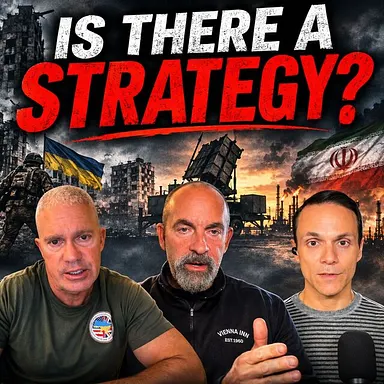
Eyes on Geopolitics hosts Dee Takos, Jonathan Hackett, Mark Polimeropoulos and Andy Milburn discuss the delayed sale of Patriot interceptors to Ukraine, which the guests note would not be fielded until the 2030s. They argue that Washington's Russia policy, including diesel deals and sanctions waivers, looks contradictory to allies, and they examine how a National Security Council they see as dysfunctional shapes policy.
The conversation then turns to Iran, where the guests weigh five courses of action outlined by an analyst, from negotiation to economic pressure and major strikes, and question what objective any escalation would serve. Listeners will hear the panel's reasoning on the risks of retaliation, the rise in oil prices, and why none of the options offers an easy route to victory.
In this episode Dee Takos, Andy Milburn, Jonathan Hackett, Mark Polimeropoulos
The transcript of this episode on Ukraine air defense and Iran strategy was made with the same technology HappyScribe uses for Teams transcription.
Ads in this audio differ from the text. Tap the sentence you're hearing to follow along.
Synced: the text now follows the audio.
This episode is presented by Vehr Watches. Go to vehrwatches.com/theteamhouse. Hey guys, we're back. Eyes on Geopolitics. I'm here with Mark Polimeropoulos, Jonathan Hackett, Andy Milburn. A lot happening as usual. Happy Sunday. Happy November 1st. Kalomina, like we say in Greek, which means have a good month. What's going on? You guys tell me, what are we tracking? I know, Mark, you sent in a bunch of stuff which I found Very interesting. The first one was that bullshit announcement about us selling 500 PAC-3 Patriots to Ukraine that are supposed to be delivered in 2030, which is like, what the fuck's gonna happen? Who knows what's gonna happen by 2030? The guys, they need them now. Let's kick off with that one. Let me get your take on that.
So first of all, I appreciate the invite yesterday, the book show. Oh, wait a second. Oops. I didn't get it.
I thought I emailed you. My
bad. No. Awesome show. I love this place.
He always does that. Oh, I thought— oh man, I thought I invited you to whatever it is.
No. But I'm— so I'm actually— I'm kidding. Because actually, I love the concept of the show. I'm going to go back and watch it because just the idea of— and for all of us here, I'm sure every time you go out and you talk about stuff, people always ask you, what books are you reading? What books do you like? So, that's an awesome idea.
You'll be on for the next one.
I promise. I don't know if I'm going to accept the invitation. John's got enough humility for at least that. I'm Greek. I hold grudges for a long time, like thousands of years.
You? No way.
Thousands of years. I don't believe you. So, D, great point bringing up. So big announcement by the State Department. We're going to sell stuff to Ukrainians that they absolutely need because they're getting pounded right now and they're going to come in 3 years. And so there's 2 ways to look at this. One is, of course, long-term, this is a good thing if this is going to be Part of the strategic relationship between the United States and Ukraine. Short term, it does nothing, and Ukrainians are facing a really tough winter where you know the Russians are committing you know atrocities and war crimes. And so my my worry on this when Ukrainians need this right now is that you know there's a notion of oh the U.S. is coming to the rescue. You know the cavalry's coming, except they're not this this summer this winter. And you know there's always the idea that we do need to have other countries step in. The U.S. I think we have to accept the U.S. is not going to do it now. So Europe and others have to step in, and I worry. an announcement like this without understanding the nuances of the crap's not on the way means people aren't going to do anything.
And so the most cynical part of this, and look forward to everybody else's take, is that this is not going to ever happen. And this is kind of the Rubio and other crowd to kind of— so trying to look reasonable when it comes to Ukraine, but really not doing anything tangible. But it's funny because on social media it was announced And so there's some plausible, some very smart voices who said, oh, this is great, until they realized that it's not coming for several years. So not something that should necessarily be celebrated as a way that we're going to save lives this winter, and it's going to be pretty gruesome.
Typically, the further off in time an announcement is about a foreign policy thing, the more likely it is to be a domestic statement, a domestic-oriented statement. And the closer in time to the announcement to the action occurring, the more likely it is to be a true foreign policy action. And I think that's right now an example of what we're seeing, where 2030 is a long way away. And it has a lot of reminiscence to the departure from Afghanistan announcement during Trump 1, where it was sequenced so that it would occur in the next presidency, not in the current presidency, which here this would be 2 years after the next presidency, in the middle of a midterm, by the way. Again, so it seems to be carefully timed for domestic political reasons, and maybe there will be some political will to give them weapons, but that's not like, to me, the primary purpose of that announcement. Especially 3 days before our own elections here in the US, which means it might have been a concession to some of the more moderate Republicans, the more Ukraine-focused Republicans to say, look, we're still thinking about Ukraine, we still care.
Been a lot of negative press about us with Russia, but don't worry, we've got some plans in the future for Ukraine. So please make sure you go to the polls. That's what it sounds like to me.
Yeah. I mean, and when you look at the terms of the agreement worth about $2.1 billion, but as we said, they're not going to be fielded until the 2030s. Canada, Germany, and Norway are helping fund the sale, are picking up, um, you know, the, the cost of these. It's not like they're being given to, uh, Ukraine, um, alongside EU-backed loans. Um, and, uh, and, and, you know, meanwhile Russia escalates attacks on cities and energy infrastructure. I, you know, the, the good news to come out all of this is Ukraine is standing pretty well by its on its own. We've talked about this, and we, the whole world can learn from, for instance, what Ukraine has learned about air defense. I'm here in Saudi Arabia, and open source, you know, there's a Ukrainian team here helping the Saudis with their air defense. But I think too, to put this in perspective, you know, as you guys know, we need to take a step back and look what has happened since the beginning of this month. I mean, Trump announced a deal with Russia, right, to supply more than 300,000 tons of diesel immediately, saying there's another half a million or so tons would follow in November, and then a million tons, and eventually 3 million tons.
And meanwhile, the Treasury's waiving sanctions on Russia's energy sector to make all of this possible while we're threatening and beefing up threats of tariffs on hostile countries, really our real enemies like Canada. And so, you know, the Treasury waiving sanctions on Russia conflicts with— what was it— the Lindsey Graham sanctions law, right, which Trump signed in September. You know what I mean? And then you've got the rhetoric, you know, it's time for Ukraine to get a new president. Zelensky could have many more deals, and for some reason, have made many deals, but for some reason he chooses not to. It's as though Ukraine is the aggressor, right? And then, just to take the effing biscuit, we press Kyiv to stop striking Russian oil infrastructure because it's working. All right. We threatened to cut early warning intelligence, reportedly. I mean, Putin said the strikes cost Russia about 1% of GDP. That's probably among Kyiv's most effective levers to counteract what's being done to its own energy infrastructure right here at the beginning of winter. And fortunately, Ukraine continues the strikes. I think most recently it was on a massive petrochemical plant. I mean, these are deep strikes using long-range drones against things that we can learn from.
They're striking the right balance between all the high-end sophisticated Ferrari drones that we have that we cannot afford to lose and blue-collar drones that are sophisticated enough and be mass-produced enough to do the job. And Ukrainians are doing a great job there. And then we've got the Starlink disruption, right? SpaceX, No surprise there, restricting Starlink and, what's it, Starshield, right, for over a week. And that didn't— there was talk at the time, oh, this disrupted Ukrainian deep strikes, but actually it also interrupted, as we talked about before, the interceptor drones that Ukraine relies on. to go after the Shaheds and the other drones hitting their cities. And, you know, I mean, then we denied responsibility for that. And now we say, oh, look at this, we've approved the sale of Patriot missiles. Meanwhile, Witkoff is calling Putin a humanitarian. I mean, that's—
So one quick thing on that, and let me ask Jonathan, because you're sitting at a school of excellence in the United States, so you will certainly understand the foreign policy nuances, or I would call it dysfunction. But what Andy just laid out is this bizarre policy in which US, actually overall US policy seems very much to have shifted towards Russia, towards Putin. Mind-numbing for all of us. I think we've talked about it a lot, and Andy just laid out all the things that we have done that have certainly benefited Moscow. And we have the President of the United States complaining about Ukrainian strikes against Russian energy infrastructure. What's happening behind the scenes though is the CIA, my old outfit, and this is all per open source, is providing the Ukrainians targeting assistance to hit what? Russian energy infrastructure. That's a good thing. We want that to happen. So I'm glad that my old outfit is still doing that, but it also shows to me the incredible policy dysfunction. And this is the definition of a country that does not use a policy process. The National Security Council, I assume, is irrelevant now because if you take a look at the history of our country, of our diplomatic foreign policy relationships, things go really astray when you have military, economic, political spheres all going in the wrong direction.
This is classic. Nothing of this makes sense. And so you have this kind of really bizarre situation in which the president and all of his advisors are complaining about some something that we are actually doing. Comment on that, Jonathan, as sitting at Yale University, the center of the history of diplomacy in the United States.
For better or worse. Yeah, I think back to like 1987, the Goldwater-Nichols Act that integrated the Joint Chiefs of Staff into the way that it is now, that created the National Security Council into a kind of new shape that it is now post-1947 National Security Act. There were a lot of legislation that happened in the late '80s because of failures of policy like you just described, similar types of failures. For example, the Iran Contra affair, which was a result of a type of national security policy planning happening kind of behind the curtain without actual executive input the way it should have worked. Congress saw that and they said, we need to have a new way of doing this. That's what Goldwater-Nichols in part did and also created the requirement for a national security strategy that each president would have to put out. So President Reagan in his second presidency, that was the first time we had a national security strategy. which I've mentioned before, is kind of mind-blowing that since World War II, we never had a national security strategy until 1987. But it's not something that works automatically and it kind of requires care and feeding.
And if you look at our national security strategies from, let's say, 2017 till now, you can see a massive shift. At first, 2017, it was the great power competition was our big focus, focus away from counterterrorism toward China as our pacing threat. That was what Mattis put in there in the National Defense Strategy, which is subordinate to the National Security Strategy. and the National Military Strategy, then that kind of changed over the years, the last few years. Suddenly, the threats that we used to think were threats as far as policy is concerned are no longer in that document. And I think that reflects the dysfunction that you're describing, Marc, where we don't have a unified strategy. And this has always been a discussion within academia in the US that the US lacks grand strategy. We don't do grand strategy well if we do it at all. Even here, like John Lewis Gaddis, who's still teaching at Yale, teaches a class on grand strategy. And basically the, the point of that class is that we don't have grand strategy, right? So like, it's kind of understood in academia that we lack that, but it's something that requires kind of these enlightened leaders in a National Security Council to help shepherd ideas into some kind of pipeline, even if it's not perfect, to make it so that they're all oriented toward the same objective so that if we have several different operations at the same time, they're kind of all moving in the same way.
They may not be perfectly orchestrated, but they're at least kind of— there's some thought, some, some string kind of wrapped around them, keeping them together a little bit.
This one is radically opposed to each other. I mean, it's wild, right? Never. I've never— I've actually never seen anything like this.
It's indicative of exactly that system not working or being used. So we don't have the string wrapped around, we don't have the shepherd standing there, which would be Mark Rubio in this case. We don't have him saying, hey, let's get that operation a little bit over here. Let's put the funding a little bit over there. You also don't have congressional input the way that you used to have, like the Gang of 8, for example, used to have quite a bit of oversight and input onto a lot of this national security activity. They would be notified ahead of time for certain things, sensitive things. There would be covert action information going back and forth between the presidency and a presidential finding. After the finding goes, they would give updates as required by law under Title 50. A lot of those updates aren't happening the way they're supposed to. So you have a Congress that's not informed and also not enforcing things that they've passed as laws. The laws are there. They're just not being enforced as far as national security policy is concerned. Then on the National Security Council side, you have individuals with little fiefdoms or islands that are actually working at cross purposes in some ways.
You have these unelected officials like Whitcoff, for example, going from place to place in the Middle East to Europe, 2 areas that require deep policy understanding. You can't have both, I don't think. I don't think you can be the same person and have the level of depth required for both of those theaters, and he's trying to do that. So he's spread thin anyway. So even if he was a perfectly good actor and perfectly informed, already be at a disadvantage because he's a single individual solving 2 different problems at the national security strategy level. So there's a lot of this dysfunction as a result of a National Security Council that's not working the way it's supposed to by law. And people could ask, why not? How do we fix it? And I think it has a lot to do with Congress needs to step up and actually enforce its laws that already exist.
Tuesday.
It's not like we need new laws. Yeah, exactly. And that's what Tuesday is. It's a referendum on this policy problem.
Hey, Andy, one quick thing on this. I think this will be great for the listeners and viewers. So, your role in special operations, everyone knows your extremely distinguished career. And one of the key parts of this is the ability to work with, understand, partner up with our friendly liaison services, our friendly partners around the world. If you take a look at exactly what Jonathan laid out, this kind of bizarre dysfunction, Let's put yourself in the position, you obviously were in Ukraine for a while, but even back when you were in the SOF world, what would it be like right now doing a side-by-side with Ukrainian SOF when you see the president all over the place, yet intel still flows for deep strikes? I mean, is that a difficult personal dynamic that you have to manage?
Yeah, undoubtedly. I mean, the Ukrainians, you'll find, You'll find that in most professional militaries overseas, the average soldier pays more attention to politics and geopolitics than perhaps in the US military. And the Ukrainians cover it very, very closely. And so even when I was there, remember, I mean, it was under the Biden administration, but remember all the drip feeding of assets? Remember HIMARS and there was hemming and hawing.
ATACMS.
There was escalophobia affecting every single decision. So we would give the Ukraine, oh, here's 5 HIMARS, and then we're going to wait, and then now here's 12. We're going to wait until the Russians understand the capabilities, can jam them, and can use good countermeasures, and then maybe we'll give you some more. I mean, it was ridiculous. And so the average, or at least the guys we met, who we dealt with, They understood all that and they didn't take out hostility on us because we were there. But it was very clearly evident to them and contrast that with their attitude to the Brits. Boris Johnson, who I know is a very divisive figure in British politics and I'm not here to praise him, but he's a hero there, right? Yeah. Because the Brits have always The Brits have always been 100% in support of the Ukrainians. I mean, right behind the Baltic countries, they've been incredibly consistent. I mean, they emptied out their inventories of breaching gear for the offensive in 2003. They emptied out their inventory of Storm Shadow missiles. They had no qualms about giving long-range precision strike capability en masse. to the Ukrainians.
So sorry, I'm— yeah, it makes it— it does make it very difficult because, you know, we like to think, well, soldiers don't care about politics. That may be true of our soldiers. And I mean, it just is. It's not just our soldiers. Our soldiers are representing— Marines are representative of society. Americans generally don't care about geopolitics unless it hits their pocketbook. But our foreign countries partners definitely do, and they know what's going on. And so, your role as an advisor is always affected by the geopolitical climate to some extent. Yeah. End of the day, it's personal relationships, but it really helps if your country's on the right side when it comes to dealing with that country. And I mean, honestly, as US guys in Saudi Arabia now, we're dealing with this now a little bit, as you can imagine. I can't talk about it in depth. I mean, the Saudis have been very gracious and courteous to us, but it's a little embarrassing. You know, it's a little embarrassing to be in a country that the US appears to have turned its back on. I mean, there are Patriot launchers coming out to the Middle East now at a time when Patriots are in short supply.
And where are they going? To Israel. And do you think that's not covered in the local media? Of course it is. You know, the one country, the one country in the Middle East that can rely on the US no matter what, no matter what, right or wrong, is Israel. And that is noted too. And, you know, you have to— I mean, who would have thought I would ever quote Richard Nixon? I'm not, I'm paraphrasing him. But, you know, during the aftermath of the Yom Kippur War, where, of course, the US came in to help Israel, I mean, Nixon in some of these— records now that have been released since expressed a lot of concern about the fact that we were now seen as being just simply allied to Israel and have deserted our Arab partners in the region. And I think we're in danger of being seen to do that now. And, you know, I mean, all of us who have been in SOF have worked closely with Arab partners in the region, you know, Jordan. You know, aside from our time in conflict zones, Afghanistan and Iraq, Jordan is a, you know, a huge partner of ours.
And all of us have worked with Jordanian staff and to a lesser extent, you know, Emirati staff, you name it. And it's, Yeah, you know, before I get into rambling, yeah, it's a very— it's, to say the least, it's disappointing. And, you know, the last part about this is you talk to the average SOF guy and they understand, you know, whatever their political views, whatever their political views, you assign them to a partner nation role and they will dive in and learn the culture.
We've heard a lot over the last few years about whether it's possible to build things in America. Our presenting sponsor today, Verra Watches, is putting that question to the test. Verra was founded in Venice, California in 2016 with a simple goal: to rebuild U.S. watchmaking while producing watches tough enough to withstand the toughest outdoor environments. Today, Verra is the largest independent watch assembler in America, assembling watches, in California, Arizona, Rhode Island, and Alabama, while also manufacturing its leather straps in Illinois and Florida. Every Vare watch is built for active use with a guaranteed waterproof warranty, scratch-resistant sapphire crystals, and high-quality materials and components throughout. That combination has helped Vare earn more than 10,000 5-star customer reviews, including thousands from people who rely on their watches every day in demanding professional environments. All of us here at the team house have been wearing Arvaire watches for a while now, and you can check mine out right here. This is the Meridian diver watch in navy blue. It's a very classy watch, and this is the actual rubber, um, dive watch band if you wanted to, you know, take it in salt water. But it also comes with a normal, uh, silver band and a nylon band if you prefer that.
And D, what kind of watch are you wearing there?
I have the C4 Tactical Field Watch. It's solar powered too. I'm loving it. And it's funny because I had this laying on my coffee table the other day, actually, my homie came in and to watch football or whatever. And he's a watch guy. And he's like, oh, is that that Vare one? He— I'm not even making this up. Like, I'm not even bullshitting. I'm like, holy shit. Yeah, like they're gonna be presenting sponsor for the team house. And they sent us all a bunch of watches. Like, yo, I love this watch. And I literally Sold the watch. I sent him the link, the Teamhouse link, and I'm like, yo, buy a watch from this, from this link. Because if you do buy a watch from that link, which is verawatches.com/theteamhouse, you— when you purchase a watch, you get a free watch roll that you could fill up with 3 watches so you could travel with your watches and stuff like that. It's really cool. It's leather. Yeah. And I was so excited when he was like, yo, is that that Vare watch? I see it all the time. I was like, so amped that he came up with that.
Yeah, it
It's nice. I really like the, like, nice big watch face.
You can find them at vaerwatches.com/theteamhouse. That's vaerwatches.com/theteamhouse. And if you use our link, you'll get a free watch roll worth $59 with your purchase. Also, Vaer does offer a 20% discount for active duty military, veterans, and law enforcement and first responders. So you could check that out at any time if you are any one of those. Uh, yeah, I'm excited about this sponsorship, so I really hope people go and check out Vair.
Yeah, absolutely.
One quick fun story on this, because I think all of us have been involved in the betrayal of allies. It's just unfortunately something that we do, um, uh, you know, whether it's Afghans or Syrians or, or Kurds or the Saudis. Now, the, the, you know, in our, our brother here, uh, who's not on the pod right now, um, uh, Mick Mulroy, when him and I were up living with the Kurds in Northern Iraq in December of 2002. I remember I was a pretty young case officer and I had my speech all ready for a very senior PUK official. And I was like, America's going to come to your aid. We're going to kick Saddam's ass, blah, blah. And he stopped me. He was very senior in PUK intelligence. He stopped me. He said, Mark, stop. He said, we've been betrayed by you. We've been betrayed by Iran. We've been betrayed by the Saudis and the Israelis. We've been betrayed by everybody in the region. So save your speech. We're friends right now, but we understand the game. And I felt a little stupid, but then later on, as I reflected over the years, I think the Kurds are the one state, nation-state, whatever you want to say, who do understand that the US at some point is probably going to hightail it out of there.
And that's just, I never forgot that and I never gave a ridiculous speech like that again.
Yes, certainly. I mean, that's a great example, the SDF. We've already, we have since turned our backs on them. And this isn't about emotion, it's to our own peril, right? Yeah. I mean, the Islamic State didn't go away, all right? The conditions that nurtured the Islamic State didn't go away when all this focuses on the war with Iran, undoubtedly bad things are simmering away there in the Syrian hinterland, and we no longer have the means to affect them. I'm not Chicken Little, but you guys know, I mean, we haven't learned from our mistakes, have we?
And also the way our partners look at us, you know, we mentioned the missiles for Ukraine being delayed by years and so on, but then these states, our partners, look at Israel and they see that we give them $6 billion a year, no strings attached since 1979 because of the Camp David Accords. And they're like, why can't we have something like that? I mean, Israel currently is fighting offensive operations outside of its borders, you know, with Iran, for example. Ukraine is fighting a domestic war and they just need air defense systems. And they're saying, well, why can't we just have air defense systems? You know, I mean, the early relationship with the US and Israel was when John F. Kennedy gave Hawk missiles to Israel for the very first time. That was the very first foreign military sale to Israel. I think it was 1961. I could be mistaken on the year, but since then we've just given them whatever they asked for and actually increased sometimes more than they asked for. And then we have allies and partners in Europe that have suffered side by side with us, both in Europe and outside of Europe, especially with Article 5 in Afghanistan.
And they're asking for help and we're kind of giving them this little drip, like you mentioned, Andy, the little drip in a hamster cage of help if we give them anything. Meanwhile, Israel is getting whatever it wants and it's got to cause some consternation in those allies and partners in their ministries. of defense when they need help from us.
One quick thing on that. You know, I attribute this not to— look, the US is always going to support the Israelis. That's just the way foreign policy goes here. But this is the Trump administration. I think President Biden would have sent Patriot interceptors to Ukraine. Let's just be very clear on that. This is Trump's just absolute personal animosity and hostility towards Ukraine. So I think it has a lot to do with just the notion of the US moving away from helping the Ukrainians. Because I think in a different administration, the US would have found a way to provide air defense to Ukraine right now. They would have done the same for Israel, but we would have found a way. I put this square on the shoulders of the Trump administration who just, you know, look, Trump hates Zelensky and hates the Ukrainians. We know that. And this is his— this is a very cynical and awful way in which we try to push a peace settlement by letting the Ukrainians get pounded. I think it's going to go down in the history of US foreign policy as pretty immoral and unethical. But I think a different administration would have found a way to get more air defense to Ukraine.
And a different administration probably wouldn't have started a war with Iran.
Well, there's that too.
To deplete our stockpile of Patriots.
D, that's a segue. Let's shift to Iran.
I told you guys I was professional. I sometimes show it like broken clocks twice, right? Twice a day. All right. So that, that link you showed us the tweet from Aaron McClain, who's a, you know, I want to get it right. He has a podcast called School of War Pod. He's a national security analyst for CBS News.
Former Marine.
Former Marine. Shout out. All right, cool.
I was on his podcast last year.
There you go.
There you go.
I met him in Sweden a couple months ago. Super smart guy. So I thought when he laid out those multiple scenarios, it was worth us discussing.
For sure. I'm gonna put— get them up right there. See that, guys? Beautiful, right? Mark, you're a TV guy. Why don't you read this and go ahead?
I can't read anything there. But I
mean, rather than read it by rote, I mean, we've read the tweet. Let's just talk about his point. Well, I want
I want folks who are listening and watching to be able to understand it too. So, I mean, it's on the screen so they could check it out.
Yeah. I mean, his whole point basically is he says, you know, public positions between Iraq— Iran and the US are irreconcilable, right? Short of an Iranian surrender, a deal is going to mean ceding the strait to Iran with catastrophic consequences for US power. I mean, he's kind of a pessimist there. I mean, on his first point, I'd agree with most of what he says, but I can't help thinking he's too pessimistic. I mean, given potentially some of this week's reporting, I'm not jumping to the silver lining, but the negotiations, yeah, there's not direct talks, but we've seen some weakening of positions this week. We've seen on the US side discussions that they're willing to see an agreement whereby Iran keeps a nuclear program, it just doesn't develop a weapon. And on the Iranian side, we're seeing similar kind of agreement. And an agreement to open Hormuz in exchange for sanctions, or I mean, in exchange for lifting the blockade, in exchange for sanctions relief. But without the US, remember that before, the idea was the US would do things and Iran would do things. So there seems to be some give way or some room for negotiation now.
But Andy, why is that? I mean, we've seen that before. I mean, all these things that I've talked about, I mean, literally it's like Barack revealed and the Qataris and the package. It's like the entire negotiation, everything is happening we've seen before. I'm not disagreeing with you. I'm saying, why would it be different now?
Yeah.
I mean, I agree. That's my only question. Because that was one of the courses of action that Aaron's talking about. So that would be negotiating. But why do you think that we would do something now that we didn't do before?
Why would we? Yeah, I mean, I think, well, I can't answer whether this is going to result in anything. But we're seeing on the US side, some ground giving that wasn't there before, right? It's no longer no nuclear program. Now it's, well, you know, if we can find an agreement not to reach nuclear weapon. I mean, who, you know, that's coming from— That's coming from Rubio. Who knows exactly what the stance is? I'm not even sure the president knows.
Back to the dysfunction. We don't know what that actually means.
Yeah, no, I mean, I'm not screwing with you. I'm just saying that. But it's definitely not in this administration's interest to go back to war. As McLean points out, I mean, one of the definitions of madness, right, is doing the same thing and expecting a different result. But anyway, that's the only part where I disagree with him. I mean, I agree, stay the course on economic warfare. He points out the blockade's doing real damage. Escorts have restored oil transits to, at times, pre-war levels. So yeah, stay the course. It's the least risky option. But he points out himself, it's slow and Iran isn't going to just sit still, right?
One quick thing. So why I liked his 5 courses of action, Jonathan, maybe kind of jump in because it's not binary. It's not stay the— so it's agreement, full-on, this diplomatic agreement, which Andy just went over. But then when you go, it's kind of a gradual level of of increasing military pressure, because there is possibilities of limited military strikes. And then it gets to be much more significant if you're going after Pickax Mountain. And then you start going after infrastructure targets, which means potential US committing war crimes in the eyes of many. So Jonathan, go over those other kind of courses of action and what you think about them, because I think it's just not— all of a sudden we're hearing, okay, Tuesday's the election, Wednesday the president might decide to go back to Kinetic operations, but it— there are various degrees of that, aren't there?
Yeah, I mean, even looking at this thing overall, what this looks like to me is one scenario of the failure of diplomacy. And it's an escalation in the scenario up to a point of like turning a dial all the way up to military action. And the important thing here is like, this is one channel of activity kind of all connected to each other. These are not the only scenarios, though. And some in game theory, you know, there's the idea that sometimes the only way to win is not to play. And so you have to also think about what if we didn't do this thing at all? What if there was a separate, completely different way of approaching this? And for example, I'm reading through these escalation steps, and I'm not seeing intelligence operations. I'm not seeing covert action. I'm not seeing allies and partners being used as the tip of the spear, which sounds kind of anathema to the way our foreign policy has been going. But that's an important scenario to consider, because depending on what our objective is, We might have to put our differences with our allies aside and at least secretly work together to get some outcome.
And I also don't see an objective here. I see escalation without a purpose. And that's, that's kind of dangerous because, you know, you see here like major military activity, mowing the grass as we increase the dial, but for what? And I think that should be mentioned first in any discussion of a scenario because we need to think, we need to problem frame first. Okay, what are we trying to achieve here? And what, what steps in the dial increasing will we have to turn to get to that desired end state? Instead, we just see a dial turning. It's like baking a cake and not knowing how many minutes it's supposed to bake for, what the consistency of the cake is supposed to be once it's baked. We just turn the temperature up and go check on it every 30 minutes. Well, you're going to come back to a cake that's— you can't eat it. And this is kind of the same situation here where you're just turning the dial for the sake of turning the dial. without an actual end state in mind. And that's concerning to me. Not a hit on Aaron's analysis, but I think generally the way we're thinking about this is, okay, there's going to be escalation after the midterms.
What does escalation look like? But the question we should actually be asking is, what do we hope to achieve?
That's the why. I mean, the thing that I keep finding, having spoken over the last couple of weeks with a whole bunch of current and former senior military officials, this is not the progressive left-wing crowd of war is terrible. But it's just, what is the desire? Why? Why would we do this? What's the desired effects here? You don't see that tied to a strategy. But Trump thinks in this kind of fashion, I would think. And so ultimately, this might be the menu that Chairman Dan Cain, Chairman of the Joint Chiefs, is presenting him. Right. I agree. I certainly don't see this National Security Council, this president, Jonathan, president kind of going through game theory in a Yale classroom. I mean, they should. In the old days, you would want to have the smartest people on the planet in such positions of national security, you know, roles. But I don't know. I can't even think as they sit around the Oval on a napkin planning the next steps that, do you think really Secretary of Defense Hegseth could even say anything that you just enunciated?
No, I think actually it's instead like,
by the
way, his thought process is like, why aren't they listening to me? Let's do more, then they'll listen. And that's kind of the way that it's going. And it's like, just throw more and more until they listen.
It's a very binary approach, isn't it? Military option, economic, in military. And where are the guys with the green eyeshades in the NSC who are talking strategy, right? And I think that's— so that's why I think I agree with you, Mark. I like McLean's 5 options. And I mean, just to talk through them because Dee wanted us, because I'm subservient to Dee's wishes. Thank
you,
sir. You know, to talk through them. That's why they, you know, I mean, it's, it's not particularly inspired, but it's at least here's a guy who sat down and thought about it. And you hope that in the NSC, there's a group of people who are coming up with these options. You know, it was make a deal, right? And he's got like low probability of that. Stay the course on economic warfare because it's doing real damage. Downside of that, Iraq's not sitting— Iran not sitting still. Brent's above $117. There was some limpet mine attack the other day. So waiting is costly, and for the global economy as well as Iran, right? That's number 2. And then the 3rd one, which, Mark, I think you just touched on, and John, you too, was economic warfare plus limited strikes to kind of mow the grass. To round Hormuz. Limited strikes would be— I mean, it's the most defensible military option, right? Would be IRGC fast boats, mine-laying capability, coastal missile sites, and observation posts, right? So protecting the shipping, supporting the blockade, and then keeping up economic pressure. And then he talks Where are we? The 4th option, right?
Major strikes to change Iran's negotiating position. So kind of a return to the March-April campaign, but shorter and sharper, focused on, again, missiles. He talked specifically about nuclear sites, Pickaxe Mountain. We have talked on this show about the problems now of reaching centrifuges in Pickaxe Mountain. They've been dug deeper, probably out of range of the most penetrative bomb that we have that gets much play in the media, which, by the way, is different than the mother of all bombs, which has been a total red herring in this discussion. You know, I mean, so the administration could probably argue, hey, this time it could work because the economy— it's the strikes are landing on an economy that's already under pressure. There's already an electricity crisis. And now you're matching it with economic pressure, right? And then, all right, this is Netanyahu's favorite the 5th, major strikes to Heesen regime collapse. Notice that Netanyahu around his election time has had— just before he started talking about regime change as the goal, right, in Iran. You know, I would guess that this is not something that we would articulate, I would hope, on Nothing, that, you know, this would be hit everything, to include oil, gas fields, refineries, export terminals, industry, power grid.
But the risk there of retaliation is very high, and the retaliation would come against the Gulf states. Yeah.
The Gulf allies would go crazy with this.
Yeah. Iran's already explicitly threatened Gulf Energy desalination plants, which we've talked about, are a huge deal in the country where I am now, in most countries in the Middle East, right? So, you know, I mean, one would hope that option 5 is not something that's seriously being considered, but you never know, do you?
Hey, D, how about we do an unscientific poll right now amongst the 4 of us? What do you— what do you think is going to happen?
I think we're definitely gonna— it's gonna be back to the same limited strikes that we were doing probably during February. Not limited, but pretty intensive strikes right when the, you know, they call the midterm elections and this next 2 months are, you know, in limbo.
I think there'll be strikes on infrastructure that are more broad than they were previously. For example, some in the previous strikes, there was like dual-use credibility there where, you know, this could be used for military operations. I think there'll be more punishing or punitive type strikes on non-military infrastructure, let's say water for cities and things like that, to try to force internal dissonance to make people rise up against the regime again, which is not a good, good thing the way that that would be designed. But that might happen because they don't understand how that works. So it's possible that could occur. And I would not be surprised if those things fail. The next step would be trying to seize the islands inside the Straits of Hormuz to try to push up to Abadan off of Qeshm Island and Kharg Island and hold a little bit of territory and use those as kind of like close-in targeting positions into deeper Iranian target sets, which again, not a wise move, but could happen.
Andy.
Yeah, I think, you know, a short, sharp campaign after the midterms, perhaps not immediately after the midterms, but within a week or so, somewhere between McLean's options 3 and 4. So it would hit Iran's anti-shipping forces, missiles, the nuclear sites, possibly. But I think you're going to see continued efforts indirectly for the Doha talks, for pressure to close a deal because we've all seen, even this administration cannot be impervious to public opinion when it comes to this war. Right? So there's— I mean, it's unpopular.
With that, so there was an article, I don't know, I think it was in the Washington Post this morning, and it was actually incredible. There was some administration officials say if the Democrats actually take the House and Senate and Trump is so pissed, it might cause him to further go down the road of, because he's angry at military escalation, which is insane, of course. Then you have kind of this narcissistic sociopathic mentality of just because you're pissed, you kind of go do this. with the public opinion so kind of vehemently against any kind of military activity, and the Gulf states now just pleading with the administration to give more time for negotiations, even though the chances are low. There's one thing that, and my thinking may have been influenced a little bit by just the talks I've had over the last several weeks, is, but I can't see, it goes down to Chairman of Joint Chiefs Dan Cain and CENTCOM Chief Admiral Cooper, and how they go down in history on this, because there is no conceivable military reason to do this. It's not going to work. And so that's answering the question why. So I don't know, maybe I'm saying that maybe there's nothing going to happen.
Maybe we just continue on this kind of economic strangulation campaign, hoping that military advice, much more than just options, you know, what McLean did is gave options. I would be hoping that that senior military officials in the United States, if they want to have the correct legacy, are kind of answering the question, why are we doing this? And the answer is there's no particular reason to. So I'm going to go with nothing's going to happen other than continued economic pressure campaign that the Secretary of Treasury and others have certainly advocated for. Like, why go down that road? But I'm doing so with the hope that senior officers in the US military will be able to get to the president.
Yeah, I mean, hoping that advisors to the president point out that a deal is still possible because Washington has softened its nuclear demand. And according to kind of the Doha structure that's being discussed now, Iran makes the first moves, right? So, there seems to be concessions. But I mean, I agree with you totally. And I agree with McLean when he says at the end, right? He says none of these options offer a clear route to victory.
And,
um,
do you think Jim Mattis would have just told Trump there's no reason to do this?
Yeah, 100%.
Yeah, I mean, I would, I would, I would hope that— I mean, I, I can't speak for Mattis. I would hope he'd point out that, you know, the American people need a clearer explanation of the strategy and the cost, right?
By the way, there's one other thing on this too. So you're not only putting U.S. forces at risk, You know, there's men and women who are going to be flying aircraft into harm's way. There's sailors on ships and Marines on ships who could get hit by kind of Iranian reprisals. It's also Iran has a, you know, has a vote in this. And we haven't even talked about yet, you know, the potential— any of these courses of action means an increase in Iranian retaliation, which could be asymmetric attacks. It could be cyberattacks. It could be a host of different things.
Yeah, absolutely.
And so there could be, you know, this might not be pain-free.
I mean, the war's already cost, what, $27 billion? I think it's worth it. And we keep talking about American lives. Look, I mean, of course, I mean, of course, that's important. 23 military lives. It's not insignificant. I mean, but, you know, counterpoint could be, well, that's pretty, you know, low cost for a war. But the point is, for what? I mean, we have not— there's been no strategic gains at all. We're in a worse position than we were in February. I don't see how anyone could argue that. Except for the idiot who says, hey, you know, I only used to be able to fit $50 in my trunk. Now I can get $130 of gas in. You know, it's a miracle. It's, yeah. I mean, the optimistic side of me says to myself that, you know, going back to full escalation, options 4 and 5 in particular is not good for the United States. It's not even good for the administration. It's, I mean, it's, they're all disastrous choices.
Right. Hey, Dean, one quick question. Yeah, I got a question for you.
No, no, no.
We haven't talked. So I was busy last week. I started getting hit up by all these folks. Even my wife, she's like, we need to buy a generator. I said, what's going on? There was like this hysteria over this like doomsday Prepping thing. I don't know if you all followed that, but I came back and my wife has several cases of water and we got canned tuna fish everywhere. And now, I want to buy a generator, but now I get to go out and buy a generator. What the hell happened last week with this kind of doomsday
scare? Yeah, something happened. Yeah. I wonder if it's bleedover from Burnham's advice to the British public, which is long, but that's been longstanding. I mean, Resilience of infrastructure, resilience of households has long been a discussion in the UK preceding the war with Iran. And if you look at the government advisories in the UK, they're not talking about war with Iran necessarily. They're talking about weather, all sorts of things. But it seems that somehow that has bled over.
Crazy.
And I asked someone the other day, an American, so why, why are you advising your family to go out to the grocery store and buy, you know, as though it's COVID again and buy 100,000 rolls of toilet paper?
It was chaos at Costco, I heard. Costco was a mess.
Was it really? Yeah.
I mean, you would have got your ass run over by these crazy people. It was terrifying.
Iran doesn't need to try and, and, you know, and you hear bullshit answers like some cyberattack. Yeah. I mean, Iran doesn't need to go after a hard target like United States. And even if it did, it could decide to, it would be very— they would be narrow at strikes. I mean, cyberattacks are like jamming, right? You can't do a blanket countrywide cyberattack that shuts down everything. But there's no need to. There are much softer targets here in the Gulf. Much softer ways of hurting the United States.
D, did you prep?
No, I did not. I kind of saw that in the news. I was— I didn't really pay much mind to it. I mean, I think also what the information that got picked up and disseminated was like about the thing being sent out to embassies about being able to operate for 90 days on their own and stuff like that. I think that also helped kind of stir, stir the pot a little bit. But I want to ask before we go, I want to hit on a couple topics. Number one, actually, it's a financial topic having to do with the price of oil. I'm gonna ask John this because he's smartest. He knows what the financial stuff is. He's a secret billionaire. John, in McClain's thing, it mentioned that Hormuz's oil exports were kind of close to what it was before the war. I don't know if that's accurate or completely accurate, but why is Brent crude still above $100?
The thing is risk, right? Risk has a price. So even if they're literally— and we've mentioned this on the show before— even if literally everything returned to normal on the ground, insurance companies and private entities who have something to do with this oil, whether they're the shipping companies, the recipients, the purchasers, the factories that use the crude pellets to make plastics, all of them are looking at this and they're like, I hear you saying that, but I don't trust that. Or I hear you saying that, but it's too risky for me to buy it at the lower price. I have to be at a higher risk profile right now to participate in this market. And that's multiple actors on different sides of the transaction. And that's causing these increases to stay high because it's actually, yes, there are in some areas returns to normalcy for some of the Gulf states in import-exports because of the intense amount of expenditure the US is putting right now. They have 24-hour air sorties going on. They have jets in the air all the time trying to prevent Iran from interfering with the U.S.-supported import-export activity and to prevent Iran from exceeding its blockade.
So you have this intense U.S. activity going on. And if the U.S. decided tomorrow to stop that, it would not be safe anymore. Right. And as Andy mentioned, there was a limpet mine placed on a ship this week. That was the first time since 2019 that Iran placed a limpet mine on a commercial vessel. That's a big deal. And you only need one limpet mine to make shipping companies go through the roof in concern because it just takes one explosion to lose $400 million worth of oil into the Gulf. And then the company is responsible for cleanup environmentally. So like now you have an additional cost built into that. And all this is in the actuarial sense being built into the insurance policies attached to these vessels, right? So this is driving prices up. And remember, Brent crude comes from Norway, It's the most stable crude oil in the world. So we use that benchmark because it's least sensitive to volatility in the world market. If we were using Saudi crude, for example, the price would be way more volatile, but still over a smooth average, it would actually be quite correlated to the Brent crude.
So you're not going to see Brent crude go down until those shipping companies, like the private individuals, are sure that their risk is really mitigated. in a way that's long-term. Because remember, these are futures contracts. That's not the price of oil to buy it now. That was somebody last month or last 6 months ago or whatever time purchasing that futures contract at a time when it was uncertain what things would be like today. That's the price you're seeing on the Brent crude. That's how futures contracts works. So it's kind of fascinating with these commodities where it's not reflective of today's risk. It's reflective of whose mind was in action on that contract months ago, weeks ago, days ago, Thinking about how things might be today. Of course, it's unpredictable and it's not perfect. So that unpredictability and that imperfection and the time value of money, these things are all layered into that price of oil and some other factors too, which is kind of fascinating because it has nothing to do with what's happening right now. It has everything to do with what was happening the day that that contract was purchased and then perhaps resold.
Very interesting. Another quick question before we get out of here. What the fuck's going on with Poland? John?
Yeah, so big picture in Poland, you have a president and a prime minister, so it's a parliamentary system. The prime minister is pro-European Union, the president is pro-Trump. This is causing divisions. The crux of the issue this week is that the Constitutional Court is having some issues in choosing justices or judges, and there's supposed to be a process where these judges get brought in, right? So if you think about There's the independent judiciary, there's the parliament, there's a conflict between these 2 entities within their government, in their top level of government. And what you see, it's not really a coup. It's called a coup by one side and it's called the correct thing by the other side, right? Because the way the constitution is supposed to be working is that these justices are brought in by parliament. However, they're being rejected. So there's a little bit of a conflict there between the independence of the judiciary, which is like the main thing, And the vulnerability here is how can Russia exploit this, right? Because Poland is kind of the gateway to Europe as far as a Russian invasion is concerned, in addition to the Baltic states.
But Poland is a major issue and has been for centuries. And so I think that is why the EU is so concerned about it, because they think what happens if that pro-Trump president wins on this challenge? Trump is already pro-Russia in their eyes. This could be a concern for Europeans further west of Poland.
Beautiful. Guys, I want predictions for the midterms. What's going to happen? Mark P, go first.
Both houses go to the Democrats. The blue wave is, is, is, is here.
Colonel?
Yeah,
I agree with Mark.
John?
Yeah, I think the Senate will be tight, maybe 2 or 3 seats over the majority, but the House will be a lot more In favor of Democrats.
So not enough votes to convict on impeachment. Goddamn it. All right, boys, a pleasure. Anything else before we go? Please, the floor is yours.
I want you to be prepping. I want to see D do his doomsday prepping. If you had to prep, what would you buy?
Non-perishable food.
What kind of food?
Beans.
Tuna.
Tuna. Gas, I guess, and water. See, I can make it. I would make it through SERE school. Guys, check— if you guys want to follow the— anybody listening wants to follow the guys, check the links in the description. Of course, Mark's Twitter and everything else down in the description. John's books, of course, Iran's Shadow Weapons and the Theory of Irregular War, down in the description. Of course, Andy Milburn, one of my favorite biographies I've read. When the Tempest Gathers. Links are in the description. Looking forward to his next book coming out soon about the Israel-Gaza War, or Israel-Hamas War. Do us a favor, buy a watch. Number one, verowatches.com/theteamhouse. And also check out our Patreon, patreon.com/theteamhouse to help support the show. Guys—
Listen to our book talk yesterday.
Yeah, that link, it's on our, it's on our, it's on our YouTube page. Not going to be available on audio. We did it live. It was a lot of fun. So check that out. And, uh, that's all I got. Thank you guys.
Bye guys, see you next week.
Hello everyone, if you're hearing this, uh, you are not a member of the Patreon. You can get your hands on ad-free episodes that come out early, and you can ask us questions, maybe we'll answer them. You can also watch the Team House podcast completely ad-free and early, and you can also watch it live as we interview our guests. And it's the best way to support the channel. So if you can, if you're open to it, you can go to patreon.com/theteamhouse. That link is in the description. We appreciate the supporters and we hope you would consider being one. So it's patreon.com/theteamhouse. Thanks, guys.
We break down the delayed Patriot sale to Ukraine, Washington’s increasingly contradictory Russia policy, and what that dysfunction looks like to U.S. allies and partners. We also examine the possible paths forward with Iran, including renewed strikes, economic pressure, negotiations, the risks of retaliation, and why no option offers an easy route to victory.VAER Watches ⬇️https://www.vaerwatches.com/theteamhouse get a free watch roll with your purchase.20% for active duty, veteran, leo, & first responders Support the show on Patreon:⬇️https://www.patreon.com/TheTeamHouseJack's news outlet:⬇️https://thehighside.substack.com/Find Jon Hackett here:⬇️Jon's Twitter:https://x.com/jonathanhackettJon's LinkedIn:https://www.linkedin.com/in/thejonathanhackettJon's books:https://www.amazon.com/stores/author/B0C5L659N5?ccs_id=e11a2062-f8d3-498e-bfd7-7d2f3869caf6Linkedin: https://www.linkedin.com/in/thejonathanhackettTwitter: https://x.com/jonathanhackettFind Marc P here:https://x.com/MpolymerFind Andy Milburn here: Twitter ⬇️https://twitter.com/i/flow/login?redirect_after_login=%2Fandymilburn8LinkedIn ⬇️https://www.linkedin.com/in/andrewmilburn2023Substack ⬇️https://amilburn.substack.com/Andy’s book ⬇️https://www.amazon.com/When-Tempest-Gathers-Mogadishu-Operations00:00 – Start00:37 – Patriot Missiles for Ukraine… in 2030?01:30 – Why the Announcement Does Nothing for Ukraine This Winter03:02 – Is the Patriot Deal Really About U.S. Domestic Politics?04:07 – Europe, Canada & Norway Help Fund the Sale05:00 – Russia Escalates Attacks on Ukraine’s Energy Infrastructure05:30 – U.S. Diesel Deals With Russia & Sanctions Waivers06:27 – Washington Pressures Ukraine to Stop Striking Russian Oil07:00 – Starlink & Starshield Disruptions08:27 – Is U.S. Policy Quietly Shifting Toward Russia?09:00 – CIA Targeting Support vs. White House Policy10:09 – Why the National Security Process Is Breaking Down12:04 – America’s Grand Strategy Problem12:35 – The National Security Council Isn’t Working14:09 – What U.S. Policy Confusion Looks Like to Our Allies15:00 – How Ukrainian Troops View Washington16:19 – Why Britain Is Seen Differently in Ukraine17:00 – The Importance of Consistent Support to Allies18:00 – What Saudi Arabia Is Seeing From the U.S.19:05 – America’s Relationship With Arab Partners20:19 – Marc’s Story About the Kurds & U.S. Betrayal21:34 – Turning Our Back on the SDF22:21 – Why Allies Compare Their Support to Israel’s23:33 – Is This Specifically a Trump Administration Problem?24:38 – Iran War Depletes U.S. Air Defense Stockpiles24:47 – Shifting to Iran25:53 – Five Possible U.S. Courses of Action Against Iran27:31 – Are U.S.-Iran Negotiations Actually Different This Time?28:39 – Economic Pressure vs. Renewed Military Action29:25 – The Escalation Ladder With Iran30:16 – The Missing Question: What Is the Objective?32:07 – Why Escalation Without an End State Is Dangerous33:26 – The NSC’s Binary Approach to Iran34:07 – Option 1: Make a Deal34:30 – Option 2: Continue Economic Warfare35:00 – Option 3: Limited Strikes Around Hormuz35:30 – Option 4: Major Strikes on Iran36:01 – Can Another Air Campaign Actually Change Iran’s Position?36:30 – Option 5: Strikes Aimed at Regime Collapse37:40 – Predictions: What Happens After the Midterms?38:04 – Jonathan Predicts Broader Infrastructure Strikes38:56 – Andy Predicts a Short, Sharp Campaign39:36 – Could Election Results Push Trump Toward Escalation?41:30 – Is a Deal With Iran Still Possible?41:59 – What Would Jim Mattis Tell Trump?42:20 – Iranian Retaliation & Risks to U.S. Forces42:57 – What Has the War Actually Achieved?44:00 – The Doomsday Prepping Panic45:13 – Costco Runs, Generators & Cyberattack Fears46:11 – Why Dee Didn’t Prep46:46 – Why Oil Is Still So Expensive47:03 – Risk Premiums, Insurance & Shipping Through Hormuz48:55 – Why Brent Crude Doesn’t Reflect Today’s Conditions50:01 – What’s Going on in Poland?50:09 – Poland’s Political Crisis Explained51:33 – Midterm Election Predictions52:09 – What Would Dee Buy for Doomsday Prepping?Become a supporter of this podcast: https://www.spreaker.com/podcast/the-team-house--5960890/support.