
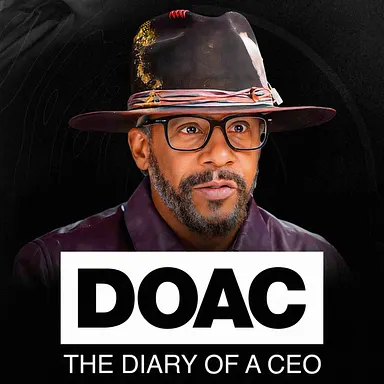
In this Diary Of A CEO episode, Steven Bartlett talks with comedian Katt Williams about his childhood, which he describes as marked by severe physical abuse in a strict religious household. Williams explains how reading classic books and discovering comedy gave him an escape and a sense of control, and how he left home at thirteen and lived in a Miami park.
He recounts his first stand-up set at sixteen, his years of study and repetition before his first special, and his decision to fund his own specials. Listeners will hear his views on rejection, self-worth and independence, which he presents as lessons from his own experience.
In this episode Steven Bartlett, Katt Williams
This episode's transcript, covering Katt Williams's childhood, comedy career and the Miami years, was made with the technology behind HappyScribe's AI meeting minutes.
Ads in this audio differ from the text. Tap the sentence you're hearing to follow along.
Synced: the text now follows the audio.
From 5 to 12. I was tied up to a pole in the basement. Hours at a time. Yeah. My parents thought you could beat a child half to death on a weekly basis, to the point where they're unconscious in a bathtub before school. Because in order for me to live this religious life that I was set up to live, it meant that I had to be 100% invested, and early on I had decided I'm just not going to do it.
Kurt Williams.
You left home at 13 years old. This is where you slept in the city of Miami. You end up being a salesman, and you became a pimp.
Yes. I'd knocked on a door where some ladies of the night resided, and their pimp had been killed, and they would have conversations on a nightly basis that I know for a fact are responsible for me becoming a better man.
And then your first stand-up comedy event was you lying to a bouncer to get in because you were 16 years old, and you win the competition.
Yes. But I don't do comedy again for another 5 years, because I still didn't understand this was a job you could do, but it was one of the first medicines that I discovered. It was super important in me just making it day to day, and at some point I was more sure that this was part of my destiny.
I read that you wrote down the names of 300 comedians, and you made the decision that you were going to study all of them.
Because they were funnier than me, and that's what I had to fix. Because I'm in LA, I'm on Comic View, doing acting on sitcoms.
Your parents. They're still alive?
Yes.
How do you feel about them today?
Um.
Guys, I've got a favor to ask before this episode begins. The algorithm, if you follow a show, will deliver you the best episodes from that show very prominently in your feed. So when we have our best episodes on this show, the most shared episodes, the most rated episodes, I would love you to know. And the simple way for you to know that is to hit that follow button. But also, it's the simple, easy, free thing that you can do to help us make this show better, and I would be hugely grateful if you could take a minute on the app you're listening to this on right now and hit that follow button. Thank you so, so, so much.
Kat, can you take me into your earliest context? If I was a fly on the wall in your life under the age of 10, what would I have seen, experienced, felt?
Well, those were great years for me. I learned to read pretty early, like 3. I felt like I was growing so much because I was reading adult stories, and I was reading what adults were going through, and I was trying to figure out, how old am I going to be before I get this thing figured out? Because I couldn't figure out who gets to take adventures, who gets to be on adventures, who like, how do you put yourself in these situations that I find all of these people in these books in, like soldiers and captains and stowaways, and I love that part.
I just wanted to try to figure out how to make myself one of those people.
Be careful what you wish for. If you wanted an adventure, you've certainly got an adventure.
Right, right, yeah. But I just assumed that's how it worked out for the hero. Like, five bad things had to happen to Cinderella before she was able to be the heroine. Like, she had to have a terrible family life. They had to treat her bad. She was being verbally abused. She was given a terrible job. The stepsisters were awful. But for some reason, she maintained, and she, um, she kept the type of person that she was still until things lined up.
So I naively thought that that's how it worked out for all heroes, that it was just bad, and then it got greater later. I just held onto that. And so I was looking for my opportunities.
It's funny, because I have thoroughly researched your story, and I had no idea how much you have been on an adventure, to say the least. And it's funny you talk about Cinderella there, but maybe you are the Cinderella of comedy, because it really is a hero's journey, your story.
As much as you can do for 5 foot 5. It's, yeah, it's as much a short king story as anything else.
And you had a strict religious upbringing.
Right.
Tell me about that.
We didn't celebrate holidays and birthdays and things like that, and I wasn't able to do a lot of extracurricular activities. All of the activities were Bible-based, but I got a pass with books, and so that became my pressure valve for feeling restricted and suffocated. I could go to my room and get in these books and be somewhere completely different for 2 hours and come out of my room feeling an entirely different way, like I had been part of something a lot bigger than me.
Were you different from your peers at that age? Did you feel different?
I knew that my upbringing was not the same as my peers, and I knew that there was a lot more leeway and freedom out there in the world of being a kid than I was experiencing. Even when it was super bad, I didn't look at it as bad as it was. I just assumed that if it was more difficult, that just meant I was destined for better things, I thought.
And now as an adult, when you look back on this little guy, have you noticed that he was different in hindsight as an adult?
No.
No?
That's probably the thing I did best, was I preserved as much of him as I could in 55 years. I was always cognizant of this guy and what he was thinking, and I've been a happy person my whole life.
I mean, how old are you here? You're probably what, 5 to.
So I'm 5 there and 7 there.
How did it feel to see these photos?
Um.
I say that because you passed them back pretty quick.
Is that not normal?
People don't usually pick them up and pass them back to me.
Like playing cards?
Yeah.
Redeal. I kind of feel sorry for him. Now I can look back at the pictures and see how happy and carefree that he was, also knowing what he was going through even at that time behind the scenes. I'm just incredibly proud for the little guy that it worked out for him the way that it did. Yeah, because that's all the pictures of me. All the pictures of me.
I'm happy just like that. But probably had a terrible day.
You feel sorry for him because of what he was going through.
Right.
What was he going through?
There are times when being joyful and inquisitive and ongo 24/7 can probably be more than a handful for young parents with their first child, and, you know, they should be able to make mistakes as well, but.
I know that was from reading your book, that was abuse in the home from your parents. Is that what you're referring to?
Right. Corporal punishment wasn't really useful in my life. It was, um, my parents believed in spare the ride, spoil the child. So, um, if there were issues, you could just beat it out of them, whatever it was. That didn't really work for me. I handled it a different way, and I kind of felt like it was just more evidence that I had meaning in my life and that I could potentially turn out to do something meaningful, or what would all of this be for.
When I leave home at 13, it's been almost 6 years, almost half my life coming. Like, I've been preparing from this point to 12 that if I get an opportunity to go on my way as an adventurer, that that's what I'm going to do.
If you're 5 and 7 years old here, at what age did the beatings start in your household?
Just from 5 to 12. So it's a 7-year period. I've forgiven all the participants, so it doesn't make it easier to go back and peel scabs off just because I've forgiven everybody involved. It's such an important part of my life just because we need to be put in difficult situations for us to be able to find out what we're made of and what we're capable of.
How I handled that situation was one of the first instances of me actually being a man to me, to myself, because I had to make grown decisions a little earlier than most, and it's certainly not pleasant to discuss. I don't enjoy discussing it, but it's still a critical part of the story.
As I was reading your book, in this chapter, the chapter says, "This is for your own good. Between 8 and 12, my life turned into a private war zone disguised as our basement." It started small, if you can call it that small. At first it was 3 or 4 whippings a week, and I say whipping because that's what they called it, like it was some wholesome Southern tradition passed down from big mama. However, the whippings matured into something monstrous. The belt turned into an extension cord, and the extension cord turned into a water hose.
When that started tearing skin instead of teaching lessons, they switched to a 2 by 4, and they claimed it was because I was hard-headed and knew too much.
Right.
I say this because, you know, some people hear about tough parents, but this is a different category of punishment.
Yeah, this is tied up to a pole in the basement.
Your parents.
Hours at a time, yeah.
Hours at a time.
Yeah. But to their credit, I was fast and evasive, and they tried it without tying me, and that didn't work well. I was able to maneuver the entire house. So that's where it eventually came to.
Because you knew too much?
Not because I knew too much, more because I said too much, and I would know what the repercussions were going to be and still say it. The things that I was questioning them on were, a lot of times, biblical in nature, you know? You're trying to instill upon me this particular truth that we collectively believe in, and I'm explaining to you, I don't believe that, and it's going to have to be discussed because you told me the Bible was written by God.
So I don't want to see any errors. I don't want to see any mistakes. I don't want to see a passage that talks about how you should treat your slaves, because now I have a different conversation that I need to have. And, um, yeah, even at that point in my life, I just wanted to know what the truth was about things, and I thought that that was a safe place for it, but, you know, I was still willing to take whatever came with it.
Did you, as a child at that age, have any idea that treating a child that way is unacceptable, or did you think that was normal? And how has time changed your perception of what that was? And do you now classify that as abuse?
Yeah, I was cognizant. I understood that the things that my peers were getting in trouble for, I had never done any of those things. Like, I had never committed any crimes. I was a virgin. I had never snuck out the house to go to events. I just knew that they didn't care for me as a person, and so for the first few years, I was just trying to figure out what it was about me that they didn't like.
Once I realized that it was out of my hands, then I privately just got defiant about it. Beat to your heart's content, I'm going to still keep talking shit through the process, and I'm going to commentate this for myself, and I'm going to say things like, "How does this make you feel? You sure are beating your baby a lot. You say God loves us?" That's me during the process, because that's how I was able to handle it.
But yeah, I knew it was abuse then.
You said you realized at a young age they didn't care for you as a person.
Right.
Was there any sign of love in that relationship with your parents, or was it all this abuse?
No, I felt like it made them better parents. Like, I appreciated them more than I think I would have, like, because all the mothers that I saw seemed to love their kids, you know? And I wasn't really sure why my mother didn't feel that way. I was really thankful that they took as good a care of me as they did, considering how they felt.
Were they loving affectionate at all, outside of this war zone in the basement, as you call it?
No, but they didn't start off that way, so they didn't have to make any adjustments. I would watch sitcoms and see those families. That's where I would notice that this isn't exactly how the family dynamic is supposed to go. I'm watching The Waltons or something, you know? Oh, she's supposed to kiss me every night, huh? Huh, it's interesting. Yeah, it wasn't lovey-dovey like that, but again, I was thankful for how well they treated me, considering.
I read you were an extremely intelligent young child, especially as it relates to book smarts. Your 7th grade placement test results were so high that your school said you could go straight to college. You are a different thinker. You think very differently to others. I think you observe the world differently to many people as well. And, you know, also hearing about your great love for some of these books they have here.
Ha ha, look at there. Two great books. Mm-hmm.
These were two of your favorites?
White Fang: Call of the Wild by Jack London. I was just mesmerized that he was able to create this captivating story that had me fully taken. Like, this was one of the first ones where I couldn't start another book. I had to finish this and understand it. And The Swiss Family Robinson, I was just so proud of them as a family, and seeing what the dynamic was of everybody working together and everybody having different strengths and weaknesses and always having to depend on one another.
And I could find something in each of these tales that I could directly put into my life. You know what I mean? Like, yeah.
You had two younger brothers, Steven and Brian.
Correct.
Was the treatment the same for Steven and Brian, or was it different?
It was different, which made me feel like it had been more me. But yeah, one of my brothers suffers with mental illness, and my baby brother's a genius. When my middle brother was born, he looked exactly like my father. It made the whole house better. Like, they were so happy to have him.
They were so happy to have him that I realized what a disappointment I must have been to them for whatever reasons. It was 8 years in between them and I, so I had lived quite a long time as only child before they showed up.
Were they ever tied up in the basement?
No. To their credit, they were aware of the fact that that didn't work. They understood it didn't work, if nothing else.
As I've gotten older, I've realized that I learned a model for what relationships are and love is from watching my parents. And I didn't realize that until I looked at some of my habits and responses when I became an adult in romantic contexts. I discovered that I was heavily avoidant because I grew up in a household where my Nigerian mother and my father were often at sort of verbal war. My Nigerian mother would often, you know, spend many, many hours a day shouting at my father, and my father would never say anything.
It was just 7 hours of screaming in my house. And I used to wonder, like, why wouldn't my dad leave? Like, I wanted him to leave. I was willing them to break up because it was so volatile. And then, you know, you don't really know as a young person whether that's changed you in any way until you, you know, you get to 21 or you're 14, and someone wants to be in a relationship with you, and you find yourself running away from it. Because I think at a young age I'd learned that commitment is prison. Like, my father, in my mind, was in prison. So 14, 15, 16, I spent 4 years pursuing this girl.
She turns around finally and says she would be in a relationship with me, and I got the same feeling of, like, that someone was taking me to prison. It's like a trigger went off, and I dissuaded her from being in a relationship with me after 4 years of pursuing her.
Right.
And then I didn't get into a relationship until I was almost, I was closer to 30, was my first relationship. And so I reflect and go, oh my God, I didn't realize that I had learned a model for love and relationship and affection, and at some point I have to do the work to sort of unlearn that.
Yeah, well, it was the opposite. My mother and father's relationship equals out to the greatest love story I've known my whole life. Like, my parents were married when I met them, and they're still married to this day. Their love for one another is what I based marriage on. Like, I've never seen or heard them argue with one another. I've never seen them have a disagreement between one another.
I've only saw love in their relationship with one another my entire life.
Which is very confusing.
Right. Outwardly, they were perfect. Everything they presented was a perfect view of what you would think it should be. There were just things behind the scenes that were terrible. But when they did a great job, they did a great job. And I can't tell the story fairly without mentioning those things.
In page 165 in your book, you say, "If I'm being honest, my complicated pattern with women didn't start in adulthood. It started at home. My mama was ground zero." That's supposed to be your first lesson in love. Warmth, reassurance. Instead, I got love in sample sizes. That kind of shortage doesn't scream at you. It moves in silently and reshuffles the furniture in your heart.
Right, because not getting the love from somewhere where you assume that it naturally comes in is a little bit more difficult to process why that's not happening. The love from other women was all around me and present with every new woman that I met, it seemed. But because of my upbringing, I didn't have any sisters, and my mother wasn't engaged personally with me like that, so I didn't have a frame of reference for how women thought or dialogue.
I was getting it from books I was reading. I remember reading Little Women, and I read the entire book, and when I got to the end, I didn't understand any part of it. I just didn't understand the different women and how they could all be related and yet all have these completely different viewpoints on things. And yeah, I probably had to read it 2 or 3 times just to understand.
I think until that point, I thought that men and women were pretty similar in their thought processes and in their communication, only to find out there's almost no more intriguing subject than women and how important they are to our world and.
Because the model of a woman in your life was your mother.
Right, right.
Was the abuse dealt at the hands of both your mother and your father?
Evenly.
Evenly?
Yeah. Yeah. In order for me to live this religious life that I was set up to live, it meant that I had to be 100% invested, and I had to act the way that I believed. And early on, I had decided that I wasn't going to live a double life. I wasn't going to pretend for you that this is my life and I'm happy with this and.
The religious part.
Right, with these answers to these questions, and yeah, I'm just not going to do it.
Were they Jehovah's Witnesses?
Allegedly. Could have been Scientologists, but yes.
Why do you say allegedly?
Well, because this isn't in any body's religious framework, you know? Like, they weren't doing this to stay in good graces of the religion. Like, the religion wasn't condoning this. Even then, nobody thought you could beat a child half to death on a weekly basis to the point where they're unconscious in a bathtub before school, and you're having to try to get them to where they can, where the bleeding will stop so they can go to school.
Like, no religion condones that. But we were high up in the religion and an example to a lot of people, and so it was necessary that I do a better acting job or give in.
Unconscious in a bathtub before school, and they put you in the bathtub because you were bleeding.
Right. Well, we had like an hour to play with sometimes as far as what just happened, and now I'm in no shape to be getting ready for a school day. But we got to get the bleeding to stop, and we got to, you know, epsom salts, I believe, just so we can get a good scab on so he can afford to put his clothes on and get on off to school.
Because no matter what happened, I was never missing school. School was like everything in my world. Just to get a chance to be out of this situation and in a different situation where they don't even know that that situation took place. Like, that's why I look happy in all the school pictures.
They beat you until you were unconscious.
Yeah, they had great stamina. Yeah, these would go on for hours. Like, generally, that's when they felt like they had done too much. Because when it first started, like, I had neighbors next door that loved me, an older white couple, and I knew their house was too close to our house for them not to be able to hear. So a lot of times I would make sure that it was boisterous enough that the neighbors could all bear witness to what I was going through.
And when I saw them years later, they were so crestfallen. They were like, we just didn't understand what was going on because we would hear it for hours and hours at night, and then we would see you at 7:00 a.m., and you'd be all dressed and smiling and on your way to school like it didn't happen. And I got so much from that. Like, I was so prepared for what might happen out in the world, considering just because I knew I could count on me in those situations to figure an answer out where we could be good.
I know you're going somewhere with this.
No, I'm just so fascinated. This is why I'm not looking down at my notes, because it's just, no, I'm fascinated by how, in my words, such a horrific early experience ends up leaving scars on you. And, you know, I sat and interviewed Michael Jordan and Kobe Bryant's coach, and one of the things he said to me is, we will have a dark side and a light side, as he referred to it. And he said, our dark side is fundamentally connected to our light side. So in the case, often when you meet, you know, comedians, there's a stereotype that they were trying to make someone happy, whether it was themselves or a parent when they were younger.
And that's really where comedy originated from. Often, this is the stereotype, and that's what's made them the great comedian or performer or artist they are today. And that's kind of what I was mulling, is how this experience is at all connected to what you then went on to do in your life professionally.
That's not really where the bridge for me was. I never thought I would be involved in comedy, but I learned early that I could count on comedy to help me change how I felt. So I was interested in all forms of comedy, no matter who was doing it, no matter if it was slapstick or silent or whether it was literary or whether it was Don Knotts.
I appreciated the fact that it didn't matter what you were going through. If you could put yourself in a position to get a laugh, it would absolutely make things better.
Make you better or the audience?
There was no audience. It was just me. I just knew that watching a comedy film is going to change my day. Like, I'm going to laugh enough times in this that when I come out of this situation, I won't feel the way it was when I started. And comedy always came through for me.
You're describing comedy as if it's medicine.
I would have used anything that worked. Comedy made light of all situations, even at a funeral. If you're in a funeral proceeding and a joke is told, it hits even harder because we need the laugh. When I shut that room door, that as soon as I shut that door, I'm in control now.
Your bedroom door.
Yeah, and I know things about my brain that I don't think other people know. I know that I can put things in here, and it will change how I see things. I fed myself on comedy things, just comedy material, because it was just so helpful. When it came a point where I could do comedy, that was out of nowhere. That's the one thing I had never even put in my head is that I could be involved in comedy, but I already had a proper respect for how important it was.
You left home at 13 years old and ran away. Take me into what led up to that decision.
I didn't run away. It was only a matter of time before the authorities were involved, and that's just how it happened. Like, I never said anything to anyone. My parents never said anything. It was wonderful. Blessed administrators at school that noticed that the guy who loved nothing more than gym physical education wasn't dressing out for gym sometimes, and they found that to be odd and unlike him.
So, you know, the police were called to the school. They did an investigation, took pictures, and the plan was that they were going to come to our house the next day and make arrests. And so I needed to not be there when that happened so that my younger brothers had a chance.
So the police took photos of your body.
Yeah.
And what did they find?
Well, it was obvious. Like, I got covered in extension cord wounds. Like, they're pretty deep. They're often you can see the progression from the extension cords to the water hose. So you can, there's damage on my body.
Did you want the police to know?
No, but I didn't have a way of proving to myself that this is egregious and outside the way, outside the norm. This is beyond the pale. This is criminal. I didn't really have a frame for that. But they did, and they were quite clear that it doesn't go like this. Like, nobody gets to do this to a child, and it doesn't matter what you did. So when I asked them, so what's going to happen tomorrow?
And they were like, we're coming to the house. We're going to arrest your parents, and we're going to move your brothers to a safe place, you and your brothers, where everybody can be safe. And my question was, could they at least promise that my two younger brothers wouldn't be separated, you know? Because we had loads of family in the city, you know, and there were many options for that. So I just wanted that as a guarantee from them, and they explained to me that they couldn't make any guarantees like that, that that's not, they weren't part of the system.
Their job is to remove the kids, and however the system has to deal with it, that's how they deal with it. And so that was basically what I was trying to circumvent, was letting my situation ruin my brothers' situations.
Who told your parents that the police were coming?
I told them everything that had happened that day in school.
How did they react?
I guess they took it well. From the story they knew, I couldn't have had anything to do with it.
And when you're 13, you sit with them, you're 13 years old at the dinner table, and you say, listen, I'm going to leave. Did you have a plan for where you were going to go and what you were going to do? Did they try and stop you leaving?
Well, I think many parents of the time had a thing where as long as you live under this roof, these are the rules, you know? And ours was no different. And I was just letting them know that I could no longer live with the rules and regulations. And.
But you're 13 years old. You're not a man yet.
But I'm 5'5", and my father's 5'3", so I'm taller than the man of this house, and I'm not going to let you beat me again. That's where we are now. So whatever one you got off, that was the last one of those. If you're in a situation that is no longer feasible for you as a person and it's bad for your health, literally and figuratively, whatever age you are, you've got to make a grown decision and a right decision.
And that was certainly it for me.
Did you have a plan?
No. No, no, no, certainly not.
Did you have money?
Mm-hmm. It was millions of dollars for a 12-year-old, but I think it had like, I think it had like $1,200.
$1,200.
So I was literally hemorrhaging cash.
Did you move into somewhere else, or were you homeless from 13 years old?
I went to a truck stop, found out which trucks were going to warm weather places, because I had been in Ohio my whole life, and I just knew I didn't want to deal with being out there by myself and the winter weather. And so it really left me like California, Texas, and Florida as my options, and Florida is where I ended up. So immediately upon getting to Florida, to Miami, I'm homeless, as you put it, but I didn't feel like that.
I didn't own the home I was just at, you know? And I didn't feel comfortable there. So I didn't feel homeless. I felt free, and I felt like today I'm not a victim of any circumstances.
I found a sign of the park that you slept in from 13 years old, which is Peacock Park in the city of Miami.
So isn't it interesting that it literally says where magic happens? Like, what other park in America has that? Like, why would you, why is that there? But my life story says magic happened there. That's crazy. Yeah, you certainly do your due diligence. I've never even seen that sign.
What magic took place in Peacock Park when you were 13?
For somebody who didn't really have a social footprint in the world and somebody who loved stories, this was a front seat viewing of some of life's turmoil and tribulation. So I'll say it's 1983, Miami Vice. There's a lot of things going on in Miami at the time, and there's this homeless enclave that exists at the back of this park.
Everybody in this enclave was doing terribly in life, and it was a new circumstance for them. They were just a doctor, and they were just a lawyer, and they were just a nurse recently, and they just had a wife and a family and people that loved them. And they made this particular decision, and they got on this particular drug, and then the whole story is downhill from there. And this guy who's telling me about his whole life until alcoholism shows up, and he can't hang on, and he loses everything that means something to him.
And that's 100% responsible for why I never tried hard drugs, because I got scared straight, like, too early. Like, nobody told a story of good times, how great being on LSD was, or how greatly cocaine had changed and affected their life. Like, they were living good lives. They were good people. It was just certain decisions that you make that you can't get back.
No peacocks at the park, interestingly enough. But yes, magic definitely happened for me there.
Were you taken care of by the homeless community in the park? Was it a safe place for you?
No, I don't think there were any safe places. And some people are homeless because they're terrible people. Some people are terrible people, and they've burned all of the bridges in their life, and they've hurt people that didn't deserve it, and they've made awful decisions, and that's how they end up in that situation. I had to learn that there's good and bad people out there.
What were you doing to make money at that time?
For the most part, I was able to find some employment that didn't need my identification and just somebody that owned a business that didn't mind a guy coming in and working after hours. So God looked out for me there. And I tried my hand at car theft, which was a lucrative thing in the area that I was in. I really gave myself a hard time about it and couldn't morally continue just because I didn't want to, I didn't want this to be the one thing I was good at is doing something illegal.
So I had a very brief stint with that.
On page 55 in your book, you talk about how one day you're walking along the highway and your parents and brother found you, and they pulled up beside you in their car. Take me into that moment. What did they say? What did you say?
It was probably like the most movie-like scenario I've ever been a part of outside of a movie. And this is now a year and a half later, and I've been to three or four different locations in this state, and I'm literally just walking alongside the highway when a vehicle pulls over.
So up until this point, I've been checking all the milk cartons I can find at the stores, and I know that nobody's looking for me. There's no missing persons.
You were actually checking milk cartons?
Well, yeah, because I had such a large family, and I was certain that I had been missed. I thought I was a great kid. And so I had to come to grips with the fact that, no, nobody misses you, and nobody cares that you're gone, and nobody noticed you're just out there. I was just really in shock because I wasn't sure if they had been tailing me for a year and a half. Have they been following me for a year and a half?
Were they aware of where I was the whole time? I didn't have any of the information. So it was a very weird meetup. But I was also what I thought, the way that I would feel about seeing them was completely erased by how happy I was to see my brothers. And I didn't realize in that year and a half how gut-wrenching leaving my brothers was going to be in my life.
And so that kind of overwhelmed everything. And they let me know that they were in Florida and, yeah, just hopped in.
Were they looking for you, or did they just happen to drive past you?
It's the state they went to. So we find out later on that when I leave that day, they leave the same day.
They moved as well? Oh, because the police were coming.
So they moved the whole family that same day.
To Florida.
So it never looked to my family or people that loved me. It never looked like I had left home. It looked like the family had moved. And because they were missionaries, people thought that was perfectly understandable.
So they tell you to hop in the car. Presumably, you get in the car.
Mm-hmm.
And is there a conversation that you have with your parents at that time? Is there a hugger?
No, but they're so, I know they're glad to see me for some reason. And I didn't leave on that note, but everybody is overjoyed to see me.
You know, because when you objectively describe these situations, when you say things to me like, I realized that nobody was looking for me and nobody missed me, these are very difficult things for me to hear. Because it's heartbreaking to hear a child say that about their parents. But you're able to say it in a way that's quite matter of fact. And that makes me wonder, like, how you've processed the emotions of all of this through your life. And have you at all been able to sort of, like, compartmentalize, maybe is the word, or maybe just generally sort of numb yourself to be able to process and move forward in life without, you know?
Thank you. That's kind of a compliment if that's what's going on. But yeah, I wasn't getting what it was I was expecting from these two individuals. But I was getting so much from places I didn't expect it. So for however poorly my parents might have done in the situation, my grandparents were wonderful. Like, my.
Right.
Right, exactly.
So the picture of all of your family.
Literally the best family possible, like, as far as happiness and well-being and, like, yeah, my parents' shortcomings didn't change any of that.
It used to be that working for yourself was a massive, massive risk, but that world has completely changed. If you've got a business idea that you can't stop thinking about, I think you owe it to yourself to at least try and make it happen. And that is where our show sponsor, Shopify, comes in. Their smart platform includes everything you need to start selling and get that idea off the ground. They have this drag-and-drop editor. They have this AI sidekick and helps you. They have analytics, and you don't need to be an expert to get going. Shopify's best-in-class checkout makes sure that you're getting paid from day one.
It helps more of your customers finish their purchase because their checkout is so efficient, and it saves their info for next time. Personalized checkouts like that equal more conversion, equal a faster growing business. Nothing kills that early enthusiasm you have for a new idea than that first initial step to get going being difficult, complicated, or expensive. And you need to save as much time and money so that you can focus all of it on growing your actual business. And that's what Shopify gives you. Head over to shopify.com/bartlett, and you can start your free trial right now.
What I'm about to say is an ad, but there's something quite different about this particular ad. Grokbot now sponsors this show, and I've already invested in SpaceX, which is the company that owns Grokbot. Grokbot is an app on my phone, but it's also on my computer. And basically, I have all of these different agents. You can think of them like team members that are working with me to do work right now. And unlike other AIs, they all have their own computer, which means that if I turn off my phone, if I close my laptop, they continue working seven days a week, 24/7, on tasks that I've given them.
I've got one that comes up with new creative ideas based on things that I've said on the podcast. It is absolutely insane. This only came out in August. It's freed me up again to do the things that only I should be doing as a creative, as an entrepreneur, as an investor, which is the sort of higher-level things around taste, creativity, judgment. You will get more done with Grokbot today, and you can get 50% off your first month by heading to x.ai/doac. x.ai/doac. You go on a mission to Haiti with your family shortly thereafter.
You talk about that a lot in the book, and then you return back to America after the Haitian government collapses. You're 15, 16 years old when you return. You didn't return to school once you got back to the US. You worked in a carnival, I believe, around that time.
Yeah.
When does your first stand-up show happen?
So now we're back from Haiti. I'm trying to figure out what my life holds.
You're still living with your parents at this time? You're back living with them?
No. If it's not for going to Haiti, the whole come live with them thing already wasn't going to work. I was already grown past my years. Like, I got this whole grown man life that just wouldn't, couldn't be put in a child's box again. But as I'm out there in this world where they have this city where the carnival people come to when there is no carnival, I'm in that area, and there's five or six people that are part of this business where they sell flowers.
And one night, they weren't going home after work. They were going to go to this little club, this little bar.
And these are all adults, 21-year-olds.
Well.
And you're 16?
I think maybe the oldest person might be 21, but everybody else is 18 and 19. And I'm just 16, you know? And I only have dress clothes. So, you know, everybody just assumes that I'm an of-age young man. But as we're in this line, there's somebody ID-ing people, and I realize that this is going to be a situation because nobody here knows how old I really am. And right as I'm trying to process what to do, I see that some people aren't getting in this line with us.
Certain people are walking around the line and going up to the bouncer and saying something, and he's letting them right in. No ID, no money exchange, nothing. So I'm paying attention to that, and I'm noticing, oh, they're going over there and telling them they're a comedian and getting in. That's the first time I even know that comedy is taking place here. It turns out they're having a comedy competition. I'm able to get in without an ID because I tell him I'm a comedian.
He lets me in, lets me know I'm number five. I'm thinking, when we get in this place, I'll be able to just go back where my friends are. But when we get in there, it probably only seated, like, 30 people, the whole venue. So there was nowhere to hide. I was literally comedian number five. They explain that you're just getting up there and you have whatever it was, three to five minutes, and you go up there, and when everybody's done, they'll pick who they like the best. And so that was my first foray into comedy of any kind.
You win the competition.
Right. But evidence that I had no idea what was going on because if I was up there for four or five minutes, I only told one joke. I didn't have multiple topics or anything. I literally got on stage and I talked about one subject the entire time. It was just they liked the subject.
And you didn't do comedy again for years after that night.
Yeah, I don't do comedy again for another five years just because I still didn't understand this was a job you could do.
Did you know you were funny?
I knew that you needed a certain bit of intelligence to be funny. I knew that it was more difficult than it seemed. But I just assumed that my success had more to do with the subject matter that I had chosen at that particular time. And it paid $25 for five minutes, although I could appreciate, huh, that's pretty decent money for talking. It still didn't seem like a job opportunity.
If I'd asked you, at that age, 16 years old, what you want to be in the future, what would you have said to me?
I wanted to be a soldier and die for this country.
And you applied to become a Marine at 16 years old. You did all the tests, you passed easily, and then one of the clerks reviewed a file and realized you were four months too young to join. You say in the book, my dream died before I even laced up my boots.
Yeah, because this isn't happening at the time that I'm talking to you. This is happening a year earlier. I had already, yeah, so I was 15. I was 15, but I was crushed because I don't know if you are old enough to remember how the Marine Corps commercials were at that time, you know, with the pulling the sword out of the rock. Ugh, yeah.
You end up being a salesman for the next sort of five years, selling a bunch of different things.
Correct.
And eventually, you became a pimp. Is that true?
Yeah. All circumstantial.
Circumstantial.
Yeah, all circumstantial. So I am introduced to door-to-door sales, right? And I'm thinking, well, I kind of already have a leg up in this particular industry because I find that what stops most people from being really good at door-to-door sales is not feeling comfortable talking to people or talking to people that you don't know or, you know. And I have been doing that my whole life, so I didn't have that particular trepidation.
And all of the things that I was selling were such good things and so useful to you as a person that I felt really good about being the person bringing them to you. Like, I initially was selling books and magazines, you know, and I was a reader, and I wanted people to do more reading, and I get a commission. It was a great, a perfect thing for me. As far as the pimping part, I didn't sign up for that.
I just knocked on a door where some ladies of the night resided, and they had just lost their guy in a tragic incident that was on the news.
Oh, my gosh.
And yeah, their pimp had been killed out there on the streets. Because I was in control of my life, if I really wanted to, I could quit what I was doing and help them.
And these women trained you on how to do the job.
Right, right.
And you say also showed him what it was like to be a man.
Remember, as I explained to you that I hadn't grown up with women in my family, really. So whatever conceptions I had about these ladies because of what they did for a living, they quickly dispelled all of that for me in very matter-of-fact ways. And they would have conversations on a nightly basis that I know for a fact are responsible for me becoming a better man.
Like, the things that they taught me, I needed to know. I needed to know how important hygiene is for a man, and I needed to know the things that women don't like about men and how easily fixable most of these things are. And that was their discussion 24 hours a day is just how terrible men were and how awful they were. And I was just determined that I was going to do my best to not be in those situations.
But they were beyond helpful for me.
Do you think God brought you back to comedy? You're sort of 20 years old at this point, but I've heard you talk a lot about how prayer and God played a role in you coming back to comedy and really sort of orientating your career towards comedy.
Because I needed to know which lane had potential for me because my situations were so desperate that I was willing to try almost anything because I had the heart for it. You know what I mean? So I just realized how weak I was morally if I could make a fast buck. So I was disappointed in myself that if somebody showed me the opportunity to sell drugs, that I would even entertain it.
I needed him to deliver me from me. I needed an opportunity for my life that would allow me to be a single parent, would allow me to be at home all day, work at night, something that I could do without having to look over my shoulder. And I asked for these things specifically when I didn't have any idea where to go next or which direction to head in.
That is at the point where I'm asking God to please just send me something that meets all of this criteria. And if you do it, I will immediately show you how grateful I am based upon how hard I go at this thing, whatever it is.
How did you know this is what he sent you? I mean, I've got a little recreation of something that I heard you did in your bedroom. I read that you wrote down the names of 300 comedians, and you made the decision that you were going to study all of them so that you could become the best.
If I had this list, this would have been what I was trying to go for. On my list was not the comedians who were already household names and were what I deemed famous and out of there already. This was the 300 comedians that were working already and in my time, place, and era. And so, you know, there was hundreds of comedians that never progressed past Comic Viewer, never made it to Def Jam.
These were the competition, and I was trying to figure out how do I get past these 300 names to even get my name considered with these guys that are already up here. That was what I was trying to do.
And you obsessed about it.
Well, because they were funnier than me, and that's what I had to fix.
This is what I'm curious about is what it takes to become great. People don't see that. They don't see you writing 300 names down. They see you on stage now. And so when they struggle, sometimes they take that as evidence of their own inadequacy. So in your mind, from what you learned through this period, what does it take to become great? People look at you and think, maybe he was always just great. Maybe he was born that way.
I often tell the story that one of the first lessons that I learned was what separates an American from wonderful people from around the world. We believe that tomorrow can be better than today was, and that if you can find a situation or a lane or a path, the only thing that never fails is if you outwork the people you're in competition with, you can beat them in this country.
Did you do that?
Yes.
How?
Yes. Because everything that I had read and studied and seen led me to believe that that was the case. Like, even as a kid entering the landscaping business, I only got this one lawnmower, but nothing stops me from getting 26 clients. I can get 26 clients. And even though you, as a grown man, you don't have 26 contracts, me as a kid, I can outwork you. I can do more yards for cheaper and make those type of decisions guaranteeing me more work.
And every time I tested this out, it worked. It worked for cutting grass, it worked for shoveling snow, it worked for selling door-to-door. As soon as I found out it takes me 300 no's to get 30 yeses, I no longer was bothered by the no's. My job is now to get more no's than you. And I know I'm going to be more successful than you because my goal today is to make 900 people tell me no because I want 90 sales.
So, no, even in stand-up, like, I'm not judging these comedians on their background or their delivery or any of that. I'm watching their comedy, and I'm counting how many times the people laugh. So everybody has a 15-minute set. I'm counting and tabulating how that went for you. Maybe you don't even have this information, but I know that in a 15-minute stand-up, your name is good for nine laughs.
And I know that I'm trying to come in at 16 and 17 for the same amount of time. And so I'm not crossing your name off the list until I am outproducing you.
And you work seven days a week.
Eight hours a day.
Eight hours a day doing comedy or?
Yeah, yeah, yeah. Because I thought that was the shortcut to getting better. If I treat this like a real job, because I expect from it the things you get from a real job, if I spend eight hours a day on this, there's no way my competition can keep up with me. It seems like a no-brainer that if I work harder, better things will happen.
How many years did you spend before you got a, quote, you know, they call it like a big break, a moment where you kind of notice that things are shifting? How many years of repetitions did you put in before you had a moment where you go, fucking hell, this is, I think I might be able to really live off this and provide myself for this, and I think I might be different. I think I might have broken out.
Six years?
Six years.
Six years. So there was six years in between, huh, okay, I'm a stand-up comedian. Because remember when I won the competition, part of the prize for the competition was that you got to open for a tour that was already happening. So as soon as I won.
The competition at 20.
Right.
Yeah, in Oklahoma.
Immediately, it was, I'm the five-minute opener to this particular show. So I'm immediately going in as a professional comedian. But it is six years from that point before the first milestone. In the meantime of that six years, because I believe that the big break is inevitable, because I believe that that's how it works for everyone, I'm just trying to make sure that I'm in the best possible position when that happens.
So that's what makes me move to Sacramento initially for two years because they've got four or five comedy places and white audiences that pack into these comedy rooms. And I need to be as funny as I possibly can for these white audiences. I don't want to have to have a different set when I go to an all-white audience. I don't want to have to be another part of me.
I want to do a better job at being funny, you know? So by the time I achieve some modicum of that, now Def Jam is on and Comic View, and I'm realizing, oh, I'm not that funny to my people. Like, I'm doing really well at white clubs, but as far as a black comedian goes, I'm bottom tier.
Like, these other people are way far ahead of me. But just because I hadn't been in front of black audiences, you know? And so then I go to Oakland and I spend two and a half years there where it's all black audiences and audiences with a high comedy IQ where they're seeing comedians from Los Angeles on a weekly basis. And so that gave me another ground to break until by the time I leave Oakland, now I'm at least, not that I'm as funny as I need to be, but I'm at least equally funny if the audience is white predominantly as I am if it's black predominantly.
And I found that at all times, you can find the pattern to success. The quicker you find it, the quicker you can put it in action so that you know that it's the case. So from my first special to my 14th special, I have been doing exactly everything the same way. I'm writing them the same way, I'm thinking about them in the same way, and I'm turning them over in the same fashion as I was then because my job is to keep doing it till it doesn't work.
As long as it continues to work, as long as I can tour the 100 cities, be better at this hour of comedy because I tried it out with people in the West and the East and the North and the South. I've traveled it. I know which parts to add. I've taken out things that weren't funny enough and refixed them. And I now know that at the end of that 100, once I've done 100 cities, I know that this can now go worldwide and this will be funny for the masses and do that.
And then immediately after I've done that, I have already written the next hour and I am now on the road again doing that 100 cities in the next part of this conversation. And so I have done that the entire time that I've been going.
And you end up getting your first stand-up special at 35 years old called Cat Williams Live, which I recall seeing many, many times. This is what I find fascinating about all the people I interview is your first comedy show is 16.
Yeah.
You go back to comedy at 20 years old. And from 20 to your first special is 15 years. Now, most people don't realize things take this long because we, you know, we're on Instagram and we see just the sort of end result. And we assume you must have been always funny. So we sort of discount the hard work and the repetitions and the you figuring out, okay, you'd finally cracked white audiences, but fuck, you're not funny with black audiences. So that's a whole nother sort of transformation that needs to take place. And I just tend to think that when we think about success, for whatever reason, we think it's quick.
And because of that, again, when it's not quick for us, we go, well, it must not be for me or this industry must not be for me. And that's what I love when I, you know, hear stories like yours because if I told any, I think, well, if I told a lot of young people, by the way, it's going to take you 15 years to get your special, I'm not sure how many people might sign up for that.
If we're being honest, if you'd have told me that, I probably wouldn't have continued. I didn't see it like, oh, I'm just getting into this at 25 and it's going to be 35 before I even qualify. Every time I would come to God and say specifically, I need something to happen, it would happen. That was probably the most surprising part of the book is you can literally see that I'm not doing anything special in these circumstances.
Something unseen is taking me out of this situation and putting me over here. And if I do a good job, so be it. But if that doesn't work, I'm being put in another situation and given another opportunity. And, yeah, I've just been handled with such great care. It looks like, yeah, you did this 15 years before you made it. No, I was being successful every day. Every day that I was able to be a comedian and somehow make enough to live for today and then go on to the next show, I was more sure this was part of my destiny because I'm hitting the milestones sometimes so fast.
Like, I moved to Los Angeles in New Year's, it just happened for 1999, we're going into the year 2000, and I'm saying, all right, I'm going to move to LA, I'm going to get on TV, I'm going to make myself a real actor, and I'm going to start going on these auditions, and I'm going to get a movie.
And did you get rejected?
No. All of it happened the first year I'm there.
Wow.
The first year I'm in LA, I'm on Comic View, and so I'm on TV, and then I'm a legitimate actor on sitcoms when I get there. And then my first audition is Friday after next, and I get the first audition. Like, everything just kept happening in a positive way and specifically what I had privately been asking for.
Did you think you were going to be great? You move to LA, you start getting these opportunities. In your head, were you manifesting greatness? Did you think of yourself as being a great, or were you just so focused on the pedals?
I would have never said great.
You never would have?
Said great, no. Still to this day, like, I don't view myself like that. Like, we're all special. Like, we all have the potential of greatness. And some people are cheated out of it just because of their circumstance or because of whatever, you know? But I believe that we all have the same potential. My job was trying to find out what it was for me.
Were you scared of losing what you had? Sometimes people that come from the places you come from have a bit of a scarcity bias. Once they've seen the bottom, they either kind of go two ways often. They're not scared of the bottom anymore, or they have a scarcity bias where they work so hard because they realize it could all be taken away. I'm wondering what camp you're in in that regard.
Yeah, I never saw anything get taken away. I always saw that to the victor goes the spoils. And in my research, it was always the person who had worked the hardest while people weren't looking, who had been planning when they didn't know they were planning, when they had acted like the practice was as important as the work itself. It seemed to me like those were the people that progressed no matter what we were discussing.
And so I knew who the comedy greats were, and I didn't envision ever being with them. I just knew who the middle of the road and the mediocre people were, and I was determined to not be one of them.
Through that period up until your first special, you become a father. Lots of things happen in your life. You know, I was reading about how many times you got arrested. It says you went to jail 30 times in total in your life, roughly, for gun charges, for drugs, marijuana charges. You get this special at 35 years old. Who paid for that special?
I did.
You paid for it yourself?
Yeah, I paid for the next eight.
Is that typical that you pay for your own specials? I thought you'd be given some sort of advance or.
I had met Prince Rogers Nelson before I ever had any type of job or knew what it was I was going to do for a living. And he was instrumental in my life just because he always wanted to discuss business. He always talked about business, how important it was. And there were certain things he ingrained in me long before I knew I was going to be in entertainment.
And part of that was, his lesson was, the thing that you're going to be most proud of yourself if you maintain, right, is the thing that you already are before you get started. So what he told me was, every artist, no matter how successful they are at any given point, what they really wish they could be is independent.
And the problem is, you started off 100% independent. You were the only person that believed in you. And then you auctioned off parts of your independence and let other people take ownership in this thing because they believe in it more than you do. And they'll put up the money and so on and so forth. So already before I had entered, I was determined that I would do a good enough job that if no one was beating down my door for these specials, that they would still be worth something.
And by me paying for it, I could make sure that we hired the right director, the right producer, that the venue was right. So many things that sometimes aren't perfect in stand-up, I could make those things perfect with the production and then just shoot myself. So when we did the first one, that's when we were introduced into the world of licensing. So here was this situation where I could do it myself, I could license it to a HBO or a Comedy Central, they would pay me for it, and I had already shot it, so I already am making a profit.
And then they were going to put it on their platform for a month. And after a month, it then reverts back to me and I could sell it in DVDs. I was so thankful that no one believed in me. I was so thankful that nobody wanted my product because it gave me the opportunity to have it.
When someone becomes hot, the vultures show up in entertainment, in business, in, you know, in lots of different industries. And the vultures come in and they try and tell you things. And as you were describing there, it can sometimes change your incentives. It can make you more short-term. It can mean that they take your IP away or whatever it might be. For people that are maybe earlier in their career and are potentially going to, you know, encounter the vultures, the vultures that are in Hollywood or in business or whatever that are going to come in and promise them something, you know, give them a carrot now, but that might take something from them later.
What advice would you give to those people? You know, you've just given a wonderful piece of advice about maintaining independence as much as you can, betting on yourself. I heard that in there as well. Is there anything else people need to know about the way that sort of success plays out and maybe a mistake you made in this regard? Maybe I'm asking this for myself because, you know, I'm 34 and I now live in Los Angeles. People are giving me lots of opportunities.
Right. One of the most important things for my life is self-worth. And I would urge all artists to check your self-worth with yourself. If you're an artist of any kind, I want to know what are you worth. And I want you to be able to show me with your peer group what you're worth.
This is how it works. If you're a football player, you play this particular position, and the people who play this position are getting these type of contracts. That's what the contract looks like for a guy who's a running back. And you have that because you need to know what your self-worth is.
I have to ask you a question here.
Yeah.
This kid, this kid was not someone from everything you've described to me that one would assume had much self-worth because you were in an environment where you were treated in such a way where one might conclude that they're not worthy. But it seems like you understood your self-worth as an adult. And I say this because there'll be many people who have had their self-worth removed from them in their early experiences. It could have been a teacher that said something, a circumstance.
So they're listening now and going, yeah, but Cat, I don't think I'm worth much, and I don't know how to pretend that I am.
Yeah, I never, I never, I never spent one moment like that. And I would suggest you at home, don't allow yourself to think that anymore. Your brain is not as smart as you think it is. Even if you have to lie to yourself about what your self-worth is, that's what you should do. You are in control of what your self-worth is. And there are no worthless people.
There are no worthless endeavors. And if you read more, you would know that you are more than qualified for what it is you're trying to do. And people far less qualified than you, people with far less talent, people with far less opportunity have all been able to do this one thing. I was in a better position than most because I wasn't basing my self-worth on myself.
I was putting all of that on the God that I serve and putting Him in a position to where it was, yeah, if you're real and you love me and you know I love you too, then I don't think you're going to let me just get tossed about on the waves out here. I think that if I do my best to become a better person and to make better decisions, I think that that's going to be reciprocated.
And I'm only asking that if I should ever get to a point where I don't know what to do, that I would be able to call on you and you'll help me figure this thing out. And otherwise, I personally wouldn't feel like God was real if it wasn't for the fact that I'm having these conversations and I'm asking for the things that I need and I'm getting answers to them and I'm following what I think the answer is saying.
So you're able to see that all the mistakes were me. Like, I thought the wrong thing, I was thinking the wrong thing, I wasn't aware of, and I would just make the decisions. But you're not out here alone, and you shouldn't feel that.
You definitely don't have a victim mindset.
Because I haven't been victimized. Like, you can't do that and be winning all the time. And I'm literally winning all the time.
Some people will be thinking, Cat, listen, you described your childhood, a circumstance where you were born into a family where your parents didn't appear to care about you. Some might say you have ample opportunity to have a victim mindset. You were dealt not the best of cards in that earliest context.
Right. But remind yourself, I'm basing everything on these books I'm reading. And in these books that I'm reading, nobody did. I didn't read not one book of, hey, this person had everything and it was all given to them and everything was fine. And there was never any turmoil or strife in their life. And boy, they turned out great. I never read that book. I've seen it go the opposite way. I've seen stories where this man is raised as a prince his whole life and feels like he has a great understanding of how the world is and then later finds out with the prince and the pauper how circumstantial everything is, that if you were in this situation, what would you be then?
Yeah, I had seen too much of that. I refuse to look at the negative when the positive is so overwhelming.
There should be a button just down below here. And if it says subscribed, you're already subscribed. If it says subscribe but, that means you're not yet. And if you're not subscribed, please could you do us a favor and hit that button? It helps to show more than you know. And according to the algorithm, you're someone that watches our show, but you haven't yet hit that button. Thank you so much. One of the things that was sprung to my mind as you're describing your relationship with God is when I reflect on that early experience where many of the beatings that you said you got from your parents originated from you having a dispute with the religious teachings that they were sort of projecting onto you.
One might assume, and I think I assumed, that that would mean you turned away from religion and God as an adult. But you're sat here with a massive cross around your neck talking about how God has guided you throughout your life. How do I square those two things?
Well, I early on in my life made a separation between God and a relationship with Him from religious practices completely. So I made a separation between religion and a relationship with God. And I assumed that for whatever nationality or creed or race that the person was, their personal religion was their way of explaining and handling and dealing with a relationship with God.
And even as an adult, I found for the most part that regardless of what someone's religion is, the key thing is that in their religion, they are attempting to get the people that follow them to be better people. And I learned from studying other religions, I just learned how much different religions are really agreeing with one another.
There's not all of that much disagreement as far as what the goal is in religion. It's really just acknowledging the fact that you have free will to make terrible decisions and to be an awful person and to do awful things to other people. But you would live a much better life if you had a list of things that you don't do, that lines that you won't cross.
And if you feel an obligation to your creator, then there are ways that you show that. Giving back to others and a heightened level of humanity is what all religious people are after. So I respect that even though I don't join the religion.
Are you religious?
No.
Are you not part of a religion?
No.
Okay. Makes sense.
No. Just because after studying the religions, there's parts I agree with with all of them. At the end of the day, these are people. And most of these people are just trying to be better people. And religion is what they're using to do that. But I couldn't imagine where the world would be if we didn't have that, if there weren't people actively trying to be better. So no, I separate that. Yeah, that's been helpful for me.
How do you think about risk, taking risks with your creativity? There's this video that I literally sent before we sat down to my team where I sat here with Rick Rubin, and it talks about risk. And I wanted to get your perspective on whether you agree.
I think the risk and the success go hand in hand. It's only through the risk that the greatness is shown.
So it's not possible to sort of produce more of the same and still be considered a great?
I don't think so. I don't know. It doesn't seem right to me. It feels like there's this edge. There's a tightrope, and you're walking on the tightrope. And if you make it, it's really good.
So factual. Such a gem. In my particular case, I found that the only risk is betting on something where I'm not involved. So there's a risk in me betting on the Dallas Cowboys versus the Green Bay Packers because I have no bearing on what the Packers are going to do. And I have no bearing on what the Cowboys are going to do. And I can't influence it in any way.
That's risky. Betting on myself, zero risk. Zero risk. Whatever I need him to do in the situation, that's what he's going to do. He's going to come through. If he's got to outwork, he's going to outwork. If he's got to apologize, he'll apologize. If he's got to be vicious, he'll be vicious. If he's got to maneuver, he'll maneuver. I only have one betting on myself and my God.
I don't consider it a risk if what I'm betting on is myself.
Have you always been like that, or has that confidence grown and compounded through time, experience, and evidence?
I'm only basing it on the evidence. I didn't just agree that I have to get 300 no's to get 30 yeses. That wasn't what I agreed upon. It was me going as far as I can to find out how many no's does it take. I learned from the losses far more than I learned from the victories. But again, that's what makes it not a risk because I found that regardless of how it turns out.
I'm curious if I sat 20-year-old Cat here that just won that comedy show in Oklahoma, whether that Cat would have had the aura and the confidence of this one. And I think the reason I care about that question is because that shows me what the journey has given you. And the journey changes people. It reinforces things in them, ideas that were like made of polystyrene become principles that are like made of titanium.
No, they'll tell you that I always acted like this.
Oh, okay.
Like, that's the whole thing. Like, I haven't changed anything. Like, later on, they would say, yeah, he started wearing suits because, you know, people were wearing big suits at the... No, no, no. I can show you me at 5. I had on a suit. It's the same guy. Same look on the face. Same everything. Like, yeah, I made very little personal growth where it was unnecessary. I thought there was a lot of wonderful things about myself even younger, and I wanted to maintain those things.
I wanted to keep my curiosity. I wanted to keep the fact that I didn't just believe something just because I heard it, that I thought that research was the answer, you know? I promise you, 20-year-old Cat was outwardly just as confident. Like, I had security as a comedian when I was making less than $10,000 a year doing stand-up. I'm saying I was never the guy that didn't believe.
I always believed. But what I'm saying is that that confidence was based on what I believed in, not based upon what I was.
When you look back on key moments in your career, do you see how a Cat without the confidence might have ended up in a different place? No? I say that because it's so obvious to me. I don't even, you know, I wasn't there, but I go, someone with that level of confidence and belief is going to open doors that would have otherwise appeared to be concrete walls to someone else.
Right. Yeah. No, and I understand that it might look like confidence, but fear of failure should not be confused with confidence. I had an overwhelming fear of failure. I thought failure is what happens when you don't work hard enough. I was going to be a rudderless ship if this doesn't work. So this has to work. Like, every...
There was no plan B.
Everything is counting on this, and this is the best thing that's ever presented itself in my life. I know from these books that you don't get unlimited chances.
Did you take holidays?
I was never in a position to take.
But you got special after special after special.
Right. But I went 10, 15 years before the first milestone. So as soon as you cross into the part where, oh, I'm really in this business, now it becomes a whole different set of criteria. Now I'm guaranteed 15 minutes of fame. Nobody gets a chance to decide when they're going to be on and when they're washed. It just happens. And so my job is to see if I can get as much time out of this 15 minutes as possible. And there are certain things that I can't afford to do.
I can't afford to tell my whole story in my first few years of stand-up, or else if I actually become something, what story am I even going to have to tell? There's nothing wonderful or complimentary or edifying about 35 arrests and going to jail 35 times. But if I told you at the end that all the charges were going to be dropped for everything, that you would never be in prison after 35, like they will all go away?
Well, then I'm in then. But again, you don't know till the end. But I was cognizant that whether we like it or not, we're all leaving a story. I had just read so many of them that it was in my head. No, everybody's life is a story. Like, somebody's later on going to be looking at you to see what you did in certain circumstances and how it went for you.
There's something really powerful that reminds me of part of my earlier journey when I left university and I was shoplifting pizzas to feed myself. And I remember recording this video on this old smashed-up phone of like my objective despair. So I'd open the fridge and go, look, there's nothing in it. And then I'd record it and then I'd show these bailiff letters that I had on my desk. And I was recording it because... And then when you look at my diary, which I kept on these Facebook notes, I am telling myself, I'm telling myself that I've been asked to record this because there's a documentary crew that are going to make a story about this someday.
And when I look back on that, it wasn't true. But that's what I'd said to myself. And when you look back on that moment and you describe the objective nature of like, this is a shitty situation. Objectively, you being in the back of that park with several homeless people, objectively a shitty situation, you realize that there's two ways you can take a shitty situation. You can see it as the destination or part of a story. And if it's part of a story, it exists on an arc.
And that, I think, can be liberating and allow you to act in such a way where you don't fall into despair or victimhood. And that's kind of what I've heard through the lines of what you're saying is because you read so many books, you understood narrative. And that the most objectively difficult parts of your life were actually just part of a narrative. You can make hell out of heaven or heaven out of hell based on the narrative in your own head.
Yeah. And I had... There were these books, I'm not sure what they were called, but they were these like destination books where they would give you the story of the characters, right? And they would get to a crossroads and they would say, okay, so it's set up. He can either go south and do this or he can go north and make this decision. But he can't do both. And that was a great joy for me is to pick one, see where that ended up, and then go back and read it again with the different decisions to see how, you know?
And I got so much out of that that I started incorporating that into my decision-making process. I never want to make a move unless I know what is the best-case scenario for this situation so that if I get there, I can know that that's what that is and what's the worst possible thing that could happen in this situation. And if I can know both of those going in, I feel much better about any of the undertakings.
So in order to keep myself honest in these decision-making processes, because sometimes you just are human and weak and you make the wrong decision, if it ever was in my head and I didn't know what decision to make, I would just immediately go, okay, what does the black superhero do in this case? And whatever that answer is, do that. Does he go into it with his head up as if it's going to work out fine and then it's able to look like his faith was reward?
Yeah. It's good life advice for everybody listening.
Yeah, it works.
What would the superhero do right now if this was a movie?
I did it. I did it already.
And you are someone clearly that believes they're holding the pencil and writing their own story.
Mm-hmm.
Again, this is not necessarily typical. Some people believe they're on a roller coaster and they're strapped in with a seatbelt and it's going up and then down and left and right. And then some people believe they can author their story and that's quite clearly what you've done throughout your career because you've been the author.
Right.
How important are the people you choose to work with?
It's the family you do get to pick. With your family, you don't really get any say-so. You just come into this world and then you're introduced to the people that make up your family. And in our business, that behind-the-scenes family can be the agency used to take you out of the equation or what is used to help solidify you. You know, we all know you don't want yes men.
You don't want... Are you being threatened?
I still have some time to go, but I'm being told your PR team are going to come and pull you out.
No, don't worry about that.
They're saying five minutes.
We're almost done. Yeah, we know the time. We got the time.
You being threatened?
I saw you blink twice.
So much.
Right.
The gun came round.
Yeah. Right. Yeah. I'm just, just know I'm appreciative to be here with you.
No, I appreciate that.
And you having me and I know how difficult what it is you do is. So I'm grateful.
What I think about is representing your story in the best possible way that I can and in all of its shades. So that's why I like, that's why we take the time because, you know, I think, you know, you'll know, good stories take time and they need space.
Yeah.
So it's, I'm always at a bit of a, my style of interviewing is always at a bit of a challenge when there's not enough space. You know, like, because you said you've watched, so I like to listen.
Right. But the superhero would tell you, take all the space you need. Do what you do. Don't let these people pressure you by this schedule of mine. It has no bearing on anything. This is it. Right.
You know, what I'm trying to just leave the audience with is there's lots of people and there's specifically lots of young black men and young black women that I know will listen to this show because they can relate and relatability is a huge part of inspiration. That's what the science says and what you all know. And I want to give them sort of an understanding of how to navigate from where they are now, the obstacles that they're going to experience in their hero's journey, which is going to be rejection. It's going to be accidentally working with the wrong co-founder or agent or person.
It is going to be, we talked a lot when we've covered that part, which is it's going to be a bit of patience. You're going to have to become a master at something and that's going to take time and sacrifice. What else do they need, Cat, as they go on their own hero's journey?
I'm just so proud of anybody that can take something out of this. It means you're doing a good job if you can find inspiration anywhere. Like I said, find you something to believe in that isn't you. Find something that you can count on. And I found that early and I'm thankful that I found it early. Like everything that I learned about the universe and our planet and everything I learned made me believe that we were created by an entity that was smarter than us, cared about us, and that looked way far in the future to make sure that our personal needs were met.
I don't think that they've found a location in the universe that's better for people than Earth is. And I don't think anything is coincidence. I don't even believe in coincidence because I've not seen the evidence of coincidence. And I would suggest that you not believe in coincidence either. I believe that everything is part of a greater plan. The blessing of it is the more you believe it, the realer it becomes.
And you can really track that in your own life. So that's about all I have.
Jon and Brenda, best of the life?
Yes, absolutely.
They've seen you become a global success story. Has there ever been a conversation with Jon and Brenda, your parents, about your success? Are you in touch with them? How do you feel about them today?
Well, as I said, I've forgiven them and they didn't ask for that.
They didn't ask for the forgiveness.
Correct.
You gave it to them.
Yes. Because forgiving people makes things easier for you, not easier for the people. Yeah. Forgiveness is something that you're allowed to do selfishly. You're allowed to forgive people that have hurt you. Just understanding that we all make mistakes and we all err. Now that I'm older, I see how much pressure must have been on them and how easy it would be to make a bad decision.
What do they think of your success?
I don't, I don't, I don't care, honestly. I didn't think they shouldn't be beating a celebrity. I thought they shouldn't have been treating a kid like that. Just a kid, you know? So it had nothing to do with what I've achieved and I didn't, I haven't been needing their approval on anything and I don't need for them to be proud of me or any of that.
I'm thankful that, you know, I got brought into this world.
And you're not in contact with them even though you have forgiven them.
We've been in contact throughout my life. I've been available if they needed me and I still have kids and they're grandparents and now I'm a grandfather as well. So I couldn't cut them completely out of my life. But my decision at 13 is the same as my decision at 55.
Your demeanor is different today versus other interviews I've seen you in. You seem a little bit more stoic.
I'm not a fan of the subject matter.
Which subject matter?
Like I'm not my biggest fan. Like I don't, I'm not head over heels about Cat Williams and love to talk about him and see pictures of him and.
And you knew that was going to happen today.
Well, I'm saying that's not my preferred subject matter. Generally, when you see me, I'm talking about other things. This is painful primarily, you know?
Is it?
Yeah. Because I don't, I need to tell my story, but I don't need a young person hearing this to think that any of these were smart decisions. We certainly don't live in a world where anyone as a teenager could afford to leave home and just be out in the world hoping God is blessing you. Like it's a terrible situation. All of the decisions, horrible.
But I'm telling the story so that you understand that if you didn't have anything in the world except your belief in God, you could still make it. You know? So again, yeah, I have to be kind of stoic because I'm not, I don't enjoy bashing my family members even if they are deserving of it. I don't get anything out of that.
And does it still hurt? You used the word painful.
I just want to say nice things about them. And I would if that were possible.
Cat, we have a closing tradition on this podcast where the last guest leaves a question for the next, not knowing who they're leaving it for.
Got it.
And the question left for you is what is the most important piece of advice that you would offer to the young?
Time. Time is the most important thing in your journey. The fact that you don't know how much time you've been allotted in this life. You don't know how many years that equals out to. You're only in charge of what you do with your time. And you can reset this life as many times as you need to. That is in your control. You can restart. You can go a different direction.
You can try things. I found that the only regret you have later in life is the things you didn't give a chance, the opportunities you didn't go for, the things you didn't try. And then there's a chance that you'll never find out what you were meant to do. You never find your purpose in life. And I found that those are the only people that end up unhappy, not people who might have chosen the wrong path or any of that.
And I, in the reading of books, I found out that you can make it at odd times in your life. There are hundreds of stories of people that never did one wonderful or notable thing in their life until they were 65 years old. And I tried to find what kept them going all the way, being a failure all the way through 64. And then at 65, now you finally find out because time is all you got.
And you have nothing better to do than to find out your real self-worth and where your life should go. So by all means, treat every day as close to the last one as you can. If that means the interview has to go two hours longer than scheduled, so what? You deal with that as you're in there. And if it's time to do healing, do it, even if it's painful.
Cat, thank you. The book, I'm going to link it below, highly recommend you read it because it's confronting and vulnerable and inspiring in all the same measures. And it really is truly a hero's journey. So please do go and buy the book. I'm going to link it below. I can't wait for you to sign this to me because it's one of my favorites. But also Cat has a podcast called According to Cat, which is launching. And I'm going to put a link to that below as well, which is really, really exciting. I don't need the competition in this medium.
And I shall not be, don't worry.
But I've heard some things about it and it sounds amazing, as is the book. So Cat, thank you so much for your generosity. I really, really appreciate it.
Appreciate it.
And I can't wait to see your hero's journey continue.
Thank you.
Are you waiting for the perfect circumstances to pursue greatness, or using your past as an excuse to avoid hard work? Legendary comedian Katt Williams reveals the story of his childhood and the mindset that turned a 13-year-old runaway into an entertainment icon.
Katt Williams is an Emmy Award-winning stand-up comedian, actor, and writer, widely regarded as one of the most prolific and distinctive voices in modern comedy. Beyond his massive success on stage and screen, he is the author of a deeply revealing memoir detailing his extraordinary ascent from homelessness.
In this episode, he explains:
■ The Medicine of Humor: How discovering comedy provided an immediate escape from severe childhood abuse and instilled an unbreakable sense of internal control.
■ The Hero’s Delusion: Why reading classic literature convinced him that extreme hardship was merely a prerequisite for greatness, bulletproofing his mind against a victim mentality.
■ The Math of Rejection: Why treating rejection as a predictable numbers game completely erases the emotional pain of failure in both business and comedy.
■ The Illusion of "Overnight" Success: Why treating comedy like a grueling 9 to 5 job for 15 unrecognized years set the foundation to dominate both Black and white audiences.
■ The Ultimate Self-Bet: How funding his own early comedy specials removed all career risk and proved that relying on industry gatekeepers is the only true gamble.
Chapters
00:00:00 Intro
00:02:16 From Survival to Success
00:04:05 How a Very Different Childhood Shaped Everything
00:07:27 What It Took to Survive Childhood Abuse
00:13:17 When Did You Realise It Was Abuse?
00:17:21 Did Your Brothers Suffer the Same Treatment?
00:18:39 How Childhood Trauma Shapes Your Relationships
00:23:37 The Surprising Role of Religion in a Difficult Childhood
00:27:41 How Comedy Became a Way to Heal
00:30:53 Why I Had to Leave Home to Save My Brothers
00:36:53 What It Was Like Sleeping in a Park at 13
00:41:02 The Day My Family Finally Found Me
00:45:47 Ads
00:47:56 What Really Happened at Your First Stand-Up Show?
00:53:19 How I Ended Up Becoming a Pimp
00:56:40 What Made Me Return to Comedy?
00:58:26 What It Really Takes to Become Great
01:03:32 The Big Break That Changed Everything
01:13:44 The Life-Changing Lesson I Learned From Prince
01:17:07 The One Thing Every Artist and Creative Needs
01:19:04 How to Break Free From a Victim Mentality
01:23:52 Ads
01:24:11 Why I Never Turned My Back on Religion
01:27:21 Why Taking Risks Can Change Your Life
01:30:04 Where Does True Confidence Come From?
01:33:28 How to Take Back Control of Your Life
01:38:17 Why Believing in Yourself Changes Everything
01:42:36 Do You Still Have a Relationship With Your Parents?
01:44:48 Why Am I Acting Differently in This Interview?
01:46:42 The Advice Every Young Person Needs to Hear
Follow Katt Williams:
Nine Lives, No Wives, and 69 Concubines - https://bookshelf.thediaryofaceo.com/guestbooks/katt-williams
According 2 Katt - https://link.thediaryofaceo.com/kROm0q
The Diary Of A CEO:
◼ Join DOAC circle here - https://doaccircle.com/
◼ Buy The Diary Of A CEO book here - https://link.thediaryofaceo.com/BWjLTZK
◼ Shop The Diary Of A CEO collection: https://thediary.com/collections/shop
◼ Get email updates - https://link.thediaryofaceo.com/5IB1H6E
◼ Follow Steven - https://link.thediaryofaceo.com/AGU9QP4
◼ DOAC Bookshelf - https://link.thediaryofaceo.com/BBnuCf6
Sponsors:
Shopify - https://shopify.com/bartlett