
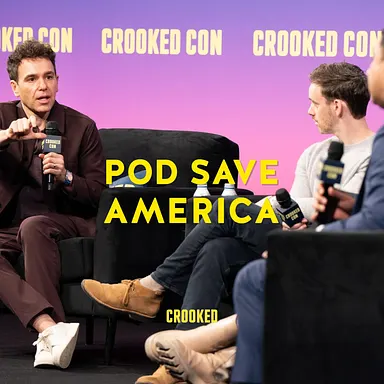
Pod Save America's panel with Faiz Shakir, Jerusalem Demsas and Derek Thompson debates whether liberalism can revive its appeal, weighing economic populism against abundance-minded policy and the risks of turning public anger into law. The guests argue over tariffs, housing, cost of living and how Democrats should govern once campaigns end.
The episode also features Iowa Senator-elect Josh Turek on his rural campaign and Mark Kelly on the Iran war, the Pentagon and whether he may run for president in 2028. Listeners will hear competing views on what Democrats should prioritize next.
In this episode Jon Lovett, Derek Thompson, Faiz Shakir, Jerusalem Demsas, Josh Turek, Mark Kelly
This transcript of the episode on liberalism, populism and Iowa's Senate race was made with the technology behind HappyScribe's AI note taker for Teams.
Ads in this audio differ from the text. Tap the sentence you're hearing to follow along.
Synced: the text now follows the audio.
Hey everybody, you're about to hear our final episode from KRÜGGERKONN. This was my conversation with Fahd Shakir from More Perfect Union, Jerusalem Densas from The Argument, and Derek Thompson from The Atlantic. We talked about the battle between liberalism, socialism, and populism—what happens when we harness people's anger for good and for ill. And we were joined by Josh Turuk, who surprised us by joining us at KRÜGGERKONN, and we got to talk to him about what it was like campaigning in Iowa and what voters from Iowa expect from him as part of this new Democratic majority.
It was a great discussion about some of the biggest divides inside the progressive movement. And then, after that, you will hear Dan's conversation with Arizona Senator Mark Kelly. They talked about pushing back on Pete Hegseth, ending the war in Iran, and whether he will be running for president anytime soon.
Hi everybody, welcome. Really excited for this conversation. You know, we were talking backstage about how we had planned to do KRÜGGERKONN: Rain or Shine, not a cloud in the sky. Very happy to be joined by Derek Thompson, by Jerusalem Densas, by Fahd Shakir, for a conversation that I've been interested in having because I think a lot of the debate online about the left versus the center—it tends to be a lot of people, you know, bringing some baggage over from the last 10 years that they've been dragging behind them.
And I think it's worth just stepping back and talking about what we can learn, and where we can find consensus, and where that debate can move forward. And so I guess I just want to start with each of you. Derek, I'll start with you. What did you take away from the victories in terms of what you learned about the policy views and ideological stances of these candidates?
Well, the victories were absolutely fantastic. And the last thing that I want to do is, like, you know, rest defeat from the jaws of victory. Like, Tuesday's result was so sensational that you almost don't want to even look at the inevitable debate that's going to happen on the internet, where every faction is going to claim that they're responsible for what happened on Tuesday and the other factions, the Democratic Party, are not. The way I've seen it, certainly for the last year, is that online, in the world of posters, they tend to think that their factions are zero-sum, but in the world of politicians, they understand that the factions can be put together.
So it's kind of like everyone thinks they're working with their own ingredients, whether you're a left populist or maybe you're an abundance pragmatist or you're a liberal or you're a moderate. And you come into this conversation being like, "Bacon is the best. Nothing can beat bacon." And then someone else says, "No, bacon is effing terrible. Tomato is the best." Then someone comes in from the left and they say, "No, it's lettuce. Lettuce is the best idea in the Democratic Party." And then here's James Talarico talking like a Bernie leftist while at the same time espousing abundance pragmatism and also moderating on issues like immigration and energy.
He's just making a BLT. And it's like the internet doesn't even know what to do with the BLT because the factions are so committed to the idea that only their truth can be the ultimate truth. I think in this respect, the politicians are smarter than the posters because they understand that to get not just 100 people to retweet you, but to get tens of millions of people to vote for you, you can't just be about one thing. You have to take a little bit from A, B, and C. And I think the candidates that won on Tuesday were very, very good at taking a little bit from many different factions and making something that was all truly their own.
Jerusalem, what about you?
I have a lot of views personally that are extremely unpopular with the American public.
Give us one.
I believe that there should be basically no restrictions on immigration. I don't really think that a lot of the rhetoric about trans people has been liberal at all. The idea that we should restrict what people are doing with their own bodies is, to me, insane. The idea that we're, like, legislating what people should do with their own children, if children have their right with their parents and their doctors to make decisions about their own health care, I think it's crazy. I think it, like, personally, I find it ridiculous. And I can, like, look at facts.
I can look at the country and I can see that there are lots of people who disagree with me, particularly in places like Mississippi, like South Carolina, like Texas, where you saw a lot of Democrats win. And I think historically everyone has understood this. I think even now everyone really gets this. You don't make decisions about whether or not you are going to believe something based on a poll. You believe what you think is true, you try to fight for it, and you confront the reality of electoral politics seriously.
And so to me, I think there's like this weird debate online about, like, well, did moderates do better? Did presses do better? Like, sure, whatever. Like, I'm glad someone's, I guess, figuring out some of the math there. But I think what's really important here is if you are someone who is very serious about shifting the country in your direction, you need to be very, very clear-eyed about where you're popular and where you're not and what it looks like to persuade people. And so I think that this sense of, oh, we shouldn't even, like, be looking at these, like, polling questions or we shouldn't even be looking at these electability questions, is actually an abrogation of our responsibility to the future of the movements we're trying to build.
If you want a future where everyone agrees with you that we should have more immigrants in this country, that they shouldn't be subject to these insane restrictions that we have put in both parties have put in place, if you believe that trans people should have this kind of freedom that cis people do to live their lives to the fullest extent of the law, that means taking very seriously that lots of people in this country disagree with you.
Fahd, what do you think?
I'm very happy. I've been, you know, many of us have been advocating for politics for a long period of time in which the Democratic Party returned to its roots as the champion for working-class people in this country. And in many ways, we all know that President Trump and his horrible record towards working-class people and his failed agenda, his lies, his hypocrisy, his hubris drove working-class people away.
And that was wonderful. Thank you, President Trump. Also, because so many Democrats across the spectrum got the message and understood that if working-class people feel that they have been let down and betrayed, that if we are honed in on economic questions—who has too much power in society? Are we angry at a billionaire class? And what can we do to channel expanding health care, taxing the rich, taking on big tech and AI data centers?
If we center that conversation, we will get vast majorities of people. And everyone got that message. And I'm very pleased to see that when we've centered the economic pain and suffering and said we've got an agenda that speaks to it, large numbers of people are there. And so, John, as I say that, I say we have conquered in many ways the hope and ambition of politics. And now the tough part comes because we are in the mode of policy. And so the question is, if we can all campaign as economic populists, can we govern as one too to sustain those majorities?
And it will be—it will require some of the factions and the tents and the pushes, and I get that. That's going to be a healthy and constructive tension. But I would hope—and I mentioned this when, you know, when the great mayor of New York City, Zoram Amdani, won—and many of us went and talked to, you know, DSA activists and people who had helped him get there. And I would say to them, and I say to you all now, is that as we have talented leaders step to the fore, hopefully we can give them the grace that they are going to fight for the best possible outcome, the greatest good for the greatest number.
That is our ambition. And we should push on them. We should provide that tension and give them the space to hopefully find what are the best ways to expand health care, what are the best ways to tax the rich, what are the best ways to regulate AI. As long as, in my view, we are centered on those major things that the American people were demanding of us and want answers to, we'll do all right.
So on this question of economic populism, it does seem like a through line that connects a lot of these candidates, right? You have Abdul is doing his version of economic populism. You're seeing that in Texas. You're seeing that in Mississippi. But populism can mean a lot of different things. And I sometimes struggle to understand the difference between populism as a kind of aesthetic, being angry at the right people, and then what the actual policies would be. For example, right, there have been populists campaigning on eliminating income tax for people under a certain threshold.
And I understand why that would be popular, but I think in the long run, when we act as if no one gets any value from their taxes, we're doing some damage. It could also mean going after the corporations. It could be stopping AI data centers. So what is good populism to you? And how does that then translate into a coherent economic agenda?
When we are doing it best, John, it reflects the passions of people, that grassroots movements matter to you, that you channel those. And as many of us know, there's unhealthy populism. So first of all, posit that. Put that on the table. What is unhealthy populism? Well, when there are righteous anger from the masses to say, "Deport them all. Build a wall. I am so angry at the other," then you have autocratic presidents say, "Great, I will be a negative populist, cater to those, and do destructive policymaking."
Healthy populism says, "I am angry at big tech. I am angry at the health insurance companies." And to understand that and channel that into saying, "Well, great, let's expand Medicare. Let's put in a data center moratorium. Let's expand Social Security benefits." That is healthy populism in which you are channeling that anger and frustration. You're reflecting it back to people that you are angry and I understand that. I don't sit above you as an elite and say, "Oh, my life's pretty good. I don't understand why you're so angry."
That anger and frustration of so many people matters to our policymaking. And what I was so pleased about in this election cycle, so many people who are candidates went out into town halls more than we've ever done before, right? When we got into town halls, many of the people at town halls course-corrected candidates. And those candidates are learning from them themselves. "Oh, I see how angry you are about data centers." So while maybe my instincts were to say, "I'm pro-AI development and I am very, you know, I think Jensen Huang is a very intelligent person and we should all appreciate, like, the big tech oligarchs have high IQ," maybe there are some people who may have had that instinct, but they're course-corrected immediately when they go into a town hall and say, "I'm pessimistic about AI.
I'm worried that nothing good happen in my life." And you saw candidates start to speak out on behalf of people. That's populism in real time. And when we channel that, then it leads to, I think this is the question you're raising, what is going to be the policy that comes out of it? We'll have a debate about that. But we start from the place of, do people matter to this movement? And, you know, if we channel this back, John, to like a couple of years ago, I was concerned and many of us were worried, and let's call it a progressive populist movement, that we were sometimes talking about things that while important, democracy, Trump's character, negative partisanship on Trump, I get that in my view, those times, while they were righteous and correct, they didn't always speak to working-class chief concerns.
And what populism did for you is level that playing field, say, "Hey, now when you're angry about gas prices, you're angry about health care and you're angry about AI, it's not merely about Trump. It's now about something that is affecting my life." That's populism.
Can I jump in here?
Yeah, I saw it rising up in you.
Yeah, I mean, I think one of the distinctions between my worldview and Fahd's worldview is on this question of populism because there are parts of economic populism which I think almost everyone who's on the left agrees with, raising corporate taxes, increased regulation on health care, whether that's Medicare for All or Medicare for All, whatever the version of that is. There are all of these things which I think are good and I don't think are just the purview of populists. But I think Fahd is aligning a distinction between the bad kind of populism and the good kind of populism.
Like, you could cordon it off in a very easy way. And one of the most telling things to me over the past couple of years is that this election, the decline in Trump's favorabilities can be tied majority, not even like, oh, there's one, two, three. It's like, number one, it's because of the tariffs. It's because of the cost of living and what he did with tariffs and what he did to raise prices for working people. Populists on the left and right before Trump's victory, including Fahd, were pro-tariff.
They were telling us the anger that they were seeing in the public about trade meant that we should be enacting a tariff regime. This is not because populists don't know economics or they don't care about working people. It's not because they didn't care about what it would do to prices. It's because when you take anger and you immediately translate that to policy, you often get political and policy choices that end up destroying your movement. If Trump had ignored the economic populists in his coalition and listened to the boring, annoying technocrats and economists, he would not have done as badly as he just did in this midterm.
And it's not like there's number two, like, oh, it was, there's, you know, immigration was number two. Cost of living is the reason why people were upset. Tariffs, I mean, I was talking to someone who was running these focus groups. There were individuals who could tell you about specific tariffs that they themselves had suffered on. I got married last year and I had to pay a tariff for my wedding dress. And I remember being really pissed off. And I think most people would be if a couple of weeks before your wedding. I'm a procrastinator. That's my fault. But, you know, I can't blame everything on Trump, apparently. But, you know, a couple of weeks before your wedding, you're like, well, in order to get your wedding dress that you budgeted for, you have to pay a couple hundred extra dollars.
And, like, I'm lucky to have a job where I could afford that extra couple hundred dollars. But, like, other people aren't. And for other people, that was a devastating situation to find themselves into. And so I worry that when we talk about populism, we talk about doing the good kind of populism, we forget how easily populism becomes the exact thing that we're trying to fight.
Fahd, I want to hear your response and I want to come back because I want to talk about where that comes from. Yeah.
Well, obviously, I hope we all understand that there could be good tariffs and bad tariffs and that if you have a president who engages in destructive and goofy and liberation day charts that no one can understand what this tariff is doing and why and why are we going after Canada, that all of us are united in the sense that that makes no sense. If the Fed was doing terrible things and it makes no sense, you don't want to abolish the Fed and say, "Oh, I never want the Fed." You correct it. You say, "Here's the good things and here's the bad things."
And in my mind, on a tariff regime, we had them under Biden, we've had them under Trump, in which we were protecting and trying to build industry in America. If you had auto workers, you have steel workers who are believing that we need to have domestic production, domestic manufacturing, we'll make it in America is something that I believe in. And if you want to protect and ensure that some of our workers here in America are going to produce some solar panels, are going to produce electric cars, are going to produce high-end batteries, you're going to have to instill some kind of domestic rulemaking and laws to ensure we aren't going to lose out those jobs and be competed unfairly against by foreign companies who are going to cheat and lie and steal to take away some of those jobs.
This is a very basic, fundamental understanding that if we care about some American workers, there are ways to do tariff regimes that are constructive. And I don't want anyone to think that just because you have a crazy president who does crazy and irrational things, that somehow everything, that anything he has ever touched, we could never do better. We could never improve upon. We could never find a way that you would take some share of a company and it might be positive and constructive. That if you were going to do Trump accounts, that you could imagine doing Trump accounts in a positive and effective way. If you're going to do Trump RX, you could imagine doing those in positive and constructive ways.
We shouldn't blind ourselves to some things, some directions are worth learning from in this moment. This darkness moment has told us the things that we should absolutely avoid. But I think this kind of zero-sum approach to tariffs, I just don't agree with. It isn't like everything that he has ever done is bad. There are some constructive things that we can learn from. And Biden, of course, during his regime, was doing some that I thought were constructive.
And by the way, didn't remove all of the Trump tariffs when he became president. So I think just.
That was a successful administration.
Yeah. Well, so probably you two would not agree on what a good or a bad tariff is because I think you are further to the left on this question. You are more of a liberal on this question. But I think.
Just to be clear, we've polled on this and DSA-aligned Democrats are the most anti-tariff of any coalition.
Well, this is probably there's never been a time in the history of polling, I would imagine, where tariffs have looked worse because we've never had tariffs applied this stupidly. So I just think that's a debate and a good debate to have. But I think stepping back, like, what is what's happening here? Well, I think you're talking about two different things. You're talking about moral populism and immoral populism, righteous anger directed at people who deserve it, and some of the anger we see from Trump that is less righteous as at undocumented people, at trans people.
And then there's where you put that anger towards immoral or moral solutions. And that's a policy debate irrespective of the anger. What I find interesting is why the anger is such a signal. And I would put this to Derek, which is because you've written about abundance and I, you know, you've abundance became kind of one of these locusts of debate. But part of what you're getting at, I think, is there's liberalism that actually gets things done, but then there's also politicians who seem like the people who are willing to do the work to get things done.
And if I asked Democrats of every persuasion, the centrist all the way to the far left, and I said, "All right, I've got Gavin Newsom, Kamala Harris, and Chuck Schumer over here, and I've got AOC, Zohran Mamdani, and Bernie Sanders over here, which one of these two groups do you think cares more about solving the problems in your life?" And I don't think there's very many people who wouldn't say it's the left. And that is not endemic to the project of being a liberal, that you care less or seem to care less about problems.
And if your solutions are more market-oriented, you're just not as into actually getting anything done. And I'm just curious how much you think this policy debate is taking place in a vacuum that liberalism created.
I think it's really, really important to reflect the anger of the public. Right now, if I'm being honest, I do think that economic populists are better at reflecting that anger than some non-economic populists. That said, what are people angry about? They're angry about cost of living. The 2024 election was a cost of living election. Donald Trump won with a mandate to reduce cost of living. What's the first thing he does? Increase the price of anything that we import via tariffs and then start a war in Iran that mechanically raises the price of gasoline and diesel.
I mean, people were upset about the cost of housing. He slaps a tariff on timber that comes in from Canada. He slaps a tariff on the drywall that comes from Mexico. All of the inputs into a house suddenly become mechanically more expensive despite the fact that he won a cost of living election. What was the result of immediately raising the cost of living in response to a cost of living election in 2025? The people who won, Spanberger in Virginia, Mikey Sherrill in New Jersey, ran on cost of living and they won in 2026 this midterm.
Why did the Democrats just win? What did Americans by and large say they were voting on? Cost of living, inflation, economy, lots of different synonyms for the same idea. We're mad about how much everything costs. If people keep winning cost of living elections, how about a fricking cost of living agenda? How about an agenda that actually is focused very, very narrowly on reducing the cost of living that looks at housing and says, "Why is it so difficult to build a house? Let's make it easier to build a house."
That looks at energy and says, "Why is it so hard to add different kinds of energy?" Let's pass, for example, a permitting reform bill, which is currently in the Senate, to make it easier to extend transmission lines, to have the electrons that are created by a solar farm over here power your razor over here. Let's find a way to end the war in Iran, which is create, which is again automatically raising the cost of gasoline and diesel, which is an input into everything in the agricultural economy, which is, I think, a huge part of why states like Kansas and Iowa went blue.
I'm glad they went blue, but they went blue because people are feeling pain. So I agree with Fahd. I think it's really, really important to hear that people are angry, but I want the policy responses to actually solve that anger and not just talk to that anger, right? I want to solve the problems that people say they have. And I don't want to suggest here that I think that all economic populism does is simply, like, massage the anger of voters in ways that don't fix their problems.
There are solutions over here that some people really, really love. But what I'm focused on and what abundance has been focused on is how do we change the rules and the laws that make it harder to build things that will actually make people's life more affordable? To me, there's a really, really clear connection between these ideas among abundance liberals and the things that people are asking for. And by the way, it's not just, like, the libs like me who think this.
Zohran Mamdani is not going to be mistaken for, you know, a liberal centrist. But if you look at his housing team, one of the things that they are filthy with abundance folks. They've tried very, very hard to make it easier to develop housing because he knows, he knows that if you want to bring down the cost of housing, you have to build houses. There was a really interesting moment, last point, really interesting moment in the Breaking Points podcast where Sagar and Jedi was talking to Abdul Al-Sayed. And he said, "You know, Abdul, you have this policy where you want to freeze property taxes for seniors.
And I just don't, I don't like that idea. I think that's going to make housing more expensive. It's going to put it out of touch for more young people. I don't like that idea." And what Al-Sayed said immediately was, to be clear, "Sagar, I support building more homes to reduce the price of housing." Boom. His response in that moment is the first chapter of abundance. Like, that's what I ultimately want. How people win elections, what rhetoric they use is less important to me than the policies they pass once they have power.
And I'm excited for the fact that across the ideological spectrum, I see a lot of people talking as if they've read the book, even if they haven't.
Fahd, what's your response to that?
There's a lot to learn from how we should clean up and reform government, do deregulation, improve people's lives. The thing about many economic populists, and obviously Zohran is one of them, is that in the manner in which they campaign, they create a mandate for how they will govern. And so if he's going out and he's talking at a town hall and, you know, he didn't mention too many of the regulations that Derek did, but he's prepared to govern upon them. What did he talk about on housing?
Freeze the. What did he talk about on childcare? Universal childcare.
Maybe the whole world isn't New York after all.
Yeah. These are what is he doing there? He's saying to working-class people, "I am materially prepared to do something bold to change your life." He's not precluding that I will also do changing the staircase regulation and also help, you know, make sure that construction can happen in the city. He's not precluding it. What he's doing is creating a mandate to say, "Working-class people will know that you will see a direct benefit materially in your life. You will see universal pre-K in this city. You will see rent being stabilized and reduced in this city."
And that process of thinking about major reforms that would impact the pocketbooks of working-class people is what I am after. The big ticket items to my mind are things like housing, buying a car, childcare, college education. Take those things and you say, "These are major parts of working-class budgets. They eat them up in major ways. What can we do to reduce the cost of each one of those in major ways?" And I would say of many, you know, if you look at Bernie, you look at some of the populists, what we have campaigned on, that's where he's living, right?
On healthcare, on education, on universal childcare. Here's the big things. And then when we get into governing, Derek, you know, drew some completely correct. Now you have the world at your disposal. Lots of things to do. Many opportunities. Do them all.
So what I like about that, so I do think that to me is what I'm taking away from this election because, you know, I talked to Zohran when he was running about housing. And it isn't just that he talked about freezing the rent and was open to somebody's other policies. He made a point of saying that he had been persuaded by the need for more market housing. We just elected Nithya Rahman in Los Angeles. Same thing. She's somebody who has evolved on housing to come to see why we need much more market-rate housing. In fact, one of the divides she had with some in the DSA was that she had come out to reform something in LA called the ULA, which is a mansion tax that was also inexplicably applied to multifamily housing and was really counterproductive.
The city council still stood in the way of fixing it, but we can talk about the problems in LA later. But what I hear in that is kind of a synthesis of what you two are talking about, which is this is going to be very glib and I don't think it's what you mean, but it's a little bit socialism in the streets and liberalism in the sheets, right? Which is big, big important populist economic policies like freezing the rent, free college, Medicare for All.
What I'm about to say doesn't apply to Medicare for All. Policies that actually economists would say can be counterproductive, but backed up with a growth agenda, building houses, changing building codes that will actually over time have the market-based impact of getting the results that you want. And there's a lot of, I think, ideological confusion because I think liberals have been, I think, so timid and feckless in the establishment. But it's about the anger of the populace being translated into things that will actually work.
You know, abundance was attacked a lot as like, "Well, that's not a program anybody's going to get behind." But it sounds like what Fahd is saying, it doesn't need to be the whole program. But if there's a politician out there that's going to be calling for Medicare for All, well, I'll also get behind a policy of forcing the AMA to have more doctors. I don't know what you think of that.
There was no point in writing the book where Ezra and I had a phone call where we said, "This book only succeeds if candidates campaign exclusively on pages 14 through 97," right? The idea was never that these rules would become the only words that people could choose to put on bumper stickers. People should run based on what's happening in the world and what's happening to the people's lives that they're trying to get votes from. I mean, you know, I think someone like, for example, Jon Ossoff, I wouldn't, I don't know that you would necessarily think of him as an economic populist.
He has a very clear message. Cost of living, yes, but the other C, corruption. He is incredibly, like, magisterially articulate on breaking down Trump's corruption. It would be crazy to say that abundance liberals want to stop people from talking about Trump's corruption because then they're not running on the principles of abundance. No, like, you should run on what works and you should run on what's happening. Trump's corruption is lurid. Of course you should talk about it. People's cost of living is much higher than it was six months ago.
Gas prices are significantly higher than they were because of an unbelievably stupid war. You have to talk about these things. But at the end of the day, what I care about is outcomes. I want people's lives to get better. And people's lives get better not because of what happens at the ballot box, but because the people who win based on what happens at the ballot box do policies that make people's lives better. That's what I care about a hundred times more.
And so I think Jerusalem, one of the things I think that I take from your writing is you're not motivated by fear and rage. You're a data person and you're an economics person. And it makes you uncomfortable, even if that anger and those strong emotions lead people in the right direction, because it could lead them in the wrong. But it also means that some of the more boring and important decisions we could make don't get a lot of attention and obviously don't become campaign talking points, right?
Like, no one's going to campaign on the problem of where we put our stairwells in buildings. Certainly, no one's going to make a campaign around the importance of permitting reform. And yet, probably right now, if you could think of what is the most important thing we could do to have a clean energy economy going forward, it would be to pass a deeply unsatisfying, complex, confusing, in some ways contradictory permitting bill. Weird town, DC.
And so I feel like sometimes you are sort of screaming from the rafters for everybody to calm down and just listen to the technocrats. And there's literally no constituency for you. How does that feel?
So I like not being a campaign strategist. That is not my job. I run a magazine and it's called The Argument and we love, thank you. And I think a couple of things. There is a view that the anger people feel, which I feel too, and I'm motivated by anger at what I saw happen to Alex Pretty. I'm motivated by anger watching families get torn apart. I'm motivated by anger of hearing from friends who feel like they can't live in the states where they grew up because they don't have the abortion or trans protections that would make them feel safe to live there.
Anger is normal. Anger at reality is correct. But then there's a question of centering your own emotions in political debates that influence not just the 330 million people that live in this country, but the billions of people who live all over the world. My anger does not help a child in Gaza. My anger does not help a child in Tigray, where I'm from. My anger does not change what's happening under authoritarian regimes all over the world.
It does not solve malaria as one of the leading killers of children. What does do those things? What I care about and who people I like to support are individuals who understand the anger that I feel, that are motivated by the same principles and values that I hold, but also are not so overwhelmed by their emotions that they can't actually step back and think, "Well, then how do I help people?" Because over and over again, this is the problem that happens with populism.
Because again, like, if we're just talking about whether or not, you know, someone can reflect rage back at an electorate, that's across the political spectrum. You have really far right authoritarians doing that in some countries. You have far left socialists and communists. You have centrists who are able to do this. I mean, that is literally what's happening in Canada right now is you have a centrist prime minister who's reflecting his country's genuine rage at the American tariff regime. This is anger and being a good politician is not the purview of any political party.
What populism does is it says that anger should be your guide for what exactly what to do. Not values, not understanding, but if everyone says in the country, "You know what? We're really, really angry about immigration and we're really upset about immigration," that is a signal that democratically elected representatives should use to understand how to fix the immigration system to actually resolve those concerns. What were those concerns? They were chaos at the border. They were the fact that state and local dollars were being taken up by immigrants and not going towards native-born population.
I had very progressive people telling me under the Biden immigration wave that they felt like New York was full because they were watching migrants on the streets in downtown Manhattan. What is the reaction to that? Populism says, "Okay, stop. It's very, very simple. Just stop. Stop these individuals from coming in." And you have also, I'll say, left populists who have become also very anti-immigration as a result of this. But liberalism says, "Yes, people are angry about immigration. How do we resolve that while remaining true to the things we believe?"
Many things you can implement to do this, and I won't give you my entire dissertation, but you can read about it on theargumentmag.com.
One of the ways in which people have signaled their disagreement with that establishment is by running a little bit against the Democratic Party. They've either run as Democratic Socialists or just in their kind of presentation as outsiders from the Democratic Party. But when you look at, say, sort of what Bernie Sanders has argued for, or you look at what some of the more left candidates outside of, say, city-run grocery stores, it's actually more of a signal of being willing to fight really hard and do more than what the previous elected leaders have done.
A little bit more than that, Jon. I think you're on the right track. The indefensive rage and anger channeled constructively into policymaking. One of the biggest problems we face in our political and economic system is capture of the elites, capture of big money. If you agree with that, how are you going to take on established corporate monopolies, concentrated power? If you have the willingness to do it. You may not, right? Some people just want to, public-private partnerships will fight.
And there's roles for that, right? Some of the things that Derek is talking about, there's ways that even the elites would be comfortable with. But there's some things that the elites are not going to be comfortable with. Pierre de Terre tax or some taxing of the rich. They're going to be angry with. Well, if you are a constructive populist movement, you're going to know that people are your power. That if I'm going to push against a billionaire class who's going to say they want every data center in every community in America, the rage of the people constructively channeled is what is my bulwark, is to ensure that the policymaking that is going to happen is going to happen for working-class people because you and I will know that the rage of people matters here.
If we're going to tax the rich, that I'm going to channel what is the actual feeling of working-class people into this debate. I'm not going to tell you I'm smarter than you. I got a better idea than you. I don't really care. Just now's my time to govern. You can go sit in a corner. No, I'm going to bring you into governing. We're going to fight this fight together because I know together we are dealing with too much concentrated power at the top. That I do think is a fundamental difference just in how we might think about the transition from both politicking and into governing.
That you're creating mandates while you're politicking to do some of this governing in which the populism that you've created and cultivated is helping you drive an agenda to work for working people.
Yeah.
I guess where I'll lead this is what I I'm glad we're having this conversation because I do think a lot of what becomes these very dug-in debates online really ultimately ends up being a conversation about how we are going to reimagine some version of New Deal liberalism today, whether it's building very quickly and better or kind of figuring out a set of policies to have a market economy that doesn't leave a whole swath of the country completely destitute or kind of building a safety net for people, right?
And I think whether it's, you know, socialism versus liberalism is really more of a debate about what it becomes more of an aesthetic debate. I don't mean that in a pejorative way. Like a debate about care and attention as opposed to outcomes. And the outcome debate becomes a little bit more, I think.
But Jon, I do think there is a tension of fighting against elite power.
Yeah.
I do think that, I mean, you know, if we got into some of this, there is a little bit of a concern over if we're going to stop AI from banning all prior authorizations, right? Or use of AI in medicine. Who's for AI in medicine, right? We all know, right? The United Health and many of the companies are good with it. And the question then becomes, do you, are you comfortable taking them on and doing things that, as you say, are going to possibly be economically deemed to be by an elite economic class not great.
But sorry to interrupt.
Awarding progress.
Right. But what I think what's interesting is I would say I'm looking for the kind of liberals who are ready to have that fight because they're furious about what these companies are going to do and they believe in a market economy that works and sees the way these institutions undermine it. And instead, we have kind of ideologically incoherent or just ill-considered establishment politicians and people with fire in their belly fighting against these institutions. And there's this space that I think writers on the outside fill in.
And my hope right now is that we have a new group of politicians, some of whom were able to kind of quietly run heterodox campaigns because no one thought they were going to win and now they're going to be in the Senate. And we actually have one of those candidates here. And so I do want to bring him into the conversation. And we were so appreciative that he could make the time. Please welcome the next senator from Iowa. It's Josh Turrick.
Hi. Thanks for being here. Good to see you.
Good to see you. I'm going all the way last month.
Yeah.
Thank you.
Josh Turrick. So we're having a very intellectual conversation about what it takes to win people back. You just did it on the ground. You've had a, what, 48 hours to think it over? 72 hours?
About.
What are you, what is so far your sort of lesson about going from somebody people basically had written off to someone who is now going to be a senator representing Iowa?
You know, I said for 450 days that the right candidate with the right message, right work ethic, and the right political wins, we can win anywhere. And I'm really, really proud that the blue tsunami absolutely smacked Iowa. We won three congressional seats, a governor's race, and a Senate race.
Do you see yourself as an economic populist? Like, how do you, and what does that mean to you?
I consider myself a common-sense prairie populist. And I'm happy that we once again have representation in the United States Senate from prairie states. We used to be able to win. Tom Harkin for 30 years in Iowa, Dashiell up in South Dakota. Now that we've got representation, Iowa, Kansas. Yeah, I think that this is all about economic populism. The issues that were important in Iowa, what we heard every single day was cost, corruption, kitchen table issues. I was running for 450 days on a livable wage, affordable housing, affordable healthcare, drinkable water, functioning public schools, overturning Citizens United, corruption, term limits, banning members of Congress from trading stocks.
These are the issues that people care about.
So if you think about what Trump has done as the fuel, I think it still matters what kind of car you're driving. I still think it matters who's driving the car, right? I think campaigns matter, candidates matter, even in a climate like this. But obviously, your campaign benefits from the fact that this is a moment in which people are extremely dissatisfied. How do you think of your job to keep a bunch of people who may have voted for Trump two or three times and could very well send you or some of your colleagues in two years packing because, you know, they wake up like, like, what happened?
What happened? What did we do last night? Kind of a thing.
You're absolutely right. What I think we have to do is from day one, we have to prove that we are the party of the people, the party of the workers, the party of the middle class. And every single day, we have to provide policy, solutions to people's problems. Because what I'm convinced of is the reason why people voted for Trump is because he accurately identified the problem, that the status quo was not working for the middle class, for the average Iowan. The problem is his solution was completely the opposite.
So for 450 days, I've been saying, I've got the solution. It's prairie populism. And so now we've got to go out there and immediately provide results. And that's going to be ending the war, repealing these tariffs, bringing back ACA subsidies, raising the minimum wage. These are the issues. If we don't provide results, that pendulum is going to swing right back and we are going to be renting these seats for two years or six years.
So big coalition. You know, Hakeem Jeffries said that Americans didn't elect Democrats to get even. They elected Democrats to get things done. And I think that statement has the benefit of both being true and making everybody really, really mad because of what it, what people think it actually might mean. And, you know, Donald Trump says, oh, I want to work with Democrats.
Then he appoints someone like Stephen Miller to be chief of staff, which suggests he's much more interested in not working with Democrats. But you're someone clearly elected on this economic message. There are people that are going to be pushing for big fights on accountability that are going to make Trump less likely to sign bills to overturn Medicaid cuts. Do you view the corruption piece of this, the accountability pieces, as something that is an equal task? Is it something that you care about, but is not nearly as important as the economic message? How do you think about it?
We certainly have to have accountability in government. I mean, people have lost faith in their institutions and lost faith in their representatives. And so there certainly is an accountability component. But for me, what I'm really clear of is we did this. I mean, we impeached Trump twice. Where did it lead us to? I think that the goal is we provide policy, solutions to people's problems in a bipartisan way. We have to address the cost and corruption, kitchen table issues. That is what I'm laser-focused on.
Faz, you mentioned this when we were talking earlier, that there was a period of time where Democrats were focused on legitimate, important, but non-persuasive topics, right? Defending democracy, Trump's terrible character. We're in this euphoric moment where everybody gets to be for everything. We're for investigations. We're for repealing the Medicaid cuts. We're for ending the Warner Rent. I agree with that. We should be fighting to do all of those things. But there's going to come a time of choosing where we're going to have to figure out what we can get from this president, if we can get anything at all.
And at a certain point, what you just said becomes a question for Congress. Do we put aside, potentially, do we put aside some of these questions and focus on getting a deal on something like Medicaid?
Well, first of all, you're going to, in my view, not discount that Trump could sign something. Like Josh just, Senator Turrick has mentioned that he's campaigned on raising the minimum wage, right? And many people did. Is it possible that majorities in the House and the Senate could pass the first raise in the minimum wage since 2007, negotiate what that number will be, show back to Iowans we put it on Trump's desk? What do you think Trump's going to do? If you think you know, you don't know, right? No one knows. But I think it's our obligation to compel that action.
The last time we raised the minimum wage was when President George W. Bush was president. The House came in with majority leaders Pelosi and Harry Reid. It was $5.25 an hour then. They compelled. They put it on his desk. They put it in a bill. And they said, Mr. President, you're raising the minimum wage from $5.15 to $7.25 an hour. That was the last time we did it. So my point being that don't just think, oh, well, Trump's president, all we can do is investigate him. All we can do is, yes, we can do that. But we've won, to his great credit and to so many prairie populists, speaking to this economic pain, we can and should deliver on healthcare expansion, raising the minimum wage, and so many other things.
He took on Big Ag in a very successful way. Cancer rates in Iowa are going up. Many people angry at the consolidation in agriculture. Now, is that a world that you could imagine that working with people who are similarly minded about wanting to take on that power is possible, right? I got to believe it's possible.
So, and I want to open this up to everybody, but I'll start with you. Senator-elect Turrick, that's fun to say. Must be strange to hear this week. You know, a big part of what we've seen is a shift of rural voters to the right. And that's happened over many years as those, as these parts of the country has felt as though the Democratic Party didn't represent them, their policies didn't speak to them. I think there's been also a lot of propaganda to make Democrats seem like, you know, outsiders to those communities trapped in the cities, which many of us are.
What would you like to see now that we have sort of this new vanguard in places like Iowa, in Kansas, Democrats do in the Senate and in Congress to prove that we deserve the support of rural parts of the country again? And I'm curious what others think about that too.
Certainly going to have to provide results. I mean, Iowa has been hurt more by the war in Iran. You know, gas prices going up, diesel prices at an all-time high as farmers are out there harvesting their crops, input prices like fertilizer prices skyrocketing. And they were already skyrocketing because we had done nothing to address monopolies. The tariffs were really decimating my state in particular. So I think we need to have mandatory cut-shrimp origin labeling on beef and pork. We can help bring back actually beef producers in this country that way.
I would like to see us pass a farm bill. I'd like to see us have year-round E-15. There's a lot that we can do, but we need to pass a farm bill, but a farm bill that doesn't just benefit Big Ag, that actually benefits rural communities and small family farms. Because it has been the rural communities that have been hurt the most by the policies, the War in Iran, the tariffs, the Medicaid cuts. I mean, in a state like mine, 3.2 million, in the last six years, we've closed 842 healthcare entities, 160 independent pharmacies.
These are communities that are hurting and struggling. We got to pass a farm bill to actually provide results for these people.
I'd love to ask a follow-up question about the farm bill. You know, we were talking earlier about, like, what would a real cost of living agenda look like? It's like, it's so ironic that just two years ago, Trump won for the exact same reason that Americans just repudiated him, which was cost of living. And now there's a real opportunity to build a cost of living agenda. If we imagine it as like a stool, I definitely know two legs of the stool. You just said diesel, gasoline, we got to get out of Iran. The tariffs, they severely hurt a lot of states.
And I think Iowa is toward the top of that list. But I'm interested in what the rest of that cost of living agenda looks like. What actually brings down prices for everyday staples? And maybe you can talk a little bit about what the farm bill could include, like what policies we could put in a farm bill that doesn't just help, as you said, the biggest companies, but also helps mom-and-pop farms get ahead.
I would say one, we've got to make sure that wages keep up. And so raising the minimum wage. I've said the very first bill I want to sponsor is a dignity and work bill. Raise the minimum wage, do away with sub-minimum wage, and also pass the PRO Act so our workers can collectively bargain. Got to end the war, got to repeal the tariffs as well, guardrails on insurance companies. I mean, my God, doctors should be deciding care, not insurance companies. We've got to bring back the ACA subsidies. That was 119,000 Iowans that were seeing their healthcare premiums double or triple.
In a state like mine as well, prioritizing public education, I think. We were the gold standard because we're giving public dollars to private schools. We've dropped down to the bottom half. More infrastructure to address cancer rates and water quality is another point. Yeah.
And I also have a question. We're now three interviewers to one subject. So one thing that we briefly talked about is that we're seeing kind of a nationwide tax revolt right now that I think has a lot to do with people's real struggles with affordability and not wanting to see more of their money going to government. But, you know, obviously there is raising taxes on the wealthy and raising the corporate tax rate. But we're seeing people wanting to eliminate income taxes on large swaths of the population, wanting to see people eliminate tax on tips and tax on lots of different kinds of groups that will really drain the ability for us to do things like fund Medicaid, Medicare, Social Security, et cetera.
How are you thinking about this moment and the tax revolt we're facing?
I think we're living through a second Gilded Age right now. And I think two of the biggest issues is tax avoidance and addressing the wealth divide. And so one of the best things we can do, tax billionaires and large corporations their fair share. I actually, I say that I do agree with President Trump. No tax on tips, on overtime, on Social Security. Let's stop shifting the tax burden on the backs of the middle class and regressive taxations like sales tax. And let's actually do what we have done for a large part of this country's history.
And let's tax the rich and the billionaires and large corporations their fair share.
So I interviewed Alyssa Slonkin this morning and she was talking about the dissatisfaction with the possibility of Chuck Schumer being leader. There seems to be some sort of text chain going on among some new potential senators. I don't know if you're on that text chain, if you've been added yet. Are you part of discussions about who the next leader should be? Are you planning to vote for Chuck Schumer?
Can you unlock your phone and just give it to John? I think it was a good question.
You wouldn't like the amount of text messages that I've got to respond to. I am not in that text thread. I will tell you what, I am excited to sit down and meet my colleagues here. Just got off a plane literally like an hour ago. And I want to sit down and I want to speak to every single person that is wanting to run for leader. And I want to ask them a variety of questions. I want to say, what are you going to do for Iowa? What are you going to do for Iowans? What are you going to do for the middle class? What are you going to do for the workers? What are you going to do for the rural communities that are being decimated?
What are you going to do for small family farms? I mean, for 450 days, I've been out here running on this prairie populist agenda. And that is a livable wage, affordable housing, driving private equity out of housing, healthcare, nursing homes. Healthcare is a human right. Affordable pharmaceuticals, drinkable water, functioning public schools, term limits, banning members of Congress, overturning Citizens United. The person that I will vote for is the person that most best aligns with that. And I'm excited to sit down with everybody that wants to run for leadership because this is, we've been given a mandate by the American people and we need to come through with solutions.
It's funny. I'm seeing Faz just sitting there being like, I don't even have to say anything and I'm winning this conversation.
Credit to Senator Turrick, how many events did you do in Iowa during the course of your campaign?
Oh, God, I don't know. 450 days, 99 counties. We went to every single large community, midsize community, small community. I think that when you were asking me about, you know, losing touch with rural communities, I think that's been one of the problems is that you haven't had enough Democrats that were willing to go into these deeply red counties. And, you know, for me, what was a benefit was I have been for the last four years the Democrat that represents the reddest district in the Iowa legislature.
So the two communities I represent, Trump won by 18 points and 10 points. I had to talk to a lot of Republicans. And I realized that if you're willing to get face to face with them and talk to them, say, look, not vilify them, I understand why you voted for Trump because he accurately identified the status quo wasn't working for you. But here's the solution to those problems. We could win them over. So I spent so much time in rural communities with farmers and I think that's why we were successful.
I'm going to, you know, give me your thought. Are all tariffs bad, Senator Turrick?
Not all tariffs are bad, but I'll tell you what, this chaotic, look, I didn't hear the, I'm not kidding. I got off a plane literally a second ago. So I didn't hear earlier part. Here's what I'll say about tariffs.
You were just, honestly, that is, I just wanted to say something. If you're doing that inside of your relationships, shame on you, all right? It is not healthy to go look for outside validators. Just represent yourself and talk to Jerusalem directly if you have a disagreement.
Senator, all I know, you gave me a candidate who has talked to real people and we're going to just hear, because I believe Senator Turrick has heard from some real people. Now, honestly, like, give us the tariffs answer. How do you talk to Iowans about tariffs?
Wait, wait, but what are good tariffs?
Good tariffs are tariffs that protect American jobs and American manufacturing. So, for example, like the automobile industry is a good example of a tariff that I think is positive. Not off the backs of rural communities or the agriculture industry and not this chaotic tariffs. Farmers need trade and free markets more than any other group. And when you're going after, they have lost their markets. It has led to commodities prices being upside down. So when you're going after their primary trade partners, Canada, Mexico, I mean, we have completely lost the soybean market with China because of these ridiculous tariffs.
So smart strategic tariffs to protect American jobs, not off the backs of the agriculture industry or off the backs of Iowa farmers.
Jerusalem, I would, I'll ask you a question. Presumably, if we are in some sort of a dispute with a country like China that does do a lot of anti-trade policies and protectionist policies, presumably a good tariff is a tariff that we apply as leverage in a negotiation towards ultimately a more free trade agreement. There certainly are good tariffs that help American workers.
Yeah, I mean, I want to be very clear here. All tariffs raise prices. So the question is, what do we think is worth raising prices for? For national security, of course we should raise prices. If we're saying that the Chinese government is creating market power in a way that's going to disrupt our ability as a nation to fight wars, of course. But like, we understand that the way that we're doing that is raising prices on consumers. We're not pretending that that's somehow like good for people. I think that most of the ways that people talk about protecting American workers through tariffs can be done through subsidization just as easily without raising prices.
So much of what the, you know, the climate bill under Biden did was it subsidized a ton of industries in the United States to make it possible for them to build tons of clean energy. My husband works for a thermal battery company that got one of these tax credits and is literally right now helping decarbonize the grid because of these investments. And that's a way you can improve American jobs. That's a way that you can do that without raising prices. So every time someone suggests a tariff to you, first you should ask yourself, is this worth raising cost to the American people at the moment when they have told you the number one thing they care about is raising prices?
Sometimes it is. And two, is there any other economic tool you can use other than tariffs to get to the same ends? Is there redistribution of taxes towards people that we think are in economic pain? Is it raising the minimum wage? Is it increasing subsidization of various industries? All of these are tools that many people can use that don't raise prices. And so to me, yeah, sure, I agree. There are some strategic tariffs you can do, but most of what Biden was doing was, I think, quite bad as well as what Trump was doing, including the tariffs on lumber from Canada, the tariffs that were protecting American jobs, which I think did not actually do that.
Well, Senator-elect Josh Turrick, thank you so much for taking the time to be here. I'm glad you could be here and bring some of your experience from being on the ground in Iowa, which I think it's really helpful. And I appreciate this panel for having this discussion because I think what's exciting about this election is it gives us an opportunity to kind of move a lot of these debates forward and find the places of consensus and brand new stuff to fight about. And so thank you to Derek Thompson.
Thanks, Senator.
Thank you to Jerusalem Densis. Thanks, Faz, for being here. And thank you, Senator-elect Josh Turrick.
Please give Senator Kelly a warm welcome.
Thank you for doing this. Thanks for being here.
I'm going to ask you about the election results, the campaign, what's going to come next in the Senate, what may be coming next in your life. But I want to start with some news we got yesterday. Yesterday, Donald Trump fired Susie Wiles, appointed Stephen Miller as chief of staff. Get your reaction to that. What do you think it means for what the next two years are going to look like in America?
Well, I was really surprised. I thought the president would have learned a lesson from last Tuesday.
Famously introspective Donald Trump, yes.
Right. Apparently 80-year-old, you know, men like this president don't learn lessons. He represents the worst of this administration. And the stuff he has done on immigration enforcement has resulted in dead Americans and people illegally being sent overseas. It's been a disaster. Now with him as the chief of staff, I don't know if the president can push back against this guy.
So I'm worried about it. And we'll have to see what happens. Donald Trump has the right, I guess, to put whoever he wants in that job. We have no role in the Senate. We can complain about it. That's about it. Maybe he won't be there for long. That's the hope.
There's not a long shelf life for most of his chief of staffs over the years.
Susie Wiles was the outlier.
Yeah. I mean, two years.
And it's interesting, the people that get fired in this administration happen to be women, right?
Yes.
Right. Kristi Noem, Tulsi Gabbard, Pam Bondi, now Susie Wiles. I could think of others that also need a good firing.
Yes. We got a couple of those on our list we're going to get to. Let's talk about the election. You spent a lot of time, you were traveling all over the country. I just want to get a sense of what, you know, obviously we thought we might get a blue wave, thought we might get a blue tsunami. We got something even better than that. Just your sense on what drove this election and reaction to the results.
Well, we did a little poll in my Senate office the day before the election about how this would all turn out. I've been to 23 states campaigning with people this election cycle. Senate candidates, House candidates, governors, even Ledge candidates. And I could really feel the energy. So when I filled out my little ballot for our in-office poll, I put us at 55 Democratic senators and 250 House members.
That's pretty good.
Yeah. And most people thought I was crazy. But I could really feel it. And we have great candidates that were running. I was down helping Annie Andrews in South Carolina. About a year and a half ago, I'm sitting on my daughter's couch in Tucson. My daughter Claudia, and she says to me, "Dad, do you know Annie Andrews?" And I said, "Never heard of her." And he says, "She's running for Senate in South Carolina.
Watch this video." So a couple days later, I called her, reached out to her, started talking to her and kept in touch. And I really saw something there. I thought, you know, if things went well, she could win in South Carolina. And of course she did. But now we might even win a seat in Mississippi.
I'm so glad you had the reaction to Annie Andrews because I had her, I interviewed her on Pod Save America and it was sort of when Darlene Graham was already the nominee, was already the nominee. And I was like, maybe you have a, like just mathematically, maybe there's a shot. But then when you meet her, she is a star. Like you just know right away she is an absolute star.
Yeah, I became a big fan.
You have, you know, now we're sort of like the dog that caught the car, right? Voters picked us, picked Democrats because they're angry about costs and they want to end the war. What, and recognizing that Donald Trump is a veto pen and the filibuster still exists and all of this, but what can, what do you think Democrats need to do in the Senate to be responsive to exactly what voters want right now?
Hey, we have to deliver. We've got to deliver on cost. We got to deliver on this war and do things to compel this president to end it. He also needs to get rid of, I talked about firings. He needs to get rid of the Secretary of Defense. I mean, this guy, I mean, if I was to rank the disasters in this administration as people, he's the biggest disaster. I mean, he is the one that drove this conflict, that convinced the president.
It seems that he convinced the president this is going to take a number of days. And now we're over six months. And he is by far the least qualified person for a cabinet position in this administration. He also made a decision, I think it was him, we need to find out. And I would like to find out who drove the war plan. Like why did we bomb 16,000 targets and use up an enormous amount of munitions that, by the way, means that all of us, everybody in here, everybody across the country is now less safe because Pete Hegseth had no idea what he was doing.
That guy needs to go. The president should fire him. If he doesn't, we'll see what happens this week.
Do you, on Hegseth, like Thomas Massie in the House has proposed an impeachment process. Are you open to that process? If it comes to you in the Senate, do you think he should be impeached?
Did you look at the articles of impeachment?
Yes.
I mean, one of them is about me.
Yes.
Specifically.
I just want to get you on the record here. Yes.
So yeah, of course. And it's not just because it's me and the articles of impeachment. This guy, and the worst thing he's done has nothing to do with me. Though he is trying to silence millions of veterans, especially retired service members like myself. He wants to shut us up. I mean, I said something, president didn't like it. President said I should be hanged, executed, prosecuted. He couldn't even get the order right.
And then they tried to prosecute me and five of my colleagues. When that didn't work, Pete Hegseth tried to reduce me in rank and take away my pension. So then I had to sue him. So that case is still working its way through the court. I was wondering just the other day if he's no longer the Secretary of Defense, what happens to my lawsuit? Because it's Kelly versus Hegseth.
I think they just swap out Kelly versus whoever the next Fox Weekend anchor is who gets the job. Yes.
Right. Jesse Waters.
I was going to say Fox. It's Kelly versus Waters. Yes.
Can you talk a little about the, like obviously, as you mentioned, the idea of the conception and execution of the Iran war plan has been disastrous. But it's not obviously the only thing that Hegseth is doing to the Pentagon. Just talk about what do you think about the long-term damage to the morale, the readiness, the safety of the American people through his leadership at the Pentagon?
Well, all of that has been negatively affected, right? Morale's in the gutter. The firings of admirals and generals, some of our best leaders dismissed without cause. Just changing the culture. The culture is about killing people and lethality. Those are Hegseth's words. He would run around on a stage. I've never seen anything like this from anybody that I've ever served with. I spent 25 years in the United States Navy on active duty.
From senior enlisted to junior officer to senior officers, I've never seen anything like that where it becomes just about how many people can we kill at any given moment in any given conflict. And then this whole thing about testosterone. I mean, the U.S. military doesn't need more testosterone. It needs better leadership right now. And that starts with him. So it's going to take a while to put the pieces back together.
And the damage to the leadership ranks with these admirals and generals being dismissed, that's one thing. The other problem is that we have a lot of officers, middle-grade officers that probably thought to themselves, maybe it's a woman or a person of color that says, "Hey, there's not a place for me here anymore." And they'll just leave. And we've already seen that. They've already been leaving. And that's going to hurt us for more than a generation. I assume one of the areas that with our new, with the Senate Democrats' new found ability to do oversight and to look into things that you want to look at is the boat strikes in the Caribbean.
How are you thinking about that?
There's a video out there of the, well, it's not out there yet. It will be eventually. And it might be in 2029 when there's a Democrat in the White House. I don't think this president, under any circumstances, is going to release evidence that that damning of this administration. But eventually it'll be out there. That has to be investigated. We got to get to the bottom of who made the decision to do this after a period of time. This is one of the Venezuela, the first boat that was struck, there were survivors.
And then sometime later they hit it with a second weapon and killed those survivors. And the rationale they gave to do that is complete bullshit.
You can say it.
I mean, it makes no sense. And in the law of war manual in the military or the law of armed conflict, talk specifically about survivors in the water and how they must be treated. It's also in the Geneva Conventions. And I think any analysis of that situation, you're like, well, they didn't get treated in accordance with the law. So that needs to be investigated. And there needs to be accountability.
But that and the war in Iran, I mean, that's just the tip of the iceberg here. There's all the stuff we don't know.
Yeah.
Right? That's when you see these kind of really bad policy decisions and also corruption in this administration. I think the corruption stuff is, we're probably the tip of the iceberg.
It is notable that we're only talking about the war crimes they announced. We don't even know about the ones they didn't announce. That's right. Let's talk a little bit about affordability. And so, like you said, we got to get something and we got to deliver. Are there some specific ideas you think the Senate should get to work on right away?
Well, I have legislation to suspend the gas tax and also the diesel tax and aviation fuel tax. That's pretty straightforward. And that will help people. It's not everything, right? We got to get to the root cause of some of these problems. And on fuel, the root cause is in the Middle East with the Strait of Hormuz. So the president's got to figure out a way out. You know, he started this thing and the problem that he immediately got into is he started it without a well-defined strategic goal.
And without the goal, you can't come up with a plan. So then he turned it over to Pete Hegseth and that's why he had this ridiculous plan to drop an enormous number of munitions on an enormous number of targets unnecessarily, killing a lot of Iranians that didn't need to die. We've got dead Americans, injured Americans, all because there wasn't a well-defined strategic goal at the beginning. He also didn't anticipate something I imagine people must have told him that the Iranians can shut down the strait.
So we can't leave the strait closed. We don't want to, I wouldn't suggest he escalates this. He's got to figure out a way out. And that means a negotiated settlement. If I gave the president any advice on this, it would be to fire his son-in-law and his golf buddy. Dan, there is no chance the best person in our country to negotiate and end to this just happens to be his son-in-law.
That's not possible. So they got to get rid of them. And then I think Donald Trump is going to have to accept a deal that was like the one he tore up. Is he going to be able to do that? That's the question. If he doesn't, I think he just kicks the can down the road until he's gone.
Are there things that Democrats and Congress can do to force his hand, either through a war powers resolution or funding? And Hakeem Jeffries the other day said, you know, we got to bring this war to an end. We're going to try to end this war.
I think the funding.
Okay. Can you talk a little bit about that and how you're thinking about it?
Well, I mean, they've got to come to Congress for money. They're asking for $1.5 trillion for the defense budget, a ridiculous sum of money. Also asking for a supplemental on munitions. There's also ultimately, if you want to use the big hammer, the big hammer is White House operations funding. We control that. So if he can't find a way out of this, we can put pressure on him. And by the way, that $1.5 trillion, that is an obscene amount of money. As I said, you know, I'm on the Armed Services Committee.
I served in the United States Navy for decades. I really care about the capability of the military and service members having what they need to defend us. When I got to the Senate five and a half years ago, well, next month it'll be six years, the defense budget was $740 billion. Now they're asking for $1.5 trillion, more than double. Let me ask you something. Do you feel so unsafe that we should be spending twice on defense as we did six years ago?
I don't. I mean, we've got challenges, certainly have challenges. And we've got to build the military we need to deal with those challenges, but we can't be wasteful about it. And this president is asking for programs that we don't need, like his Trump-class battleship with his name on it and stuff that won't work. The space-based interceptors for Golden Dome being at the top of the list for me.
So we've got to right-size the defense budget.
In order to get anything done, right, you're going to need just not specifically on the war, but on whether it's your gas tax legislation or any of the other affordability measures, you need both Republicans and Trump. Let's put Trump aside. I'm not going to even ask you to predict his behavior. But do you think that there will be, in the wake of this election result, Trump's unpopularity, the fact that Republican senators now know they're not safe in places like Kansas, Mississippi, and South Carolina, perhaps a little more willingness to find a spine from your Republican colleagues?
Yeah, I think so. I also think, you know, Tuesday was a big win for the American people. I wouldn't even frame it as a win for Democrats. They just don't like the Republicans more than they don't like us right now, right? So we're given an opportunity. We've got to deliver for the American people. And if I was a Republican in the Senate, I'd want to be on the side of the American people. And that's not being on the side of Donald Trump right now. So I think we'll get some more support.
We're going to have to see. We'll find out more on Monday and Tuesday. And then we'll be back the following week.
You're going to have a lot of new colleagues in the Senate come January. Many of them who were elected have said that they do not intend to support Chuck Schumer for Senate leader. They say they're looking for new leadership. Just curious how you're thinking about what's going to happen there, about whether anyone might challenge him, how you think at least, even if it's not, if no one challenges Schumer, how Senate Democrats can be responsive to this view that we need a fresh approach that's akin to what the voters wanted.
Well, we've got to be responsive and we've got to do things differently than we've done before. We've got to deliver. We've got to be aggressive about it. The corruption thing I think is at the top of the list. The stock trading of members of Congress. By the way, I don't do that. Of 535 members, I'm pretty sure this is still accurate. I'm the only person with a blind trust, a public schedule, and don't take any corporate PAC money.
So I would like everybody to meet that standard. But we also have to get to the bottom of this president and his corruption, the crypto scams, the $400 million airplane from Qatar, selling the American people, you know, crappy phones and bad meat and wine and all this stuff. I mean, this is just ridiculous. It's at a level that's almost incomprehensible, right? Unlike anything we've seen before.
So we've got to get to the bottom of that. And we've got to show the American people this corruption. I think it's one of the reasons they lost on Tuesday. I'd actually put it at the top of the list. You know, when Donald Trump does the first corrupt thing, like maybe his first crypto scam, I think a lot of people might be thinking, okay, maybe that's not true. When you get to like through a dozen corrupt things, I think people start to figure it out. And I'll tell you what, they don't like it.
You know, they don't like hearing that there are members of the AG committee in the Senate that trade cattle futures. Think about that for a second.
Do you think you can get the ban on members trading stocks done? Like everyone keeps talking about it. We've been talking about it since 2018 and it keeps not getting done, which really does feed a lot of cynicism of the American people.
I would recommend to anybody in the House or the Senate, don't be on the wrong side of that vote.
Yes. It is an 80-20 issue. Yes.
Yeah. Well, the American people now realize what's going on here with folks who are making millions and millions of dollars on information that the American people don't have and members of Congress only have because they have this job. It has to stop. It is, and I think it will. I think this is the moment.
After the election, Hakeem Jeffries was on Morning Joe and he said, I'm paraphrasing here, the American people sent us here to get stuff done, not just to get even. A lot of people missed the just in there. But obviously, you know, we know that people want to check on Donald Trump, but they also, and this is something that showed up in a lot of focus groups and polling, voters sometimes think that we're too obsessed with Trump at the cost of other stuff. How are you sort of thinking that balance between making sure that we hold them accountable, but maybe not making it our entire personality as a party?
Well, you know, I'm thinking of like put this stuff in like three buckets. There's the accountability bucket. We've got to do something there. We are a country of laws. And if we abandon the rule of law, then we just become a banana republic. There has to be the delivering for the American people. We have to send stuff to his desk that he'll sign. And then I think we've got to be a little bit more ambitious and show the American people what we could do if we were also in charge of the White House. So I would separate it that way.
But I agree with you. It can't look like, I mean, you didn't say this, these are my words. I don't want it to look like a witch hunt. I think it's got to be the most egregious stuff. And it's also about showing the American people what actually is happening with this administration. It needs to be part of what we do. It can't be everything.
Okay. I'm going to ask you some questions here. I suspect you're not going to answer them, but we're just going to proceed.
I always answer all the questions.
Well, you say the word, I mean, everyone says the words after the question, but so I would say among the people who have been out there, whose names are mentioned about 2028, you have been maybe the most forthright about the idea that you might be thinking about it.
It's because I'm always honest when I give these.
Okay. So are you, Senator Mark Kelly, are you planning to run for president?
I am thinking about it.
Okay. All right. Okay. That's good. Not everyone on the stage has been that explicit.
I'm also talking to my family about it.
Yeah. Yeah. I want to talk to me about your.
We've had conversations. We're going to continue to have them.
Yeah. Talk about your process for making the decision. In addition to talking to your family, what you're evaluating, how you think about it, and why you think were you to make the decision, you would be the right person for this job.
That's a big part of it. I don't have the typical resume of somebody in the U.S. Senate. And I spent the first part of my career flying off of an aircraft carrier. I flew 39 combat missions in the First Gulf War. I was an undergrad in marine engineering, not many of them in the United States Congress. And then I went to grad school, got a master's degree in aeronautical engineering, went to test pilot school, worked as a Navy test pilot for a while.
Then I was an instructor at the school. Then I went and became an astronaut.
That's the one I wanted to get to.
I did that for 15 years. I don't have the typical resume. I also never like grew up like planning to be a U.S. Senator. I mean, I'm really here because of what happened to Gabby as part of it. That, and I'll tell you, let me tell you a quick story. The night before the election in 2018, I'm at a get-out-the-vote rally in Phoenix with my wife, and we're watching the gin blossoms. Gin blossoms fans in here.
This young woman comes up to me. She didn't seem much older than my eldest daughter. And she just, she was standing next to me and she leans over and she says, "Hey, my son has Down syndrome and I'm terrified he's going to lose his health insurance. Would you please consider running for the U.S. Senate?" So I told her I would consider it. That was in November of 2018. I announced in February. And that's basically why I'm here in this job.
My ambition when I was younger was to be the first person to walk on the planet Mars. And I failed miserably.
You still got time. You might have to work with people on jobs anymore, right?
I don't have a rocket ship anymore.
I've heard if you're a trillionaire, you can buy one. So there is that option. Do you have a timeline about when you want to make a decision by? These are important questions, people. Why are you laughing?
I do.
Can you share what that is?
No.
Okay. Well, that was honest. I will say that. Yes. Senator Mark Kelly, thank you so much for answering almost all of my questions.
You're welcome.
Thank you, guys.
Thank you, everybody.
All right. Thanks, everybody, for listening. John and Dan will be back in your feeds with a new episode on Friday.
Positive America is a cricket media production. Our show is produced by Austin Fisher, Saul Rubin, McKenna Roberts, and Michael Goldsmith with Reid Sherland, Elijah Cohn, and Adrian Hill. Our team includes Matt DeGroat, Ben Hefcote, Jordan Cantor, Charlotte Landis, Kenny Moffett, Adam Lippert, Joseph Dutra, Desmond Taylor, Dan Farrow, David Toles, Mia Kellman, Ryan Young, and Naomi Single. Our staff is proudly unionized with the Writers Guild of America East.
Liberalism was once seen as radical and inspiring. Today, it’s associated with cringe politicians and incremental policies that may poll well but don’t meet the scale of our challenges. Lovett sits down with More Perfect Union’s Faiz Shakir, The Argument’s Jerusalem Demsas, and The Atlantic’s Derek Thompson, co-author of Abundance, to debate the Left’s challenge to a withering establishment, whether liberalism can answer that challenge, and the ideological debates that will shape the future of Democratic politics. Plus, Iowa Senator-elect Josh Turek stops by to talk about what powered his victory in Iowa. Then, Dan sits down with Arizona Senator Mark Kelly about what the new Democratic majority can do to stop the war in Iran and whether he’s going to run for president in 2028.
Hate listening to ads? Become a Friends of the Pod subscriber for ad-free episodes of Pod Save America, Pod Save the World, Lovett or Leave It, Runaway Country, Offline with Jon Favreau, and more—plus exclusive content, including bonus episodes of Pod Save America. Subscribe now at crooked.com/friends, on Apple Podcasts, or through the Pod Save America YouTube channel.
You can request a transcript by emailing transcripts@crooked.com. Include the podcast name, episode title, and air date. Please allow 48 hours for delivery.