
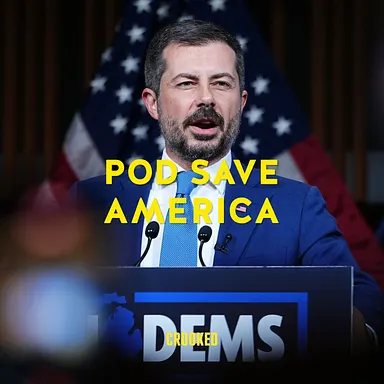
Dan Pfeiffer talks with former Transportation Secretary Pete Buttigieg about where Democrats should go after the midterm elections. Buttigieg credits candidate style, go-everywhere campaigning and message discipline for the wins, and he argues for quick, clean bills on issues like the minimum wage.
The conversation covers party factions, Medicare for All Who Want It, court and Electoral College reform, campaign finance and Israel policy. Listeners also hear his case for rebuilding rather than reversing Trump-era damage, and his thinking about a 2028 run.
In this episode Dan Pfeiffer, Pete Buttigieg
This Pod Save America transcript of Pete Buttigieg on Democrats' path after the midterms was made with HappyScribe's AI note taker technology.
Ads in this audio differ from the text. Tap the sentence you're hearing to follow along.
Synced: the text now follows the audio.
Today's presenting sponsor is Simply Safe Home Security. If you're hosting Thanksgiving this year, your home will soon be packed with family and way too much food. With Simply Safe protecting what matters most, you can focus on enjoying your guests instead of stressing. Right now, lock in peace of mind before the holidays with 70% off their Black Friday sale at simplysafe.com/crooked. Unlike traditional security systems that only alert you after a break-in is already underway, Simply Safe is built to stop it before it starts. Smart AI-powered cameras watch for potential threats and alert a live U.S.-based agent ready to intervene.
The agent intervenes in under 30 seconds, speaking through the camera to stop an intruder in their tracks and calling for urgent 911 dispatch when it's needed most. Our CEO recently got Simply Safe. She loves it. She thought it's set up was super easy, took a couple hours. Now she's got the app on her phone. She likes that it's very easy to arm and disarm. The system is reliable through power outages. It reconnects automatically without needing to call customer support. So she's very happy and says everyone who's used Simply Safe that we know. We've partnered with Simply Safe to offer our listeners the biggest savings of the year: 70% off your new system with professional monitoring.
When you visit simplysafe.com/crooked, that's simplysafe.com/crooked, and when you order, type in Pod Save America at checkout. It lets them know we sent you, and it really helps the show. Simply Safe, ahead of crime in real time.
Welcome to Pod Save America. I'm Dan Pfeiffer. Today you'll hear my conversation with Pete Buttigieg. I wanted to talk to him post Blue Tsunami because he's someone who's been thinking deeply about the way forward for Democrats, how to win elections, but also how to govern. He has a book out on that exact topic next year called Next. In it, he lays out his long-term vision for rebuilding the country. Plus, he's very likely to be running for president in a few months. It was a great conversation. We talked about the election, about the agenda for Democrats going forward, and how he's thinking about running for president. But first, a quick reminder. You helped make the blue wave happen.
You raised millions of dollars and filled thousands of volunteer shifts. Some of you even ran for office and won. But there's more work to do, which is why now is a great time to become a Crooked Media subscriber. A subscription gets you ad-free episodes of all your favorite Crooked pods, excellent newsletters, exclusive subscriber-only content like Pod Save America Only Friends, and my show, Polar Coaster. And most importantly, you're helping keep independent pro-democracy media going. Head over to crooked.com/friends. And while I have you, I want to make a pitch for my newsletter, The Message Box. It's the best way to get serious analysis of what's happening in politics based on the data and my way too long experience working in politics.
I'm breaking down the results from the midterms to tell you what happened, why it happened, and most importantly, where Democrats need to go from here. I have a special discount for Pod Save America listeners to get 20% off your subscription. Go to crooked.com/yesweedan. And now my conversation with Pete Buttigieg. Pete Buttigieg, welcome to Pod Save America.
Thanks for having me on.
We are here in Denver at the What's Next conference, which is a gathering of elected officials, operatives, political people to have a conversation about what's next for the Democratic Party. Obviously, the mood here, like it was at Crooked Con last week, is much better than it has been at a Democratic gathering in many, many years. You were out on the trail. You campaigned, I think, for about 100 people. You were one of the, in some cases, you were the only National Democrat who campaigned for some folks in some pretty red areas. You saw a lot. Obviously, these results are a dramatic shift from 2024.
Political environment's very different. We had wind at our backs at the time. But when you look at what Democrats actually did, the kind of candidates we had, the message they had, what was different in 2026 than it was in '24 that led to these results?
Well, look, there were a whole set of specific things about excellent candidates. Candidate quality mattered. The way they said things, not just what they had to say, how they said it, but where they said it, I think, was really important. A lot of them do.
What do you mean by that?
Well, the kind of go everywhere strategy from somebody like Rob Sand doing a town hall in literally every county in his state to Scott Calo in Mississippi literally working the line at a MAGA rally, right? I mean, it really just kind of embodied that idea of reaching out to everybody. And it kind of matched something that I've long believed, which is that if you really think there's no such thing as a permanently red seat or state, then you got to campaign accordingly and act accordingly. And I think we had candidates who did that. They had a different tone and style. It wasn't just trying to go tweet for tweet with Trump or, in fact, a lot of it wasn't reactive to him that much at all.
It really was kind of about what's next and what people need. There was message discipline, something we don't give ourselves credit for often as Democrats, but definitely, I think we saw what had worked in the few elections of 2025. Voters made it abundantly clear that affordability was on their mind. But I also think a lot of candidates did a nice job not getting caught in this idea that you can't talk about the corruption or the problems in our political system because that would take away from the kitchen table.
They connected the dots. Like, this is why we can't have nice things. And the problem at the kitchen table has to do with the corruption in the system. So all of that, I think, was not just a dynamic that worked out well for us. It's like to the credit of the candidates and the campaigns and everybody who's part of it. Now, the other way to look at it is we had these results largely because of disgust with the status quo. And disgust with the status quo is also what got Republicans elected the last time.
And so if we want to make sure that this is not just one more mark in the oscillation of this pendulum that just is swinging faster than ever, then we got to make sure that we materially change the status quo, that we get that we're not here to put in some prior status quo. And that's going to be really hard because we still don't have the White House and we don't have a lot of time.
What does that look like specifically? Right. Because you're right. Like, we cannot force Donald Trump to sign bills. We do not have enough votes to override his veto. We've even been able to get them to his desk. Like, how do we actually show people that we are either making their lives better or trying like hell to make their lives better?
Well, I'd like to see a rapid fire of discrete, clean pieces of legislation. I know the kind of norm here is you spend months putting together the giant HR1 and it winds up having 2,000 pages and 300 amendments and it's supposed to carry everything. And if you ask for a clean bill, they tell you you're naive. This time around, I think it's really important that we just do up or down on basic stuff. Raising the minimum wage, reversing the Medicaid cuts, banning partisan gerrymandering, something immediate to expand access to healthcare, even if we're still working on the Universal Healthcare plan that might take longer to put together.
Just these things, you know, a child tax credit, things that we know are good policies that two-thirds of the American people are for, that 99% of Democrats are for, that a healthy number of Republicans around the country are for, but that Washington Republicans are consistently against. Because that way we really make it clear what we're about. And what all or most of these policies should add up to is we're putting money back in your pockets and we're trying to get politics out of your face.
Those two things are definitely the things I kind of heard and felt the most out there. Now, how much of it does the president sign? I don't know. He might sign a lot of it. It's not like he cares about policy at all, right? So he might sign it and then we get a good policy. He might veto it and then we get a good fight. You know, as messy as the ending of the healthcare shutdown was, it successfully reminded Americans that they trust us on healthcare. So even that fight was a clarifying fight. That was a healthy thing.
But obviously, the real objective is to get good policy done. And the other thing, of course, is it's time for some blue federalism. We're in charge of all these states where we don't have divided government, where we got a trifecta. We'd better show people that when you give us that kind of power, when you give us a trifecta, we're going to use it to make your life better in every way that we can. And a lot of these decisions are made closer to home. It's no substitute for having the White House or having Washington, but you can make a huge difference. And actually, a lot of the good policies that then could be a model for what Washington ought to do.
There's a lot of question about whether Democrats are the right leaders for that strategy. Do you have a view on that question?
I think, you know, a lot of that is kind of emergent. I think, you know, in many ways, it's especially in the attention economy, like whether the word leader is in your title is kind of less necessary to you being a leader than ever. But I do think it's a really good thing that so many of the people now in not just in the media, but in the Democratic caucus are people who just figured out how to win in a very Trumpy district or a supposedly bright red state.
And I think that's going to help us be kind of calibrated for what to do next.
We're obviously having this debate happening on the hill now where Schumer is running for reelection as leader. Chris Van Hollen announced last night that he's challenging him. That's sort of a proxy for a larger sort of post-election debate we're having in the party about ideology. Should we be more, did we win because we were progressive or moderate or what's the right way to govern or run or what makes someone more electable? You were asked this question on Fox News recently. You rejected the premise as I suspect you will right now. You described yourself as a Pete Buttigieg Democrat.
Yeah.
Tell me what that means. And are there people without the last name Buttigieg who are Pete Buttigieg Democrats?
I think so. I don't know if they want to call themselves that, but to me, it has to do with being seriously committed to major economic policy that is both popular and wise and believing that we need to undertake major systematic change in what's broken in our political system, that those two things go together and don't cut against each other. So whether it's economic issues we know we need to tackle, raising the minimum wage, getting the child tax credit out, getting everybody healthcare, or, you know, things that were pretty provocative when I was floating them, you know, when I was running for president talking about Supreme Court reform, it was pretty lonely.
Even Bernie didn't want to talk about adding justices. It seemed pretty far out. I would argue that view has aged well. And now I think that's, if not in the country, certainly in the party, a mainstream view. So I think we need to take these big swings, be ready with a constitutional amendment if that's what it takes to deal with Citizens United, and not be afraid of those major systemic changes. And also be ready right now to deliver economic policies most people already want. Because otherwise, I mean, the funny thing is, I think we came up at a time when as Democrats, so much of our stuff was unpopular.
Like when I was just getting old enough to follow the news, we were on the back foot on welfare, healthcare, both in the Clinton years and in the Obama years up through 2010, which was my first time on the ballot. Taxes, right? Choice was not as strong of an issue for us as it is now. Marriage, obviously, right? You have all these issues that have kind of imprinted on us the idea that if we're for something, it must be unpopular. Now, actually, on issue after issue after issue, we have not just like a 51% majority, like a 70% majority on the issue.
And yet, we're not exactly winning 70% in a lot of these elections, although, you know, a lot of that changed this year.
Yeah.
So I think part of what explains that is we no longer have to persuade people that these are the right thing to do. We have to persuade people that we're serious about doing them, which is where the reform piece comes in. So anyway, that's kind of how I look at it. You know, for people trying to, there's going to be a lot of people, as there always are, demonstrating why the recent election results prove that they were right all along, right, in their factional fight.
So there's a remarkable consistency in people's takes on that.
Sure enough, you were right all along. But, you know, what I've seen is moderates won, progressives won, people across the country won when they were connected to where they were from and when they had a message that appealed to lots of people and when they took that message out and didn't just rely on kind of familiar traditional channels and formats to try to talk to people.
One thing that we saw from a lot of the Democrats who won in red states or dramatically reformed to red districts is that there was always one or two issues where they disagreed with the party on, right? Whether it was James Talarico being perhaps more supportive of oil and gas than your typical National Democrat, Scott Calo talking about the Second Amendment in Mississippi. Are there one or two issues where Pete Buttigieg disagrees with the mainstream Democratic Party view?
I mean, you know, in the 2020 campaign, I definitely staked out some positions that I still believe in that weren't always kind of popular in the party. You know, one thing is I think we got, we really over-torqued on the student loan thing as a party. I have a very hard time explaining to my relatives in Michigan who did not go to college why they should be paying for people who do. I believe there are ways to make sure that you come out of college debt-free. I believe college should be more affordable.
I don't believe in like a magic wand to fix that for everybody who borrowed money. And look, I also have a lot of issues with the two-party system itself. I am a Democrat. I will always be a Democrat, I think, unless the party does something very strange. But I think a huge problem with the system, the huge problem with the parties is that there's only two of them. And that makes some Democratic organizations nervous when you talk that way. But I think that a lot of the problems we've had around polarization, gerrymandering, even some of what goes on with money would be better if we were actually a healthy multi-party democracy.
That's interesting. Are there the main reason we are not a multi-party democracy is the way the Electoral College works. But are there other things you think we could do that would allow for there to be more vibrant additional parties out here?
Yeah. Look, I'm still working on how to explain this one in plain English. But, you know, one thing that would make a difference is if we had our district set up where you had multiple members elected at the same time. And this is not like a totally exotic thing that you can only do in like Switzerland. We do it all the time for like school board. We just haven't done it lately for Congress. If you do that, there's a lot of evidence that you would have more parties and more independent candidates represented in Congress. So that's one model for proportional representation.
And that would, that's uncapping the House, right? You'd increase the overall number of.
Separate from how many members are in the House. This is, so you take Indiana, we got nine districts in Indiana. If you have three districts and those nine members were elected by taking the top three vote getters out of every district, so you have fewer districts and they're bigger, you would expect to see more first-time candidates. You would often, I saw this on my city council where three out of the nine were at large. You get people who are actually very different from each other elected by the same people. You just get kind of more diversity of thought than the people you elect. Also harder to gerrymander when you do it that way.
Now, the question of how many House members we have also, I think it's not as important, but it is important. Part of why I invoke it is to remind people that we've acted like a lot of things are set in stone that are actually not. I, you know, sometimes will ask the trick question of like which part of the Constitution says 435 members of the House.
Or nine Supreme Court justices.
Or nine Supreme Court justices. At one point, we had 10. People forget this is in the Lincoln year. Obviously, kind of complicated to try to have an even number of Supreme Court justices. But like we went with that for a while as a country. I think we start out with three or five. And same with the House. The number of House members changed again and again and again and again. And the reason we got to 435 is, well, there was no reason. We just stopped. There was some weird fight in the '20s while they were doing the bill and they just stopped. Now, having dealt with Congress, I understand why a lot of people are thinking like more congressmen? Are you sure we want more members of the House?
I mean, you've spent time in New Hampshire. They have about, what, 400 state representatives?
Yeah. But, you know, they also have that culture of a true citizen legislature. And one of my favorite things going back to the midterm results was how many candidates stepped up who were really just, they reflected that ideal of the citizen legislator. You think about like Katie Bidia-Stout, you know, just a very like normal human who was also committed to, you know, she's a teacher and then a family lawyer. Rebecca Cook, I think, was still waiting tables until not that long ago, you know, running for Congress. Bob Brooks is a firefighter.
You know, you had folks who were really were what we all fantasize about politicians being like, which is that you're just a regular citizen, you get fed up and you decide to run. And it's pretty cool to see that happen.
Pod Save America is brought to you by Willy's Remedy. Tired of waking up hungover and bloated after your post-work drink? Now you can have fun and relax without the regrets. Thanks to Willy's THC-infused social tonic. Willy's is an alcohol alternative that actually works, delivering an uplifting euphoric buzz that you can really feel with no negative side effects. Willy's is a premium THC-infused social tonic crafted by the legendary Willie Nelson, who is, as we all know, an expert in the cannabis space. He has done his 10,000 hours and more, that is for sure.
With only 15 calories and three grams of sugar, this tonic gives you all the fun and relaxation and none of the regret and comes in five milligram and 10 milligram doses with a delicious blend of passion fruit, lemon, and lime. Enjoy it as a shot, over ice, or mixed into your favorite mocktail. It is not the feared edible you overdid in college. Every bottle is third-party lab tested for accurate dosage so you can trust and customize your experience. One shot helps you relax, unwind, and de-stress. Perfect for taking the edge off after a long day and just as great for socializing, making good company even better.
I can vouch for Willy's. I love Willy's Remedy. It is like the perfect amount of magic THC, whatever it is that's in there to give you that little buzz you want, but it's never too much and it tastes good and it mixes right into whatever drink you want. And I'm just a huge, huge fan of it. Willy's is the number one THC-infused beverage in the US with over 350,000 happy customers and over a million bottles sold. Order now at drinkwillys.com and use the code CROOKED for 20% off your first order, plus free shipping on orders over $95.
That's code CROOKED at drinkwillys.com or use the store locator to find Willy's on shelves near you, like your local Total Wine, Specs, ABC, or local liquor store. Pod Save America is brought to you by Noble. Have you ever stopped to consider just how vulnerable standard luggage really is? I actually have. You can just unzip it right there and just steal stuff. When you're traveling, your luggage isn't always in your sight. Anyone with a regular pen can pierce a zipper in seconds and zip it right back up like nothing happened. Your laptop, your passport, any other valuable items can be gone before you even land at your destination.
That's why Noble completely redesigned the suitcase. They removed the zipper and replaced it with a heavy-duty latch lock system that seals like a safe. You get that reassuring click. You can actually hear it and feel it when it shuts tight. It gives you complete peace of mind no matter who's handling your bag. Noble isn't just the safest luggage out there. They've actually fixed everything that used to drive us crazy about travel. There's a built-in charging port to keep your phone fully charged on those long travel days. A front laptop pocket makes TSA a breeze. And maybe the most unique feature, a flip-out cup holder built right into the luggage.
That's a cool idea. Noble's all-in-one carry-on is the durable, safe, advanced luggage you've been looking for. Every suitcase comes with a 100-day money-back guarantee and free three-day express shipping. Did we mention it has a lifetime guarantee? It's the last suitcase you'll ever need to buy. You'll be buried in that thing and no one will be able to get you out because it's locks. Noble gives you real travel peace of mind, security, design, and convenience all in one for a limited time. Noble is having the biggest sale of the year. Head to nobletravel.com for up to 67% off your entire order.
That's N-O-B-L travel.com for up to 67% off. After you purchase, they'll ask you where you heard about them. Please support our show and tell them that Pod Save America sent you. It's one of the consequences of having two parties is that we have growing factions within the two parties we have. And one of them, obviously, in the Democratic Party is the Democratic Socialists of America. You know, they won a bunch of primaries this time. I think there's upwards of 50 members in Congress who've been endorsed by DSA. When you think of two questions on this, I'd like to know why you think socialism or the DSA is growing in popularity within the side of the Democratic Party.
And second, where do you differ from the Democratic Socialists when you think about the role of government in the market?
I think it's actually a little hard to define some of their commitments, even though like the definitions of socialism are usually about the market. The stuff that gets thrown around, at least in the internet, and everybody's talking about what DSA is, are more like about these like slogans or like radical proposals like open borders or abolish ICE, which not only, you know, especially this like open border or abolish the Senate entirely. I mean, it's really important to point out that even though, for example, when I was on Fox, they asked me about those things that they had pulled from a DSA handbook, I don't know of any Democratic candidate for Congress who's on board with that.
So, you know, what does it mean to be endorsed by the DSA? It probably really depends a lot on the candidate. What I know is that, you know, most everybody in the Democratic Party believes in some kind of market economy overall. Like I haven't seen even the leftiest candidates for Congress saying that we need to like, you know, have the workers control the means of production and, you know.
Or have the government take stakes in companies.
Steal.
Yes, exactly. As the Trump administration is doing.
Yeah. So I think really what we need to think about is, okay, what's going on with the relationship between government and markets? And I think it's hardly a radical leftist position to say that part of what's happened is that it's out of whack in ways that have led to enormous concentrations of wealth and power with not just wealthy individuals, but corporations kind of getting their way. Many markets where there are too few players for there to be a healthy market. I mean, I saw this with freight railroads when I was at DOT, increasingly with airlines, which is why we intervened in a proposed airline merger.
It's part of that. But you see it in a whole, obviously around tech, we see a lot of this too. So I don't know. I'm still finding that a lot of the supposed debate over socialism is kind of incoherent when you try to take it down to brass tacks. What interests me in the short term for a legislative agenda, and I say this with some humility because I'm not even a legislator. I wasn't just elected to Congress. But what I hope the people who just were will do is identify those things that, again, they're like 60 or 70% issues with the American people, but they're also like 99% issues within the Democratic Party.
Like the idea of raising the wage, which even a majority of Republicans believe we ought to do, depending how high you go, is not something that pits like moderates and the left against each other either in our party. Maybe we would disagree about like exactly how high it is, but like we'll figure out a number, right? The premise at the very least that we should be moving in the direction of expanding access to healthcare. And by the way, I've also seen like a pretty striking convergence within the Democratic coalition on something resembling what I was proposing back in 2020.
We called it Medicare for All Who Want It. I think a lot of people who say or said they were kind of Medicare for All or bust have now decided that what they really meant was a public payer, but you don't absolutely have to. We don't command you to be on it, which is what I was calling for.
Can you say a little bit about exactly what that means? Because this was a big debate in the Michigan Senate race. There's already demands on the Hill from some of these newly elected members to vote for Medicare for All, vote up to LCA has called for one. Just talk a little bit about the difference between what was commonly understood as Medicare for All, at least in the 2020 campaign, sort of Bernie's idea, what you proposed and where you think folks are now.
Yeah. So what I propose, we call it Medicare for All Who Want It, is you set up a Medicare or Medicare-like public health insurance and everybody is on it by default. But if you don't want to be on it, you can opt out. So it's the default. It's not just available, but we assume that you're on it unless you say that you don't want to be. But if you'd rather not be, you'd rather be in a private plan, you have to have some kind of insurance. But if you'd rather be on a private plan, you can do that. And I got beat up a lot in 2020 from the left for saying that this was the way to do it.
But what I believed was it put enough humility in the policy that if we're right, if the Medicare for All view is right, that this is the best answer, then given a choice, everybody will choose to stay on the public plan anyway. And if some people would rather not be on the public plan, then that's evidence that at least for them, it was not the right answer, right? And so we'll be really glad that we didn't abolish private healthcare. Now, Medicare for All 1.0 was you ban private insurance and you order every American to be on public insurance, whether they want to or not.
I thought that went too far. I feel the exact same way eight years later. But I also think we should consider what it tells us that back in 2020, when we had, what did we have? Like 10 presidential debates?
I mean, at least, yeah.
You would have thought the question in American domestic policy was exactly which flavor of universal healthcare we were going to deliver the following year. And here we are eight years later and none of it happened. So the really important question is, what is actually going to happen sooner rather than later?
Since you ran last time, you know, you have you entered government service. You were the Secretary of Transportation for President Biden. The Biden administration did lots of great things. I take that away. Infrastructure, which you worked on, the climate bill, a whole bunch of things. Did a lot of repair the damage from Trump. But ultimately, the ultimate project was to defeat Donald Trump, defeat Trumpism, and sort of make that period from 2017 to 2021 this brief aberration in American democracy. That obviously did not happen.
Sort of it was a system failure. We end up back with Trump more powerful than before. What are the things that you think that the administration, not necessarily in transportation, but broadly, got wrong that led to that outcome?
Look, we could point to particular policy mistakes. I think not paying enough attention to the border quickly enough was a big one. And I think we wanted to wave it away. It's just like Fox News making something out of nothing. But the border really did amount to a crisis. It really was a problem. And we really did not, the administration did not act quickly enough there. There were other specific things. Getting the schools open more quickly with COVID, I think, would have made a big difference. But to me, the deeper, more fundamental thing was the premise that you talked about, the idea that there could be such a thing as a quote unquote return to normal.
And, you know, I did my part to support that, even though in 2020, you know, competing against Joe Biden and everybody else for president, return to normal was not my message. It was not my premise. But I thought if anybody could achieve return to normal, it would have been Joe Biden. And the administration came in and tried to take care of the basics, infrastructure, industrial policy, some things. I'm really proud of what we did on the infrastructure front. But the reality is there was no way that it just wasn't true that Trumpism was a blip.
It just wasn't true. And so instead, what turned out to be the case was that the Democratic administration was the kind of anomaly in what basically amounts to a Trump era, which began, you could argue, the moment he came down that escalator in what, the summer of 2015?
Yeah, 11 years ago.
And has been going on ever since. And some would argue it began to end on Election Day a few days ago. But whether that turns out to be true or not, I think all depends on what we do next and whether we're and I worry, in fact, I'm preaching against this at this conference and elsewhere. I do worry that we still have a temptation to you hear the phrase, for example, reverse the damage a lot. And look, I get it. The damage is brutal, what the Trump administration has done. But I'm trying to really minimize my use of any word that has the prefix re in it to reverse or restore or return, certainly rewind, cannot be our project.
Because if the old status quo was working, we wouldn't be here. Trump wouldn't be here. Like we are all of that is what led to all of this. We got to show that we get that. And by the way, that's exciting. This could be a moment that is as defining for what the rest of the 21st century is like as the kind of New Deal post-World War II moment was to define everything we grew up in. But what we have to accept is a lot of things that we inherited growing up, these institutions from international institutions to like federal agencies, were getting rickety; they were breaking down.
It doesn't mean it was okay to demolish them and destroy them. But now that they have, there's going to be a clean slate. And we should really think about how we re.
The rebuild is the tricky part there. Yes.
Yeah. And maybe rebuild is appropriate, but if we're going to say re, often the job is more about replace rather than repair. Think about the Department of Education. Totally wrong to destroy the Department of Education. Also, I don't know a lot of people who would say in a vacuum they would have created the Department of Education the way it looked in, say, 2020 or 1999 even. So if we're going to start over, which you kind of have to because they blew it up, what are we going to do? Foreign aid.
We should absolutely be doing humanitarian aid. Criminally wrong to have destroyed the U.S. Agency for International Development. I hope that Marco Rubio is held accountable for lying to Congress about children dying on his watch, especially because by the time he sat in Congress and said no children had died on his watch, we knew some of their names. Criminally wrong what they did. Also, everybody I know in the world of international development aid would have liked things to be structured very differently than they were as of a few years ago.
Now's our chance.
Pod Save America is brought to you by Bilt. Here's a question. Are you getting rewarded for paying your rent or mortgage right now? If the answer is no, you need to check out Bilt. Becoming a Bilt member means earning points on every housing payment no matter where you live. Bilt points can be redeemed for flights, hotels, Lyft rides, Amazon.com purchases, future housing payments, and more. They also have parking with Metropolis, member-only experiences, down payment on a home, select restaurants. Bilt's new AI neighborhood concierge doesn't just answer questions; it executes tasks.
From paying your rent and hailing a Lyft to booking dinner reservations across 50,000 plus partners, it handles your to-do list while automatically applying your member benefits. First, download the Bilt app. Second, link any credit or debit card to the app so purchases at your local spots become even more rewarding. And third, ask the neighborhood concierge in the app pretty much anything and it'll alert you about exclusive member benefits near your home. Download the Bilt app and join the membership for where you live at joinbilt.com/cricket. That's J-O-I-N-B-I-L-T.com/cricket.
Use our link so they know we sent you. You announced a book this week called Next, which tackles this very topic. I have to go back and look at the blurb. I'm not sure there are any words. They begin with R-E in there, but that is the basic point is how do we come out of this? What are some of the I want to hear a little bit about the book, but also what are some of the principles you would, you know, and I will also bother you about running for president later in this podcast, but presuming that you had that role, what are some of the principles you would bring to that process of, I have to use a reword, rebuilding or reinvigorating what USAID, Department of Education, or any of these other things that Trump destroyed?
So I tried to write it in a way that would matter kind of no matter who's running for president and really focus on exactly that set of questions. And I think we do need to go to the basics. Something actually the right sometimes does more than we do, just really engage with first and core principles to look at two sets of things. What is it like to be an American? And I think we just won an election because what it's like to be an American is not good enough. And then what does it mean to be an American? And weirdly, people like J.D. Vance spend a lot more time talking about what it means to be American than we do.
And we need to change that. I think we start, you're asking about some of the principles that guide us with the very basics about the principles that make America America. I think there's three sets of things. One is political equality, just the idea of a political system that is fair. That is a founding core principle of our country's entire existence. Obviously, we're not there right now. And addressing that and having a fairer political system is, I think, unless we do, we struggle to recognize ourselves as a country.
There's a related economic one, the American Dream, which actually was not exactly the way the founders were thinking and talking about it, but it became as integral to America as the Constitution. And the American Dream is no longer available to most Americans. If you, and I mean that statistically, if you were born when my mom was born in the end of World War II, 90% chance you were going to finish ahead of your parents economically. That number is now slipping to below 50-50.
So there has to be an American Dream that's available. Social mobility. The belief that if, you know, to borrow the old Clinton era formulation, if you work hard and play by the rules, you get ahead. And then the third thing that I think has been a little harder for Democrats to talk and think about, which is I would argue that America playing a positive and leading role in the world is actually so important to us, even though it's fairly new since World War II, that it's become core to who we are as a country. And if we don't have those three things, a fair political system, the American Dream, and access to economic mobility, and a constructive leadership role in the world, then we're really not America.
We won't recognize ourselves and everything falls apart. And when you hold those in mind, you get to, or at least I get to, very specific policy ideas. So the book, which comes out in January, it's not a policy manual. It's not a grand unified theory of everything. But it guides us and these things kind of guide us in certain directions on why we prioritize things like banning partisan gerrymandering, why we refuse to accept that just money and politics has to work the way it does forever, ever since Citizens United. And also much more concrete things about giving people more control of their lives back, giving people some of their time back, which is why everything from a higher minimum wage to paid family leave are priorities or ought to be priorities.
So I try to tackle all of that, wrestle with all of that, and hope that it starts some good conversations.
You talk in a lot of interviews. You did it right in 2020. And you just mentioned in your book, you talk about structural reform to the system. That's something that was very, very in vogue in the party. And Trump won. It was a part of the 2020 campaign. Not everyone was on Supreme Court expansion, but, you know, abolish the filibuster, Electoral College. We're talking a lot about that. So I'm going to go through a couple of those with you. Electoral College. You said we want to get rid of it. You ran on it in 2020. I've heard you say it several times this year on podcasts. Requires constitutional amendment.
Now, there's also the National Popular Vote, Interstate Compact.
Which is suddenly viable.
That's what I was pointing. So for people to understand, that's a process where states get together and once you get to 270 electoral votes among those states, those states all agree to award their electorates, whoever wins the popular vote. We now, with all the trifectas that we now have, have the capacity to do it. Do you think that is a good way to go about ending Electoral College?
Yeah, we should totally do that. And just to back up to a bigger pattern, when we study the right and we study Trumpism, we should notice what seems like a paradox, which is a bias toward action with like immediate, I mean, especially the shock and awe of Trump 2.0, like just doing things. And also a kind of a long-termism. You got the Heritage Foundation. You know, the project, the iterative effort that became Project 2025 started in 1980. Yeah, right. So same for our priorities.
I think we need to hold out like big, long-term, ambitious things, including things that require updating the Constitution and ask ourselves like, what could we get done by September? And we should be like basically it's getting the base hits every time we can and also, you know, taking the big swings.
So on the National Popular Vote Compact, there are obviously a lot of legal questions about it that are out there, but even beyond those, one of the questions, one of the criticisms we hear about or one of the things people have is that at a time in which there is tremendous distrust of the system, the fact that a handful of states all governed at some point in time by Democrats would give the popular vote, would give the presidency to someone who maybe did not win the Electoral College under traditional means.
Like what's your level of concern about that?
I think it's a little backwards. A fair election is one where the person who got the most votes wins. And a fair election is one where everybody's vote counts the same. And for all the stuff people think up to somehow defend this weird, arcane, twisted system we have, at the end of the day, I've never heard a serious principle argument for why everyone's vote shouldn't count the same as each other or why the person who got less votes should. Every other election we have for Senate, for governor, for county assessor, for dog catcher, for class president, always the person who gets the most votes.
It's what an election is. It's arguably not an election. And by the way, like small communities get a lot of attention. When you're running for governor, you don't like apply some different weight to a different county that has less people in it. Rural communities still get a lot of attention in a race for governor. So we know this. And I think just any time you're thinking up some reason why one American's vote should count more than another's or why the person who gets the most votes wouldn't be the winner, I think you're on a slippery uphill path.
On court expansion, right? Your plan is not just expand the court. You have, at least in 2020, I don't know if you've changed, you had a larger reform plan. Can you talk a little bit about that plan? And then also, this is another thing that gets a very, very strong reaction from folks. So how would you, so both, what's the plan and how do you sell it to people?
So the point is to reform the Supreme Court to be less partisan. And one way to do that is to have more justices. And there's a model called a balanced bench. I'm not a constitutional scholar. I don't even have a law degree, but people who do have written some pretty compelling articles about how you would design a system where some of the members are only seated if there's a consensus among the remaining members. So, for example, not more than five can come only from a president of one party. The other five have to be seated by a consensus, the remaining ten.
That's not the only way to do that, but it's a way to do it. But this is the point. The point is to have a less partisan Supreme Court. You do not change the structure of the Supreme Court to make it more progressive. I would like it to be more progressive. The way to do that is to elect the Democratic presidents and congresses, and they will appoint more progressive justices. That's its own project. I think where we get into trouble is if it seems like we want to change the structure of the Supreme Court just to make it more aligned with us ideologically.
So at the end of that world, that's, we win a trifecta in 2028, in 2029, we just add two justices who.
Right. And that's what they call packing. And that is, I think, a race to the bottom.
On campaign finance reform. We just spent, you know, an ungodly sum of money in these elections, billions of dollars. There's a half a billion dollars spent in the state of Ohio alone, like just insane stuff. This has all changed dramatically since Citizens United. Congress, you've talked a lot about the need to do a, that we should actually be out there trying to do a constitutional amendment for Citizens United, which I 100% agree with. I think we should do it. I'm kind of surprised that more people that were not actually out there, like actually really doing this yet.
Yes, it's true.
Because it's been.
Well, think about this. Citizens United, I think, was in 2010.
Yeah, 16 years ago. Yeah.
So if the big objection to a constitutional amendment is it takes 15 years, if we'd started in 2011, this would be the year. Yeah, right. And then that's what gets to my earlier thing of like, obviously we need to act in the here and now. We also need to take on longer-term projects.
There are some other, we can't solve the exact problem of Citizens United, but there are two other, there are some other ways we can address the problem of money and politics. One is through legislative action on some things. And the other is this idea that's in Hawaii right now, that there's been a lot of places where states are trying to make corporation. Maybe you could explain exactly how that process is.
Yeah, so this is a bank shot around Citizens United. I campaigned for this in Montana, and Montana passed it with, I think, 65% of the vote. So it tells you that this is something that people want. And the basic idea, and again, I try to not get out of my depth as a non-legal, non-scholar, but the basic idea is, okay, the courts said that like you can't regulate campaign spending because that regulates speech and that's a First Amendment problem. I think that's wrong, but whatever. That's the law of the land at the moment.
But even now, corporations don't actually have rights. They have powers. And they only have the powers that are conferred on them by law. And it turns out the relevant law here is state law. Corporations exist as a creature of state law. And so one way to approach this is to update the state law that enumerates the powers the corporations have to just say, by the way, if you want to be a corporation doing business in Montana, you do not get to be a corporation that uses your treasury dollars to manipulate elections.
That's just not a thing. If you do that, you're not a corporation. And it is built on something that in principle should be robust against Citizens United. You know, obviously this will go all the way to the Supreme Court. We'll see what happens. But just as importantly, I think having the people turn out and vote two to one in a very conservative state to do this. By the way, Montana has its own interesting history of powerful anti-corruption tradition dates back to a hundred years ago when Bill Clark, who was kind of the Elon of his day, richest guy in America, he was a copper king when that's what they called the copper kind of barons when copper mining dominated Montana and was stuffing the pockets of legislators to buy himself a Senate seat.
It's interesting, even then, richest man in the world, maybe definitely the richest man in the country, and his fondest desire was to become a U.S. senator. Like this pattern of people who want for nothing deciding to get involved in politics is apparently something that never goes away. Anyway, important thing is that law passed. Hawaii did it the other way. They did it through state legislature. There are, I think, a dozen states thinking about this. And we should absolutely do that. We should do everything we can. There's also things we could do, by the way, around disclosure that should not run afoul of Citizens United.
So again, do what we can now under the current framework and do everything we can to change the framework.
In 2020, as you mentioned, in 2020, Medicare for All was the dominant conversation. I don't want to pretend what the dominant conversation that 2028 Democratic primary will be, but one very, very divisive issue within the party right now involves around Israel and our relationship with Israel. How do you think our relationship to Israel should change? Should we, are you open to cutting off aid to Israel, arms sales? How are you thinking about that?
Yeah, the relationship has to change. I mean, you could argue that the conduct of the Netanyahu government changed it, but also so much has happened and so much has changed. And any U.S. ally, anybody who wants to be a U.S. ally, it matters what you do and what your choices are. So the basic way I come at this is that there are three sets of things at stake when we talk about and think about what's going on in the Middle East and our relationship to Israel and our responsibility to promote the safety of Palestinian and Israeli people.
First, before we go abroad, look around at home where there has been an explosion of antisemitism, also a disturbing rise in Islamophobia. And much of this, of course, has traveled with activity and interests in what's going on in the Middle East. And we just have to be full-throated, unequivocal, and unambiguous in rejecting any kind of hate, including this antisemitism that has become far, far too present in our politics and our culture.
In theory, that should have nothing to do with what's going on in the Middle East because that's just, hate is wrong no matter what your politics are. But we've seen how these things travel together and we got to be on top of that. There is the right and need for the Palestinian people to have human rights and safety and self-determination. And that is true not only in the context of the atrocities that took place in Gaza, but also what's going on in the West Bank and the settler violence and in some cases settler terrorism.
And then there is, of course, the continued need, at least I believe, a continued need to support the idea of a Jewish Democratic state. If all of those things are true, then all of those things are compatible or at least should have to be compatible, right? If they're all true. And we need to hold space in our party for all of those things to be true. Now, there are some people who will not embrace one or more of those things, but most of us do.
Most Americans do, most Democrats do. And that's where I think our approach to this issue has to be centered and where it has to live.
But I very much agree with that, but there are, you get to some specific questions pretty quickly, right? Trump, two days after the election, said he wanted to end aid to Israel. We had, there was a vote in Congress where a lot of Democrats voted to cut off aid to Israel. Do you have a position on that?
Yeah, I think that, you know, we're at a point now where that is, we've kind of outgrown even, you know, the Israeli government would acknowledge that it does not make sense in the long run for there to be that kind of financial aid. I think where this issue really comes to a head more specifically is questions of, you know, the details of the security partnership between the U.S. and the Israeli government. And I think that U.S. law has to be followed and U.S. values have to be upheld. And whenever the Israeli government does something that contravenes our values or our policies, that could affect any number of things, especially if we know that, you know, part of what happens in that partnership, part of what happens in that relationship between these countries could shape what happens on the ground.
We do bear responsibility for what a country that we have partnered with chooses to do. I don't have every kind of if-then scenario mapped out. I think the most important thing, though, that has changed in the relationship and must change in the relationship is we have to move out of this idea that nothing they do could change anything we do. And instead, say, you know, the choices that they make, especially if they're made with American money or American, you know, defense equipment sometimes, that does in fact affect the relationship and it could affect what we decide to do next in the context of that partnership.
Pod Save America is brought to you by Chili Pad. The news doesn't clock out. Late alerts and midnight screen time make a full night's sleep hard to come by. When your mind stays wound up, your body stays too warm to drop into deep sleep. The good news, that temperature problem is fixable. You could put your phone down, but that's impossible. So enter Chili Pad 2.0, the water-based mattress topper that actively controls your bed temperature from 55 to 115 degrees all night long. No new mattress if it's right over what you already have. Chili Pad 2.0 actively cools or warms your bed using water, and water is key here. Fans just move hot air around. Chili Pad uses actively chilled water to pull heat away from your body.
It's the difference between standing in front of a fan and jumping into a cold pool. One actually works. And if you and your bedmate can't agree on anything these days, here's one thing you can settle without a debate. Dual zones let each of you dial in your own temperature independently, bipartisan comfort. I don't know, maybe you should be single, but you should have a Chili Pad. It's the best. I've loved having one. Basically, you know, you can do it from your phone. You can make your bed really cold if you're hot. You can make your bed really warm when you're sleeping. It's the best. And you can each have different temperatures if you want to, if you run a little hotter, it is great.
Visit sleep.me/crooked to get up to $640 off your Chili Pad 2.0 with code crooked. As an added holiday offer, Chili Pad is including a three-year protection plan for free. This increases your Chili Pad 2.0 value up to $1,038. This special offer is available for Pod Save America listeners and only for a limited time. Order today with free shipping and enjoy an extended holiday return window. You can return it for free if you don't like it with their sleep trial. That's www.sleep.me/crooked. The headlines will still be there in the morning. You might as well wake up ready for them.
Now we're at the part where I try to get you to tell me you're going to run for president, which you could do. It would be cool if you did on this podcast. I don't suspect you will. But you have said you are, I think you might have said inclined or leading towards or possibly thinking, you're obviously thinking about, where are you in your decision process? How are you thinking about it?
I mean, I guess the only thing that really makes sense to say is that, you know, I'm not on the cusp of some announcement right now. Maybe some folks will be, maybe some folks will be out there any day or any week. It's not like that for me. But, you know, what I'll say is that, you know, a year and a half ago, when I decided not to run for Senate and not to run for governor in Michigan, the only thing I knew for sure was that I had to try to be helpful, to make myself useful in the campaigns that were actually happening and to help the people who did choose to be on the ballot.
And I'm thrilled with what happened and thrilled to have played a part in that and also really energized by what it was like out on the road. We did these town halls. You know, Derek Van Orden wouldn't do a town hall in Western Wisconsin, so we went and did one for him. And, you know, a thousand people came all the way through to, that was early, that was in the winter, you know, all the way through to a few days before the election when Scott Colom and I were in Biloxi and a thousand people came to that. And that energy has been incredibly encouraging. And what I've seen is there is a hunger, not just for one party or another to win, not just for a particular policy, but there is a hunger for a different kind of politics in this country.
And that's what I've been working on since I started getting involved in national politics when I ran for president. It's what I've been writing about. And there is clearly a moment here where we can get this right and we have to get this right. And that continues to be my focus.
One thing that's changed a lot since you ran last time is you now have young kids.
Yeah.
Your kids are about the same age as my youngest. Doing anything with young kids is hard, but especially running for president, you've done it before, so you know what you're getting into. When Barack Obama made the decision to run with young kids, he had not run before. He did not know what he was getting into. How does that affect your calculus? How are you thinking about, were you to run the logistics of having kids, bringing them on the trail with you? How do you get home, that sort of stuff? Because it's a very different thing. Not that many people do it with young children these days.
Yeah, it is hard. I mean, the one thing I can tell is that there's no right answers or easy answers. Obviously, the priority is the safety and the privacy of our family and that they're going to be okay no matter what I do professionally. But yeah, there's everything from just the worries that you have taking on any kind of intense and demanding job that means traveling a lot, which is tough in its own right when you have little kids, all the way through to the implications of, you know, what we have to think about when it comes to privacy and security.
And, you know, honestly, looking at my kids and being around my kids, like, kind of propels me in two opposite directions. I mean, there's a side of me that wants to run away from all the bullshit and right into the arms of my family. And there's another part of me that looks at them and thinks like they have so much at stake in what's about to happen. They don't have a vote. They don't really have an idea of what's going on around them. And yet it will decide what their life is like. And I got to be part of making that better. And I think, I think anybody who's who cares about the country and cares about their family feels those tugs all the time.
And it's more kind of celebrated in the case of, you know, people who run for office. But, you know, anybody, especially anybody who's involved in politics. And I think about the, you know, campaign staff and volunteers, advocates, everybody who's involved in this. I think there's some, I felt it, you know, we're in a lot of people's living rooms and backyards doing canvas kickoffs. And many of them, you know, their kids were around and sometimes their kids had something to do with why a couple in Michigan decided to kind of convert their house into a launchpad for, you know, canvases and door knocking every weekend.
And I think there's a version of this. It's obviously extreme if you're deciding whether to run for president, but there's a version of this that every citizen with a family kind of feels, which is like, how do I, you know, when do I kind of take time away from the family or complicate the day-to-day routine of our family in order to do right by my family as a citizen and participate in this process to try to make our community and our country better?
How has having kids changed you as a politician?
I mean, all the cliches are true, right? Like it changes everything. It changes how you look at the world. It changes how you look at yourself. You know, I tell a lot of stories about conversations I have with the kids. And I, by the way, I used to think it was kind of unbearable when like politicians mentioned their kids all the time. And now I just like, I get it because like it's just, you know, they're the most important people in my lives. Them and Jasmine and like what they do, of course, shapes like what I think about when I get up in the morning. I think it tugs me back out toward the long term.
Like when I was, when I announced, I had this line in my stump speech in 2019 or 2010, 2020 about 2054 being the year that I would reach the age of President Trump at that time. And so like as a very, you know, young person to be running for president, that sort of like authenticated that I was like thinking about the long view. It was about me. Now I think about, you know, it's 2026, we did all this America 250 stuff. And I'm realizing that like, they'll be there for America 300.
Yeah. I got like a one in 10 shot of making it in my 90s. It's like we can hope. Yeah. But like they'll be there for that. Like they'll be grilling out and they'll be like talking and thinking about what was going on in the 20s, the 2020s, the way I might think about like and ask my parents about what the 60s was like. You know, so I think like you just have a different sense of the stakes when the people you care most about are going to be, they're going to see the 22nd century and all this stuff just matters in a different light that way.
Does anyone else's decision affect your decision? Gavin Newsom said he would not run if Kamala Harris ran. Does her decision affect you in any way or is this solely about you and what you think you can bring and how you think about the race?
I think it's mainly about what you bring. But of course, if you see somebody else who you think ought to be the person out of the entire field, including you, then the right thing to do is to support them and follow them. And again, there are many times in my career when I thought about running for an office and then I didn't. And sometimes one of the reasons was there was somebody else that I was very happy to vote for and volunteer for and help. Every time I've run for office, it's looking at the two sets of things.
Like what does the office call for? What does the office need? Specifically in this moment, what does the office need? And what do I bring to the table? And part of what I bring to the table is like, is it different from the others? Part of what I, part of what propelled me to do this in 2020 was I thought I have something that's different, something that won't be part of this debate unless I'm there. And I'm not like the others.
I brought up Kamala Harris and I brought the question of Kamala Harris in particular, not just because Gavin Newsom said that, but I heard you say on a podcast recently, she's the person who's running. You probably know the best. You obviously worked with her, you campaign for her. And so just about the whether just she specifically affects you or at all.
I don't think that any one person right now kind of drives our decisions. But yeah, I mean, obviously, you know, I wanted her to be president. I did everything I could to help when she was running for president.
Last question for you. Obviously, you're in this active process of thinking about running for president. I'm sure you're looking back at your last campaign, which by almost every single measure was a tremendous success. You started out at zero in the polls. You won the Iowa caucus. You made it to the very end. But the goal was to become president and that did not happen. So are there less things that you, when you look back on that, are there things, lessons you want to apply to this one, things you want to do differently? You thinking about the race differently based on that experience?
Oh, of course. Yeah. I mean, anytime you do something, you learn how to do it better, right? And there's so many things I'm proud of. I mean, again, I think a lot of our policy ideas from Medicare, who all for all who want it to Supreme Court reform aged well. I think our style of politics, the go everywhere thing is something that aged well. And some more of the blocking and tackling stuff, like, you know, we were one of the first campaigns at that level to really do relational organizing at a large scale. And now I think that's just kind of table stakes, but that was pretty novel.
So there are things that we got right that I would love to keep doing. And of course, there are things I got wrong. I grew as a candidate every day. I became a better debater. I learned how to relate to groups that were not groups I understood well from my time as mayor of South Bend. And I think it'll be really important, not just for any one candidate who wants to run, but also as a party that we kind of learn from that moment of 2019, 2020, when the world looked a certain way.
And yeah, all kinds of things that you think about doing differently.
Pete Buttigieg, thanks so much for joining us on Pod Save America. Always great to talk to you.
Same here. Thanks for having me.
That's our show. Thanks to Pete Buttigieg for coming on. John Tommy and Level will be backing your feet on Tuesday with a brand new episode.
Pod Save America is a crooked media production. Our show is produced by Austin Fisher, Saul Rubin, McKenna Roberts, and Michael Goldsmith with Reid Sherland, Elijah Cohn, and Adrian Hill. Our team includes Matt DeGroat, Ben Hefcote, Jordan Kanter, Charlotte Landis, Kenny Moffett, Adam Lippert, Joseph Dutra, Desmond Taylor, Dan Farrow, David Toles, Mia Kellman, Ryan Young, and Naomi Single. Our staff is proudly unionized with the Writers Guild of America East.
Pete Buttigieg sits down with Dan to lay out his vision for Democratic leadership in the wake of last week’s blue tsunami, from offering immediate relief on the cost-of-living crisis to tackling systemic problems like corporate money in politics and a broken Supreme Court. Then they discuss factionalism within the Democratic party, why Dems need to think bigger than just reversing the damage caused by Trump, whether Pete’s planning to run for president in 2028, and his new book, “Next,” which comes out early next year.
Hate listening to ads? Become a Friends of the Pod subscriber for ad-free episodes of Pod Save America, Pod Save the World, Lovett or Leave It, Runaway Country, Offline with Jon Favreau, and more—plus exclusive content, including bonus episodes of Pod Save America. Subscribe now at crooked.com/friends, on Apple Podcasts, or through the Pod Save America YouTube channel.
You can request a transcript by emailing transcripts@crooked.com. Include the podcast name, episode title, and air date. Please allow 48 hours for delivery.