
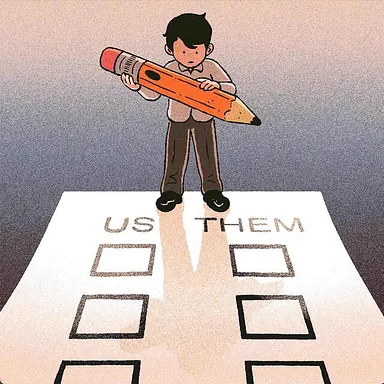
The episode explores how people try to change minds in the 2026 midterms through three stories. In Detroit, a Black supporter of Abdul El-Sayed tries to win over a friend who objects to his Arab heritage.
In Montana, Democrat Alani Bankhead refuses to leave her Senate race after an unexpected super PAC-funded surge, despite pressure from party figures and rumors of a plot to push her out, which she disputes. Ira Glass then recounts the Ben Franklin Close, a car salesman's technique.
The final story follows Republican organizer Sam Negron in Allentown, who argues Hispanic voters are still backing Trump despite polls showing losses.
In this episode Ira Glass, Rose Johnson, Sam Negron
The transcript of this episode on persuading voters and car buyers was made with the technology HappyScribe uses for its note taker for online meetings.
Ads in this audio differ from the text. Tap the sentence you're hearing to follow along.
Synced: the text now follows the audio.
On the next Throughline from NPR, the surprising story behind the discovery of insulin, led by a failed Canadian surgeon.
The best way to describe it would be a reluctant hero.
It's a story rife with personal grudges and many, many dogs. Listen to NPR's Throughline in the NPR app or wherever you get your podcasts.
A quick warning, there are curse words that are unbeeped in today's episode of the show. If you prefer a beeped version, You can find that at our website, thisamericanlife.org.
So sure, over $11 billion is being spent on advertising for the election next week. But of course, in addition to the ads, there are still human beings out there in this election trying to persuade the old-fashioned way, person to person, in one-on-one conversations, which is where you really see what people are made of and how they're deciding who they're going to vote for. People really say some stuff. One of our producers, Ike Baris Kondaraja, met this woman, Rose Johnson, in Detroit. The Senate race there is too close to call. And one problem that Democrat Abdul El-Sayed's been having is getting Black voters. Rose has been out trying to convince those voters. And Ike, who is she?
Okay, so Rose is a retired police dispatcher. She's a great-grandmother. And she's only been doing this about a year. but she's already worked on 7 campaigns. She kind of got obsessed.
And you met at a community center? Yeah.
At the front of the room, her reverend was hosting this live radio show, and there's about 50 people who showed up to hear it. They're all Black. And the show spent about half an hour telling people to get out and vote for Abdul El-Sayed. But Rose didn't need the nudge. She was already on board.
Well, I mean, he comes here all the time, so we see him all the time.
She's done so many events that he's been at that now he I stand behind him 1,000% because I feel comfortable with him.
He's very, very approachable. He reaches out to you. And when you see him and you meet him, he knows you. So if he see you in the crowd, he gonna wave at you. He gonna hug you if he can because he knows you. He don't act funny. He's— he's the guy.
She's knocked on doors for him. She's done phone banking. But she knows lots of people don't agree with her. Even people who usually vote for Democrats. So if he's showing up like you're saying, why don't people like him?
It's just the religion. They wanna say, oh, the Arab. I don't see that.
Have people told that to you?
Yes! I have a friend of mine, and she talks crazy anyway. And she said, well, I have to be honest with you. I can't vote for him because he's an Arab. And I said, Well, that's dumb because they said the same thing about Kamala Harris. They said Kamala Harris, they didn't want to vote for her because she's a Black woman. So I get so upset when people say that. And if she wants to be my friend, she's gonna do the right thing and vote for Abdul. Otherwise, I just can't mess with her. I don't want to hear her complaining about, oh, oh, oh. I don't want to hear it.
And the things she's saying came up with basically every Black supporter of El-Sayed I talked to while I was in Detroit. They all describe this decades-long tension between Arabs who own stores and the Black patrons who shop there. Detroit has seen decades of violence and distrust and racism between these 2 groups. And Rose has seen this attitude towards Arabs and other newcomers too.
They get businesses, they get stores, they get loans, they get a lot of things that we didn't get coming into this country as African Americans. you know, and they just feel like they're entitled. Just don't come here and act like you're better than us, you're privileged. We get that enough from white people. So we don't need that from others. We need a ban against white people, you know, my opinion. Because it's us against them. That's my opinion.
I mean, she says that with people she knows, she's been able to talk them out of their prejudice and into a vote for El-Sayed. But there's this one person in her life— you heard her talking about her earlier, one of her oldest friends— and she's been making the case to her for weeks. And I asked if I could listen in and record their conversation.
I can call her now. I'm gonna put you on speaker. So tell me your opinion of Abdul and why you— are you gonna vote for him? No. Why?
I don't want to.
I mean, can you elaborate?
I really can't say why I won't vote for that little guy, because to be honest with you, I don't trust him. That's why I won't vote for him.
What is it about him you don't trust?
His nationality.
What does that have to do with anything? A lot.
What I'm saying is I want to vote for an American.
He is an American. He's a— he's Arabic American.
No, no, not enough.
We're African American.
That's different. I'll vote for them.
For us.
I'm not gonna vote for him. I'm just being honest with you.
Okay.
Could I ask, is there anything he could change, like a policy, or is there anything he could say? By the way, this is— my name's Ike. I'm a reporter talking to your friend Rose about El-Sayed, and I was wondering, is there an argument or something that you could hear that would change your mind?
There probably is, but it just—
I don't trust him.
I'm not clear on none of his point of view.
I haven't listened to none of his speeches.
So would you like to meet him in person, have a conversation with him? Because I can arrange that.
This is one of Rose's, like, special moves. It's kind of a flex. This is exactly how she got her sister to vote for Detroit's current mayor. She just put them on the phone together.
Oh, wow!
But when Rose offered the same thing, like, Do you want to meet El-Sayed in person? She said no. She just can't right now. She said she's got too much going on. Her brother just passed away, and she's heading down to his funeral.
So did Rose give up?
No. I mean, Rose is just as stubborn as her friend. And she said, I am gonna take her to the polls. I'm gonna hold her hand right up until the booth. And when she goes into the booth, the place that I can't go, I'm gonna be whispering outside the booth, Abdul, Abdul, Abdul.
Well, ladies and gentlemen, for all the talk the last few weeks about how so many people have changed their minds about President Trump and the Republicans, and all the talk about how tables are about to turn in these midterm elections, let us remember, please, how hard it is to change anybody's mind. Today on our program, we have stories about people who are not changing their minds so easily. and some unusual and extraordinary things being done to try to get them to change, including a tale of millions and millions of dollars being spent all in the hope that just one person, one person, would change her mind. That's our first act today. From WBEZ Chicago, this is American Life. I'm Ira Glass. Stay with us. This American Life, Act 1, Where's the Party? In the Senate race in Montana this year, there's been this messy cloak-and-dagger fight among Democrats where longtime big-name Democrats are not endorsing their own nominee. And so many people have been trying to persuade one of the candidates, Alani Bankhead, to do something that she has refused to do. People were scratching their heads. Why not? To untangle all this for us and tell the story is reporter Heather Tall Murphy, who lives in Montana and somehow seems to be able to get anybody in the state on the phone.
Lots of things about Alani Bankhead's biography are perfect for someone running for Senate. She's former Air Force, 44 years old, counterterrorism specialist, intelligence analyst. Then she became a child sex crimes investigator. She's been part of dozens of convictions. She thought the Republican incumbent was doing a terrible job. He didn't show up for important votes. He didn't seem in touch with voters around the state. She was really bothered by that. And so she decided to run. She drafted up an announcement and posted it to social media. To LinkedIn. Why LinkedIn? Uh, I love LinkedIn.
Yeah, LinkedIn is my jam.
It's unconventional for a political announcement. Oh, well, I'm not a— I'm not a politician. I'm a public servant. I like to see myself that way anyway. She knew she was a long shot to win the race. In the Democratic primary, she was running against 4 other people, 2 far more established. She'd never ever run for anything before, never been to a city council meeting or a protest. And she was still pretty new to Montana, moved here just a few years ago from Hawaii. She had few connections, no family ranch. Montana has also never sent a woman or a person of color to the Senate. Ilani is both. She's Puerto Rican. It went about how you'd imagine. A few months after announcing, Ilani found her campaign floundering. She'd raised less than $15,000, a tiny amount for a Senate campaign. All of her media was homemade, and her positions were boilerplate Democratic stuff. Affordability. End the war in Iran. Stop dark money in politics. She was getting very little attention. And then one day in May, everything changed.
I was in the car with my campaign manager. I don't remember where exactly. I think we were driving somewhere. And her stepdad had texted her and he was like, I love the ad on TV. And we're like, what ad?
Democrat Alani Bankhead, U.S. Air Force veteran, running for Senate to fight for our public lands. For affordable healthcare and to stand up to MAGA Republicans who think they're above the law. Ilani Bankhead, the fighter we need in the U.S. Senate.
The ad was good. Slow-motion, gauzy shots of Ilani. An old photo from her Air Force days looking veteran-y. And there were more ads. Ilani walking with her police dog.
Ilani Bankhead is stepping up to defend our public lands from the Trump agenda. Alani Bankhead, the proven fighter we need to defend.
And at that point, did you know who was creating them?
No, had no idea. I remember running on the treadmill at the gym and seeing myself twice in a 20-minute run, and I was like, I need to get the hell out of here.
On one hand, this was a huge gift falling out of the sky, but it was also confusing. Who was doing it?
It felt really weird because I was skeptical. I'm like, why are these people putting these ads on? What do they want?
Nobody had approached us. There had been zero conversations.
We hadn't gotten a whiff of anything. So we didn't know what was happening.
What were all the things that went through as possibilities for you? So it was either amazing angel investor or some nefarious plot.
I was like, someone trying to influence me later on in the election or— Some very, like, a MacKenzie Bezos, like, really generous person who was like, I see her and her background and we need to help her.
The TV ad blitz was accompanied by glossy mailers, social media ads, text messages, and phone calls. This kind of thing happens. Super PACs show up and pay for ads for candidates who have no idea who they are. But this was an extreme version of it. Suddenly, this totally unknown novice's campaign had way more money pouring in on its behalf than anyone else in her race. 10 times more money than the obvious frontrunner, a former state lawmaker who'd been campaigning for 2 years. There was a name on these commercials: a super PAC called Progressive Vet PAC. Ilhan had never heard of it, but the name made sense. She's a veteran. FEC filings showed that the super PAC had raised $2.8 million. And it seemed to have been created specifically to support her. This kind of super PAC money is something Ilani actively campaigns against. So she put out statements on social media saying, these are not our ads. Because this was a super PAC, and it's illegal for super PACs to coordinate with political candidates, Ilani and her campaign didn't believe they could call them up and ask a lot of questions. On the PAC's financial documents, there were only 2 names.
Someone who's listed as treasurer, and a compliance guy. It's impossible to see who donated most of the money, but a few hundred thousand were connected to a billionaire finance guy named Jason Carroll. Carroll co-founded a company that's involved in 10% of all the trades in the U.S. stock market. The ads kept pouring in. On primary night in June, Ilani and her husband held a watch party at a divey bar in the state capitol. one where lobbyists and lawmakers often hang out. There were little American flags dangling from the ceiling. The huge influx of ads had taken Ilani from an unknown to getting stopped by strangers at the grocery store and at the gas station. The ballots had been so sudden, there were no fresh polls to predict how the vote would shake out. Ilani watched as the first results were tallied. As soon as that first chart hit the screen, I was at the top. And it didn't stop. So— and we won by double digits. So pretty decisive win. It was crazy. It was just— I mean, you're just in shock, right? Because in January, everybody was like, who the hell is this girl?
She's never going to win. Ilani Bankhead had essentially gone from political nobody to runaway U.S. Senate nominee in just 3 weeks' time.
And if tonight proves anything, it's this. Never underestimate what one person can do. The future of this country will not be decided by the loudest people online or the richest people in Washington.
It'll be decided by individuals. This, of course, is not what happened. It was the opposite. The loudest, richest people had completely turned this race upside down and propelled a totally unlikely candidate to a double-digit victory. After the primary, rumors start flying about who had just elevated Ilani Bankhead from long-shot unknown to the Democratic nominee for Senate in just weeks. Who was behind this giant infusion of super PAC money? And I'll get to that mystery in a minute. But for any of this to make any sense to you, I need to explain how the race laid out at this point. Ilani was now set up to face a Republican former U.S. attorney named Curt Almey, a Trump loyalist who'd been lined up by the outgoing Republican senator. She was also— and this is important— facing a second candidate, an independent named Seth Bodnar. His ads were running everywhere.
In Washington, they force you into a box: Democrat or Republican. And you vote how you're told to, even if it hurts your state.
And I reject that.
Bodnar, like Ileani, is former military. Served in Iraq. A Green Beret.
I'm not a politician. I'm a soldier, a businessman, a husband, a father.
Bodnar's resume is full of impressive credentials. First in his class at West Point, 2 master's degrees from Oxford, Rhodes Scholar, a Bronze Star. And unlike Alani Bankhead, Bodnar has deeper ties and way more political connections in Montana. His wife's a 5th-generation Montanan. His most recent job? President of the University of Montana, which of course brings all kinds of personal and political connections across the state. A perfect centrist candidate for this political moment. So that's what Alani was up against. But she looked at this formidable opponent and thought, well, okay, this is the part where Montana Democrats will unite behind their nominee. Instead, something strange happened. Those millions of dollars of mysterious ads supporting her? Stopped running. Ilani started getting calls from reporters about the Progressive Vet PAC that had funded those ads. They're like, Progressive Vet PAC is saying your race is unviable, or something about, like, you can't win, so we're taking our money elsewhere.
And I was like, bye. You know, I mean, we didn't ask for that money anyway. And that's what we told all the reporters, right? We're like, we didn't ask for this money. We don't want dark money. We're opposed to dark money.
In other words, the group that put her on the map was abandoning her. So what was going on here? Well, Montana is one of 5 red states where Democrats are so unpopular, the brand is so toxic, that lots of Democrats have concluded that in certain races, that no Democrat can win. So the best path to victory is to back an independent. And in 4 of those states— Idaho, Nebraska, South Dakota, and Alaska— they did it. The Democratic nominee bowed out over the summer, leaving the field open for independent candidates in those states to sweep up all the voters who are unhappy with Trump and the Republicans. This is what so many of us in Montana thought was happening here. The rumor was Democratic strategists threw themselves behind the independent Seth Bodnar, hoping they could get the Democratic nominee to drop out. And to ensure that it happened, they took an extra step. during the primary. They urged their rich donors to send money to the newcomer, Ilani Bankhead, figuring as a newbie, she'd be the most likely to drop out. Anyway, that was the rumor, and that was what Ilani suspected. Something that looked fishy to Ilani was that the billionaire connected to the super PAC, Jason Carroll, had also given money to Bodnar.
So to me, that's as much of a smoking gun as you're going to get to show that Progressive Vet PAC was pro-Bodnar, I think, with the intent of get Ilani elected and get Ilani pushed out of the election. So it reaffirmed that it was a nefarious plot. Yes, it did. Why do you think you were misread as someone who was more likely to drop out, or the most likely to drop out? I think because I'm female and I look really young and I'm brown and I'm petite. And I'm kind. And I've, you know, people have mistoken that for weakness my entire career. She's cute and adorable. Like, you could— she's a pushover. Like, she won't be that hard. Which I think is really hilarious because joke's on them. Like, eat shit, you know? Get some better consultants. I reached out to Carroll, the billionaire, but he didn't respond. I also tried to get the super PAC's treasurer. When I asked Seth Bodnar about what happened in the Democratic primary, he said flat out, He was not part of any plan to force out any Democratic nominee. He wasn't involved, doesn't know where the money came from that poured into Ilani's campaign.
So where did the money come from? Who was behind it? Who had just elevated Ilani Bankhead from long-shot unknown to the Democratic nominee and then hung her out to dry? I called all kinds of people about this— Democratic insiders and operatives, No one was exactly sure what had happened or if the rumors were true. Until I got to Max Baucus. Baucus is a huge deal for Montana Democrats. He was a Democratic senator here for more than 3 decades. He knows everyone.
No, I was not. But I do know some people who were involved.
Who was involved?
Some people I know, been involved in Montana campaigns. Really wonderful people. Um, they, they were part of some organizations that directed the money.
But they told you that they were gonna pick somebody who would be more likely to withdraw? Somebody told you that?
That's— yes, that's correct.
Okay. That's correct. Baucus wouldn't name names, but he's one of many big-name Democrats in Montana who've thrown all their support behind Bodnar, the independent candidate, saying he's their best shot at beating the Republican. And going on at length about what an amazing, impressive person Bodnar is. Since that conversation, I've spoken with politicians and political insiders, and as best as I can reconstruct, here's what happened. It all began with a meeting in August 2025 in Anaconda with Democratic politicians and strategists from Montana and beyond. They talked about how only an independent could win certain races in the state. And their win would require getting the Democrat to withdraw. Meanwhile, Bodnar, this promising former Green Beret who some Democrats had been eyeing for years, decided he was ready to take the plunge as an independent. One Democratic insider told me about later conversations where strategists discussed which Democratic candidate would be the best to push out after the primary. There was the Native American man. They decided it would look bad to push him out. And they knew the frontrunner, the former state lawmaker, would never drop out. She'd said so many times. So they settled on Ilani Bankhead.
Though no one spoke to her about this. In Nebraska, where Democrats were also running this strategy, they did get a commitment from the Democratic nominee to drop out in advance. Democrats didn't make an agreement like that with Ilani. But they funded her during the primary because they needed someone to knock the frontrunner out of the race. And if you talk to the frontrunner about what happened, that is definitely how she sees it. Her name is Riley Neal.
It was a purposeful effort to repress my race. And I can't say that after this experience, I feel like much of a Democrat.
She told me about this one very unsettling phone call she says she got right before Bodnar entered the race from a well-known Democrat in the state.
And he said, so how much would it take you to drop out of the race? $500,000? And I said, no, hell no, I, I don't need that kind of money, you know, I don't, I got plenty of money. And he's like, how about $15 million?
No, he didn't.
And I said, yes, he did.
And I said, $15 million.
I laughed to make it less serious and said, how about $50 million? And I'm not dropping out. And then he laughed and we ended the conversation.
Did he say why he would want you to drop out? No.
I don't know if he was just— it was a trial balloon or if it was sincere. I don't know.
He could probably say I was just messing around.
But you can ask my husband because I thought he was dead serious.
Oh, that's completely false.
The person who she said made this offer to her? Former Montana Governor Brian Schweitzer, a Democrat. If the offer were sincere, this would break state law. I called up Schweitzer and told him what Riley Neal said.
I have absolutely no idea about that.
By the way, not only no idea, this is outrageous for her to have said that.
Okay, so she said that then the conversation switched and she was quite surprised, and then you both laughed, and then you hung up, and then you didn't talk to her again.
I, I may well have done that because the rumors were out there that, uh, that people were getting offered to get out of the race.
Wait, so what do you mean you may well have done that?
The rumors were all over the place that people were— that, that whoever won this race might be getting out of the race.
I see.
But I was not proposing anything to anybody. I was saying, I mean, how ridiculous it would be if somebody would propose to pay money to get out of the race. I may have been making a point, uh, that That you can't be bought. Maybe somebody else in this race can be bought, but I knew she couldn't be.
He told me this whole story makes no sense. He endorsed Riley Neal through the primary, then endorsed Ilani after she won. He believes it's important for the party to stand behind their Democratic nominee. So after speaking with several people who've worked for Schweitzer, I don't think he was offering her a bribe. I think what might have been happening here is that he might have been trying to figure out if anyone could get Neal to drop out. So he threw these numbers at her. Or he might have been making a joke. Who knows? Everyone's so paranoid at this point in Montana politics. Anyway, back to Elani. After the primary, this intense pressure campaign started to get her to drop out. Lawn signs started appearing all over the capital city of Helena. They papered Helena and my neighborhood with yard signs that said, Elani, drop out. We heard about that because one of our neighbors, he travels a lot for business. And as he was leaving at, like, 4:00 AM, he called my husband and was like, hey, like, there are these signs around the neighborhood. We might have one. Do you want me to go get it?
A yard sign? I think we might. She carried this big blue sign into her living room. So it says, bow out, Bankhead. Thank you, Ilani.
Please bow out. Paid for by Montana Freedom PAC, mtfreedompac.org.
Not authorized by any candidate. The other side says, bow out Bankhead, step back so Montana can step forward. Paid for by Montana Freedom PAC. The Montana Freedom PAC supports Botner. At this point, I have to pause and say, whoever was in on the plans to boost Alani Bankhead with the idea that she'd be a pushover, that she would wither and quit, their scheming could have benefited from some more basic research about who she is. There's the frequently cited stuff, like working as a senior bodyguard for a secretary in the Air Force, but she's also a life coach and podcaster. People often point to her self-help podcast and sort of make fun of it for its live, laugh, love vibes. It's called Humble Warrior. Journey Beyond Imposter Syndrome. This is where I invite you into a space where high achievers and spiritual leaders converge To redefine success and self-worth. But if you listen to what she's actually saying on it, her thing is, here's how to get past these moments when you feel like you're not qualified. Her whole focus is on telling people not to give up. She's written a book on it, runs trainings on this kind of thing for law enforcement.
Still, the pressure on Elani has only increased, and it's easy to see why. If the polls are right and nothing changes, the Republicans will easily hold on to Montana's Senate seat. The Republican is polling over 40. Bodnar's numbers are in the high 20s or low 30s. And Ilani is trailing behind them both in the teens. If she quit the race and Bodnar somehow picked up all her votes, he might win. She hasn't raised very much money since the primaries, while Bodnar has raised millions. Everyone in politics is seeing this, and Ilani started to get calls from Democrats outside the state. They weren't actually telling her to drop out. It was more like, hey, looks like you don't have much of a chance. You have no money. How can you actually compete here? I heard that one of the calls was from one of Ilani's political idols, Elissa Slotkin, a Democratic senator from Michigan, also with a military background like her. So am I correct that— did Elissa Slotkin call you and ask you to resign? I cannot confirm nor deny. Why not? Come on. Because that's not my style to, like, name-drop in that way.
I respect her. I reached out to Slotkin and didn't hear back. I mean, on the record, I had a U.S. senator, a sitting governor, and a former member of cabinet call me to try to get me to drop out. Did any of them come visit you in person, or all phone calls? One of them tried to come visit me in person, and I told them not to come because I just thought it was weird. And I suspected they were going to try to get me to drop out. And I was like, I don't want you to travel all this way for you to fail at your mission. So can I ask you, too, when these people called, did anyone ever offer you or hint at anything you would get? Like, we would support you in future runs, or maybe you could have a job, or, like, we're going to support you. What were kind of things that they tried to offer? Oh, yeah. There was probing.
They're like, What do you want to do next? And I was like, what do you mean? They're like, well, me and my colleagues, we got into the House, and then I got into Senate, and others are governors. What's the next thing? And I was like, nothing. I'm running for Senate, and that's it. And they're like, okay.
And then they're like, the DNC's standing up this female veteran office to support female veterans running as Dems.
Would you want to run it?
And I was like, Why would I go work for the same organization that has stabbed me in the back and told me that I'm not supportable? That makes no sense. Ilani would not tell me who talked to her about this job and said they didn't explicitly ask her to drop out. But the state's Republican attorney general recently announced he's investigating what happened and whether it broke the law. The DNC says they never offered her a job. As Ilani heads into the final days of the race, she says she hasn't had a moment of doubt about what she should do. There's no one out there, not on your campaign, who believes that you can win based on the polling numbers. Do you still think you could win? If polls mattered, Hillary would have won. She says if the Republican wins. She'll feel fine.
I will be proud to have run the race that we did. And I mean, it will have been the people of Montana that voted that way. It's the people's choice. It's not my choice.
Her response is always like this. She ran. She won the party's nomination. She didn't break any rules. If someone trying to manipulate the race is disappointed, that is their problem. It's like one part moral high ground, one part middle finger. The deadline for Ilani to withdraw, for her name and the Democratic Party to be removed from the ballot, came and went. People are still urging her to suspend her campaign. Ilani Bankhead's refusal to leave the race fueled a whole second pool of rumors. The rumors are that she's actually a tool of the Republicans. a Republican plant who's trying to split the anti-Trump vote to help the Republican candidate win. What's been left is a mess here for Montana Democrats. The head of the state party just resigned and endorsed Bodnar. The Republican candidate is so confident in his win that he hasn't been coming to debates or even hosting many public events. I went to the godfather of Democratic politics in the state, Jon Tester, to see what he made of all this. You know, I don't think Tester is the last Democrat elected to Senate in Montana, a seat he held for 18 years.
He understands well how thin the margins can be in this red state. He once won his seat by fewer than 4,000 votes. Tester was one of the first big-name Democrats to support Bodnar. I heard many rumors that he was actually behind the scheme to pump money into the primary for Elani. But he insisted to me that he had nothing to do with it and thought it was, quote, Stupid. Still, he's clearly frustrated by Ilani's decision to stay in the race.
I don't know what her motivation is for running, but either way, I don't think there's an understanding of the gravity of the situation. I don't think there's an understanding of what's at risk here. Um, look, our democracy's hanging on by its fingernails. If that. Congress has been AWOL for a year and 3 quarters. And so is this important? Yeah. I mean, I'm 70 years old. I worked my whole damn life to make sure we have a country that my kids can enjoy and be able to prosper in. My grandkids too. It may be gone. And I've ran 4 times. And I can tell you, I can tell you when I was behind and I can tell you when I was close to being ahead. And there's no way that anybody that knows anything about politics would say if you're in Alani Bankhead's shoes that I've got grassroots support and I'm going to win this thing. You're smoking something illegal if that's what you're thinking. Because it ain't there. I don't see it. I have not seen it. There was a homecoming parade at the University of Montana. that I was at this weekend, Bodnar had 40 people in his float.
I saw one lady carrying an Ilani Bankhead sign. If that's grassroots support that's gonna push you across the finish line, you got a different view of politics in Montana than I do.
I wanted to know what Ilani made of that in these final days. I called her while she was on her way to a campaign event in Billings and played her what Tester said.
I don't really care. Uh, I think Jon is pitching some kind of hissy fit. Um, I put my ring in the hat, I won 48,000 votes. Um, and if they want to support democracy, then they can support the Democratic candidate.
I think Ilani's truly convinced herself that it doesn't matter what the intention of the money was. She won the primary because voters, after learning about her, voted for her. There was this moment when I was watching her campaign at a fall festival in a small town outside of Helena. She made her way through the crowd and person after person stopped her saying, hey, Ilani. You got this, Ilani. Nice to see you, Ilani. They shake her hand, tap her on the shoulder. She seems to be enjoying herself. What a great crowd. In all those other states, the Democratic candidate got out of the way for the independent. The one in South Dakota dropped out after his house caught on fire. Ilani is the last one standing.
Heather Tall Murphy. Her story was produced by Miki Meek. Coming up, an oracle and a reporter walk into a bar— or shop. That's in a minute from Chicago Public Radio when our program continues. It's This American Life. I'm Ira Glass. Today's show, Talk Me Into It. With the midterm elections upon us, we have stories of people convincing other people to change their minds. We have arrived at Act 2 of our program. For this act, we're gonna leave the world of politics for just a minute. And talk about the tactics of persuasion that professional salespeople use to get us to buy a car or a refrigerator or a timeshare or whatever. So this is Act 2, the Ben Franklin Close. Noah Adams died a few weeks ago. And maybe you know who this is. He was one of the longtime hosts of All Things Considered on NPR. Back when I was young, I was his tape cutter for a while. And I have to say, I learned so much about interviewing Listening to how he would structure his interviews and how he would come up with questions that drove in surprising directions. And since he died a couple of weeks ago, I've been thinking about one of the stories that he did that has always stuck with me.
And it was this story where he was not the interviewer. He was actually the interviewee in this story. And this was about one of the jobs that he did before he came to NPR. Noah had been a car salesman. Lexington, Kentucky, at a VW dealership. And he was interviewed for this documentary called The Selling Game. And you'll hear, like, he's being interviewed, but mostly just kind of tells this long story without a lot of interruption. And in it, he explains that he used to go to these salesmen training seminars where they would teach different moves and sales techniques. And there was one technique that he saw people do and that he heard recordings of that he said was just incredible. But he could never bring himself to do it. He said he would just be too embarrassed. As we'll hear, it requires a lot of shamelessness. The technique was called the Ben Franklin Close. Noah said that you would use this when you got the customer to the point where they had picked out the car, the insurance policy, or whatever it is that you were selling. They picked out the one they liked, but they just hadn't committed.
They were hesitating. And then it's your job as a salesman to get them to buy right now. Like, don't wait, buy it right now. And they're saying, I don't want to jump into it. I want to think about it. That's when it's time to kick in the Ben Franklin close.
And you say, fine.
This is Noah.
Let's think about it together. And you absolutely have to say, do you know who Ben Franklin was? You say this to a college professor. I mean, you have to say it. Do you know who Ben Franklin was? The reason you have to do it is because you get them involved and interacting Yeah, yeah, we know who Ben Franklin was.
Do you know what old Ben Franklin would do when he found himself in a situation like this? Then you'd wait, and they'd say—
they have to, you know, they have to say, no. What would Ben Franklin do? At this point, you pull out a piece of paper and a pencil and a ruler. It's a white piece of paper, nothing on it. You say, Ben Franklin, when he found himself in a situation just like this, couldn't decide what to do. But take your piece of paper, And then you take the piece of paper out. And he'd draw a line down the middle.
You draw a line.
And he would then put on one side of that line the reasons why he should do this.
And then Noah explains that you, the salesman, then write down on the left side of the paper all the reasons why they should buy today. You know, our old car is on its last legs, and there's a special deal on the financing, like, whatever. Let's say there's a married couple there. You have them name reasons, and You name reasons, and then you write in big block letters, so you have to turn over the page and continue the list all the way down the back.
Whatever product it is, if the salesman's any good at all, he can come up with about 20 reasons, with the help of the customer, why this should be done today, right now. And then— and this is the fun part of it— well, then what old Ben Franklin would do is take the other side of the page and write down the reasons why He shouldn't do this at this time.
And then the salesman who has helped them, who has written down, in fact, in big block letters, the reasons why they should, then takes the piece of paper very casually and pushes it across the desk and gives it to them, gives them the pen and says, okay, uh, very, you know, very nicely, now you folks write down the reasons why you shouldn't. And then just leans back. He's not helping them at this point. And they're lost. They don't know what to do.
I'm just going to jump in again. I think this moment is the reason that this stuck with me all these years, is that the whole sale is built around creating this very awkward social experience where you put the customers on the spot, and they find themselves suddenly participating in this really ridiculous exercise that you roped them into. And, like, in theory, they could stand up and walk out, but doing that would just feel weird. It would be like violating some sort of, like, social rules of sitting there in the room with you. And so these poor customers, they always play along, and they kind of sort of tentatively, you know, pick up the pen like they've been instructed.
And they look at each other. Well, let's see. Bob, what should we write? Let's put down this: shouldn't jump into a decision. Number 2, maybe it's too much money. And the salesman just sitting there waiting. And they look at him for help, you know, because he helped them with the other one. And he can't think of any reasons why they shouldn't buy it right now.
And he just looks at them and he's sort of tapping his finger on the desk and time's going on, the clock's ticking, and they get to 3, maybe 4. I've seen 4. And then, then the salesman says, well, is that all? Is that it? Is that all? And he says, let's see how many you got.
Let's see, there's 1, 2, 3, 4, 5, 6, 23 reasons why you should buy it today, and let me see how many you have. Here it says 4. This is what Ben Franklin would do. He would then total up the reasons for And the reasons against.
Then you just lay the paper on the table and sit there. And you sit there and sit there and sit there until they say something. And salesmen have a hard time doing this.
You have to be quiet because the next move is theirs. They have to make it. And you should be willing to sit there and wait 30 minutes for them to do it.
So you wait, Noah explains. And he said what sometimes happens is that at this point, the customers will say what's really bothering them, like why they are not buying right now. But notice, any specific reason they give, like the payments or whatever, any specific reason, a good salesman has an answer to that specific reason and can kind of solve that problem for them and then close the sale.
Is it the color? Is it me? Is it my company? Is it the delivery time? Is it the price? Can I give you more money? Can I get you a new one, you know, from the factory? I can get you this right now. You know, you've got to get that objection, turn it around, use it to close.
So it's pretty airtight. And the interviewer asks Noah, what can the consumer possibly say to get out of this and not buy this item?
Ah, I've thought of that many times. And when I used to go to these sales training seminars and listen to these people who are really good, I tried to figure out a way that a customer could get out of it. And there is only one way, and I figured it out. And I've used it a couple of times, and it's hard to do. The only way out is to be willing to step out of the role that you've created for yourself and say, I don't know why, I just don't want it.
The salesman's been trained to handle every possible objection that you can come up with. There is not an objection you can come up with that the salesman has not been trained To take, turn completely around into a closing device, and pin you down to a contract.
And if you say, I don't know why, I just don't want it. I don't know why.
It'll floor him. He has no response to that.
Noah Adams, 1976, on a show called The Selling Game, being interviewed by another old mentor of mine, Keith Talbot, who I am 100% sure is listening. Hello there, Keith. If you know Noah's work at all, you can totally understand why he would never be able to bring himself to do the Ben Franklin close. Noah was like the master of connecting with people, with anybody, and getting them to open up. This kind of manipulation, just not his nature. Though Noah's wife Nina says that she did see Noah tell salesmen a bunch of times, I don't know why, I just don't want it, and then walk away. She says he got her doing it too. All right, back to politics. Act 3, Polls Schmoles. We now turn to one last persuader in this program of persuaders. This is a Republican in Pennsylvania who seems to have a real gift for bringing voters over to his side. He also has some predictions and some thoughts about the polls. That he was happy to share with our producer, Aikshri Skandarajah.
Sam Negron is the oracle of Allentown. I first met him 2 years ago at this weird moment in time. Remember when a comedian at a Trump rally called Puerto Rico an island of garbage? Sam was out here doing damage control with voters.
There's 29 dump sites.
He said it wasn't gonna be a problem for Trump. And he was right. Trump did better with Hispanic voters than any Republican ever and picked up lots right here in Allentown. That's the Oracle. This time around, every poll is saying Hispanic support of Trump is down. But Sam's been knocking on thousands of doors for a PAC called Pennsylvania Republicanos. And again, he's saying it's not going to be a problem.
And I don't know where they're getting those numbers because it's not what I see. It's not what I find. And when I talk to people, what I find is that they're still on board, that they're still voting Republican, that they see the Democratic Party have been taken over by socialists. I've even been able to help a few switch parties through our slate cards.
From Democrat to Republican, registered Republican in the last year?
Yeah, it's the last 2 months. I've Flipped a couple of people. They were frustrated with the Democrats.
And I'm like, well, come here, I got you.
What's going on?
What? I'm telling you, Ike.
So that's the mission. Is Sam right? We head out onto the streets of this majority Hispanic town to find out if Trump voters really are sticking with Republicans. It's slow going at first finding voters. Until we stopped by a barbershop.
This is my favorite part of town because it's still affordable and it's not so much drama.
There's a reason why barbershops are a cliché of election coverage. It's a room designed for long conversations. And Sam happens to know the barber here from way back. He actually wanted his sister to date him, but she thought he was too nice. Sam hasn't seen him in more than a decade.
We'll see if Willie's here. See, I won't even know if I'll recognize him. He was a pretty kid. Willie?
Uh, yeah, he's right there with the red hat.
Willie Castillo is happy to see Sam. Tells him he's got 6 kids now. Sam says, I've got 5. Raised 5 more. Willie's like, hey, do you remember my brother? He's cutting hair just over there. Sam's like, remember my sister? She's still crazy.
I used to be on her, but I can't— but he's a good kid. He's too nice.
Then Sam tells him why he's here.
2019, I switched parties to Republican. Yeah. And I've been somebody that's—
some people see me as influential in helping other Hispanics what I consider see the light. Right? Right.
And— I am a Republican, bro, just so you know.
Okay, okay. And that, that was the main question. There's news reports all over the place saying that a lot of Hispanics that swung towards the Republican Party and voted for Trump are 2 years later regretting doing that vote. And that, that's the question, right?
In the past 2 years, no, I haven't, I haven't regretted that I supported him.
Sam is looking at me smiling with his arms open like, see? Willy is even on board with how Trump is removing immigrants.
I actually got, no lie, friends that I found out that they were illegal after they got arrested by ICE.
In the last 2 years?
Yeah. Those people, they got taken by ICE and they got deported.
These are good friends of yours? Yeah. Even though your own friends have been removed from this country by the Trump administration, you still support the Republican Party.
Yeah.
Can you explain that? Because I think that might be a hard thing for people to understand.
I'll be honest with you.
I know a lot of immigrants that came into this country personally that don't belong here, not because They're immigrants because they're criminals.
They're criminals.
Just for the record, the vast majority of immigrants detained and deported by the Trump administration have no criminal record. How about your friends?
Had they been—
My friends are not criminals. The people I know, they're not criminals. They're good people. They wanted to come here and work.
But no.
You came in in a certain way, now you gotta go back.
So Willie's still backing the president. And his party. That's one point for Sam. Willie's 21-year-old son is quietly listening. He's cutting hair too. I ask him where he's at. He's like, nah, I didn't vote. And is certain he will not be voting anytime soon. He sends me to AJ, another younger guy who's been listening nearby.
I voted Trump. Trump, yeah.
How do you feel now?
Yeah, I'm not really into all them— everything he got going on. I just know a little bit here and there.
So you regret voting for him?
Sam jumps in.
Do you feel like it might have been a mistake voting for him?
The regret is probably from the racistness, like people will be saying he's racist, all that. But no, I don't—
me personally, I don't regret it, no.
Yeah, he knows—
he knows what he's doing. Most of the time.
That's another point for Sam. In the waiting chairs at the front, I meet another guy. Black guy. Hang on. Honorary Dominican, according to a barber nearby. He's also sticking with Trump. He wishes ICE would go further. Not technically a Hispanic voter, but I'll give Sam the honorary point. Sam's killing it. His prophecy's coming true. Outside, we run into one more person, Rolando Rolón, an older Puerto Rican guy who was sitting on a pink camp chair in front of the store. He's got a cane, aviators on, lots of jewelry on his hands and neck. He's been voting Republican for a long time. And he also stands by his vote for Trump.
'Cause that job is a tough job, and the mess that was happening before is not easy to fix in 2 years.
He's gonna vote Republican in the midterms. But with one possible exception.
I understand the government is Democrat, and I admit it, he's doing a good job. Which one?
Shapiro.
Governor. Yeah, yeah, yeah.
I gotta be realistic. You know, he's doing a good job.
You're gonna vote for Shapiro for governor?
I'm not sure.
Sam senses opportunity, like when a lion hears a gazelle step on a branch. His head snaps towards the undecided voter.
Hola. ¿Me permite?
Sí, sí.
Rolando also perks up. He obviously would rather talk to Sam than me. Sam asks him, what do you know about the Republican candidate for governor, Stacey Garrity?
You speak English. I know Stacey. I can't say that I know her personally. I've done a lot of work with Stacey as—
Sam pulls up pictures on his phone.
He's done private security at some Garrity events.
And these are of him and Garrity. Videos he's taken behind the scenes with her. Also pictures of her in uniform. He talks about her military service. Her years in Harrisburg as treasurer.
Um, it's somebody that you really need to look into because Stacy Garrity, puppy, just La Uca, and look up on the information.
She's the one running against Shapiro. They just had a debate. There was several times that the moderators had to say to him after he finished answering, okay, can you answer the question now? You know what I mean?
Yeah, something that he monkeyed around Right.
You know, you know attorneys, brother. They're good at talking and saying stuff. Yeah. For me, it's different, especially with her, since I've done protection for her so many times. It's different when you go to a place and you see these candidates talk. Obviously they got their, you know, their game face on. It's different when we're in a back room waiting and I'm helping her mom get into, you know, you know, into a chair or— and we're talking. I find her to be a very, very genuine person, someone who really cares. And I believe that she would be the better candidate. That's just my opinion, but it's something you should look into.
Yeah, I think that—
What's he gonna say faced with that charismatic sell?
To be honest with you, I'm not gonna vote for Charles Shapiro after what he Somehow millions of dollars in Stacey Garrity ads hadn't reached him, but Sam did.
Sam? That's one last bonus point for Sam. That was crazy, right? That was crazy. Did you bring me to Republican headquarters disguised as a barbershop?
No, brother. What I'm finding is that most of us are still on board. I was a little worried at first, but now I'm not worried. I think we got this.
A lot of people are predicting a blue wave. For real?
I've heard that. I can show you my Facebook. It's all red, brother. From all the people that I've spoken to, I don't see a blue wave coming. I don't see it. It would shock the hell out of me.
I called the Oracle back just days before the election. He's still predicting a red wave, with a Republican winning his local congressional district and Republicans gaining seats in the House and the Senate. For Pennsylvania governor, he says Stacey Garrity will beat Josh Shapiro. All of these predictions are the opposite of what the polls say. On Tuesday, we get to find out if Sam is still the oracle of Allentown.
I'm Sri Kandaraja. He's one of the producers of our show.
Your present love has been untrue. Been untrue. But if you're looking for real happiness, come on over, get this loving I possess. You say you're tired, you can't go on this way, then you better take heed to what I say.
It's better, come over to my side.
Come over to my side.
Well, the program was produced today by Lily Sullivan and edited by David Kestenbaum. The people who put our show together today include Michael Kamite, Andrea López-Gruzado, Emmanuel Jochi, Hannah Jaffe-Wald, Adrienne Lilly, Seth Lind, Andrea Marks, Miki Meek, Katherine Raimondo, Stone Nelson, Nadia Raymond, Anthony Roman, Ryan Rummery, Ruby Schwartz, Alyssa Shipp, Christopher Sotala, and Diane Wu. Our managing editor is Sarah Abdurrahman. Our senior editors, David Kestenbaum and Nancy Updike. Our executive editors, Emmanuel Barry. This is our very last week with Kathryn Raimondo mixing our show. She does such beautiful work that you hear and don't know is hers, but we do. We're gonna miss her. Special thanks today to Victoria Eavis, Chris Moyles, Montana Public Radio, Nathan Heller, Mina Ganasian, Mido Habeh-Evans, Constance Van Cleve, and Jenna Molster and Julie Rogers at NPR. Our website, thisamericanlife.org, where you can stream our archive of 900 episodes for absolutely free. This is literally the 900th episode right here. Again, thisamericanlife.org. This American Life is delivered to public radio stations by PRX, the Public Radio Exchange. Quick program note: this is gonna be the last time I mention the live show that we did onstage in Los Angeles. In that show, I told stories, these amazing comedians improvised scenes based on the stories.
It's super funny. We filmed You can watch it for free by signing up for a free trial of This American Life Partners membership. And yes, we are doing this hoping you're gonna try it out, see all the bonus episodes and the other stuff you get, and decide to stick around and support the show. But if you don't, if you just watch the live show and then cancel, no hard feelings. We're still friends either way. Head to thisamericanlife.org/lifepartners. Use promo code VIDEO for the free trial. That link is also in the show notes. Thanks as always to our program's co-founder, Ms. Tori Malatia. You know, this week, the place that he goes for acupuncture, they offered him a job. He told them, that's ridiculous.
Why would I go work for the same organization that has stabbed me in the back?
I'm Ira Glass. Back next week with more stories of This American Life. Next week on the podcast of This American Life, Shawn has tinnitus, a disease where the frequencies that he hears get replaced by a loud buzzing. And to get across to his wife what the world sounds like to him, he created the simulation you're hearing right now.
So this is about what it sounds like in my head right now. Consonants are getting harder to understand. And you're probably able to hear my vowels, but my consonants—
Getting other people to understand what's in your head. Next week on the podcast on your local public radio station.
It’s the midterms! This week’s show is about people changing their minds and not changing their minds — and the people trying to do the persuading.
Start a Life Partners free trial to watch our new video, A Night of Stories and Improv.(00:00:00) Prologue: In Detroit, Rose Johnson tries to convince other Black voters to vote for Abdul El-Sayed. Her friend isn’t having it. (7 minutes)(00:07:30) Act One: In Montana's Senate race this year, Democrats have been caught up in a messy cloak-and-dagger fight, with longtime big-name Democrats not endorsing their own nominee. So many people have been trying to persuade one candidate, Alani Bankhead, to do something she’s refused to do. Heather Tal Murphy reports. (27 minutes)(00:36:34) Act Two: While working as a car salesman, longtime All Things Considered host Noah Adams learned about a technique to supposedly close a deal. Ira remembers hearing the story decades ago and was thinking about it after Noah’s recent death. (9 minutes)(00:44:24) Act Three: Sam Negron has been working for years to bring Hispanic voters into the Republican Party. He was a part of the push two years ago that helped Trump win more of the Hispanic vote than any Republican. This year, every national poll predicts Republicans losing ground with those voters. But Sam says he is still seeing the exact opposite when he talks to people. He invited producer Ike Sriskandarajah to come to Allentown to see the red wave he is predicting. (11 minutes)Transcripts are available at thisamericanlife.org / This American Life privacy policy. / Learn more about sponsor message choices.