
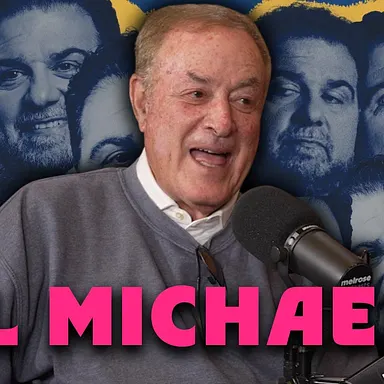
In this conversation from The Dan Le Batard Show, Al Michaels reflects on his six-decade broadcasting career, from his first minor-league job in Hawaii and his early dream of calling the World Series to the partners he worked with, including John Madden and Chris Collinsworth. He says passion, preparation and a bit of luck keep him in the booth, and he explains why he would rather not hold a farewell tour.
The discussion also covers his approach to live play-by-play, his views on criticism and modern sports media, and memorable games such as a 1986 American League Championship Series contest. Listeners hear how he handles nerves and mistakes.
In this episode Dan Le Batard, Al Michaels
This episode's transcript of Al Michaels's conversation with Dan Le Batard was made with the tool HappyScribe built to transcribe audio to text.
Ads in this audio differ from the text. Tap the sentence you're hearing to follow along.
Synced: the text now follows the audio.
If there's an anxious moment, obviously it's when you're coming on the air. And having done 11 Super Bowls on national television, I know when I'm going to look into that lens, you got 100 million people, or whatever the number is on that particular day. You're like a horse coming out of the starting gate: get out cleanly. You don't want to throw the rider. You don't want to stumble. You don't want to fall down. Just get out cleanly. And I know that every time I've done a Super Bowl, you get going. And it's almost like when the players say, you know, you take that first hit and then you're back where you belong.
I've been here before. I'm ready to go. It's exciting as hell. Welcome to South Beach Sessions. We had to come out and see this man. This man, we fly to see the legends around here. I have heard this man's voice in my life since I was 12 years old. I've never met him. And I feel like I sort of know you, but I also feel like you do a very good job in public for many years of broadcasting of people not knowing you.
So I am hoping to learn a little more. Al Michaels, thank you for making the time for us.
Great to be here. You can't get rid of me.
I want to keep you around for a while because I think your career is fascinating. And I'm also curious the how's and the roots of how you do it. So what is your relationship with the work?
I think the key thing is passion. And people have said to me, obviously at this point in my life, aren't you going to retire? And I would if I didn't have the passion. It's real simple. I think I would. I will know when it's definitely time when I can't do the job. That's a different thing. Health, of course, plays into that too, Dan. But to me, the whole thing is wanting to be there, loving to be there. As a kid growing up, my father took me to my first baseball game at Ebbett's Field.
We could walk. We lived in Brooklyn. We could walk to Ebbett's Field. And I remember thinking, oh my God, this is just the greatest thing in the world. And it's the first thing I remember. And I remember thinking, man, how great would it be to get a job where you get in for free, you get to see all the games. And I got that job. And I've never forgotten that. And so that's why I think I still have the passion I do for this.
Same. Because my memory of my father, like I remember the size of his hand when he brought me through the orange bowl, the electricity of it. But when you're talking about passion, are you talking about passion for sports and stories, talking about passion for the craft?
I think it's both. I think obviously I love walking into a stadium. I still do. I get excited. We get there obviously three hours before any game and I watch it build. And now you know that you're going to do a telecast. And I've been lucky enough for a lot of years to know that a good part of the country will be watching it. And I love the craft. I really do. And I think I try to, I can't reinvent the wheel, obviously, at this particular point. But I think there are some tweaks you can make along the line.
But I feel like the fundamentals are there. I mean, it's almost like going back to a journalism class in the 10th grade at Hamilton High School here in Los Angeles. And it's who, what, when, where, how, and why. Those are the fundamentals. And I try to stick to those. And I try to feel as one with the audience and as somebody who has loved sports and watched sports and listened to games from the time I was six or seven years old. I think I have a very good connection with the audience and what they want.
Now again, the audience is very disparate these days. There are sophisticated fans. There are fans non-ADHD. You want you to scream the game at them. But I think I have a fairly good understanding of the general sports fan and what most of the audience wants. I think I do.
I like that the acid in want me to scream the game at them because the only criticisms I've ever heard of you in a distinguished career of broadcasting in 50 years is whenever it is that you were broadcasting basketball, somebody, people wanted some more enthusiasm. And now I suppose that's the criticism of the day on Amazon.
Oh, it is. There's no question. And then some of us are in that realm too. I think I'm very similar to my brethren in Joe Buck and Jim Nance. And they don't scream the game at you. I think for me, on television, you build drama. You can see it. Radio is a different animal. I grew up through radio. And obviously there, maybe you can be a little bit more excitable to bring the audience maybe closer to the game.
On television, it's visual. On television, you can almost get away without using verbs because people see the verb. The verb is a visual verb. So in this, in today's world, you can't appeal to everybody. You can only appeal to, you hope the majority of the audience. And you're always going to get criticized. Name somebody in our business, in any business now, who doesn't get ripped by somebody on the internet. It happens.
You gave the answer though to when are you going to retire before I even asked the question. And I'm curious if you are annoyed now that people even bring it up, like that you have the answer for it, but it's not a question you want to keep hearing about.
Yeah. I think, you know, look, a lot of people say to me, don't retire. You're not retiring, are you? And I'm saying, well, at a certain point, you retire or you die. One of the two things are going to happen. But as long as I want to be there. And again, I go back to that word, Dan, passion. If you're excited, if you want to be there, if you look forward to the game, you can't wait for the game to start. As long as that is there in my fiber, I'll keep on going.
And it's funny because the other night I went to a retirement dinner, a surprise dinner for Sam Rosen, who's done the New York Rangers for 40 years. And I think he's stepping away a little bit because he had a health episode last year. But Sam is still at the top of his game. And we talked about the fact that he can't wait for the game to start. I get it. That's exactly how I feel. You get into the stadium. Let's go. Let's kick it off. Let's drop the puck. Let's do whatever it takes to get the game going. We can't wait.
Do you do much in the way of nerves? Because you used to be somebody who would eat dinner while broadcasting Sunday night football.
Well, that sort of became something that Chris Collinsworth put out there. But I think it was a little bit embellished. I mean, I may grab two bites of a steak at halftime or something. And Chris turned it into a six-course Michelin three-star meal.
The crème brûlée.
The crème brûlée. No, it's not quite that. Believe it in him.
But how about the nerves though? Like, are you still somewhat? I mean, surely at this point you have confidence that you, the confidence if nothing else in the prep, because I'm guessing you still don't, you're still not loose about it. My guess is that you are prepared every time.
The only time I would really be nervous, Dan, is if I wasn't prepared. If I wasn't prepared, obviously, then I'm going, wait a second here. I'm afraid to go on the air. But I could never let that happen. I always have to be tightly in sync with what's going on, making sure that I'm completely prepared, ready to go anywhere. Now, obviously in sports, the great thing about sports is you don't know where the game is going to go. And sometimes you're not prepared.
But now my experience will kick in at that particular point. But I feel like every game is almost like, I know I'm not going to ruin a 45 or 50-year reputation in one night unless I did something horrifically unbelievable, which I can't imagine happening. But I mean, for the most part, I think of every game as kind of like an audition. Hey, I got to be really good tonight. I got to be better than I've ever been. And that's the attitude I take into every game.
Still?
Still. Still. Because I owe it to the audience. I think it's important. I think it's important. They've tuned in. They want me at my best. I can't always be at the top of my game. Can't. Try to though. I'm always trying to, I guess, to use a baseball analogy. I'm trying to pitch a perfect game. Trying to pitch the perfect game.
And never have?
No. I think I've come close a few times. But there's always something. No matter what it is, I'll think about something. How did I miss that? You know, and I should have, could have, might have. So no, there's no game. To pitch a perfect game over three hours on national television is almost impossible. But at least you try to come as close as you can.
Do you remember the actual games we're talking about here where you were like, ooh, almost? Which are the games?
I do. Well, I'll go back to one of my favorite baseball games. It would have been the fifth game of the 1986 American League Championship Series. It's the Angels against the Red Sox. And it was a wild game. Five to Angels lead. They're up three games to one. They're going to clinch the pennant. Gene Autry is going to win his first championship. I mean, it's crazy at Anaheim Stadium. That's when Don Baylor hit a home run to make the score 5-4. Dave Henderson hit that famous home run for the Red Sox 6-5. But then the Angels came back in the bottom of the ninth and tied the game.
And the bases loaded and one out. And Doug DeCincy and Bobby Grinch couldn't get the winning run home. The game goes to the 10th inning.
Is this the Donny Moore?
This is the Donny Moore game. This is the Donny Moore to Dave Henderson game. Exactly right. And so now it's extra innings. And the Angels have a man at first base. It's Jerry Narin, who was either pinch running or coming to the game. And the count goes to three and two. And Gary Pettis is the batter. Switch hitter batting, left-handed, almost no power. And he hits a drive to deep left field. I mean, it's a hot day at Anaheim Stadium. The ball is just traveling like crazy. And Jim Rice goes all the way back and makes the catch against the left field fence.
And as he reaches up, he hauls it in and has to look into his glove to make sure he caught it. So now the game goes to the 11th with a Red Sox win. And the Red Sox eventually will go on to win game six and seven. And they go to the World Series where they run into the whole Bill Buckner thing against the Mets. So now I'm driving home because it's a home game for me. And I'm on the freeway and I'm thinking, I think that's about as good as I can call a baseball game. And then I'm going, wait a minute. What was Jim Rice doing playing so deep against Gary Pettis?
And then I think, well, hell, the night before, Pettis had hit one over Rice's head in the fourth game. And I was going, why couldn't I have thought of that? So in other words, as happy as I was and as proud as I was of the job I thought I did that day, I'm going, damn, there's just something there. You know, it was a walk in the ninth inning of a perfect game. I screwed up.
I can't believe the recall that you just had for that. I don't remember things I did a half hour ago.
Me neither.
With those kinds of details. Do you have others like that one? Do you have that kind of recall for everything?
Not everything, but I can recall a lot of things. A lot of things. And I find that it's funny. A more recent vintage, it's harder. But you go back to a lot of the stuff I did early on in my career. Yeah, I have pretty good recall about some of the stuff that happened. Yes.
Do you have another game that jumps to mind like that where you were very close and very close to whatever you think perfect was?
I would think, yeah, I would say the Super Bowl following the OH season, the Arizona Cardinals against the Pittsburgh Steelers. It turned out to be John Madden's last broadcast. I didn't know that until April, John, but it was John and I were finishing our seventh year together. Had a wonderful time. I thought John was brilliant that day. The game was crazy because first of all, what were the Arizona Cardinals doing there, right? They lost like 50 to 7 to New England in week 15.
And then the nine and seven.
And then the nine and seven team. And then Larry Fitzgerald has a postseason for the Asians. And Kurt Warner is the quarterback. And somehow they get into the, you know, they beat Philadelphia in the NFC Championship game. And, you know, people are going, what are the Cardinals, this moribund franchise doing there? And it was, and the Cardinals were able to hang in. That's the game that featured two of the most iconic plays in NFL history. James Harrison's 100-yard interception return at the end of the half when Arizona is going in to take the lead and instead of.
Did you nail that call? Did you nail that call?
I thought I caught that call pretty good because he's going down the sideline and.
That's crazy.
Right. And meanwhile, not only does he go 100 yards, but the clock is running out. So if he doesn't get into the end zone, if he gets knocked out at the one-yard line, he can't even kick the field.
Fitzgerald's hunting him down.
Oh, wait.
He gets there a yard later.
Larry's running. Larry, I said later, I think Larry ran through the entire state of Arizona because he's getting in the middle of his bench and he can't get back to tackle Harrison. So Harrison scores. And then Fitzgerald scores on a long touchdown reception with about two and a half minutes to go. And then Rothlesberger leads Pittsburgh on a great drive. Incredible drive. I think he made three third-down passes, get down deep, and then that Santonio Holmes catch with Sports Illustrated had that picture. You've got three Cardinal defenders around him.
And somehow Rothlesberger, it's like his third or fourth choice at that point, puts it up in the air perfectly. Holmes gets his feet down in. And I remember I walked out of that game thinking, yeah, I think that's about as good as I can do. But again, I would pick it apart later on. But that will always be one of my favorite telecasts ever because it was John Madden's last game. And John was fabulous. But he waited till April. And then he, and when John retired, you know, he made it very simple. He just said, it's time.
It's time. He knew it. And that was the end of that.
I've seen you quoted in a way that suggests that that's the way that you're going to do it. You seem to admire the way that Madden did that.
No question. I don't need, and people say, well, why don't you do like a victory tour? No, what are we talking about? First of all, it would be embarrassing to me to do that, to go around the country. Oh, this is Al's last game. Who cares? I mean, to me, it's not a big deal.
Oh, but it'd be sweet to hear people tell you how they feel about you during something that might be difficult for you if you get a lot of identity from this, which I imagine you do.
Well, yeah. But I mean, I appreciate, I get a lot of very nice feedback and have for a good part of my career. And I'm very appreciative of it. But I don't need to be told, oh, you know, a lot of people tell me because, you know, I'm old enough and they're young enough that, you know, I'm the soundtrack of their lives in sports. And it's wonderful to hear that. Look, there were soundtracks of my life too. Vince Scully, Kurt Gowdy going all the way back. I get.
I'm a Cuban boy in South Florida. You introduced me to hockey. Your call on that game introduced me to the sport of hockey. And it's been all downhill for you since then, right?
Totally. Hey, listen, that is number one. Nothing is ever going to beat that. Nothing. But I think that, I mean, to me, it would be embarrassing to have that tour. And I know that Vince Scully was a great friend and the greatest baseball announcer ever by far. And Vince was resistant to having a grand tour. He was 86 years old in 2016. And then finally, they really had to convince him.
But it was kind of a different animal because Vinny, you know, remember, he was the voice of a team. So he was part of a family, the Dodger family, you know, a huge family through the years. And I know they used to have these contests about greatest Dodger of all time. Was it Koufax? Was it Duke Schneider? No, I'll tell you who would win every year was Vinny because he spanned generations. People loved him. He's in your house every night. I'm a different animal. When you're on national television, there's really no home base.
And I suppose if I was the announcer for a team, yeah, maybe I'd have a kind of like a farewell tour. But there's like, I'm all over the place. You know, people have different rooting interests as opposed to a broadcaster like a Vinny or Marty Brennaman in Cincinnati who was there for 45 years and actually succeeded me after I did three years back in the early '70s. But no, I mean, I think when the time comes, I'll pretty much say, hey, thank you very much and see you.
Embarrassing? Embarrassing. You think it would be embarrassing to absorb the, and I understand it's a distinction you're making I hadn't considered, which is the idea of your, you wouldn't have a regional adoration anywhere of a connection to people that you would say goodbye to. But embarrassing because you don't want to be a part of this. You've been taught to not be the story, to just be the accent on the story.
That's right. That's exactly right, Dan. Yeah. I think when you make yourself the story, you're doing a disservice to the business. So I don't want to be, I don't want to be the story. I want to be the narrator or the connection or the conduit or whatever, but not the story. No.
So I would imagine that you're a bit mortified by the evolution of your profession to the point that today's media, part of the advancement of many media members, is to insert yourself or try to insert yourself in the story because attention is the new currency.
But most of that comes from the shoulder programming and talk shows. It's very hard for a play-by-play announcer to get into that realm because you'd probably be thrown out because people, they want to watch the game. Now, it's a completely different animal to go on a show, first take or whatever you have, and argue with each other and have, you know, contentiousness and all of that. That's a different animal. And you have, when you're doing play-by-play, you don't have time to get involved in these discussions and in dialogue.
You don't. To me, the greatest example of what television is, live television of sports events, going back to 1980, the Olympics in Lake Placid. Obviously, we know what happened. But prior to that, my partner was Ken Dryden, the great goalie for the Montreal Canadiens, who retired at the age of 30, won multiple Besinet trophies and Stanley Cups. And Kenny and I had met in Moscow about two months before the Olympics to scout the Olympic teams that were playing in a tournament in Moscow.
All of the teams were there except for the United States team wasn't participating, but the Soviets were there, Canadians, Finns, Swedes. And the first night Kenny and I meet, and Kenny's very erudite and, you know, he almost looked like a professor. He's everything but the pipe and the glasses and the slippers. But, you know, a very imposing fellow, extremely well-read. And he's written some fantastic books. And so Kenny talks to me for several minutes about the difference between international hockey and national hockey league hockey at that point.
The wider ranks, the fact that it's a more physical game in the National Hockey League. And he finishes and he says, now, do you think this is something the American audience would be interested in? I said, yes. But Kenny, let me introduce you to the world of television. Can you say it in eight seconds? That's it. So the play-by-play genre is completely different than going on a three-hour talk show and spilling your guts about everything in the world.
What do you think of the evolution of sports media? Because you're right, it's a bit of a give me the fact sanctuary. There's part of the reason I think I don't know your personality is because you're a bit purposeful about making sure that we don't know your personality because you're trying to get out of the way of what it, I don't understand the rigor you're applying in I must stay out of the way. I'm not the story here.
Well, maybe people probably get to know me on shows like this because now I can talk and I have a lot more time to expound a little bit. And I'm not averse to showing my personality, who I am, but it would be in something like this show or going on other shows or being interviewed by, you know, any number of people over the course of the years about particular events or whatever or talking about.
But the game is sacred is what you're saying. The game is sacred.
The game is the most important thing by far. Now, I can help make you understand maybe the game better. I can entertain you, but the game is still the essence of what I do. That is, you can't lose sight of it. And the one time, maybe you'll see me if the game is a complete blowout, you know, then I can go a little far afield. I think people enjoy that. I know that the first year we were on Amazon, we were doing a game in Denver and working with Kirk Herbstreit, who I didn't know until we started working together.
And Kirk, you know, Kirk loves football more than anybody on the planet. And the game was so terrible. It was only our fourth game. And I said early in the fourth quarter, I said, is it possible a game can be so bad that it's good? And Kirk goes, no. Hold on a second. And then that game went to overtime. It was horrendous. It was 9-9. No touchdowns. Penalties up to kazoo.
You still seem pissed off about it. You sounded pissed off. You sounded on behalf of America. You were indignant watching how shitty that game was.
But people love that. They love that. And then we had a shot coming out of commercial going into overtime. And there's a shot from outside the stadium and, you know, a few hundred people leaving and going to the parking lot. And Kirk says, it's overtime. How can they leave? And I said, they've seen enough. So, I mean, that's as much personality as I will inject into the game right there, right?
Not just personality, opinion too, because I felt in your voice sort of an undercurrent of I'm too old for this shit. Do you know how many of these I've seen that are better than this one?
Well, it wasn't that too old. Look, I've done 900 to 1,000 NFL games. Not all have been great, obviously. I've had a whole bunch of those as well. But, you know, I think at that point, I think I'm connecting to the audience at that point. I think a lot of, you know, a lot of people said, that's exactly how I feel.
It's unusual to hear disdain in your voice when broadcasting a game. When you ravage yourself after a game that hasn't gone well, how gentle in general are you with yourself?
Well, again, it's the, probably it's the perfectionist in me. And I don't like to be anything but perfect. I certainly try to be. It's almost impossible. But it depends. I mean, there are times when I won't really be pissed off at myself to the extent that, damn, you know, but I'll think, why couldn't I have thought of that at that particular time? And it's mainly things that happen and they happen rapidly, instantaneously.
And I'm just upset with myself for not thinking it through more quickly. So it's more about that. I mean, I don't beat myself up because I know there's another game coming up pretty soon. So you have a chance to, I don't want to say a tone, but maybe you'll pitch the perfect game next week.
What would your wife of 58 years, Linda, say to me about your perfectionism?
She understands it. She just lets me, you know, if I'm upset about something in regard to, you know, how I performed or whatever, she gets it. So, you know, let's, and I don't really vent. I mean, it's like, okay, let's kind of move on. Deal with it. Make it quick. Don't belabor it.
Well, I've read some quotes from you. You don't like to spend a lot of time in the past. In fact, I've read something I wanted to ask you about, which is you're saying that you have a practiced discipline about trying to stay present. This is something I've learned since the death of my brother, sort of the importance and the tranquility of trying to not allow the mind to race off into other places where there's less gratitude.
Right. Right. Yeah, no, I don't, you know, like there's a phrase in Yiddish, you don't want to be an out the cocker, which means, you know, living 20 years ago, 30, whatever. So look, I love being with people and like you and I are discussing the 1986 American League Championship Series and the Super Bowl from '08 and all. That's fine. But you got to live in the present, live in the moment if you can. And I've always felt it's important. I mean, the past is the past. It's wonderful.
But don't keep living there. And I don't really think about the future that much either. In the moment, in the present, wake up each day and think, hey, this is pretty cool. I'm alive and here we go.
Are you introspective though? Because looking into the past would be helpful there, right?
Can be. Can be. But don't just, don't immerse yourself in it. You know, I just enjoy life. I'm a curious person. I like to wake up every day and, you know, can't wait to read the papers, go on the internet, find out what's happening in the world, not just the world of sports, but just try to stay current, topical, and be able to discuss the events of the day or what's taking place at that moment in time. That's important to me.
What is the best and worst stuff involved with being 80?
Well, I guess the worst stuff is thinking about it. It's as I keep telling my friend, the great John Shaw, who was the president of the Rams for a lot of years and one of my great buddies, I said, John, we can't do the math. Let's stop doing it. Don't do the math. You know, I used to wake up, you know, Dan, I thought when I was starting my career, I thought I was going to probably die by the time I was 40. And I wanted to accomplish everything by the time I was 30.
And I accomplished some amazing stuff because it was in the right place at the right time. I did the World Series on national television at age 27. How I got the job at the Cincinnati Reds. We win the pennant. NBC uses the team announcers. I'm going, this was my dream. I'm in high school thinking about, I want to do the World Series. I got to do it before I'm 30 because at 30, you know, you're an old man. At 40, you die. So think about that.
Why did you think you were going to die at 40?
Because 40 just seemed like ancient at that point. It did. You know, and I was always, I think I was driven early on by wanting to do all of the stuff that I dreamed about, which has come true, amazingly enough.
You've exceeded. You've exceeded your expectations.
And do it faster. No question. As a kid growing up, I'm dreaming about doing the World Series. I'm dreaming about doing the Olympics. The Super Bowl didn't even exist at that particular point. Got them all. Got them all. Kentucky Derbies, Indianapolis 500s. I mean, the whole thing. It's like crazy. I feel anointed in that regard. And I dreamed about all of this stuff, Dan. And it all came true in spades. It did. And I'm going, and believe me, there is nobody more appreciative and more thankful than me.
And I think I wrote a book in 2014 and didn't know how to end it. And then I think my last line was, you know, if God wants to get even with me in my next life, I'm working in a sulfur mine in Mongolia on the night shift. And that's the reverse of the life I've lived.
Yeah, you've lived it in the light. What kind of ambition monster were you at a kid as a kid to conquer that way that early?
I think I thought that having been introduced to it that early, and I think maybe growing up in Brooklyn and then we moved to Los Angeles, same year the Dodgers did all crazy things. So I listened to Vinny. My whole, my whole, from the time I was six years old, I heard Vinny.
I love that you call Vinn Scully Vinny because you've known him.
Right, Vinny.
He calls him Vinny.
Vinny, yeah. But that's how I knew him. And we became very good friends, obviously, through the years. And I was honored because when he was going to do his last year, they asked me to do the ceremony at Dodger Stadium before the opening day in 2016. And he wanted me to do it. And I was very excited and honored to do that. But I think listening to him, and he made me so much, so love baseball. And then I loved the other sports as well. My father was a gigantic sports fan.
So we went to, you know, we went to see the New York Rangers when I was seven. That's how I became a hockey fan. The football giants. We had three baseball teams in New York at that time. The Yankees and the Giants were there. The Knicks. So my first NBA experience would have been going to Madison Square Garden, the old garden, in an A-team league, and they would play double headers. So the first game might be Fort Wayne against Syracuse. And then they leave after that game, after the court, and the next game, here come the Knicks and the Celtics.
So you get to see half the NBA in one afternoon.
Yeah, but everyone who lived there got that. And you got all the jobs. Like, what was the nature? What was the nature of the ambition, right? Like every kid wanted to be doing what you were doing. How did you get there? How were you better than the others? And how obsessive, compulsive were you about, I need to get ahead?
Very busy. In high school, I knew exactly what I wanted to do. And then when it came time to go to college, I wanted to go to a school where it afforded you the opportunity on the campus station to do games. Now, it's not like it is now where every school has that. But now, in those years, and we had moved from New York to Los Angeles, I wanted to stay out West. I wanted to go away to school, but not far. So Arizona State had one of the very, very few radio and TV programs with the opportunity for the student to do the games.
So we picked Arizona State. Like I say, we, it's my father and I. And I went down there, and sure enough, that turned out to be unbelievable for me. Because the baseball team, which won a national championship my junior year there with Sal Bando and Rick Munday and Reggie Jackson. So I've known all those guys going all the way back. But I remember thinking, you know, wow, I've had the opportunity to do almost 200 baseball games. I've done probably 40 football games. I've probably done close to 100 basketball games.
I've done track meets. I was the sports editor of the school paper. So I was immersed in this. I was ready to go. And all I needed was that one opportunity, that one break. And it came in Hawaii, of all places. Went over there to meet with the general manager of the Hawaiian Islanders. A man by the name of Jack Quinn gave me the job. And maybe it was, you know, out of the canon since then.
I want to talk to you about Hawaii, but you've mentioned your dad, Ebbets Field, a couple of times. It was your mom, though, that took you to the racetrack, right?
Yes, it was. Yeah. Now, this is when we moved out to California. And my mother was pretty much a combination of Phyllis Diller meets Joan Rivers. She was a character and she loved pulling pranks. And my father was more upstanding. So he would take me to Hollywood Park like on a Saturday. But my mother would come to high school, to Hamilton High, go to the principal's office on a Wednesday and say, Allen has a dentist appointment.
And then she'd take me out of school. And the dentist appointment was at Hollywood Park. Right? That's the mother of mothers. So, and then a couple of my buddies knew what was going on. So then my mother would come with a note for them as well until the school got hip to what was happening.
It seems slightly irresponsible.
It was amazing. So that's how I got into horse racing and all of that. And then going to Arizona State of all crazy things, my journalism professor was a guy named Gordon Jones, who became the handicapper for the Los Angeles Herald Examiner and is well known in horse racing circles. And we would end class early if we had something in the Daily Double at Turf Paradise to get, you know, to get out of Tempe and go to the racetrack.
Well, when you mentioned connection to audience, I imagine, I don't know what the comment is you get most often, probably some form of, do you believe in miracles? Yes, an enduring thing from 45 years ago. But I imagine many people are a great, very high on that list would be people thanking you by slapping you on the back for all the gambling references during the game when you're speaking in code.
I was way ahead of my time, wasn't I? I guess because now, I mean, I always enjoyed, there was always a part of me that enjoyed being the rascal and just kind of doing something a little off-center. And so for all of those years, what I would do, obviously, the score was 41-0. I might say, this game is not quite over. And of course, that became sort of a thing. And I would always try to envision in my brain the sports books in Vegas and, you know, the guys laughing like crazy when I would say something like that. And now, of course, it's like, you know, the lines and the whole thing and over-unders.
But it was fun doing it in those years. It was fun because you kind of, you know, you're tweaking the establishment a little bit, even though there was no way the NFL wanted me to stop doing that, right? I mean, they could, you know, bare their teeth. Oh, I wish you wouldn't do it. Not really. You know, it was okay for them too.
The rascal stuff comes from mom, right?
1,000%.
Because I don't know, we have a lot of evidence of you being a rascal.
Not a lot. But I mean, it's either well, you know, I was more of a rascal. I was a rascal in college. You know, in college, most kids are rascals. But I.
It's what college is for.
It's what college is for. Right, exactly.
Not learning.
Exactly. Exactly. So, you know, but I think I'm not, you know, me, I'm not, certainly through my work. I mean, I'm not cut and dried.
Oh, I'm not accusing you of being cut and dried. I just don't think anyone here would be saying, that's crazy that Al Michaels sort of tilts toward rascal.
Right. Well, I kind of do it parenthetically. Let's put it that way.
Well, but you're also so respectful of what it is that you're doing, right? You've got, like, you don't, you're so mindful about not getting in the way of what it is that you're doing that I don't see the rebel. I can't look at a lot of points other than the gambling in your voice. And in 50 years of broadcasting, find a lot of, you know, looking for the dangerous edge.
I think a rascal is a little sure to be in a rebel. You know, a rascal, rascal's fun. You know, a rebel can be a pain in the ass. So that to me is a distinct difference.
Well, I think most people watching this would say, fun, pain in the ass.
Pain in the ass.
I don't know. I think so. I think I might get some of that. But take us through your upbringing. Like, what are the things that your parents instilled that are the things that you still carry with you now?
Well, I'm lucky because I grew up with fantastic parents. I was born when they were 18. So you can imagine, you know, I kind of happened, right?
Yeah, they're not ready to be parents.
Not ready to be parents. And not a lot of money. And we had a, we lived in a one-bedroom apartment on Ocean Avenue in Brooklyn until I was 11 years old. And my father was, you know, kind of working his way up, was with a talent agency in New York. And then we moved to, he got a $10 a week raise or whatever. We moved to Long Island for two years. And then out to California when I was almost 14 years old. So I had a, my mother was fantastic.
My father was a tremendous man, very smart. And, you know, again, 18 years old, he's a father. And he was the one who introduced me to like everything in the world. And he died when I was 38. You know, I still miss him to this day tremendously because I could go to him with almost anything. And he would have a great understanding and be able to evaluate it. And again, I'm so lucky because so many kids don't have the upbringing that I had.
And so it was, you know, when we lived in Brooklyn, somebody once said, oh, Al had a silver spoon. A silver spoon. Let me get this straight. We lived in a one-bedroom apartment on the second floor of a Brooklyn apartment building. And my brother and I slept in the bedroom and my parents slept on a Kestrel convertible in the living room until I was 11. That's some silver spoon. Let me tell you something. That's plastic dishes and knives and forks. But anyway, I was, they were wonderful, wonderful people.
And again, I'm a byproduct of them. There's no question.
How would you articulate for us the secrets in being married for 58 years?
Number one, a lot of luck. Because when you meet somebody in the 10th grade, in the 10th grade, and then you know each other for six years and you're married for, as we have been at this point, 58. And she's, you know, fantastic, the love of my life. And she's been rocking and rolling with me all the way. And I tell you, Dan, the greatest thing is that we've shared everything. There's nothing in my life that hasn't been shared with Linda Michaels. So it's like, it's incredible.
And I am, again, you know, unbelievably thankful for my life, my career, and finding the right girl. I mean, you know, you pick somebody out of a bassinet, you know, when I met her when we were 14 years old. And it's been a wonderful ride. And again, I go back to that, you know, I'm working in that sulfur mine in Mongolia on the night shift in my next life.
How have you and her changed over those 58 years?
I think we've evolved. I mean, you get older. You know, when you're, we got married at 21. We're different people. But, you know, we've just grown together. We've grown together. And we kind of raised our kids with the right thing. And, you know, again, I'm so lucky because I have two incredibly well-adjusted kids. I have four grandkids. And I'm just, you know, I've lived the dream. You know, you hate to even say it because again, you go back to a Yiddish term, a kenaharra, meaning, you know, don't talk about something because you're putting the evil eye on it.
And it's, you know, I'm lucky.
But you regard it as being a journey that does not have a whole lot of hardship or doubt in it beyond, you know, growing up with not the silver spoon.
I would say, for the most part, yes. Yeah. Yeah. But just, and I think a lot of it has to do with appreciation. We appreciate it. We've never said, we've never, oh, we got to keep up with the Joneses or do this or do that or these people are doing this. No, never. It was just, I think, a great appreciation for the lot in life that we've been given.
I'm going to give you a little bit of failure here. Why did Chick Herrn get rid of you after four games as a Lakers announcer? And does that represent the greatest failure of your distinguished career?
Number one, I shouldn't have been there, right? I get a job in PR with California Sports, Jack Kent Cook. And they want, and Jack Kent Cook used me as a sacrificial lamb to make Chick work with somebody. Chick wanted to work alone. So, you know, I shouldn't have been there to begin with. And then Chick and I became good friends through the years. And in fact, when Chick died, the LA Times asked me to write the appreciation piece, which I enjoyed doing very, very much.
Did Pat Riley assume the role soon after you did?
No, Hot Rod Hunley got the job. So Hot Rod had retired and then Hot Rod came in and he was Chick's partner for a while. And then I think it was several years later when Riley came in there and was Chick's partner. But, you know, of course, I was upset, embarrassed, angry, but that, it all happened so fast. And then on the heels of that, the Hawaii thing happened. So it's almost like, forget about that.
Well, tell us about Hawaii. So you immediately start winning broadcasting awards in Hawaii. And I would imagine there's at least some culture shock in being over there that young.
There was, but we loved it. We loved it. And, you know, I was married at that point and Linda and I, we had an apartment at the foot of Diamond Head on the 11th floor, small apartment. But Dan, I would wake up in the morning, I'd go swimming either there's a pool downstairs or go into the ocean, go into the Pacific Ocean and come back, get dressed, go to work. You know, I was doing baseball, football, basketball, you name it. I'm on television twice a day. I'm writing a column for a local paper. And by a couple of really odd things about this.
So in 1970, I'm doing University of Hawaii football, the rainbows. It was before they were the Rainbow Warriors. They were the rainbows at that point. And there's a guy playing for them who had no idea. There was no memory of this guy, what his name was, what he did. But I find out earlier this year that Jim Nance is doing a game in Kansas City. And Taylor Swift's father, Scott, comes into the booth and said, you know, I played for the University of Hawaii in 1970 and Al Michaels was the announcer.
And it was true. It was true. Looked it up and, you know, I don't remember him. I don't think he remembers me, but he knew that I was the announcer for the Hawaii team in 1970. And it was all about baseball at that point. I did three years of baseball, Hawaiian Islanders. We at that point became the most successful minor league franchise. We drew almost a half a million people in 1970. And we won our division. We went into the playoffs against the Spokane Indians who were the Dodger farm team. Steve Garvey, Davey Lopes, Bill Russell.
That's a pretty good team.
Bobby Valentine, managed by Tommy Lasorda. And Lasorda dines out. I used to dine out on the story about how he discovered me because he would always talk to Al Campanis, the general manager, after every game and give him a recap of what happened. And one night he says he calls Campanis after, I think, we played a seven-game series because they came over because of the travel situation. Teams would come over all week. So Spokane is there. Got to know all those guys. And he calls Campanis and he says, hey, you know, Valentine did this, Buckner did this.
Hey, Al, there's a kid over here. He's doing the games on radio. This kid's really, really good. I know you got Vinny, but you should keep an eye out of this guy. His name is Al Michaels. And the conversation continues. Campanis says, Tommy, what, this guy you're talking about, this Al Michaels kid, how do you know he's any good? Tommy says, I've been thrown out of the last four games. I've been out in the clubhouse listening to him. Now, so of course, Tommy embellished it, but he was thrown out of three out of four.
One night he gets, like the third game of the series, he gets thrown out in like the second inning. And in Hawaii, the clubhouse was way beyond the center field fence. So it's not like you come up through a tunnel in the dugout. So Tommy gets serenaded, right? He walks all the way. He's 500 feet from home plate. He is listening on the radio. So the next night he comes out, he gets thrown out when he brings out the lineup card, right? So now he's two full games. And then in the sixth game, he got thrown out like in the sixth or seventh inning. Now, on top of all of this, the umpire who threw him out was Bruce Freming, who would go on to umpire like 35, 40 years in the making.
I mean, you can't make any of this up. And our manager is Chuck Tanner and I got all these guys. I mean, it's like, this was crazy. So Lasorda takes credit for finding me. Then the Cincinnati Reds find out about me. They bring me in in November of 1970 to meet with me. And I wind up getting that job. And by the way, I got to mention one thing here. This is a good opinion for you. Steve Garvey should be in the Hall of Fame. The fact that Steve Garvey is not in the Hall of Fame is absurd. It's ridiculous. I don't care about this war shit and all this other whatever it is, right?
Whatever it is. It's all about analytics, Dan. Come on. Please. Put Steve Garvey in the Hall of Fame. Stop it already.
I love your indignance. Do you have more of these? I'll take all of them that you got. The old sports columnist in you.
You got me wound up.
Do you think of yourself initially as a writer? Like, were you dreaming of broadcast? Like, what, the dream was what in its earliest stages?
The dream was broadcasting, but I knew to broadcast well, I needed to be able to write because what you're doing is you're writing in your head and saying the words. So I majored in radio and TV at Arizona State, minored in journalism. I was the sports editor of the state press at Arizona State. I was the sports editor of my high school newspaper. So I loved to write. I did the appreciation pieces I said for Chick Herrn. So I love to write.
But explain to me the beast in you, Al, because like, you're doing stuff young. You know what you want. What grade? Eight? You're eight or nine years old and you know what you want. Give me the details of what it took.
I think it took just, again, I think almost more than anything, it's an AFTA where I thought I could do all of this. And I look back now and go, man, alive, did I get the break of breaks? Now, again, I did all of the grunt work, you know, growing up, writing in the high school paper, taking a cassette recorder to Dodger Stadium and setting up, you know, in the high end, down the left field line where nobody was and calling the games on that, doing all of those games at Arizona State.
I mean, school was fine, but it was all about being able to broadcast those games. So I positioned myself, I put myself in a position to at least have the opportunity if somebody could hear me and give me a break. And of course, that happened, you know, in Hawaii. Hawaii, that was the big break. But I prepared myself. This wasn't like I woke up one day and said, I want to be a sportscaster. I wanted to be it since I was the time, you know, the time I was a kid, dreamed about everything and did all of the things I think you had to do.
But again, I go back to this being naive because I'm thinking, wow, I'm going to do this, I'm going to do that. And I'm going, if there's no Jack Quinn in my life in Hawaii, I don't know what happens. I don't know.
Oh, but it's not luck. It's not luck to get all the things, Al. It's not.
You need that first break. That first break is huge, huge. And I wind up getting that break in Hawaii and we are the successful minor league team and I get noticed and that leads to Cincinnati and I'm doing the Cincinnati Reds with Rose Bench, Morgan Perez, Sparkey, at 26 years old. Wow. You know, it happened, it happened fast, but it happened because I built a base.
I can probably get another opinion out of you if I ask you about posthumous Hall of Fame Pete Rose. I'm guessing I could find something in there that gets you indignant again.
Yeah, I wouldn't say indignant. I mean, look, Pete was a good friend in addition to somebody I covered, you know, every day for three years. He was a good friend. I saw him two months before he died. He came out here because they did a documentary on Pete, the matter of Pete Rose. I've never enjoyed covering a player in any sport more than Pete because Pete was the embodiment to me of what an athlete should be every day, coming to the ballpark every single day and having covered him in a spring training game and in the seventh game of a World Series.
There's no difference. He played it the same way. Balls out, all out. So I wish he would have gotten in. I understand what he did. What he did was bad. I get it. I understand it. But I mean, now to put him in posthumously, I don't know what that means at this particular point. You know, I could get indignant about Garvey because Garvey has to be in. And I understand why Pete wasn't put in. But to me, what Pete did, that's a record that was impossible to break. Ty Cobb's record. Impossible.
And he did it. And it's not that Pete had all the talent in the world. He didn't, but he worked his ass off. And he was a lot of fun to be around.
So you've mentioned your beloved Vince Scully Vinny a few times now. He came on with us one time and he told the story of being mortified by his greatest mistake, which is he meant to say hot shot, hit, foul. And shot and hit became shit. And he recalls all of the details of that at bat in the 1960s. Do you have an error that haunts you?
No, I really, I don't. And again, you know, somehow Vinny was able to survive that, I guess, right?
Yes. He did okay after that.
You might say. No, I once got a shit on the air because we came out of commercial. We were doing a game. I was on Monday Night Football and Leslie Visser was our sideline reporter. And, you know, Leslie went to Boston College and she's always throwing the Boston College stuff in there. So in the commercial break, Leslie said something about somebody who was in the game at Boston. So I didn't realize we were out of commercial. I said, Leslie, stop that Boston College shit.
So it made noise at that point. But again, this is kind of like pre-internet, pre-anti-social media and all of the rest. So, you know, you survive those moments. What can I tell you?
You've carved out a simple life for yourself, right? Do you have management? Do you have an assistant? Do you have like people around you tending to the economy of Al Michaels?
No, I don't. I have a representative. I mean, you know, Marvin Demos represented me for a lot of years, but, you know, Marvin does the deals and is a mentor in many ways. No, I don't. I have, I'm lucky I have very good friends who, you know, if I need feedback or advice or whatever or a boost, I've got a lot of people, enough people in my life. I'm very lucky in that regard. Built a nice base of pals. But no, I kind of do things by myself.
It's like, you know, being booked for this show. Hey, talk to me directly. It's just easier that way. Simple. You know, I think it's just the more you can uncomplicate your life, the better it is. That's always been the way I've gone about it.
What are the parts of the job that people don't know about? Because if I said to the average person watching a game, Al Michaels has one game a week. Al Michaels has to prepare for one game. That person might think that that job is five hours, seven hours, nine hours. They don't see you, you know, looking at the 50th guy on the depth chart on Tuesday.
True. Yeah. And now we're kind of immersed in information that's available to us. I think we live in a world, Dan, of people talking about TMI, too much information. I talk about TMM. There's too much misinformation. So one of the hardest things now is we have, I have access to everything. I have access to, the fans have access to almost everything. I have access more than they do because I can pick up the phone, call people, meet with people, and get some insight and information that they can't.
But I try to do as much study as I can, watch as much tape as I can before a game. You know, I watch tape differently. The analysts will watch like Kirk, before that Chris Collins were the judge. They're watching it differently. They're looking for the things that they can bring out as an analyst. What I'm looking at is if I'm doing a game like I have the Cowboys and the Cowboys have been on national television a week before, I want to know what they did with the broadcast itself.
In addition to, you know, what the game, what happened in the game, but what are the things that have been talked about and the things that haven't been talked about, right? Because I don't want to go on after 40 million people that watch the Cowboys on Fox and come and go and tell a story that's been told last week. I'll reference it. I'll go, hey, as you know, as they said last week or, you know, Kevin Burkhardt said or Joe Buck said in the older days, olden days, give them credit for, you know, what was said.
But give us the idea of the preparation. Explain to us, to get to the broadcast for Al Michaels to be prepared and feel confidence in his preparation, what is the tax on that?
Well, it starts, it really doesn't stop. I mean, even now, I'm paying close attention to everything that happens in the National Football League because I want to, my brain kind of works like a calendar. I see my brain working, you know, from back to front. So I have this base of back in April, they were talking about this and now here we are in September or October. And that's, I kind of have a chronological brain.
Is it crowded up there?
It's very crowded up there. In fact, I'm trying to dump a whole bunch of stuff out of it and I can't do it. Tell me where you want me to do it.
You're a hoarder. You can do some of it here.
I am a hoarder. No, I know. I'm trying to, I'm getting rid of a lot of stuff here.
Let it go here. Like if you want to just dump it out right there, that's a good place for it.
It'll come back in by the time I get to the street though. That's the problem. So I find that, look, you do all of the reading you can, you do all of the research that you can, and then you just have to just back it off a little bit as you get to the game, right? Slow it down. Time out. You can't get all of this stuff in. And I would say of all the stuff we are prepared for, you know, we have production meetings and we have, you know, a big meeting the morning of the game and all of that. We talk about a lot of things of which maybe 10% get into the game.
That's a lot. 10. Because unless it's germane to the game, it doesn't matter. We can have the greatest story in the world about the Nickelback or whatever. If he's not a part of the game, where are you going with this? You're going nowhere. Nowhere. So you got to tie it into it. And this is what I told the young guys coming up too. Make it germane. Watch, you know, understand what the game is. And early on, you know, I worked for, you know, Rune Arvids at ABC hired me back in 1976 and he brought to television.
Up close and personal. Because to Rune, you know, the games were good, but there's a sameness to the games. What's different? It's the people. It's the people. People want to have a, the audience wants to have a connection with people. And so I've always been driven by that concept too.
How do you deal with anxiety?
I'm sorry, how do I deal with?
Anxiety.
Fortunately, fine, you know.
I would imagine the prep helps with that. I imagine that you have to.
Oh yeah, no, no, no question.
The confidence of expertise and excellence and all of that stuff, like you said, stack successes on top of each other. But if you're a little afraid beforehand that you don't want to embarrass yourself on the air, you're going to do all of the things that need to be done.
No question. There's no, no. If there's an anxious moment, obviously it's when you're coming on the air. And having done 11 Super Bowls on national television, I know when I'm going to look into that lens, you got 100 million people or whatever the number is on that particular day, you're like a horse coming out of the starting gate. Get out cleanly. You don't want to throw the rider. You don't want to stumble. You don't want to fall down. Just get out cleanly. And I know that every time I've done a Super Bowl, you get going.
And it's almost like when the players say, you know, you take that first hit and then you're back where you belong. I've been here before. I'm ready to go. It's exciting as hell. But the anxiousness comes early on. No question.
Can you explain to somebody watching this, I mean, so much learning that you've done, if you could put some advice in a box on what you've learned about this business and about the craft for that to represent you and explain to an Al Michaels who's eight years old right now watching this, how do I get there? Like how do you, beyond luck, what are the things, the tangible things that you've learned?
You have to work at it. You have to work hard at it. I think you have to be optimistic too. I think you have to think you can do. And I would say, and I tell this, you know, when I talk to a lot of my high school kids or college kids who are interested in the business, think positively. I can do this. I can do this. And I don't want to sound like a pastor or somebody because I'm not a particularly religious or spiritual person. But I think if you have negative thoughts and if you think about why it can't be done, that's going to overwhelm the possibility of what can be done.
Now again, you know, the other thing is, you know, maybe you're set up for a disappointment because you're thinking you can do it and then you don't get the break. And I don't know. Again, Dan, I go back to, if I don't get that initial break, I can't, I might have been unbelievably disappointed. I don't know. I don't know what I, maybe I would have done something else in this business, but I got the break of breaks and it led to all these great things. And that's where the luck comes in. And you're going to need some luck. And I tell these kids too. I said, you know, it helps to have a rabbit's foot in your pocket.
But think that it's going to be there. You have to. And don't keep thinking about what you can't do. Think about what you can do.
Where did that develop? Just a general positivity there because there's plenty of cynicism in this business. There are plenty of unhappy people who arrive at success and aren't grateful for it.
Probably I was too young to think negatively when I started thinking this way. So I always thought this way.
You've always been a generally positive person.
Always. Always. Yeah.
Was that in your home?
Yeah. I would say so. Yeah. Yeah. I was encouraged. And again, I had very, very smart parents who encouraged me and lifted me and all of that. And so that was huge.
And was it hard when you lose your father when he's 38 to remain positive?
Oh, no. At that point, no. At that point, you know, I'd already been established myself. This is 1983. I'd already done a lot of things and, you know, done the World Series at Lake Placid. He got to see a lot of my success. Yeah, it was just devastating to lose somebody, you know, when he was, he's 56 years old. I'm 38 years old. And I felt for my siblings too. You know, my younger brother and my sister's 13 years younger than me too. So they didn't get the full Jay Michaels.
And so you, but you feel, you feel a gratitude about, oh, he got to see all the things.
No question.
He got to see that I had, well, but you arrived at all of so many successes before 40 years old. So he got to, so there was the shared part of that.
No question. And that's, you know, in my heart to this day. Thank God.
When we talk about age and people are asking you about retirement and you're saying, I'm not a particularly religious or spiritual person, but you're talking to your friends about mortality. What is it that you wake up with that inspires you, that pushes you to new places that make you feel most alive?
Well, number one, I don't dwell on the age part of it. I don't dwell on mortality. I did it when I was younger. Sure did. You know, again, as we discussed earlier, going back to, you know, in my 20s, I think I'm going to die at 40. Here I am, double it. So I just kind of like, I don't know, maybe it's just a mindset of living in the moment, living today. Living today.
Not yesterday, not tomorrow. Today. And that's what I try to do as best I can.
Where'd you learn it though? Because it's such a, I know people hear this all the time about presents, but I'm telling you that this is something that it took the death of my brother, the greatest pain I've known, to sort of awaken in me an alertness that you're articulating and philosophers, Eckhart Tolle will tell you, if you live in the future, you're living in something that doesn't happen, that people, that fear and regret are the two poisons. Looking back at regret, looking forward, that they're the two poisons because they keep you from now.
I don't know where I learned it. It had to evolve through the years. But I've kind of always been this way. So.
But you don't do much regret then. Like they're not places along the path where you're like, oh, I could have done that.
So minimal as to be infantessimal. Yeah.
What a charmed existence.
No, it's great.
Congratulations. I want to salute you for seeming to have found genuine happiness and gratitude in life. It's a conquering success story all around.
You're treating me like Joel Osteen now or something.
Oh, just I'm happy. I'm happy. If you're coming in here saying, I love what I do. I still have passion. I'm present. I've simplified my life. It's been, I don't know how much joy there is in the doing because that's gotten in the way for me. I've been somebody who like aspires and tries to get ahead. And if you're trying to get ahead, sometimes you can get ahead of yourself. And all of a sudden, joy gets lost in that transaction. It doesn't seem like you're carrying yourself like that.
No. I mean, look, not everything has been smooth sailing. I mean, there have been bumps and, you know, swails along the way. Nothing gigantic. But it's like, okay, let's just move, just keep sailing. You know, it's like, you know, you're on a plane and there's turbulence and you're going to come out of it and this guy's going to be clear. And I, you know, I try to keep that mindset. I think that's important because otherwise you sit there and you, you know, you wallow in nonsense and ugh, and just, and it's no good for your health either.
No, well, no, no, but if, if, I don't know whether you do anything in the way of breathing exercises or meditation, but the mind can be a poison and the idea that your mind is something that gives you the illusion of control when like it, it's something I struggle with. I try to slow it down and I struggle with it all the time.
Yeah. It's, hey, life its own self is dangerous. It's, you know, you talked about, you know, emotions and regrets and all of that. You know, to me, the most poison, not, I shouldn't say the most, but something that's so bad is jealousy. People are so jealous these days. Maybe it's through time immemorial, I guess it's been probably the same way. That can kill you too.
Yeah. Look at what he's got. Yeah. The mental health struggle.
Right. Why don't I have this? Ooh, boy. No.
Yeah. You don't find yourself wanting to know those things.
No. Fortunately, no. And if you start to go that way, forget about it. Man, just appreciate your existence. That's how I look at it.
Last question.
Sure.
The outside of your family, the most substantive relationship with a partner that you have had in broadcasting, understanding that I'm asking you to make one decision, not to the neglect of anybody else, but I'm asking you, the one most meaningful partnership that you've had.
Well, this has to be, it's got to be a tie. Really, Dan, I'd love to be able to tell you this, but I have had some incredible partners. I mean, I'll go back to Tim McCarver and Jim Palmer, the three of them. It's a three-man booth is hard, very hard. That's the only one I've been in that I said we got the most, it was better as a three than as a two. So I had Jim and Tim. I go back to Ken Dryden. That's a one-off 1980 Olympics and we did '84 and '88 as well.
Frank Gifford and Dan Diedrich, we had a wonderful time, 11 years together. I go to John Madden, seven years. Chris Collinsworth is like a brother to me. Like a brother. 13 years with Chris, still going strong. He's great. And I've developed in three years and with Kirk Herbstreit, it's gone by real fast. I've been very, very fortunate because I've had, I've had these fantastic partners. And so I've been very lucky in that regard. I've also had a couple of really famous partners.
I had Bruce Jenner and I had O.J. Simpson. Now we're going into a completely different realm, but just through my career, I think I listed one time I had over a hundred different partners because I did things like motorcycles on ice, did a lot of auto racing with Jackie Stewart, the Wes Scott, and diving with Ken Sitzberger and all crazy stuff. Basketball, Doc Rivers would be another guy. Doc and I only worked together that one.
But to be clear, the tie is Bruce Jenner and O.J. Simpson, right? Like that's the tie.
Well, they're kind of like any very separate cast.
Okay, but I asked you to pick one and you gave me the whole resume, which I'm grateful for. By the way, for those who do not know, it is a resplendent tapestry of a career.
It's incredible.
But the tie was, I still don't understand the tie and partnership. Yet no one's going to be offended because I'm forced, I'm badgering you.
I know you are.
The closest relationships, the two closest.
So the longest was with Chris Collinsworth. So, you know, you got 13 years. Fantastic. And again, John Madden, seven years. So twice as long. McCarver and Palmer and I, I think off and on because we lost the rights and we got them back, you know, probably.
You know what? Unfair of me. You gave everyone the credit. You did it right. I'm doing it wrong.
Chris has been the longest marriage or whatever.
No, fun pain in the ass. Fun pain. That's why everyone likes you and not everyone likes me.
I'm not sure about that.
Everyone likes Al Michaels.
I don't know.
Thank you, sir. I appreciate this.
Hey, this was great. I really enjoyed this.
As did I.
Man, this is like going to therapy.
Yeah, we should do it again. Let's do it again. Let me in there deeper.
It's hard to get booked by you though.
You don't have an assistant. You don't have someone. We've got to reach you directly.
Pony Express, no problem. Thanks, man.
Thank you, buddy.
The NFL, NBA, MLB, NHL, and Olympics may have their individual legends, but Al Michaels is the legendary voice of them all.
In this legendary conversation from March 31, 2025, one of the greatest sports broadcasters of all time shares with Dan his most cherished moments and iconic calls from six decades of covering the most major prime-time sports events of any announcer. Al reveals how it all began for him, how he created the career of his dreams and how equal parts luck and skill turned him into the man he is today. Al also tells Dan what he learned from the incredible broadcast partners like John Madden and Cris Collinsworth he's had along the way, and he explains the reason why he's not looking to retire anytime soon. The legacy of Al Michaels continues… watch the NFL on Amazon Prime Video.
Learn more about your ad choices. Visit podcastchoices.com/adchoices