
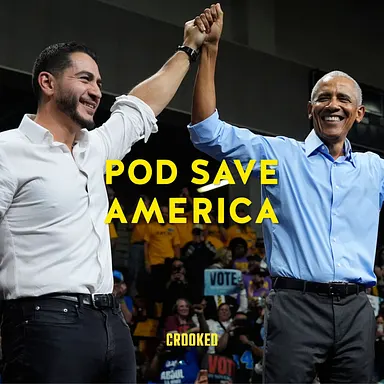
Recorded just two days before the midterms, this Pod Save America episode features CNN chief data analyst Harry Enten walking host Tommy Vietor through the final polls. They discuss the historical punishment midterm parties usually face, why a Democratic House blowout looks increasingly plausible, and whether pollsters are missing Republican voters.
The conversation also covers closely watched Senate races in Texas, Michigan, Alaska, Ohio and Maine, plus bellwether districts to track on election night. Enten argues that polls have underestimated Republicans in recent years, while noting that Democrats outperformed their polls in 2022.
Listeners will get a practical guide to reading the numbers as results come in.
In this episode Tommy Vietor, Harry Enten
The transcript of this Pod Save America episode on the final midterm polls was made with the technology HappyScribe built to transcribe video to text.
Ads in this audio differ from the text. Tap the sentence you're hearing to follow along.
Synced: the text now follows the audio.
Today's presenting sponsor is Simply Safe Home Security. If your home security has been on your mind lately, there's no better time to protect it than now, with Simply Safe. Right now you can save 70% on a new system, their biggest savings of the year. Running to get a dog into the studio?
Get her. Unlike traditional security systems that only alert you after a break and is already underway, Simply Safe is built to stop threats before they even reach your door. Hundred is currently breaking into the studio. She's being very quiet. She's a very good girl.
Let her in. She just— she knows the code. In my heart. Smart AI-powered cameras watch for potential threats and alert live U.S.-based agents ready to intervene. The agent intervenes in under 30 seconds, speaking through the camera to stop an intruder in their tracks, and calls for urgent 911 dispatch when it's needed most. Here are some of our CEO's favorite features: the app is easy to use, allowing her to arm or disarm the system directly on her phone from anywhere. If she's ever unsure if she locked her door, she can check in the app, lock it from there, to give her peace of mind that her home is always secure. She can even monitor the cameras from the app to check in with family or friends as they arrive.
Yeah, that's right, our CEO is a woman.
Damn right.
We've partnered with Simply Safe. To all of our listeners, the biggest savings of the year: 70% off your new system with professional monitoring. When you visit simplysafe.com/crooked, that's simplysafe.com/crooked, and when you order, type in "Pod Save America" at checkout and let us know we sent you. And it really helps the show, so go to simplysafe.com/crooked. Simply Safe, ahead of crime in real time.
Der Black Friday steht vor der Tür. Letztes Jahr haben Unternehmen auf Shopify Milliardenumsätze erzielt. In dieser Feiertagssaison könntest du dazugehören, wenn du jetzt startest. Mit Shopify kannst du schnell starten, deine Website gestalten und noch vor den umsatzstärksten Tagen des Jahres verkaufen. Worauf wartest du noch? Starte dein Business, bevor es zu spät ist. Kostenlos starten auf shopify.com.
Welcome to Pod Save America. I'm Tommy Vetore. It is only 2 days until the midterms, 2 days until Election Day, and we are all just refreshing those polling sites as fast as we possibly can to deal with our anxiety, to see what's going to happen, and to figure out what the numbers tell us. So I brought in an expert today. We are going to talk with CNN's Chief Data Analyst Harry Enten. You can find him on CNN. He does hilarious and really informative bits with John Berman on CNN on TV. You can also find him on the EntenScale on CNN All Access, and Harry does exclusive data coverage for CNN on YouTube.
We spoke on Friday. We broke down the kind of broader mood music of the electorate and what he's seeing in polling. We talked about the odds of Democrats taking the House. We walked through all the Senate races to see what the Democratic chances are in each. We also talked about some concerns about polling and response bias and whether pollsters are getting enough Republicans on the phone to get accurate samples. It was a great conversation. I think you're really going to enjoy it. But also, on a midterm night, you don't have to go it alone.
Because to celebrate, to commiserate, to do both, Alex Wagner is going to do a live stream. She's going to be joined by a bunch of your favorite Crooked hosts, including me, Stacey Abrams, Aaron Ryan, Dan Pfeiffer, Lovett Favreau, everybody. It's all happening on the Pod Save America YouTube channel on Tuesday, November 3rd, at 9:00 PM Eastern, 6:00 PM Pacific. So come check it out. Subscribe to Pod Save America on YouTube so you don't miss it. Now, here's Harry. Harry Enten is the Chief Data Analyst for CNN, but he is so much more than just a numbers guy.
He gives you the data with pizzazz, usually with my friend John Berman. I love the kind of routine you guys have around.
Nice ass.
Harry, great to see you, buddy.
Ah, you know what? Anything to help brighten people's mornings with a little bit of numbers. You get both your vegetables, but you get a little dessert as well.
We'll see about the dessert. You also, for those just listening and not watching on YouTube, by the way, subscribe to Pod Save America on YouTube. What are you doing? We're trying to build a progressive counterweight to all the right-wing crap on YouTube. Harry's got like a beautiful mind background with lots of graphs and charts and numbers. I assume it's all just nonsense you made up, but it looks cool.
You know what? Any comparison to Russell Crowe I will take.
Yeah, well, you do look like a young Russell Crowe. You also seem to be Donald Trump's favorite TV personality or CNN personality. He said, this is a quote, "The best person on CNN is pollster Harry Enten." Is that because he thinks you're hot and have a great ass?
Oh my God. Look, I can't comment on other people's backsides. You know, I'm about what's up here. I'm pointing to my head. I'm not as much as what is on my back. But you know what? Maybe he watches. You know, in that case, he would be of the same opinion as my mother. That is, I'm a good-looking young Jewish boy.
Okay, so let's get to the polls, not the ones. Anyway, big picture. Historically speaking, one of the iron rules of politics is that the party in power loses seats in the midterms. There are some exceptions, but most of the time, the president gets punished in the midterms, especially when his approval rating is low and Donald Trump's approval rating is quite low. Set the table for us. What is the historical average in terms of the hit the party in power takes? And how do you think Trump's current approval rating impacts the likely outcome here, kind of just big picture?
Yeah, okay. So, you know, you sort of teed it off there. If I didn't believe three midterm elections since the Civil War in which the White House party did not, in fact, lose seats in the House. 34 with FDR was one. Bill Clinton 1998 is two, and George W. Bush in 2002 coming off a 9/11 is three. It would be highly unusual for the White House party not to lose at least some seats going into a midterm election.
Add that to the fact that there are only two presidents, by my count, besides Donald Trump, who had a sub-minus 15-point net approval rating. That's approval rating minus disapproval rating. Only two others besides Donald Trump who had a sub-15, minus 15-point net approval rating, those being Harry S. Truman going into the '46 midterm and George W. Bush going into the 2006 midterm. And in both of those cases, their parties didn't just lose seats. They got absolutely shellacked.
And they didn't just lose the U.S. House, they lost the U.S. Senate as well.
You don't say.
So, yes, you don't say. In both of those cases, the opposition party ended up with north of 230 House seats. And so I think, you know, a lot of people have been, you know, at least a few months ago, thinking about those redistricting efforts that the Republicans have been doing, thinking about how polarized our politics are and being like, this may just be a midterm. Yes, Democrats may gain the House majority, but they won't, you know, quote unquote, "blow it out." But the historical comparisons that we have to this midterm, in terms of the president's unpopularity, suggest that it's quite the possibility that Democrats don't just take back the House, but take it back rather easily, at least according to how unpopular Donald John Trump is.
I want to walk through some specifics on the House and then go through some specific Senate races. But first, I need to just unload my anxiety on you like you're my therapist. The thing that keeps me up at night is polling error and response bias. I think this write-up from a recent New York Times poll of Minnesota summarizes well. I'm just going to read this to you guys.
Sure.
So they have Peggy Flanagan, the Democrat in Minnesota, defeating Michelle Tafoia, the Republican, by 54 to 40. So this is from the Times' write-up. This is one of the biggest outliers we've ever published. No nonpartisan poll of the race has shown Ms. Flanagan by up more than 4 percentage points since Labor Day. If the polls, or our polls, wind up underestimating Republican strength this year, we may look back and say this was the canary in the coal mine, something like a 2026 equivalent of the Seltzer poll showing Kamala Harris ahead in neighboring Iowa in 2024.
In hindsight and even at the time, that result was clearly a warning sign that pollsters were struggling to reach white working-class voters rather than any indication of Democratic strength. There are good reasons such a warning might come from Minnesota. Unlike every other state we polled this cycle, Minnesota doesn't have party registration or partisan primary participation on the voter file. As a consequence, we have fewer tools to correct non-response bias. There was a similar article in the Washington Post Friday that talked about the problem of contacting Republicans in Kansas.
Harry, do you want to talk me down from the ledge, or is it appropriate that I'm kind of sitting up there? How do you think about this problem?
Look, I don't think any of us should be on ledges. I'm a big believer at the end of the day, we'll wake up on Wednesday morning and hopefully nobody anywhere has jumped off of anything.
Okay.
But what I would say is this. Look, we know that in the Trump era, especially in states that Donald Trump won in the prior presidential election, there has been an underestimation of Republican strength. It's been four points on average in close Senate races. That is Senate races in which the polling average before Election Day was within five points. You all of a sudden take that and you put it across the Senate map, and if, let's say, it happened in all the states, then Republicans don't just hold onto the United States Senate, they hold onto it with ease.
Of course, that said, that said, this is like, I feel like this is the season where I say, "But," or "however," couching everything just so I still have a job come Thursday morning. No. It's because, you know, there are many different pathways you can take. And I would also say that in 2022, the last midterm that we had, in fact, what you saw was that in 100% of the races in which they were the close Senate races, right, five points on either side, the Democrats outperformed their final polling in all of them.
Pollsters have been trying to attack this problem of underestimating Republicans. The question is, did all of that work, has all that work actually paid off or not? And if you had the answer, if I had that answer, I can assure you, I wouldn't be here with you right now. I would probably be on some island living somewhere because then I would be all-knowing and know the future.
Yep, yep.
And I would be in a much better place than having an NHL playoff beard, you might say, or in this case, the Elite Up to Election playoff beard.
Yeah, you'd just be on Kalshe betting on races and walking away with a lot of money. Okay, so that's the anxiety. Those are the things that we're uncertain about. The reason I'm nervous, some of the kind of things in the ether why Democrats, I think, have PTSD or not as hopeful as the data might suggest they could or should be. But let's start with the House of Representatives. The Cook Political Report says the most likely outcome at this point is that Democrats flip between 12 and 25 seats, resulting in Democrats holding 227 to 240 House seats in the 2027 when 2027 starts the new term.
Does that sound right to you? And is there a broader range that you're kind of thinking about, kind of like the hopium to doomer range?
Sure. So I do think that that sounds broadly as a good starting point. And one of the things I think is so interesting, right, is right now, if you look at the Cook Political Report or you look at Sabato's Crystal Bowl or what have you, you will see that Democrats reach a majority just by combining the lean, likely, and solid categories for them. They don't need any of the toss-up races. That is highly unusual. That has not generally been the case. So for me, you know, right now, I almost think at this point, at this point, assuming we know what we're talking about and Tuesday may come and go and it turns out there was something missed, the 225 sort of almost feels much more like a floor than it does like a ceiling.
Okay.
If you look at the people who obviously do this mathematically and have built statistical models, they are all north of 230 as the most likely outcome. And, you know, I did a YouTube exclusive. This is one of the most fun things in our era of, you know, of being able to reach people in different, you know, mediums is, you know, I went on, I was like the chance of a blowout, and I defined a blowout as 230 or north has been rising, and that is absolutely the case. So I think that that's fine.
A 227, a 240, or 230, or whatever the exact number was that you said, I think that's perfectly fine. I think that's a nice middle ground. But I really would not be surprised by north of 240. You know, there was sort of this analogy that was, you know, done in terms of if Democrats get north of, let's say, you know, a nine or a 10-point popular vote victory, which some of the generic ballot polling or some of the national House polling certainly suggest is plausible, you really could end up, if you're able to stretch it out, it's not like you go from, okay, you know, we, if we are the Democrats, we win by nine, or Democrats win by nine, and then it becomes, you know, we gain three seats versus if we go from winning by nine to winning by 10 or 11, it becomes you may win 10 more seats or 12 more seats.
You know, it just, you get this sort of deluge as Republicans, you know, when they did the redistricting, either mid-decade or at the end of the last census cycle where they tried to essentially say, oh, it would never get that high, but the levy may, in fact, be breached. So that's certainly, certainly plausible on the hopium side. And I can go through the potential worst-case scenario for Democrats, but I have been speaking for a long time and my TV mind is going, shut up, shut up, shut up, shut up, shut up.
We'll stick with the hopium on this one. But so we got some political junkies listening to this show. They are going to be, you know, refreshing the CNN website. The second polls close in a lot of these states. What are some bellwether districts you are watching and why? And what can they tell us kind of early on, maybe some East Coast districts or Eastern time zone districts that might help us sort of have a signal about where the night is going?
I mean, look, when the polls close at six in Kentucky, Kentucky six, I think, is the number one, right? This is the district around Lexington. Ben Chandler back in the day, who is in the lineage of Happy Chandler for the baseball fans who are out there, who, of course, was the commissioner when Jackie Robinson broke the color barrier, had been a longtime rep there. That is a Trump district. Trump won that district rather easily, but has some ancestral Democrat ties to it. There has been some data to indicate that the Democrat there can, in fact, may do very well, but truthfully, doesn't even need to win there.
If that race is close, I think, is an indication. In Indiana, Victoria Sports' district, the number of which is escaping me right now, that's another indicator, right? If that race is close, not saying that Democrats are going to necessarily flip either of them, but I think those are sort of two places you can sort of sort of start off with. Beyond that, you know, I am going to be interested at 7:00 p.m., you know, how does Don Davis do in North Carolina? Obviously, there have been some redistricting done there, and I'm interested to see if not only if he holds his seat, but whether he does significantly better.
Beyond that, you know, Florida, I'm interested in the Latino districts. Donald Trump made a lot of gains with Latino voters back in 2024. And putting aside, look, I don't, as we discussed, I don't think that one or two House seats are going to make or break a majority for Democrats. But Latino voters are very, very, very, very, very important to James Talarico and his hopes to become the first U.S. Senator as a Democrat elected from Texas since 1988.
So getting some early signals on the Latino vote in and around Orlando, down in the Miami-Dade area, I think I'd be interested in that as well.
Okay, that's good. Good. Helpful stuff to watch. Pod Save America is brought to you by Wild Alaskan Company. The difference between low and high-quality seafood is enormous. It's also one of those things that's tough to accurately assess for yourself in the grocery store. Wild Alaskan Company offers the best way to get wild-caught, high-quality seafood delivered to your door on your schedule. Each Wild Alaskan box comes with individually portioned filets.
They're vacuum-sealed. They're easy to prep and great for any meal, no matter how quick or elevated. All the fish is quick-frozen, fresh from the Alaskan waters, which helps lock in its freshness, texture, flavor, and key nutrients like omega-3s. It's fish you can trust with no GMOs, antibiotics, or other additives. Every order supports sustainable harvesting practices and Alaskan fishermen whose history is tied to the region and to the practice. We've had a bunch of Wild Alaskan at my house. I made some really good salmon a couple of times. We made just some like white fish tacos. There's a million options.
It tastes delicious. It's easy to cook, like in the pan or just in the oven, and we highly recommend it. Wild Alaskan Company is so confident that their fish is the best that they offer you, 100% satisfaction and money-back guarantee, so you can try your first box risk-free. Go to wildalaskan.com/crooked for 35 bucks off your first order of a premium wild-caught seafood. That's wildalaskan.com/crooked for $35 off your first order. Thanks to Wild Alaskan Company for sponsoring this episode.
Pod Save America is brought to you by HIMS. Confidence is showing up ready, not second-guessing yourself in the moments that matter most. Getting support for your sexual health should be straightforward and stress-free. With HIMS, you can access customized plans designed around your unique needs, all without leaving the comfort of your couch. Just answer a few questions and you'll be connected with a licensed provider to get started. No awkward pharmacy visits or waiting in line. If prescribed, your treatment ships discreetly to your door. See why eight in ten HIMS customers said they were able to satisfy their partner in bed with HIMS.
It's not about managing a condition or treating a symptom. It's about having the sex life you actually want. Step into the bedroom with real confidence, knowing you're fully prepared. Be prepared, be strong, be confident, be HIM, ready to be HIM. Visit hims.com/crooked to get personalized affordable care for weight loss, sex, testosterone, and more. That's hims.com/crooked, hims.com/crooked. Prescription products require an online consultation with a licensed healthcare provider who will determine if a prescription is appropriate. Restrictions apply. Individual results may vary based on a survey of HIMS customers.
See hims.com for full details. So the Cook Political Report says the range of outcomes in the Senate, they believe, is Democrats netting two to six seats. We need four for the majority. North Carolina seems like a done deal. Georgia seems like a done deal. Or if Democrats lose those states, we got big, big problems. So we're just going to set those aside and skip them. Let's start with Texas, though. You just mentioned James Talarico. The latest CNN poll has Talarico up six points over Ken Paxton.
Nate Silver's polling average has Talarico up 3%. What is the data telling you about Texas? And what do you think, you know, Talarico needs to win here? What's like the secret sauce?
Okay, so let's let me take it from the other side. If I'm, let's say, a Republican, I'm saying, okay, guys, we got to hold this seat. We know that historically we have done very well in Texas. What we just need to do is turn out Republican voters and, you know, get Ken Paxton to essentially equal what Greg Abbott has historically done. And that would be enough even if we lose independence. That's our plan. Here's the problem. The problem is manifold. First off, the problem is if you look at, I believe, the last Fox News poll, James Talarico is getting nearly 30% of non-MAGA Republicans.
Wow.
That is a huge, huge number. And could potentially you combine that with the fact that he's winning independence by 20, 30, 33, 34 points, depending on which poll you're exactly looking at. After Donald Trump won independence in Texas by a point, that's a problem. And then we spoke about Latino voters. There's polling that shows James Talarico up 30, 40 points with Latino voters potentially in Texas. Donald Trump carried the Latino vote in Texas by 10 points, according to the exit polls.
You don't have to be a mathematical genius to know that those two numbers don't sound anything alike. Now, here's the question. The question, of course, is, I think, again, a lot of the listeners on here, if you are a Democrat, you are worried about, can I trust the polls? Well, here's what I would say. First off, there has not been any example since Lloyd Benson was elected in 1988 of a Democrat polling as well as James Talarico is right now. Two, on that same sort of line of thinking, Beto O'Rourke actually outperformed his final polls back in 2018.
So this, to me, is one of those weird states where if I was skeptical of the polling, yeah, I'm skeptical of it everywhere insofar as, you know, the elections are so tight and small, you know, even small differences in the polls can make a difference. But in terms of the list of states where I am the most skeptical of the polling, Texas is actually in the middle of the group or down near the bottom. I actually believe those polls. Now, the race is tight enough that a four-point switcheroo makes all the difference. But I look at those polls, that to me seems like a real deal, especially considering that Ken Paxton is the least popular GOP nominee for the Senate in Texas this entire century.
Yeah, I mean, this is an interesting state because it's a combination of factors. Like Talarico is good. Paxton is historically awful. The demographics, as you mentioned, are important here. I mean, there's a huge Latino vote in Texas. We've seen a big shift there nationally. Trump's approval rating is down.
Awful.
Yeah, I think I trust the polling. I feel bullish on Texas and trust the polling in Texas in part because what I'm hearing privately from campaigns tracks with what I'm seeing publicly in public polls, which is Talarico up by a bit. Gina Inohosa may be having a chance to pull out that governor's race. When I hear you say that Talarico is polling, what was it, 30% of non-MAGA Republicans? That makes me wince and worry about response bias because those seem like the kinds of Republicans who might answer a poll, whereas, you know, Trump fans just won't.
But we'll see. We'll see.
We'll see. I mean, look, Ken Paxton's still doing very well with MAGA Republicans. You know, obviously, that's in some ways, or many ways, or is a self-selecting group in. But we'll see. We'll see. We'll know soon enough.
We'll know soon enough. All right, let's turn to Michigan. To full disclosure, I have been an Abdul Al-Sayed supporter since the primary. He's a friend. We did a show with him here, Crooked Media, so we're very biased. I think he's an incredibly talented communicator. I think the polling average has him up almost four points over Mike Rogers. But I'm very anxious about the narrative in the closing week. Like Trump's out there calling Abdul a jihadist. He's questioning his loyalty to America. Haley Stevens, the woman Abdul defeated in the primary, and her husband have made these kind of high-profile comments that I find quite unhelpful.
I know the campaign wants to be focused on the economy because that's what voters really care about. This stuff is not focused on the economy, but like, I don't know, how important is the closing couple of weeks to you? How much of this do you think is like Twitter noise versus like what voters are really going to vote on? What do the numbers say here?
Okay, so this to me is one of the most interesting races insofar as I don't think that the narrative matches what the polling data is showing us. So we had a CNN poll that had Al-Sayed up seven, okay? After just after the primary, Fox had a poll that had them tied. I'm sorry, did not have them tied. Had Mike Rott. You can see my playoff beard is sort of also emblematic of my lack of sleep. Had Mike Rogers up by four.
Obviously, if you look at the average, you look at those two polls, there's been a clear shift. You look at the average of polls, there's also been a shift. When you look, for instance, at the issue of Israel, I think a lot, you know, a lot of folks, some in the media, some in the sort of the, you know, the chattering cliche, you might say, have thought that that issue would work for Mike Rogers in the general election the way that it seemed to work for Al-Sayed in the primary. Here's the thing is voters who say that Israel's their top policy or say it's, you know, an extremely important in their vote, they're more likely to support Al-Sayed.
Al-Sayed's favorables are higher than Mike Rogers' favorables. Like I'm looking at the polling and what I hear in one case doesn't necessarily match up with what the polling is suggesting. That doesn't mean, you know, in the primary, the very limited polling that came out and it wasn't necessarily the highest, the quality polling did overestimate Al-Sayed. It's possible. It's possible. Anything is possible. But in terms of what I see as the narrative out there versus what the polling data is saying to me, I'm not sure there's a state in which the two of them are further apart than the Wolverine state.
Yeah, I noticed that too. You were formerly the CEO of Wedgwood polling, right?
Yes, that's exactly right. Yes.
The polling firm that was faking numbers.
Yes, that's exactly who I was. I can, you know, it's one of these things. It's so funny. We're a decade ago, nine years ago, I guess I should count it as nine. Don't make it further along than it needs to be, Harry. A decade ago, I wrote an article, you know, for 538, which is where I was formerly employed, with a very similar thing. And it's one of these issues that I think we sort of have going on right now and is only as AI has sort of taken things, et cetera.
I'm not going to be surprised if we I'd be very surprised if we don't see more attempts at the Wedgwoods.
Yeah, it's too easy to just make up numbers, post them on the internet, get a bunch of people to share them, and, you know, get it out into the ether long before, you know, companies like the New York Times or CNN or 538 have a chance, 538 RIP, have a chance to vet the pollster in the polling and kind of dispense with it when it's fake. Let's turn to Alaska. I was feeling bullish about Alaska. Mary Potola has overperformed a lot in past elections. She is up nearly four points in the polling average.
But then the New York Times came along. Huge conservative bias over there. I've always said it.
Yes, of course. That's always what they've been accused.
Always been the narrative about the Times. They ran this big story about efforts by Democrats to recruit another guy named Dan Sullivan to run in this race and siphon votes away from Senator Dan Sullivan, the Republican incumbent. Harry, is there any data that can help us assess the impact of this story? And how much, like how much stock do you put in the idea of October surprises generally in a cycle like this where the broader story is the economy and inflation and gas prices? And that cake seems pretty baked, especially in Alaska, where I think you're talking like $8 a gallon.
Yeah, look, there are a few things going on. First off, Mary Potola has absolutely outperformed sort of the baseline that we've seen. You know, she won a House seat in 2022, for example. Now, granted, Sarah Palin wasn't necessarily the strongest of candidates I've ever seen, but she still won one. That being said, look, Alaska has elected one Democratic senator in the 21st century, and that was Mark Begich in 2008. And his opponent had literally just been convicted in a federal trial in Ted Stevens.
If you take that away, the last time that Democrats won a United States Senate race in the great state of Alaska, and it happens to also be the last time they won in a midterm, was Mike Grevel in 1974. Grevel, who I think to this audience is probably better known for running for president in 2008 and then also sort of in 2020 and skipping stones along a pond.
Yeah. Through a rock.
Through a rock, yes. This to me is a tough state to win if you're a Democrat. Now, the fundamentals are there. I guess the question is, does this go beyond the bounds? You know, one of the things I think we've learned in the Trump era is that what we thought were the norms might not have been the norms, and you can break norms and be fine.
Yep, yes.
Is this the norm? Does this go beyond the normal bounds? Does this go beyond the normal bounds? I don't know the answer to that question. That being said, I laughed to myself insofar as what are we doing? If I'm a Democrat, I'm asking myself, what are we doing? What are, and you know, as I, what are you doing? For another reason, this is a ranked choice voting state.
It's so stupid. It's so stupid. It's like, I don't know. Yeah, like the ranked choice voting piece of it is relevant for listeners just because it means it seems less likely that having another Dan Sullivan on the ballot is going to actually impact the vote. But the effort to recruit this guy seems so goddamn ham-handed. And then you have this former Mary Potola campaign manager who decided to go unburden herself to the New York Times and then try to take it all back. Like that's a thing you can do? Just like I retracted my quotes and she was going to do a wrongful termination suit to the campaign.
It's like, seems like you were rightly terminated if you were going to unburden yourself about, you know, all the, like anyway, it was just so stupid and messy and foolish. And I was like, we don't need to do this, guys. Like I feel like this is obviously not helping her win right now.
No, no. And so look, the other question that I kind of have is because the polling from there has been so limited, I don't even know if we'll be able to measure it. I'm sure there'll be some questions, you know, if some good pollsters will put on their questionnaires, but it's going to be difficult to even measure the exact effect on it. At this point, you know, you look at the prediction markets, we'll get some final polling, I'm sure, in the last few days. You know, my baseline is maybe you take a point or two off of Potola, but I don't know if that's the right baseline or not.
And even if it is, it might not be enough to change the race if the pre-polling, pre-this week polling was right on with the result. It may get Sullivan a little bit tighter, but it may not even be enough.
Yeah, yeah, we'll see. Pod Save America is brought to you by Stamps.com. We could all use a few more hours, even minutes in the day for ourselves. Skip your trip to the post office and stop letting mailing steal your precious little time with Stamps.com. With Stamps.com, you can print postage and shipping labels from your computer or phone 24/7 with up to 90% off UPS, USPS, FedEx, and more. No lines, no trips, no waiting. Get everything done in minutes and even schedule free pickups so carriers come right to you.
Whether you're sending letters, contracts, important legal documents, or packages, Stamps.com makes mailing simple for businesses of all sizes, including multi-location offices. You can even send certified mail with proof of delivery right from your desk. We've been using Stamps.com for years here at Crooked Media. It was a really great way to send merchandise or just kind of like day-to-day business mail. You'll save a ton of time. Who wants to drive to the post office? Literally no one. Go to Stamps.com. If mailing is taking more time and more money than it should, try Stamps.com for free for four weeks and get a welcome kit.
Go to Stamps.com/PSA to get this offer today. That's S-T-A-M-P-S.com/PSA, Stamps.com/PSA, taxes and fees apply. Pod Save America is brought to you by AG1. November is when the end-of-the-year chaos starts to pick up speed. That means a packed social calendar, occasionally questionable food choices, and long nights. Your routine and some of your health goals might be starting to fall by the wayside. That's where AG1 shines. When life gets overwhelming and your routine suffers, AG1 keeps things simple.
One scoop in cold water every morning before anything else. One scoop covers what a giant handful of separate supplements would. 75 plus ingredients, vitamins, minerals, adaptogens, pre and probiotics, and superfoods. No cabinet full of bottles. No figuring out what to take and when, just a no-brainer streamlined part of your routine. And it's not just marketing. AG1 is backed by four separate gold standard clinical trials. This is not them just doing one study in-house. It is four independent studies with key nutrient levels that improved within months with consistent use.
And here's something new. AG1 Pro, same daily drink, now with a performance and recovery layer built in. Five grams of Creavitalis, a premium German-made creatine monohydrate with one of the most studied compounds in sports science, plus CAHMB for muscle protection and zinc carnosine for gut support. Next Gen is the foundation, pro as what your body needs to recover. I'm a big AG1 fan. I was for a long time before they were a sponsor. I like to just put it in a morning smoothie. You blend it up with whatever you're having, a little protein powder, banana, whatever it is, peanut butter.
It tastes great. Actually adds a lot to it. It's a nice little flavor. Or if you don't feel like eating that that day, throw it in water, chug it down. It's great. It's easy, it tastes good, and it's a great way to get all the nutrients you need. For a limited time, visit drinkag1.com/crooked and get a free immune support bundle, including omega-3 fish oil and vitamin D3 plus K2. With your first subscription of AG1 Next Gen or AG1 Pro, that's drinkag1.com/crooked.
All right, so people feel pretty bullish about Ohio, which is surprising to me because Trump won the state by 11 points in 2024. JD Vance won pretty overwhelming in 2022. I think he got 53% of the vote.
Won it by six, I think.
Yeah, Trump got 53% in 2020. So it's been a pretty conservative state. Though Sherrod Brown has been, you know, a winning Democrat. He's had the secret sauce to win in Ohio many, many cycles. So right now, Nate's polling average has it at 48% for Sherrod Brown. John Husted is at 45%. This is another state where I worry about a polling miss. But what do you think of Sherrod Brown's chances against John Husted's fat, juicy, thick, thick dumper?
I mean, let me tell you, I will never be able to think of John Husted the same way ever again after Donald Trump. The way that he's talked about Husted's backside and the way that he's spoken about Ken Paxton and his personal appearance, I have to say Trump does know how to make a line that makes you remember it automatically.
Oh, yeah. Yeah. Can you model the value of being kind of caked up, having like a bedog-a-dog?
Yeah, I mean, let me tell you, we do have data that indicates that taller presidential candidates do better. Maybe we should be doing some research into how their backsides actually project electoral chances.
Some for 2028, yeah.
That's right. That's something for 2020. We're always building towards the future. Look, if I'm a Republican in that state, I say, look, we have won every statewide race recently. We have had, we've been underestimated in the polling. That is absolutely the case. And so I look and I say, maybe this is happening again. And that's something to hang our hats on. That being said, look, Husted is an appointed incumbent. And there is a massive difference between being appointed and being elected.
There are anecdotes out there that suggest that some of the voters in that state of Ohio, the Buckeye State, the great Buckeye State, actually still think that Sherrod Brown is the incumbent there. And he has gone on the ballot and won in Senate races in Ohio time in and time out. He did it in Trump's first midterm election. I will say that Ohio is one of those states where, again, if I were ranking the list, I would put Ohio closer to the top of the list of where I'm the most skeptical of the polling data.
Interesting. Okay.
And that is in part because it's a state with a lot of white working-class voters. It's a state, you know, where we looked at the polling in 2020 and, you know, Joe Biden and Donald Trump are pretty gosh darn close. And then Trump blew them out. You look at the polling in 2022 and while Bernie Moreno did seem to pull away from Sherrod Brown near the end, a lot of the polling, middle of month of October, I don't think Bernie Moreno actually even popped a polling lead until like late October. I think it was like the 15th, the 20th, at least in terms of the polling that I was looking at.
So that's a race where, look, Sherrod Brown has run before, has done well. AI plays in that state in a way that I don't think it plays as much in other states. And Brown has made a big deal about the data centers there. And it shows up in the polling data. But it's certainly a state where I still think Sherrod Brown's more likely to win than not. But it's certainly the state where I'm the most sort of eyes need to be wide open about the potential for a polling miss.
Interesting. Okay. Yeah. Well, Sherrod is snatched. So we'll see if that factors in. Maine is one I'm anxious about. Obviously, the process for going from Graham Platner to Troy Jackson was not ideal. It took Troy Jackson a while to get going as a candidate. I think he was off the trail for a while. He had to raise a lot of money quickly. Susan Collins is a historic overperformer in her elections. The current polling average in Maine has Jackson up 2.5 points. But I also feel like we're not seeing a ton of quality data out of Maine.
What is your take on Maine? And can you just remind people of the way Susan Collins has overperformed the polls in the past or overperformed, you know, other elections in her state?
Well, first off, on both of those are the case, the last three election cycles. So this is dating back 2020, 2014, 2008. She's outperformed her polls, and not just by a little bit, but I think in each of those cases, it was at least five points, if not double digits, which was the case in 2020. So she definitely has a history of doing so. And more than that, she's obviously outperformed the partisan baseline, right? Donald Trump lost in Maine rather easily or hard for him.
And Joe Biden won rather easily in 2020. And then Susan Collins walked to reelection, beating her polls very easily. So that is all the case. Here's the thing about Maine that I do think is interesting, which is even in those polls, those years in which the polling showed that Susan Collins was trailing, it was Sarah Gideon back in 2020. She was still better liked than not in the polling. That is her favorable was higher than her unfavorable. That's not the case this year.
Her net favorable rating, net favorability rating, and I think in our CNN poll was like minus 10, minus 11, minus 12, somewhere in that neighborhood. So this may be a different climate than we're used to seeing. And our CNN poll, again, we categorize as no clear leader. I think it was something like 49, 45, Jackson, something in that range. It was four points that are separating them either way. Yeah, I get it. Your skepticism, again, based upon the fact that Susan Collins has outperformed the polling and seems to pull, you know, a rabbit out of the hat each time.
But I almost am like, it kind of makes a lot of sense, right? You know, we're getting more polarized than ever before. Donald Trump is really, really unpopular in Maine. You know, she really hasn't run in a tough year since 2008. And that was when the correlation, that was the same year in which, you know, Mark Pryor was running basically unopposed. I think maybe there's a Green Party candidate running in Arkansas. That's just a lifetime ago. So I get your skepticism, but kind of also makes sense to me.
Okay. Okay. Am I more fun to banter with than John Berman, your partner in crime on CNN? I've known John for a long time. He's a very funny guy, but he has to play the straight man on TV. I always wonder why let him loose.
I am a fan. When you can get Johnny B to go a little loose. Johnny B, you know, he was a Hasting Puddings guy back in his Harva days. He's a very funny guy and very quick.
What the hell does that? Oh, is that like a club thing?
Yes, it's a club thing. I dare anyone in the audience to look him up from his Hasty Pudding days. I think John probably hates me for it, but I think it's a perfect, you know, it really encapsulates John of how he's honestly one of the smartest guys that I know. And he's also one of the kindest guys I know. He's also one of the funniest guys that I know.
He's very funny. Does that mean there's like a photo of him like singing in his underwear somewhere? Is that what we're digging up?
I can't say. You might have to Google that out.
I'll figure that out. I was probably on a fun saver, so we'll work on that. Iowa. Looks too close for me. Don't like it. Polling average has Josh Turick ahead of Ashley Hinson by less than a point. Both candidates are at 46. I hate polls. They're at 46 or 47 because I feel like they always cut against us at the end. There's a libertarian in the race who could siphon some votes away from the Republican. I don't know how impactful that would be, but it's always a good thing for Democrats when your win number is like 49 and not 50.
The Democrats I talked to are a little worried about Iowa. The best news I've heard from someone very in the know is that Josh and Hinson are tied. Republicans seem a little more bullish. What is the number? What is the data telling you on Iowa?
It's not the 51st seat if I'm a Democrat. That's what it's telling me. I think Democrats could win there. I think Josh Turick could win there. But it's not the race that, you know, if Democrats win Iowa, they are winning other states first to get them the majority in the United States Senate. I think the bigger story out of Iowa, to be honest with you, is what's happening in that gubernatorial race, right, with Rob Sand. And I think that that's somebody as I sort of project out of my own head and I go, there's someone who might be running for president one day. He's one of them.
Look, Josh Turick has run, it seems to me, a good campaign. Ashley Hinson, actually, in terms of the Republican campaigns, has run one of the better ones as well. I look at that race and I say, would it surprise me if Josh Turick won? No, it wouldn't surprise me. But it's also the race where if I were a Democrat, I would be more worried about that race in terms of the close race I'm looking at than any other. For no other reason. You know, we talk about polling misses. Iowa's home to the greatest polling miss, I think, in the last decade in terms of most notable.
Got it. Rob's going to hate us for mentioning him as a presidential candidate. The only time I think Rob's ever sent me a gruff text was when I mentioned him as a 2028. And he's just like, dude, come on. This is not going to happen. I don't want that. Speaking of these governors' races, there are a bunch of states where there are these targeted Senate races and targeted governors' races. Gina Inahosa in Texas, Amy Acton is running against Vivek Ramaswamy in Ohio, where Vivek is just, you know, in the gutter. Rob Sand in Iowa that you just mentioned. To what degree do you think we should expect governor and Senate races to be correlated?
How much vote switching should we expect these days? What do you think?
It's certainly the highest, you know, look, Phil Scott, although there is some polling to suggest that Phil Scott may lose in Vermont, Republican governor of Vermont, but I think is the favorite in that race. That gives you an idea, right? That still there are states that vote one way for, you know, federal races and then in a statewide race can vote a completely other way. It's more than you used to expect, but I wouldn't be surprised by, you know, split verdicts. Texas is an example where I wouldn't be surprised by a split verdict.
I wouldn't be surprised that even Kansas, I wouldn't be surprised of it in Iowa. I wouldn't be shocked by it in Ohio, although I think they'll probably both go Dem. So I think that there could be, there could be some that people still are willing to split their ticket. We saw it in 2022. We saw it in 2024. Granted, you know, the Republican candidate for governor in North Carolina in 2024 was not exactly the strongest candidate I've ever seen, but we saw it there as well.
Pod Save America is brought to you by Mint Mobile. Groceries are up, gas is up, rent is up, your wireless bill also up. It seems everyone is finding new ways to squeeze more out of you, everyone except for Mint Mobile. While other carriers keep finding new ways to charge you more, Mint Mobile has kept plans starting at just 15 bucks a month. Stop overpaying for wireless just because that's how it's always been. Mint exists purely to fix that. All plans come with high-speed data and unlimited talk and text delivered on the nation's largest 5G network. You can even bring your current phone and your number. Ditch overpriced wireless with Mint Mobile.
It's so easy. Sign up online and get three months of premium wireless service for 15 bucks a month. For a new wireless plan starting at 15 bucks a month, go to mintmobile.com/crooked. That's mintmobile.com/crooked. Cut your wireless bill to 15 bucks a month at mintmobile.com/crooked. $45 upfront payment required, equivalent to $15 per month. New customers on first three-month plan only. Taxes and fees extra. See Mint Mobile for details.
Blondplay, our docuseries exploring the people and forces shaping the South, is back. New slash, the South is the new political epicenter of the country. Democrats are way on their heels in this region, but Republicans are going through their own reckoning in the South too. We're in the final stretch of the midterms, and the political map has only gotten more competitive with new states and districts emerging as potential flips. So we thought it was time to get back out on the road and take a closer look at what's actually happening on the ground. I'm Erin Haines, journalist and expert on all things Southern politics.
And I'm Jennifer Palmieri, former White House Communications Director. Tune in on Mondays to Longplay Series on YouTube or wherever you get your podcasts.
All right, let's talk about some of the kind of best case scenario for Democrats stretch Senate race states. So we got Kansas, South Carolina, where the New York Times has it tied. Nebraska, Florida, Mississippi. Can you rank some of those in terms of like likelihood of Democrats actually being able to win there and talk about what you're seeing in the data?
I mean, I think Kansas is the one that's most likely to flip. You know, for one, a few reasons. Number one, it's the polling that we see out of there. I mean, there have been multiple polls now either showing a tie, a nominal advantage for Hamilton, or in the case of that Washington Post poll, though, you know, you mentioned the write-up at the top about it. You know, they seem to be skeptical of their own data.
Yeah, they're really struggling to get Republicans on the phone, essentially, is the problem.
Correct. That being said, you know, once fool me once, shame on you. Fool me twice, shame on me. You know.
Can't get fooled again, yeah.
Correct. You just see that data and you speak to Republicans and they don't think Roger Marshall has run a good campaign. Yeah. And Adam Hamilton is well-known, you know, pastor, et cetera. Fits the right profile in that state. Seems to be more popular than that. Roger Marshall, the least popular Republican Senate nominee in Kansas, is laying a campaign this century for sure. You haven't seen polling like this. And I looked it up. This laying a campaign for a Democrat in 30 plus years.
I was able to get all the way back to Sam Brownback's first run. I couldn't get any data further back than that. So I look at that data and I go, yes. And then I will also just note, you know, put the polling aside for a second. You know, I was interested in sort of Kansas's, let's say, journey in the last few presidential elections. And sort of if you were to rank it out, right, which states are the most Republican versus the national vote. Kansas used to be ranked like ninth or 10th, and now it's closer to 18th or 19th.
It has actually shifted to the left, even as it's still been voting for Republicans for presidents. One way to put it is Texas, you know, went Republican, voted for Donald Trump by 13 points in 2024. Kansas went for Donald Trump by 16. Yes, 16 is slightly bigger than 13, but it ain't that much of a difference between the two of them.
What about South Carolina? Do you buy that? Like Darlene Graham is obviously a terrible candidate. You know, she had one of the worst debate performances I've ever seen where she was kind of like, I don't do foreign policy. I could imagine a world where voters aren't thrilled to watch, you know, a Senate seat be treated like an heirloom that gets passed down in the family from Lindsey Graham to her. But like, what do you make of those numbers?
I mean, look, we've now seen a number of polls that show a close, but South Carolina is a very racially polarized state. It's one of those things, you know, when I think of Mississippi or Louisiana, you know, your South Carolinas, when you, you know, you look at the polls, you see it's a racially polarized state. It tends to mean the state is very inelastic. Ergo, you know, the results are always within sort of a certain range. I see a Democrat getting a 45, 46, 47% of the vote. The question is, can you really get to 50%?
And that to me, look, I think Annie Andrews has run a good campaign. But again, is it possible? Sure. I don't think I would have imagined that we would have gotten a race that was a tie. This laying a campaign, but it's, I think you're right. It's definitely one of those stretch states.
So the last three states that I mentioned are Nebraska, Florida, and Mississippi. We had this horrible Supreme Court decision, the Kellay decision, which sort of further gutted the Voting Rights Act. There seems to be some evidence that that decision is driving significant Black turnout, especially in Southern states. Can you talk about what we're seeing in the early vote data and whether it gives you any hope in these states or should give me hope in these states?
Yeah, I mean, the only thing I ever hope for is a Buffalo Bill Super Bowl. I'm going to be honest with you.
This could be your year.
This could be. The offense is absolutely tremendous, led by Josh Allen. The defense is a train wreck.
Yeah, my Patriots beat your ass too.
Yes, I recall that. It's one of those, I'm going to quickly sidetrack and then get back on the path. It's like Josh Allen has like one of the best records ever for when his defense gives up 30 or more points. He has won the majority of those games, I think, which is insane. It's insane. We'll see. I hope springs are turning. I'll be up there for Thanksgiving. We'll see what happens.
Nice new stadium. Congrats. It looks beautiful.
Thank you. Thank you so much. The taxpayer money very well.
I would love to throw you through a table sometime, which is a nice thing for someone in Buffalo. That's what they do in Buffalo. You just, you know, elbow drop a table.
We'll make it happen.
Cool.
You know, so look, when I look at the early vote data, it's definitely the case that I see that Black turnout is up significantly. And obviously, if you're going to do well in a state like South Carolina, if you're a Democrat, you need the Black turnout to be sky-high. Same thing for Mississippi. Same thing for Louisiana, which is now sort of being bandied about a little bit more than I think we would have been, we would have thought. Again, these are not close to toss-up races necessarily, but on a very good night for Democrats, you know, it could go high.
I would say, in all honesty, you know, when I think about the Black turnout being up, yes, it's probably, it is certainly helpful in South Carolina, but I think, I think actually two states and two races where I think it could be particularly helpful, or at least two states and three races maybe. I think of Georgia Governor Keisha Lance Bottoms trying to become the first Black governor of Georgia, first female governor of Georgia. And John Ossoff obviously has been winning there rather easily in the polls, but you know, will Lance Bottoms come along with him?
I also think of Texas, which actually has a significant Black population as well. It shouldn't be, you know, undervalued there. And I think of Talarico, yes, but I also think of the governor's race as well. So look, Democrats don't lose when Black turnout goes higher and certainly the early vote data. And you know, the way I often see it is when a group of voters believe that their rights to representation or voting is trying to be taken away from them, which I think many Black voters and certainly many Democrats feel is the case, then they tend to turn out in higher numbers.
And certainly the early vote is, let's say, in line with that.
So over my years in politics, I have learned not to pay a lot of attention to early vote, not to pay a lot of attention to the first round of exit polls, because they tend to be misleading or at least revised and off and break my heart. But is there anything you're seeing in early vote numbers so far that kind of affirms what you've seen in polling or tells you a story that you find interesting?
I think for the most part, early vote is, you know, one of those experiences where you can see what you want to see. I think, you know, you could go to Nevada and obviously John Ralston has done the stuff out there and we have a very long baseline. I think you could say that it is good for Democrats. But overall, if I'm being honest, maybe I'm just not smart enough to understand the early vote data like some people are.
I doubt that.
I tend to be like, this is just one of many things. There's nothing, another way to put it is there's been nothing inconsistent with what I see in the polling, with what I see in the early vote data.
Just for listeners, the hard thing to know is like, okay, you see this early vote data, it's heavily Democratic. Is that a sign of more Democratic votes to come or are Democrats just voting early and we're kind of cannibalizing our election day vote? Because Donald Trump's voters, correct me if I'm wrong, Harry, I mean, Donald Trump likes to vote early by mail himself, so does his family. But Donald Trump voters tend to vote on election day and they come out in droves and that's when we end up losing.
That has at least since COVID been the case, right? This is one of these things, one of my favorite little historical anecdotes is the reason that George Bush won the state of Florida in the 2000 election was because he won the absentee vote. Al Gore actually won the in-person election day vote in Florida in 2000. So what is now might not necessarily be of what used to be. But no, that for the most part is correct. The one thing I will point out is that I do think the percentage of people voting by mail will be down this year.
And that is in part because Democrats are, you know, are worried with all these new rules that have been put into place in certain states with some talk about, you know, the USPS and mail voting, that they will in fact say, you know what, why risk it? Let's go vote in person, whether that be early or election day. And that kind of makes it also difficult to understand, which is, you know, the votes on election day count just as much as the early vote does. And in a midterm election especially, turnout is the name of the game.
And so we don't know if the people who are sitting out now are going to show up on election day or they're just going to sit out altogether.
Yeah, good point. Okay, so anyone who is alive in 2020 knows that election night is no longer a thing. The counting can take days. I know this is an especially acute challenge for you because there's a scenario where some higher up at CNN gets handcuffs, chains you to a desk. You don't get to go home for three, maybe four, maybe five days. When do you think we'll have a good sense of which direction things are heading? Like what are the key like timing inflection points for you as you're watching these results?
Yeah, I'll tell you this much, which is maybe this is a bit of a surprise. You know, look, if the polling data is right, that is, you know, assuming there isn't some last minute October surprise in every state. And assuming that the polling now is what the polling is on Monday, et cetera, then to me, I look at it and I go, this may actually be a quote unquote early night. That is, it won't last days. It last days if we're reliant on Alaska or it's a, you know, a very tight race in Maine where the vote can sometimes take a little bit of a while and, you know, it can go into Wednesday, et cetera.
Obviously, Alaska with its ranked choice voting, it's relatively slow to count to the other states and then yet in the ranked choice voting could take a while. I think if I am a person who's looking at this, I think 2, 3 a.m. we will very likely know what is going on. Unless Michigan, you know, Michigan, we sometimes get those vote drops in from Detroit. That could be the last thing we're looking at. But most of the states, they count relatively quickly.
And more than that, we will know, you know, we'll get an early idea in Ohio. We will get an early idea in North Carolina, right? We will get these early indicators, which will tend to suggest to us what exactly, which way the tide is going. I will note, I'll admit, I haven't really watched Kansas election nights all that closely.
Nor have I, nor have I, but I'm excited to try. Final question for you. So we talked at the top about some of the challenges with response bias and pollsters reaching people, right? There both seem to be like more polling than ever before, but also this crisis with people not answering their phones and maybe now not answering online surveys. But at the same time, we have all this new data. There's prediction markets and Cauchy and Polymarket and all this stuff. So as we roll through this election and into 2028, how are you thinking about the health of the kind of polling industry and data analytics?
And how do you think it's going to evolve as we get closer to, you know, maybe the most consequential election of our lifetimes in 2028?
Yes, every, excuse me.
They all are.
They all are. They're all the most consequential election. I've only been hearing that now forever. Although granted, I really wonder if in like 1996, you know, they were like, oh yeah, this is the most consequential election ever between Bob Dole and Bill Clinton, which had like no voter turnout. I'm fairly sure most people were like, eh, whatever. I think there's a whole Simpsons about that, by the way. Look, I think of it in a few ways. One, which is, you know, if you look at the horse race polling, it actually hasn't become less accurate over time really.
Yes, 2020 was a big error historically speaking, but 2024 actually was perfectly fine. What has happened is that the races have just simply become significantly closer. You know, every national presidential election, the national popular vote has been within single digits since 1988. That is the longest such stretch since we started counting the popular vote really on a nationwide scale back in 1824. So as long as we keep getting close elections, I think a skeptical eye towards the polling is worthwhile.
And I'll also note, I'm going to be interested to see once, assuming Trump does not try to run for a third term and isn't on the ballot, whether or not those biases still exist. That being said, I tend to take a sort of worldview of this is I look at all of the data. I look at all the data. I look at the polling data. I look at the prediction market data. I look at the registration data. I look at the national indicators. I'm of the belief that the more data that you have in there, the better. And then you can sort of weigh up and weigh down what you don't think is worthwhile.
In terms of the polls themselves and the individual polls, yeah, I think I'm going to take a skeptical eye if I, you know, go to the website and the persons and the people who are supposedly running the polls don't have pictures or maybe not names. I think that's generally a pretty good idea.
Yeah.
But look, it's sort of the Wild West, but I welcome people if they want to try and go and poll. But you know what? I deserve the right to then say, you know what? I got to be honest, I don't necessarily think that the individual who has no experience of this and isn't willing to show their face, I'm not going to use their data.
Should I do a little DIY polling myself? Just call a bunch of people, just ask them questions randomly?
You know, you can certainly try. If nothing else, look, you can do your own poll, but I tend to think if you call the people you know, they'll probably be more left-leaning than not. It might not be.
I'm doing a random digit dial. What are you talking about?
Oh, you're going to random digit dial?
Of course.
You know, if you call cells, I believe you still have to do it yourself. You can't get one of those automated things, which I believe you can still only do with landlines.
The final friends here and do your own research.
That's right.
The narrative. Harry, thank you so much for joining the show. Good luck to you on the next couple of days. Good luck to your Buffalo Bills, but not that much luck.
Here's the thing. I will sacrifice a week of sleep for a Bills Super Bowl title because where else would you rather be than right here right now is what I'd be saying is if the Bills were in the Super Bowl.
Amen to that. All right, that's it from us. Love it. Favreau and I will be back with you on election day.
Positive America is a cricket media production. Our show is produced by Austin Fisher, Saul Rubin, McKenna Roberts, and Michael Goldsmith with Reid Sherland, Elijah Cohn, and Adrian Hill. Our team includes Matt DeGroat, Ben Hefcote, Jordan Cantor, Charlotte Landis, Kenny Moffett, Adam Lippert, Joseph Dutra, Desmond Taylor, Dan Farrow, David Toles, Mia Kellman, Ryan Young, and Naomi Single. Our staff is proudly unionized with the Writers Guild of America East.
Longplay, our docu-series exploring the people and forces shaping the South, is back. New slash, the South is the new political epicenter of the country. Democrats are way on their heels in this region, but Republicans are going through their own reckoning in the South too. We're in the final stretch of the midterms and the political map has only gotten more competitive with new states and districts emerging as potential flips. So we thought it was time to get back out on the road and take a closer look at what's actually happening on the ground. I'm Erin Haines, journalist and expert on all things Southern politics.
And I'm Jennifer Palmieri, former White House Communications Director. Tune in on Mondays to Longplay Series on YouTube or wherever you get your podcasts.
CNN's Chief Data Analyst Harry Enten joins Tommy for one last deep dive ahead of Election Day. They break down the rising chance of a Democratic blowout in the House, how much to trust the polls, and what to watch for as results come in on Tuesday night. They also crunch the numbers on the most nail-biting Senate races and take a look at the most surprising states that are now in play. Then, Harry tells Tommy what it's like being Trump's favorite pollster.
Hate listening to ads? Become a Friends of the Pod subscriber for ad-free episodes of Pod Save America, Pod Save the World, Lovett or Leave It, Runaway Country, Offline with Jon Favreau, and more—plus exclusive content, including bonus episodes of Pod Save America. Subscribe now at crooked.com/friends, on Apple Podcasts, or through the Pod Save America YouTube channel.
You can request a transcript by emailing transcripts@crooked.com. Include the podcast name, episode title, and air date. Please allow 48 hours for delivery.