
Every line of this episode of In The Dark was transcribed with HappyScribe technology. See also: Teams transcription.
Ads in this audio differ from the text. Tap the sentence you're hearing to follow along.
Synced: the text now follows the audio.
Hi, everyone. It's Madeleine. I'm here with an update that I truly wish I did not have to give, and I know that this news will be hard for many of you to hear. Curtis Flowers, whose case we investigated for season 2 of In the Dark, has died. Curtis was found in his home in Mississippi earlier this week. The cause of his death is not yet known, but in recent weeks, he'd been struggling with complications from diabetes, and had recently been hospitalized for an infection in his foot. Curtis was 56 years old. I spent the past day thinking about those 56 years and how many of them were wasted by a justice system that showed itself to be profoundly unjust. Curtis was just 26 when he was arrested and wrongly accused of the murder of 4 people in a furniture store in Winona, Mississippi. By the time he got out, after his conviction was overturned by the U.S. Supreme Court, he was 49. Curtis spent nearly 23 years of his life locked up, much of it on death row in Parchman Prison, where his cell reached more than 100 degrees in the summer and rats ran down the halls.
Many of his neighbors were actual murderers, people with severe psychosis who would yell for hours, bang on their cell doors. Every so often, one of them would be taken away to a chamber to be injected with chemicals and killed. While Curtis was in that cell, his sisters and brother were out in the world creating their own families, raising children, having summer cookouts with fried catfish and dance parties until late at night. Curtis didn't get to do any of that. His main connection to his family was on the phone. And he was on that phone all the time, hearing about the life that was happening without him. Most of those calls were with his mother, Lola Flowers, who's one of the most resilient people I've ever met. On the phone, Lola was always the mom. Curtis, what did you have for breakfast? Curtis, do you still have that cold? Curtis, are you checking your blood sugar? So many times I would be at the Flowers' house, the phone would ring, And Lola would go into a back room, and I would hear her voice, soft and kind, lilting up and down, talking to her son. Often, their calls turned to what life would be like once Curtis got out.
Because Lola was a woman of faith, she believed so deeply that Curtis would get out, even in the face of incredible obstacles. And so she and Curtis would talk about what food Curtis might want to cook once he was released, And Curtis would clip out recipes and send them to his mom to hold on to for him. That was Curtis's life, stuck in a small cell, separated from his family, talking on the phone with his mom, dreaming about what his life on the outside could be. This was how he spent his late 20s, his entire 30s, nearly his entire 40s. So much time lost, so much time taken from him. During this time, Curtis was tried 6 times by the same prosecutor, the white district attorney Doug Evans, who tried Curtis over and over again before all-white or mostly white juries. Curtis kept appealing, and he kept winning because the Mississippi Supreme Court kept finding that D.A. Doug Evans had broken the rules, that he'd misstated the facts, he'd asked improper questions not in good faith, He'd even violated the 14th Amendment to the U.S. Constitution by striking most Black people off the jury. And yet, D.A. Doug Evans would just try the case again.
In 2019, the Supreme Court reversed Curtis's conviction from his 6th trial and found that D.A. Doug Evans had engaged in a, quote, relentless, determined effort to rid the jury of Black individuals. There was no punishment for Doug Evans. The punishment, nearly 23 years behind bars, had been served by Curtis alone. Curtis got out in December of 2019. The years of freedom that followed were not what Curtis and his mother Lola had imagined on all those calls. By the time Curtis got out, Lola had died. Curtis had asked to be allowed to attend his mother's funeral, But he wasn't granted permission. His request had been opposed by D.A. Doug Evans and the state attorney general. Not long after Curtis was released, his father, Archie Flowers, started showing signs of dementia. And so Curtis moved in with his father and became his full-time caregiver, spoon-feeding him applesauce, helping him do a little shuffle dance to get his body moving, singing old gospel favorites together. Like they had so many times during visiting hours at Parchman, sleeping in bed side by side every night. Until one day last year, his father died, and Curtis was now in his mid-50s and living alone.
The time after his father's death had been difficult for Curtis. When I last saw him at his father's funeral, he told me he was thinking about finally buying the motorcycle he'd been eyeing for years and riding it across the country on an epic road trip far, far from the town of Winona, Mississippi. But Curtis did not leave Winona. He died in his parents' house, where he'd been living alone after his father died. His body was found on October 7th, just 6 years, 9 months, and 21 days after he'd won his freedom. Curtis deserved better. To me, what was most remarkable about Curtis in the time I knew him was that he did not seem at all bitter. And he had every right to be. No one would have faulted him for that. But Curtis told me he didn't want to think about those people who treated him so terribly. He wanted to think about his mom and his dad, his family. All Curtis wanted was to live a happy life. Surrounded by the people who loved him. I've been thinking a lot about the first visit I had with Curtis after he got out of prison.
We met up at his sister's house in Texas, and Curtis was so excited to show me all the letters that people had sent him offering their support when he was on death row. He had a whole box full of them spread out on a table next to his sister's pool, and we sat there and talked and talked, and Curtis told me how happy he was to finally be free. As we were getting ready to leave, Curtis offered up a song, one of his favorites, a song he'd sung as a young man before everything happened, a song he'd sung so many times with his father during visiting hours at Parchman, a song he was singing now as a free man outside, the sun on his face on a beautiful October afternoon. This is how I want to remember Curtis Flowers.
I've had some good days. I've had some hills to climb. I've had some weary days and some lonely nights. But when I look around and I think things over, all of my good days outweigh my bad days, and I, I won't complain. I've had some good days. I've had some hills to climb. I've had some weary days and some sleepless nights. But when I look around, And I think things over. All of my good days outweigh my bad days. And I, I won't complain. How was that? Was it all right?
Oh, man.
It's been a minute.
Yes, but—
I try.
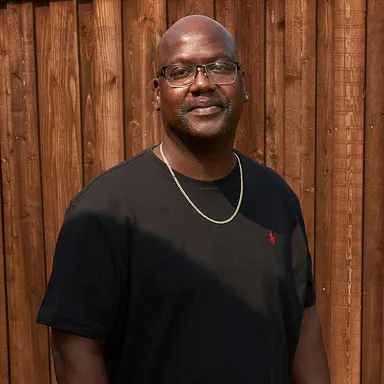
We received tragic news this week from Winona, Mississippi. Curtis Flowers was found dead in his home at age fifty-six.
Photo by Ben Depp
Learn more about your ad choices. Visit podcastchoices.com/adchoices