
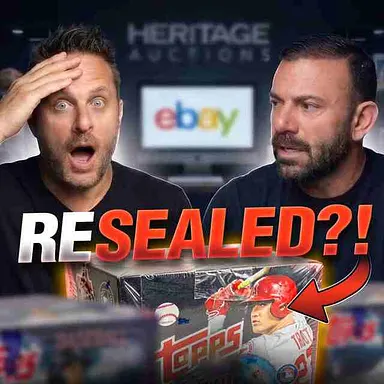
This episode of Collector Nation features Erik Myers, vice president of modern sports at Heritage Auctions and a former anti-counterfeiting leader at Topps, discussing how counterfeit trading cards are becoming harder to detect. He argues that AI could soon make fakes nearly indistinguishable from real cards and describes how resealed boxes with pulled case hits are sold online.
The conversation covers why he recommends buying sealed product only from card shops or manufacturers, his career path from PWCC to Heritage, and how cash advances and auction categories work at the auction house. Listeners will also hear his views on modern versus vintage cards, the market for Pokémon, and how to tell raised numbering from printed numbering.
In this episode Bella Schaefer, Ryan Alford, Erik Myers
This episode's transcript on counterfeit cards and resealed boxes was made with the technology behind HappyScribe's transcription service.
Ads in this audio differ from the text. Tap the sentence you're hearing to follow along.
Synced: the text now follows the audio.
You pull out all the case hits, and then you just reseal them, and then you sell all the boxes online. The consumer would never know.
Is that happening more than we realize? Packaging?
It's happening at such a scale. I would never buy a box of cards off eBay ever again.
The anti-counterfeiting thing, I just want to touch on it because you mentioned it.
The level at which it's done is way beyond what you could imagine.
You're scaring me as it is. I mean, but I want people to be— we need people to be aware of this. I'm Ryan Alford.
And I'm Bella Schaefer.
And this is Collector Nation.
We're curating all of the content in the hobby just for you, all in one place.
All the videos, all the podcasts, all the reels, all those drops you want right here, right now.
What's up guys, welcome to Collector Nation here on the Collector Nation Network here in the beautiful Easley, South Carolina, the home of Collector Station, the store and our studio. We've got Bella emceeing in the back. Normally you see her all the time. Now she's not here. She's got to— we need someone running all the show and keeping everything in order. She's back there. I'm right here. You know why I'm pumped? I'm excited because I got a good friend, someone, someone that I've met in the last— I ran into him in the first National, second National. We were like, uh, Boys from another, and got to be a part of a really special moment with him, which we'll talk a little bit about as much as he'll let us. But he is Eric Myers. He's the VP of Modern Sports at Heritage Auctions. What's up, brother?
How you doing? Thank you for having me, dude.
I mean, I'm glad you're here, man.
I'm glad to be here. It's— it was a fun trip. It really was. It's a nice little town. I like it.
I'm so blessed to have you here, man. And, uh, Love that you got up here. What's, what's first impressions of the shop?
Of the shop? I love the shop. I like the modernization. It doesn't have that traditional white walls, just, uh, that, you know, I'm 48, so when you grow up going to card shops in the '80s and '90s, they all seem to kind of have this older style feel. There's not a lot of pizzazz, not a lot of modernization to it. And I really like that about nowadays. You go into shops And they all kind of have their own pulse.
Yeah.
And I like that. I really do.
That's cool, man. Well, I'm glad you're here. Glad you're in studio with us. Pumped to tell your story, man. Got to hear it a little bit. Uh, you guys buckle up. It's, uh, it's a story, dude. Uh, you know, it's almost like when you think about the odds of you being here, you know, uh, not real high. Um, And previously head of innovation and counterfeiting at Topps, correct?
Anti-counterfeiting.
Anti-counterfeiting. Sorry. Okay, dude, you've had your hands in a lot.
Yeah. So my first job in the industry was I was the sales director at PWCC back before Fanatics had bought them. And, you know, now it's Fanatics Collect, right? So I worked there for several years, loved it. And I worked there for several years and left right as the acquisition happened. I was acquired from PWCC to Alt. They were doing less than $300,000 a month in revenue when I got there. And they really, they had some really good, high passionate people, some very intellectual people. They just needed somebody to help kind of calm the storm, if you will, calm the seas. some good leadership, good mentorship, and they needed some structural changes. So I went there and I gave Lior and the alt team a year before I eventually headed over to land at Topps, owned by Fanatics. And I— when I got there, there was no— there was no research and development team, there was no innovation team, there was Anti-counterfeiting wasn't a concept at all. It wasn't— not even sure it was really a discussion when I got there. And then so I helped them with innovation, research and development. And I had been obsessed with the dissection of counterfeit cards and anti-counterfeiting since probably '93, '94, behavior pattern of our industry for decades.
So when I got there, I ushered in different concepts of anti-counterfeiting at Topps. And then now, as of 3 months ago, I transitioned to VP of Modern Cards at Heritage. Heritage had— and I'm from Dallas. Heritage corporate office is Dallas-based. It was in my backyard. A lot of great people. They've been around for decades. You know, and they're a cornerstone just in the auction community.
Yep.
Not even just talking about sports cards or TCG, just globally. And they've got, I believe, around 58 different verticals, or different, um, what we call verticals, or different silos of things that they sell: bullion, coins, comics, stones, space stuff, TCG. So they— there's so much to learn there.
We're going to talk a lot about heritage. Um, you know, the, the anti-counterfeiting thing, I just want to touch on it because you mentioned it. Was it head in the sand? We got so much going on, like, like we didn't realize how big it was, or ignorance? You know, like, it just blows my mind that, that you— that they wouldn't have been more focused on it till you got there.
Well, you know, so I can't speak for anything prior to my arrival, but I know. So let's just assume cards— I know there are some off-brand cards in the 1860s and '70s or whatever. Let's kind of just take cards back to— I think Babe Ruth's rookie card is 1916. So let's just kind of go around 1916, 1920.
Yeah.
So for the past 100 years, there really just— it wasn't even so much just Topps or Bowman or Panini or Upper Deck, just industry-wide, there was no accepted measure, and there was nothing that they were diligently pursuing to embrace combating counterfeiting. I believe everybody objectively acknowledges that it is a problem. It's just a problem at what level? And how do you quantify that level of a problem? And really, is it something the manufacturers should be taking serious, or is that something that, that's on the onus of the collector or on the— and remember, we have grading companies, Beckett, SGC, CDC, PSA. They're the ones that are paid to authenticate. Right? So who's the onus on? Is the onus on the grading companies? Is the onus on the collectors? Is the onus on the manufacturer? And at a manufacturer level, they deal with so many different vendors. Like, how do you integrate that? And anti-counterfeiting, when I started studying it, there's so many different nuances to inject anti-counterfeiting measures. All of those take a lot of— you've got to be passionate about it. It's a lot of time. And then how do you inject that in anything?
Whether it's clothing, handbags, metals, polymers, cards, and nobody had ever done it before.
Yeah.
So that's part of how do you go about doing something nobody else has done and allocating capital to do it? Because you don't know how much capital it's going to take to do it.
There's no roadmap.
I knew that I was— I know that regardless of what it takes, that's one of the things I was born to do is change industry in that measure, anti-counterfeiting. And I cannot tell you how many sleepless nights I had to remind myself of that because when you're the only one screaming and that— and you have to remember, I just moved back from Korea. So, I spent years in Asia and a lot of my time was spent dissecting these counterfeit measures that people are doing and then reverse engineering the counterfeiting measures to come up with anti-counterfeit solutions. And when you know what they're doing over in Asia and other parts of the world, to counterfeit and replicate, combine that with AI technology and the scalability at which it progresses, it's just a matter of time. So to come over to a manufacturing place and say, hey, but it is a massive problem that is only going to get exponentially worse in an industry that's already collectively worth, just sports, $35, $40 billion.
The printing's gotten pretty damn good. Well, AI and everything else, right?
It's only going to be maybe 3 to 5 years max before AI would be able to scan a card or anything, reverse engineer the pattern, the, the files. The AI doesn't really need your original files to reverse engineer that. It can scan the card, completely reverse engineer the— it'll know if you have 1 hits of white, 2 hits of white, all aspects of it, right? Getting paper is generic. Getting polymers is generic. Once you have— once you can reverse engineer the files, you print it. you can replicate the card. Yeah. You'll be able to do— on your traditional chrome style or paper or foil board style card, I think within 18 to 36 months there'll be no difference to tell at all, other than maybe if you have the right numbering system, like what machines they're using to number. Outside of that, you're going to need objective measures to tell the difference, and we're seeing fakes hit the market now that are just— shops can't tell. I mean, you just— you— it's— and that's just at a card level. We haven't discussed packaging, you know. So I mean, that's, that's a whole nother messy subject.
Yeah. Is that, is that happening more than we realize? Packaging?
All I can say is, as a consumer, I would never, and I mean never, buy a box of cards or case of cards unless it came from an— from the manufacturer or direct point from the manufacturer. It's happening at such a scale that unless you're buying it from somebody, unless you're buying it from the manufacturer or someone that you know that you trust, or they got it like somebody got the allocation, right? Like that card shop, whether it's Panini, Upper Deck, whoever, if it didn't come straight from— like, I would never buy a box of cards off eBay ever again. Ever. I don't care if it's 1984, '94, 2004, 2023, Prism, Topps. I don't care. I would never do it.
So is that prevalent, the packaging?
Bro, you have no idea. I can't get into it too much, but you have no idea. They are that good at it.
Yeah, that's, that's the scary part.
Because if you're not counterfeiting— let's assume if you're just counterfeiting the packaging and you can remanufacture the wrappers, the cards in there are still real. The consumer would never know. So if I can replicate the shrink wrap and the wrappers, right, and then put— and just pull the one banger, the one case hit out.
Yeah.
And put like a $200 card in, into the case or into the box or whatever. Because if you open up all the cases, you know every case is gonna have a case hit.
Yeah.
You pull out all the case hits, put a few hundred, and then you just reseal them, and then you sell all the boxes online. you don't have to sell the cases anymore. You just sell the boxes, and you've pulled out 6, 7 figures in hits, and it costs you just wrappers and shrink wrap. I mean, the level at which it's done is way beyond what you could imagine, and the efficiency— the efficiency is insane. Like, I mean, it's mind-blowing. So I just recommend, if you're a card collector or consumer, Buy from card shops or directly from the manufacturer. I don't care who the manufacturer is. Pay the extra 5%, 10%, and I promise you, you're doing yourself a favor.
Yeah, you know, it's crazy. Well, here's what I do know. You know, I'm an artistic guy, I'm a creator, and I know that, like, I've played around with just cards, making them for my kids or doing design projects or whatever, and on my own home printer I can make some foil cards look pretty damn good. I'm like, shit, if I can, if I can do this, people a lot smarter than me in printing, that there, there's some nefarious behavior going on.
A lot. And think about if you were, if you were just doing the packaging and you made, did that for a year or 2, made a few million bucks. Every time you're doing it, you're pulling back close to 6 figures on it, right? Roll that over 6, 7, 10, 15, 20 times, made a few million bucks. You take that few million bucks You then take that into the machines you need to print.
Yeah.
You then paid for your counterfeiting with this other nefarious behavior, and then it just snowballs. I mean, we're seeing counterfeit Chrome cards, counterfeit, um, what I call, you know, high-value inserts. Yeah. Right? Like the, you know, the patch autos, autos. Yeah. Patch swapping, all those things. We're seeing all that, and it's just getting bigger and bigger and better and better. Secure Authentication LLC. Oh, interesting. So it's an anti-counterfeit company.
Nice.
You know, I've gone to this convention called IACC, International Anti-Counterfeit Convention. All these other companies started offering me jobs. When I worked at TOPS, they called me— there's a gentleman by the name of Brian Versakis. I love him. He was a great coworker. He called me the mad scientist. That's what they called me, was the mad scientist, because I was always working on something just— it would seem off the wall, but highly sophisticated and very efficient. So, there's a couple of things that are my strong obsession points into anti-counterfeiting. One of them is they don't have to be submicron nanoparticles but nanoparticles which the industry measure calls taggants. That's its industry name. And if made properly, the morphological uniformity, how identical they are to each other, can be 80%, 85%, 90%. So, the particles can be completely identical to each other. Okay. That's one aspect of my—
Most people are watching, uh, the game and Eric's counting nanoparticles.
Yeah, I, I probably find as much enjoyment doing that as I used to on fantasy football or watching games.
Hey, hey, better time spent. Tell us a little bit about your upbringing and what you went through to get here.
Yes, I'm originally from Dallas, Texas, and, you know, I grew up in a— both my parents worked, but I grew up in a family that, you know, I knew my parents loved me to the best they could, but there was a lot of alcoholism, 5 or 6 felonies, like 17 arrests, spent, you know, collectively a couple years behind bars. And then like, and this is me in early 20s. I'm not even 22, 23 at this point, right? Yeah. So this is me—
I was barely getting started, you know, as an adult, you know.
I know, I felt like it was about the end, right? I didn't plan on living to be 30 or 35 at that time. Not when you've got 17 arrests and half a dozen felonies or whatever. I probably cried myself to sleep for 2 or 3 years at night. And I just had the opportunity to— or I met a military recruiter getting my hair cut one time. My mom has offered to get my hair cut for me once. It was around Thanksgiving. She wanted me to spend Thanksgiving with my family for a day or two. And this is like '06, '07. And the recruiter's like, hey, if you don't, you know, I mean, if you'll be in the infantry, you know, uh, and you don't have any, you're not on parole or anything, you don't have any outstanding warrants, you can get clean. You can go in the military. So it took me a few months. That was November. So March 3rd, about 20 years ago, I got clean. And then May 22nd, my birthday, was basic training. While I was in the military, I didn't want to spend my free time drinking on base or doing all the dumb things that soldiers can do.
I would get on eBay or other things and try to figure out how I could make some money to make up for the time that I had lost. That's how you got introduced. And that's how I got introduced. Because my life of crime started about the age of 15. Right before that, I was like every other kid, obsessed with cards, sports, you know, and all those things were a passion in my life. So, but for that whole time period, I didn't know anything else but crime. So I went right back to what I knew before crime. And that was cards. And so I was just, when I got into it, I was just trying to make an extra $200, $300, 'cause at the military time I'm making like $1,270 a month, bring home, nothing. Man, if I could make an extra $300 a month, oh, that's a car payment when I get back home. I could, that's, I was so grateful. And then I had a $15,000 military bonus and I had met some really good people in the process who helped steer me right and not take advantage of me. And man, you fast forward a few years, I'd made $100 grand, then $500 grand, and the next thing you know, you're making— you've made $1 million and then you can make $1 million a year.
You know, throughout the course of my time over the past 20 years, I think I've bought and sold right at $89 million in cards. from $15 grand. Yeah. The industry saved my life. Without cards, without something wholesome and pure that I could put myself into on Fridays and Saturdays, so I'm not out drinking with the boys or, you know, going to topless bars, doing all those things people in their 20s and 30s do or whatever, you know, that, that are destructive. I, I would, you know, throwing myself into cards really gave me a second chance at life. that I didn't think, that I don't think I would've had, had I not had that. And I'm really good at fixing these issues. So I wanted it to make it one of my life's missions is to try to give back to an area that gave me so much.
So Eric, you know, we were at the National.
Yeah.
It was, let me just say that if you're listening, like I'm in my 40s. And so I've seen a lot of surprises like birthdays or giving somebody gifts or just all kinds of stuff. The pure unbridled surprise, it seems like a lot of times like when you're older, when there's a surprise coming, you know it's coming kind of a little bit. This was the most true, purest, naturalist example of someone not knowing it's coming and just raw emotion. And it was— Sean Mori had a gift for his friend Eric here. We were all hanging out in the Ludex Lounge at the National, and Sean, he was talking about the painting that you're gonna see the story of here. And I said, hey, my crew's here, why don't you let me get that on camera for you? And he's like, y'all can do that? I was like, hell yeah, we can do that. And he said, you think you can distract Eric? I said, yeah. He's like, yeah, not hard to do. Not hard to do. Well, Eric and I can naturally conversation. And so we proceeded to have a chat and said we're gonna go down to see, uh, Maury Henderson's work and some other things and get on the floor a little bit.
And so Eric and I spent 10 or 15 minutes just chatting, yapping, and he didn't know it was coming, but Sean had gotten a gift for Eric and we captured all of it. And I don't really wanna tell you anymore. I just want you to watch this right here. Anything that gets kids off Off the phone?
And off the phone, you know, like if they're collecting in here and hustling, learning how to talk to adults. Like my 2 boys are here, 2 of the 4, you know, I'm here for them.
Like I don't have to be here to do this, you know. Like, I'm—
you had touched on something and I think it's profound because it really made an impact in my life, is watching kids learn how to interact with each other but on an intellectual manner. for them to know how to be able to quantify the data. Yeah. Track metrics. And then they can go and look at players that they like. But they're learning so much. They're basically learning how to run a business on their own. 100%. You know, but, but on a personal level, they're not just going to Zooms, they're not just doing emails. It's a personal business interaction.
Can I steal him for a second? Yeah, you need him.
No, no, you too. You should check this out. Okay. Maury, can I introduce you to Eric?
My name is Eric Myers. I'm Vice President of Heritage. Oh, awesome. Yes, sir. Yeah, you do some amazing work, sir. Thank you. Pleasure meeting you, sir. You as well. Yeah, that's, that's crazy. This one over here, That's my favorite player. Oh, is it? Ted Williams, yeah. Really? Well, I mean, he served in 2 wars, flew in 39 combat missions. Yeah, you know, I mean, he's, he spent, I think, 3 years of the prime of his career from the age of 24 to 27 fighting for the country. Well, you know, he was a combat fighter too.
Yeah, and, and I mean, to come back and still be such a hero.
Well, he, he won it. Oh yeah, yeah, without question. He won the Triple Crown. Left, went and fought in the war. Gone 3 years, comes back and wins the Triple Crown again. So he batted .406, Triple Crown, goes off in his mid-20s, fights for the country, comes back within 2 years, wins the Triple Crown again. Which is, I mean, this— if, if a person did half of Ted Williams' career today, his cards would be $5 or $7 million. Well, I mean, I mean, back then he was a genuine gentleman too, right?
Like, he, he was—
So my favorite Ted Williams This one here? That's Ted Williams. So this is for you. My favorite Ted Williams story is, so Ted Williams in his Hall of Fame speech, he is the first Hall of Fame athlete. During his Hall of Fame speech, he made a pitch. He thought that the Negro League players should be in the Hall of Fame. So he actually got shunned by a lot of the media for even bringing that up because he thought that, that a lot of, there was a lot of the Negro League players that he played played against and played with were equally as talented as he was, and he thought that they were getting a bad rap. And media really took it against him. They never really forgave Ted for kind of shining the spotlight on something that the world wasn't ready to talk about. But I think that's really— a lot of people don't give him enough credit for that.
I'm glad that that's all changed.
Yeah, of course. Yeah, well, and the reason is, so Ted Williams— so the reason I'm a big Ted Williams fan is I'm half a Hispanic. My mom's Mexican. So Ted Williams is half Mexican, right? His mom's Hispanic. So growing up as a kid who's of a mixed race, he was always somebody that I always looked up to, you know.
Oh, that's awesome. So you like this one?
Oh, I just— well, Ted Williams in general. Yes, yes sir. Yeah, yeah. I mean, I'm just a huge Ted Williams fan.
Did you put cards? I put cards right in it. Yeah. What kind of cards?
What kind of— that's how— what year is that from? Do you know what year that's the statistics?
Oh, well, I mean, that's going to be like mid-'50s. Yeah, because he— yeah, it's at the end of his career. It just got me in the shop just now. No way. Did you put it in there? You put the Spark Labs in there? That's awesome. Thank you. Oh, no way. Oh, shit. That's yours, buddy.
It's got it all in there.
Thank you. Um, yeah, I really appreciate that.
Oh, you know what, it's, it's, uh, I think it's like I love doing it. This guy came all the way.
Such a monster. Thank you, man. Thank you. Yeah, I appreciate that.
I'm sure we love you, bro. Yeah, thank you, bro. Love you. Thank you.
Yeah, that's cool.
I'm happy you like it. Oh yeah, Sean came up to my house.
I'm gonna put it in my office at work. Oh, I hope so. I really do. Yeah, no, that's really cool. Yeah, thank you, sir. I greatly appreciate that a lot. Thanks, Sean.
Yeah, Sean, uh, Sean made this all happen, and, uh, we've been, we've been talking about this for pretty much a year or so.
Oh yeah, that was awesome.
Yeah, I think—
no joke, no joke.
He did.
There's snowstorms.
Yeah, it's in there. It's in the paint.
Is it?
It'll light up.
Oh, that's so awesome, bro. That's so awesome, man.
So over and over.
So you guys can go over it later and see it.
Oh yeah, I know. Thank you. Yeah, thank you, sir. I'm, I'm a big fan. I'm a big fan. Thank you.
Well, thank you, and I, and I, I truly appreciate that.
Yes, sir.
Yeah. Collector Nation is not just a podcast. We are your one-stop shop for all things hobby.
All the best creators, all the best reels, all the best content curated for you every day.
And if you're interested in learning more, go to thecollectornation.com or download our app on iOS or Android.
We'll see you there.
Heritage Auctions. Heritage Auctions. What's up with, uh, Heritage? I mean, my— all right. Vice President, Modern Sports. What does that mean? And, uh, what do we do every day?
So they offered me a role and I told them I would take it if they gave me a VP role. And my, my daily function is— things move a little slower there, not in a bad way at Heritage, because we want it— it's a big company. It's like probably $6, $7 billion company, right? But we want to grow and modernize. So yes, I'm over Modern Sports, but they also want to try to innovate and become better in the auction space. How can we get customers' cards, you know, in faster? Cards or items, doesn't matter the vertical. How can we get them paid out faster? With cards, we just started at the National doing hard cash advance. So we actually— let's say you can sign a quarter million dollars in cards, give you $100,000 $125,000 cash advance, depending on the metric, whether it's modern or vintage, stability of the asset. Yeah. And actually giving you tangible cash, like $100 bills, right? Okay, I like it. So that's, that's one thing I started at Alt. Yep. Uh, I will give credit, there was a guy named Chris Jackson who worked at Alt that, that had positioned it, proposed it before me.
One thing I love about Heritage, they're not— they don't get paid on a commission base. So your commission is a very, very small aspect of your salary. So nobody's had a cutthroat mentality. Very, very team-oriented. Love that. So it's easy for me to teach. So I want people to start really cross-pollination their knowledge and help each other teach and grow as one.
You know, modern versus vintage. What heritage? How does heritage— what's the cutoff for heritage? What's the year?
They probably put it somewhere around '80. I put it at '84. But in those few years, you know, you could back it up to '79 for Gretzky. But really, a lot of people look at the Gretzky as kind of like the hard cutoff, where I personally have a mid-vintage category. So I have vintage and then mid-vintage, which is going to be— Heritage is pretty much going to look at it as your '80s and newer, mid-'80s. And I— and we pretty much agreed for our company is basically '84. And we take the '84 Star Jordan because that's a— you can look at it, that, that's a 6-figure card whether it's a PSA 9, 8, and a half, 8, Beckett 9, probably Beckett 8.5. You throw an auto on there, definitely 6-figure card. That's a known card that just kind of like, it pokes out on the sales data sheet, right? Yeah. So we're like '84 Star newer, that's going to be modern, you know. But there's still—
I feel like the top of the game, the high end, is feeding the hobby because awareness, right?
Yeah.
The big, these big pieces It makes the hobby more known, right?
Rising tide lifts all ships.
And so it's like, it's not affordable or attainable for 99% of the market, so it's not about that. But it does— it hits New York Times and it hits the TVs, it's the commercials, it's the awareness, like, channel for the hobby in a lot of ways.
Rubin's— Michael Rubin's kind of polarizing, love him or hate him. But he's a beast of a businessman. Michael Rubin has done more for this card industry—
Agreed.
Than I can say any other single—
See, I'm of— I'm—
I would say at least 40% of the market's takeoff, or this bull run we're on, could be probably attributed directly to Rubin and what Rubin has done for the hobby. Just because he's bringing in, like, you know, Hamilton, Lewis Hamilton, all these other people, and he's just on it and on it and on it. And, and again, love him or hate him, this dude has made it to where the bull run has lasted longer and longer. Will there be a pullback? Most likely. When? Nobody knows. But these big banger cards going 6, 7 figures— now, as a modern card guy, it is speculating, right? Yeah. So I'm, I'm, I'm gonna call it how I see it. It's subjective, but from my— what I see as subjective as an objective outcome, statistically in all likelihood, you have a better chance of ROI long-term vintage versus modern. You have a greater short-term ROI profitability with modern. Yeah. Right. So it's, it's bittersweet, right? I think you can 3 or 4x in modern really quick, but you can lose 60 or 70% just as fast. Yeah. Guy gets a DWI, hits somebody in a car, blows out an ACL, whatever.
Like Charizard's not gonna blow out their ACL. You know, Pikachu's not gonna get a DWI. Nah. So with modern here, you have way better upside, way bigger downside, but I think you need both to balance each other out. You know, you need, you need the people who want to be day traders like on Robinhood. Yeah, right. And then you need the people that are just like, hey, I want to buy Costco or JP Morgan. The $8 million Cooper Flag sale. Yep. And then last week, my friend Rob Go Shout out to Rob. Love Rob.
Love Rob. We had him on the show.
Did you really? Yeah. Oh dude, I love Rob. He's awesome. So his, his jersey just sold $12.2 million. A Finals game-used, fully authenticated Jordan jersey for $12 million, or Cooper Flagg card for $8 million. Give me this guy. Give me this guy, you know. And I like cards, but I love me some cards. But so I think, I think it's a bigger discussion, right? So people talk about cards or certain widgets, and I, I say, look, there does come a time where I would rather have a Cooper Flagg rookie jersey for $1.5 million, like say his Game 1 jersey for $1 or $2 or $3 million. I would rather have that than an $8 million rookie card. I'm a bigger card guy 100 times more than I'm a jersey guy. But you still have to look, and it all depends, are you buying it just for personal enjoyment, show your buddies, make a cool chain out of it, whatever? Whatever. Or is there potential ROI involved? Because ROI involved, Dude, take— give me the jersey 10 out of 10 times. Yep. We all lived through Zion Williams, right? He was supposed to be the great— best— they used to like the better than Shawn Kemp, better than Dominique.
He was supposed to be— he was basically, you know, a Shawn Kemp in a Shaq body. Yeah. How that— it didn't work out. I mean, his cards are down 80 or 90%. Most of these people aren't going to pan out. And don't get me wrong, you brought up Cooper Flagg. Yeah. I've lived all over the world. I've lived in 7 or 8 states, but I'm from Dallas. Cooper Flagg's a Dallas Maverick, right? Yeah. Dude, our hero in basketball is Dirk Nowitzki. There aren't a lot of Dirk Nowitzki fan clickers. So Cooper Flagg is the thing now. We've already seen what happens when somebody brings us a championship, and Dirk did it and beat the best of the best. Like, the 2011 run, arguably the best run ever. So like, where's the upside on Cooper Flagg? I don't know, like maybe they're gonna— people start gonna view the Mavericks different, but it's a mid-market team, you know. It's not the Lakers, not the Knicks. No.
And I like— and I think Cooper's the truth, but he's great.
He's great. But I just thought $8 million, dude, that's a lot of money. I know. But if the person that buys it has $500 million in the bank— and I'm a huge Flawless guy. I made a ton of money in Flawless, you know, 2012 I think to 2017, and for Kobe, right? At one point there was 26 Flawless patch auto Kobes, and I owned 22 of the PSA 10s. There was 26 PSA 10s. Wow. I owned 22. My buddy Chase had 2. There's a red one I didn't want because the auto ran off, and this guy LG Sports Cards had another one, and I owned over 90% of them. All right, and I was— dude, I crushed it selling them 50 or 60 apiece. Now those cards like $400,000, $200,000, $300,000, $400,000 apiece. But the problem is the run-up is so high. Mm-hmm. It can't stay there. It's got to come back. Same with Exquisite. I think Exquisite, if you have the chance, sell it now. There could be more upside, but with every market, there's a bull run and a bear run, a bull run and a bear run. The key is the old adage: unless you've got a lot of money, like a lot, a lot, a lot of money, buy low, sell high, right?
Right now it's high. Right now. So that's what I tell my customers, right? You know, And if you want to hold on to it, God bless you. But if they call me and ask me my advice, if you bought it for $60K, it's worth $500K, you might want to consider something. I mean, because, dude, these, these are real numbers, man. You know? Yeah. I had a guy called me a few weeks ago, spent $20 on a few boxes of cards 20-something years ago, pulled a Jordan patch auto, '98 Jordan patch auto. He was into it for like $5. And then we closed the deal like $200 grand, you know. And he was like, what do you think? You think you get more in auction? If now, because the market's gone up, he probably could have. I said, but $220, you're in here for $5. This dude's offering you this amount of money right now. Take it, take it, bro.
Yeah. If anybody's listening, how do they work with Heritage? Like, what's, you know, to get—
Yeah, you can, you can reach out to me directly. Uh, on Instagram. It's, uh, my Instagram is @haole_hustle, H-A-O-L-E underscore hustle. You can find me there or just call the Heritage or send an email to Heritage directly.
So always looking for what, what's the kind of the— what are we looking for? What's high, like high-end, low-end, like collections?
Really anything over $100, $150. So we have, so we have weekly auctions, we have monthly catalog auctions, we have— so we have 2, 2 big auctions a year, Platinum. Those are probably going to do $50, $60+ million in auction. Then we have catalog auctions. Now that actually has a catalog too, so all the customers get one, you know. We have a catalog auction as well. And underneath the catalog, we have a showcase auction. It's basically a catalog auction without a catalog, still a monthly auction. Then underneath that, we have weekly auctions. So if your card's $300, $400, $500, $1,000, $5,000, $10,000, you want to run it weekly, we can run it weekly. It'll do just fine. If you want it in a catalog, say you got a $5,000, $10,000, $20,000 and you want a catalog, We can do that too. The catalogs just aren't every month. I think we probably do 5 or 6 catalogs a year, and then we do 2 Platinums, and then 3 or 4 Showcases about, you know. And then the weeklies last for 2 weeks and they're constantly running. We have 3 million active bidders, right? 3 million bidders in our pool.
Wow. Because you have to remember, we have 58 different verticals, and there's a lot of cross-pollination of bidder activity from one vertical to the next. So, and we've had a lot of activity recently in that. People that collected 6-figure watches now coming over into cards. A lot of TCG now coming over to cards. People doing coins and currency now coming to cards, vice versa. Because you're on one website, you can just go to one or the other. So if you have to cross those—
yeah.
And so that's where, that's where Heritage— so Heritage can also pay you in bullion.
What's the most unique thing? I mean, you've only been there 3 months. What's the most unique thing you've seen, like, come across the desk or someone else's that, like, that's, you know, in the hobby in some way?
Man, we had a card just come in and I can't talk about it. It's like a $4 or $5 million card. Whoa. This older gentleman pulled it from a pack years ago. Oh my God. Is it modern? Yeah.
Okay.
It's, it's, it's, it's a '97 card. That's all I can say.
Can you say what sport?
Basketball. '97. Yeah. Hmm. I submitted a top 1 photo for auction. It's an actual picture from 1982 when Jordan won the championship. There's only 1 copy known to exist. That's the top 1. It's a picture of Jordan at 19. He's cutting down the net. The coolest thing I've seen since I've worked at Heritage— you'll know this, most nobody else won't— when I was— my first day, I was walking down the aisle, walking down the hall. It's like one long hallway. They were boxing up the actual throne from the Game of Thrones we just sold for like $900 grand, right? But that wasn't the coolest thing. In the crate next to it, I see this little like Muppet head sticking out, right? And I was like, is that the actual uniform? Is that the— they go, yeah, it was the actual uniform Alf wore in the TV show Alf. You remember that show? Yeah, I remember that show. It was set next to it. And I was like, dude, that's Alf. Is that the real Alf? And they were like, yeah. Is that the whole costume? Yeah. Original Alf. It was the original Alf. So, but unless you grew up in the '80s, yeah.
Or, you know, you don't know—
Got cat hairs in its mouth.
I know, right?
We're gonna rip some packs here in a second. But what's, what, like, maybe not getting enough attention? Like, somewhat everything's hot in the hobby, so this is a hard one to answer, I recognize. But like, what's got upside? Or in, and when I say upside, not what's going to go from $100 to $1,000. jerseys, bats, game-worn. What's a niche or a certain card variety or set? Is there anything that's like—
I think people grossly underestimate how big Pokémon is in TCG. The market cap for sports cards, if you add all sports cards, vintage and everything, is probably in excess of $50, $53, maybe $55 billion. The market cap, the IP for Pokémon itself is $150 billion. That's a 3x multiplier. Pokémon, so the The biggest card you could probably buy that I think that has long-term legs and value is a 1996 no rarity Charizard PSA 10. There's 12 known in the Pop Report. Pokémon's been around for 30 years. For 30 years, and now it's a $150 billion IP. Cards have been around for 110 years, and then we're about to break $50 to $60 billion. We're literally in 5 years into Gen 2 of Pokémon. Generations, 25 years. So we're only 5 years into Gen 2, and it's a $150 billion IP. That is insane. Like, imagine, imagine where we would be right now if sports was a $150 billion IP and they, they're just now testing with serial numbers. There's no autographs, there's no patches. It's truly organic and it is ingrained to all aspects. I, I would say 7 out of 10 kids that collect cards or into cards are into Pokémon more than into sports cards.
every 3 out of 4 deals that have been happening at the counter up there are Pokémon.
Yeah, TCG. You don't have any swag or, or posters or anything of Pokémon. You don't need it. Do I think there's gonna be a pullback in Pokémon? Absolutely. I think it'll go up and pull back just like everything else. Do y'all feel it at Heritage, the Pokémon? Um, we're doing, I want to say, $50 million, $60 million, whereas we did— I think we doubled, a little over doubled in the past year. Yeah. And I think by 2028, we'll probably be well into $100 million. I don't, I don't see— so Pokémon printed 12 billion cards last year. I can't tell you other— I can't tell you what Topps printed, but I just want kids doing things that help them connect with their parents better in a wholesome manner.
I mean, I spent $100 grand in like 4 months, but it was worth every penny. Like, 80% of the store was stuff that we, you know, ripped together. 20 packs, 8 cards per pack. Guest gets the honors.
I'll grab, grab 2.
Yeah, there we go.
3, whatever. Um, go for it.
So my, my— there's one of my sons says bottom right always has— we'll find out. I'll do top, the 3 there. That's what we got to start. We'll see what happens. Only 2 in there, so we'll see if he's right. Hogan always says that. LSU female, you— they usually recruit pretty well. Uh, auto out of 150, Zakiyah Johnson. All I know is they're always dressed to the nines and LSU recruits well, so I don't know.
That's crazy that, uh, the auto is actually on the bottom right.
Yes, it is. It was first pack. First pack.
Yeah, that's, that's a good one.
Uh, so who knows, young, young kings.
I've got another, uh, you got another auto?
I don't know if it's auto, but it's a parallel numbered, I think.
What? I'm going to this bottom right. Yeah, go there. I'm taking these last 2 bottom rights. Uh, let's see, we just need a box called bottom rights. Bottom rights. Thomas Sober. I think your son's on to something. Yeah, I know.
He always likes it. Up, up.
Rookie.
Kobe Sanders rookie. Not— who knows? At a $250 though. We're pulling heat over here, guys. All the numbers.
Huh? Yeah. Ace Flag.
Not Ace, not Ace Ventura. It's Ace Flag.
Uh, yeah.
He looks like somebody tried to draw a Koopa. Kind of looks like Ace Ventura. That's so bad. Sorry.
I mean, I mean, just being honest.
Yeah, that's what he looks like.
What's your name? Ace.
Ace Flag. He looks like somebody tried to, to draw, uh, Keanu Reeves from memory. I thought that was hilarious.
What do you got there? Is that AJ?
Um, nothing really. That card's made horrible. I think it's so—
wow, bent. We need some Chief And I— oh boy, we got orange.
No way. No, you didn't.
Colin Murray-Boyles auto to 25.
What? So it's the WNBA? So you got 2 W— No, that's not WNBA.
No, he played at South Carolina.
Oh nice, South Carolina guy.
Colin Murray-Boyles auto. That'll—
sticker. Uh, it's Looks like it's on card. Is it a sticker? Is it a sticker?
Why do you got a sticker on it out of 25? Still a cool card. I mean, I wish it was Cooper, but we'll take Colin Murray-Boyles. He played at South Carolina. He was, he was very good at the game of basketball.
I like these, the way that they— so if you feel the numbers on it. So when I was at Topps, we did, we would go to this hot— I think Cook Children's Hospital, I believe.
Yeah.
And we'd bring, dude, like tens of thousands of dollars of product, probably like $40 grand, $50 grand. Wow. And all these kids that were, you know, fighting cancer or whatever, it was probably only me and a few other people. We'd go up there, me and Keeley and a couple other people, and just let the kids rip every— all they wanted, basically to the heart's content. They got to keep whatever. I saw a bunch of kids pull like anywhere from $400 to $1,500 cards. And they just let him keep them.
That's awesome that they would do that. I think I have gold here.
No, you don't.
Uh, I think it's a pretty good player too.
This is why it's no fun ripping with Ryan, because he always takes all the good cards.
Just because I have an X-ray machine in the back doesn't— I don't know.
I think he CT scanned these, knew exactly where the packs were.
Yeah, I knew exactly where they were. I think you need to open the rest. And let me see if there's— you need to get the Cooper Flagg like extra auto, dude.
If there's a— do they ever have extra autos?
Yeah, sometimes. Kidding me? In a box that I opened?
Dude, like, you're in. I'd be the one person to get the one auto in the box instead of the 2.
Dude, I've had that with the boys. We've bought a hobby box and we got— I was like, they were— I, I almost had— they had to fight back tears, they were so disappointed.
I was like, you got one auto?
Yeah, it was like a $1,000 box too. Oh, I was like, who am I gonna— who can I wrangle?
Where? I know, you almost want to videotape them when you open them.
I know, I was like, dude, this is a— it's one thing if it's a blaster and you don't get like one parallel, okay, but an auto out of a $1,000, you're missing— come on.
Like a $20 auto, $40 auto.
Yeah, yeah, I think the other one was like Booty Baker.
And that's why repacks sell for so much. It's 'cause you guarantee like a 30 or 40% floor. Yep. Numbering style.
Is one raised, one lowered? Like imprinted? Wow. That's right.
Again, there you go. That's another one. So it's supposed to be all numbered. Everything under 100 is supposed to be raised. Under 100? And number 250 isn't. Hmm. I wonder why that one's not.
That's interesting. Yeah. Hey, there we go.
So the lesson is the machine that raised the— adds the raised numbering is way more expensive. So the machine that actually embosses, you can probably buy them in the secondary market, unfortunately, for $15,000, $20,000, maybe not even that much, maybe $8,000. You know, they're so cheap versus a machine that actually embellishes. It's a form of embellishments added on after the fact. I mean, that's a million bucks, you know. So, but yeah. Eric, drop—
I know you dropped some social stuff, website details, all that stuff one more time for everybody.
Yeah, so if you're a manufacturing company of any sorts or style, whatever, and you're looking for somebody to come in and give you an assessment of how you can better protect your your product, you can look at my email, Secure Authentication LLC, and you can also follow me on Instagram at haole_hustle, H-A-O-L-E underscore hustle. Any, any questions you might have, whether you want to hire me or, you know, for authentication purposes, if you just have questions about cards, where to send your auctions, if cards are legit, not legit, or just looking for a good way to get in the hobby, please feel free to reach out. I'm answering my phone 7 days a week.
Love it, brother.
Yeah.
Hey guys, you want to find us, thecollectornation.com. You'll find all of the latest articles. We'll have this episode in our podcast section under Collector Nation. We'll have highlight clips, links to Eric's personal stuff and his personal, uh, details he has shared, as well as Heritage Auctions. We appreciate Eric for coming in.
Thanks for tuning in to the show. Be sure to follow us on your go-to podcast platform and catch the full video episode over on YouTube. Visit us at collectornation.com and follow Ryan on Instagram @ryanalford. Now get out there and collect yours.
Ryan Alford sits down with Erik Myers, VP of Modern Sports at Heritage Auctions and former head of innovation and anti-counterfeiting at Topps, to talk about how AI is changing counterfeit cards, how resealed boxes are being sold, and why you should only buy sealed product from card shops or manufacturers. Download the Collector Nation app and visit thecollectornation.com for more.
Erik shares how the hobby gave him a second chance, why he once owned 22 of the 26 Flawless Kobe PSA 10s, a $4–5 million card that just came into Heritage, and why he thinks Pokémon is bigger than most collectors realize. Plus, the National moment we captured when Erik was surprised with a painting.
Topics Covered:
Erik Myers’ path: PWCC, Alt, Topps and now VP of Modern Sports at Heritage Auctions
Why the card industry ignored counterfeiting for so long
How AI will make counterfeit cards nearly undetectable in 18–36 months
Resealed boxes: how case hits get pulled and boxes resold
Why you should only buy sealed product from card shops or the manufacturer
How the hobby gave Erik a second chance
Erik’s surprise painting gift at the National
Heritage Auctions’ cash advances for consignors
Modern vs. vintage: where the 1984 cutoff comes from
Michael Rubin’s impact on the hobby
Cooper Flagg’s $8M card vs. a $12M Jordan Finals jersey
Owning 22 of 26 Flawless Kobe patch auto PSA 10s
When to sell: Flawless, Exquisite and buying low
A $4–5 million 1997 basketball card pulled from a pack
Why Pokémon may be bigger than sports cards
Heritage’s 3 million bidders and 58 collecting categories
Basketball pack rip: autos and numbered cards
Raised vs. printed numbering: how to spot the difference
🔗 Links Mentioned in This Episode
Collector Nation
Website: https://thecollectornation.com
Download the App: https://apps.apple.com/us/app/collector-nation/id6795562084
Instagram: https://www.instagram.com/thecollectornation_
TikTok: https://www.tiktok.com/@thecollectornation
YouTube: https://www.youtube.com/@thecollectornation
Erik Myers
Instagram: https://www.instagram.com/haole_hustle
Secure Authentication LLC: https://www.secureauthenticationllc.com/
Heritage Auctions
Website: https://www.ha.com
Sports Auctions: https://sports.ha.com
Collector Station
Website: https://thecollectorstation.com
Instagram: https://www.instagram.com/thecollectorstation
Ryan Alford
Website: https://www.ryanalford.com
Instagram: https://www.instagram.com/ryanalford
⭐ Would you still buy sealed boxes online after hearing this? Tell us in the comments. Subscribe for more interviews with the biggest names in the hobby, and download the Collector Nation app (iOS and Android) for real-time card alerts and market data.
#sportscards #counterfeitcards #collectornation