
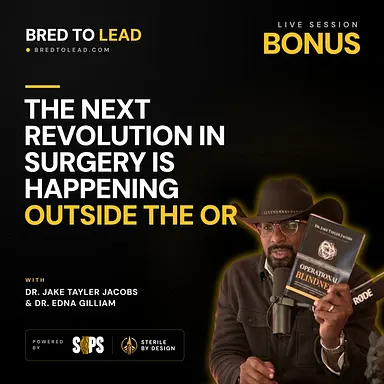
“Bonus: The Next Revolution in Surgery Is Happening Outside the OR” was turned into text by HappyScribe’s speech recognition. Related tool: AI meeting transcription.
Ads in this audio differ from the text. Tap the sentence you're hearing to follow along.
Synced: the text now follows the audio.
Just because someone is certified doesn't mean they're verified to do the job. How y'all doing this morning? Now y'all in a room that's controlled by Texans today. If you can't tell, I'm from Dallas and I'm happy about it. How y'all doing? Y'all all right? Oh, I know what's going on. They didn't feed y'all this morning yet. That's what's going on. Yeah, yeah, we got hunger on our bellies. All right, we're about to start. Go ahead.
All right, well, good morning everyone. Welcome to this session. Um, I want to welcome you all here today. The next professional revolution in surgery is happening outside of the OR. Building the workforce architecture sterile processing never got presented by CIDS Healthcare Solutions. Before we get started, I want to take the time to introduce our 2 speakers who will be speaking here. We have Jay Taylor Jacobs, who is the President and Chief Operating Officer of CIDS. Hey. And then we have Edna Leo, who is the Assistant Vice President of Perioperative Services, SPD, of the Delaware Valley Memorial Children's Health. So take the time to welcome them, and we'll let them go through the rest of the procession shortly.
Well, you know, when CHOP introduces you, you know you got to be doing something right. Thank you, Lady D. Y'all say, hey, Lady D. Hey, Lady D. All right, so obviously you know that this little whole little shindig is going to be different this time. You know, I've seen y'all up in here. Y'all been on your phones, on your laptops. I'm in your business. You know, you know what we say in the Baptist church in the South? I'm in your Kool-Aid. I'm about to be all in y'all Kool-Aid today. But we're going to be talking about some real crazy things, some amazing things today. And we're going to be talking about a lot of things dealing with SPD. Say SPD. SPD. I know a lot of y'all mad at SPD right now. Y'all laughing too hard today. Get up off my department. So first and foremost, first of all, come here, come here, come here, Dr. E. Come here, y'all look at Dr. E. Get on down here. It's okay, y'all, I know her husband. It's okay. Come on down. Oh my goodness. I know her husband. It's okay. Y'all look at Dr. E. Girl, you better do it today.
Girl, you better do it. She's talking about, I'm modest, I'm modest. Dr. E, for those of the people that's in this room, raise your hand if you don't know Dr. E's background. Raise your hand. You see, you said you was Chris Brown in here. Oh, well, you know. So can you let everybody know who you are, where you come from, and why you are even qualified to talk about what we're talking about today?
Sure. Okay, first and foremost, I am not a Texan. I was born in Philadelphia, live in New Jersey, and work in Delaware. So again, I am— yep, give it up, give it up. Yep, yep. Eagles, right? Y'all support the Eagles?
Yeah, yeah, yeah, we know, we know who your group is. It's in the middle. Her group is in the middle. I just want to let y'all know they're planted.
We don't own Jackie. She's a Cowboys fan. We don't own Jackie.
Jackie, we love you. We love the
Cowboys! But I am the Assistant Vice President for Perioperative Services and Sterile Processing, and I am here today really for one purpose, and that purpose is really to advocate and call to action that OASU OR and SPD has, in my experience, has always had a— Lion
and hyena?
Yeah, pretty much. And my mantra is one team, one purpose, one patient. I think we spend a lot of time as perioperative leaders managing individual departments and not enough time connecting people. processes and the expertise required to provide great patient care. So that's why I'm here today.
And I'm here to sing, ain't no mountain high, ain't no valley low, ain't no river wide. If you need me, call me. Hey, no matter, don't Don't worry, baby. Now we're supposed to be teaching, y'all singing. So my name is Dr. Jake Taylor Jacobs. You can just call me Jake, the guy with the big— the big guy with the black hat. That's cool. And we're— we've been in sterile processing 21 years. Say 21. 21. And we were started by 2 phenomenal women. Say ooh. Ooh. Uh-huh. One of them is here. Raise your hand, Donnie. Raise your hand. This is our co-founder. Stand up for real quick. Listen, listen. Hey, the girlies got to know. You know, the girlies got to know. And so I'm proud to not only be here to support a woman-founded company, but we were the first sterile processing consulting company ever created in American history. And it was for the— so thank you, girl. The girlies do it. Shannon, the girlies do it all the time. I see you with your red suit, girl. So here's the thing. When it comes to sterile processing, we all know that that relationship is really Give me a word.
Intentional. Intentional and challenging. I can tell y'all went to good school.
All the words.
Y'all went to the good school. I went to the school in Texas. I don't know. But the thing is, our goal is so that we can bridge that gap, so we can have real conversations, so that we can elevate the way that surgeries look like in every hospital all across America. And I want to tell you something. them. Temporary staff and staffing is not the solution.
That's right. Agreed.
Okay, we all agree? We all agree? Y'all tired of temp staffing being on your budget? Hello. Hello, somebody. So that's what we're going to talk about today, and she's— Dr. Edna is really like here to make sure that I don't go over 60 minutes. But the reason why Dr. Edna and I are doing this relationship type conversation together on the stage is because Dr. Edna actually has the number 1 SPD in the country. This is a lady that actually learned sterile processing because she didn't want to have a department that she was overseeing that she did not understand. We're going to talk about data, we're going to have all the statistics, we're going to have all the cool things, but Dr. Edna, before we kind of get going into the presentation— Yes. Can you tell them why You decided to say, hey, you supposed to be up there looking all cute. Now I told your husband that, okay? I know her husband. I just want to let y'all know one more time. All right, so, so, so, so can you tell them what made you as a periop leader say, I need to learn sterile processing, I'm gonna learn it now?
Quite frankly, the regulatory requirement, because when I sat in front of a surveyor, I wanted to know what I was talking about. But not only that, there is so much involved in SPD, and, and we're going to have a courageous conversation. We have standards of behaviors, and one of them is to have a courageous conversation. So how many of you in this room are peri-op leaders, directors? All of you? Okay. In your first role where you took over as a perioperative director, did you oversee SPD? Okay, a few. How many of you really understood the functionality and the complexity of SPD?
We got 2 hands, E. We got 2 hands.
Yeah, and so that's the truth. I will be very transparent to say that outside of understanding that that was a department that cleans surgical instrumentation, that was probably the gist of what I understood about SPD. So as a peri-op leader and taking my first role and understanding that every time there was a regulatory visit, they spent hours in SPD, I felt that it was my duty to understand how that department worked. So that's why, Dr. Gates.
So, so obviously y'all can tell I got ADHD because I done been everywhere. I'm sitting on the stage right now. But the thing I want is just for the next 45 minutes, if we can, I just got one request. Tell the hospital and your church and your children, I need 45 minutes of full focus. Can we do that? Yeah. Because SPD is a big conversation. Accreditation 360 with Joint Commission has absolutely changed the way that SPD is looked at. And we think about the complexities of SPD, it absolutely can change the way the patient lives their life for the rest of their life. And we have to start having that conversation. And that's what today is actually about. And so I'm going to say these phrases. Now put your good glasses on. Yeah, I know y'all be having 2 glasses. Donnie, raise your hand. She got 3. It depends on the distance. She has to change her glasses. But when I get to the end of the phrase, I want you to say part of surgery. Y'all got it? So when I read it, you're going to say what? Part of surgery. Now, when y'all mad at SPD, y'all got a lot more vocal than that.
So I need the same vocality. Is that a word? It feels good in my spirit. So we're going to use that, vocality. All right, so I'm going to say, for an example, the person cleaning the instrument is—
Part of surgery.
Now y'all don't have to yell at me. It is— no, it's not Sunday no more. It's not Sunday. All right, y'all ready? The person cleaning the instrument is?
Part of surgery.
The person inspecting the instrument is?
Part of surgery.
The person validating the sterilization cycle is?
Part of surgery.
The person releasing that load is?
Part of surgery.
And the person preparing the case is?
Part of surgery.
See, until you start looking at sterile processing as— Part of the surgery. You will not get what you need from them. Have y'all ever been in a friendship, relationship, or situationship— I ain't in your business, I'm just talking— where one person was the dominant force in the relationship? Y'all talking, mm-hmm. Hey, hey, hey, listen. Listen, listen, listen, that little finger was moving. He like— but you didn't feel included. So what did that make you? Less than. Less than. What else? Defensive. Defensive. What else? Anyone else? Give me one more. Mad. Mad. She got 3 right here, okay. This is our valedictorian. And so what we have to focus on is If I want sterile processing to be at the level that we are in the OR, I have to also consider maybe I should know the department that I'm managing. I have to know it. Because if I don't know it, if I don't understand it, if I'm not trying to get some type of center of focus, there's going to be— it's going to be impossible for us to actually build that relationship. Because I don't know if you all know that regardless of what everyone says about healthcare, no matter the systems, the technologies, and we have the best.
No matter any of that, last I checked, healthcare is still ran by people. Yes. Yeah. Am I right? Yes. And the hospitals are still controlled by nurses. Am I right? Yes. Now the doctors be doctoring, but after the surgeon's surgeon and they do the incision, the little— what they call it? Incision. Incision. I got you. I just want to make sure y'all was up today. After they do their incision, they do their surgery, they move on to the next patient, but who's still there taking care of their patient? The nurses. But if the nurses, the mothers of the hospital, aren't trying to get to know all the children that you're responsible for, there's a reason why there's a combative nature. And we all know that because as humans we all want to be cared for, understood, seen, and felt. Can we all agree to that? Okay. So when we talk about the mismatch between the responsibility healthcare has placed on this workforce, the thing that we have to understand is that the complexities of sterile processing has changed, right, E? Yes. So E, let me ask you a question. 5 years ago versus 5 years today, what questions or things that Joint Commission— what is Joint Commission asking today that they didn't 5 years ago?
Well, I don't know if any— we're in our Joint Commission window right now, so—
Through the mock, yeah.
So we just recently had a mock survey. So with the new Joint Commission process, they are gonna want to speak to your staff. And in particular, the mock surveyor walked in and said, I want somebody who's been here less than a year, and that's the person I'm gonna talk to. So let me ask you, how many of you are confident that your associate that has been there less than a year can speak to the processes through and through of sterile processing?
We got 1, 2, 3. I need to come to Boston Children's. She's been to my hospital. I don't know, Boston Children's. Y'all know Boston Children's be lying some Okay. So one of the things we have to see about sterile processing is responsibility did what? Y'all got to read with me now. Responsibility what? Went out. Regulatory safety? Went out. Instrument complexity? Went out. But workforce infrastructure? Went out too. That's right. So SPD 40 years ago, Sharon Green-Golden, Y'all stand up. First of all, stand up, Sharon Gringo, and let them see your dress today, baby. Oh Lord. Yeah, hey, hey, y'all can say I'm pro-ladies. Girl, you better do it. Okay, what was sterile processing looking like 40 years ago versus today? And make it quick, we only got 60 minutes.
40 years ago, we were just beginning the processing instruments, and everybody looked at hope. They hoped we did it right, you know, you thought we did it right, versus today where we have now become more educated. You good?
You good?
I told you I got you. You started— your services evolved, you left SPD behind. You didn't take us with you. But once surveys started realizing we existed and we had exercise and problems, you all came around. And you said we give reasons for the problems. That's the difference.
So, so there's a song that says, how did we get here? Nobody's supposed to— well, you wanted to sing, didn't you? I know it, I know it. Hey, hey, that blazer is blazering, you hear me? All right, so we're talking about something. It says, how did we get here? I want to answer these 3 questions today. Can we answer those 3 questions? How did we get here? 2 professions, same era, 2 very different outcomes. And what does 45 years of not being heard, seen, felt, or understood— what does that affect in sterile processing? The second question we're going to answer today is, what does the workforce stand today? We're going to talk about how we actually surveyed 125 leaders of sterile processing. Y'all say leaders. Leaders. These are people running your departments. 125 different leaders. And 189, because, you know, we had some other numbers. I know it sounds crazy, but 189 different hospitals and facilities. And some of these are some prominent hospitals and facilities. We're going to talk about that. And the third one is what does the fix look like? So when we talk about this, the hospital was not originally organized around the surgical procedure.
Now we got to give context because I believe that content without context is a catastrophe. Everybody say, content without context is a catastrophe. And a lot of us, when somebody has a good buzzword and it feels good in your shinanah, say shinanah. Shinanah. I like you. I didn't expect that. I thought I was going to beg you. All right, so, so, so, uh, when, when content sounds good and it feels good and it comes from a conference from somebody that you just admire. You don't understand the context of the delivery of the information. And so you take it back to your hospital not knowing that their hospital's a mess, but y'all don't know it's a mess. So then you take those strategies, those systems, those methodologies to your hospital and you wonder why it's not working. Shannon, it don't work because it don't work. So care is not cure. So when we talked about this, the very first portion of hospital care actually was about care, not cure. We're just trying to get people together. Hey, Heather. Hey. Hey, hey, hey, hey, shawty. So, so care, not cure. So when we talk about hospitals, hospitals were actually closed— were controlled by religious organizations.
It was about just easing your pain and suffering. It was more pain management more than anything. But after war, after war, after war, then surgery became a part of the hospital system. So when we think about that, you got to understand the history before you understand today, okay. The second thing is surgery happened elsewhere. So surgery, innovation of surgery, innovation of healthcare actually happened on the battlefield. And they had these military structures because at first it was about loving care and it was controlled by nurses. And then after World War II, all these men came with all these ideas. of structure from the battlefield and brought it to healthcare. So the healthcare that we're living on today is historically built off of what was learned at war through innovation of war— of surgery. And so that concept of surgery was not a part of the practice of hospitals and healthcare historically. So we have to understand that context because as things evolve, we must change. My grandfather used to tell me something, E. You know what he used to tell me? What'd he say? He— girl, I like you. What he said was, he said, when facts change, so do I.
So y'all say, when facts change. When facts change. That's right. Y'all need to repeat after me. Y'all trying to get to the other part. Say, when facts change. When facts change. So do I. So do I. The problem that we have with leaders, no matter the sector or industry, is that when facts change, you don't change. Because what worked for you, what makes you feel comfortable is the thing that's your comfort spot because everyone knows you to be that. But if you do not change, you age out. Not because of your age but because of your mentality. And this is the issue that we're dealing with not only in the world today but specifically in the industry that single-handedly saves more lives than anyone else. The superheroes that we see in movies are actually in the hospitals every day. 15, 16 hours. I don't care if you're touching a patient or you're doing paperwork. We're all a part of that ecosystem of saving and changing lives. Can we agree? And so the last thing is science moved on, but let's look at perioperative nursing. And Dr. E, I'm gonna need you now because you got your little nursing partners.
They looking at me like, what this SPD dude gonna talk about? I'm about. ready. Okay, so I want to talk about something. 1949, operating room nurses organized nationally. Just to give you all a little history about me, I'm not from healthcare. I'm from operational turnaround. I specialize as a corporate fixer. When I come into an industry, I have to research the industry so that I can be able to match you where you are. So I've been in 7 industries, 7 sectors so far. The largest company I ever built with or partnered with was Amazon and Coca-Cola, and they a mess, a big mess, a huge mess. But when I came into healthcare, this is the first organization or the first industry where operational turnaround, that business unit plus the heart part, actually mattered. Because don't nobody care about Coke like that but to drink it. But when we talk about saving lives, say saving lives. Saving lives. Same lives. Those things matter. Can we agree? And so when we talk about these things, so me and my team of geeks, I know we don't look like it because we're Texans and we like to ride horses, but outside of that, we're geeks, I promise you.
And so 1949, operating room nurses organized nationally. Can anyone tell me why that happened? Can anyone tell me in 1949 why the OR nurses started to organize together collectively? Who said that? What'd you say, girl? Girl, you get a book. You get a book. So this book is called Operational Blindness and it's to be able to close that gap for perioperative leaders all across the country. You got that book, girl. Y'all say good job. Good job. All right, so because nurses— it was nurse abuse and, you know, all our nurses at the time was killing people. I'm just being honest, along with the surgeons. Everybody was just dying. And so they needed to get together so that we could be able to actually build an organization. Standards developed around administrative clinical practice in 1965. 1968, standards reaffirmed. The specialty began to wrestle openly with professional preparation, staff development, because at this time the actual government starts to put mandates to say, hey, you need to Professionalize this specialty. Right. It's not that nurses didn't have a collective development. It's that surgery was just new. And it was so new because coming back from World War II, we had to get better.
And so there was a call like kind of coming to the altar. At the meeting, ah. So, so we had to come to the altar and say, hey, how can we get better? And so we started to see this development, but last I checked, as long as there were surgeries, there were instruments, yes? Yes. So one organization began to develop, and I ain't going to lie, y'all got smart, but you left your cousins in the dark. Why y'all leave us? Because we want to get smart too. Because when we look at sterile processing, the role was a little bit different. Notice what happens here. We see here that it says professional preparation and staff what? Development. And individual what? Potential. But I don't— where do y'all see that here? Because I don't know if you all know that nurses actually control the pendulum of where healthcare goes. I don't know if y'all know that. So we don't have nurses that say, hey, sterile processing 2. I don't know if y'all heard me. If we don't have nurses that say sterile processing 2, y'all are going to keep having headaches and working 15 hours and missing time with your cheerings.
Say cheering. Cheering. Y'all got to say— no, don't say children. We say cheering. She was like, no, it's children. No, no, Dr. Jake, I don't know where you went to school. It's children. It's cheering. Cheerio. There you go. And so what I want us to look at is this— is this— is this change. Everything in sterile processing matched you all, but what are the 2 major things that are missing? Someone say something. Read it out loud. Somebody want to read it? On this side? with the good eyes. What are the 2 red things? Universal progression system. Universal what? Progression system. There is no career pathway for sterile processing. Y'all know that. Matter of fact, in most hospitals it's just sterile processing tech. Not a tech 1, not a tech 2, not a tech 3, not a tech 4. There's no development. There's no growth. There's no pathway. There's no development. So last I checked, without vision the people shall perish. So what does that mean? If you don't give people something to Mm-hmm. To progress to, they began to cannibalize where they are. Matter of fact, the, the even concept of manager of sterile processing, y'all know that's a new concept.
We were so low that they just called us supervisors. We couldn't even get the manager title. Think about that. Think about giving 40 years of your life. And there's no progression or track. And you want them to care as much as you do. Is that fair? No. That's not fair. But these are instruments that you need every single day. Last I checked, Joint Commission goes downstairs to SPD just as often as they do OR now, right? And so what's the second thing? Know what? Universal leadership pipeline. Some hospitals have managers, some don't. Some have directors, some don't. We have leaders that are paving the way like Angus at Boston Children's as an executive director at Boston Children's that fights every day just to get his voice heard because he's still processing. Ha, we're nurses and doctors, you don't matter. But we matter when Joint Commission comes, don't we? Yeah. We matter when you need that instrument for that surgery, don't we? But imagine only mattering when you need me, but I don't matter when you don't see me. Like we're talking about a human connection here because until you start seeing healthcare as we all see it, humans helping humans, people helping people, you will never see sterile processing in the way that we should.
Can we agree to that? So let's look at data. 2009 was the first year. Say 2009, E. 2009. Y'all, she is the best partner ever. Listen, I owe you a chicken wing.
Maybe 2.
Okay, fried. So 2009, because y'all know Black folk like fried chicken and watermelon. Y'all know that. So 2009. 2009 was the first year that Joint Commission ever even considered sterile processing. Did y'all know that? 2009. Hmm. 2009. It was 20% of hospitals found a finding. So you know every hospital's like, we have no findings. Do you know it's only because Joint Commission didn't know how to identify findings in sterile processing? So of course your hospital passed Joint Commission. Because they didn't know what they were looking for. But notice what happened year after year. 2011, what's the percentage? 35. 2014?
50.
2016? 60. And the reason why I don't have 2017 is simply because I needed to put that big large text right there. But 2017, there was 76% of hospitals had hospital Hospital-level findings that could shut the hospital down. It was so egregious that there was a campaign to change the way we identify findings. That's why we have that new category, 1, 2, 3, widespread pattern, that whole thing, so we can kind of identify what it looks like. But the truth is it was so scary that every hospital had to be shut down simply because sterile processing wasn't where you thought it was supposed to be. supposed to be. And it was— versus dealing with it, putting resources to it. We campaigned to change how we identify findings, but we didn't change how we develop the people in the department. Just kind of let's, let's, let's figure out a way to shimmy around it. And that's the truth even with OR nursing, even with nursing. We do just enough to pass our accreditation surveys. But not enough to really verify if people are actually good. Now I will tell you this. I will tell you this.
Sterile processing, we got some stuff to fix too. And I'm going to talk about that too in a second. But I do want to talk about 45 years. Say 45. 45. From 1981 when Universal supported education for central sterile processing became available, 2026. We have 45 years of absence in leadership development, career pathway, and opportunities to see growth. But you want your manager to talk to your OR manager and be at the same level but was never given the same opportunity for development and growth. That's just the truth. So we talk down but don't build up. So our SIPS logo, in the middle of the SIPS logo there's a hand and our hand is where the eye is and it's OR reaching down to To pick SPD up. Because the only way for us to actually be elevated is when the OR, perioperative services, that department actually says, hey, let me get you to where we are now. Until then, it's pointing. Who did wrong? Let me protect myself. But the only way you can get home and sleep at night to make sure those instruments are there is to make sure we help a hand.
Help a hand. So 45 years without professional development, I already talked about that. So when we look at— no, this is your favorite part, Edna. So we start working with E, the number 1 SPT in the country, and we look at how to verify the capability of a person a little bit different. And it's so unique that we're even looking at how can we bring that to nursing because in most cases competency or availability or ability It's determined based on how you passed that last test. Can I agree to that? Uh-huh. You get that 90 on that test, you say, I'm the best nurse on the East Coast. But a lot of us are good at passing tests, but if I actually test you in the field, it's a little bit different. So we verify capability in 3 ways. We verify by evidence of certification. Okay, cool. Certification and licensure just tells me that you are licensed and available to practice. But how many of you all just blink twice? Don't raise your hand, they may be with you. Blink twice if you know people that are licensed and certified that should not be in healthcare.
Girl, I seen 7 blinks back there. Girl, I said 2. I said 2. I said 2. So imagine if that's in nursing, just imagine what that is for sterile processing from people coming off from any career, just getting into your space of sterile processing, getting certified, and now we're trusting them to run everything. When you have people that are beside you every day, you like, girl, how did you pass undergrad? The second thing is validation. We want to validate that. We want to see you in action. Can you actually perform? perform and do your job through different simulations and practices to ensure that you are capable and verified to do it. And the third way is the operational map. What can we go from here? Dr. E, why did you love us looking at the technician in such a way that we looked at them as how can we look at them as operators, not just technicians, from that threefold perspective?
Well, I will be totally transparent to say that Jake was working to help with some IFU work, and he presented this product to me. What was my first reaction to that?
My people are certified. We number one in the country. I don't know what we need help with. Y'all, she is feisty.
Um, but actually, when he did the demo with me, I was more than impressed because this was the first way objectively that we can really look at not only the competency but the knowledge of the SPD technician. And I have many SPD technicians that are, you know, that have been in the field for many, many years. And so I actually went to them first and I said, hey, CIPS has, you know, presented me with this product.
What do you all think about it? Should we do this assessment? What do you think they
said? No.
No.
No, no.
We're good. We're good. So Jake and I had this conversation and I said, you know what? I'm going to take the test.
What'd you say, Jake? I said, you lying to me. Because most executives that are in leadership positions not only sterile processing, But peri-op leaders don't really want to get a real test of what they really know or don't know. They kind of hide it. And Dr. E was like, I'll take it because I need to know where I am. If I'm going to hold people accountable to something, let me test what my knowledge is. And go on and tell them because you want to. That's why you brought it up. Actually, I want you to tell them. She actually scored the highest of anybody, including sterile processing leaders that's been in the game 30 years.
But he did warn me, and he said, you know what, I think you'll be a yellow belt, maybe a white belt.
Y'all, I was mad she got brown.
But I said to my leaders after I took the test, because what impressed me about the test is that it wasn't just multiple choice, because I think with multiple choice it's very easy to pick out the right answer if you've been doing this long enough. What impressed me about the test was the open-ended question, and it used AI to really kind of hone in. So if you're answering like a tech, it's going to score you like a tech. But if you're answering like a manager or a director, it's going to score you that way. And it's really looking to see if that tech is able to answer the question and tie it to a standard, tie it to guidelines, tie it to patient safety. So I went to all my leaders, my periop leaders— I'm sorry, and my SBD leaders, and I said, you all are taking a test. What'd y'all say?
Oh, they was mad. Matter of fact, Barbara, raise your hand. Barbara's still mad right now. Barbara's still mad right now, y'all. She been mad at me since.
It was eye-opening. Eye-opening to people that have been doing this muscle memory every day for many, many years. It was eye-opening. And we actually had to have a period, no lie, of, I don't believe in this test. Why did we do this? We brought Jake's team in. to really talk them through it. And once we got through the other side and they understood what they didn't know, now everybody is really on board and we're working towards getting to the other side.
So what we did, we did a paid beta. Boston Children's, stand up, y'all. This is Angus. I forced him to come here. Y'all say hey to Angus. Angus is a phenomenal leader that's not scared to push the limits. Angus and Boston Children's was the first organization to say yes. You can have a seat, Angus. I don't want your beauty to cast over mine. There's only one tall Black man that can be up at a time. All right, so we're looking at this here, and we're looking at this. We actually did a survey. We did our— what we call our placement test of 125 leaders across the entire country. And we did 3 different regions: East Coast, Midwest, and West Coast, just to make sure that nobody could say that the data was skewed. You know what y'all like to do. Okay. So we— 125 leaders, over 189 hospital systems, because you know some leaders have multiple facilities, multiple— okay, thank you. I knew chocolate. I don't know if people understand because, you know, Boston Children's up there, we don't really trust them up there. But what we will say is here, out of 125 sterile processing managers, directors, and leaders running your SPD, how many of them were white belt, no belt?
A good majority, right? White belt, no belt means entry-level tech 1. And these are people, 1 out of every 3 had what we call the triple crown. The triple crown is when they have all 3 major certifications. So you're like, oh my gosh, you got the certifications, you have the years of experience, oh my gosh, I got to— and then you hire them and you're like, who from hell did you come from? Because I know the devil is a what? Liar. Girl, yeah, I know y'all. You know my pastor? Yeah, my pastor, my daddy. So, so, so the deal is the data actually scared us, but this is data that we've been knowing for 21 years. I told you all that we were the founding pioneering sterile processing consulting company in American history, and so we've already started off staffing and consulting, so we knew what we had. We knew what we had. We knew the market. And unfortunately, nurses kind of deal with the same thing. You learn from muscle memory, but when you're asked to explain, you're given different scenarios, situations happen— You got it? I kind of got stuck. I told you I got ADHD.
So the thing is, what we looked at, and it was scary. More than 76% of the managers and leaders that run your departments are operating at a Tech 1 level. They're good enough to do the job, and you trust them because they'll do what you say, and they're agreeable, and you like them, so you hire them and promote them. But they're not the ones that are qualified and capable to run your department. You know, we talk to peri-op leaders all the time. Yeah, me and my SPD manager, we're good, we're great, everything's amazing. Hey, we don't have that issue here. Dude, that camera is close as hell. But the truth is, when we actually get into that department, when you realize that your SPD leader hasn't been blowing smoke up your butt because you don't know SPD. And you're like, man, I'm a little gassy. The reason why you're gassy ain't the food you're eating. Smoke is being blown up. It ain't coming down. And so what we have to actually identify is like, how can we close this gap? Because this is an SPD issue. Say certifications are not enough. Certifications are not enough.
We have to verify development. develop and actually invest into the development of those that we depend on today. You have to. You have to find budget. You find budget for your nurses, but we don't find budget for SPD to develop and grow. These are things that are important. So when we looked at this, 95 of the 125 have never been verified before, but all 125 had perfect competency scores. And the average of them had more than 10 years of experience. They passed every competency review, had more than 10 years of experience, were all certified. One of 3 had all 3 certifications. But when we tested them, because we know SPD, they all tested at a And then what happens is Edna had this epiphany moment.
She said, wait, what are you doing? Well, wait, wait, wait, wait, wait, wait, wait, wait, wait, wait, wait, wait, wait. This is your conscience. Your conscience. He does make a lot of mistakes, mistakes, mistakes, mistakes, mistakes. I did have bio burden, burden, burden, burden, burden, burden. That instrument was missing, missing, missing, missing, missing. He lied, lied, lied, lied, lied. He said it was water quality, quality, quality, quality, quality.
But the truth is, you had someone unverified teaching someone unverified Right. Taught to someone unverified, and depending on their emotional stability that day determined what type of quality of development they got that day. So you have people that are white belts teaching people that are no belts that are teaching people that are no belts that are teaching people that are white belts, and we say because of tenure and time, you are now qualified to run my Department. But if we all raise our hand, how many of you end up realizing that you're running your SPD?
Mm-hmm. Mm-hmm. I see some nods. Yeah, somebody— some of y'all with your SPD people right now. I got you. Okay, I got you. I got you. You can't raise your hand.
But you end up running your SPD. And so when we look at this, then we did this operational blindness. That's what the index book is about. Well, operational blindness, we actually surveyed peri-op leaders, 189. And out of 189 leaders that we surveyed, somebody read that percentage. 99.5. 99.5. 99.5% of peri-op leaders said that they were blind to SPD. It was a black box coming in, black box coming out. 99.5 was a blind survey. You could just tell the truth. And many of them actually said, the reason why I don't want to admit it is because I am fearful that my job and my— and my leadership thinking my ability to actually oversee this department will be at jeopardy. So I'm not saying anything. But I am struggling and I don't know how to fix it because there are so many areas in Perry Opt that I'm already struggling with.
I can't go downstairs and fight with something I do not know. 99.5% of perioperative leaders said that they were struggling with SPD when the blanket is covered, your eyes are covered, and nobody else can actually know if you can do a good job or not. 99.5%. And so we look at this. 37.5% were perioperative leaders, 39.5% were SPD leaders. Now imagine that 39.5% 39.5 of the 189 that were SPD directors or managers, we went with whoever's the highest. 39.5% of them said, even your leaders that are running your SPD, said that they were blind to the operations of SPD. Just imagine, just imagine all the things that we could do. Could be. Y'all don't know Barney? Imagine all the places we can go. That's SPD leaders running your department that said that they were blind, but they don't want to say anything because their promotion or them being a manager will be at what? Jeopardy. So they'd rather not say because they know that the hospital won't give them the funding that they need. And so the top was operational leaders that was running it. Here are 5 drivers that they all had in common.
52.9% says the metrics that they present us do not match reality. I see that you're saying that we have a 99% success rate, but when I'm looking at these trades, I counted 10 this week. No early warning capability. Nobody's warning. There's no system that warns you. 49.2, interventions fail to stick. So you bring consultants in, you bring technology in, you bring process changes, and then what happens? After they leave, what happens? Come on, y'all, talk to me. It goes right back. It goes right back. Because why? Temporary fixes do not change permanent damage. You can't put new wood over a termite-infected foundation. You got to pull up the wood, clean out the termites, treat it several times, and then lay down new wood. But new technology is like putting lipstick on a pig. Last I checked, it's still oink. It's cute. But it's only candy. So we have to start to say, hey, these temporary fixes because we don't want to roll up our sleeves and fix the issue, we just say staffing and FTE count fixes it. We just need more staff. Well, your leadership team says you had staff. We hired them. It didn't fix it.
You had consultants come in. They did surveys and audits. It didn't fix it. So what is the problem? Development of your workforce. Growing them up to the level of accountability that you desire for them to have. That is where they are. So whether you have 2 people in your FTE count in SPD or you have 100, each of them deserve the same development opportunities because you had it. You are a factor of the industry and government changes, regulatory changes. You benefited from the organ— the industry changing. So it was a part of how you grew. But that didn't happen for SPD, but we needed a part of that surgery cycle. Issues found after OR impact: 47.6% said by the time it surfaces, the schedule has already been hit. You finding out right then and These instruments ain't it. And what they always say, we need more instruments. I told you SPD got issues too. We got issues too. It's not just— it's just not about OR. It's about accountability on both sides. 49.7%— 47.6% says we find out after we pop that tray. The patient is already— On the table. On the table. Some of y'all be cutting them up.
I'm just joking. They're already on the table. The schedule has been hit, and last I checked, any delay costs the hospital money. Can we agree? Yes. And every time it costs the hospital money, you know that takes away from your pay raises, that takes away from your bonuses, that takes away from other positions that can be created. So this is why it's important. The 47.6 can't even translate to executives. Leaders struggle to explain root cause in objective system-level terms because it's hard for us to actually make that thing. Dr. E, can you please tell me in true transparency, before you started to learn SPD for yourself, how hard was it for you to actually build that relationship with SPD?
It was challenging, and I'll be very transparent that I'm a learner. nurse by background, and I think I kind of brought that into that relationship because I saw it from one perspective. When you need an instrument or there's a missing instrument or a broken instrument and you're in the room with the surgeon who's like, give it to me, give it to me, give it to me, that pressure of having to respond in the moment, it's very easy to say, well, SPD didn't have it in the tray, or SPD did X, or SPD did this. But at the end of the day, when you really look at the relationship, a lot of it begins in the OR. If you have an issue with bioburden, that begins in the OR. If you have issues with missing instruments, that begins in the OR. So when you start to be able to look at it from a more global perspective, you come into it with that way. But I'll be very transparent. I was very OR-centric, and that was my focus. SPD did it.
And so, Jackie, come here real quick. Yes, you. Yes. Come on, come on. I only got like 11 minutes and 20 seconds. So Jackie, you being a director of periop. Yes. And now you have been blessed with SPD overnight. Raise your hand if you was blessed with SPD overnight. Such a blessing. Hallelujah. Glory. It's a blessing. Don't talk about us, but just talk about you. Talk about what challenges that you dealt with, and then now after being— understanding the the value of SPD, what that looks like today. So before and after.
So first of all, I served in the OR for 41 years, and when I took over or became part of the SPD leadership, I had to find a way to bring SPD and the OR together because again, we process As Dr. Williams said, reprocessing starts in the OR. And again, we meet, my team meets every single day to discuss any issues that occur in the OR. Because until we learn to work together, we can't fix it. We can't fix it. And one of the issues, just to give an example, when we're talking about misses, The first thing we thought of was, oh, SED didn't put it in the tray, or, you know, it's because SED didn't, um, you know, process the tray correctly, however they want to say it. But like I said, it starts with OR. So if an instrument is missing, did we put the instruments back in the correct baskets before we sent them up to SED? Because now on one car I could have 2 trains, and if you commingle those instruments and you set them on the table when I'm putting or assembling one train, I have 3 or 4 things missing, and I may not assemble those other trains until maybe later in the day.
So if we as OR nurses Or the OR team work a little harder to make sure that we make their job easier. And also, when we talk about biodegradable, we gotta flush those things in the OR. It's at the point of use that we have to make sure that we do that in order to work as a team to best prevent it.
Y'all give her a round of applause. Girl, you better walk, walk, walk, walk, walk, walk, walk.
Jackie gets a book.
No, she don't get no book. That is not fair. See, look, before you know it, her whole team get a free book. You gotta see, you slick, all right? Yeah, you be couponing. I know it. So I want y'all to repeat after me. Certification. Certification. Repeat after me. Certification is not verification. Just because someone is certified doesn't mean they're verified to do the job. That's right. So hiring, developing, courting, growing, and trusting takes time. And sometimes we're so eager to fill a role or a hole That's right. That you will take anyone willing but that's not capable. That's Exodus 18. Y'all can go read that in my favorite book. So, so what we want to find people who are capable, not just willing. Because everybody's willing for a pay raise. Everyone's willing for a leadership position. But not everyone is capable to handle the weight of that position, especially Especially with the complexities of the hospital and as it's changing. So we have to make sure that we're a part of that fix. And so a lot of times what happens— raise your hand if you have an instrument tracking system. Okay. About a third of hospitals in America have an instrument tracking system.
But those that have an instrument tracking system, they're still having the same problems that those that don't. So obviously instrument tracking is not the sole solution. Workforce development is. Your team needs to be developed, well, verified of where they are so that you know. So one hospital that we helped, I can't tell y'all who and I would never, but they in Cali. That's right. Infections galore. So many Bone, tibia infections. Y'all know blood don't go in there. So they're going to be on antibiotics for what? Ever. The ever. The ever. Boy, that blazer is good. Boy, you better be lucky I'm 6'4, because, Alan, I was going to take that. Zuno Medical. Okay, so you see that? I got the plug in right there. That's an SPD issue. That's not a peri-op leadership issue. However, you're responsible for it. So your name, your position, your title, your brand, your integrity is on the line because you trusted your SPD leader that told you everything is fine. Everything is fine, I got it. You went home, you promised your CEO everything is fine, and then 3 infections or 3 delays or instruments that are missing, now you're looking at— you're looking like the liar.
Now you're having sleepless nights all because the data is wrong. And I'm not talking about instrumentation data. I'm talking about capability data. And I know you love the people that you work with for years. Some of you have people that are legacy people. But it also is your job to hold them accountable to their job. Yes, sir. To invest in their ability to grow. So we look at 3 things: process, people, and performance. Is your process actually SPD process or did y'all do like this blanket hospital process? Is it like this blanket, hey, everyone needs to be universal? Then when we go and look at your SOPs, we say SOPs should be so clear that your child can go in there and do an instrument in Process 1. Because a lot of our SOPs, when we look at it, it assumes that you have the knowledge to figure the rest out. And as we know, that common sense ain't always what? Logic. And you be like, how did you get here? Lord. So we have to assume you know nothing. I'd rather hurt your feelings with what you do know than to assume that you know something.
I'll apologize for breaking things down, but things as concrete and as simple that if someone from EVS can't come into sterile processing and look at that SOP and do it, they may not do it as fast, but if they're not in the department, if you take your peri-op nurses and people down to SPD, and they look at that SOP and that process, can they do it? And most times, most nurses, when you actually process your first tray or set of trays, that relationship with SPD changes. I'm not talking about go down there and see what's going on. I'm talking about get on your hands and knees and dry a case cart. You'll realize that takes 45 minutes. Performance. Then we go to people. Are they verified? Are we developing? Then the performance, can we do it? So we build our development structure like this, from white to black. So white says, hey, foundationally you have the basics. Yellow belt says, hey, you can do the job but you need supervision. Green belt states, hey, I don't need you at all, I can do my job without verification. Let me just go real quick. Let me go back so you can see this data again.
So I said Green Belt says I can do my job, I don't need verification. Look at the staggering difference. Most people that are running our SPDs are here. Wow. Only 14 of the leaders that we verified and tested were at the level of Green Greenbelt, and 3 were Perio leaders. But the point I'm making is that a lot of times we trust but don't verify, and we're scared to verify or find people that we trust to verify because it makes us look crazy. Okay. I just wanted to show y'all that real quick. We're almost there. So when we look at this, we look at this as a development track. So we're working with hospitals to make this development Development track a part of their career ladder. When I get to a certain place— so at blue belt, that's your people leadership level. Now you can actually start doing people leadership things, developing, precepting, coaching. My undergrad was in education and it's absolutely scary how many people are considered preceptors and educators that don't know how to precept and/or educate. Or educate. Oh, you're a people person. Let me just— put you here. And then you wonder why your entire workforce are like, huh.
Come on, girl, what'd you just say? You're the best at what you do. I ain't got no more books. Okay, I ain't got no more books, girl. I'm— listen, I'm on food stamps. All right, so we got brown. Brown belt is the level that people should be at to manage a department. We're talking about managing Yeah. Millions of dollars of instruments. We're not talking about being a technician. We're talking about money management, instrument management, asset management, people management, operations management, process management. These are things that have to be developed, taught, built, programmed, and these are the things We just want it to happen out of osmosis. If you want to go home without doing 14 hours a day, you better start investing into that development. We can help you with that. And black belt, we actually have no black belts in the system. So most leaders can tell you that they have 60 employees. You say, how many FTEs do you have? We got 2 minutes. How many FTEs do we have? I got 60. Then I say, okay. give me a breakdown of who they are. I got a manager, a supervisor, some OR liaisons.
But they can't tell you how many can independently handle specific complex instruments, how many are qualified preceptors, how many operators are ready for leadership development and promotion ready, how many are capable for gaps that are concentrated on night shift, how many service line Without adequate advanced instrumentation and how many need to be developed from scratch? That's what you need to look at. A lot of us look at staffing mix just based on tenure. We don't look at staffing mix based on true ability. And a lot of our shifts are built with a bunch of people that are no-belt white belts that shouldn't be together. And you're wondering why those— that instrumentation can't get right. They may have been there. You may like them. them, but that's not it. So we help, obviously we help with all those things, but Dr. E, I just got some questions for you. We got to go, okay? First question, you are already recognized as the best in the country. Why are you rebuilding anything?
Because it's the right thing to do for the patient.
Yeah, yeah, yeah, okay. Why are you rebuilding anything?
It's the right thing to do for the patient, but I also want to see a team of professionals get to the next level because they work hard every day, and they're the department that's least recognized but deserve all the recognition.
So you came up through OR nursing, not sterile processing. What did that let you see, and what did it hide?
I think coming up through OR nursing, it taught me a lot about processing. And actually, nursing is a second career. I started off in finance Like you, but what it didn't teach me was the complexity of sterilization. So being in this role now, it has allowed me to see how when teams work together, how successful outcomes can be.
That's right. And if you are a peri-op director, you— your OR manager is not going to build that relationship if you don't force it. You have to have courageous conversations and not allow for them to dump on you just for you to agree with them so you can get on with the conversation. You got to— you have to get both sides in the room to get the full truth because people only say the side that they like. Dr. Edna, when your team went through the placement, what did the results tell you that you did not already know?
Certification was not enough.
And last question, what has the What has the OR actually gotten back from this, your peri-op team?
A path forward. A path forward. I actually took the data and I sat with the president of our hospital.
That's right.
And I explained this process to her. And what made me feel good is that she totally got it. She totally got it.
So not only do we focus on instrument management, we focus on people management, development management, patient management. Because if you invest and you develop the people that are in your basement, your patients have such a tremendous, tremendous, tremendous outcome later. So we're Sibbs Healthcare, and we have a workforce development platform, the only one built specifically for sterile processing. We have this cool little LLM system It's a question system that allows for you to ask it any question. You can get AAMI standards, you can get consulting questions, you don't have to spend tons of money actually getting the information that you need in your department, but it develops your organization overall. We are in booth 208. We don't want to sell you today, but we do want to have SPD conversations today. So if you want to have an SPD conversation and be honest so we can figure out what that resolution is, and again— We're not selling anything. Temporary staffing is not the solution. Finding a new leader with a process or an organization that's not built for it is not the solution. Because most leaders, even ourselves, have not been trained on how to build organizations from scratch.
You kind of just take and you mix-fit what you have. So we have to figure out how can we look at development and sterile process in a different way because complexities are changing. Robotics are coming, automation is coming, so that means sterile processing again is going to see another evolution. And the headache that you have now will be the heartache that you have tomorrow. So we absolutely have to look at what sterile processing looks like because we want— we don't want to take your place, we just want to be the cousin that you love the most. Okay, so booth 208. What booth? 208. 208. And come talk to us about sterile processing, come up outside. We'll be outside. I have a couple of books I have to give out. Let's talk SPD matters so that we can be able to close that gap, because we do need your hand in order to get up. Thank you so much for this time.
Good job.
You did an amazing job.
CERTIFIED DOES NOT MEAN VERIFIED TO DO THE JOBRecorded live in front of a room of perioperative leaders, Dr. Jake Tayler Jacobs and Dr. Edna Gilliam make the case that the next professional revolution in surgery is happening outside the OR, in sterile processing. Dr. Edna, a periop leader who learned SPD for herself, explains why she took the assessment before asking her own leaders to.IN THIS EPISODE• How surgery came into the hospital, and why OR nurses organized in 1949 while sterile processing went 45 years without a career path• What surfaced when 125 SPD leaders across 189 facilities were assessed: certifications alone were not enough• Operational blindness: why so many periop leaders see SPD as a black box, and why temporary fixes don't change permanent damage• Process, people, performance: a development track that turns technicians into verified operatorsKEY TAKEAWAY"If you don't give people something to progress to, they begin to cannibalize where they are."━━━━━━━━━━━━Bred To Lead is powered by SIPS Healthcare Solutions.BredToLead.comSterileByDesign.comSIPSHealthcare.com